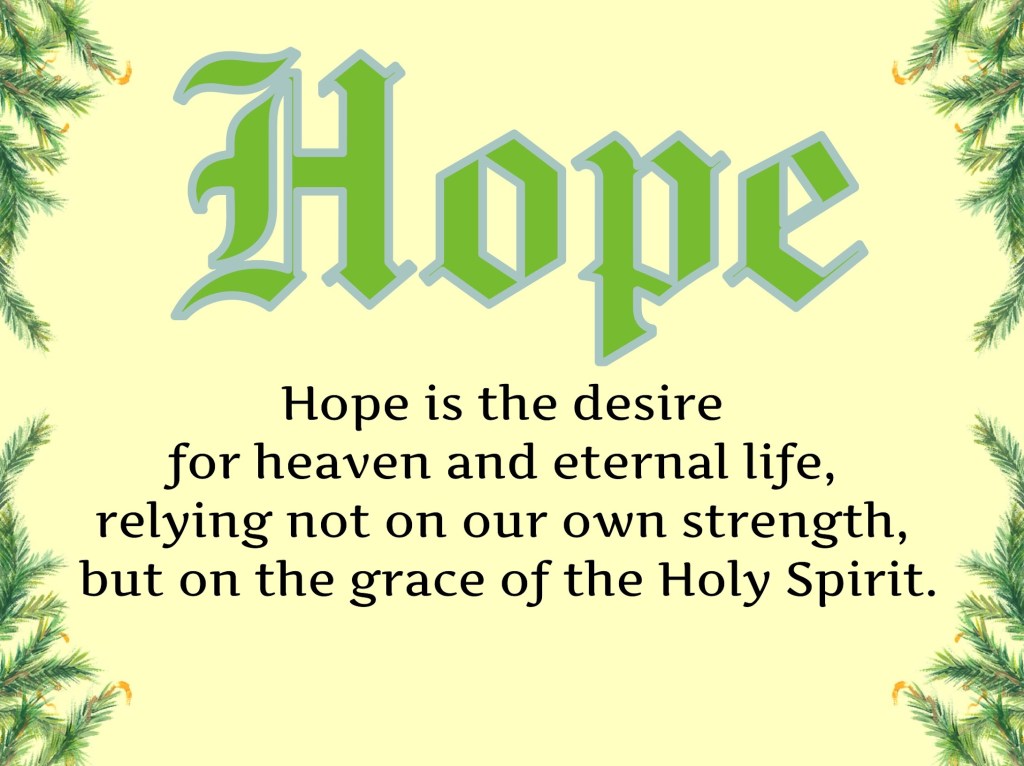
The theological virtues are faith, hope, and love (charity). These are considered supernatural gifts from God that cannot be earned through human effort alone, but are received at Baptism and help guide a person’s moral life by directing them toward God.
In our readings during this third week of Lent, we travel the distances between despair and hope, hard-heartedness and repentance, law and mercy. We enter the experience of Hosea as he longs for the return of grace, of the courageous woman at the well, of Peter as he matures in faith, of the Pharisee and tax collector at prayer. Again and again, we are offered the threads of repentance, mercy, and hope that knit us into God’s heart and eternal imagination for us.
During Philadelphia’s harsh winter, Joe lived on a steam grate in center city. George had met him there while volunteering with a homeless outreach program. Joe, articulate and engaging, was easy to befriend. Nevertheless, he was afraid to come in to the shelter.
One morning, on his way to a downtown meeting, George stopped to pick up coffee. He decided it would be nice to take a cup to Joe on his way. Sitting down on Joe’s grate, George offered him the steaming coffee. “Oh, thanks anyway, but I only drink tea,” Joe said. George burst out laughing at his noble mistake. “You didn’t think homeless people had choices, did you?” Joe countered. George, a good-hearted, generous man, learned a lesson that day about the human dignity often hidden under accretions of poverty, neglect and disenfranchisement.
Jesus made no such mistake when he met the woman at the well. Instead, he peeled through her accretions by respectful engagement and questioning. The woman, heartened by him, responded wholeheartedly.
This week, God invites us to strip away any pretense or fear keeping us from coming home to Mercy. The readings remind us to hear, observe, and teach the Divine Law. They encourage us to soften our hearts for God’s voice.
God knows our brokenness and hard-heartedness. Yet, God invites us to repent and to believe that we are not far from the kingdom. This week is a good time to seek God’s feedback on our lives by a sincere examination of conscience and a fearless request for healing. It is a perfect time to come home to Love.
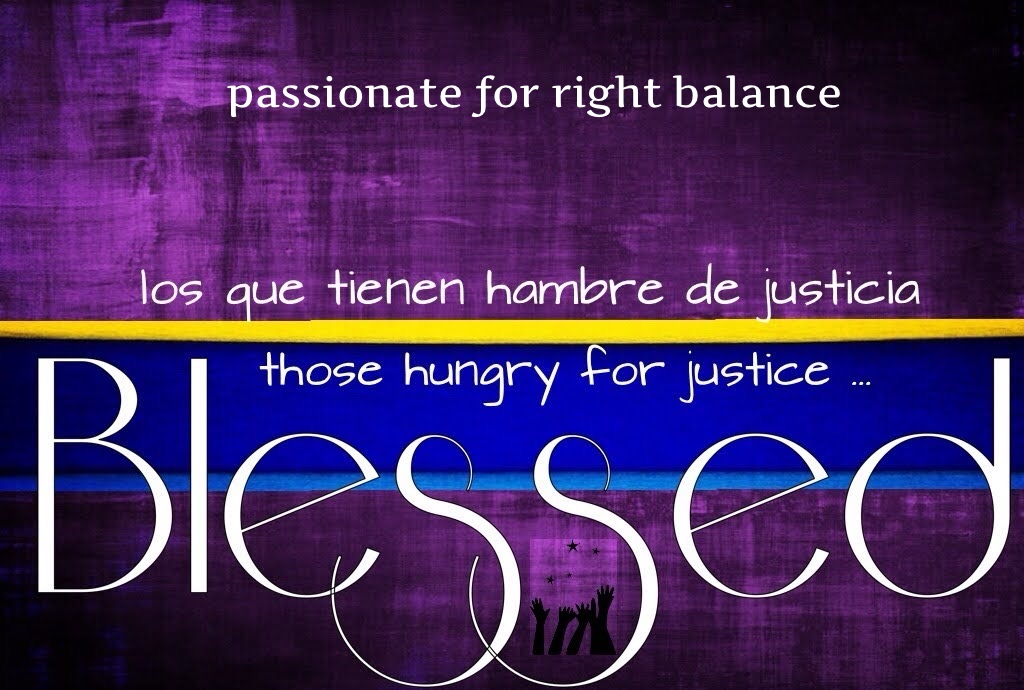
What does it mean to hunger and thirst for justice? The Greek word translated here as “justice” is dikaiosune, a term that refers to personal righteousness as well as to social justice. Those who hunger and thirst for dikaiosune have a deep yearning for things to be right in their individual lives and in society. This will happen when God’s kingdom comes completely and creation is restored to God’s original intention. ~ from the website theologyofwork.org
In our readings during this second week of Lent, we are encouraged to let go of guilt, to “remember not the things of the past”. We hear the story of Joseph, who was sold by his brothers, only to “redeem” them by his forgiveness. We are challenged to change the “season” of our hearts and embrace the full life of the Paschal Mystery. Our hunger for justice is truly the deep desire, not for any kind of reprisal, but for right balance in our lives with God and with all Creation, as seen in this story.
“Can you let this not be about you?” the chaplain asked, as Jane tried to explain her resistance and guilt. Evening darkened the small office just outside the tumultuous ER. There had been a building collapse, and Jane’s mother had been nearly crushed. Jane was the only relative, a long-alienated daughter. “But I’ve wanted to be reconciled”, she wept. “I just never had the courage to face her. Now it may be too late.”
Over several hours, the chaplain patiently encouraged Jane along a path of self-awareness, helping her realize that it was herself she needed to face. Her mother’s situation, while tragic, offered Jane a catalyst to confront the years of excuses and denials that had paralyzed her. Slowly, the hope of reconciliation washed over her.
When her mother finally stabilized, Jane leaned close to her battered face. Her mother summoned the strength to whisper, “I have never stopped loving you.” That forgiving whisper breathed a vital courage into both women. Each would survive a particular kind of death that day.
Despite our best hopes and intentions, life can collapse around us. Broken promises, unfulfilled dreams and soured relationships can litter our landscapes. We may even lose God in the rubble. This week, Isaiah offers us God’s forgiving invitation, “Come now, let us set things right”, says the Lord. “Though your sins be like scarlet, they will become white as snow.”
God will never stop loving us. God longs to embrace our repentant hearts. Let us listen to and believe God’s whisper.
Music: Remember Not the Things of the Past – Bob Hurd
Supplication is a humble and earnest prayer that asks God for specific spiritual or material aid.
They stood quietly by a sunlit window. “I have forgotten how to have fun,” Anne said, gazing wistfully toward the wintering trees.
Her friend knew the statement to be true and did not argue. Recently retired, Anne had managed a heavy career by rigorously systematizing her life. She was dependable and predictable – like a trusted clock. But somehow, her joy had been caught in the gears.
Sometimes, change is as simple as confronting unexamined routines. At other times, it requires a profound turning. In this week’s readings, we hear the language of such radical transformation: “be reconciled, be holy, ask, repent, forgive” – words commanding a ruthless examination of our attitudes. They suggest that, in order to renew our hearts, we must let something in us die.
Paul begins the week reminding us that our sinful world is redeemable through the gracious gift of Jesus Christ. Believing this, we will have the courage for true transformation. Such faith frees us of our blindness to the unholy in our lives.
Throughout the week, Esther, Jonah, the God of Moses, and Jesus himself encourage us. We make this Lenten journey in the company Holy Ones who radicalized their lives in faith, awareness, action and joy.
Unless, like Anne, we discover some discomfort in our souls, we will not seek change. Such discovery requires that we pray at the windows of our souls. Have we forgotten the spring-like beauty of a life lived deeply in God? Have we never known it in the first place? This week, we are invited to seek God’s Mercy, to return to joy, or maybe to find it for the first time!
Music: Miserere Mei – Mozart
Suggested Reading:
Psalm 51, interpreted by Rev. Christine Robinson
Have mercy on me, O God, For I’ve messed up again Sinned against You in thought, word and deed, and in what I have left undone. Been–all too human.
Can you make me a new heart, O God? and a right spirit? Can you break my willful plundering of all that is Yours? If I got it together again, others would follow— I could teach, guide, help—and I would!
O Lord, open my lips, that I may praise you. I know you don’t want ritual sacrifice were I to give a burnt offering you’d be exasperated. What you want is that new heart and right spirit. For this, I pray.
For Your Reflection:
What feelings or reactions do I have after reading this reflection?
Do my feelings or reactions remind me of any passage or event in scripture, especially in the life of Christ?
What actions might I take today because of my response to these readings?
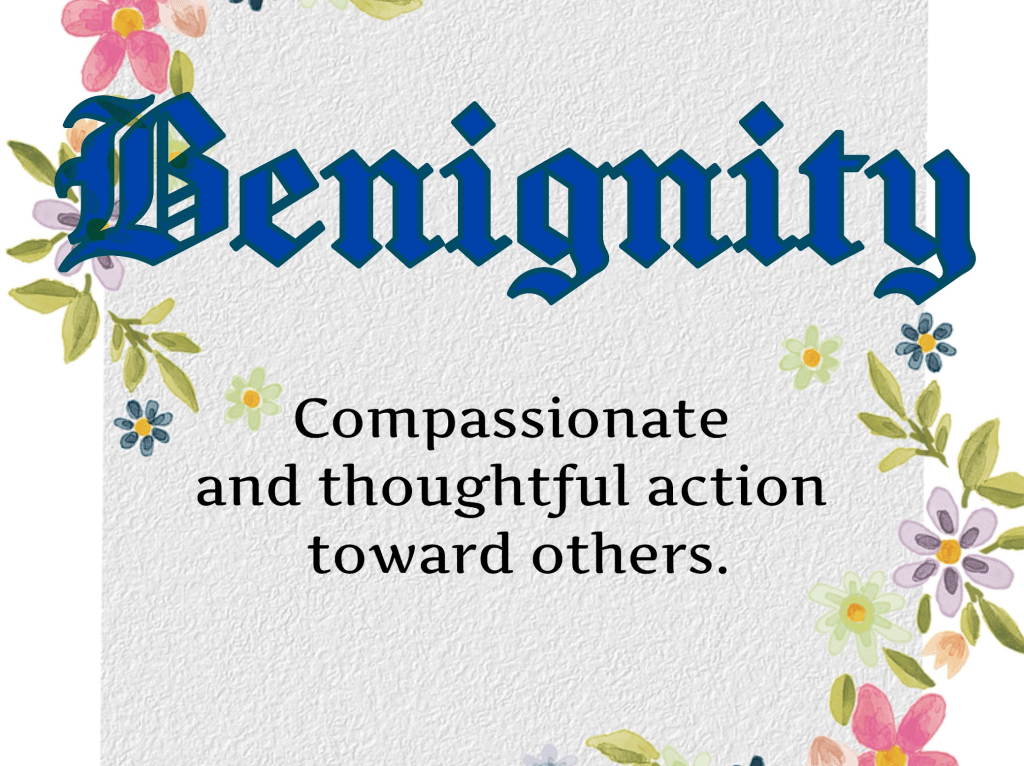
Benignity, a Fruit of the Holy Spirit, is defined as compassionate and thoughtful action toward others.
Sister Gertrude was my beautiful 3rd-grade teacher. She was kindness itself in human form, the personification of “Benignity”.
About two weeks before Valentine’s Day, Sister said we could give one another “friendship cards” by posting them to the decorated box she had set in the classroom corner. On February 14th, the box would be opened and we would learn who our best friends were, and even if we might have some secret admirers! I was really excited because I was in love with Johnny Meyers, but I didn’t think he knew I was even alive. I thought this might help me find out!
It sounds like a delightful idea, doesn’t it, until you think about the couple of kids who don’t have any friends, or the ones whose families can’t afford the cost of cards.
I didn’t think about any of those things when I was eight years old, but I do remember one curious thing. On Valentine’s Day, every child in our classroom received several cards, even Henry Walsh whom we all shunned because he was mean and selfish. Besides, he wore his hair little bit like the monster kid from “The Blob”!
Then I realized that Sister’s conversation with me a week earlier might not have been an isolated incident. Maybe she had taken aside other kids besides me and given them three or four cards. Maybe she had encouraged them too to send a card to someone it was hard to like, or to someone who might not have friends. She had told me that we don’t always know what makes a person unlikable, but that usually it wasn’t their fault. Maybe a surprise card could help them out a little bit.
So, I sent a card to a few kids I didn’t like that much. And I learned the lesson Sister was trying to teach. It was the kind of lesson that kept on teaching for the next seventy years … and still going, each year with deeper understanding.
Yeah, and here’s the funny part that I have never fully unpacked. Henry Walsh, class mini-monster, sent ME a card! Apparently, he thought I didn’t have any friends, or maybe he wasn’t too thrilled with my hairdo either!
By the way, Johnny Meyers did send a card, and I don’t think it was one Sister gave him because it came with a friendship ring out of a Cracker Jack box. We all know what that means! Even I knew, and I was only in 3rd grade!
Nevertheless, I didn’t marry Johnny despite that Valentine’s Day proposal, but I learned a life-long lesson about love from Sister Gertrude.
Music: Try a Little Kindness – Glen Campbell’s song sung by Collin Raye
Today’s news is full of impending competition – (even outside Washington 😂). Who will prevail, be the best, break the record, win the trophy?
But the opening of the Olympic Games and the start of Super Bowl weekend have me thinking about other kinds of games – the ones we play for fun, not to gain advantage.
Long ago, an older friend complained to me, “I have forgotten how to have fun!” The declaration startled me and left me speechless. If there was a formula, “young me” didn’t have it. However, over the decades of my own aging, I have pondered that remark, often examining my own life for signs of “fun diminishment”.
Those signs do seem to increase as responsibility grows or as energy wanes. What came naturally to us as children requires a little attention as we mature. As kids, we simply ran outside into the sunshine or rain, found somebody or something that absolutely entranced us, and magic happened.
I remember sitting on the front step with my friend Harry. We were both nine years old. I had just gotten a plastic camera in the mail with a quarter and a coupon from a cereal box. For an hour or so, we took pictures of pigeons perched on the telephone wires and garbage cans. We imagined ourselves expert artists creating a legacy for generations. It was easy then to forget that we were serious fourth-graders with unfinished homework, impending report cards, and a few chores before bedtime. It was also easy to forget that there was no film in the camera!
Later in life, that kind of beneficial forgetting is not so easy. We must unleash ourselves from a chain of “to dos” and “be carefuls”. We know better now. We don’t go out in the sun without screening, nor into the rain without an umbrella. We mostly try to avoid pigeons and garbage cans. Our potential “playgrounds” become much more constrained, sometimes inhibited by a false requirement of excessive money, planning, or chemical relaxation.
Examining my fun levels today, I realize how blessed I am.
My nieces, nephews, and grands live hundreds of miles away from me. Yet they provide me with invaluable links to pure fun. Every morning, a few of us play Wordl, Connections, or Crossplay together. I know they may be checking to see if I’m still alive, but the main purpose is fun – and the precious assurance of mutual care.
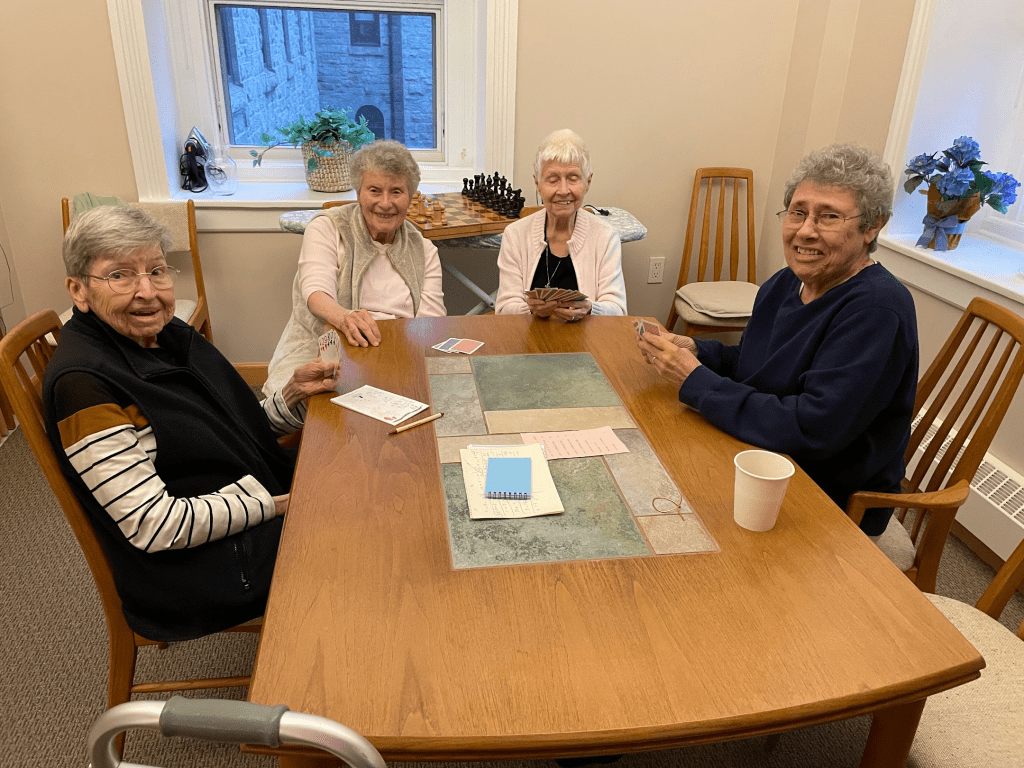
The younger kids delight me with photos of themselves doing modern imitations of Harry and me with the pigeons. In our convent community rooms, I may find a game of pinochle, Hand and Foot, chess, bingo, or gin rummy. Even more precious, there always awaits a conversation with memories of good times, funny stories, and the generous abandon of enjoying one another.
So, if I came up with a fun formula today, it would include these essentials:
Fun is any “playground” where we find and give joy.
To have real fun, we don’t focus on the score.
We need time to have fun, just like we need time to eat, sleep, work, and pray.
We need to know what fun is – that it makes us laugh, appreciate the other, relax, and surrender self-importance
Fun is essentially spontaneous, but we can expose ourselves to its influence by not taking ourselves too seriously.
Fun always requires getting “outside” – even if it means only from our self-centeredness.
We can have fun alone with a game or movie, but it helps to have someone to have fun with, (and as Pope Leo said, someone not created by AI.)
The virtue of Love, known as caritas or charity, is a theological virtue defined as loving God above all things and loving one’s neighbor as oneself.
A friend and I had gone mall shopping not too far from my parents’ home. Finishing early, I asked Mattie if she’d mind an unplanned stop to see Mom. I knew Mom would delight in the surprise visit.
Had I alerted Mom, a banquet would have awaited us. She loved to feed people, and she did so with masterful skill. But this impromptu stop occurred the day before weekly shopping. Thus, the coffers were relatively low, at least by Mom’s standards.
Nevertheless, the kitchen table soon filled with the essential makings of a great sandwich. Mattie and I dug in as Mom arrayed a host of condiments at table’s center. However, in the abundance, one glass jar stood out in contradiction. Alone, behind the green Vlasic label, hid the last remaining kosher dill, an unlikely survivor of my family’s lunch habits.
As Mom joined us at the table, she realized the situation. She looked at Mattie, our guest, and encouraged her, “Eat the pickle, Sister!” We all burst out laughing and, indeed, Mattie did eat the lonely pickle.
Our shared laughter signaled a deeper understanding of this straightforward scene. No one had to enumerate what lay behind Mom’s encouragement:
As our guest, you get first choice. (Hospitality)
Somebody’s got to eat it. It might as well be you. (Practicality)
It’s not really important if the rest of us get a pickle. (Discernment)
We are blessed to have more choices beyond the pickle. (Gratitude)
We’ll be fine, even if we are “pickleless”. (Blessed Assurance)
You are the important thing, not the pickle. (Respect)
And anyway, who left one stinkin’ pickle in the jar! (Wise Judgement)
For years to follow, Mom and I laughed about that remark. We quoted it often when there was a nebulous situation that called for a final choice, because the phrase contained all the essential elements of a loving and expeditious decision:
What’s important in this situation?
Who or what has the greatest need?
What resources free us to be generous?
What action will best reflect our values?
And, remember:
Not to decide is to decide. So never resist a generous impulse
I delight in remembering the story today, the anniversary of my mother’s death. She left me so many lessons under the most unlikely appearances. Who would think that a pickle jar might influence my decision-making for the ensuing 40 years! Thank you for that pickle, Mom, and for all the other loving condiments you left to dress my life!
Music: ‘Tis A Gift to Be Simple – Yo-Yo Ma and Alison Krauss
For Your Reflection
What feelings or reactions do I have after reading this reflection?
Do my feelings or reactions remind me of any passage or event in scripture, especially in the life of Christ?
What actions might I take today because of my response to these readings?
As we draw close to the Holy Season that will close our year, let’s welcome each final day as an extraordinary gift, grateful for the faith, hope, and love that sustain our lives.
Music: “Your Love” from “Once Upon A Time in the West” ” – by Ennio Morricone – performed by Hauser
For Your Reflection:
What feelings or reactions do I have after reading this reflection?
Do my feelings or reactions remind me of any passage or event in scripture, especially in the life of Christ?
What actions might I take today because of my response to these readings?
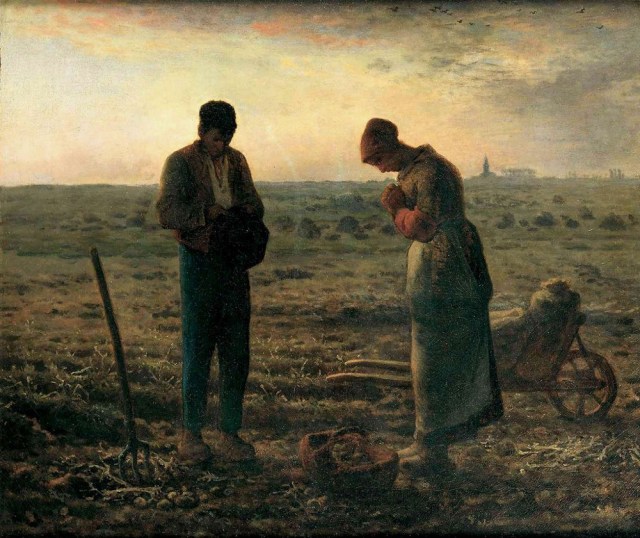
In grade school, we had a course called “Picture Study”. Every Friday afternoon, Sister distributed small blue McLaughlin Notebooks. In them, we found the treasures of the great art galleries – paintings by Monet, Van Gogh, and Rembrandt. One of my favorites was a picture by Millet called “The Angelus”. In it, peasant farmers pause to pray as they gather their small harvest at the close of day. All the colors of late fall had dripped from the artist’s brush to capture feelings of peace, completion and hope.
I have a dear friend who doesn’t like fall. She is a complete and beautiful “summer” spirit! For her, autumn brings a sense of “closing down”. The freedom of summer evaporates; the heavy sharpness of winter looms. Some of us might feel that way as the sunlit hours shrink. But, for the reflective heart, there are deep blessings in Autumn’s ebbing.
Indeed, fall dances to a different tune from summer. The carefree skip of July becomes the thoughtful stroll of late October. It is a time for gathering, for counting the harvest, for putting up the fuel to sustain us through the winter. It is a time no longer to take things for granted. It is a time to pause and prepare. We begin to consider what the waning year has given us, and what it has taken.
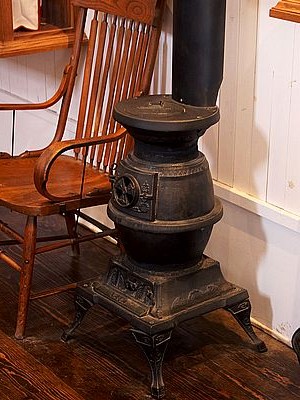
As a child, I lived in a very old home originally built to house the 19th century immigrant factory workers of North Philadelphia. The kitchen, added by my grandfather’s own hands, was unheated. In the 1940s, my dad installed a pot-belly stove to warm this preferred gathering spot for our family.
Dad always left for work before the rest of us woke up. Beginning in the late fall, he would light a fire in that little stove every morning. By the time the rest of us assembled for breakfast, a freshly-perked pot of coffee awaited us atop the stove as a greeting from dad. I associated my father with that comfort and that delicious scent. Although we wouldn’t see him until late at night, his kindness accompanied us in the cozy, inviting kitchen every morning.
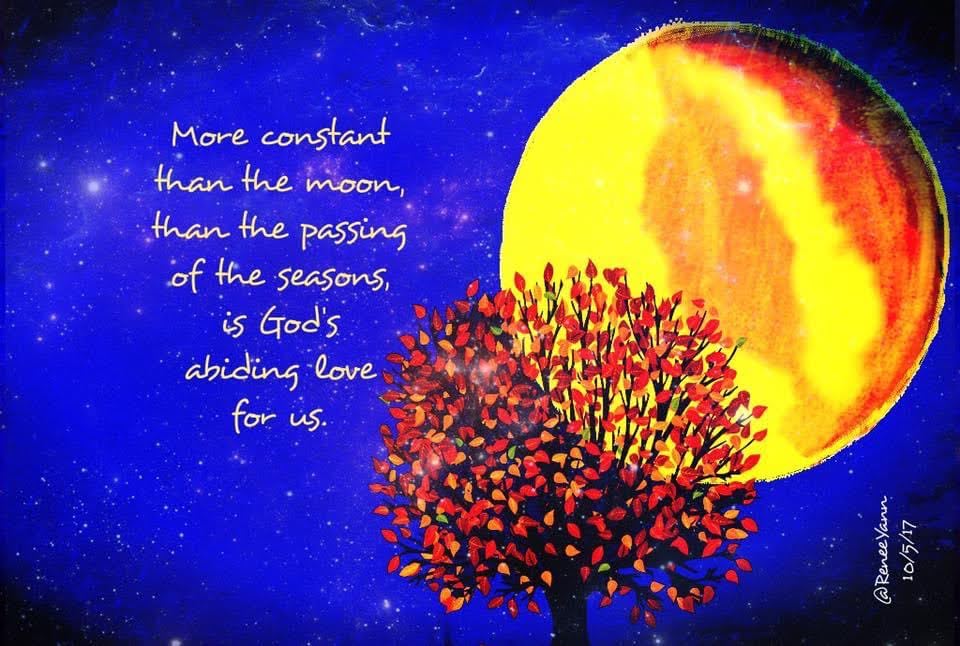
As deep October approaches, the earth steeps itself like fragrant tea in its own magnificent colors, but the chill suggests the coming change. Seeing this, I remember Dad and realize, such is the work of autumn:
to express beauty in the subtle colors of our kindness
to build the warm fires we know our loved ones will need
to brew the fresh tonic that wakes others to life and warms them against its sometime chill
It is a time now to glean summer’s final fruits and to wrap ourselves in their bounty; to listen, in the snug quiet of our spirits, to the voice of Love in our lives. What does Love ask of us as winter approaches? For each of us, the answers will be different. In the gathering October stillness, to what does the Divine Spirit invite me?
Music: Autumn “Allegro-Adagio Molto” (The Four Seasons) – Antonio Vivaldi
For Your Reflection:
What feelings or reactions do I have after reading this reflection?
Do my feelings or reactions remind me of any passage or event in scripture, especially in the life of Christ?
What actions might I take today because of my response to these readings?
Hold hands with your life. Look it in the eyes. There, in the stillness, God is revealing the miracle of knowing who you are.
But life can be hectic, can’t it? You might not have time to just “hold hands”, right?
Don’t you sometimes feel like Indiana Jones, running ahead of that huge boulder, trying to keep all your responsibilities from overwhelming you? Or maybe you feel as if your life has run so far ahead of you that you’re racing to catch up to it, watching it turn into a dot on the far horizon.
Life wasn’t intended to be like either of these images. Our lives are meant to be savored and lived in a deep awareness of our “present”. NOW is the only time we have. The people we are with, the challenges and joys we experience in this moment – this is our life. So many of us, running from the boulder or chasing the dot, let the beauty of our lives evade us.
When I see people holding hands, I am reminded to be still and to appreciate my life in the present. It’s beautiful to see a couple walking hand in hand, breaking a new pattern in the fresh snow. They might be young, just beginning an unimaginable journey. Or they might be elderly, having walked beside each other through miles of love and sacrifice, joy and sorrow.
I love to see a parent holding hands with their child. The child may be small, reaching up for security, protection and comfort. Or the parent may be old, reaching over for the same things. What a blessing to be beside someone whose touch can sustain your life!
Prayer is a kind of holding hands – God reaching for us, and we for God. I tried to capture the experience in a poem I wrote many years ago:
Poem: A Long Faith – Renee Yann, RSM
This is the way of love, perhaps
near the late summer,
when the fruit is full
and the air is still and warm,
when the passion of lovers
no longer rests against
the easy trigger
of adolescent spring,
but lumbers in the drowsy silence
where the bees hum—
where it is enough
to reach across the grass
and touch each other’s hand.
So hold hands with someone you love today, human or divine. Slow each other down to a deep appreciation of the gift of life in this present moment.
Music: Holding Hands – Creative Commons Instrumental Music
For Your Reflection
What feelings or reactions do I have after reading this reflection?
Do my feelings or reactions remind me of any passage or event in scripture, especially in the life of Christ?
What actions might I take today because of my response to these readings?
I had been away – busy and incommunicado for several days. The message was the last one on my answering machine when I got home. It lay curled like a wounded kitten at the end of a long line of incidentals.
Mag had died at 101 years of age – the long faithful friend of my grandmother, my mother, and me.
My Grandmother
The manner of Mag’s faithfulness to each of our generations had been different: a companion to Grandmom, a guide and confidant to Mom, a distant but vigilant observer and encourager of my life in my mother’s stead after Mom had died.
When I called back to acknowledge the message, there was only one meaningful way to announce myself: “This is Eleanor’s daughter.” Just that said everything – it paid tribute to both Mag’s and my mother’s lives. It recognized the duty I owed in both their names. Mag’s daughter said, “We don’t expect you to come… we just wanted you to know.” My mother’s voice spoke in the silence of my heart – “Of course, you will go.”
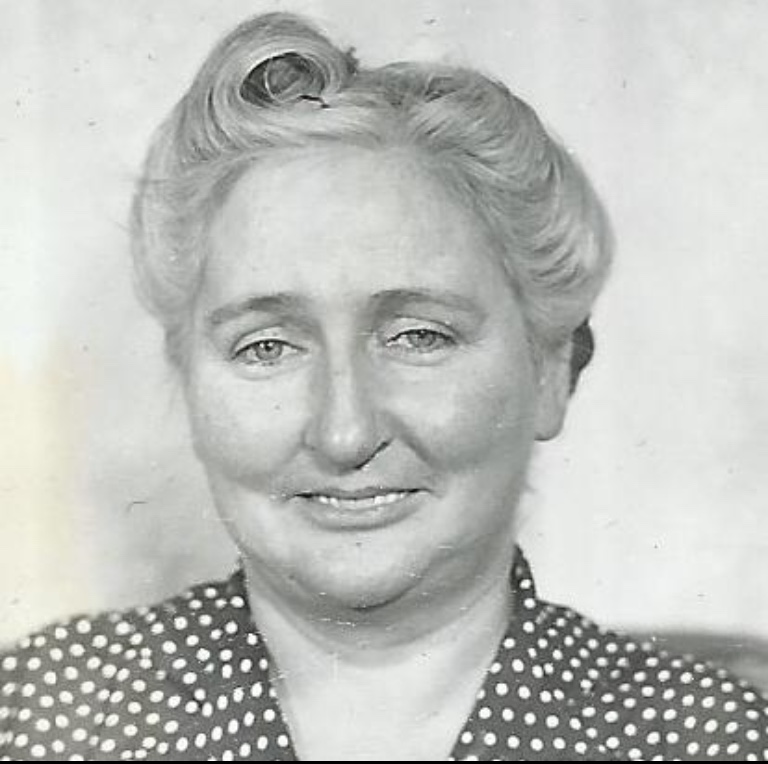
Eleanor, my Mother
So I traveled to the place where I grew up. There will never be any place that you know more intimately than your childhood neighborhood. You ran through its alleyways and knew its secret hiding places. You explored every inch of its terrain and, to this day, can remember its textures, smells, dangers, and promises. That day, I drove into its heart, remembering.
As I approached the neighborhood, I saw that its edge had frayed like a tattered fabric. The industrial and commercial corridor that had hemmed the old neighborhood had disappeared. Abandoned lots had replaced the thriving factories and immigrant-run shops of my youth. The bustling avenues where I had once threaded my shiny Schwinn bike now echoed like empty canyons under my tires. Loss rose up in my throat like a bitter aftertaste.
But as I neared the church, the fabric began to re-weave. People still lived in the houses and gathered on the brick pavements. I saw neighbors walking to church, as my family had when I was young. I was to learn that the deep human links that had embraced our parish family remained unbroken.
It had been nearly fifty years since I last worshipped in St. Michael’s, but the church of my childhood was perfectly intact. Not only had it been physically restored to the perfection of its 200-year-old origin, but the descendants of many original families remained or had returned for the funeral. During the wake, we reconnected, weaving names and histories into a warm swaddling of belonging.
During preparation for the solemn funeral service, many people came to visit me in the silence of my heart: my parents who had taught me to pray, the sisters and priests who had nurtured my call to religious life, my neighbors and friends whose lives had found graceful regeneration each Sunday in this sanctuary. This place had been the heart of our “village”. It was where we learned and acknowledged that we live life together, not alone – and that the myriad pieces which make up who we are belong in some way to every person who has ever touched us. Every one of us attending Mag’s funeral was paying honor to that reality.
It takes a lifetime to fully learn the office of honor. As a teenager, I was uncomfortable accompanying my mother on her many dutiful journeys: not wanting to visit my old maiden aunts in their very Victorian home, to take a pot of soup to a house in mourning, not knowing what to say at a neighbor’s wake. I remember my mother’s words on such occasions: “We show up. It’s what we do – because it’s all that we can do. It’s an honor to be with someone at these moments of their lives.”
I am old enough now to cherish that role of honor guard. I have learned its beauty and character from the many – including Mag — who have kept vigil beside me and my family in the challenges and blessings of life. I went to Mag’s funeral privileged to exercise that role in my mother’s name – to assume the duty of our family to “show up”.
To stand within duty is to be like a surfer poised inside the huge curl of a powerful wave. It is to ride on an energy that does not belong to you – to open yourself to it with gratitude, awe, and trust. It is to know – in an indescribable way – the profound power of God that holds all life together beyond time and beyond burden.
At Mag’s funeral, I was – once again – proud to be Eleanor’s daughter. I know that she and Mag smiled as I rejoiced in that pride. On this Mother’s Day, I remember that day as a very intentional gift to me, and I treasure it beyond telling.
Mom and I when Pope John Paul II visited for the Eucharistic Congress
Music: Thank You
For Your Reflection
What feelings or reactions do I have after reading this reflection?
Do my feelings or reactions remind me of any passage or event in scripture, especially in the life of Christ?
What actions might I take today because of my response to these readings?
Suggested Scripture: Proverbs 31 (Adaptation)
Who can find a valiant woman? She is worth far more than rubies. Her family has full confidence in her and lacks nothing of value. She brings them good, not harm, all the days of her life. She gets up while it is still night; she provides food for her neighbors and portions for the very poor. She considers a field and buys it; out of her earnings she plants a vineyard. She sets about her work vigorously; her arms are strong for her tasks. She sees that her work is fruitful, and her lamp does not go out at night. In her hand she holds the distaff and grasps the spindle with her fingers. She opens her arms to the poor and extends her hands to the needy. When it snows, she has no fear for her household; for all of them are clothed in scarlet. She is clothed with strength and dignity; she can laugh at the days to come. She speaks with wisdom, and faithful instruction is on her tongue. She watches over the affairs of her beloveds and does not eat the bread of idleness. Her neighbors arise and call her blessed; her family also praises her: “Many women do noble things, but you surpass them all.” Charm is deceptive, and beauty is fleeting; but a generous woman is to be praised. Honor her for all that her hands have done, and let her works bring her praise at the heavenly gate.
















 Lavish Mercy