Today, in God’s Lavish Mercy, Paul gives us one of his most heartfelt and beautiful passages, and Jesus offers us a puzzling parable about the kingdom.
Paul’s exhortation to sincere holiness is a passage that warrants frequent reading. At any given point in our lives, one or another of its encouragements will seem to ring profoundly true with our circumstances.
One of the lines that I particularly cherish goes like this in the old Douay-Rheims version, which is where I first encountered it as a young girl:
Love one another with fraternal charity: with honor preventing one another.
The bolded phrase fascinated me. I didn’t understand what it meant. From what were we to prevent one another?
It was not until I came to the convent that I begin to discern the power of this verse. At the time (during the Dark Ages, of course), the Sisters lived under the 1952 Constitutions of the Sisters of Mercy, an adaptation of the ancient Rule of St. Augustine. As postulants, we each received a 4×6, 128 page copy of the Rule. In direct and intentional language, it set the frame for our whole lives.
I nearly memorized it, especially Chapter 14 on Union and Charity. Right in the middle of the Chapter, I found this precious line:
They (the Sisters) shall sincerely respect one another. The young shall reverence the old and all shall unceasingly try in true humility to promote constant mutual cordiality and deference, “with honor preventing one another”.
Sister Inez, our dear early instructor, explained that this meant to anticipate the needs of our beloved sisters, especially the elderly; to do for them what might be difficult for them before they had to ask. In other words, to prevent their need. She said that this anticipatory charity should mark our service toward everyone, especially the poor, sick and ignorant whom we would vow to serve.
The more all of us can live together with this mutual love and respect, the closer we come to the kingdom of God, to the banquet table described in today’s Gospel. Jesus came to gather us all around this table. Pity on those who resist his invitation because their lives are entangled in self-interested endeavors. Their places are taken by “the poor, the crippled, the blind and the lame” and all those on the margins of society.
As we join our sisters and brothers at the banquet of life, may we love and serve one another sincerely, always with honor preventing one another.
Poetry: Emily Dickinson
If I can stop one heart from breaking,
I shall not live in vain;
If I can ease one life the aching,
Or cool one pain,
Or help one fainting robin
Unto his nest again,
I shall not live in vain.
Music: a little motion mantra this morning. Maybe you might want to get up outta’ that chair and join in🤗
Today, in God’s Lavish Mercy, we pray with Psalm 49, the point of which according to Walter Brueggemann is this:
The point is that death is the great equalizer, and those who are genuinely wise should not be impressed by or committed to that which the world over-values.
Walter Brueggemann: From Whom No Secrets Are Hid
We may have heard the sentiment stated more succinctly by an anonymous scholar:
You can’t take it with you.
This is the core message Paul imparts to Timothy in our first reading:
For the love of money is the root of all evils, and some people in their desire for it have strayed from the faith and have pierced themselves with many pains.
1 Timothy 6:10
The advice is about more than money, or “dollar-bucks” as my 7-year-old grandnephew calls them.
The instruction is about our priorities – whom, why and what we love, value, and sacrifice for.
Walter Brueggemann
The opposite of this “love of money” is an unselfish, sacrificial love for others. This is the love Jesus hopes for in his disciples as he blesses them in today’s Gospel.
It takes courage to live such discipleship. As human beings, we tend to fear any kind of deprivation. We crave security, and sometimes we think money and possessions can give us that. Our readings today redirect that all too common misperception.
The world can be a very dark place, and of course, we will have fears and worries. Paul and our psalmist direct us to the right place to calm these concerns. Jesus calls us to believe in and live in the Light which is our true security.
Our psalm reminds us to keep our eyes on the eternal promise we have all been given.
But God will redeem my life, will take me from the hand of Darkness.
Psalm 49:16
Poetry: Accepting This – Mark Nepo
Yes, it is true. I confess,
I have thought great thoughts,
and sung great songs—all of it
rehearsal for the majesty
of being held.
The dream is awakened
when thinking I love you
and life begins
when saying I love you
and joy moves like blood
when embracing others with love.
My efforts now turn
from trying to outrun suffering
to accepting love wherever
I can find it.
Stripped of causes and plans
and things to strive for,
I have discovered everything
I could need or ask for
is right here—
in flawed abundance.
We cannot eliminate hunger,
but we can feed each other.
We cannot eliminate loneliness,
but we can hold each other.
We cannot eliminate pain,
but we can live a life
of compassion.
Ultimately,
we are small living things
awakened in the stream,
not gods who carve out rivers.
Like human fish,
we are asked to experience
meaning in the life that moves
through the gill of our heart.
There is nothing to do
and nowhere to go.
Accepting this,
we can do everything
and go anywhere.
Music: His Eye is on the Sparrow (You might recall this version from the movie “Sister Act II”)
Today, in God’s Lavish Mercy, our readings lead us to consider when, why, and how God speaks.
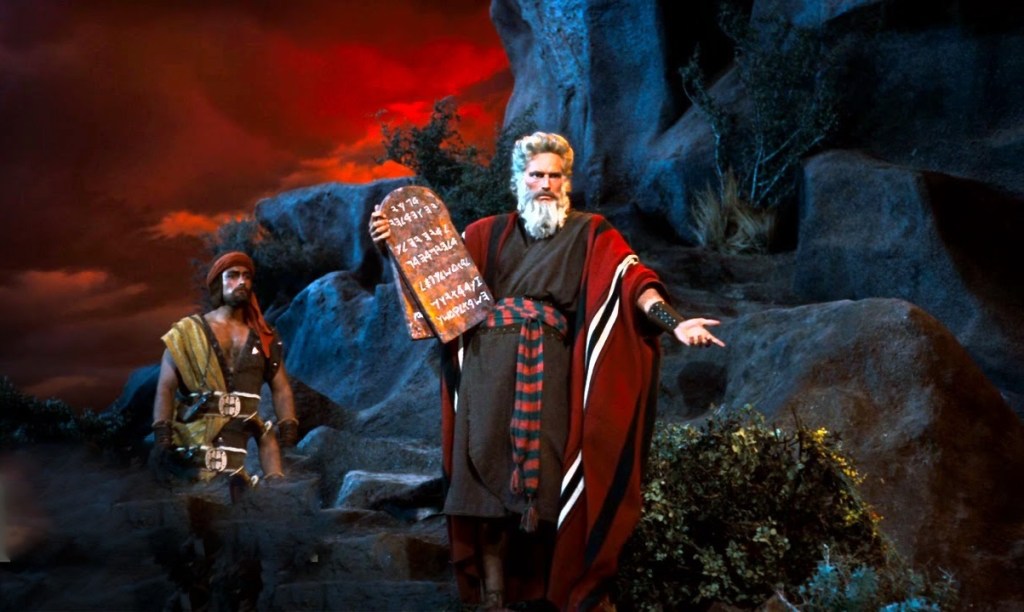
We all know that the big scene from Exodus is the delivery of the Ten Commandments. So as Sinai bubbles and churns in today’s reading, we may be waiting for that theophany.
But today’s passage from Exodus is not about the Commandments themselves. It is about getting oneself ready to hear what God is about to say.
God instructs Moses on how to prepare the people so that they have listening hearts able to respond with understanding and commitment.
While Israel was encamped here in front of the mountain, the LORD told Moses, “I am coming to you in a dense cloud, so that when the people hear me speaking with you, they may always have faith in you also.” When Moses, then, had reported to the LORD the response of the people, the LORD added, “Go to the people and have them sanctify themselves today and tomorrow. Make them wash their garments and be ready for the third day; for on the third day the LORD will come down on Mount Sinai before the eyes of all the people.”
Exodus 19:9-11
They are to expect a “cloud”
They are to see Moses as a conduit to God.
They are to prepare their hearts by symbolically preparing their garments.
They are to wait, in the mode of a vigil, for the Lord to speak.
In the late 1960s I, like the rest of the immediately post-Vatican II Church, was hungry to learn more enlightened theology. Around that time, I had the amazing opportunity of attending a lecture by the controversial priest and theologian Fr. Hans Küng. Some considered him a prophet, and some an iconoclast. But no one disagreed that he was a genius and an eminent voice for reform in the Catholic Church.
I was just beginning my theological education, and I knew — well actually — zip!
So I began to read everything I could find by or about Küng. I did serious prep work before the day came for the lecture. And it helped. I was ready to listen. My brain was spinning when I left the presentation (Küng is not easy!). Still, what little I understood inspired me to the next steps in my learning which has been life-long.
I think that’s what God is doing in today’s passage – readying hearts to listen to God’s life-long invitation to Covenant. That Covenant will be rooted in the community’s hearts by their faithfulness to the spirit of the Ten Commandments. And it will grow like any healthy relationship in love and mutual disclosure.
In our Gospel, Jesus talks about listening too. When asked why he spoke in parables to the crowd, Jesus replies:
Because knowledge of the mysteries of the Kingdom of heaven has been granted to you, but to them it has not been granted. To anyone who has, more will be given and he will grow rich; from anyone who has not, even what he has will be taken away. This is why I speak to them in parables, because they look but do not see and hear but do not listen or understand.
Matthew 13:11-13
Parables can be a little bit like those Sinai clouds – their truth may not be immediately evident. But by faithfulness, the horizon clears and the light dawns. Although they might appear to be, parables are not descriptions of sowers and seed, and prodigal children or devoted fathers. Jesus’s parables are revelations about us and God, told in simple stories so that we won’t be quite as dazed by their powerful truth as I was by that long-ago lecture.
When I walked out of the Küng lecture, believe me, I was in a cloud. His presentation was so dense with meaning that I felt like I knew less coming out than going in! Sometimes when we hear the parables, we might have a similar feeling. But that’s why we pray, year after year, with the infinitely revealing scriptures. They meet us where we are in our particular circumstances, and will always take us deeper into God if we are prepared to let them.
And Jesus assures us that our efforts to follow him will be rewarded:
But blessed are your eyes, because they see, and your ears, because they hear. Amen, I say to you, many prophets and righteous people longed to see what you see but did not see it, and to hear what you hear but did not hear it.”
Matthew 13:16-17
Coming into deeper relationship with God takes time – dedicated time for silence, prayer, reflection, learning, and action born of contemplation. Let’s renew our deep desire for this kind of relationship.
Prose: excerpts from “The Cloud of Unknowing“, which is an anonymous work of Christian mysticism written in Middle English in the latter half of the 14th century. The text is a spiritual guide on contemplative prayer in the Late Middle Ages. The underlying message of this work suggests that the way to know God is to abandon consideration of God’s particular activities and attributes, and be courageous enough to surrender one’s mind and ego to the realm of “unknowing”, at which point one may begin to glimpse the nature of God. (Wikipedia)
When you first begin, you find only darkness, and as it were a cloud of unknowing. You don’t know what this means except that in your will you feel a simple steadfast intention reaching out towards God. Do what you will, and this darkness and this cloud remain between you and God… Reconcile yourself to wait in this darkness as long as is necessary, but still go on longing after him whom you love.
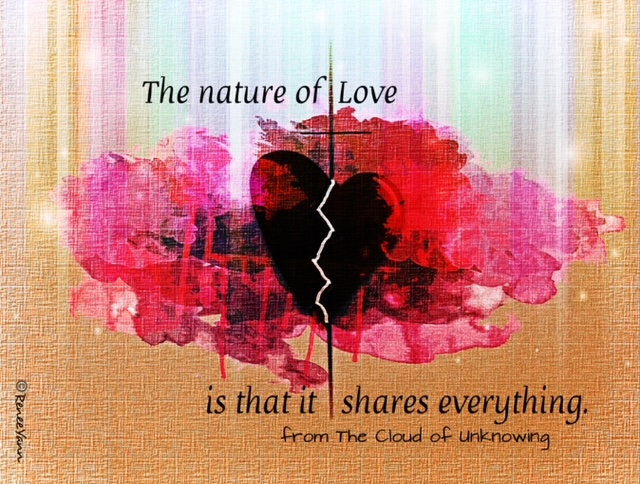
The nature of love is that it shares everything. Love Jesus, and everything he has is yours.…He may, perhaps, send out a shaft of spiritual light, which pierces this cloud of unknowing beteween you, and show you some of his secrets… then will you feel your affection flame with the fire of his love, far more than I can possibly say now…
Music: Transcending from “The Cloud of Unknowing” by Robert Kyr
Caritas patiens est benigna est omnia suffert omnia credit omnia sperat omnia sustinet videmus enim nunc per speculum in enigmate tunc autem facie ad faciem nunc cognosco ex parte tunc autem cognoscam sicut et cognitus sum nunc autem manet fides spes caritas tria haec maior autem his est caritas
Love is patient, Love is kind. It bears all things, Believes all things, Hopes all things, Endures all things. For now we see In a mirror, dimly, But then we will see face to face. Now I know only in part; Then I will know fully, Even as I have been fully known. So now remain Faith, hope, love; These three, But the greatest of these is love.
Today, in God’s Lavish Mercy, we receive an in-depth teaching on Christian generosity.
In the early Church, as in the Church today, evangelism and ministry require material support. In Paul’s time, the mother Church in Jerusalem needed funds to support ongoing mission activity.
In our first reading, Paul writes a “fund-raising” letter to the Greek Corinthians. He challenges them to be generous by raising up to them the outstanding example of the Macedonian churches (Philippi, Thessalonica, and Berea). These communities, despite their current hardship, gave beyond expectation to the Church’s need.
Macedonia and Greece had a competitive political relationship. Whether or not Paul was using this contention to stoke a response in Corinthian generosity, we can only guess. However, Paul is very clear about what should motivate the Christian heart to charity:
For you know the gracious act of our Lord Jesus Christ, that for your sake he became poor although he was rich, so that by his poverty you might become rich.
2 Corinthians 8:9
While Paul has offered a tutorial on material giving, Jesus inspires us to a much deeper generosity. Jesus asks us to imitate God in our loving benevolence:
Jesus said to his disciples: “You have heard that it was said, You shall love your neighbor and hate your enemy. But I say to you, love your enemies and pray for those who persecute you, that you may be children of your heavenly Father, for he makes his sun rise on the bad and the good, and causes rain to fall on the just and the unjust.
Matthew 5:43-45
God’s generosity – God’s beautiful Mercy – does not distiguish between who is deserving and who is not. God’s love is universal and irrevocable. Jesus, who is the enfleshment of God’s Love, explains that God’s perfection consists in this Absolute Mercy. He tells us that we should strive to live a life in imitation of this Merciful Perfection.
For if you love those who love you, what recompense will you have? Do not the tax collectors do the same? And if you greet your brothers only, what is unusual about that? Do not the pagans do the same? So be perfect, just as your heavenly Father is perfect.”
Matthew 5:46-48
Jesus is telling us that by living in generous mercy, beyond worldly expectation, we become “perfect” or whole in the Wholeness of God. Mercy heals not only those we touch, it heals us.
Poetry: To Live in the Mercy of God – Denise Levertov
To lie back under the tallest
oldest trees. How far the stems
rise, rise
                 before ribs of shelter
                                                 open!
To live in the mercy of God. The complete
sentence too adequate, has no give.
Awe, not comfort. Stone, elbows of
stony wood beneath lenient
moss bed.
And awe suddenly
passing beyond itself. Becomes
a form of comfort.
                         Becomes the steady
air you glide on, arms
stretched like the wings of flying foxes.
To hear the multiple silence
of trees, the rainy
forest depths of their listening.
To float, upheld,
                  as salt water
                  would hold you,
                                              once you dared.
To live in the mercy of God.
To feel vibrate the enraptured
waterfall flinging itself
unabating down and down
                                   to clenched fists of rock.
Swiftness of plunge,
hour after year after century,
                                                          O or Ah
uninterrupted, voice
many-stranded.
                                  To breathe
spray. The smoke of it.
                                  Arcs
of steelwhite foam, glissades
of fugitive jade barely perceptible. Such passion—
rage or joy?
                                  Thus, not mild, not temperate,
God’s love for the world. Vast
flood of mercy
                         flung on resistance.
Music: Mormon Tabernacle Choir – Holy Art Thou »-(adapted from Handel’s Largo “Ombra mai fu” in “Xerxes”. A beautiful instrumental version is under the hymn lyrics below.)
Holy art Thou, Holy art Thou, Lord God Almighty Glory and Majesty, in Heav′n are Thine Earth’s lowly bending, swells the full harmony Blessing and Glory to the Lamb, forevermore For worthy, worthy art Thou Worthy art Thou
Let all nations and kindreds and peoples Give thanks to Thee, forevermore Give thanks forevermore
Let all nations and kindreds and peoples Give thanks to Thee, forevermore
Today, in God’s Lavish Mercy, our beautiful readings this Sunday paint the picture of a God Who is eternally in love with us.
The writer of Exodus twenty-five hundred years ago knew this.
Then the LORD called to Moses and said, “Thus shall you say to the house of Jacob; tell the Israelites: You have seen for yourselves how I treated the Egyptians and how I bore you up on eagle wings and brought you here to myself. Therefore, if you hearken to my voice and keep my covenant, you shall be my special possession, dearer to me than all other people, though all the earth is mine.
Exodus 19:3-5
Yes, God is eternally in love with us. Paul knew this when he wrote to the Romans about a half-century after Jesus lived on earth.
For Christ, while we were still helpless, yet died at the appointed time for the ungodly. Indeed, only with difficulty does one die for a just person, though perhaps for a good person one might even find courage to die. But God proves his love for us in that while we were still sinners Christ died for us.
Romans 5:6-8
And Matthew knew that God is eternally in love with us when he recorded this memory of his beloved Jesus:
At the sight of the crowds, Jesus’ heart was moved with pity for them because they were troubled and abandoned, like sheep without a shepherd. …. Jesus sent out these twelve after instructing them thus, “Do not go into pagan territory or enter a Samaritan town. Go rather to the lost sheep of the house of Israel. As you go, make this proclamation: ‘The kingdom of heaven is at hand.’ Cure the sick, raise the dead, cleanse lepers, drive out demons.
Matthew 9:36; 10:5-8
If God has loved us this long and this much, isn’t it time for us to really love God back?
In the above situations, and in our own lives, all that God ever asks for is faithfulness – through ups and downs, through ins and outs – God longs for our unwavering relationship.
A deep loving relationship like that requires our complete attention toward the Beloved.
How’re you doing with that?
It’s a question I’ll be asking myself – and God – in my prayer today.
Poetry: from Love’s Fire: Re-Creations of Rumi by Andrew Harvey
It is He who suffers his absence in me
Who through me cries out to himself.
Love’s most strange, most holy mystery--
We are intimate beyond belief.
Music: The Everlasting Love of God – Matt Boswell and Matt Papa
Today, in God’s Lavish Mercy, we hear Moses tell the People:
You are a people sacred to the LORD, your God; he has chosen you from all the nations on the face of the earth to be a people peculiarly his own.
Deuteronomy 7:6
We modern readers may be a little put off by the use of the word “peculiar” which, since the 16th century, has taken on the connotation of “odd” or “uncommon”. But the original meaning of the word is “to belong exclusively to one person“, as in “Honey, I love you and you belong to me!” Moses is telling Israel that this is the way God loves them.
Below is a song many us will remember. Maybe as teenagers we even did the “Stroll” to its dulcet tones. The love described in this song is but a pale shadow of the love God has for us, and the longing sung about is but a weak imitation of God’s longing for us. Listen to it and let God sing to you – singing around the words and into the meaning behind them.
Thinking of God as we listen to a song like this can make God very human. And, of course, that is exactly who Jesus Christ is. Jesus loves us with a human heart and a divine love. He loves us with a Sacred Heart.
All love is refined and proven in sacrifice. Jesus testified to his infinite love for us in his Passion, Death and Resurrection. In that miracle of redemptive love, God embraces, strengthens and commissions us. We are to love as God loves – to have hearts themselves made sacred by imitation of Christ.
“Come to me, all you who labor and are burdened, and I will give you rest. Take my yoke upon you and learn from me, for I am meek and humble of heart; and you will find rest for yourselves. For my yoke is easy, and my burden light.”
Matthew 11:28-30
Prose: In the late 17th, St. Margaret Mary Alacoque shared her vision of Christ’s Sacred Heart. In a book of her writings published after her death we read:
Christ showed me that it was His great desire
to be loved by human beings
and of withdrawing them from the path of ruin
that made Him form the design
of manifesting His Heart to us,
with all the treasures of love, of mercy, of grace,
of sanctification and salvation which it contains,
in order that those who desire
to render Him and procure Him
all the honor and love possible,
might themselves be abundantly enriched
with those divine treasures
of which His heart is the source.
Devotion to the Sacred Heart was fostered by the Jesuits and Franciscans, but it was not until the 1928 encyclical Miserentissimus Redemptor by Pope Pius XI that the Church validated the credibility of St. Margaret Mary’s visions of Jesus Christ in having “promised her that all those who rendered this honor to His Heart would be endowed with an abundance of heavenly graces.”
Today, in God’s Lavish Mercy, Judas Barsabbas and Silas are chosen to deliver a letter from the Apostles to the Gentiles in Antioch. It’s a critical letter – containing the apostolic decision regarding how the Antiochan church must observe religious practice.
Have you ever waited for a “decision letter”, one for which you were not sure of the outcome? Maybe a college or job acceptance letter? A bid on a new house? Or maybe a contest you entered desperate to win?
I remember waiting for the letter announcing whether or not the Sisters of Mercy would accept me into their community. It was a nerve-wracking wait for many reasons. I really wanted to be a Sister of Mercy but, after the initial interview, I wasn’t sure I could fill the bill.
The ride to the interview had seemed so distant from where I lived – in many ways. I had never seen such beautiful houses as those in the neighborhood surrounding the Motherhouse. And the entrance to the convent itself was, and still is, breath-taking. My six-foot self felt extremely small.
Sister Mary Assisium, who interviewed my parents and me, was an icon of the pre-Vatican II religious. She was perfection in her beautiful habit, cultured speech, quiet gait, and ultra-serious tone of voice. Her eyes seemed like big lakes in a sacred monument.
She scared me to death! I was a lanky, loping, gum-chewing teenager who still dropped the “g”s on my “ing”s. As we drove home from the meeting, I was pretty sure there was no way these women were going to invite me to join them! I think my parents were pretty sure too.
That interview happened on April 7, 1963. On June 2nd, I came home from work at the neighborhood deli, carrying a pastrami sandwich, to find an unopened letter lying on our dining room credenza. About ten feet away, Mom sat in the kitchen staring back and forth from the letter to me. For a few minutes, I stared back and forth from the letter to Mom, then finally got the guts to open it. It was dated May 31, 1963, Feast of the Queenship of Mary. ( After 1969, that date became Feast of the Visitation)
It said this, but in a lot of different, more beautiful words:
But the letter also implied, although not stated, an understanding that reassured my doubts.
Judas Barsabbas and Silas carried the same kind of letter to the Chrisitan Gentiles in Antioch. “You’re in. Just as you are.” And our Gospel today, tells us why that is so – Love.
Love is the test which measures us for Christianity – not religious practice, rituals, or personaility traits. The apostolic decision-makers understood this and came to a conclusion based on Gospel love.
Jesus makes this clear in our reading today, and how blessed are we to receive his invitation:
This is my commandment: love one another as I love you. No one has greater love than this, to lay down one’s life for one’s friends. You are my friends if you do what I command you. I no longer call you slaves, because a slave does not know what his master is doing. I have called you friends, because I have told you everything I have heard from my Father. It was not you who chose me, but I who chose you and appointed you to go and bear fruit that will remain, so that whatever you ask the Father in my name he may give you. This I command you: love one another.
Poetry: Acceptance – Robert Frost
When the spent sun throws up its rays on cloud
And goes down burning into the gulf below,
No voice in nature is heard to cry aloud
At what has happened. Birds, at least must know
It is the change to darkness in the sky.
Murmuring something quiet in her breast,
One bird begins to close a faded eye;
Or overtaken too far from his nest,
Hurrying low above the grove, some waif
Swoops just in time to his remembered tree.
At most he thinks or twitters softly, 'Safe!
Now let the night be dark for all of me.
Let the night be too dark for me to see
Into the future. Let what will be, be.'
Music: The Letter – by the Boxtops: Well, the Sisters of Mercy didn’t exactly say they “couldn’t live without me no more”. But that’s the way I read it! 🙂
On this last day of the month, let me start with a caveat: I love April. It is the month of my birth and the birth of several people I love. April often gives us our first glimpse of spring and our first sounds of Alleluia.
But April is also full of contradictions: teasing sun and drenching rain; “shorts” weather one day, mufflers the next; a large measure of Easters, but a heavy dose of Good Fridays.
In other words, April – like its cousin October – is most perfectly reflective of our rollercoaster lives. And that reflection mirrors, not exactly a sadness, but a certain purple wistfulness inherent in all of life. Catherine McAuley described it this way:
This mingling is something we balance within ourselves every day of our lives, but maybe especially in April, as the great poet T.S. Eliot notes:
April is the cruellest month, breeding
Lilacs out of the dead land, mixing
Memory and desire, stirring
Dull roots with spring rain.
Winter kept us warm, covering
Earth in forgetful snow, feeding
A little life with dried tubers.
So what do we do with April’s “cruelty” which might be defined as that tinge of melancholy lurking even in the greatest joy?
Rather than push it down or turn away from it (which I think most of us try to), there is a gift in prayerfully breaking open that languor, like an egg shell holding life’s fragile and surprising transformation.
For example, we might place before God in prayer these “cruelties” which carry both joys and sorrows:
Change which, in any form, requires a shifting from the comforts that have secured us
Loss that comes in the shape of missed opportunities, lapsed friendships, harbored unforgiveness, wrong choices and a hundred other “wish I could do over”s
Aging which, though a blessing when considering the alternative, brings a slow reckoning with our vulnerabilities
Bereavement, that terrible forest of loving memories and winding sadness where we feel lost as we long for healing
The poet Phillis Levin captures the power of such reflection in her beautiful poem. It’s a sad poem, but articulating it gave the poet an emotional release that carried healing :
Under a cherry tree
I found a robin’s egg,
broken, but not shattered.
I had been thinking of you,
and was kneeling in the grass
among fallen blossoms
when I saw it: a blue scrap,
a delicate toy, as light
as confetti
It didn’t seem real,
but nature will do such things
from time to time.
I looked inside:
it was glistening, hollow,
a perfect shell
except for the missing crown,
which made it possible
to look inside.
What had been there
is gone now
and lives in my heart
where, periodically,
it opens up its wings,
tearing me apart.
As we move into the bright light of May then summer, it’s important not to neglect that shadowed strain running through and binding all human experience. When we, like Catherine McAuley, find it rising to the surface of our lives, we too must reflectively pray it into God’s heart so that we can find its healing power and peace.
Today, in God’s Lavish Mercy, we continue what we began on Monday, a long immersion in John’s Gospel which will not conclude until Pentecost.
As a guide in praying with the glorious Gospel, I am using a book from the series “A Catholic Commentary on Sacred Scripture”. This particular volume is “The Gospel of John” by Francis Martin and William M. Wright. These authors open their work with this beautiful introduction:
Pope St. Gregory the Great compared Scripture to a “smooth, deep river in which a lamb may walk and an elephant may swim.”
These words certainly apply to the Gospel of John. Within its pages are found divine teachings articulated with simple images such as water and light, memorable stories composed with literary and dramatic skill, and glimpses into the very mystery of God, proceeding from the most profound mystical illumination. Like the loaves and fishes multiplied by Jesus, the Gospel of John provides a superabundance of spiritual teaching, edification, and challenges to all its readers, whether beginners or experienced.
Our Gospel today gives us the central point inspiring John’s entire Gospel:
God so loved the world that he gave his only-begotten Son, so that everyone who believes in him might not perish but might have eternal life.
John 3:16
As we go deeper into our post-Easter journey, on the way to the confirmation of Pentecost, we need to keep repeating this amazing truth to ourselves …
And it helps to remind ourselves as well that “God so loved ME … that God gave God’s ALL for me.”
As we pray with John’s Gospel over the next several weeks, we will be doing the same work that the Apostles are doing in our first reading from Acts. We will be telling the story of Love – the story of Jesus who lived, died and rose from the dead to save us.
Each little part of that story can teach us and change us. By our choice to believe, and to act on that faith, we are transformed from darkness to Light in the power of the Resurrection.
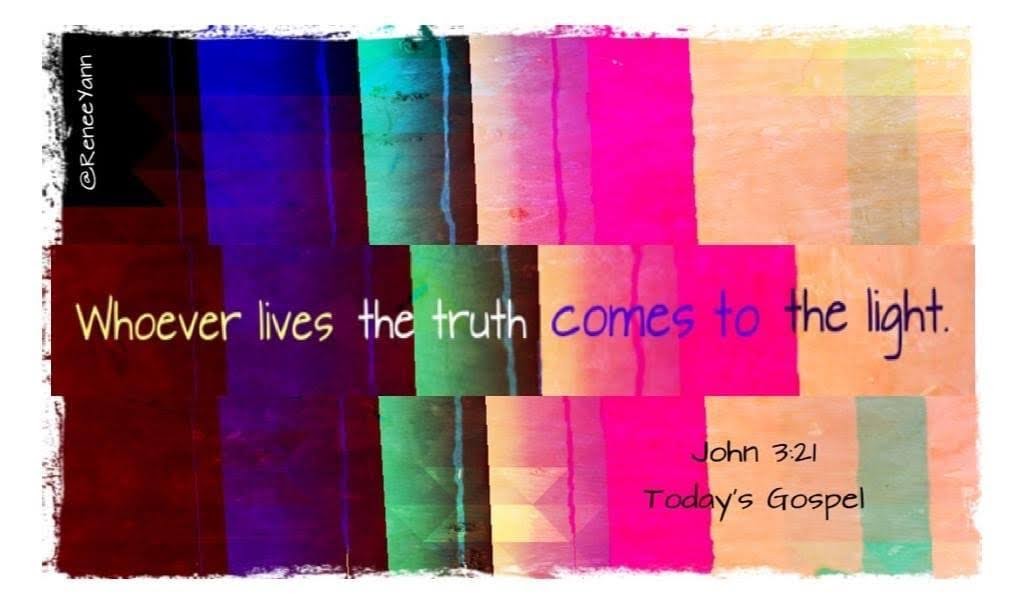
And this is the verdict, that the light came into the world, but people preferred darkness to light, because their works were evil. For everyone who does wicked things hates the light and does not come toward the light, so that his works might not be exposed. But whoever lives the truth comes to the light, so that his works may be clearly seen as done in God.
John 3:19-21
For today, we may want to consider any darkness in our world or in ourselves that we wish to carry into God’s amazing Light and Love. There, let us lay the darkness down and pray to live the truth which John encourages us to live.
Poetry: “Truth”, said a traveller by Stephen Crane
“Truth," said a traveller,
“Is a rock, a mighty fortress;
“Often have I been to it,
“Even to its highest tower,
“From whence the world looks black.”

“Truth," said a traveller,
“Is a breath, a wind,
“A shadow, a phantom;
“Long have I pursued it,
“But never have I touched
“The hem of its garment.”

And I believed the second traveller;
For truth was to me
A breath, a wind,
A shadow, a phantom,
And never had I touched
The hem of its garment.
Music: God So Loved the World – Sir John Stainer
God so loved the world, that He gave His only-begotten Son, that whoso believeth in Him should not perish, but have everlasting life. For God sent not His Son into the world to condemn the world; but that the world through Him might be saved. Amen.
Today, in God’s Lavish Mercy, the greatest act of love unfolds around a simple table, in the last rich hues of a Jerusalem sunset. No doubt the Twelve whom we are used to seeing in the paintings, and the many other who had sustained Christ’s journey by their service, sensed that this was an extraordinary Seder.
As you place yourself in the scene, you may wish to be one of the Apostles, or you may be the one who baked bread that would become His Body. You may be the one who decanted the precious wine to be His Blood.
Wherever you are in that ancient, yet living story – and wherever you are tonight, let the ancient awe fill your heart as you hear these astounding words:
Brothers and sisters: I received from the Lord what I also handed on to you, that the Lord Jesus, on the night he was handed over, took bread, and, after he had given thanks, broke it and said, “This is my body that is for you. Do this in remembrance of me.” In the same way also the cup, after supper, saying, “This cup is the new covenant in my blood. Do this, as often as you drink it, in remembrance of me.” For as often as you eat this bread and drink the cup, you proclaim the death of the Lord until he comes.
1 Corinthians 11: 23-26
After the supper, to help us comprehend his incomprehensible Gift, Jesus shows us what Eucharist looks like in everyday practice. It looks like the selfless service of a tender foot washing, the humble bending of our hearts to tend another’s need.
So, during supper, fully aware that the Father had put everything into his power and that he had come from God and was returning to God, he rose from supper and took off his outer garments. He took a towel and tied it around his waist. Then he poured water into a basin and began to wash the disciples’ feet and dry them with the towel around his waist.
….
So when he had washed their feet and put his garments back on and reclined at table again, he said to them, “Do you realize what I have done for you? You call me ‘teacher’ and ‘master,’ and rightly so, for indeed I am. If I, therefore, the master and teacher, have washed your feet, you ought to wash one another’s feet. I have given you a model to follow, so that as I have done for you, you should also do.”
Dearest Jesus, teach us the deep, deep lessons of these readings. Let them live in us in sacramental vigor poured over the world in Mercy.
As you walk now from the Upper Room toward the Agony of Gethsemane, let us walk beside you in trusting love.
Poetry: Loves – Scott Cairns is the author of eight books of poetry, including The Theology of Doubt (1985), The Translation of Babel (1990), Philokalia (2002), Idiot Psalms (2014), and Slow Pilgrim: The Collected Poems (2015). Spirituality plays an integral role in Cairns’ writing; in an interview, he said, “I’ve come to think of beauty as how God woos us to himself. One doesn’t so much create it or illuminate it as partake of it. Thereafter, one participates, collaborates, in its endless development.”
One of the more dramatic poems is “Loves.” In the voice of Mary Magdalen it offers a strong critique of the separation of flesh and spirit: “All loves are bodily, require / that the lips part, and press their trace / of secrecy upon the one / beloved . . .
Loves
Of Love’s discrete occasions, we
observe sufficient catalogue,
a likely-sounding lexicon

pronounced so as to implicate
a wealth of difference, where reclines
instead a common element,

itself quite like those elements
partaken at the table served
by Jesus on the night he was

betrayed—like those in that the bread
was breakable, the wine was red
and wet, and met the tongue with bright,

intoxicating sweetness, quite
like ... wine. None of what I write arrives
to compromise that sacrament,

the mystery of spirit graved
in what is commonplace and plain—
the broken, brittle crust, the cup.

Quite otherwise, I choose instead
to bear again the news that each,
each was still itself, substantial

in the simplest sense. By now, you
will have learned of Magdalen, a name
recalled for having won a touch

of favor from the one we call
the son of man, and what you’ve heard
is true enough. I met him first

as, mute, he scribbled in the dust
to shame some village hypocrites
toward leaving me unbloodied,

if ill-disposed to taking up
again a prior circumstance.
I met him in the house of one

who was a Pharisee and not
prepared to suffer quietly
my handling of the master’s feet.

Much later, in the garden when,
having died and risen, he spoke
as to a maid and asked me why

I wept. When, at any meeting
with the Christ, was I not weeping?
For what? I only speculate

—brief inability to speak,
a weak and giddy troubling near
the throat, a wash of gratitude.

And early on, I think, some slight
abiding sense of shame, a sop
I have inferred more recently

to do without. Lush poverty!
I think that this is what I’m called
to say, this mild exhortation

that one should still abide all love’s
embarrassments, and so resist
the new temptation—dangerous,

inexpedient mask—of shame.
And, well, perhaps one other thing:
I have received some little bit

about the glib divisions which
so lately have occurred to you
as right, as necessary, fit

That the body is something less
than honorable, say, in its
... appetites? That the spirit is

something pure, and—if all goes well—
potentially unencumbered
by the body’s bawdy tastes.

This disposition, then, has led
to a banal and pious lack
of charity, and, worse, has led

more than a few to attempt some
soul-preserving severance—harsh
mortifications, manglings, all

manner of ritual excision
lately undertaken to prevent
the body’s claim upon the heart,

or mind, or (blasphemy!) spirit—
whatever name you fix upon
the supposéd bodiless.

I fear that you presume—dissecting
the person unto something less
complex. I think that you forget

you are not Greek. I think that you
forget the very issue which
induced the Christ to take on flesh.

All loves are bodily, require
that the lips part, and press their trace
of secrecy upon the one

beloved—the one, or many, endless
array whose aspects turn to face
the one who calls, the one whose choice

it was one day to lift my own
bruised body from the dust, where, it seems
to me, I must have met my death,

thereafter, this subsequent life
and late disinclination toward
simple reductions in the name

of Jesus, whose image I work
daily to retain. I have kissed
his feet. I have looked long

into the trouble of his face,
and met, in that intersection,
the sacred place—where body

and spirit both abide, both yield,
in mutual obsession. Yes,
if you’ll recall your Hebrew word.

just long enough to glimpse in its
dense figure power to produce
you’ll see as well the damage Greek

has wrought upon your tongue, stolen
from your sense of what is holy,
wholly good, fully animal—
the body which he now prepares.
Music: Tenebrae Music for Holy Thursday – Giovanni Pierluigi da Palestrina (1525-94)
This musical meditation is based on the Lamentations in the Book of Jeremiah. The word “tenebrae” means “shadows”.










 Lavish Mercy