What Is Hope?

February 28, 2022
Monday of the Eighth Week in Ordinary Time

Today, in God’s Lavish Mercy, the word “HOPE” binds our readings together.

Blessed be the God and Father of our Lord Jesus Christ,
who in his great mercy gave us a new birth to a living hope
through the resurrection of Jesus Christ from the dead,
to an inheritance that is imperishable, undefiled, and unfading,
ept in heaven for you…

1 Peter 1:3

Wow! That’s uplifting isn’t it!

But praying with this passage, I am aware of how hard it is to really define hope. We can get it mixed up with wishing or imagining.

Hope is very different,
and much more powerful, than wishing.
It is a share in the power of God
to animate our world with divine life.

When we wish, we imagine better things and often do what we can to make them happen. Sometimes our prayers take the form of wishes – our desire for people or circumstances to be well or better. Those wishes may or may not come true. And if they don’t, we may lose what we incorrectly defined as “hope”.


We see that kind loss happen in the young man from our Gospel today. He wishes to be a better person. He wishes to truly center his life on God. He even takes the first step to make his wish come true by asking Jesus for advice:

As Jesus was setting out on a journey, a man ran up,
knelt down before him, and asked him,
“Good teacher, what must I do to inherit eternal life?”

Mark 10:17

Jesus immediately loves this sincere young man. But says tells him that he has too many “wishes” cluttering his hope for God. Jesus encourages him to clear out space in his life for God’s Presence to transform him. Then everything will become an expression of the divine life within him.

Jesus, looking at him, loved him and said to him,
“You are lacking in one thing.
Go, sell what you have, and give to the poor
and you will have treasure in heaven;
then come, follow me.”

Mark 17:21

Sadly, the man cannot summon the spiritual strength to tap into his gift of hope – to rely fully on God in his life. The gift of hope is within him, as it is within all of us. But the way to it is so tangled with all his possessions that he despairs of finding it.

At that statement, his face fell,
and he went away sad,
for he had many possessions.

Mark 17:22

The Catholic encyclopedia says this:

Hope is defined to be a Divine virtue by which we confidently expect, with God’s help, to reach eternal felicity as well as to have at our disposal the means of securing it.


Being a “Divine virtue” means that hope, like faith and love, is given by God to each of us as a share in God’s own nature. It’s like a “divine” family trait that marks us as children of God.

When we see a child that looks exactly like a parent, we might hear people say, “You could never deny him. He looks exactly like you!” That’s how it is with the “divine virtues”. They allow people to see God in us and so to deepen their own faith.

Hope is that confidence in God which is so complete that it does not have to be proven by miracles or fulfilled wishes. Hope endures in all circumstances. It throbs within us like sacred DNA. All we have to do is clear the way for it to shine.


Poetry: Two of my favorite poems today:

  1. Emily Dickinson, in her masterfully woven metaphor, says that hope is feathered:

“Hope” is the thing with feathers –
That perches in the soul –
And sings the tune without the words –
And never stops – at all –

And sweetest – in the Gale – is heard –
And sore must be the storm –
That could abash the little Bird
That kept so many warm –

I’ve heard it in the chillest land –
And on the strangest Sea –
Yet – never – in Extremity,
It asked a crumb – of me.


And one of my favorite poets, Lisel Mueller, says that hope is “all we know of God”:

It hovers in dark corners
before the lights are turned on,
it shakes sleep from its eyes
and drops from mushroom gills,
it explodes in the starry heads
of dandelions turned sages,
it sticks to the wings of green angels
that sail from the tops of maples.

It sprouts in each occluded eye
of the many-eyed potato,
it lives in each earthworm segment
surviving cruelty,
it is the motion that runs
from the eyes to the tail of a dog,
it is the mouth that inflates the lungs
of the child that has just been born.

It is the singular gift
we cannot destroy in ourselves,
the argument that refutes death,
the genius that invents the future,
all we know of God.

It is the serum which makes us swear
not to betray one another;
it is in this poem, trying to speak.


Music: Living Hope – Phil Wickham

Love – The Unfailing Bridge

Today, in God’s Lavish Mercy,  we begin our readings with God’s stern but magnificent commission to the prophet Jeremiah: 

… stand up and tell them
all that I command you.

What Jeremiah had to tell the Israelites was not comforting news. He prophesied that if they didn’t repent from their idolatry, Jerusalem would fall into the hands of foreign oppressors. Nobody wanted to hear it. They led Jeremiah a life, to the point that he is often referred to as “The Weeping Prophet”. Over the course of forty years and the reign of five Judean kings, Jeremiah’s message continues until, in the end, it comes to fulfillment in the Babylonian Captivity.

Jeremiah Lamenting the Fall of Jerusalem
Rembrandt

How did Jeremiah sustain such confrontational preaching in the face of intractable resistance?

Perhaps the answer lies in our second reading. He did it out of love.

Arthur Cundall, a British scripture scholar writes:

“God wanted a person
with a very gentle and tender heart
for this unrewarding ministry of condemnation.
Jeremiah’s subsequent career shows that
he had this quality in full measure.”

Jeremiah is a living example of the loving, humble, truth-seeking, hope-impelled soul described in 1 Corinthians, our second reading.

Strive eagerly for the greatest spiritual gifts.
But I shall show you a still more excellent way.
If I speak in human and angelic tongues,
but do not have love,
I am a resounding gong or a clashing cymbal.
And if I have the gift of prophecy,
and comprehend all mysteries and all knowledge;
if I have all faith so as to move mountains,
but do not have love, I am nothing.

1 Corinthians 13: 1-2

In Luke’s Gospel today, we see Jesus rejected in the same manner as Jeremiah. Jesus’s message calls his listeners to deep conversion of heart in order to be redeemed. Like the ancient Israelites, they don’t want to hear it. They cannot break through their comfortable existence to acknowledge its emptiness.

Jesus is Rejected at Nazareth
Maerten de Vos – 16th Century

And he said, “Amen, I say to you,
no prophet is accepted in his own native place….

… When the people in the synagogue heard this,
they were all filled with fury.
They rose up, drove him out of the town,
and led him to the brow of the hill
on which their town had been built,
to hurl him down headlong.
But Jesus passed through the midst of them and went away.

Luke 4:24; 28-30

The message for us today? Is there an emptiness somewhere in our hearts that we have not yet given over to God? Are we filling it with “false gods”, rather than the loving virtues described in Corinthians? Is there even a small resistance to the Word that keeps us in a “dead space”.

We know where our “dead spaces” are, and we deeply intend them to come alive again. Today, let’s choose to walk the bridge from intention to practice.


Poetry: Jeremiah – Saint John Henry Newman

"WOE'S me!" the peaceful prophet cried,
"Spare me this troubled life;
To stem man's wrath, to school his pride,
To head the sacred strife!

"O place me in some silent vale,
Where groves and flowers abound;
Nor eyes that grudge, nor tongues that rail,
Vex the truth-haunted ground!"

If his meek spirit err'd, opprest
That God denied repose,
What sin is ours, to whom Heaven's rest
Is pledged, to heal earth's woes?

Music:  One of my all time favorite songs (Wow! And how about the snow geese at the end of this video!)

The Flame

January 26, 2022
Memorial of Saints Timothy and Titus, Bishops

Today, in God’s Lavish Mercy, we have the beautiful letter from Paul to Timothy, filled with tenderness, encouragement, hope and the sweet suggestion of loving memories.

Paul, an Apostle of Christ Jesus by the will of God
for the promise of life in Christ Jesus,
to Timothy, my dear child:
grace, mercy, and peace from God the Father
and Christ Jesus our Lord.

2 Tim 1:1

On life’s road, what an indescribable blessing to have even one companion who loves us the way Paul loved Timothy — to care for our whole life, our whole soul, and our whole “forever”.


Timothy and His Mother, Eunice – Henry Lejeune

In his letter, Paul reveals that Timothy has been immensely blessed with such love throughout his life. Timothy’s mother and grandmother, Eunice and Lois have already – for many years – tendered Timothy in the faith.

I think gratefully of my own mother today, on the 34th anniversary of her death. How indescribably blessed I have been by her love and faith!


In this heartfelt epistle, Paul notes that he prays for Timothy daily. Perhaps as you read his words you may, like me, think of those who have nurtured and cared for you in a way similar to Paul’s love for Timothy; to Eunice’s and Lois’s love for him.

Do we pray for those who have blessed us and loved us in our lives? Do we tell them so, if they are living? Do we thank and remember them if they have gone home to God?


Paul closes this part of his letter with such a powerful charge to Timothy:

For this reason,
I remind you to stir into flame
the gift of God that you have
through the laying on of my hands.

In other words, it is not enough just to be grateful for such gifts. We must use them to light and warm a next generation of believers and faith-filled lovers.

Many people have rested the hands
of blessing on our spirits, our hearts.
May we be filled with generous gratitude
today and everyday.


For those who have done otherwise, may we forgive them and, as best we can, release them to God’s Mercy. Perhaps they, by the grace of God, have left us with another kind of “gift” — as Mary Oliver has written:

Someone I loved once gave me
a box full of darkness.
It took me years to understand
that this, too, was a gift.

Poetry: God’s Grandeur – Gerard Manley Hopkins

The world is charged with the grandeur of God.
    It will flame out, like shining from shook foil;
    It gathers to a greatness, like the ooze of oil
Crushed. Why do men then now not reck his rod?
Generations have trod, have trod, have trod;
    And all is seared with trade; bleared, smeared with toil;
    And wears man's smudge and shares man's smell: the soil
Is bare now, nor can foot feel, being shod.

And for all this, nature is never spent;
    There lives the dearest freshness deep down things;
And though the last lights off the black West went
    Oh, morning, at the brown brink eastward, springs —
Because the Holy Ghost over the bent
    World broods with warm breast and with ah! bright wings.


Music: for your remembering prayer: James Last – Coulin

David, the King

January 24, 2022
Monday of the Third Week in Ordinary Time
Memorial of Saint Francis de Sales, Bishop and Doctor of the Church

Today, in God’s Lavish Mercy, our readings place us at watershed moments in the lives of David and Jesus.

All the tribes of Israel came to David in Hebron and said:
“Here we are, your bone and your flesh.
In days past, when Saul was our king, 
it was you who led the children of Israel out and brought them back.
And the LORD said to you, ‘You shall shepherd my people Israel 
and shall be commander of Israel.’”
When all the elders of Israel came to David in Hebron, 
King David made an agreement with them there before the LORD, 
and they anointed him king of Israel.

2 Samuel 5:1-4

In 2 Samuel 5, David fully assumes the kingship through the approbation of the community. The scene marks the culmination of his rise to power and “the beginning of the rest of his life”.

Through our readings in Samuel until now, we have ascended with David to the pinnacle of his life. We are about to begin weeks of moving down “the other side of the mountain”.


Scholars generally see the David narrative in two primary units, the Rise of David (I Sam. 16:1—II Sam. 5:10) and the Succession Narrative (II Sam. 9:1—20:26; I Kings 1:1—2:46). Chapters 5:11—8:18, fall between two larger units. Whereas the first presents David in his ascendancy, the second presents David in his demise and expresses pathos and ambiguity. Our chapters thus come after the raw vitality of the rise of David and before the terrible pathos of the succession narrative. They show the painful process whereby this beloved chieftain is transformed into a hardened monarch, who now has more power than popular affection.

Walter Brueggemann, First and Second Samuel

In our Gospel, Jesus also comes to a sort of “continental divide”. But rather than community approbation, Jesus encounters the condemnation of the scribes who have come from Jerusalem to assess him.

The scribes who had come from Jerusalem said of Jesus, 
“He is possessed by Beelzebul,” and
“By the prince of demons he drives out demons.”

Mark 3:22

From this moment in his life, Jesus too launches into his “kingship”, one that looks very different from David’s. The ensuing chapters of Samuel will reveal how David struggles and succumbs to the temptations of power and domination. The Gospels, on the other hand, describe Jesus’s “kingdom” as one of humility, mercy, and love for those who are poor and suffering.

Only through faith can we understand the inverse power of God present in the Life, Death and Resurrection of Jesus, and in our own lives. Jesus, the “new David”, is anointed in the Spirit to reveal and incorporate us into the kingdom of God.


Prose: from Immanuel Jakobovits who was the Chief Rabbi of the United Hebrew Congregations of the Commonwealth from 1967 to 1991.

To those without faith
there are no answers.
To those with faith, 
there are no questions.

Music: King David, music by Herbert Howells, sung by Sarah Connolly from a poem by Walter de la Mare

King David – Walter de la Mare

King David was a sorrowful man:
    No cause for his sorrow had he;
    And he called for the music of a hundred harps,
    To ease his melancholy.

    They played till they all fell silent:
    Played-and play sweet did they;
    But the sorrow that haunted the heart of King David
    They could not charm away.

    He rose; and in his garden
    Walked by the moon alone,
    A nightingale hidden in a cypress-tree
    Jargoned on and on.

    King David lifted his sad eyes
    Into the dark-boughed tree-
    ''Tell me, thou little bird that singest,
    Who taught my grief to thee?'

    But the bird in no wise heeded
    And the king in the cool of the moon
    Hearkened to the nightingale's sorrowfulness,
    Till all his own was gone.

The Miracle is Love

January 4, 2022
Memorial of Saint Elizabeth Ann Seton, Religious


Today, in God’s Lavish Mercy, our readings are full of surprises for Jesus’s new followers and for us.  

Jesus begins to reveal what his Presence among us is all about. The message is this: I am here for the poor, hungry, sick and abandoned:

The Lord has sent me to bring glad tidings to the poor
and to proclaim liberty to captives.

Luke 4:18

And Jesus wants us to be like him.


In our first reading, John makes that sound so simple:

Whoever is without love does not know God, for God is love.

1 John 4:8

Someone might read that line and think, “OK! I can do that! I love lots of people and things. I know how to love.” 

But then our Gospel suggests that maybe we, like the disciples, have a lot to learn about how God loves. Mark shows us that Jesus is living a new kind of love.


Imagine the situation. John the Baptist has been murdered. The new disciples are returning from their first “apostolic gig”. They, and probably Jesus, are shocked, saddened and tired. Jesus recognizes this and tells them:

“Come away by yourselves to a deserted place and rest a while.” 

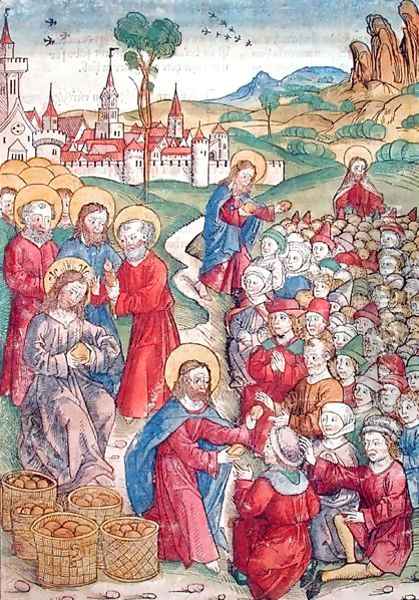
Multiplication of the Loaves – Michael Wolgemut

But instead the hungry crowds followed them, their needs intruding on the deserved and desired solitude. The disciples sound a little annoyed in their practicality:

By now it was already late and his disciples approached him and said,
“This is a deserted place and it is already very late. 
Dismiss them so that they can go 
to the surrounding farms and villages
and buy themselves something to eat.” 

Mark 6: 35-36

But when Jesus saw the crowd, his response was not annoyance or practicality.

When Jesus saw the vast crowd, his heart was moved with pity for them, for they were like sheep without a shepherd…

Mark 6:34

In the Greek translation, the word for “moved with pity” is “ἐσπλαγχνίσθη” (Esplanchnisthē) – “splancha”

“Splancha”, in my mind, says that the heart of Jesus ”rumbled with mercy”; that he was so shaken to his roots with compassion that he pulled heaven down in a miracle to feed these people who were hungry at every level of their being.

The crowds, and indeed the disciples, are surprised not just by the cataract of fish and bread. But they are even more deeply astounded at this astounding demonstration of how God loves – with impractical, unlimited, immediate, miraculous generosity!


The lesson for us? Just as the disciples were commissioned to distribute the basketsful of miracles, we are charged to carry God’s mercy in our time.

Through the grace of Baptism, we have it within us to be the agent of miracles – the power to let God love through us. As John encourages us:

Beloved, let us love one another,
    because love is of God;
    everyone who loves is begotten by God and knows God.

1 John 4:7

Poetry: Miracles by Robert William Service

Each time that I switch on the light
A Miracle it seems to me
That I should rediscover sight
And banish dark so utterly.
One moment I am bleakly blind,
The next–exultant life I find.
Below the sable of the sky
My eyelids double darkness make.
Sleep is divine, yet oh how I
Am glad with wonder to awake!
To welcome, glimmery and wan
The mighty Miracle of Dawn.
For I’ve mad moments when I seem,
With all the marvel of a child,
To dwell within a world of dream,
To sober fact unreconciled.
Each simple act has struck me thus–
Incredibly miraculous.
When everything I see and do
So magical can seem to me,
How vain it is to seek the True,
The riddle of Reality . . .
So let me with joy lyrical
Proclaim all Life a Miracle.


Music: Beloved, Let Us Love One Another – a perky encouragement for your prayer 🙂

The Holy Family

Sunday, December 26, 2021

Sorry for the late post today. Blame it on my being the big cook today and on my Aunt Peg’s wonderful pineapple casserole. She went home to God almost 30 years ago. But she lives in my kitchen anytime I cook a ham…and so many other times in my heart. ❤️ Merry Christmas once again, my friends.

in case you’d like to try it!

Today, in God’s Lavish Mercy, our prayer is turned to the Holy Family, that unique configuration of love which nurtured the developing life of Jesus. Can you imagine how tenderly the Father shaped this triad, this nesting place of love for God’s own Word?

Today, we look to the Holy Family so that we might see our own families through their lens of grace and mercy. We pray to the Holy Family so that we might be strengthened in the virtues that will help us build our own families: sacrificial love, reverence, courage, unfailing support, committed presence, shared faith, gentle honesty, unconditional acceptance.

“Family” is the primordial place where we learn who we are. The lessons it teaches us about ourselves – for better or worse — remain with us forever. 

This is my crew. How blessed I am in them!

Not everyone is blessed by their family. Family can ground us in confidence or undermine us with self-doubt. It can free us from fear or cripple us with reservation. It can release either possibility or perpetual hesitation within us.

Some families are so dysfunctional that we spend the rest of our lives trying to recover from them. But some, like the Holy Family, allow God’s dream to be nurtured in us and to spread to new families, both of blood and spirit.


The challenge today is to thank God for whatever type of family bore us. Lessons can be learned from both lights and shadows. Let us spend time this morning looking  at our own families with love, gratitude, forgiveness, understanding. Where there are wounds to be healed, let us face them. Where there are belated thanks to be offered, let us give them. Where there are negligence and oversights to confess, let us use them as bridges to a new devotion.


For some, it may seem too late to heal or bless our family. Time may have swallowed some of our possibilities. But it is never too late to deepen relationships through prayer, both for and to our ancestors.

May this feast strengthen us for the families who need us today. May it be the beginning of refuge for families broken and tested by migration and worldwide inhospitality


Music: God Bless My Family ~ Anne Hampton Calloway

God Knows My Truth

November 8, 2021
Monday of the Thirty-second Week in Ordinary Time

Today, in God’s Lavish Mercy, we pray with the comforting yet challenging Psalm 139, a prayer of awareness, intimacy, and trust.

O LORD, you have probed me and you know me;
    you know when I sit and when I stand;
    you understand my thoughts from afar.
My journeys and my rest you scrutinize,
    with all my ways you are familiar.

Psalm 139:1-3

The thought that God knows us so intimately might be both assuring and/or scary — depending on how we know and understand ourselves. The psalmist describes an overwhelming wonder at the thought of God’s closeness:

Even before a word is on my tongue,
    behold, O LORD, you know the whole of it.
Behind me and before, you hem me in
    and rest your hand upon me.
Such knowledge is too wonderful for me;
    too lofty for me to attain.

Psalm 139:4-6

As we pray Psalm 139, the awe settles into a deep awareness that God’s penetrating Presence in our spirits is ever beneficent and merciful. We pray to yield to its Love and seek its Wisdom.

Where can I go from your spirit?
    From your presence where can I flee?
If I go up to the heavens, you are there;
    if I sink to the nether world, you are present there.
If I take the wings of the dawn,
    if I settle at the farthest limits of the sea,
Even there your hand shall guide me,
    and your right hand hold me fast.

Psalm 139:7-10

On this 32nd Monday, we begin a week of readings from the Book of Wisdom. Written in the century surrounding the birth of Christ, Wisdom is the work of a poet, theologian, philosopher, and moralist. 

Today’s passage alerts us, as does our Gospel, that holding God’s Presence within us, we must live lives that bear it witness:

For wisdom is a kindly spirit,
yet she acquits not blasphemers of their guilty lips;
Because God is the witness of the inmost self
and the sure observer of the heart
and the listener to the tongue.
For the Spirit of the Lord fills the world,
is all-embracing, and knows what the person truly bespeaks by their lives.

Wisdom 1:6-7

A millstone at someone’s feet …

For as our Gospel tells us today:

Jesus said to his disciples,
“Things that cause sin will inevitably occur,
but woe to the one through whom they occur.  
It would be better to have a millstone hung around the neck
and be thrown into the sea
than to cause one of these little ones to sin.”

Luke 17:1-2

Poetry: Wisdom – Tagore

The small wisdom 
is like water in a glass:
clear, transparent, pure.

The great wisdom 
is like the water in the sea:
dark, mysterious, impenetrable.

Music: The Perfect Wisdom of Our God – The Gettys

Love or Hate, hmm?

November 3, 2021
Wednesday of the Thirty-first Week in Ordinary Time

Today, in God’s Lavish Mercy, we pray with Psalm 112, a hymn to the human generosity which mirrors God’s own:

Happy are they who fear the Lord
and have great delight in the divine commandments! 

Light shines in the darkness for the upright;
the righteous are merciful and full of compassion. 

For they will never be shaken;
their righteousness will be kept in everlasting remembrance.

Psalm 112: 1-6

Paul and Jesus seem to give us contradictory messages about how to achieve this “righteousness”. Paul talks about love, and Jesus tells us what we must “hate” – a bit of a challenge to untangle the core message.

Here’s one way.

We probably don’t like Jesus telling us to hate anything, as in:

If anyone comes to me without hating his father and mother,
wife and children, brothers and sisters,

and even his own life,
he cannot be my disciple.

Come on, Jesus! You don’t mean that do you – my sweet mom, my precious kids???


No, the scholars say, Jesus doesn’t mean “hate” the way we interpret it in modern English. He is using the common, hyperbolic language of the ancient East which, in this circumstance, would mean “love less”.

So what is Jesus really saying? 

This, I think.

We love many people and things in our lives. But we must love God, and God’s dream for all people, above and within all things. 


And that’s not easy! Life is a maze of relationships and situations that can get us very confused about what is most important. That’s why Jesus uses such strong language to remind us that there is only one way through the maze: to love as God loves. This is the heartbeat of our life in God!


Paul says this too, indicating how to negotiate the maze by keeping Love’s commandments.

Brothers and sisters:
Owe nothing to anyone, except to love one another;
for the one who loves another has fulfilled the law.

Romans 13:8

If we love with God’s love, of course we will love those we cherish. But we will love them selflessly, with an infinite generosity that always chooses their eternal good. And we will try always to love all Creatures in the same way. This is the kind of love Jesus taught us on the Cross. May God give us the courage to learn.


Poetry: Prayer of Mother Teresa and Brother Roger of Taize 

Oh God, the Creator of all,
you ask every one of us to spread
Love where the poor are humiliated,
Joy where the Church is brought low,
And reconciliation where people are divided. . . 
Father against son, mother against daughter,
Husband against wife,
Believers against those who cannot believe,
Christians against their unloved fellow Christians.

Music: Ubi Caritas performed by Stockholm University Choir (texts below)

Latin Text

Ubi caritas et amor, Deus ibi est.
Congregavit nos in unum Christi amor.
Exsultemus, et in ipso jucundemur.
Timeamus, et amemus Deum vivum.
Et ex corde diligamus nos sincero.
Ubi caritas et amor, Deus ibi est.
Simul ergo cum in unum congregamur:
Ne nos mente dividamur, caveamus.
Cessent iurgia maligna, cessent lites.
Et in medio nostri sit Christus Deus.
Ubi caritas et amor, Deus ibi est.
Simul quoque cum beatis videamus,
Glorianter vultum tuum, Christe Deus:
Gaudium quod est immensum, atque probum,
Saecula per infinita saeculorum. Amen.

English Translation
Where charity and love are, God is there.
Love of Christ has gathered us into one.
Let us rejoice in Him and be glad.
Let us fear, and let us love the living God.
And from a sincere heart let us love one.
Where charity and love are, God is there.
At the same time, therefore, are gathered into one:
Lest we be divided in mind, let us beware.
Let evil impulses stop, let controversy cease.
And in the midst of us be Christ our God.
Where charity and love are, God is there.
At the same time we see that with the saints also,
Thy face in glory, O Christ our God:
The joy that is immense and good,
Unto the World without end. Amen.

The Heart of Love

October 31, 2021
Thirty-first Sunday in Ordinary Time

Today, in God’s Lavish Mercy, we pray with beautiful Psalm 18:

I love you, O LORD, my strength,
    O LORD, my rock, my fortress, my deliverer.
R. I love you, Lord, my strength.
My God, my rock of refuge,
    my shield, the horn of my salvation, my stronghold!

Psalm 18: 2-3

In our readings, both Deuteronomy and Mark proclaim the call to love God wholeheartedly.

In Mark, it is one of the scribes who initiates this proclamation by asking Jesus which is the first – most important – of the commandments. Unlike many of Jesus’ encounters with the scribes and Pharisees, this one does not seem hostile. The man, as one might expect of an expert in the Law, wants to know if Jesus continues the priorities of the Torah. 

One of the scribes came to Jesus and asked him,
“Which is the first of all the commandments?” 

Mark 12:28

He is pleased with Jesus’ answer. And Jesus is pleased with him. We can almost see Christ’s smile at the scribe’s sincere and lived response. 

Jesus replied, “The first is this:
Hear, O Israel!
The Lord our God is Lord alone!
You shall love the Lord your God with all your heart,
with all your soul, 
with all your mind,
and with all your strength.
The second is this:
You shall love your neighbor as yourself.
There is no other commandment greater than these.” 
The scribe said to him, “Well said, teacher.

Mark 12: 29-31

This man sees through the Pharisaical confusions which have been heaped upon this most important law. He understands that love of God and neighbor mean infinitely more than burnt offerings and public sacrifices.


How do we reach this wholehearted love in our complex lives? We’re not busy with burnt offerings, but we are distracted by so many forces that lay claim to our attention and devotion. 

We love many worthy and unworthy things in our lives. We often confuse real love with one of its masquerading forms – “loves” that are self-serving rather than other-serving.

Today’s Alleluia verse is an answer to our, “How?”.

Whoever loves me
will keep my word, says the Lord;
and my father will love him
and we will come to him.

John 14:23

Real love is proved by action. It’s that simple.
What do my actions say about where my heart is?
Let me just flip back through my last 24 hours
to see if God would have smiled at my choices, words, and actions.
And let me change what I need to change for tomorrow.


Poetry: from Rumi

Last night I learned how to be a lover of God,
To live in this world and call nothing my own.

I looked inward
And the beauty of my own emptiness
filled me till dawn.
It enveloped me like a mine of rubies.
Its hue clothed me in red silk.

Within the cavern of my soul
I heard the voice of a lover crying,
“Drink now! Drink now!”—

I took a sip and saw the vast ocean— 
Wave upon wave caressed my soul. 
The lovers of God dance around 
And the circle of their steps
becomes a ring of fire round my neck.

Heaven calls me with its rain and thunder—
a hundred thousand cries
yet I cannot hear…..

All I hear is the call of my Beloved.


Music: V’Ahavta- Marty Goetz

V’Ahavta is part of the Shema Yisrael (שְׁמַע יִשְׂרָאֵל)- a prayer that serves as a centerpiece of the morning and evening Jewish prayer services.

God’s Generous Jealousy

Monday, September 27, 2021
Memorial of Saint Vincent de Paul

Today, in God’s Lavish Mercy, we pray with Psalm 102 which, together with our first reading from Zechariah, paints a picture of enduring love and hope:

  1. the desperate yet hopeful prayer of one overwhelmed by life

Let this be written for the generation to come,
    and let  future creatures praise the Lord:
“The LORD looked down from the holy height,
    from heaven  beheld the earth,
To hear the groaning of the prisoners,
    to release those doomed to die.”

Psalm 102: 19-21

2. the response of a faithful God, overwhelmed by love

Thus says the LORD of hosts:
I am intensely jealous for Zion,
        stirred to jealous wrath for her.
    Thus says the LORD:
I will return to Zion,
    and I will dwell within Jerusalem;
Jerusalem shall be called the faithful city,
    and the mountain of the LORD of hosts,
   the holy mountain.

Zechariah 8:1-3

The “jealous love” described here is an infinite and divine Love – the only Love entitled to be possessive because It has created us. 

It is a jealousy unlike our human pettiness, rooted instead in God’s desire for our free response to the gift of our creation. 

God loves us so much as to continually bring us home to Love despite any detours we take.

Lo, I will rescue my people from the land of the rising sun,
    and from the land of the setting sun.
I will bring them back to dwell within Jerusalem.
They shall be my people, and I will be their God,
    with faithfulness and justice.

Zechariah 8:8

In our prayer today, we might allow ourselves to be aware of God’s “jealousy” for us throughout our lives, never giving up on turning us toward Love – even when the turning may have been “like a hurricane”.


Poetry: GOD OF SHELTER, GOD OF SHADE (ISAIAH 4:6) by Irene Zimmerman, OSF

God of shelter from the rain,
God of shade from the heat,

I run from You
through the muddy street
of my uncommitted heart
till wild winds beat
against my doors,
blasting sand
through all my walls,
and I stand
without retreat,
hear Your command
to be the wheat. 

Sweet the giving!
Sweet this land! 

God of shelter from the rain.
God of shade from the heat.

Music: How He Loves Us – David Crowder Band