On That Day & This One

Many things live, not just the plants, animals and humans that grace our world.  Memories and promises live.  Vows live. So do grudges and prejudices. Unlike our physical life, these less tangible realities become stronger with time.  Tales of valor and achievement live, often becoming epic with the passing of the years.

Simple kindness lives too, blessing not only the current receiver, but the unseen generations to whom it is passed. Every morning, old fears and new hopes wake up within us all.  They vie with each other to become the engines of our lives.  The happy ones among us have learned to let hope win.

mother Patricia with flower
Mother Patricia near her death in 1915

On this date in 1861, a small group of just such happy, hopeful people came to Philadelphia. On that hot August afternoon, the first Philadelphia Sisters of Mercy, led by 26-year old Patricia Waldron, arrived at Broad Street Station in North Philadelphia. They carried no worldly possessions. They came with only a dream for Mercy.  It was a dream so alive in them that it still inspires us today, over 150 years later.


Can’t you see them standing on the busy platform, the hissing steam trains encircling them in mist?  They must have felt “be-misted” themselves, these mostly Irish country girls engulfed in a big city.

Union troops heading south crowded the platform.  Busy Broad Street crackled with news of the burgeoning national strife.  Lincoln himself would visit the city in the coming weeks.

And hidden within the seams of this bustling city’s garment lay the poor – the ones for whom they had come.  How to reach them?  How to help them change their lives?

Ranging from sixteen to twenty-seven years old, these brave young women had been charged with establishing a kind of “new nation” themselves – not of politics, but of mercy.  I am sure they, like the young stout-hearted soldiers surrounding them, were also a little weak-kneed. They too had their battles to face. They too would see starvation, illness, attack and death – but they would endure for the sake of the Mercy dream, God’s dream for the poor.

cemetery
Today we honor our beloved foremothers who led the way in faith and commitment.

Enduring dreams begin with small first steps.  So, hailing a horse-drawn carriage, Mother Patricia Waldron led her young band to their new lives.  Thus she began the grace-filled saga many of us know so well and of which we are a part today.  Their dream lives in us who love Mercy:

  • in our continued effort to find those who are poor and sick in a world that ignores them
  • in our choice to be compassionate in a world that often chooses violence
  • in our commitment to care in a world of treacherous indifference

On that sultry August day 1861,  and on this one 2019, people have choices to make.  They have vows to keep. Some choices live forever.  In the name of Mercy, what will you choose today?

Let the Light In

Friday of the Eighteenth Week in Ordinary Time

August 9, 2019

Click here for readings

Today, in Mercy, we have the first of a few readings from the Book of Deuteronomy. In today’s passage, Moses gives the first of three speeches to the community. These speeches are a sort of manifesto a family patriarch might give before he dies, framing the family history and code to direct coming generations.

Ps77 crack


Dad


The reading falls on a most appropriate day for me.
Today would be my Dad’s 104th birthday.
The occasion invites me to recount all the blessings
given to him, me, and our family.


When we, as people of faith, step back from our lives in reverence, we realize God’s immense goodness to us. Moses encourages his people to do just such stepping back:

Ask now of the days of old, before your time,
ever since God created man upon the earth;
ask from one end of the sky to the other:
Did anything so great ever happen before?

We might ask ourselves the same thing. 

  • How has God been with me and my family through our lifetimes, and through the generations that preceded us?
  • In both our lights and darknesses, how has God continually called us to relationship?
  • How have we revealed God’s voice to one another by our love, honesty, support, patient accompaniment, generous correction and forgiveness?
  • How have these gifts to one another allowed us to become gifts to the larger world?
  • What am I passing on to the next generation of the fidelity and sacrifice which has blessed me?

When I think of my Dad, there are so many symbols that show how he answered those questions with his life. They aren’t big manifestos like those of Moses. Instead: 

  • a frayed prayer book that I watched him finger daily
  • an old receipt for my bicycle bought in incremental payments he could barely afford
  • his sincere distress one Assumption Day when he had forgotten to go to Mass
  • his steadfast attempt to work even when illness weakened him and his humble trust in God when that weakness appeared to triumph
  • a treasured conversation about his hope for heaven
  • the appreciation now, in my maturity, of his thousand quiet acts of faith and love

All of us might spend some time in gratitude for the legacy of faith and love we have received. No family is perfect, and the grace may come to us in clarity or in disguise. But it comes. 

There are fractures and tears in every family. There were some even in Moses’ “family” and Moses himself! And we cannot magically heal them all. But God asks us to remember that God abides with us even in any fragmentation. Just as the poet Leonard Cohen sings:

There is a crack in everything.
That’s how the light gets in.

Click here to listen to Cohen’s moving song

If what we remember in our family history are weaknesses, how have they made us stronger? If what we remember are strengths, how have they made us more generous? In either case, how have we heard God’s voice in our story? How have we let the Light in?

As Moses tells his people:

This is why you must now know, and fix in your heart,
that the LORD is God
in the heavens above and on earth below,

and that there is no other.

Music: As for Me and My House – Promise Keepers

Sabbath and Jubilee

Saturday of the Seventeenth Week in Ordinary Time

August 3, 2019

Click here for readings

Sabbath-Should-We


Today, in Mercy, our reading from Leviticus may seem pastoral and peaceful in tone as it describes the days and years of rest and jubilee. Don’t let that tone fool you. This is perhaps one of the most radical, transformative passages in Scripture!

These verses from Leviticus describe and mandate an economic system based on respect and care for neighbor and earth. They require the community to take significant, reflective pauses in what might be an otherwise relentless drive to personal prosperity.

These commands are rooted in the understanding that God is the Creator, and therefore “owner” of all – people, animals, the land and its produce. We are to use these resources with reverent mutuality. If we do not, we become caught in an economy that inflates some at the expense of others – that is, an extractive economy.

Lv25_17_extraction

In an extractive economy, those with power and money siphon resources from the weak and vulnerable. This cycle grows ever more greedy because the “haves” can never have enough. Eventually, both human and natural resources are exhausted and the faulty, actually sinful, economy fails.

Sabbath and Jubilee are meant to restore balance by causing us to reflect on and reverse the pitfalls of a greedy, extractive system.

The parallels to present day realities are stunning! We live in a world where everything is a commodity at the disposal of those who control money. Walter Brueggemann calls this “the oligarchy of concentrated wealth…the network of the wealthy and powerful in the U.S. and around the world who basically outflank or control governmental structures.”

This unmitigated imbalance eventually creates impoverished nations whose citizens are plagued by violence, who must flee their homeland simply to survive. It spawns a culture of “disposability” where even human beings are bought and sold into exploitation. It creates a system where you may be sold anything, even if it kills you like tobacco, opioids and carcinogenic products. You may buy anything, even if it kills the people who provided it, even if it kills the earth for future generations.

So we simply cannot read Leviticus today as an ancient writing meant to organize a long-ago agrarian society. This scripture is speaking to us, demanding that we pause to consider how we contribute to or stand against such systems.

The reading is asking us to develop a deep, sacred awareness of all human beings as “neighbor”, and to live, unflinchingly, out of that awareness.

Music: The Workingman’s Hymn – Joshua Davis (Lyrics below)

Some people hunger for the greenback bill
Some folks hunger for the top of the hill
Some people just tryin’ to get a decent meal
Well I know that we can turn it around

Some people sleepin’ in a fine feather bed
Some folks are dreamin’ of an old homestead
Some just need a place to lay their head
Well I know that we can turn it around

[Chorus]
I know that we can turn it around
There’s one thing that I’ve found
If there’s a force in the dim singin’ a workingman’s hymn
I know that we can turn it around

River bottom up to home on high
In the light of the endless sky
Jetsettin’ or just gettin’ by
I know that we can turn it around

[Chorus]   [Bridge]

From the 9th Ward up to Patoka Lake
One man’s joy’s been another man’s pain
But the sun keeps shinin’ through the drivin’ rain
And I know that we can turn it around

Unconditional Love

Tuesday of the Seventeenth Week in Ordinary Time

July 30, 2019

Click here for readings

Today, in Mercy, we consider God’s unconditional love.

God and Moses and the People have been through it. The trail of complaints, the golden calf, the shattered tablets – these are relational dramas to the extreme! Exodus is definitely soap opera material! Does it feel a little bit like your life, or your family’s, or the families you read about in the news?

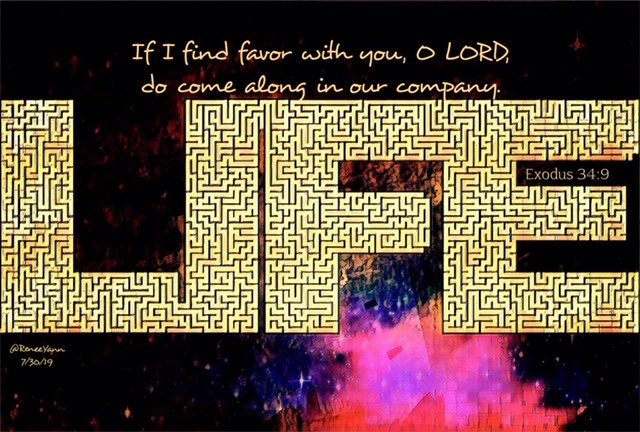
Ex34_9 Life

Life is indeed a drama! And our relationship with God is highlighted and shadowed with its twists and turns. For that reason, today’s passage offers us so much comfort and confidence. Even after all that has happened, God reveals himself to Moses like this:

The LORD, the LORD, a merciful and gracious God,
slow to anger and rich in kindness and fidelity,
continuing his kindness for a thousand generations.

Moses is so moved by this new knowledge of God’s unconditional love, that he welcomes God as part of their community:

If I find favor with you, O LORD,
do come along in our company.
This is indeed a stiff-necked people;
yet pardon our wickedness and sins,

and receive us as your own.

We are invited by this reading to open ourselves to that same unconditional love, to thank God for journeying with us through life’s convolutions. Stiff-necked at times, repentant at others, we are always God’s beloved.

As we negotiate the intricacies of our life today, we might trustingly say like Moses:

Lord, do come along in my company.

Music: Outrageous Grace – Godfrey Birtill

Honor Those Who Bore You Life

Memorial of Saints Joachim and Anne, Parents of the Blessed Virgin Mary

July 26, 2019

Click here for readings

Today, in Mercy, our Exodus reading coincides perfectly with today’s Memorial Feast for Anne and Joachim, grandparents of Jesus.

Exodus20_5

In the passage, we have one of many Old Testament formulations of the Ten Commandments. We learned these codes as children, and perhaps have always interpreted them as laws which, when broken, marked us as sinners.

While this is one approach, a more mature and life-giving one is offered by the Biblical scholar Terence E. Fretheim:

The focus (of these directives) is on
protecting the health of the community,

to which end the individual plays such an important role.
Exodus: Interpretation: A Biblical Commentary for Teaching and Preaching

The command to honor one’s father and mother clearly demonstrates this approach. It is a command not only for children to be docile and obedient. Rather it denotes a life-long responsibility to care for parents and other  nurturers of our lives. The command also suggests the responsibility of these nurturers to live honorably so that their children may respond to their example with equal honor.

Today is a day to pray for our own families and for all families, for the young and the elderly, and for those walking the tenuous bridge in between.  It is a day to assess how well we carry our responsibilities to honor, obey, bless and foster life for one another.

It is a day to be deeply grateful for the love of family which we are blessed to experience; a day to pray for healing for those not equally blessed. Let us pray for families distressed by the necessity to migrate, and further burdened by nations’ failures to keep the commandment of neighborly love.

Like Mary, may we embrace the elders in our lives who love and need us, be these parents, mentors, community members, or neighbors. Scripture promises us that, in doing so, we shall have “mercy bestowed on us down to the thousandth generation.”

Music: Love Remains – Hillary Scott

Trust and Fears

Saturday of the Fourteenth Week in Ordinary Time

July 13, 2019

Click here for readings

Today, in Mercy, our readings are an interplay of trust and fear, just like most of our lives are.

Related image

The TV character Adrian Monk is the exaggerated personification of our human fears. You name it, he’s afraid of it. Most of us aren’t that bad off, thank God. But we all have fears at times, and maybe life-long ones.

We might entertain conquerable anxieties like fear of water, or public speaking, or heights. These limits to our courage can be stretched by lessons and practice. 

But the deeper fears, like those central to today’s readings, are radically existential and perhaps never fully conquerable. These might include fear of meaninglessness, loneliness, diminishment, and death.

Joseph’s brothers handle their doubts by straight-talking with him. They trust his assurances. Joseph addresses his concerns about burial by pressing a promise from these same brothers.

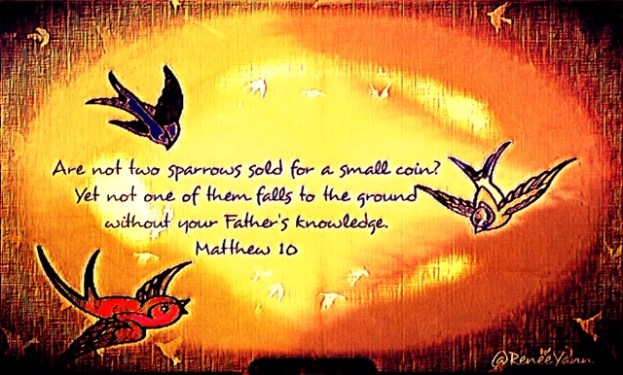
Mt10_sparrow

In our Gospel, Jesus tells us how to deal with our deepest worries and fears. He assures us that no one or nothing can break the insoluble bond of love God has for us. He promises that we will endure eternally within this love. He reminds us that, ultimately, this is the only thing that matters.

The image of the free and unfettered sparrow shows us how God wants us to live and enjoy our creaturehood. The image of a loving God, brushing our hair and counting every one of them, may inspire us to deeper trust as we pray today.

You may be familiar with the trusting phrase attributed to Julian of Norwich:

“All shall be well,
and all manner of thing shall be well.”


Actually, it was Jesus who spoke the word to her in a vision:

“But Jesus, who in this vision informed me of all that is needed by me, answered with these words and said: ‘It is true that sin is cause of all this pain, but all shall be well, and all shall be well, and all manner of thing shall be well.’

“These words were said most tenderly, showing no manner of blame to me nor to any who shall be saved.”


Indeed, we will meet the results of sin and darkness in the world and in ourselves. Julian grew to understand that, in God’s love, we are saved from that darkness:


And from the time that [the vision] was shown, I desired often to know what our Lord’s meaning was. And fifteen years and more afterward I was answered in my spiritual understanding, thus: ‘Would you know your Lord’s meaning in this thing? Know it well, love was his meaning. Who showed it to you? Love. What did he show you? Love. Why did he show it? For love. Keep yourself therein and you shall know and understand more in the same. But you shall never know nor understand any other thing, forever.’  

    Thus I was taught that love was our Lord’s meaning. And I saw quite clearly in this and in all, that before God made us, he loved us, which love was never slaked nor ever shall be. And in this love he has done all his work, and in this love he has made all things profitable to us. And in this love our life is everlasting. In our creation we had a beginning. But the love wherein he made us was in him with no beginning. And all this shall be seen in God without end … 


Music: All Shall Be Well – Kathleen Deignan (Lyrics below)

All shall be well and all manner of thing shall be well.

Receive the gift of healing
from the well of tears;
be washed anew
by grief and sorrowing.

Receive the gift of healing
from our mother Earth,
her deep and dark
and secret verdancy.

Receive the gift of healing
from the shaman’s touch:
the wounded healer’s power
to revive.

Receive the gift of healing
in the arms of love,
embraced in passion
and compassioning.

Broken Dreams

Memorial of Saint Benedict, Abbot

Thursday, July 11, 2019

Click here for readings

Today, in Mercy, Joseph reveals himself to his brothers. The story is rich in emotional layers, leading us to reflect on the unfolding chapters of our own lives.

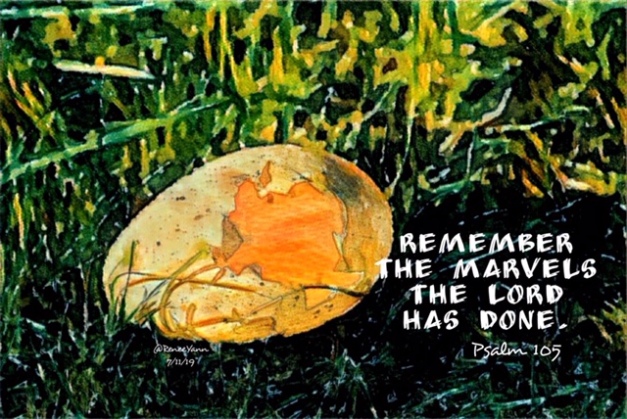
Ps105

Have you ever looked back to a personal circumstance which, when it occurred, seemed shattering, even unbearable? That same circumstance, when viewed through the long lens of time, may have -amazingly- turned out to be a blessing.

The event may have been a job we didn’t land, a loss we almost couldn’t bear, a failure we tried to avoid. Nevertheless, by the grace of God, we endured and even thrived. We learned new things about God’s power in our hearts, about the resilience of hope, and the effable dynamism of trust.

We learned how to forgive ourselves and others, how to be nourished by community, how to start over – perhaps with better intentions and greater wisdom.

Such was the atmosphere for Joseph and his brothers in today’s reading. Praying with this reading, let us give thanks for God’s Presence, even through the dreams that once seemed broken.

Music: Even If by MercyMe

Oh, Brother!

Wednesday of the Fourteenth Week in Ordinary Time

July 10, 2019

Click here for readings

Today, in Mercy, our journey through Genesis leads us into the thick of the Joseph narrative. This is a long and intricate story, covering thirteen chapters in Genesis. The drama is rich in theological and psychological themes. Even outside the Bible, its scenes would stand the test of literary craftsmanship. Today’s reading offers us just one example.

Ford_Madox_Brown_-_The_Coat_of_Many_Colours_-_Google_Art_Project
Joseph’s Bloodstained Coat by Ford Maddox Brown

We enter the story a little later in the action. Joseph, the favored son of Jacob and thus hated by his jealous brothers, has been sold by them to a band of Midianite merchants. Ending up as a slave In Egypt, Joseph, by means of a series of dreams, saves the Egyptians from a terrible famine. He is greatly honored for this, becoming almost the equal of the grateful Pharaoh.

During the widespread famine, Joseph’s treacherous brothers come to Egypt seeking grain. He recognizes them although they are unaware of who he is. After leading them through a series of trials, Joseph ultimately forgives and reconciles with them. He brings his whole family to live in Egypt, protected by the aura of his unexpected prosperity.

One of the many suggestions for our prayer today might center on the inevitable dramas within families and communities fueled by favoritism, jealousy, even treachery. But reading Joseph’s story, we must consider these inevitabilities in the long-term light of God’s abiding grace, the power of forgiveness, and God’s will to give us new life even as we stand in our concupiscent ashes.

At times in our own life story, we may act as, or be impacted by, behaviors like those of doting Jacob, the envious brothers, or entitled Joseph. We might find ourselves entangled in a drama to rival this dysfunctional family of Jacob! Our prayer leads us to ask, “How were they ultimately delivered to freedom, restored to love?” 

The controlling, underlying theme of the Joseph narrative is that our hidden God remains with us in all of life’s roller coaster episodes. This God longs to grace us with the redemptive powers of repentance, forgiveness, hope, renewal and generosity. These graces can heal our bruised human story, letting it announce the saving power of God if we but open our hopes, choices, and dreams to it.

Music: Any Dream Will Do – from Joseph and the Amazing, Technicolor Dreamcoat, Andrew Lloyd Weber

Wounded by Mercy

Tuesday of the Fourteenth Week in Ordinary Time

July 9, 2019

Click here for readings

Today, in Mercy, we continue to learn from the amazing saga of Jacob.

This passage tells a story we may have heard: 

Jacob, after years in isolation, is returning to seek reconciliation with his aggrieved brother Esau. Jacob is stressed, penitent, and maybe a good bit nervous about the first encounter.

He tries to get a decent night’s sleep before the highly anticipated meeting. But that was not to be.

Jacob and AngelJPG
Jacob Wrestling with the Angel by Eugène Delacroix

Jacob wrestles through night with an unnamed stranger. The stranger – perhaps an angel, perhaps God – wounds him, renames him, and ultimately blesses him.

The passage is so worth a reflective read! In that reflection, we may see glimpses of our own relationship with God. God comes to us too, unexpectedly, in both our lights and our darknesses. God wrestles us to look him in the face, in the heart – to turn our attention from all the luring distractions and shallowness that keep us from him.

At best we, like Jacob, might come to a sort of truce with God: we do not fully know God’s Name but we, nevertheless, receive God’s blessing. That blessing changes us, renames us. And, in a visible way, it marks us – just as Jacob was marked by a “limp”. We become vulnerable to the things of God, to God’s hope for the world, to the Mercy of God for all Creation. We become marked by a Love which, though it seems to weaken, is our ultimate and indefatigable strength.

Today’s final thought: Will we let ourselves be changed by the grace offered us in life’s struggles? Will we let ourselves be renamed and marked as God’s own?

Frederick Buechner, in his sermon The Magnificent Defeat talks about such surrender:

Power, success, happiness, as the world knows them, are his who will fight for them hard enough; but peace, love, joy, are only from God. And God is the enemy whom Jacob fought there by the river, of course, and whom in one way or another we all of us fight-God, the beloved enemy. Our enemy because, before giving us everything, he demands of us everything; before giving us life, he demands our lives – our selves, our wills, our treasure.

Will we give them, you and I? I do not know. Only remember the last glimpse that we have of Jacob, limping home against the great conflagration of the dawn. Remember Jesus of Nazareth, staggering on broken feet out of the tomb toward the Resurrection, bearing on his body the proud insignia of the defeat which is victory, the magnificent defeat of the human soul at the hands of God.

Music: Jacob Wrestles with the Angel – Leo Kraft

Believe

Feast of Saint Thomas, Apostle

Wednesday, July 3, 2019

 Click here for readings

Today, in Mercy, our readings lead us to pray for faith.

John20_27 Thomas

Faith is not a commodity or an achievement.
Faith is a relationship and a journey.

It is a gift and an exercise of grace.
Never stretched, it withers like an broken ligament.

It ebbs and tides with our personal and communal dramas.
It deepens with prayer, silent reaching, and a listening obedience to our lives.
It shallows with our demands, like Thomas, only to see and to touch.

It is fed by the Lavish Mercy of God Who never cuts its flow to our souls
if we but take down the seawall around our heart.

On this day when we celebrate the power of tested and proven faith,
may we bring our needs into the circle gathered in that Upper Room.

Standing beside Thomas today in our prayer,
may we place our trust in the glorified wounds of Christ.

A video today for your prayer: Blessed Are They That Have Not Seen