Today, in Mercy, our reading from 1 Samuel tells the intriguing tale of David’s magnanimity toward Saul. Saul is enraged and jealous of David whom Samuel has anointed as king to replace Saul. David is continually in Saul’s crosshairs.
But one night, David stealthily enters Saul’s camp. Even though he has a chance to kill Saul, David spares his life out of respect for his kingship.
While it’s not exactly “love for his enemies”, David does demonstrate a largeness of spirit that foretells today’s Gospel. This gracious spirit demonstrates that David is in right relationship (covenant) with God.
Our Gospel is part of Jesus’s Great Sermon in which he restates and renews the covenant of right relationship. If our spirits are true to God, we will love as God loves. We are to be merciful as God is merciful.
This Law of Love is the essence of life in Christ. It is a profoundly challenging call.
How hard it must have been for David as he stood, spear in hand, over his sleeping enemy – over the one trying to kill him!
How hard it is for us not to be vengeful, retaliatory, and parsimonious when we feel threatened or exploited.
But we are called, in Christ, to the New Covenant of love. By that call, we are endowed with a right spirit.
Today, Jesus asks us to love, forgive, and judge all others as we ourselves would want to be treated. He asks us to live with a divinely magnanimous heart.
Let us pray for the strength to respond.
Music: O Mercy – Stu Garrard, Matt Maher and Audrey Assad
Today, in Mercy, Adam and Eve get to “pay the piper”. Now, they have to answer to God for the delicious, forbidden bite!
And God is tough on them! No hint of that “lavish mercy”! Of course, the writer(s) of Genesis had to fold a lot of explanations into this story such as:
why we feel body shame
why we are estranged from nature
why women suffer labor
why men work hard to no avail
why we die
We know that these explanations were written originally to meet the questions of an ancient culture. They were told and retold in the form of a story with all that structure’s inherent possibilities and handicaps.
Some of us are inclined to accept “story” only as history, demanding that the events recount specific concrete people and interactions. In other words, we demand that Adam and Eve were real people with a historical identity.
Some of us accept the “story” only as myth, not necessarily integral to the foundation of our modern faith.
The great biblical scholar Walter Bruggemann says neither stance is accurate. He says that these sacred stories are “mystery” which continue to unfold through the ages in the faith-life and sharing of the living community.
As we pray with these passages, we may deepen our faith by looking for the revelations within them:
God created us in God’s own image
God formed a covenant of love with us
We are called to be responsive to that loving covenant
We sometimes fail and reap the fruits of that failure
But God did not dissolve Creation nor the Covenant
And so, in every age, we place our hope in Jesus Christ, the New Creation and New Covenant
Today, in Mercy, our readings are about being opened by the grace and power of God.
In the Genesis passage, Eve and Adam eat fruit from the tree of knowledge. Their eyes are opened to good and evil.
In our reading from Mark, Jesus opens the ears of a deaf man, allowing him both to hear and to speak clearly.
In the first passage, Adam and Eve’s new “openness” brings a burden. Their innocence now fractured, they must forever exercise their free will to choose good over evil.
In the second passage, the deaf man’s burdens are lifted. He now has no obstacle to hearing and proclaiming God’s mercy.
Like Adam and Eve, we bear the burden of knowledge in a disturbing and sinful world. Every choice challenges us to be and do good in a culture of human degradation.
But like the man who was cured, we have been transformed by Christ’s touch. We see, not just with the discernment of good and evil, but with God’s eyes – with the power to see past death to life.
This power is expressed in our lives by:
our faith in a world filled with uncertainty
our hope in a world trapped in despair
our love in a world blinded by selfishness and greed
Every morning, God wakes us and says, “Ephphatha – be a sign of my gracious openness in your world because I am that Openness for you.”
Today, in our prayer, let us find what is closed in us. We may have judged and shut out someone. We may have given up on a good and necessary practice. We may have withdrawn from a generous responsibility. We may have capitulated to a life-sapping addiction. Inside us somewhere, we may have curled up into“No”!
God calls us to be a “Yes” to the abundance of life and grace God offers us. We are called to open, to be “uncurled”. This poem by e.e.cummings has helped me on occasion with such uncurling.
love is a place
& through this place of
love move
(with brightness of peace)
all places
yes is a world
& in this world of
yes live
(skillfully curled)
all worlds
I bet I know the first word that popped into your mind when you read today’s headline:PROSECUTION!
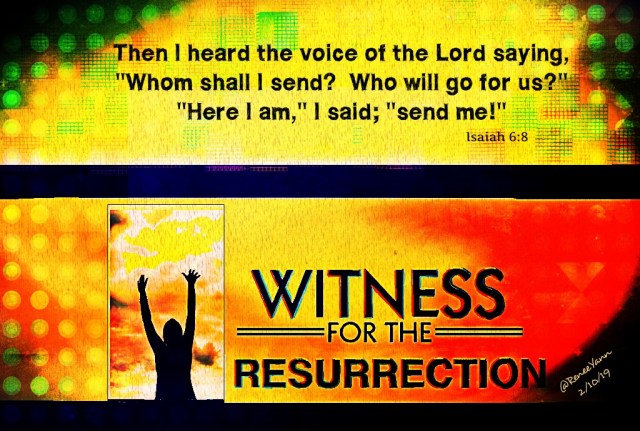
Today, in Mercy, our readings invite us to consider WITNESS — not for the prosecution, but for the RESURRECTION!
In our first reading, we see Isaiah dramatically commissioned to WITNESS to the vision of faith in his heart. He responds wholeheartedly:
Then I heard the voice of the Lord saying, “Whom shall I send? Who will go for us?” “Here I am,” I said; “send me!”
Our second reading, Paul describes how Christ appeared to him and commissioned him, “the least of the Apostles” to be his WITNESS. Paul, too, responds wholeheartedly:
He appeared to me. Therefore, … so we preach and so you believed.
In our Gospel, Simon Peter, James and John are awed by the miraculous power of Jesus as their nets pull hundreds of fish from the otherwise unproductive sea. Jesus tells them that, by their WITNESS, they will attract hundreds of souls to his message. They also respond wholeheartedly:
When they brought their boats to the shore, they left everything and followed him.
For the Word of God to live,
WITNESS is everything.
Macrina Wiederkehr, OSB, in her beautiful book, “Seven Sacred Pauses”, describes the level of WITNESS in the first disciples:
They were impelled to continue proclaiming the Gospel in the face of opposition. They were zealous in preaching because they felt passionate about being entrusted with the sacred message.
Think of this often-heard philosophical conundrum:
If a tree falls in the forest, and no one is there to hear it, does it make a sound?
Logic tells us that it does. But what does it matter if no one hears it?
If the Resurrection happened, and no one bears witness to it, what does it matter? That is the importance of our call to WITNESS – just like Isaiah, Paul, Peter, James, John, and two millennia of believers who carry on the sound of that tomb bursting open to eternal life.
How will we witness to our faith today – not by preachy words or empty opinions, but by our active passion for justice and mercy in the world, and in our own choices?
Today, in Mercy,our readings refer to Christ’s infinite compassion by using the image of a shepherd.
It is an image that, while not completely lost on us, is removed from our daily experience. Within the image, though, are elements which transcend time and culture. These elements become clear as we pray with our Responsorial Psalm 23:
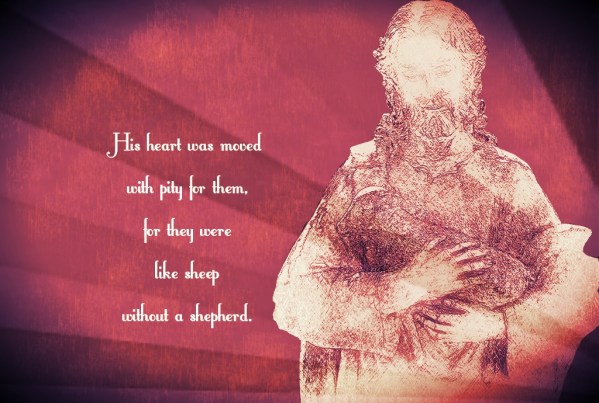
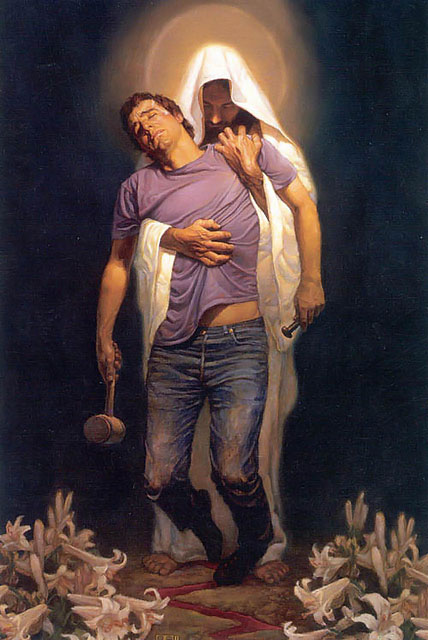
Just as Jesus looked at the crowd with pity – (pietàs – a devoted, compassionate love), so he looks on us. It is love like that conveyed in Michaelangelo’s Pietà, where Mary looks on Jesus with a love we cannot imagine.
Psalm 23
(Jesus sees that we need rest from the things that harass our spirits.)
The LORD is my shepherd; I shall not want.
In verdant pastures he gives me repose.
Beside restful waters he leads me;
he refreshes my soul.
R. The Lord is my shepherd; there is nothing I shall want.
(Jesus sees that we need guidance in our complex and morally bereft world.)
He guides me in right paths
for his name’s sake.
Even though I walk in the dark valley
I fear no evil; for you are at my side
With your rod and your staff
that give me courage.
R. The Lord is my shepherd; there is nothing I shall want.
(Jesus sees that we are hungry for deeply spiritual nourishment.)
You spread the table before me
in the sight of my foes;
You anoint my head with oil;
my cup overflows.
R. The Lord is my shepherd; there is nothing I shall want.
(Jesus sees that we need to be assured that we are deeply loved and protected.)
Only goodness and kindness follow me
all wthe days of my life;
And I shall dwell in the house of the LORD
for years to come.
R. The Lord is my shepherd; there is nothing I shall want
What assurance, what pietàs, do we most need from God today?
Perhaps these modern images of Pietà will help us with our prayer.
Modern Pietà – Michael BelkChrist Holds the Beloved – Thomas Blackshear
Music: Piè Jesu – Andrew Lloyd Webber
sung here by Lea Salonga & Daniel Rodriguez (note English translation in lower right)
Today, in Mercy, I would like to share a homily about today’s Gospel that I prepared for the Catholic Health Association in 2015. Even though it is a little long, I hope you find it fruitful for your prayer.
It is a soft, summer morning in Capernaum and Jesus is in the height of his ministry. Large crowds follow him wherever he goes, crowds hungry with hope; crowds fired by his counter-cultural words and miraculous deeds. This morning, Jesus prepares to speak to them, to translate into language they can comprehend the Eternal Life that lives in his heart. His back is to the gentle, sunlit sea. The hubbub softens to a murmur, finally stilled by the lapping waves.
But before Jesus can begin, a distressed man bursts through the gathered crowd. His robes fly about him as he runs to Jesus and falls at his feet. This man is important, so important that we all have known his name for two thousand years. This is Jairus who lives nearby and organizes the worship in the synagogue. Now breathless and swallowing sobs, Jairus pleads with Jesus: Please! My daughter! You can give her life!
Every loving father has been Jairus at least once in his life. We know these fathers. We are these fathers. They are the ones who burst into emergency rooms with a seizing infant in their arms. They are the ones who stare blankly at the pronouncement of a stillborn child. They are the old men in war-ravaged countries who kneel at the sides of their fallen sons and desecrated daughters. They are all the men throughout history rendered helpless by the forces of unbridled power, greed and death.
The merciful heart of Jesus understands this man and his desperate urgency. Without even a word, Jesus gets up and accompanies Jairus to the place of his pleading.
But there is another urgency pushing forward from the crowds: a woman, apparently of low importance for we have never known her name. She is a woman whom the ages have defined by her affliction. She is “The Woman with the Hemorrhage”. Without the status of Jairus, she approaches Jesus as such a woman must. She crawls behind him at his heels, reaching through the milling masses to even scrape the hem of his garment.
This is a troubled woman, a stigmatized woman. Her life has been spent, literally, in embarrassment, isolation, fatigue and, no doubt, abuse. For twelve years – coincidentally the life span of Jairus’ s daughter – her vitality has bled out of her. Her face is gaunt; her eyes sunken. Her soul’s light is all but extinguished. She is a woman who knows a particular kind of scorn.
We know these women. We are these women. They are the ones filled with remorse for an aborted baby. They are the ones who miscarry their longed-for child. They are the women whose beautiful young sons are profiled, stereotyped and hunted on the violent streets. They are the mothers of “The Disappeared”. They are the women who suffer disproportionately from war, poverty, hunger and violence. They are trafficked women, prostituted women, women victimized by the long saga of domination and dehumanization.
It is just such a broken woman who stretches her fingers through the Galilean dust in a last reckless reach for healing. She finds only the hem of his robe. Touching it, she is transformed, like a parched meadow in the spring rain. Her whole being reaches up to receive the holy restoration. She knows herself to be healed. And it is enough; it is everything. She retreats into the resignation of her otherwise lonely life.
But Jesus wants more for us than just the practical miracles we beg for. We ask for one healing; Jesus wants our eternal salvation. We ask for one blessing; Jesus wants our entire lives to be filled with grace. We ask for one prayer to be answered; Jesus wants our life to become a prayer.
Jesus feels the electrical touch of her hope. He feels the secret healing she has extracted from him. He turns to seek her. Can you see their eyes meet? Yes, the bleeding has been stemmed, but he sees the deeper wounds that scar her soul. His look of immense mercy invites her to tell him “the whole truth”. By her touch, she has commandeered a physical healing. But by his gracious turning toward her, her entire being is renewed. In this sacred glance, her history has been healed. Her future has been pulled from darkness into light. Her capacity to love has been rekindled. She now and forever will remember herself as a child of God.
Jairus waits, no doubt impatiently, at the edge of this miracle, anxious for such power to touch his daughter’s life. He fears they have lingered too long with the woman. His servants arrive, confirming his fears. He receives the dreaded report, “Your daughter has died.”
Jesus now pushes Jairus to the gauntlet of pure faith. In the face of this devastating news, Jesus tells him, “Do not be afraid; just have faith.” Is this not an almost impossible command? Like Jairus, we all know what it is to worry for our children:
Fathers of color teach their sons behaviors to protect them from profiling.
Immigrant parents fear their children will be ripped from them in a pre-dawn raid.
Famine-ravaged mothers watch their children disappear into hunger.
In hospitals and doctor’s offices, devastated parents summon the courage to accompany their critically ill child.
And Jesus says, “ Don’t be afraid. Have faith.”! What can he possibly mean?
Perhaps it is this simple. In Jairus’s home, Jesus takes the dead girl’s hand. He says, “Talitha, koumi – Little girl, arise.” His call to her heart tells her there is no darkness, devastation or death from which God cannot draw us into life. This is the truth Jesus brings to the little girl and to us. But it is a truth that, in our fear and need, we cannot always see.
For the moment, this girl lives. But at some time in history she, like all of us, will die. So the miracle is not the restoration of her life. The miracle is that her eyes, and her parents’ eyes, are opened to the power of God over death. Despite all appearances, God’s life endures eternally.
This is the revelation of this Gospel passage. If we live by faith, we live beyond cure into healing. If we live by faith, even death can bring life. If we live by faith, we are free to release all worry into the abundant mercy of God who grants us healing even beyond our asking or desire.
Man or woman, old or young, at some time in our lives each one of us has been Jairus. Each one of us has been one or the other of these two women. Within their stories of woundedness and deep faith, our stories shelter. Jairus and the afflicted women – unnamed like so many women throughout time – believed there was a way to new life. They reached for it. They begged for it. What is it in us that cries out for such healing? What is it in us that, without the touch of Jesus, teeters on the verge of death?
Simply by believing, these three Gospel figures became new beings. Simply by believing, their orientation changed from darkness to light. By their example, let us lift up those wounded and deadened places in our hearts and world before the loving gaze of Jesus.
To what suffering in our souls is God whispering the encouragement, “Talitha, koum”? What is the “whole truth” Jesus is inviting us to confide? Let us arise and respond to him in the full energy of our faith. Let us gaze with boundless confidence into the eyes of God’s mercy.
Today, in Mercy,Acts paints a detailed picture of Saul’s conversion and call on the road to Damascus. It’s a colorful and dramatic account befitting the biography of thegreat “Apostle to the Gentiles”.
Think about this. Almost all the very first Christians (and Christ himself) were Jews. Early Christian ritual grew out of Jewish ritual. In the immediate post-Resurrection period, there were few, of any, Gentile Christians.
This is one of the reasons Paul is such a big deal. As a Roman citizen and a devout Jew, he lived with a foot in two worlds, as opposed to the Jewish fishermen who composed the original Twelve. They were local guys with minimal exposure to the non-Jewish world.
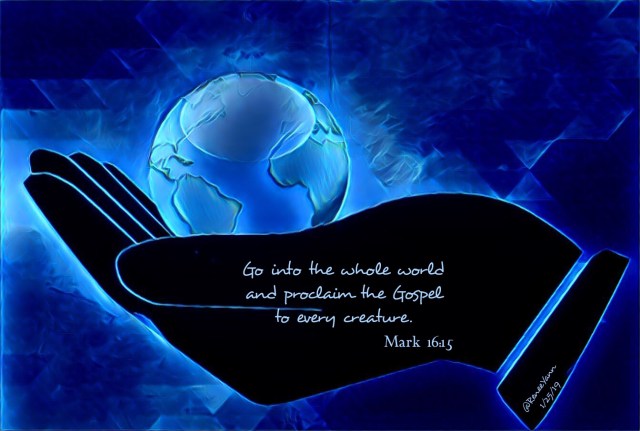
When the original Twelve (eventually Eleven) heard Jesus’s Apostolic Commission, “Go out to all the world and tell the Good News…”, they may have felt that world was confined to Israel’s borders! Paul, the post-Resurrection Apostle, demonstrated otherwise.
Paul traveled over 10,000 miles proclaiming the gospel of Jesus Christ. His journeys on land and sea took him primarily through present day Israel, Syria, Turkey, and Greece. (from Loyola Press. See website for great summary of Paul’s journeys.
How encompassing is our vision of “the whole world”, that world which hungers for the message, mercy and love of Christ?
Our Gospel today impels us with the same apostolic call as these early disciples. God’s love and fullness of life belong to all. What can I do to make that a greater reality?
Music:Facing a Task Unfinished-~ Lyrics:Frank Houghton. Performed by the Gettys
Today, in Mercy, Mark’s Gospel portrays Jesus in his “heyday”.
It is early in his ministry. Word is spreading about his teaching and his miracles. He is the “hot ticket” in any town he visits. But what was Jesus thinking in the midst of all the hubbub?
We get a few good hints in our Gospel.
Jesus withdrew toward the sea
He wanted a boat ready lest the crowd would crush him
He warned the unclean spirits not to make him known
These phrases suggest that Jesus was a bit overwhelmed by the furor. No doubt he realizes that his identity and message go far beyond the show of miracles. Can the “fandom” of these early crowds be converted to deep and committed discipleship?
This reading might incline me to consider my own faith.
Do I love and follow just the “heyday Jesus” – the One who is powerful over the demons and deaths I fear?
Or have I learned to love and follow the deeper Jesus, the One who suffers and dies for justice, goodness and love – the One Who lives in the poor?
One way to answer these questions is to ask ourselves where we find Jesus in our daily lives.
Is he confined to our Bible, our church, our prayerbooks and our moral judgments?
Or is our faith deep enough to see and love him in the suffering face of humanity – perhaps where it is inconvenient, costly and sometimes unsettling to find him?
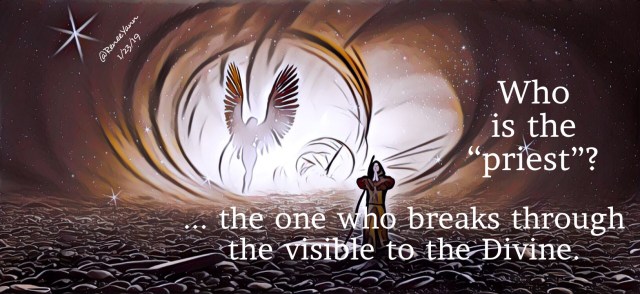
Today, in Mercy,the writer of Hebrews continues to shine light on the superior“priesthood” of Jesus Christ – that aspect of Christ’s ministry that breaks heaven open for us and reinstates us as God’s children.
Hebrews calls Christ a priest “according to the order of Melchizedek” – an order above and beyond the priesthood of Aaron and Levi.
Although there are a few references to Melchizedek in scripture, only one narrative refers to him:
After Abram returned from defeating Kedorlaomer and the kings allied with him, the king of Sodom came out to meet him in the Valley of Shaveh (that is, the King’s Valley). Then Melchizedek king of Salem brought out bread and wine. He was priest of God Most High, and he blessed Abram, saying, “Blessed be Abram by God Most High, Creator of heaven and earth. And praise be to God Most High, who delivered your enemies into your hand.” Then Abram gave him a tenth of everything. Genesis 14:17-20
Melchizedek, whose priesthood preceded even Abraham, is offered in Hebrews as a prototype of Jesus who fulfills and perfects the Old Testament promises.
Does this matter to us modern day Christians who can barely say “Melchizedek “, let alone spell it? And if it does matter, how?
An answer may be revealed in our Gospel today.
In it, Jesus challenges the old, Pharisaical, law-bound way of thinking. As the new and perfect “priest”, Jesus breaks that way of thinking with the transformation of love.
This man with the withered hand is more important than the law.
This act of healing and wholeness is more important than ritual adherence.
The priesthood of Jesus is the breakthrough revelation of what God really desires – mercy, not sacrifice.
Today, in Mercy, our first reading quotes at length from Psalm 95, and the message is reprised in the Responsorial Psalm.
Harden not your hearts.
We all know what it feels like to harden our hearts. We do it out of anger, fear, exhaustion, frustration and so many other reasons. We feel like the only way to protect ourselves and our space is –yes– to build a wall! Put up those bricks made out of our stony faces, curt words, numbing silence, distancing indifference – our hardened hearts.
Today’s reading tells us that is never God’s way.
The way to freedom, peace, self-respect, joy and fullness of life is always found in relationship – in building bridges.
Jesus builds a bridge in today’s Gospel by connecting with the leper. This leper has been walled off from society by illness and disfigurement. Most people’s hearts are hardened against him, but Jesus is “moved by pity” at the leper’s isolation.
The leper, too, has built a bridge by reaching through his own hardened heart in faith and trust. Surely all the years of mistreatment had made him wary of trust, had immobilized him in self-protection. But he allows himself a courageous plea to Jesus, and he is heard.
It is no easy challenge to soften a hardened heart. Some of our walls are very high, some of our bricks very heavy. But, one by one, we can choose opportunities for forgiveness, kindness, understanding, patience, encouragement, listening and companionship – even, and especially, toward those estranged in any way from us or from themselves. And even toward ourselves when we have become hardened to our own beauty and goodness.
To begin might take only a smile, a prayer, a phone call, a small kindness, an invitation, a moment of ordinary conversation…. just these might start to crumble a wall, to soften a heart.
Music: Soften My Heart, Lord (and adding a second song, just because I think you’ll like it.)








 Lavish Mercy