Psalm 27: Waiting with Faith

Memorial of Saint Charles Borromeo, bishop

November 4, 2020


Today, in God’s Lavish Mercy, we pray with Psalm 27, a brilliant testimony of faith and trust.

As you know, I write each day’s reflection on the preceding morning. As I write today, most polls have not opened. The political fate of the US remains hidden in a future yet unfolded. And yet you will be praying with this reflection on a morning when at least some of that fate will be known.

What to say then that will hold meaning no matter how the chips fall? The question was causing me some consternation until I opened to our psalm. 


God has an infinitely bigger view of reality than any one of us! And our psalm invites us to live in that “blessed assurance” despite the shifting exigencies of our lives.

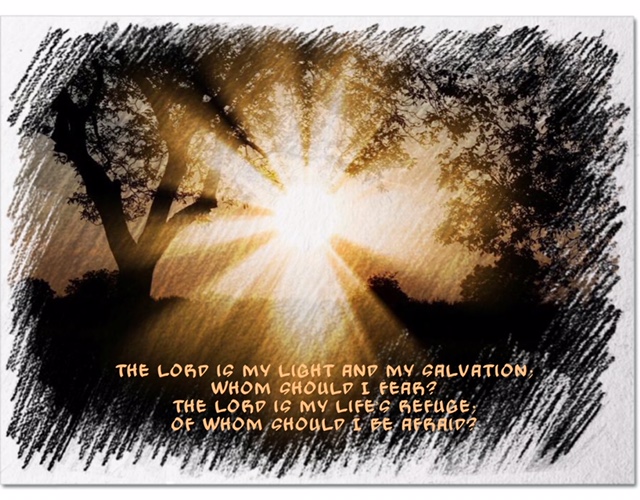
The LORD is my light and my salvation;
whom should I fear?
The LORD is my life’s refuge;
of whom should I be afraid?


Will the election outcome matter to me tomorrow when I wake up to pray? You’re darn right it will! But there is a foundational truth that matters far beyond the day’s circumstances:

One thing I ask of the LORD;
this I seek:
To dwell in the house of the LORD
all the days of my life,
That I may gaze on the loveliness of the LORD
and contemplate God’s eternal Presence.


Indeed, it is toward that hope that all our life’s energy must be directed. No matter who emerges victorious from the election, we must continue to work for a world where every person enjoys the bounty of the Lord.

Today I hope and pray for leaders who work with us, not against us, in that pursuit. In any case though, let us pray for courage to continue, with God’s grace, to build a “land of the living” for all God’s people.

I believe that I shall see the bounty of the LORD
in the land of the living.
Wait for the LORD with courage;
be stouthearted, and wait for the LORD.


Poem: Trust by Thomas R. Smith

It’s like so many other things in life   
to which you must say no or yes.                                    
So you take your car to the new mechanic.   
Sometimes the best thing to do is trust.   
The package left with the disreputable-looking   
clerk, the check gulped by the night deposit,   
the envelope passed by dozens of strangers—   
all show up at their intended destinations.   
The theft that could have happened doesn’t.   
Wind finally gets where it was going   
through the snowy trees, and the river, even               
when frozen, arrives at the right place.                        
And sometimes you sense how faithfully your life   
is delivered, even though you can’t read the address.

Music: Blessed Assurance sung by James Ingram

“Blessed Assurance” is a well-known Christian hymn.The lyrics were written in 1873 by writer Fanny Crosby who was blind. The melody was composed by Fanny’s friend Phoebe Knapp.

Blessed assurance, Jesus is mine!
Oh, what a foretaste of glory divine!
Heir of salvation, purchase of God,
Born of His Spirit, washed in His blood

Chorus:
This is my story, this is my song,
Praising my Savior all the day long;
This is my story, this is my song,
Praising my Savior all the day long.

Perfect submission, perfect delight,
Visions of rapture now burst on my sight;
Angels, descending, bring from above
Echoes of mercy, whispers of love.

Perfect submission, all is at rest,
I in my Savior am happy and blest,
Watching and waiting, looking above,
Filled with His goodness, lost in His love.

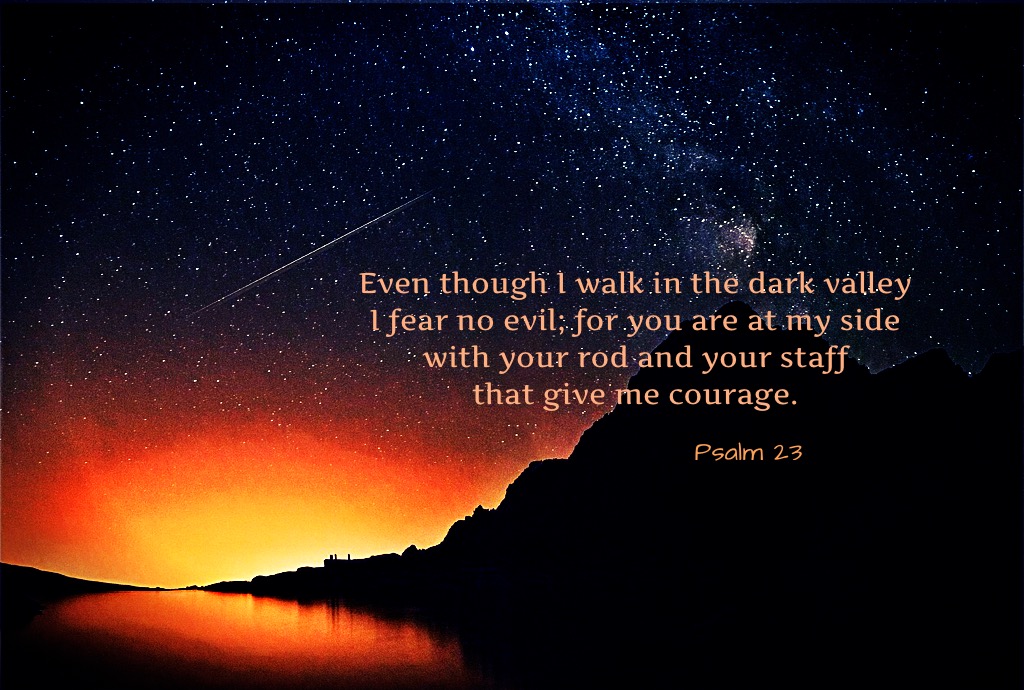
Psalm 23: Light through the Dark

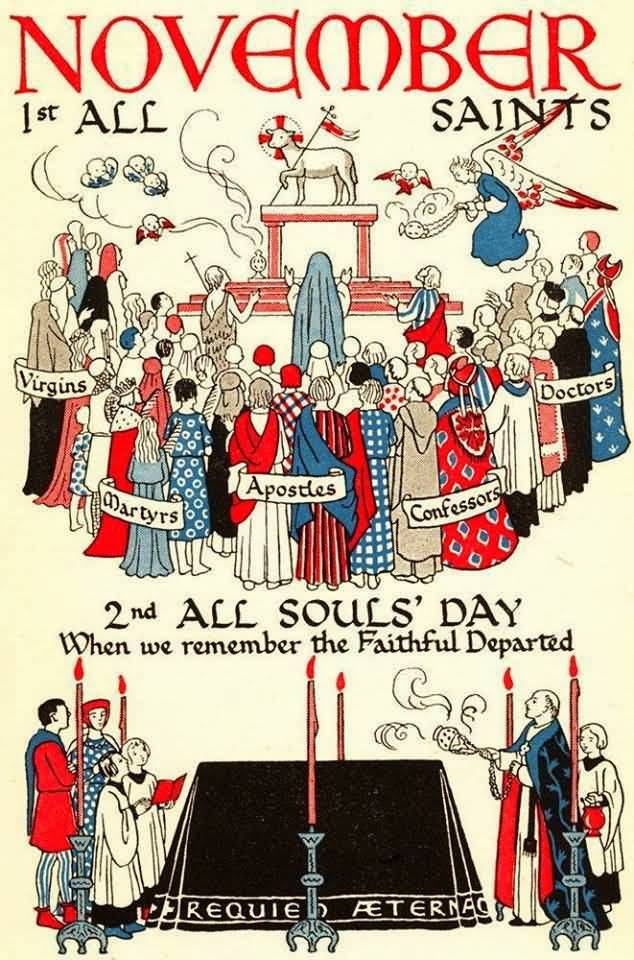
 The Commemoration of All the Faithful Departed(All Souls)

November 2, 2020

Today, in God’s Lavish Mercy, we commemorate the Holy Souls, a remembrance inextricably tied to yesterday’s celebration of All Saints. It is as if yesterday we prayed in the moon’s full light. Today, we pray on its shadow side.


We pray with Psalm 23, a psalm we have prayed scores of times at the funeral Masses of beloved family and friends. 

Just last month, we prayed it with a lighter tone, focusing on the sunlit field and restful waters.


Today, on this tender feast, we pray this psalm in its grey tones, with a lingering sense of bereavement and perhaps some uncertainty about afterlife’s mysteries.

In paradisum deducant te Angeli; 
May the angels lead you into paradise;
in tuo adventu suscipiant te martyres, 
may the martyrs receive you at your arrival
et perducant te in civitatem sanctam Jerusalem. 
and lead you to the holy city Jerusalem.
Chorus angelorum te suscipiat, 
May choirs of angels receive you 
et cum Lazaro quondam paupere 
and with Lazarus, once poor,
æternam habeas requiem.
may you have eternal rest.


The popular theology – or more clearly “devotionalism”- surrounding All Souls Day has always challenged me. There is a discomfort with the concept of purgatory, and a time of temporal punishment for faithful but imperfect souls. I have always felt that there is enough suffering in this life to redeem us from the sinfulness we struggle with.

Our modern ideas of purgatory and hell still limp under concepts left over from the Middle Ages – fire, brimstone, and devils with pitch forks. My memory still shivers with images from my grade school choir when, at every funeral Mass, we sang the heavy tones of the Dies Irae with a priest clothed in black vestments.


Post-Vatican II theology has infused hope into that devotional gloom. It has refocused us on the truth informing our understanding of death so beautifully described in our reading from Wisdom:

The souls of the just are in the hand of God,
and no torment shall touch them.
They seemed, in the view of the foolish, to be dead;
and their passing away was thought an affliction
and their going forth from us, utter destruction.
But they are in peace.

Wisdom 3:1-3

So what might be a reflective understanding of the core theology underlying this important day? The truth is that any theology is imperfect, and we do our best to imagine what is beyond our imagination.

But here are some ideas or beliefs that help my prayer:

  • our souls endure beyond physical death since they are the Breath of God
  • Christ has already paid the price of our sins and redeemed us on the Cross
  • still, we never lose our free will either in life or in death
  • we are free to choose for God or against God
  • some choose total alienation (popularly conceptualized as “hell”)
  • some choose union, but their choices are fragmented and weak at times, casting shadows over our wholeness or holiness 
  • those weak fragmentations may be healed in us even after death (purgatory) until the fullness of God’s Grace “dawns” on us and within us
  • that healing can be fostered by our prayer for one another throughout the Communion of Saints

All Souls Day is the celebration of that prayer and that healing
for those who have gone before us.
Today, we embrace all those beloved souls in our prayer,
and join the prayer of the whole Church for them.


Poetry: Comfort by Christine Robinson

I am a child of God
  I have everything I need.
This beautiful earth feeds my body.
  You feed my soul.

You guide me in the ways of Life,
  for You are Life.
And though I will walk through dark places, and eventually to death,
  I need never be afraid.

For You are with me always,
  In You I can find comfort.
With Your help, I can face whatever comes.
  
My joy overflows.
Your goodness and blessing will be with me
  Every day of my life -- and forever.

Music: Bach: Cantata No. 112, Der Herr ist mein getreuer Hirt 

Psalm 42: Longing for God

Saturday of the Thirtieth Week in Ordinary Time

October 31, 2020


Today, in God’s Lavish Mercy, we pray with Psalm 42, oh and what a lovely gift it is!

As the deer longs for the running waters,
so my soul longs for you, O God.

Psalm 42:2

Dear friends, hasn’t every one of us known this longing – just to understand, to see, to be at one with the ways of God in our lives, our world….


Paul, in today’s passage to the Philippians, is feeling tremendous pressures of persecution and fatigue. He seems to share that deep longing for certainty and peace:

I long to depart this life and be with Christ, …. 
Yet this I know with confidence,
that I shall remain and continue 
in the service of all of you 
for your progress and joy in the faith…

Philippians 3:23-24

As we pray with Psalm 42 today, we might ask God to come into our deepest longing, to open our hearts to the Divine Presence in those desires, to help us to find the Face of God in our daily experience, to love that Face, and to rest in the peace in its Presence:

Athirst is my soul for God, the living God.
When shall I go and behold the face of God?


Poems: Poems I wrote on two past retreats:

Location
This wood on this morning;
these birds singing;
these plaintive calls
from boats along the Mississippi,
through this crystal Sunday air;
 
This moment among all others,
which You have known eternally,
when I would pause,
and You,
like a deer in stillness,
shedding camouflage,
would step out
to gaze at me.

Love Gaze
Caught in the ferocious wind
of my own inadequacies,
I cling by finest web
to the energy You are,
fixing my soul on yours
in that precarious holding.
 
You are the magnet, gathering
all my emptiness beyond itself.
As if my fears were only stones
to tread upon, You come into the marshes
of my life as stillness, paused
and vibrating like a deer
among the reeds in half-light.
 
I cannot word what it is
to swim in the deep pool of your Eyes.
All the universe, and all my understanding
turn aside in reverent silence.

Music: As the Deer – David Nevue

Psalm 111: An Attitude of Gratitude

Friday of the Thirtieth Week in Ordinary Time

October 30, 2020


Today, in God’s Lavish Mercy, we pray with Psalm 111 set in complementarity with a beautiful reading from Philippians.

The heart of both these readings is holy gratitude, that powerful spiritual gift that can completely transform our lives.


Although I have been generously blessed for my whole life, I had to learn this virtue, and I’m still learning. Its lessons are infinite, as is the God from Whom we learn them. God’s generous mercy and our humble gratitude generate the dynamic energy of our spiritual life.

A lifetime may not be long enough
to attune ourselves fully
to the harmony of the universe.
But just to become aware
that we can resonate with it —
that alone can be like
waking up from a dream.

― Brother David Steindl-Rast

Sometimes we take a lot for granted. We don’t notice. We don’t realize. We don’t savor the gift right in front of us, be it clothed in blessing or challenge.


Our readings today teach us some of the steps toward that “waking up” that Brother David describes.

  1. Prayer for those we know and love, and a generous mutuality in a community of believers:

I give thanks to my God at every remembrance of you,
praying always with joy in my every prayer for all of you,
because of your partnership for the Gospel
from the first day until now.

Philippians 1:3-5

2. Pausing to recognize that everything is God’s, and that God is bringing Creation to completion within each of our lives:

Majesty and glory are God’s work,
Whose justice endures forever.
God’s wondrous deeds have won renown;
gracious and merciful is the LORD.

Psalm 111:3-4

Certainly, it is easier to practice gratitude when we experience the fullness of God’s generosity. Eventually though, we can learn to be grateful even in times where God’s largesse may seem hidden, such as loss, change, or uncertainty. 

The continual practice of gratitude can help us find the sacred sweet point in every situation, discerning these questions

  • Where is God in this moment?
  • How is God offering me grace in this reality?

There are many other attitudes and habits that can school us in gratitude. One of the books that has changed my life is Gratefulness, the Heart of Prayer, where I learned about some of these practices. 


May we pray this for one another today:

“As we learn to give thanks for all of life and death, for all of this given world of ours, we find a deep joy. It is the joy of trust, the joy of faith in the faithfulness at the heart of all things. It is the joy of gratefulness in touch with the fullness of life.”

Brother David Steindl-Rast

Music: Give Thanks with a Grateful Heart – Dan Moen

Psalm 128: Awesome!

Tuesday of the Thirtieth Week in Ordinary Time

October 27, 2020


Today, in God’s Lavish Mercy, we pray with Psalm 128, written around the time of return after the Babylonian Captivity.

Israel was in a time of re-establishment, a time of rediscovering the blueprint for a settled and fruitful life. Psalm 128 lays that formula out:

Blessed are you who fear the LORD,
who walk in God’s ways!
For you shall eat the fruit of your handiwork;
blessed shall you be, and favored.

Psalm 128:1-2

As with many scripture passages, (certainly today’s from Ephesians !!!), some of the original language doesn’t ring perfectly with our modern sensibilities. Personally, my spirituality doesn’t include “fear” when I relate to God. 

Rather than interpret such passages rigidly, we need to receive the words for the core of their meaning, which remains the same over the ages. What changes is how each culture and social evolution receives and honors the Word. This is the reason we pray with scripture and study it, rather than simply read it as we would read a cereal box.


Happy is everyone who fears the Lord…
“In this phrase, ‘fear’ is not about being intimidated or ‘shaking in your boots’ before the divine presence. It is rather about reverence or awe before YHWH, and the observation that whom one reveres, one obeys. To fear YHWH is to entrust all of life and hope to this one and follow the divine guidance. The perspective of the psalm is that such a decision about lifestyle makes a difference; living in line with YHWH’s teaching brings a profound joy and completeness to life.”

Walter Brueggemann – New Cambridge biblical Commentary

Psalm 128 invites us today to explore our sense of awe, reverence, and obedience toward God’s Presence in our lives. As we breathe in God’s boundless love for us, may we breathe out our complete trust and gratitude.


Poetry: Entering Saint Patrick’s Cathedral by Malachi Black

I have carried in my coat, black wet 
with rain. I stand. I clear my throat.

My coat drips. The carved door closes
on its slow brass hinge. City noises— 

car horns, bicycle bells, the respiration
truck engines, the whimpering 

steel in midtown taxi brakes—bend
in through the doorjamb with the wind 

then drop away. The door shuts plumb: it seals
the world out like a coffin lid. A chill, 

dampened and dense with the spent breath
of old Hail Marys, lifts from the smoothed

stone of the nave. I am here to pay
my own respects, but I will wait: 

my eyes must grow accustomed
to church light, watery and dim.

I step in. Dark forms hunch forward
in the pews. Whispering, their heads 

are bowed, their mouths pressed
to the hollows of clasped hands. 

High overhead, a gathering of shades
glows in stained glass: the resurrected 

mingle with the dead and martyred
in panes of blue, green, yellow, red. 

Beneath them lies the golden holy 
altar, holding its silence like a bell,

and there, brightly skeletal beside it,
the organ pipes: cold, chrome, quiet 

but alive with a vibration tolling
out from the incarnate 

source of holy sound. I turn, shivering
back into my coat. The vaulted ceiling 

bends above me like an ear. It waits:
I hold my tongue. My body is my prayer.

Music: How Great Thou Art – Mormon Tabernacle Choir

Psalm 1: Play Nice Together

Monday of the Thirtieth Week in Ordinary Time

October 26, 2020

2018 Reflection on the Bent-Over Woman

Click here ^


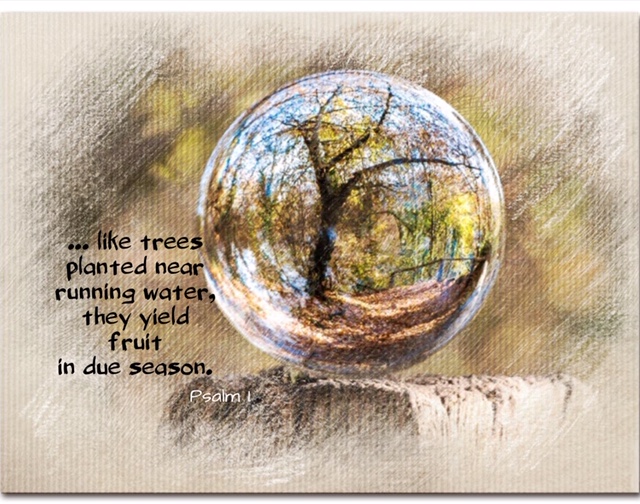
Today, in God’s Lavish Mercy, we pray with Psalm 1 which, together with our first reading from Ephesians, gives us a complete outline for moral behavior.

There are days when I feel like the world’s not doing too bad responding to that outline. But, to be honest, there are more days when I think we’re a pretty big mess. 

It may sound simplistic, I know, but why can’t we all just follow Paul’s advice and be kind?

Brothers and sisters:
Be kind to one another, compassionate,
forgiving one another as God has forgiven you in Christ.

Ephesians 4:32

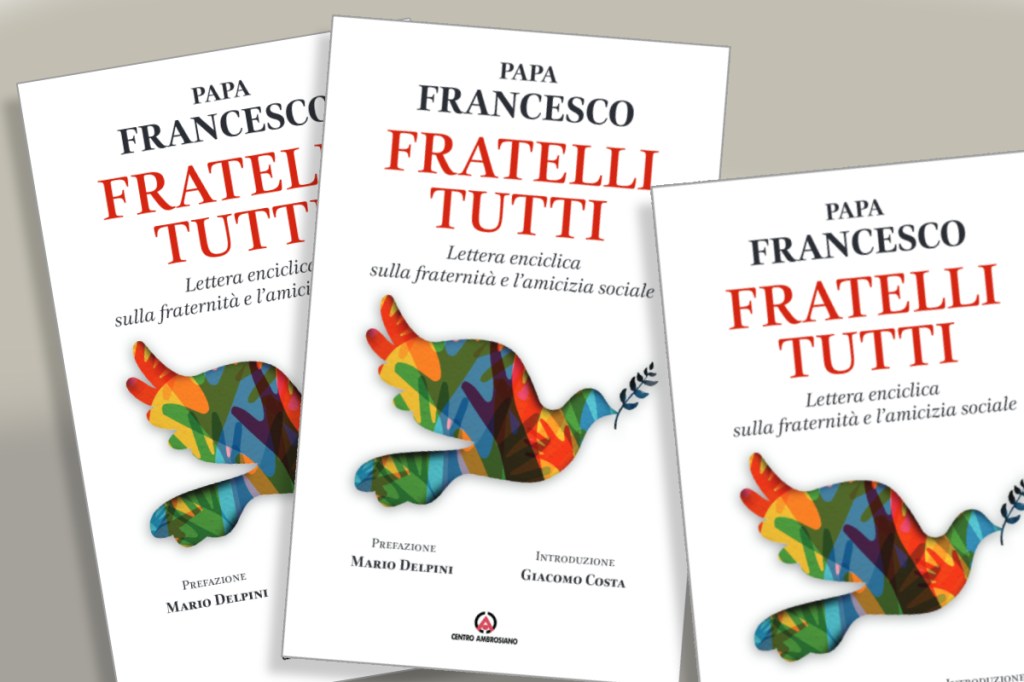
I think Pope Francis feels pretty much the same way as I do. Our reading from Ephesians could easily serve as a summary statement for Fratelli Tutti. Praying with this profound document, we can see the hope and agony of the world open before God’s Mercy, begging for healing.

(You may realize that I frequently refer to Fratelli Tutti. I believe this ground-breaking encyclical to be critically important for the future of our world. If you share my belief, you will be interested in this superb analysis written in Commonweal magazine by Austen Ivereigh.)


Psalm 1 gives us the peaceful picture of a person – and a world – centered on God’s loving law, the “plumb line” for holy balance in our lives. It is that same plumb line which Pope Francis drops for us in Fratelli Tutti.

Blessed the one who follows not
the counsel of the wicked
Nor walks in the way of sinners,
nor sits in the company of the insolent,
But delights in the law of the LORD
and meditates on God’s law day and night.

Not so the wicked, not so;
they are like chaff which the wind drives away.
For the LORD watches over the way of the just,
but the way of the wicked vanishes.

Psalm 1

Poetry: A thought from Confucius:

If there is righteousness in the heart, 
there will be beauty in the character.

If there is beauty in the character, 
there will be harmony in the home.

If there is harmony in the home, 
there will be order in the nations.

When there is order in the nations, 
there will peace in the world.

Music: Blessed Be the Tie – Sara Groves remasters an enduring hymn on Ephesians 4:32. The original was written in 1782 by Baptist theologian John Fawcett

You for a father’s throne
We pour our art in prayer
Our fears and hopes are one
Out comforts and our cares

Blessed be the tie
That binds our hearts
In Christian love
We share each other’s walls
Our common burdens bear
And love for each other
The sympathizing tear

Blessed be the tie
That binds our hearts
In Christian love
Blessed be the tie
That binds our hearts
In Christian love
Oh, kindred heart

It’s like heaven above
It’s like heaven
Oh, kindred heart
It’s like heaven above
It’s like heaven

Blessed be the tie
That binds our hearts
In Christian love, oh
Blessed be the tie
That binds our hearts
In Christian love

Psalm 18: I Love You, Lord

Thirtieth Sunday in Ordinary Time

October 25, 2020


Today, in God’s Lavish Mercy, we pray with Psalm 18

I love you, O LORD, my strength,
O LORD, my rock, my fortress, my deliverer.

Psalm 18: 2-3

The psalm is almost a mirror reflection of 2 Samuel 22, and has been interpreted as a song that David sang throughout his life to praise God’s goodness to him.


Today the psalm connects several readings, which together give us:

  • a command 
  • and a hint about how to fulfill that command. 

Bottom line, our readings tell us this:

  • First, Love God
  • And, second, here’s where to find the God you desire to love.

If we trust the hint, and act on the command,
we will be able to sing – like David –
throughout our lives. 

"You shall love the Lord, your God,
with all your heart,
with all your soul,
and with all your mind.
This is the greatest and the first commandment.
The second is like it:
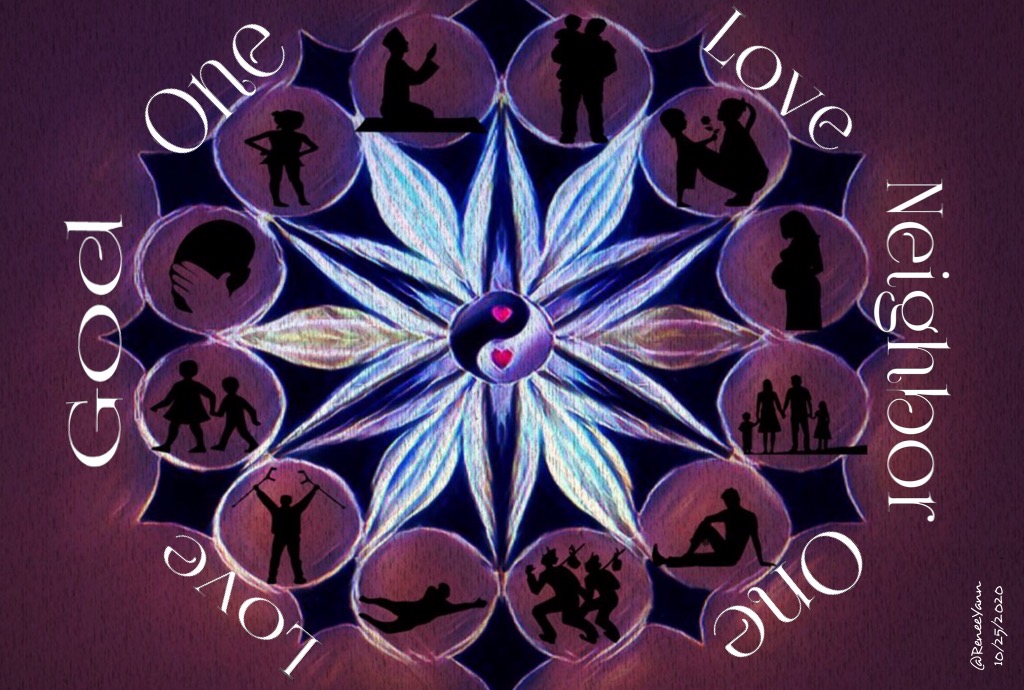
You shall love your neighbor as yourself. 

Here is a beautiful poetic interpretation of Psalm 18:

I open my heart to you, O God
  for you are my strength, my fortress, 
  the rock on whom I build my life.
I have been lost in my fears and my angers
   caught up in falseness, fearful, and furious.
I cried to you in my anguish.
You have brought me to an open space.
   You saved me because you took delight in me.

I try to be good, to be just, to be generous
   to walk in your ways.
I fail, but you are my lamp.
  You make my darkness bright
With your help, I continue to scale the walls
  and break down the barriers that fragment me.
I would be whole, and happy, and wise
  and know your love
Always.
~ Christine Robinson

Music: Overcome – Psalm 18 by James Block

Psalm 122: The Journey

Saturday of the Twenty-ninth Week in Ordinary Time

October 24, 2020


Today, in God’s Lavish Mercy, we pray with Psalm 122, one of my favorites.

I rejoiced when they said to me
“Let us go to the house of the LORD
And now our feet are standing
within your gates, O Jerusalem.


The year 1963 was a dynamic time in the Church. The landmark Second Vatican Council was reaching full steam.

Several changes resulted from the Council, including the renewal of consecrated life with a revised charism, ecumenical efforts towards dialogue with other religions, and the universal call to holiness which, according to Pope Paul VI, was “the most characteristic and ultimate purpose of the teachings of the Council”.

Wikipedia


Simultaneously, a love and engagement with sacred scripture was blossoming throughout the Church.  International scholars were completing their response to Pius XII’s 1943 call, in the encyclical Divino Afflante Spiritu, to translate scriptures from the ancient Hebrew and Greek texts. The incomparable Jerusalem Bible was the fruit of these endeavors. It had already been published in French, and was nearing its 1966 English publication.

One of these gifted Bible scholars was a French Jesuit priest, Joseph Gelineau. Gelineau was himself part of the working group for the French Jerusalem Bible, and he developed a revised version of that psalter which respected the rhythms of the Hebrew original.

In my senior year in high school, 1962-63, we were introduced to the Gelineau Psalms. That introduction came at a perfect time for me, as I discerned a call to religious life. In that discernment, Gelineau Psalm 122 became a central part of my prayer.

Jerusalem, built as a city
with compact unity.
To it the tribes go up,
the tribes of the LORD.


I felt rising in me a passionate desire to find and engage my “Jerusalem”, that journey which would pattern my life on the life of Jesus.

The outlines of the journey, the distant vision of “Jerusalem”, were so surreal and indefinite. And yet they were compelling. I came to believe and trust that I would find my path to holiness, my Jerusalem, as a Sister of Mercy. 

Like Jesus, I was given the grace and courage to “steadfastly set my face toward Jerusalem” ( Luke 9:51) And it has been an indescribably amazing journey ever since!


As Vatican II so beautifully stated in the document Lumen Gentium, chapter 5, we all share in the universal call to holiness. We all have our own path to that one, glorious Jerusalem. 

I know these Documents of Vatican II are over a half century old. But they are priceless classics that I never tire of studying. Here are some passages that might enrich our prayer today as we each consider our own call and response to God.

Therefore in the Church, everyone whether belonging to the hierarchy, or being cared for by it, is called to holiness, according to the saying of the Apostle: “For this is the will of God, your sanctification” (I Thes. 4:3; df. Eph. 1:4).

The classes and duties of life are many, but holiness is one-that sanctity which is cultivated by all who are moved by the Spirit of God, and who obey the voice of the Father and worship God the Father in spirit and in truth. These people follow the poor Christ, the humble and cross-bearing Christ in order to be worthy of being sharers in His glory. Every person must walk unhesitatingly according to his or her own personal gifts and duties in the path of living faith, which arouses hope and works through charity.

Finally all Christ’s faithful, whatever be the conditions, duties and circumstances of their lives-and indeed through all these, will daily increase in holiness, if they receive all things with faith from the hand of their heavenly Father and if they cooperate with the divine will. In this temporal service, they will manifest to all humanity the love with which God loved the world.


Poem: The Neophyte – Alice Meynell

Who knows what days I answer for to-day:
  Giving the bud I give the flower.  I bow
  This yet unfaded and a faded brow;
Bending these knees and feeble knees, I pray.

Thoughts yet unripe in me I bend one way,
  Give one repose to pain I know not now,
  One leaven to joy that comes, I guess not how.
I dedicate my fields when Spring is grey.

Oh, rash! (I smile) to pledge my hidden wheat.
  I fold to-day at altars far apart
Hands trembling with what toils?  In their retreat
  I seal my love to-be, my folded art.
I light the tapers at my head and feet,
  And lay the crucifix on this silent heart.

Music: Jerusalem, My Destiny – Rory Cooney (All lyrics below)

Refrain: I have fixed my eyes on your hills, Jerusalem, my Destiny. 
Though I cannot see the end for me I cannot turn away. 
We have set our hearts for the way; this journey is our destiny. 
Let no one walk alone. The journey makes us one.
1. Other spirits, lesser gods, have courted me with lies. 
Here among you I have found a truth that bids me rise. Refrain
2. See, I leave the past behind; a new land calls to me. 
Here among you now I find a glimpse of what might be. Refrain
3. In my thirst, you let me drink the waters of your life, 
Here among you I have met, the Savior, Jesus Christ. Refrain
4. All the worlds I have not seen you open to my view. 
Here among you I have found a vision bright and new. Refrain
5. To the tombs I went to mourn the hope I thought was gone, 
Here among you I awoke to unexpected dawn. Refrain

Psalm 24: God’s Face

Friday of the Twenty-ninth Week in Ordinary Time

October 23, 2020


Today, in God’s Lavish Mercy, we pray with Psalm 24 which has been described as “an entrance psalm” for the Temple liturgies.

Praying Psalm 24 invites us to consider how we enter and meet God in the Holy Space of our lives. 

That space, first of all, belongs to God Who created all things. We do not create it. God opens it.

The LORD’s are the earth and its fullness;
the world and those who dwell in it.
For the Lord founded it upon the seas
and established it upon the rivers.

Psalm 24: 1-2

Everything within us and around us — that “fullness” of life — belongs to God. When we acknowledge this truth in humble faith and loving awareness, we realize that we already exist within God’s sanctuary:

Who can ascend the mountain of the LORD?
or who may stand in his holy place?
The one whose hands are sinless, whose heart  is clean,
who desires not what is vain.

Psalm 24: 3-4

The journey of the spiritual life is about finding that still point in our souls where we see God’s Face in all things. That sacred stillness holds us in God’s Presence until we let go of ourselves within that Love. The Lord blesses that letting go with a “reward”:

That person shall receive a blessing from the LORD,
a reward from God the savior.
Such is the race that seeks the Lord,
that seeks the face of the God of Jacob.

Psalm 24: 5-6

The psalm doesn’t clearly state what that “reward” is, but I think it might be the grace, insight, passion, and courage to live as Paul describes in our first reading:

to live in a manner worthy of the call you have received,
with all humility and gentleness, with patience,
bearing with one another through love,
striving to preserve the unity of the spirit
through the bond of peace;  
one Body and one Spirit,
as you were also called to the one hope of your call;
one Lord, one faith, one baptism;
one God and Father of all,
who is over all and through all and in all.

Poem: The light shouts in your tree-top, and the face
— Rainer Maria Rilke, Poems from the Book of Hours

The light shouts in your tree-top, and the face
of all things becomes radiant and vain;
only at dusk do they find you again.
The twilight hour, the tenderness of space,
lays on a thousand heads a thousand hands,
and strangeness grows devout where they have lain.
With this gentlest of gestures you would hold
the world, thus only and not otherwise.
You lean from out its skies to capture earth,
and feel it underneath your mantle’s folds.
You have so mild a way of being.
……………………………………………They
who name you loudly when they come to pray
forget your nearness. From your hands that tower
above us, mountainously, lo, there soars,
to give the law whereby our senses live,
dark-browed, your wordless power.

Music: I Have Loved You – Michael Joncas 

I Have Loved You

I have loved you with an everlasting love, I have called you and you are mine;
I have loved you with an everlasting love, I have called you and you are mine.
Seek the face of the Lord and long for him: He will bring you his light and his peace.

I have loved you with an everlasting love, I have called you and you are mine;
I have loved you with an everlasting love, I have called you and you are mine.
Seek the face of the Lord and long for him: He will bring you his joy and his hope.

I have loved you with an everlasting love, I have called you and you are mine;
I have loved you with an everlasting love, I have called you and you are mine.
Seek the face of the Lord and long for him: He will bring you his care and his love.

I have loved you with an everlasting love, I have called you and you are mine;
I have loved you with an everlasting love, I have called you and you are mine.

Psalm 33: Ah, That Harp!

Thursday of the Twenty-ninth Week in Ordinary Time

October 22, 2020


Today, in God’s Lavish Mercy, we pray with Psalm 33. It’s a psalm we’ve prayed with several times over the past months.

Today, we might focus on this beautiful verse:

Give thanks to the LORD on the harp;
with the ten-stringed lyre chant his praises.

Music is its own kind of prayer. Often when there are no words for a profound joy or sorrow in our hearts, a melody can carry our prayer to God.

Our psalm recognizes a very powerful form of spiritual music – the lovely and elegant harp.


Our sweet Sister Peggy Kelly died in April last year at the age of 92. Everything about her was joy, gentleness, peace and beauty. And she was a master musician. One obituary said this about Peggy:

Her love of music and her extraordinary talent on the harp will be her legacy.
She generously shared her musical gifts at many community celebrations.


Even, here at her final Shoulders Day Picnic, Peggy’s beautiful hands, that had so lovingly caressed the harp, reached out in gentleness, warmth, and love.


One evening many, many years ago, Sister Peggy was in our beautiful chapel, practicing on her harp. There was to be a big community celebration the next day at which she would offer a solo.

Merion Chapel at Twilight

The chapel was twilighted in soft lavenders and greys. I knelt in a back far corner in the shadow’s darkest parts, praying whatever a young novice’s prayer might have been all those years ago. We were the only ones in chapel, but Sister Peggy thought she was alone.

I felt so blessed to drink in her lilting music. It wrapped me in mystery, magic, and hope. My personal concert continued for almost an hour until bells rang for the Grand Silence and we both drifted off into its depth.


That lovely experience was given to me by surprise, and it so enriched my prayer. Throughout my life, I have intentionally invited music into my prayer as a graced companion.

Today’s psalm awakens that invitation once again. Won’t you join me in responding as we pray today? (And thank you so much, Peggy!)


Poem: Music by A.S.J. Tessimond

This shape without space,
This pattern without stuff,
This stream without dimension
Surrounds us, flows through us,
But leaves no mark.

This message without meaning,
These tears without eyes
This laughter without lips
Speaks to us but does not
Disclose its clue.

These waves without sea
Surge over us, smooth us.
These hands without fingers
Close-hold us, caress us.

These wings without birds
Strong-lift us, would carry us
If only the one thread broke.

Music: Claire de Lune – Debussy