Today, in God’s Lavish Mercy, we pray with Psalm 107, a poem filled with images that hold secrets for our spiritual journey:
They who sailed the sea in ships, trading on the deep waters, These saw the works of the LORD and God’s wonders in the abyss.
Psalm 107:23-24
Those who have the opportunity to see the ocean in its many moods will quickly understand the analogy.
Life is an ocean, but we are not sailing it alone.
That’s what the Lord suggests to Job in our first reading, and what Jesus points out to the nervous disciples in our Gospel.
Psalm 107 tells us that when life distresses us we should do just what the disciples did:
They cried to the LORD in their distress; from their straits he rescued them, God hushed the storm to a gentle breeze and the billows of the sea were stilled
Psalm 107: 28-29
It also suggests us that we can hope for this result:
They rejoiced that they were calmed, and brought to their desired haven. Let them give thanks fo the Lord’s kindness and wondrous deeds to us all.
Psalm 107:30-31
The message of today’s readings for me is trust and hope — in both calm and storm. Let’s pray for it.
Poetry: blessing of the boats – Lucille Clifton
(at St. Mary’s)
may the tide that is entering even now the lip of our understanding carry you out beyond the face of fear may you kiss the wind then turn from it certain that it will love your back may you open your eyes to water water waving forever and may you in your innocence sail through this to that.
Today, in God’s Lavish Mercy, we pray with Psalm 68, some different verses for this second day:
Show forth, O God, your power, the power, O God, with which you took our part; For your temple in Jerusalem let the kings bring you gifts. You kingdoms of the earth, sing to God, chant praise to the Lord who rides on the heights of the ancient heavens. Behold, God’s voice resounds, the voice of power: “Confess the power of God!”
Psalm 68 is a prayer that gives full voice to Israel’s gratitude for being God’s chosen people. And in that way, it is a challenging psalm to pray with today as modern Israel and Palestine descend into all out war which disproportionately affects the poor, elderly, women and children.
The contradiction of our psalm, placed against this war scenario, is deeply unsettling. Does God really want the nation of Israel to dominate a geography to the annihilation of other peoples?
What I remind myself of this morning is this: biblical Israel is not the same as the political state of Israel. After WWII, the political state was initiated as part of a partition plan in which both Palestine and Israel would be independent states. The plan didn’t work out, creating multiple ensuing conflicts. The current one is just the latest edition.
Biblical Israel, on the other hand, is not a physical territory but instead a relationship – the foundational heritage of all Abrahamic faiths. For Christians it is a heritage that led to our faith in Jesus Christ, the fulfillment of God’s promise to Abraham. Although once rooted in a geography, that faith is now rooted in a universal love which reverences life for all people, particularly the poor, the orphaned, and the disenfranchised.
As I pray Psalm 68 today, I pray it with a woman named Arlette in my mind and heart. My friend Eileen McGovern introduced me to her friend, who wishes not to be named, with the following story. As we pray today, let this woman and all who suffer in war be with us.
I write for a friend who is voiceless. She lives in Bethlehem, Palestine.
I met her during a pilgrimage in October 2019, and we became friends. We have kept in touch and have grown to know and to respect one another. She is teaching me Arabic phrases. I am not a good student so we both laugh at my efforts. Or, we used to until the recent outbreak of violence.
She was born in 1948 when Palestine was a French protectorate. French is her first language, one of four. Yet she is voiceless. Who will hear her?
As a young school girl she pledged allegiance to the French flag and sang La Marseillaise when her home was a French protectorate. When Transjordan was created, as a teenager she sang the Jordanian anthem as she struggled to learn Arabic. At age 40 she became a Palestinian with the creation of the Israeli and Palestine states. She still lives in the West Bank. She has not moved, but politics again have upended her life.
She loves children. Before the Covid-19 pandemic she volunteered at a school for deaf children. At Christmas she runs a charity to give poor Christian children a gift card and food so that their families can celebrate the feast with the traditional chicken dinner, a luxury they cannot afford. During the previous intifada she used to gather Palestinian children into her home and give them chocolates and tell them stories so they would not throw stones at Israeli soldiers.
She is a woman of peace who has seen too much war. She is haunted by the memory of looking out her window to see a man standing outside her house disappear in a phosphorescent flash. This morning she told me of watching TV and seeing men desperately digging, some with their bare hands, in the rubble of a Palestinian home where the cries of an infant girl could be heard. The men did not have heavy equipment so I do not know if they were able to save her.
Now she asks: “Who am I? The Israelis do not want us here. They want me to leave the home of my birth, but I am a devout Christian who loves this land, a sacred land, the Holy Land, the land of Jesus’ birth. I do not want to leave, and where would I go? Who wants Palestinians? No one wants us. I want only to live in peace and to see people of all faiths be able to come to Jerusalem without fear. I live in fear, especially for my son who can be taken from me at any time by Israeli police. I pray, but I am afraid to hope again.”
Music: Desert – Rasha Nahas is a Palestinian artist. Below is her song “Desert” which I find both profound and disturbing. It can be interpreted as a personification poem describing the experience of the Palestinian people in the story of a single individual.
Here is a link to learn more about Rasha from America magazine:
Please just take it all away I am nobody I could name My self I float upon Pearls some songs They’ve been buried for years
My self I’m a desert torn I was born on the mountain by the sea The west rapes east My west disease I’m a little beast Hiding up the street In a little room With a little bed On the dusty floor Lies human flesh
Time melts out my eyes As my heart is bleeding quarter tones and I sail on this song
The dead sea used to be alive She had a woman and a child And she couldn’t live at home she said She wandered lost and she wandered west to the place where the bible spoke of gods All their temples and their floods They hung her on a cross She is a language no one dares to talk Sweet bleeding palms and the breeze of death They buried her She’s a roaring breath
Time melts out her eyes As her heart is bleeding Quarter tones and she sails on this song
Sweet bleeding palms And the cheering men They buried me I am a roaring breath
Today, in God’s Lavish Mercy, we pray with Psalm 68, an assertive call for God to show up and do something about evil in the world:
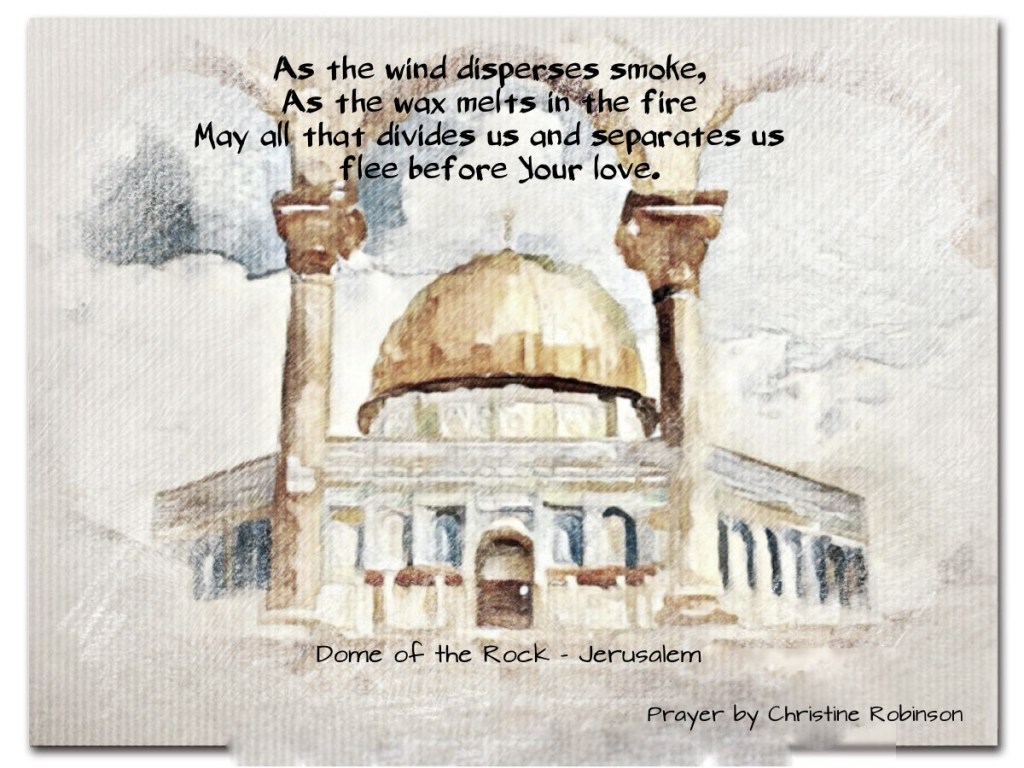
Arise, O God, and let your enemies be scattered; let those who hate you flee. Let them vanish like smoke when the wind drives it away; as the wax melts at the fire, so let the wicked perish at your presence. But let the righteous be glad and rejoice before you; let them also be merry and joyful.
Psalm 68: 1-3
Haven’t we said a similar prayer many times in our lives? Doesn’t it rise up in us now as we watch war erupt in the Middle East, as we see India overwhelmed by COVID 19?
Don’t we want God to just fix things!
But the psalm itself reveals the only way healing and peace come into the world – it is through the triumph of justice in each of our hearts. Ultimately, God has made us the means to peace:
But the just rejoice and exult before God; they are glad and rejoice. Sing to God, chant praise to his name whose name is the LORD.
Psalm 68: 4-5
The psalmist prays for communal wholeness by describing God’s active Mercy:
Protector of orphans, defender of widows, the One who dwells in holiness, who gives the solitary a home and brings forth prisoners into freedom.
Psalm 68: 6-7
But God can only touch the suffering through our hands, prayers, and actions of justice. When we allow God to do that, then we can rejoice.
Sing to God, O dominions of the earth; sing praises to the Lord. You ride in the heavens, the ancient heavens, O God; sending forth your voice, your mighty voice into our spirits
Psalm 68: 32-33
Poetry: Come to Dust – Ursula LeGuin
Spirit, rehearse the journeys of the body
that are to come, the motions
of the matter that held you.
Rise up in the smoke of palo santo.
Fall to the earth in the falling rain.
Sink in, sink down to the farthest roots.
Mount slowly in the rising sap
to the branches, the crown, the leaf-tips.
Come down to earth as leaves in autumn
to lie in the patient rot of winter.
Rise again in spring’s green fountains.
Drift in sunlight with the sacred pollen
to fall in blessing.
                                   All earth’s dust
has been life, held soul, is holy.
Music: Let There Be Peace – Vince Gill
Sorry, it’s the non-inclusive version, but the pictures are so pretty😇
Today, in God’s Lavish Mercy, we pray with Psalm 122 which celebrates the beauty and stability of Jerusalem as a symbol of God’s enduring faithfulness to us.
I rejoiced because they said to me, “We will go up to the house of the LORD.” And now we have set foot within your gates, O Jerusalem.
Psalm 122:1-2
Think of the peace this psalm brought to its reciters – the kind of peace we seek in a confusing world.
The disciples in our passage from Acts sought the same kind of peace. As the early Church – the “New Jerusalem” – developed, and diverse converts joined the community, everyone had an opinion about that development. We all know what that’s like! 😉
Many of us have been in discussions about how to use church/community resources, respond to new initiatives, or celebrate liturgy. While it’s great to have expanded energy in the discussion, it can be exhausting, particularly if some opinions are uninformed by prayer, justice, or humility.
The real issue for the early Christians wasn’t simply circumcision. The core challenge was how to remain true to the Gospel as it met the first of many generations of interpretation. To do so, they returned to the “compact unity of Jerusalem”. They held fast to the roots of Jesus’s teaching.
Jerusalem, built as a city with compact unity. To it the tribes go up, the tribes of the LORD.
Psalm 122: 3-4
The topic of circumcision has long since been resolved by gathering the community in prayerful discernment and humble obedience. But as the ages pass, the Christian community will forever be called to return/remain in the “Jerusalem” of Christ’s teaching.
We do so by continually returning to the roots of the Gospel. That’s what it means to live in radical faith.
Remain in me, as I remain in you. Just as a branch cannot bear fruit on its own unless it remains on the vine, so neither can you unless you remain in me. I am the vine, you are the branches. Whoever remains in me and I in him will bear much fruit, because without me you can do nothing.
John 15: 4-5
May we constantly grow in our love, understanding, and obedience to the Gospel so that we more fully contribute to our community of faith.
Poetry: Palm Sunday by Malcolm Guite
Now to the gate of my Jerusalem,
The seething holy city of my heart,
The saviour comes. But will I welcome him?
Oh crowds of easy feelings make a start;
They raise their hands, get caught up in the singing,
And think the battle won. Too soon they’ll find
The challenge, the reversal he is bringing
Changes their tune. I know what lies behind
The surface flourish that so quickly fades;
Self-interest, and fearful guardedness,
The hardness of the heart, its barricades,
And at the core, the dreadful emptiness
Of a perverted temple. Jesus, come
Break my resistance and make me your home
Music: Pray for the Peace of Jerusalem – Herbert Howells
Lyrics:
O pray for the peace of Jerusalem.
They shall prosper that love thee.
Peace be within they walls
And plenteousness within thy palaces.
Psalm 122 vv. 6, 7
Today, in God’s Lavish Mercy, we pray with Psalm 2 which poses an eternally recurring question:
Yesterday I read that it was the 21st anniversary of The Belfast Agreement. This is also known as the Good Friday Agreement, because it was reached on Good Friday, 10 April 1998. It was an agreement between the British and Irish governments, and most of the political parties in Northern Ireland, on how Northern Ireland should be governed. The talks leading to the Agreement addressed issues which had caused conflict during previous decades. The aim was establish a new, “devolved government” for Northern Ireland in which unionists and nationalists would share power.
But at the same time I also read another current article:
For nearly a week, crowds of Protestant and Catholic youth have provoked one another through the gaps in the wall, video footage from journalists at the scene shows. Stemming from decades-old tensions referred to as “the troubles,” the reignited violence has been, in part, caused by Britain’s exit from the European Union.
On any given day, we could take these stories and substitute the names of other countries, each struggling through cycles of strife, attempts at peace, and recurrence of violence.
The psalmist’s question echoes and the answer, over the ages, remains the same.
Why do the nations rage? They rage from the abuse of power, money, and human dignity.
What is the antidote to this recurring rage? Our psalm tells us it is simple – not easy – but simple. We must take refuge in God, govern our lives by God’s desire for good for every person, every creature.
Every war leaves our world worse than it was before. War is a failure of politics and of humanity, a shameful capitulation, a stinging defeat before the forces of evil. Let us not remain mired in theoretical discussions, but touch the wounded flesh of the victims. Let us look once more at all those civilians whose killing was considered “collateral damage”. Let us ask the victims themselves. Let us think of the refugees and displaced, those who suffered the effects of atomic radiation or chemical attacks, the mothers who lost their children, and the boys and girls maimed or deprived of their childhood. Let us hear the true stories of these victims of violence, look at reality through their eyes, and listen with an open heart to the stories they tell. In this way, we will be able to grasp the abyss of evil at the heart of war. Nor will it trouble us to be deemed naive for choosing peace.
Pope Francis: Fratelli Tutti #261
Poetry: Dover Beach by Matthew Arnold
The sea is calm to-night,
The tide is full, the moon lies fair
Upon the straits; on the French coast the light
Gleams and is gone; the cliffs of England stand,
Glimmering and vast, out in the tranquil bay.
Come to the window, sweet is the night-air!
Only, from the long line of spray
Where the sea meets the moon-blanched land,
Listen! you hear the grating roar
Of pebbles which the waves draw back, and fling,
At their return, up the high strand,
Begin, and cease, and then again begin,
With tremulous cadence slow, and bring
The eternal note of sadness in.

Sophocles long ago
Heard it on the Aegean, and it brought
Into his mind the turbid ebb and flow
Of human misery; we
Find also in the sound a thought,
Hearing it by this distant northern sea.

The sea of faith
Was once, too, at the full, and round earth's shore
Lay like the folds of a bright girdle furled.
But now I only hear
Its melancholy, long, withdrawing roar,
Retreating, to the breath
Of the night-wind, down the vast edges drear
And naked shingles of the world.

Ah, love, let us be true
To one another! for the world which seems
To lie before us like a land of dreams,
So various, so beautiful, so new,
Hath really neither joy, nor love, nor light,
Nor certitude, nor peace, nor help for pain;
And we are here as on a darkling plain
Swept with confused alarms of struggle and flight,
Where ignorant armies clash by night.
Today, in God’s Lavish Mercy, we pray with Psalm 1, a familiar reminder of what a working relationship with God looks like:
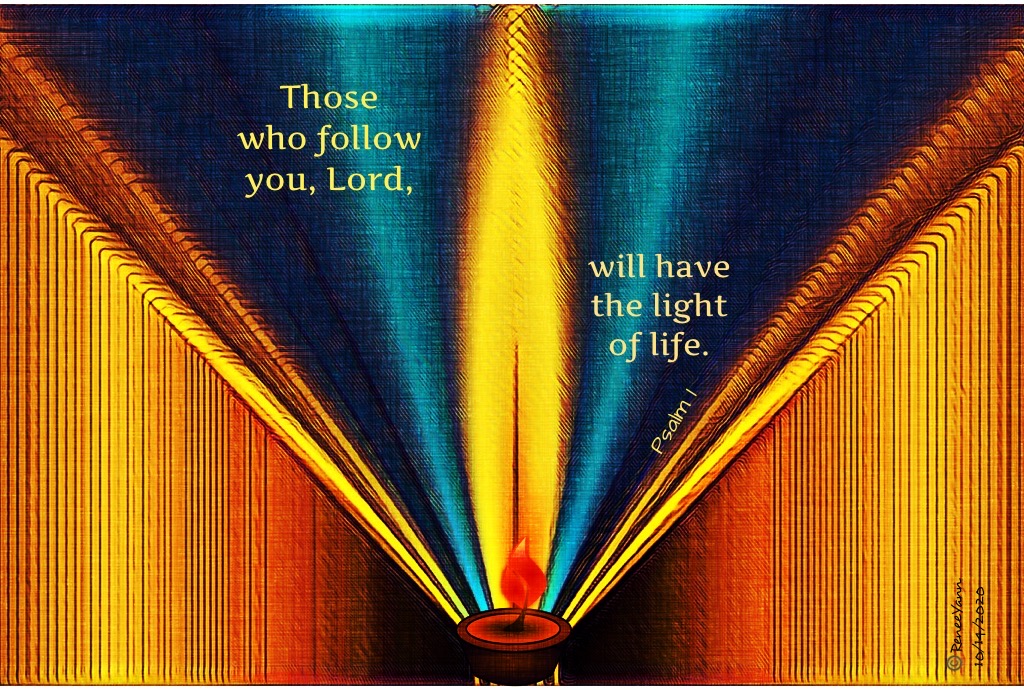
Blessed the one who follows not the counsel of the wicked Nor walks in the way of sinners, nor sits in the company of the insolent, But delights in the law of the LORD and meditates on God’s law day and night.
Psalm 1:1-2
The phrases in that little verse are so powerful!
We have seen all too clearly what happens when people “follow the counsel of the wicked”. We know how easily we can be infected by the negativity of “the insolent”. There is a spiritual distemper in us when these fractious humors fill the atmosphere.
Instead, we seek the peace and delight of being right with God. We embrace God’s law as a support and inspiration to guide us.
When we think of God’s Law, we might rightly think of the Commandments, the Beatitudes, the Torah, the Gospel – those places where we find the Law codified in words.
But we might also think of God’s Law as that silent omnipotent force that lifts the sun from darkness and sets it down again, that holds the seas in their global bowl, that lights the night with fiery stars.
Affinity with God’s Law is that loving practice which, by intrinsic prayer and reflection, gives over every moment of our lives to God’s order. That alignment, rooting us in God’s “due season”, allows goodness to blossom in us like a fruitful tree – an unfading, abundant harvest …
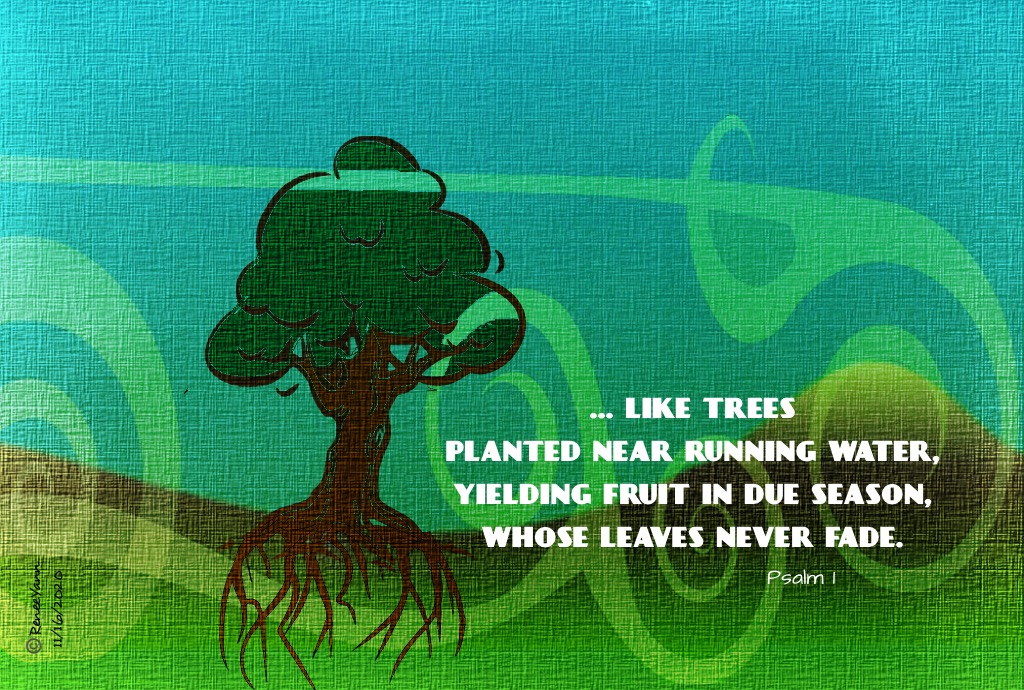
Like a tree planted near running water, That yields its fruit in due season, and whose leaves never fade, ever prospering.
Psalm 1:3
Poetry: Onto a Vast Plain – Rainer Maria Rilke
Listen.
You are not surprised at the force of the storm—
you have seen it growing.
The trees flee. Their flight
sets the boulevards streaming. And you know:
he whom they flee is the one
you move toward. All your senses
sing him, as you stand at the window.

The weeks stood still in summer.
The trees’ blood rose. Now you feel
it wants to sink back
into the source of everything. You thought
you could trust that power
when you plucked the fruit:
now it becomes a riddle again
and you again a stranger.

Summer was like your house: you know
where each thing stood.
Now you must go out into your heart
as onto a vast plain. Now
the immense loneliness begins.

The days go numb, the wind
sucks the world from your senses like withered leaves.

Through the empty branches the sky remains.
It is what you have.
Be earth now, and evensong.
Be the ground lying under that sky.
Be modest now, like a thing
ripened until it is real,
so that he who began it all
can feel you when he reaches for you.
Today, in God’s Lavish Mercy, we pray with Psalm 85 which, sprinkled heavily with “will”s and “shall”s, is written almost completely in the future tense.
This psalm, though filled with hope, is italicized with a sense of “then, but not just yet”. In the midst of a long waiting, it fuels our patience with words like “near”:
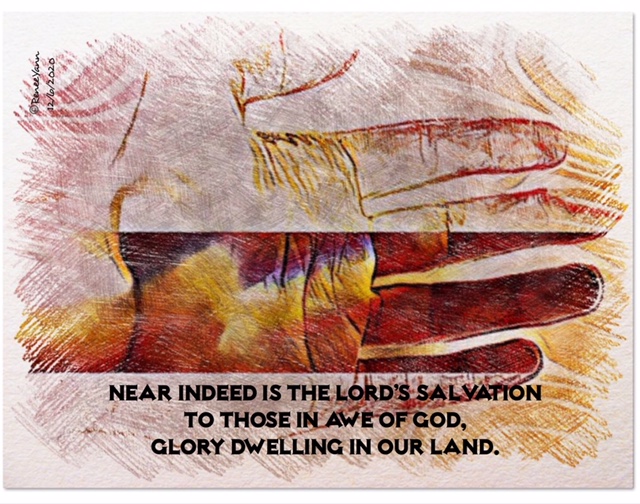
I will hear what God proclaims; the LORD— who proclaims peace to the people. Near indeed is salvation to those who are awed by the Lord, glory dwelling in our land.
Psalm 85: 9-10
Oh, my! Do we know how that long patience feels?
The feeling recalls my Dad’s answer on any long journey when I repeatedly queried, “Are we there yet.”
Not yet. But near. Not now. But soon.
The whole world shares a similar feeling right now. As we see the promise of a vaccine rising on the horizon, we still live in the worry and isolation of this pandemic. Are we safe yet?
Not yet. But near. Not now. But soon.
Let us not miss the practical lessons nor the spiritual ones that emerge as we read the psalmist’s ancient words in our current stressful times.
The practical lessons for our situation are clear:
a vaccine is near
be patient, prepare
mask up
wash hands
stay home if possible
respect your bubble and everyone else’s
Some of the spiritual inspirations might be these.
Amazing Grace is always near to us
be patient, prepare
learn from your solitude
clear your spirit of any impediments to grace
find your home in God’s Presence
rest in that Presence until you are renewed
The psalm assures us that God is with us; that the Sacred Presence will appear as we open our eyes to God’s justice and mercy.
The LORD will give us benefits; our land shall yield its increase. Justice shall walk before the Lord and prepare the way of God’s steps.
Psalm 85: 13-14
Isaiah and Mark direct our hearts to the voice of the prophet John the Baptist who proclaims, “Prepare a way for the Lord!” That’s how near God is! Just on the other side of our soul’s expectation.
In our second reading, Peterreminds us of how to be ready for the moment when “soon” becomes “now”.
But according to God’s promise we await new heavens and a new earth in which righteousness dwells. Therefore, beloved, since you await these things, be eager to be found without spot or blemish before the Lord, at peace.
2 Peter 3:13-14
Poetry: ADVENT (On a Theme by Dietrich Bonhoeffer) by Pamela Cranston
Look how long
the tired world waited,
locked in its lonely cell,
guilty as a prisoner.

As you can imagine,
it sang and whistled in the dark.
It hoped. It paced and puttered about,
tidying its little piles of inconsequence.

It wept from the weight of ennui
draped like shackles on its wrists.
It raged and wailed against the walls
of its own plight.

But there was nothing
the world could do
to find its freedom.

The door was shut tight.
It could only be opened
from the outside.

Who could believe the latch
would be turned by the flower
of a newborn hand?
Music: Soon and Very Soon written and sung by Andraé Crouch, accompanied here by Jessy Dixon
Andraé Edward Crouch (July 1, 1942 – January 8, 2015) was an American Gospel singer, songwriter, arranger, record producer and pastor. Referred to as “the father of modern gospel music” by gospel music professionals.
Jessy Dixon (March 12, 1938 – September 26, 2011) was an American Gospel music singer, songwriter, and pianist, with success among audiences across racial lines. He garnered seven Grammy Award nominations during his career.
Today, in God’s Lavish Mercy, we pray with Psalm 128, written around the time of return after the Babylonian Captivity.
Israel was in a time of re-establishment, a time of rediscovering the blueprint for a settled and fruitful life. Psalm 128 lays that formula out:
Blessed are you who fear the LORD, who walk in God’s ways! For you shall eat the fruit of your handiwork; blessed shall you be, and favored.
Psalm 128:1-2
As with many scripture passages, (certainly today’s from Ephesians !!!), some of the original language doesn’t ring perfectly with our modern sensibilities. Personally, my spirituality doesn’t include “fear” when I relate to God.
Rather than interpret such passages rigidly, we need to receive the words for the core of their meaning, which remains the same over the ages. What changes is how each culture and social evolution receives and honors the Word. This is the reason we pray with scripture and study it, rather than simply read it as we would read a cereal box.
Happy is everyone who fears the Lord… “In this phrase, ‘fear’ is not about being intimidated or ‘shaking in your boots’ before the divine presence. It is rather about reverence or awe before YHWH, and the observation that whom one reveres, one obeys. To fear YHWH is to entrust all of life and hope to this one and follow the divine guidance. The perspective of the psalm is that such a decision about lifestyle makes a difference; living in line with YHWH’s teaching brings a profound joy and completeness to life.”
Walter Brueggemann – New Cambridge biblical Commentary
Psalm 128 invites us today to explore our sense of awe, reverence, and obedience toward God’s Presence in our lives. As we breathe in God’s boundless love for us, may we breathe out our complete trust and gratitude.
Poetry: Entering Saint Patrick’s Cathedral by Malachi Black
I have carried in my coat, black wet
with rain. I stand. I clear my throat.

My coat drips. The carved door closes
on its slow brass hinge. City noises—

car horns, bicycle bells, the respiration
truck engines, the whimpering

steel in midtown taxi brakes—bend
in through the doorjamb with the wind

then drop away. The door shuts plumb: it seals
the world out like a coffin lid. A chill,

dampened and dense with the spent breath
of old Hail Marys, lifts from the smoothed

stone of the nave. I am here to pay
my own respects, but I will wait:

my eyes must grow accustomed
to church light, watery and dim.

I step in. Dark forms hunch forward
in the pews. Whispering, their heads

are bowed, their mouths pressed
to the hollows of clasped hands.

High overhead, a gathering of shades
glows in stained glass: the resurrected

mingle with the dead and martyred
in panes of blue, green, yellow, red.

Beneath them lies the golden holy
altar, holding its silence like a bell,

and there, brightly skeletal beside it,
the organ pipes: cold, chrome, quiet

but alive with a vibration tolling
out from the incarnate

source of holy sound. I turn, shivering
back into my coat. The vaulted ceiling

bends above me like an ear. It waits:
I hold my tongue. My body is my prayer.
Music: How Great Thou Art – Mormon Tabernacle Choir
Today, in God’s Lavish Mercy, we pray with Psalm 33 which has been described as “a song of praise” and a call to worship. But as I pray with it this morning, I think of the psalm as much more. Within it is a profound call to social justice grounded in faith.
Maybe my attitude is the result of a commercial I keep thinking about. You may have seen it – the one for an organization called Wounded Warriors. Every time I see it, my soul splits. There is deep compassion, admiration and respect for the veterans depicted. But there is also the raging question “WHY!”.
How can we still allow, tout, and support the systemic atrocity of war in any form? How can we see these young men and women, bodies maimed and lives fractured, and not be outraged that war even exists!
I think that, thousands of years ago, the writer of Psalm 33 may have entertained similar questions. The psalmist realizes that it is not by the superiority of the nation state that a people gains righteousness and mercy.
The LORD foils the plan of nations, frustrates the designs of peoples. But the plan of the LORD stands forever, the designs of his heart through all generations. Blessed is the nation whose God is the LORD, the people chosen as his inheritance.
Psalm 33:10-12
It is instead by acknowledging God’s care for all peoples that a nation achieves the humility, understanding, and courage to help build universal peace.
From heaven the LORD looks down and observes all the children of Adam, From his dwelling place he surveys all who dwell on earth. The One who fashioned together their hearts is the One who knows all their works.
Psalm 33:13-15
The challenge of global peace-making is daunting. We “children of Adam” have permitted ourselves to not only normalize, but to exalt war. Reversing the systems that depend on and lead to war will be a long, complex, and arduous pursuit.
But for God’s sake, and our own, we must do it! Our soul waits for the LORD, he is our help and shield. For in him our hearts rejoice; in his holy name we trust. May your mercy, LORD, be upon us; as we put our hope in you.
Psalm 33: 20-21
Reading: from In Truth, Peace MESSAGE OF HIS HOLINESS POPE BENEDICT XVI FOR THE CELEBRATION OF THE WORLD DAY OF PEACE 1 JANUARY 2006
The theme chosen for this year’s reflection—In truth, peace — expresses the conviction that wherever and whenever men and women are enlightened by the splendour of truth, they naturally set out on the path of peace. The Pastoral Constitution Gaudium et Spes, promulgated forty years ago at the conclusion of the Second Vatican Council, stated that humankind will not succeed in ”building a truly more human world for everyone, everywhere on earth, unless all people are renewed in spirit and converted to the truth of peace”.
But what do those words, ”the truth of peace”, really mean? To respond adequately to this question, we must realize that peace cannot be reduced to the simple absence of armed conflict, but needs to be understood as ”the fruit of an order which has been planted in human society by its divine Founder”, an order ”which must be brought about by humanity in its thirst for ever more perfect justice”. As the result of an order planned and willed by the love of God, peace has an intrinsic and invincible truth of its own, and corresponds ”to an irrepressible yearning and hope dwelling within us”.
Today, in God’s Lavish Mercy, we pray with Psalm 1.
Patrick D. Miller, Hebrew Scriptures scholar, suggests that Psalm 1 “sets the agenda for the Psalter through its identification of the way of the righteous and the way of the wicked as well as their respective fates” along with “its emphasis on the Torah, the joy of studying it and its positive benefits for those who do“.
Blessed the one who follows not the counsel of the wicked Nor walks in the way of sinners, nor sits in the company of the insolent, But delights in the law of the LORD and meditates on God’s law day and night.
Psalm 1:1-2
What does it really mean to “meditate on God’s law day and night”? Become a monk? Read the Bible all day? Never sleep?
Of course not. I think it means to live in the firm belief that God is in everything, and to train our hearts to see and respond to that Omnipresent Love.
We all know people who, no matter the circumstances, are focused on good and radiate a joyful confidence. There is a light within them and a peace around them. The living of their ordinary lives is a meditation on God’s order in all things.
Such a person …
… is like a tree planted near running water, That yields its fruit in due season, and whose leaves never fade. Whatever that faithful one does, prospers.
Psalm 1:3
It doesn’t mean there aren’t challenges … even protests, righteous anger, sadness and pain. Think of Jesus as he overturned the Temple tables!
It means rather that the focus is never lost because … Creation’s sacred order is our Light; and God’s law has taught ours hearts to find our joy in its Beauty.
my transliteration of Psalm 1:2
Let’s be that tree near the running water of Grace!🙏
Poem: On Beauty by Khalil Gibran
And a poet said, Speak to us of Beauty. And he answered: Where shall you seek beauty, and how shall you find her unless she herself be your way and your guide? And how shall you speak of her except she be the weaver of your speech?
The aggrieved and the injured say, “Beauty is kind and gentle. Like a young mother half-shy of her own glory she walks among us.” And the passionate say, “Nay, beauty is a thing of might and dread. Like the tempest she shakes the earth beneath us and the sky above us.”
The tired and the weary say, “Beauty is of soft whisperings. She speaks in our spirit. Her voice yields to our silences like a faint light that quivers in fear of the shadow.” But the restless say, “We have heard her shouting among the mountains, And with her cries came the sound of hoofs, and the beating of wings and the roaring of lions.”
At night the watchmen of the city say, “Beauty shall rise with the dawn from the east.” And at noontide the toilers and the wayfarers say, “We have seen her leaning over the earth from the windows of the sunset.”
In winter say the snow-bound, “She shall come with the spring leaping upon the hills.” And in the summer heat the reapers say, “We have seen her dancing with the autumn leaves, and we saw a drift of snow in her hair.” All these things have you said of beauty, Yet in truth you spoke not of her but of needs unsatisfied, And beauty is not a need but an ecstasy. It is not a mouth thirsting nor an empty hand stretched forth, But rather a heart enflamed and a soul enchanted. It is not the image you would see nor the song you would hear, But rather an image you see though you close your eyes and a song you hear though you shut your ears. It is not the sap within the furrowed bark, nor a wing attached to a claw, But rather a garden for ever in bloom and a flock of angels for ever in flight.
People of Orphalese, beauty is life when life unveils her holy face. But you are life and you are the veil. Beauty is eternity gazing at itself in a mirror. But you are eternity and you are the mirror.









 Lavish Mercy