Grateful

November 10, 2021
Memorial of Saint Leo the Great, Pope and Doctor of the Church

Today, in God’s Lavish Mercy, we pray with Psalm 82 considered, by at least one Biblical scholar, to be:

“the single most important text in the entire Christian Bible.”

John Domenic Crossan, an Irish-American New Testament scholar,
historian of early Christianity, and former Catholic priest

Council of the Gods by Raphael, (Public domain, via Wikimedia Commons)

Psalm 82 best summarizes for me the character of (the early Biblical) God.
It imagines a scene in which God sits among the gods and goddesses in divine council.
Those pagan gods and goddesses are dethroned not just because they are pagan,
nor because they are other, nor because they are competition.
They are dethroned for injustice, for divine malpractice, for transcendental malfeasance.
They are rejected because they do not demand and effect justice among the peoples of the earth.
And that justice is spelled out as protecting the poor from the rich,
protecting the systemically weak from the systemically powerful.

excerpts from Crossan: The Birth of Christianity

Rise up, O God, bring judgment to the earth.
Defend the lowly and the fatherless;
    render justice to the afflicted and the destitute.
Rescue the lowly and the poor;
    from the hand of the wicked deliver them.
Psalm 82: 3-4


In today’s Gospel, we encounter this just and supreme God in the person of Jesus when we witness the cure of the ten lepers.  

You know, it would be startling enough to run into one leper on your daily walk, right?  But TEN! That must have been an astounding situation. And to see those sad, disfigured people restored to wholeness must have been nearly overwhelming for the entourage accompanying Jesus.

Can you imagine that the recipients of such a miracle wouldn’t have clung in gratitude to Jesus for the rest of their days??? But, wow, only one even bothered to say “Thank you”.

What might have kept the other nine away,
locked in their blind ingratitude?

Perhaps it’s not such a mystery if we allow ourselves to examine our own often ungrateful hearts. We don’t necessarily mean to be boorish in the face of God’s kindness and the generosity of others, but we sometimes suffer from …

  1. Distraction: our lives are filled with frenetic activity which causes our blessings to flit by us into dizzying forgetfulness
  2. Entitlement: we think we deserve or have earned those blessings
  3. Self-absorption: we are so wrapped up in ourselves that we don’t even notice that our whole life is a gift
  4. Laziness: we might say thanks if we get around to it. But we never get around to it.
  5. Unresolved anger: we’re mad that we even needed help
  6. Non-intentionality: we fail to live with intention and reflection, thus missing the opportunities for gratitude 
  7. Pride: we are too proud to acknowledge that we need anything
  8. Fear: we are afraid something will be required of us in return for the gift
  9. Spiritual blindness: we just don’t see the nurturing power of God and others in our life

It’s likely that our nine ungrateful lepers had these human frailties. But don’t be thinking about them, or your acquaintances who share their failings.  

Let’s think about ourselves and how we want to be more grateful. Let’s think about our omnipotent God who is always Justice and Mercy.

The story is a powerful wake-up call to do better than the poor lepers did by living this prayer:

May I live humbly and gratefully today.


Poetry: The Ten Lepers – by Rosanna Eleanor (Mullins) Leprohon who was both a poet and novelist. Born in Montreal in 1829, Rosanna Mullins was educated at the convent of the Congregation of Notre Dame.

’Neath the olives of Samaria, in far-famed Galilee,
Where dark green vines are mirrored in a placid silver sea,
’Mid scenes of tranquil beauty, glowing sun-sets, rosy dawn,
The Master and disciples to the city journeyed on.

And, as they neared a valley where a sheltered hamlet lay,
A strange, portentous wailing made them pause upon their way—
Voices fraught with anguish, telling of aching heart and brow,
Which kept moaning: “Jesus, Master, have mercy on us now!”

Softly raised the gentle Saviour His eyes like midnight star,
And His mournful gaze soon rested on ten lepers, who, afar,
Stood motionless and suppliant, in sackcloth rudely clothed,
Poor Pariahs! by their nearest, their dearest, shunned and loathed.

Not unto Him prayed vainly those sore afflicted ten,
No! He yearned too fondly over the erring sons of men,
Even sharing in their sorrows, though He joined not in their feasts,—
So He kindly told the Lepers: “Show yourselves unto the priests.”

When, miracle of mercy! as they turned them to obey,
And towards the Holy Temple quickly took their hopeful way,
Lo! the hideous scales fell off them, health’s fountains were unsealed,
Their skin grew soft as infant’s—their leprosy was healed.

O man! so oft an ingrate, to thy thankless nature true,
Thyself see in those Lepers, who did as thou dost do;
Nine went their way rejoicing, healed in body—glad in soul—
Nor once thought of returning thanks to Him who made them whole.

One only, a Samaritan, a stranger to God’s word,
Felt his joyous, panting bosom, with gratitude deep stirred,
And without delay he hastened, in the dust, at Jesus’ feet,
To cast himself in worship, in thanksgiving, warm and meet.

Slowly questioned him the Saviour, with majesty divine:—
“Ten were cleansed from their leprosy—where are the other nine?
Is there none but this one stranger—unlearned in Gods ways,
His name and mighty power, to give word of thanks or praise?”

The sunbeams’ quivering glories softly touched that God-like head,
The olives blooming round Him sweet shade and fragrance shed,
While o’er His sacred features a tender sadness stole:
“Rise, go thy way,” He murmured, “thy faith hath made thee whole!”


Music:  Hymn of Grateful Praise – Folliott S. Pierpoint
We Are the Church

November 9, 2021
Feast of the Dedication of the Lateran Basilica in Rome

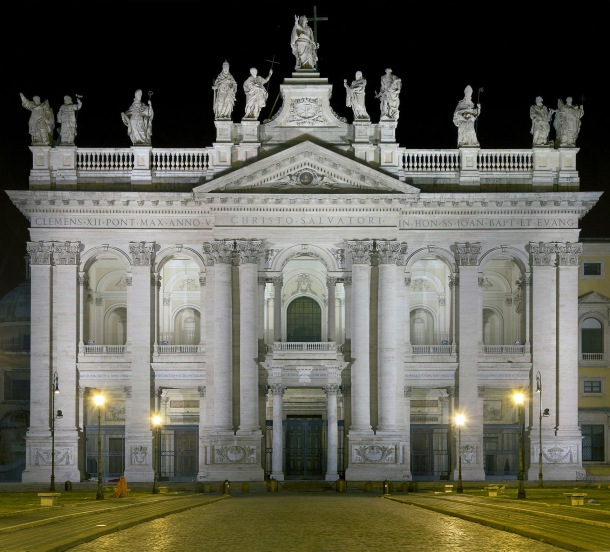
Today, in God’s Lavish Mercy, we celebrate a rare type of feast day – one that marks the dedication of a church building.  For many, that seems a little odd. We are accustomed to celebrating Mary, Joseph and other saints and feasts of Our Lord.

Here’s the thing: we are not actually celebrating a building.  We are celebrating what the building represents – the Body of Christ, the Church, made of living stones – us.

St. John Lateran Basilica in Rome

But sometimes it helps to have visible symbols of the things we venerate and celebrate. That’s why we have medals, rosary beads and candles – so that we can SEE something as we try to conceptualize a spiritual reality.


St. John Lateran is the Pope’s parish church.
Since he is the Bishop of the whole People of God,
his physical church has come to symbolize
the universal Body of Christ, the world Church.


Pope Benedict XVI in his Angelus Address, on November 9, 2008 said this:

Dear friends, today’s feast celebrates a mystery that is always relevant: God’s desire to build a spiritual temple in the world, a community that worships him in spirit and truth
(cf. John 4:23-24).
But this observance also reminds us of the importance of the material buildings in which the community gathers to celebrate the praises of God.
Every community therefore has the duty to take special care of its own sacred buildings, which are a precious religious and historical patrimony. For this we call upon the intercession of Mary Most Holy, that she help us to become, like her, the “house of God,” living temple of his love.


As we pray today, we might want to consider the gift of faith on which our own lives are built – a faith whose cornerstone is Jesus Christ. In our second reading, Paul says this:

Brothers and sisters:
You are God’s building…..
Do you not know that you are the temple of God,
and that the Spirit of God dwells in you?

1 Corinthians 3:16

And in our Gospel, Jesus speaks of his own body as a temple which, though apparently destroyed by his enemies, will be raised up in three days.

By our Baptism, that same spiritual temple lives in us and in all the community of faith. That same power of Resurrection is alive in us! So in a very real sense, what we celebrate today is ourselves – the Living Church – raised up and visible as a sign of God’s Life in the world.

Happy Feast Day, Church!


Poetry: A Perfect Church – the Roseville Bulletin. A light-hearted but honest look at ourselves as Church 🙂

I think that I will never see
A church that’s all it ought to be 
A church that has no empty pews
A church where people never get the blues
A church whose music is always great
A church where people are never late

Such perfect churches there may be 
But none of them are known to me 
If you could find the perfect church
Without one fault or smear
For goodness sake, don’t join that church
You’ll spoil the atmosphere

If you should find the perfect church
Then don’t you even dare
To tread upon such holy ground
You wouldn’t fit in there
But since no perfect church exists
Where people never sin
Then let’s stop looking for that church
And love the one we’re in

Amen


Music: Cornerstone – Hillsong

God Knows My Truth

November 8, 2021
Monday of the Thirty-second Week in Ordinary Time

Today, in God’s Lavish Mercy, we pray with the comforting yet challenging Psalm 139, a prayer of awareness, intimacy, and trust.

O LORD, you have probed me and you know me;
    you know when I sit and when I stand;
    you understand my thoughts from afar.
My journeys and my rest you scrutinize,
    with all my ways you are familiar.

Psalm 139:1-3

The thought that God knows us so intimately might be both assuring and/or scary — depending on how we know and understand ourselves. The psalmist describes an overwhelming wonder at the thought of God’s closeness:

Even before a word is on my tongue,
    behold, O LORD, you know the whole of it.
Behind me and before, you hem me in
    and rest your hand upon me.
Such knowledge is too wonderful for me;
    too lofty for me to attain.

Psalm 139:4-6

As we pray Psalm 139, the awe settles into a deep awareness that God’s penetrating Presence in our spirits is ever beneficent and merciful. We pray to yield to its Love and seek its Wisdom.

Where can I go from your spirit?
    From your presence where can I flee?
If I go up to the heavens, you are there;
    if I sink to the nether world, you are present there.
If I take the wings of the dawn,
    if I settle at the farthest limits of the sea,
Even there your hand shall guide me,
    and your right hand hold me fast.

Psalm 139:7-10

On this 32nd Monday, we begin a week of readings from the Book of Wisdom. Written in the century surrounding the birth of Christ, Wisdom is the work of a poet, theologian, philosopher, and moralist. 

Today’s passage alerts us, as does our Gospel, that holding God’s Presence within us, we must live lives that bear it witness:

For wisdom is a kindly spirit,
yet she acquits not blasphemers of their guilty lips;
Because God is the witness of the inmost self
and the sure observer of the heart
and the listener to the tongue.
For the Spirit of the Lord fills the world,
is all-embracing, and knows what the person truly bespeaks by their lives.

Wisdom 1:6-7

A millstone at someone’s feet …

For as our Gospel tells us today:

Jesus said to his disciples,
“Things that cause sin will inevitably occur,
but woe to the one through whom they occur.  
It would be better to have a millstone hung around the neck
and be thrown into the sea
than to cause one of these little ones to sin.”

Luke 17:1-2

Poetry: Wisdom – Tagore

The small wisdom 
is like water in a glass:
clear, transparent, pure.

The great wisdom 
is like the water in the sea:
dark, mysterious, impenetrable.

Music: The Perfect Wisdom of Our God – The Gettys

Be Generous Stewards

November 6, 2021
Saturday of the Thirty-first Week in Ordinary Time 

Today, in God’s Lavish Mercy, we pray with Psalm 145, the only psalm to be designated as “praise” in its superscription: A psalm of praise. Of David.

This is an intriguing psalm to be chosen for today’s readings which, at first glance, have little to do with “praise”.


Our reading from Romans is the closing chapter of Paul’s letter in which is listed a catalogue of early Christians movers and shakers. The names are of influential and generous people who joined Paul and used their resources to foster the Gospel. They were the stewards of our nascent faith and are accorded a timeless memorial in the epistle’s final chapter.(Notably, many of them are women who obviously played significant roles in the blossoming of the early Church.)


In our Gospel, Jesus explains the parable about the dishonest steward. The steward has been accused of squandering his master’s goods and is about to be fired. In order to rectify accounts, the steward rewrites customer receipts, balancing with his own commissions. That way, his master doesn’t prosecute him and his customers like him enough to consider him for the job he now needs.

The parable is about how to use our wealth of blessings in order to respond to God’s goodness to us. By our generosity for others, we also serve God.


So how does Psalm 145 fit in? When the core attitude of our life is one of thanksgiving and praise:

  1. we have the insight to recognize our true wealth, the blessings God has given us

Every day will I bless you,
and I will praise your name forever and ever.
Great is the LORD and highly to be praised;
Whose greatness is unsearchable.

2. we look to our ancestors in faith as inspiration for generosity (people like those of 

Romans 16)

Generation after generation praises your works
and proclaims your might.
They speak of the splendor of your glorious majesty
and tell of your wondrous works.

3. we draw grace from their example and from the eternal beauty of Creation

Let all your works give you thanks, O LORD,
and let your faithful ones bless you.
Let them discourse of the glory of your Reign
and speak of your power.


Poetry: Hymns for the Amusement of Children – Hymn 21. Generosity by Christopher Smart, 1722 – 1771) a talented and controversial English religious poet. 

Christopher Smart’s poetry is notable for its visionary power, Christian ardor, and lyrical virtuosity from The Poetry Foundation: https://www.poetryfoundation.org/poets/christopher-smart

That vast communicative Mind, 
That form'd the world and human kind, 
And saw that all was right; 
Or was Thyself, or came from Thee, 
Stupendous Generosity, 
Above all lustre bright.
 
" Not for themselves the bees prepare 
" Their honey, and the fleecy care, 
" Not for themselves are shorn: 
" Not for themselves the warblers build, 
" Not for themselves the lands are till'd, 
" By them that tread the corn." 

The Lord shed on the Holy Rood 
His infinitely gen'rous blood, 
Not for himself, but all; 
Yea e'en for them that pierc'd his side, 
In patient agony he died, 
To remedy the Fall. 

O highly rais'd above the ranks 
Of Angels — he cou'd e'en give thanks 
Self-rais'd, and self-renew'd — 
Then who can praise, and love, and fear 
Enough? — since he himself, 'tis clear, 
Is also Gratitude.

Music: Generous Giver – Vintage Worship

Paid in Full

November 5, 2021
Friday of the Thirty-first Week in Ordinary Time

Today, in God’s Lavish Mercy, we pray with Psalm 98, a beautiful hymn celebrating God’s munificence.

Our readings are about spiritual wealth, stewardship and Godly generosity.

Paul starts us off by proclaiming that the wealth/riches of salvation belong to ALL humanity. He presents himself as a unique “steward “ of those riches to the Gentiles.

Thus I aspire to proclaim the Gospel
not where Christ has already been named,
so that I do not build on another’s foundation,
but as it is written:

    Those who have never been told of him shall see,
    and those who have never heard of him shall understand.

Romans 15:21

Our Gospel gives us a second interpretation of “stewardship” in the parable the wily steward. This fella’ gets called on the carpet for squandering his employer’s resources. Pink slip time! 

So the steward calls in some of the debtors and reduces their debt by the amount of his own commission. By doing this, he hopes to make some friends to support him in his impending unemployment.


Talbots

Many years ago, there was a Talbot’s outlet in the Franklin Mills Mall in Northeast Philly (I know. Heaven, right?) You could get an amazing deal on the clearance items. But you got an even better deal if you went to a certain cashier for your checkout.

He was a tall, flamboyant and loudly funny guy. If a price tag was missing on an item, you got it virtually for free. He would make outlandish comments like, “Oh, honey, this isn’t your color so let’s discount it 50%.” If you bought two of the same item, he might announce,”Two for one today”, charging for only one. He was a living example of the Biblical steward! Over time, he developed a devoted buying community – those who had learned the secret of why people waited in his long line!


In today’s parable, Jesus isn’t advocating that we cheat our employers. The parable isn’t really about that at all. It is about the way he wants his disciples to be profligate in preaching the mercy of God.

Remember that this parable comes in between two blockbusters about Mercy – the Prodigal Son and Lazarus and the Rich Man. In a way, you might say Jesus is on a tear about the unbounded generosity of God in forgiveness and hope for us. Jesus makes clear that the wealth of Divine Love is delivered to us by our unbounded Christian love for one another.


So today, maybe we can think about the Talbot’s guy. We have been abundantly blessed by God’s love for us. Let’s pay it forward over and over today… and every day. Let’s generously share the infinite discount of Mercy.


Poetry: Mercy – by Charles Mackay, (1814 – 1889), a Scottish poet, journalist, author, anthologist, novelist, and songwriter.

A little stream had lost its way
Amid the grass and fern;
A passing stranger scooped a well,
Where weary men might turn;
He walled it in and hung with care
A ladle at the brink;
He thought not of the deed he did,
But judged that all might drink.
He passed again, and lo! the well,
By summer never dried,
Had cooled ten thousand parching tongues,
And saved a life beside.

A nameless man, amid a crowd
That thronged the daily mart,
Let fall a word of hope and love,
Unstudied, from the heart;
A whisper on the tumult thrown,
A transitory breath–
It raised a brother from the dust,
It saved a soul from death.
O germ! O fount! O word of love!
O thought at random cast!
Ye were but little at the first, But mighty at the last.


Music: Jesus Paid It All – Elvira M. Hall (1865) This rendition of the hymn by Kristian Stanfill (born 1983) is so interesting. Offered here with modern instrumentation, the words date back to the era of the US Civil War. Past and present meld in the ever eternal love God has for us. An original version is below in case you’d like to compare the music. i think both are beautiful.

Confident Hope

Wednesday, November 4, 2021
Memorial of St. Charles Borromeo

Today, in God’s Lavish Mercy, we pray with Psalm 27:


Our scripture passages are all about confidence in our salvation.

Do you have that confidence?
Do you ever wonder if you’re going to get to heaven?
Maybe even worry about it a little?


If so, today’s readings are for you.

Paul tells the faithful:

For if we live, we live for the Lord,
and if we die, we die for the Lord;
so then, whether we live or die, we are the Lord’s.

And Jesus, using the symbol of a lost sheep, counsels the critical Pharisees:

I tell you, in just the same way
there will be more joy in heaven over one sinner who repents
than over ninety-nine righteous people
who have no need of repentance.

Key to both readings is the call to a repentant, Christian life.


Our beautiful Responsorial Psalm captures the joy of the repentant sinner, the very ones for whom Christ died. It’s a beautiful psalm. We might want to just slowly relish it in our prayer today.

R. I believe that I shall see the good things of the Lord in the land of the living.

The LORD is my light and my salvation;
whom should I fear?
The LORD is my life’s refuge;
of whom should I be afraid?

R. I believe that I shall see the good things of the Lord in the land of the living.

One thing I ask of the LORD;
this I seek:
To dwell in the house of the LORD
all the days of my life,
That I may gaze on the loveliness of the LORD
and contemplate his temple.

R. I believe that I shall see the good things of the Lord in the land of the living.

I believe that I shall see the bounty of the LORD
in the land of the living.
Wait for the LORD with courage;
be stouthearted, and wait for the LORD.

R. I believe that I shall see the good things of the Lord in the land of the living.


We might want to turn toward
the searching Shepherd of today’s Gospel
while praying this Psalm of repentance and faith.


Poetry: The Shepherd Boy Sings in the Valley of Humiliation – John Bunyan (1628–1688), a Christian writer and preacher, most famous for The Pilgrim’s Progress.

He that is down needs fear no fall,
He that is low, no pride;
He that is humble ever shall
Have God to be his guide.

I am content with what I have,
Little be it or much:
And, Lord, contentment still I crave,
Because Thou savest such.

Fullness to such a burden is
That go on pilgrimage:
Here little, and hereafter bliss,
Is best from age to age.


Music:  In the Land of the Living – Eric Becker

Becoming Saints

Monday, November 1, 2021
Feast of All Saints

Synaxis of All Saints – Anonymous Russian icon

Today, in God’s Lavish Mercy, we pray with Psalm 24, an exultant song of praise and celebration whose opening lines leave no doubt of God’s overarching Supremacy

The earth is the Lord’s and all that is in it, 
the world and all who dwell therein.
For it is God who founded it upon the seas
and made it firm upon the rivers of the deep.

Psalm 24: 1-2

The psalmist then asks and answers the burning question of all spiritual seekers: who may come into the presence of this Omnipotent Being? Who may live in Eternal Love?

Who can ascend the mountain of the Lord,
and who can stand in the holy place of God?
Those who have clean hands and a pure heart, 
who have not pledged themselves to falsehood, 
nor sworn by what is a fraud.
They shall receive a blessing from the Lord
and a just reward from the God of their salvation.

Psalm 24: 3-5

It is these successful seekers whom we celebrate today,
the ones already embraced in everlasting glory.

As we consider their lives, we might ask the further question: how did they do it; how did they achieve holiness.

John, in our second reading, says the key to holiness is to honor the gift already given to each of us at our creation and confirmed in our Baptism:

Beloved:
See what love God has bestowed on us
that we may be called the children of God.
Yet so we are.
The reason the world does not know us
is that it did not know God.
Beloved, we are God’s children now;
what we shall be has not yet been revealed.
We do know that when it is revealed we shall be like God
for we shall see God as God truly is.
Everyone who shares this hope seeks a heart purified in God.


We honor all the Saints today, especially the multitudes whose names are unknown to us. They are the ones who lived lives of Beatitude among us, as our Gospel teaches. May they help us to learn the lessons of:

  • a liberated spirit
  • an unpretentious persistance
  • a hopeful endurance
  • a thirst for righteousness
  • a merciful and pure heart
  • a gentle peace-making
  • and a courageous pursuit of justice

These are the keys that will lift up the gates of Heaven for us, allowing the Holy One to make us holy:

Lift up your heads, O gates;
lift them high, O everlasting doors;
and the One who reigns in glory shall come in.

Psalm 24:7

Poetry: In Whom We Live and Move and Have Our Being – Denise Levertov 

Birds afloat in air’s current,
sacred breath? No, not breath of God,
it seems, but God
the air enveloping the whole
globe of being.
It’s we who breathe, in, out, in, the sacred,
leaves astir, our wings
rising, ruffled—but only saints
take flight. We cower
in cliff-crevice or edge out gingerly
on branches close to the nest. The wind
marks the passage of holy ones riding
that ocean of air. Slowly their wake
reaches us, rocks us.
But storm or still,
numb or poised in attention,
we inhale, exhale, inhale,
encompassed, encompassed.

Music: two songs for the big feast🤗

Psalm 24: Lift up your heads, ye gates – Georg Friedrich Handel
Sung by the Gramophone Chorus – Ghana


Give Us Clean Hands – Charlie Hall

The Heart of Love

October 31, 2021
Thirty-first Sunday in Ordinary Time

Today, in God’s Lavish Mercy, we pray with beautiful Psalm 18:

I love you, O LORD, my strength,
    O LORD, my rock, my fortress, my deliverer.
R. I love you, Lord, my strength.
My God, my rock of refuge,
    my shield, the horn of my salvation, my stronghold!

Psalm 18: 2-3

In our readings, both Deuteronomy and Mark proclaim the call to love God wholeheartedly.

In Mark, it is one of the scribes who initiates this proclamation by asking Jesus which is the first – most important – of the commandments. Unlike many of Jesus’ encounters with the scribes and Pharisees, this one does not seem hostile. The man, as one might expect of an expert in the Law, wants to know if Jesus continues the priorities of the Torah. 

One of the scribes came to Jesus and asked him,
“Which is the first of all the commandments?” 

Mark 12:28

He is pleased with Jesus’ answer. And Jesus is pleased with him. We can almost see Christ’s smile at the scribe’s sincere and lived response. 

Jesus replied, “The first is this:
Hear, O Israel!
The Lord our God is Lord alone!
You shall love the Lord your God with all your heart,
with all your soul, 
with all your mind,
and with all your strength.
The second is this:
You shall love your neighbor as yourself.
There is no other commandment greater than these.” 
The scribe said to him, “Well said, teacher.

Mark 12: 29-31

This man sees through the Pharisaical confusions which have been heaped upon this most important law. He understands that love of God and neighbor mean infinitely more than burnt offerings and public sacrifices.


How do we reach this wholehearted love in our complex lives? We’re not busy with burnt offerings, but we are distracted by so many forces that lay claim to our attention and devotion. 

We love many worthy and unworthy things in our lives. We often confuse real love with one of its masquerading forms – “loves” that are self-serving rather than other-serving.

Today’s Alleluia verse is an answer to our, “How?”.

Whoever loves me
will keep my word, says the Lord;
and my father will love him
and we will come to him.

John 14:23

Real love is proved by action. It’s that simple.
What do my actions say about where my heart is?
Let me just flip back through my last 24 hours
to see if God would have smiled at my choices, words, and actions.
And let me change what I need to change for tomorrow.


Poetry: from Rumi

Last night I learned how to be a lover of God,
To live in this world and call nothing my own.

I looked inward
And the beauty of my own emptiness
filled me till dawn.
It enveloped me like a mine of rubies.
Its hue clothed me in red silk.

Within the cavern of my soul
I heard the voice of a lover crying,
“Drink now! Drink now!”—

I took a sip and saw the vast ocean— 
Wave upon wave caressed my soul. 
The lovers of God dance around 
And the circle of their steps
becomes a ring of fire round my neck.

Heaven calls me with its rain and thunder—
a hundred thousand cries
yet I cannot hear…..

All I hear is the call of my Beloved.


Music: V’Ahavta- Marty Goetz

V’Ahavta is part of the Shema Yisrael (שְׁמַע יִשְׂרָאֵל)- a prayer that serves as a centerpiece of the morning and evening Jewish prayer services.

Slippin’ and Slidin’

October 30, 2021
Saturday of the Thirtieth Week in Ordinary Time

Today, in God’s Lavish Mercy, we pray with Psalm 94 which assures us of God’s patient and enduring love.

Happy are they whom you instruct, O Lord!
whom you teach out of your law;
to give them rest in evil days…
For you will not abandon your beloved,
nor will you forsake your own.

Psalm 94: 12-14

How does God instruct us in this perfect Law? Our Alleluia Verse offers this insight:

Take my yoke upon you and learn from me,
For I am meek and humble of heart.

Matthew 11:29

By imitating the humble love of Jesus, we learn to become more like God in whose image we are created.


Deepening in that imitative love is a lifelong journey. Sometimes, maybe often, our footing is unsure. Sometimes we even fall flat on our face!

The psalmist tells us we are not alone in the struggle, a verse we might repeat when we are a bit off spiritual balance:

Were not the LORD my help,
my soul would soon dwell in the silent grave.
When I say, “My foot is slipping,”
your mercy, O LORD, sustains me.

Psalm 94: 17-18

Poetry: Prayer of the Tightrope Dancer – Sister Eleanor Fitzgibbons, IHM

Oh God of tenderness
and watchful love,
You are my balance beam,
I shall not falter.
With you, my surety,
I will not fail.


Music: Two songs today

  1. Blessed Assurance – written in 1883 by Fanny Crosby an amazing creative talent and activist. She was blind from infancy.

  1. For my fellow tightrope walkers out there:
    Walk-in’ the Tightrope: Some of you might like this rockin’ song from Stevie Ray Vaughn to kick up your Saturday 😉

Catch the Word!

October 29, 2021
Friday of the Thirtieth Week in Ordinary Time

Today, in God’s Lavish Mercy, we pray with Psalm 147 which calls upon Israel to praise God for gifts received.

God has not done for others what has been done for you;
the Divine Way God has not made known to them. Alleluia.

Psalm 147: 20

The psalm gives us deeper insight into our reading from Romans. In Romans, chapters 9-11, Paul focuses on Israel’s quintessential place in the unfolding of salvation history.

In today’s passage, Paul laments the recalcitrance of some of his kin to open their hearts to the Gospel:

I have great sorrow and constant anguish in my heart. 
For I could wish that I myself were accursed and cut off from Christ
for the sake of my own people,
my kindred according to the flesh. 
They are children of Israel…

Romans 9: 2-3

Paul’s lament is not a condemnation. Rather he mourns the fact that his fellow Israelites, who are uniquely blessed by God, choose not to accept the new and transformative Gift offered them in the person of Jesus Christ.


The lesson for us when praying with this psalm and reading? Perhaps this:

God is always doing something new and wonderful in us and in Creation. God is always inviting us deeper into the relationship of love and mercy.

The path to that sacred depth is laid out for us in the Gospel where we learn to imitate Christ.


Sometimes we too are recalcitrant. We like things to be ordered and controlled, just like today’s Gospel Pharisees liked to control the Sabbath.

But the God of the Sabbath is not to be controlled by our fears, demands, or securities. That God will continue to challenge, invite, surprise, and love us into deeper relationship.

Our work is to stay open and responsive to this dynamic God Whose graces are “new every morning” – in fact, every moment…

Who sends forth the command to the earth;
Whose Word runs swiftly!

Psalm 147: 15

Poetry: He Comes Ever Again – Rowan Williams

He will come like last leaf’s fall.
One night when the November wind
has flayed the trees to bone, and earth
wakes choking on the mould,
the soft shroud’s folding.

He will come like frost.
One morning when the shrinking earth
opens on mist, to find itself
arrested in the net
of alien, sword-set beauty.

He will come like dark.
One evening when the bursting red
December sun draws up the sheet
and penny-masks its eye to yield
the star-snowed fields of sky.

He will come, will come,
will come like crying in the night,
like blood, like breaking,
as the earth writhes to toss him free.
He will come like child.

Music: Blue Dream – Fiona Jay Hawkins