Psalm 98: Mary’s Echo

Solemnity of the Immaculate Conception of the Blessed Virgin Mary

December 8, 2020


Sing to the LORD a new song,
Who has done wondrous deeds;
Whose right hand has won victory,
God’s holy arm.

Psalm 98:1

Today, in God’s Lavish Mercy, as we celebrate the Feast of the Immaculate Conception, we pray with Psalm 98, a song foreshadowing Mary’s prophetic Magnificat.

My soul proclaims the greatness of the Lord,
my spirit rejoices in God my Savior,
for He has looked with favor on His humble servant.
From this day all generations will call me blessed,
the Almighty has done great things for me,
and holy is His Name.
He has mercy on those who fear Him
in every generation.
He has shown the strength of his arm,
He has scattered the proud in their conceit.

Sister Elizabeth Johnson, CSJ, describes the Mary’s Magnificat like this:

… in the line of the great biblical singers Miriam, Moses, Deborah and Hannah, Mary launches into divine praise. Her spirit rejoices in God her Savior, for poor and common woman though she may be, the powerful, living, holy God is doing great things to her. Not to her only but to all the poor, bringing the mighty down from their thrones, exalting the lowly, filling the hungry with good things, sending the unrepentant rich away empty all of this in fulfillment of the ancient promise. In her very being this is happening, for she embodies the nonentities on whom God is lavishing rescue. This great prayer, a revolutionary song of salvation, places Mary in solidarity with the project of the coming reign of God whose intent is to heal, redeem and liberate.


Psalm 98 focuses us on the point that our prayer today with Mary is about God’s power for the poor, the lowly, the hungry, the bereaved, frightened, lost, lonely and sorrowing — all the beloved aching children of God.

Mary says there is a Power much greater than the one that oppresses any of us. Look to that Power with hope. Draw strength from that Promise.

The LORD has made his salvation known:
in the sight of the nations he has revealed his justice.
He has remembered his mercy and his faithfulness
toward the house of Israel.

Psalm 98: 2-3

Mary and Psalm 98 invite us to a “new song”
in a world that seems to have forgotten how to sing.

All the ends of the earth have seen
the salvation by our God.
Sing joyfully to the LORD, all you lands;
break into song; sing praise.

Psalm 98: 3-4

Poem: Segments of a poem “A New Magnificat” by Hillary Watson, Pastor of Shalom Community Church, Ann  Arbor, MI.

And why should I not be smiling,
knowing what I know now
about what comes after all this
when all the evil falls down,
when justice bursts like a sweet flood through the streets
and all the pennies thrown into all wishing wells
rise up like miracles?

Let me tell you the Good News:
There is Good News.
That’s it:
goodness, somewhere, rushing toward us
in the place where future meets present tense.
Hope unwinds across the fragile world
and whispers its nightmares away.

There is a good day coming, I can see it,
when the walls built up between countries
crumble back into the earth they rose from
and all the people run free where they want
like every contour of every nation was shaped by the same God,

there’s a day coming when bullets freeze themselves
in the policeman’s guns, when all the Border Patrol cars
stall out in one breath, their guns and tasers
melt into plows and paintbrushes,

and the children trapped in desert camps
sing down the walls that hold them,
they sing back the road to their mothers and their fathers.

Music: The Magnificat- sung by the Daughters of Mary
Psalm 85: Transformed Landscape

Memorial of Saint Ambrose, Bishop and Doctor of the Church

December 7, 2020


Today, in God’s Lavish Mercy, our liturgy repeats yesterday’s verses from Psalm 85. That’s how important they are to our Advent prayer! So let’s pray with our psalm in the light of the readings which surround it today.

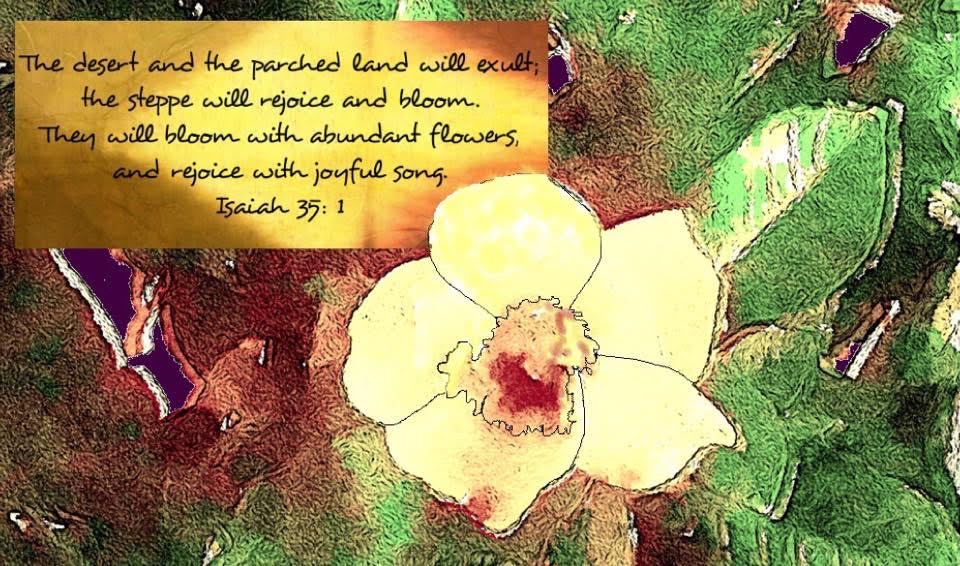
Today, in our first magnificent reading from the poet-prophet Isaiah, we read about the transformation God can accomplish even over the most broken and desolated landscapes. Isaiah encourages us to exuberant hope:

Strengthen the hands that are feeble,
make firm the knees that are weak,
Say to those whose hearts are frightened:
Be strong, fear not!
Here is your God,
coming with vindication;
With divine recompense –
coming to save you.

Isaiah 35: 3-4

In our Gospel, Jesus transfigures both the inner and outer “landscape” of a young paralytic who has good and creative friends.

And some men brought on a stretcher a man who was paralyzed;
they were trying to bring him in and set him in his presence. 
But not finding a way to bring him in because of the crowd,
they went up on the roof
and lowered him on the stretcher through the tiles
into the middle in front of Jesus. 
When Jesus saw their faith, he said,
“As for you, your sins are forgiven.” 

Luke 5: 18-20

Our psalm reflects the transformative power in both readings as we pray:

I will hear what God proclaims;
the LORD – who proclaims peace to the people.
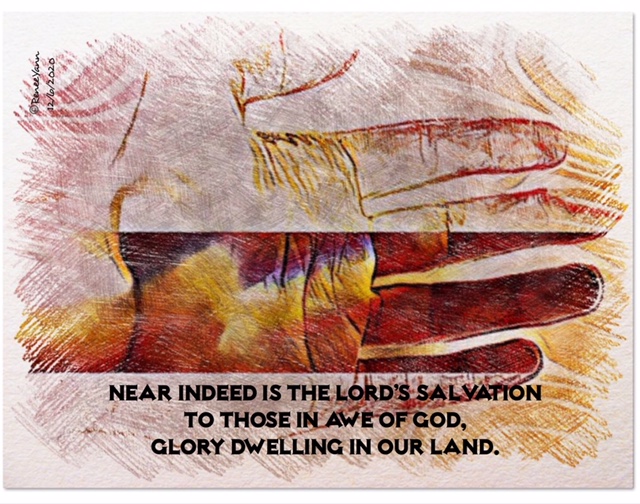
Near indeed is salvation to those who reverence God,
glory dwelling in our land.

Psalm 85:9-10

“Glory dwelling in our land”
– the land of our earth,
and the land of our hearts.
Let’s hope for it, believe it,
invite it in our prayer today.

Poetry: Rumi

And you?
When will you begin
that long journey into yourself?
Why do you stay in prison
when the door is so wide open?

Music: Handel: Then Shall the Eyes of the Blind Be Opened / He Shall Feed His Flock

Psalm 85: Near But Not Yet

Second Sunday of Advent

December 6, 2020

Today, in God’s Lavish Mercy, we pray with Psalm 85 which, sprinkled heavily with “will”s and “shall”s, is written almost completely in the future tense.

This psalm, though filled with hope, is italicized with a sense of “then, but not just yet”. In the midst of a long waiting, it fuels our patience with words like “near”:

I will hear what God proclaims;
the LORD— who proclaims peace to the people.
Near indeed is salvation to those who are awed by the Lord,
glory dwelling in our land.

Psalm 85: 9-10

Oh, my! Do we know how that long patience feels? 

The feeling recalls my Dad’s answer on any long journey when I repeatedly queried, “Are we there yet.”

Not yet. But near.
Not now. But soon.

The whole world shares a similar feeling right now. As we see the promise of a vaccine rising on the horizon, we still live in the worry and isolation of this pandemic. Are we safe yet?

Not yet. But near.
Not now. But soon.


Let us not miss the practical lessons nor the spiritual ones that emerge as we read the psalmist’s ancient words in our current stressful times.

The practical lessons for our situation are clear:

  • a vaccine is near
  • be patient, prepare
  • mask up
  • wash hands
  • stay home if possible
  • respect your bubble and everyone else’s

Some of the spiritual inspirations might be these.

  • Amazing Grace is always near to us
  • be patient, prepare
  • learn from your solitude
  • clear your spirit of any impediments to grace
  • find your home in God’s Presence
  • rest in that Presence until you are renewed

The psalm assures us that God is with us; that the Sacred Presence will appear as we open our eyes to God’s justice and mercy.

The LORD  will give us benefits;
our land shall yield its increase.
Justice shall walk before the Lord
and prepare the way of God’s steps.

Psalm 85: 13-14

Isaiah and Mark direct our hearts to the voice of the prophet John the Baptist who proclaims, “Prepare a way for the Lord!” That’s how near God is! Just on the other side of our soul’s expectation.

In our second reading, Peter reminds us of how to be ready for the moment when  “soon” becomes “now”.

But according to God’s promise
we await new heavens and a new earth
in which righteousness dwells.
Therefore, beloved, since you await these things,
be eager to be found without spot or blemish before the Lord, at peace.

2 Peter 3:13-14

Poetry: ADVENT (On a Theme by Dietrich Bonhoeffer) by Pamela Cranston

Look how long
the tired world waited,
locked in its lonely cell,
guilty as a prisoner.

As you can imagine,
it sang and whistled in the dark.
It hoped. It paced and puttered about,
tidying its little piles of inconsequence.

It wept from the weight of ennui
draped like shackles on its wrists.
It raged and wailed against the walls
of its own plight.

But there was nothing
the world could do
to find its freedom.

The door was shut tight.
It could only be opened
from the outside.

Who could believe the latch
would be turned by the flower
of a newborn hand?

Music: Soon and Very Soon written and sung by Andraé Crouch, accompanied here by Jessy Dixon

Andraé Edward Crouch (July 1, 1942 – January 8, 2015) was an American Gospel singer, songwriter, arranger, record producer and pastor. Referred to as “the father of modern gospel music” by gospel music professionals.

Jessy Dixon (March 12, 1938 – September 26, 2011) was an American Gospel music singer, songwriter, and pianist, with success among audiences across racial lines. He garnered seven Grammy Award nominations during his career.

Psalm 147: Jesus- God’s Lullaby

Saturday of the First Week of Advent

December 5, 2020


Today, in God’s Lavish Mercy, we pray with Psalm 147 coming after the consoling passage from Isaiah:

O my people,
no more will you weep;
I will be gracious to you when you cry out,
as soon as I hear you, I will answer.

Isaiah 30:19

Our readings today assure us that God sees and cares about our suffering. Like a mother who sings to a crying child, God wants to comfort us.

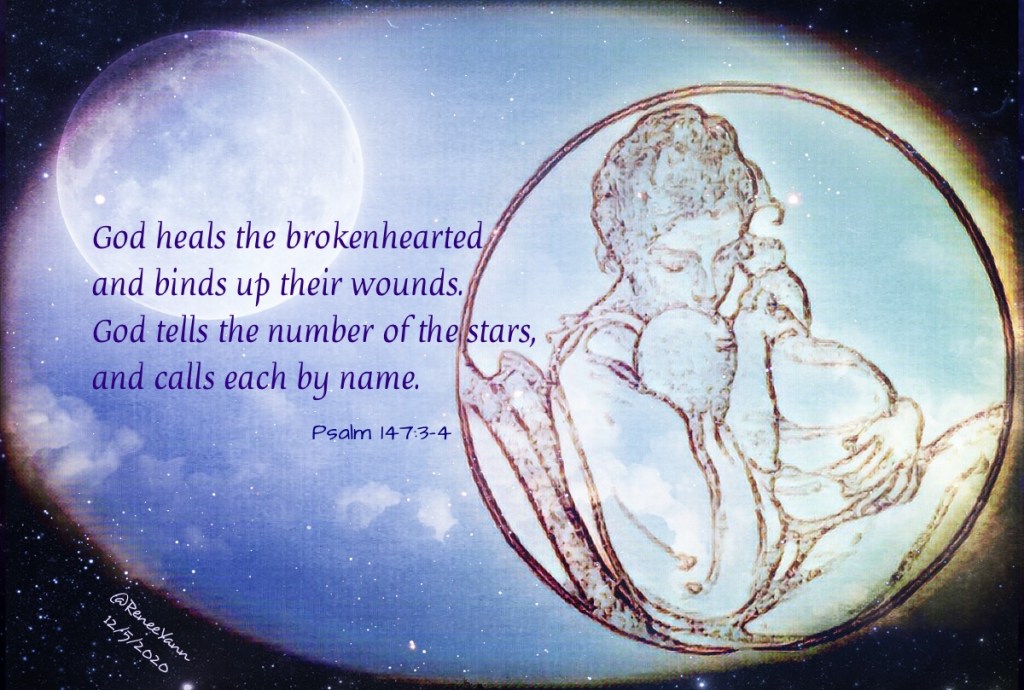
God heals the brokenhearted
and binds up their wounds.
God tells the number of the stars;
calling each by name.

Psalm 147: 3-4

God’s lullaby is Jesus Christ. In Jesus, our Creator sings over us the melody of Infinite Love and Mercy. All we need do is calm ourselves and listen. 

Jesus is the Divine Song.
He sings God’s Mercy over all who suffer.

At the sight of the crowds,
Jesus’s heart was moved with pity for them
because they were troubled and abandoned.

Matthew 9:36

All of us, at some time in our lives, stand amidst the troubled crowd. Our friends and family members too stand there at times.

Today, as we pray Psalm 147, let us place all our troubles, and theirs, in the loving embrace of God who sings the lullaby of Jesus over us.


Poetry: from Rumi

Every midwife knows
that not until a mother's womb
softens from the pain of labour
will a way unfold
and the infant find that opening to be born.
 
Oh friend! 
There is treasure in your heart, 
it is heavy with child.

Listen.

All the awakened ones, 
like trusted midwives are saying, 
'welcome this pain.'
It opens the dark passage of Grace.

Music: Quietly – Jay Stocker

Psalm 27: How to Wait!

Friday of the First Week of Advent

December 4, 2020


Today, in God’s Lavish Mercy, we pray with Psalm 27 with its glorious opening salvo:

The Lord is my light and my salvation.
Of whom should I be afraid?


 Psalm 27 reminds us that, amidst all the fluster of life, there is only one thing that matters:

One thing I ask of the LORD;
this I seek:
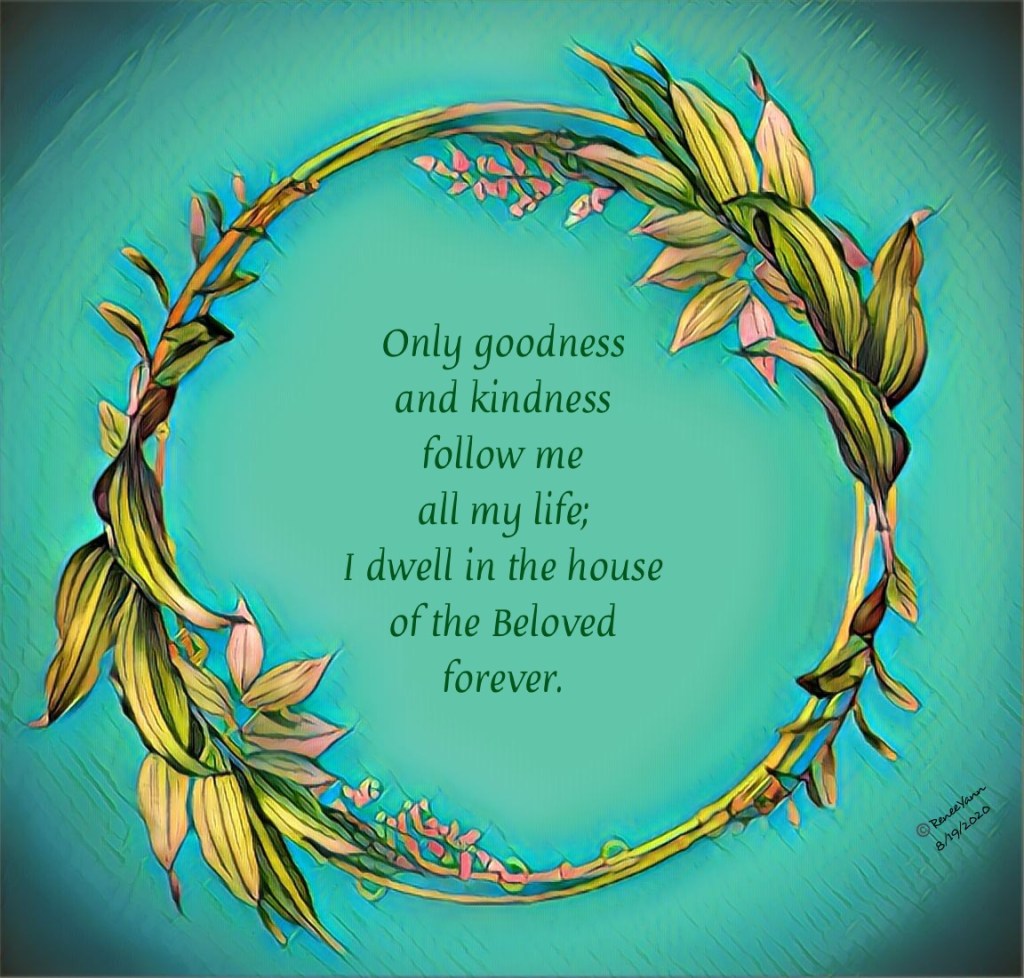
To dwell in the house of the LORD
all the days of my life,
That I may gaze on the loveliness of the LORD
and contemplate his temple.

Psalm 27:4

The hard part, as the psalmist tells us, is to wait – not just to wait for heaven at the end of it all – but to wait to discover God in each moment. 

I find waiting to be pretty challenging, especially when I’m waiting for something over which I have no control.

Sometimes God seems pretty buried in our lives and in the clamor of the world. It’s tough to wait with hope when we just can’t see the Beloved.


But our psalm charges us to practice hopeful waiting for the grace that comes to us in every moment.

May we wait with courage, hope, and confidence for the gift God eternally gives us.


Poem: from Awed to Heaven, Rooted to Earth by Walter Brueggemann 

In our secret yearnings
we wait for your coming,
and in our grinding despair
we doubt that you will.

And in this privileged place
we are surrounded by witnesses who yearn more than do we
and by those who despair more deeply than do we.

Look upon your church and its pastors
in this season of hope
which runs so quickly to fatigue
and this season of yearning
which becomes so easily quarrelsome.

Give us the grace and the impatience
to wait for your coming to the bottom of our toes,
to the edge of our finger tips.

We do not want our several worlds to end.
Come in your power
and come in your weakness
in any case and make all things new.
Amen.

Music: Waiting – by Isisip

Psalm 118: Inside the Gate

Memorial of Saint Francis Xavier, Priest

December 3, 2020


Today, in God’s Lavish Mercy,
we pray with Psalm 118
which describes the Lord’s strong city
and the gate which protects it.

Our opening passage from Isaiah exults in this Divine Strength, asking to be embraced  within its sacred space:

A strong city have we;
the Lord sets up walls and ramparts to protect us.
Open up the gates
to let in a nation that is just,
one that keeps faith.

Isaiah 26: 1-2

Jesus, in our Gospel, tells us that inclusion in the sanctuary must be merited by those who understand that God’s Will is for justice over all Creation:

Not everyone who says to me, ‘Lord, Lord,’
will enter the Kingdom of heaven,
but only the one who does the will of my Father in heaven.

Matthew 7: 21

Thus we, longing to be among the included, we pray this Advent psalm:

Open to me the gates of justice;
I will enter them and give thanks to the LORD.
This gate is the LORD’s;
the just shall enter it.
I will give thanks to you, for you have answered me
and have been my savior.

Psalm 118: 19-21

As I meditate on these thoughts, our Motherhouse property offers many “icons” to reflect upon the concept of the “gate”. The entire campus is enclosed by various types of fencing or walls. There are four gates through which one may pass into the complex.

early photo of Motherhouse main gate , Montgomery County Historical Society. The open gate is barely visible against the small pine tree on the left of the opening.

I imagine that, when first installed, these great gates offered a more formidable enclosure than they do today. Only the wrought iron hinges remain of the main gate’s  double swing panels. Yet these, driven into imposing stone pillars, still suggest the firm purpose to create a sacred space.

You will notice the open gate just under the right side of the big tree

Inside the property, another wrought iron enclosure surrounds the community cemetery. This fence’s two gates are usually open, demonstrating that their purpose too is not security but rather sacred designation.

These venerable gates, rather than castle-like ramparts, are more like torii, those traditional Japanese gates found at the entrance or within a Shinto shrine where they symbolically mark the transition from the mundane to the sacred.

The famous torii at Itsukushima Shrine, Hiroshima, Japan

During Advent, we slowly pass through such a sacred symbolic gate, once again entering the holy mystery who is Jesus Christ. We pray to be transformed, not simply by the retelling of his story, but by the Living Grace he is for us in our own lives.

With today’s powerful readings, we pray to enter more deeply into that Mystery.


Poetry: Endless Time – Tagore

Time is endless in thy hands, my lord.
There is none to count thy minutes.
Days and nights pass and ages bloom and fade like flowers.

Thou knowest how to wait.
Thy centuries follow each other perfecting a small wild flower.

We have no time to lose,
and having no time we must scramble for a chance.
We are too poor to be late.

And thus it is that time goes by
while I give it to every querulous person who claims it,
and thine altar is empty of all offerings to the last.

At the end of the day I hasten in fear lest thy gate be shut;
but I find that yet there is time.

Music: Huanqiutan Garden – Oliver Shanti 

Psalm 23: Awake to the Feast

Wednesday of the First Week of Advent

December 2, 2020


Today, in God’s Lavish Mercy, we pray with Psalm 23. On this first Wednesday of Advent, our psalm is set between two eloquent readings about the full satisfaction of our soul’s hungers.

Isaiah blesses us with his metaphor for Heaven’s abundance, when our souls will be filled to a divine capacity of grace.

In a world already redeemed, Isaiah’s vision has been fulfilled. We live our lives already seated at the banquet he describes.

But do we realize it? Do we partake every moment in the outpouring of grace given us by our Baptism into Christ?

Unaware, many of us sit at the table starving.

In our Gospel, Jesus sees the deeper hungers of the fatigued crowd. His miracle feeds their bodies but, more importantly, awakens their souls to see him as the fulfillment of God’s promise. Isaiah’s prophecy is accomplished in Jesus:

On that day it will be said:
Behold our God, to whom we looked to save us!
This is the LORD for whom we looked;
let us rejoice and be glad that he has saved us!”
For the hand of the LORD will rest on this mountain.

Isaiah 26:9-10

As we read Psalm 23 today, let’s allow its consoling verses to become our prayer of trust and gratitude for God’s “already presence” in our lives. Like the crowd awakened by Jesus’s miracle, let us open our eyes to the infinite grace spread before us, though wrapped sometimes in the mundane circumstances of our lives.


Poetry: Joy Harjo – Perhaps the World Ends Here

The world begins at a kitchen table. No matter what, we must eat to live.

The gifts of earth are brought and prepared, set on the table. So it has been since creation, and it will go on.

We chase chickens or dogs away from it. Babies teethe at the corners. They scrape their knees under it.

It is here that children are given instructions on what it means to be human. We make men at it, we make women.

At this table we gossip, recall enemies and the ghosts of lovers.

Our dreams drink coffee with us as they put their arms around our children. They laugh with us at our poor falling-down selves and as we put ourselves back together once again at the table.

This table has been a house in the rain, an umbrella in the sun.

Wars have begun and ended at this table. It is a place to hide in the shadow of terror. A place to celebrate the terrible victory.

We have given birth on this table, and have prepared our parents for burial here.

At this table we sing with joy, with sorrow. We pray of suffering and remorse. We give thanks.

Perhaps the world will end at the kitchen table, while we are laughing and crying, eating of the last sweet bite.

Music: Psalm 23 – Stuart Townend

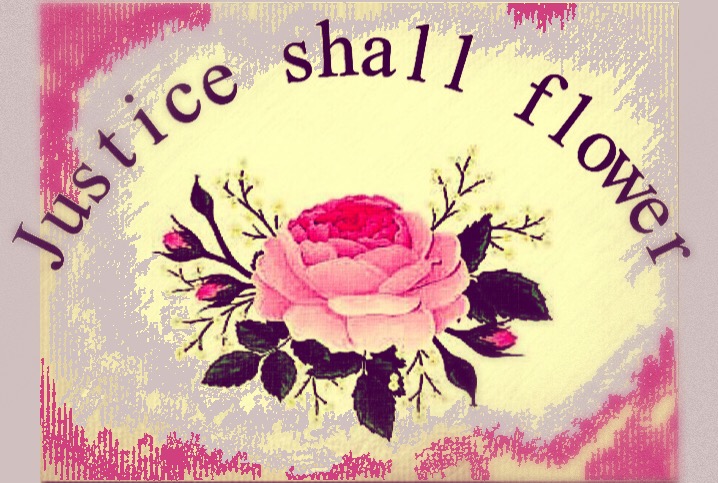
Psalm 72: Justice Shall Flower

Tuesday of the First Week of Advent

December 1, 2020


Today, in God’s Lavish Mercy, we pray with Psalm 72 which sings with Advent expectation and hope. How beautiful to hear its tones once again and to realize that God has carried us through another year.

With Psalm 72, God tells us it is time to begin again – and this time, because of all the past year has taught us, to more fully abandon our hearts to the fidelity God promises. 

Our God and King comes eternally to us
in new waves of revelation.
God’s faithful promise continues
for whatever the coming year unfolds.

O God, with your judgment endow the king,
and with your justice, the king’s son;
He shall govern your people with justice
and your afflicted ones with judgment.

Psalm 72: 1-2

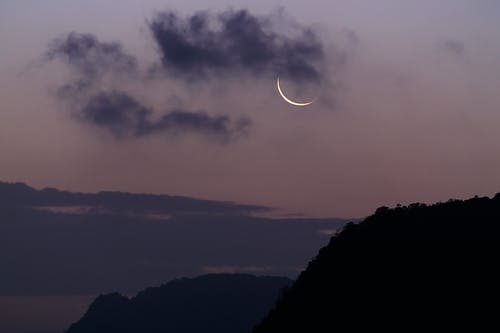
Our psalm invites us to see Creation as God sees it, an eternal relationship which endures in peace even beyond the moon’s final setting. That eternal promise brings profound peace. God, who is Infinite Mercy, loves us beyond boundaries, beyond circumstance, beyond time.

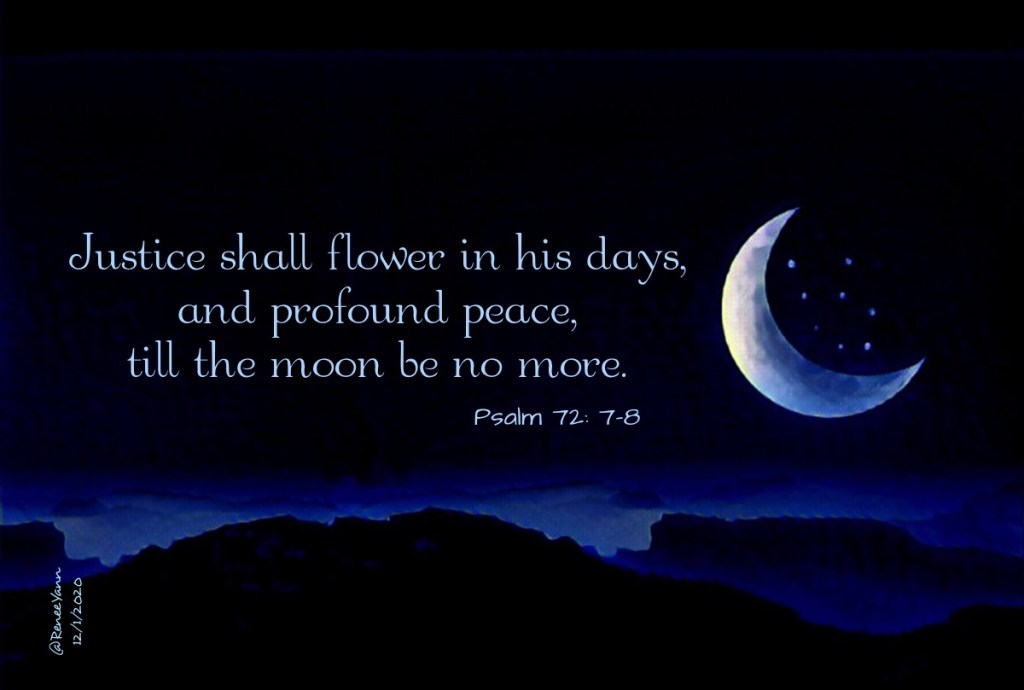
Justice shall flower in his days,
and profound peace, till the moon be no more.
May he rule from sea to sea,
and from the River to the ends of the earth.

Psalm 72: 7-8

Jesus is the Promise Fulfilled. In him, Infinite Mercy enfleshes justice for the humble and poor.

He shall rescue the poor one who cries out,
and the afflicted when there is no one to help.
He shall have pity for the lowly and the poor;
the lives of the poor he shall save.

Psalm 72: 12-13

Advent patiently teaches us to recognize such salvation and peace. It is not revealed in miracles, but rather in the enduring power of hope, trust and gratitude. Jesus is our salvation and peace. The cyclic retelling of his life, death and resurrection invites us to deepen our own journey once again this Advent.

May his name be blessed forever;
as long as the sun his name shall remain.
In him shall all the tribes of the earth be blessed;
all the nations shall proclaim his happiness.

Psalm 72: 17

Poetry: Advent Calendar by Rowan Williams, a Welsh Anglican bishop, theologian and poet. He was the 104th Archbishop of Canterbury, a position he held from December 2002 to December 2012.

He will come like last leaf’s fall.
One night when the November wind
has flayed the trees to bone, and earth
wakes choking on the mould,
the soft shroud’s folding.
He will come like frost.
One morning when the shrinking earth
opens on mist, to find itself
arrested in the net
of alien, sword-set beauty.
He will come like dark.
One evening when the bursting red
December sun draws up the sheet
and penny-masks its eye to yield
the star-snowed fields of sky.
He will come, will come,
will come like crying in the night,
like blood, like breaking,
as the earth writhes to toss him free.
He will come like child.

Music: O Come, Divine Messiah
Words: Abbé Simon J. Pellegrin, 1663-1745
English Translation of French Carol “Venez Divin Messie”
Translator: Sister Mary of St. Philip, SND
Melody: 16th Century French Carol

The English translation of “Venez, divin Messie” beginning “O come, divine Messiah” is by Sister Mary of St. Philip, SND, the name in religion of Mary Frances Lescher (1825-1904). She was one of the first English members of the Sisters of Notre Dame de Namur when they established their training college at Mount Pleasant in Liverpool, England, in about 1850. She and at least one other SND sister wrote both translations and original hymns and songs over the course of their long professional lives.

from John Uhrig’s letter to Douglas D. Anderson, Founder of the website “The Hymns and Carols of Christmas”

Psalm 80: Advent Turns Us Toward God

The First Sunday of Advent
November 29,2020


Today, in God’s Lavish Mercy, we pray with Psalm 80, an urgent call to a God from whom the psalmist has turned away.

How do we get to the point that we are turned away from God? And how do we correct that? Well, that’s what Advent is all about, and our psalm today gives us some hints about a remedy.


First: Disconnection 

Sometimes with God, as with any relationship, we simply get disconnected. It’s as if the the phone lines go down and we don’t bother to fix them.

We pray less – well, you know, because we’re busy, right?

We lose the “holy intention” in our lives to always be with God and for God, even in our choices and actions.

Advent helps us remember that such “holy intention” can only be charged by our connection to God. Advent turns us to call that Power into our lives.

O shepherd of Israel, hearken,
from your throne upon the cherubim, shine forth.
Rouse your power,
and come to save us.


Second: Confusion 

Other times, we are confused about our soul’s intimate relationship with God. We haven’t forgotten it. Actually, we work very hard to be what we think God wants. We, like a satisfied Pharisee, think our “holiness” is the fruit of our own efforts. But our life in God withers, like a once beautiful plant that languishes, overwatered and scorched. For all our efforts, our souls feel empty.

Advent helps us realize that it is God who enlivens the vine and gives the blossom, not us. Advent turns us to a humble, hopeful waiting for grace as God desires to give it.

Once again, O LORD of hosts,
look down from heaven, and see;
take care of this vine,
and protect what your right hand has planted
the son of man whom you yourself made strong.


Third: Withdrawal 

Our psalm recognizes that, at times, we withdraw from God. Perhaps we tire of working at our spiritual life. Or we weary when our works of mercy go unappreciated. Or we fail to find God’s Presence in a prayer that seems unanswered.

Advent helps us see that God is never the one who withdraws from the work of love. We do.

Advent turns us to new life by the simple calling of the Name that never fails to answer.

May your help be with the creature of your right hand,
with the beloved whom you yourself made strong.
Then we will no more withdraw from you;
give us new life, and we will call upon your name.

As we begin this Advent journey
that can so deepen us in grace and love,
let us humbly place in God’s hands
anything in our lives that needs “turning”.

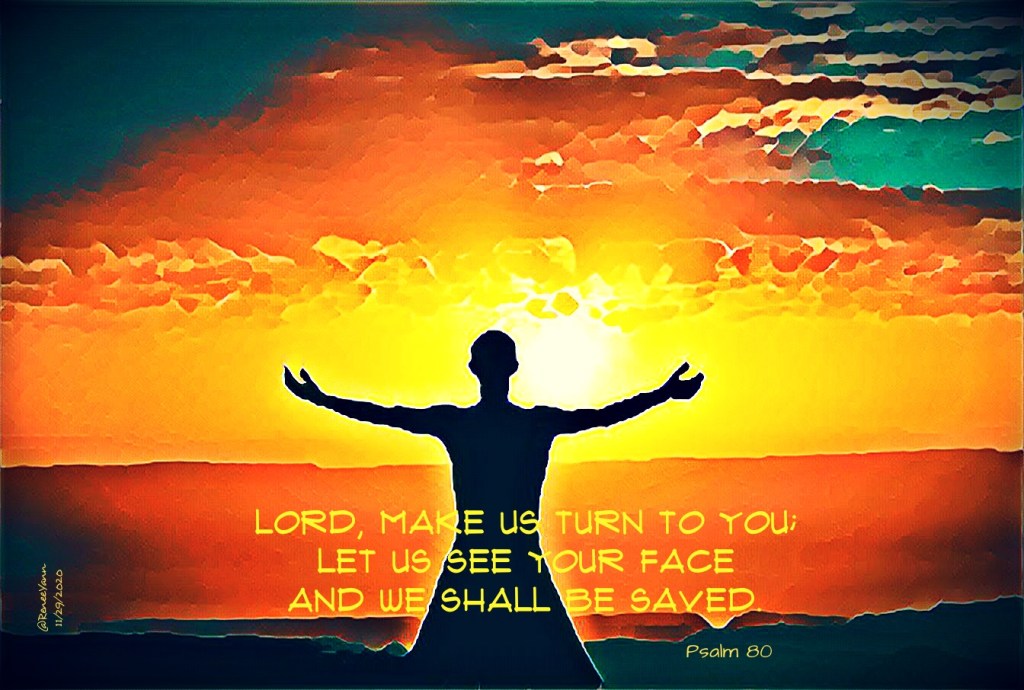
Lord, make us turn to you;
let us see your face and we shall be saved.


Poetry: Tagore – THE INFINITY OF YOUR LOVE

Stand before my eyes, 
and let Your glance touch my songs into a flame.

Stand among Your stars, 
and let me find kindled in their lights my own fire of worship.

The earth is waiting at the world’s wayside.
Stand upon the green mantle she has flung upon Your path, 
and let me in her grass and meadow flowers spread my own salutation.

Stand in my lonely evening where my heart watches alone; 
fill her cup of solitude, 
and let me turn my heart toward the infinity of Your love.

Music: Turn Around, Look at Me

Psalm 95: Advent’s Threshold

Saturday of the Thirty-fourth Week in Ordinary Time

November 28, 2020


Today, in God’s Lavish Mercy, we pray with Psalm 95. As we pray its laudatory verses, we are invited to stand on the very threshold of Advent.

Come, let us sing joyfully to the LORD;
let us acclaim the Rock of our salvation.
Let us come into the Lord’s presence with thanksgiving;
let us joyfully sing psalms to our God.


Even though the pre-dawn sky seems essentially unchanged, we can sense the First Light waiting to spring over the horizon. And, oh, how we long for it! How we need it to illuminate the shadows of this pandemic year, to warm the long cold of separation and loss, to fill the stunned silence of our hearts with a new rising song!

For the LORD is a great God,
and a great king above all gods;
God holds the depths of the earth,
and the tops of the mountains
like jewels in a loving hand.
God made and owns the sea
and the dry land, forming them from the Divine Imagination!


We join the whole Church as we pray today’s psalm refrain:

We ask God to prepare Advent’s doors in our hearts and spirits. It is time to be renewed in faith, hope, and love. Over the coming season, God will guide us to that longed-for Light. 

So for this last pre-Advent day:

Come, let us bow down in worship;
let us kneel before the LORD who made us,
who is our God,
and we are the people Love shepherds, 
the flock Love guides.


Poetry: Advent Credo by Allan Boesak

It is not true that creation and the human family are doomed to destruction and loss—
This is true: For God so loved the world that He gave his only begotten Son, that whoever believes in Him shall not perish but have everlasting life;

It is not true that we must accept inhumanity and discrimination, hunger and poverty, death and destruction—
This is true: I have come that they may have life, and that abundantly.

It is not true that violence and hatred should have the last word, and that war and destruction rule forever—
This is true: Unto us a child is born, unto us a Son is given, and the government shall be upon his shoulder, his name shall be called wonderful councilor, mighty God, the Everlasting, the Prince of peace.

It is not true that we are simply victims of the powers of evil who seek to rule the world—
This is true: To me is given authority in heaven and on earth, and lo I am with you, even until the end of the world.

It is not true that we have to wait for those who are specially gifted, who are the prophets of the Church before we can be peacemakers—
This is true: I will pour out my spirit on all flesh and your sons and daughters shall prophesy, your young men shall see visions and your old men shall have dreams.

It is not true that our hopes for liberation of humankind, of justice, of human dignity of peace are not meant for this earth and for this history—
This is true: The hour comes, and it is now, that the true worshipers shall worship God in spirit and in truth.

So let us enter Advent in hope, even hope against hope. Let us see visions of love and peace and justice. Let us affirm with humility, with joy, with faith, with courage: Jesus Christ—the life of the world.

From Walking on Thorns, by Allan Boesak, Eerdmans, 2004.

Music: Threshold – Adam Hurst