Monday of the Fourth Week of Easter

April 26, 2021


Today, in God’s Lavish Mercy, we pray with Psalm 42, the only psalm that opens with a simile, and it is a memorable one:

As the deer longs for streams of water,
so my soul longs for you, O God.

Psalm 42:2

One pictures the psalmist crossing a desert-like expanse, longing for water. A deer wanders across the distance, also showing the effects of a deep, physical thirst. The psalmist is moved by the sight to consider a deeper thirst, that profound longing for God’s consolation and grace.

Athirst is my soul for God, the living God.
    When shall I go and behold the face of God?


Not included in today’s Responsorial Psalm is this stark verse which gives us insight into the depth of the psalmist’s longing. This soul is not just thirsty, but rather desperate to imbibe Grace, yearning to slake a nearly disabling aridity.

My tears have been my bread day and night,
as they ask me every day, “Where is your God?”

Psalm 42: 4A

Psalm 42 is a powerful poem with a deep psychological message about relationship with God, particularly when that relationship suffers shadows.

Luis Alonso Schökel, SJ, professor at the Pontifical Biblical Institute in Rome, offers insight into this depth that may enlighten our own prayer:

(In Psalm 42) the manner of God’s presence is awareness of his absence. Absence which is not noticed nor deeply felt is a simple absence which causes no grief. But absence which is felt is a means of being present in the consciousness, bringing anxiety and grief.

Paradoxically, the taunts of the enemies sharpen the sensation of God’s absence and thus,in the form of nostalgia, increase the sense of God’s presence.

The presence of God in the psalm is pervasive, God’s relationship with the psalmist personal and intimate. This means to say that God communicates most intensely by creating an awareness of his absence (as in the book of Job, throughout the entire construction of the poem on two levels, and explicitly in ch. 23). If communion with God is the meaning of worship, it is difficult to deny that the psalmist worships “in spirit and in truth”…

…With its wealth of structure, its dynamics, its lyrical and dramatic intensity, this psalm exceeds mere classification. In the theme of the eclipse of God and in the lucid consciousness which expresses this theme, the psalm is of especial relevance to our time.

from The Poetic Structure of Psalm 42-43

Music: Quemadmodum (As the hart desireth the waterbrooks…) – John Taverner

In finem. Intellectus filiis Core.
2  Quemadmodum desiderat cervus ad fontes aquarum, ita desiderat anima mea ad te, Deus.
3  Sitivit anima mea ad Deum fortem, vivum; quando veniam et apparebo ante faciem Dei?
4  Fuerunt mihi lacrimae meae panis die ac nocte, dum dicitur mihi quotidie: Ubi est Deus tuus?
5  Haec recordatus sum, et effudi in me animam meam, quoniam transibo in locum tabernaculi admirabilis, usque ad domum Dei, in voce exsultationis et confessionis sonus epulantis.
6  Quare tristis es, anima mea? et quare conturbas me? Spera in Deo, quoniam adhuc confitebor illi, salutare vultus mei,
7  et Deus meus. Ad meipsum anima mea conturbata est: propterea memor ero tui de terra Jordanis et Hermoniim a monte modico.
8  Abyssus abyssum invocat, in voce cataractarum tuarum; omnia excelsa tua, et fluctus tui super me transierunt.
9  In die mandavit Dominus misericordiam suam, et nocte canticum ejus; apud me oratio Deo vitae meae.
10  Dicam Deo: Susceptor meus es; quare oblitus es mei? et quare contristatus incedo, dum affligit me inimicus?
11  Dum confringuntur ossa mea, exprobraverunt mihi per singulos dies: Ubi est Deus tuus?
12  Quare tristis es, anima mea? et quare conturbas me? Spera in Deo, quoniam adhuc confitebor illi, salutare vultus mei, et Deus meus.

1  Like as the hart desireth the water-brooks: so longeth my soul after thee, O God.
2  My soul is athirst for God, yea, even for the living God: when shall I come to appear before the presence of God?
3  My tears have been my meat day and night: while they daily say unto me, Where is now thy God?
4  Now when I think thereupon, I pour out my heart by myself: for I went with the multitude, and brought them forth into the house of God;
5  In the voice of praise and thanksgiving: among such as keep holy-day.
6  Why art thou so full of heaviness, O my soul: and why art thou so disquieted within me?
7  Put thy trust in God: for I will yet give him thanks for the help of his countenance.
8  My God, my soul is vexed within me: therefore will I remember thee concerning the land of Jordan, and the little hill of Hermon.
9  One deep calleth another, because of the noise of the water-pipes: all thy waves and storms are gone over me.
10  The Lord hath granted his loving-kindness in the day-time: and in the night-season did I sing of him, and made my prayer unto the God of my life.
11  I will say unto the God of my strength, Why hast thou forgotten me: why go I thus heavily, while the enemy oppresseth me?
12  My bones are smitten asunder as with a sword: while mine enemies that trouble me cast me in the teeth;
13  Namely, while they say daily unto me: Where is now thy God?
14  Why art thou so vexed, O my soul: and why art thou so disquieted within me?
15  O put thy trust in God: for I will yet thank him, which is the help of my countenance, and my God.

Fourth Sunday of Easter

April 25, 2021


Today, in God’s Lavish Mercy, we pray with Psalm 118.

 “This psalm is centered on God, in a movement that expresses gratitude, admiration, joy and praise. In the King James Version, the Lord is mentioned in almost every verse.” (Wikipedia)

Give thanks to the LORD who is good,
    whose mercy endures forever.
It is better to take refuge in the LORD
    than to trust in humans.
It is better to take refuge in the LORD
    than to trust in princes.

Psalm 118: 1, 8-9

Following our first reading today, the psalm focuses me on God’s Name – often “Lord”, as in the psalm – but also so many other Names of God from the riches of scripture and tradition.

… in the Name of Jesus, this man stands before you healed.
He is the stone rejected by you, the builders,
    which has become the cornerstone.
There is no salvation through anyone else,
nor is there any other name under heaven
given to the human race by which we are to be saved.

Acts 4: 10-12

The fact that we have so many names for God reminds me of how accommodating God is to my need as I pray. 

One day I need “My Rock”.

Another day I delight in “My Dayspring”.

As I wake up each morning and allow the day to embrace me, I often greet God with a special name, depending on the mood and circumstances of my heart:

  • Good morning, Beautiful Light. Take any darkness from our world this day.
  • I greet You, Sweet Lord. Thank you for the delicious gift of life.
  • Cloudy God, you have been hiding from me. Bring me into your Sunshine today.
  • God, my Strong Shoulder, stand by me today.
  • Chilly God, seeming to ignore my prayer, unfreeze my spirit to hear your answer.

Jesus invites us to pray with images that speak to our hearts. In our Gospel, He names himself a Shepherd, an image so accessible to his agrarian listeners, and which said it all without the need for theology!

Jesus said:
“I am the good shepherd.
A good shepherd lays down his life for the sheep.”

John 10:11

As we pray today, within what image is God coming to us? May we let the Holy One speak a sanctifying and special Name over us in our prayer. May it free us just as it freed the man healed in today’s passage from Acts.


Poetry: Six Recognitions of the Lord – Mary Oliver

1.

I know a lot of fancy words.

I tear them from my heart and my tongue.

Then I pray…..

3
I lounge on the grass, that’s all. So
simple. Then I lie back until I am
inside the cloud that is just above me
but very high, and shaped like a fish.
Or, perhaps not. Then I enter the place
of not-thinking, not-remembering, not-
wanting. When the blue jay cries out his
riddle, in his carping voice, I return.
But I go back, the threshold is always
near. Over and back, over and back. Then
I rise. Maybe I rub my face as though I
have been asleep. But I have not been
asleep. I have been, as I say, inside
the cloud, or, perhaps, the lily floating
on the water. Then I go back to town
to my own house, my own life, which has
now become brighter and simpler, some-where I have never been before….

4.

Of course I have always known you

Are present in the clouds, and the

Black oak I especially adore, and the

Wings of birds. But you are present

Too in the body, listening to the body,

Teaching it to live, instead of all

That touching, with disembodied joy.

We do not do this easily….


6.

Every summer the lilies rise
and open their white hands until they almost
cover the black waters of the pond. And I give
thanks but it does not seem like adequate thanks,
it doesn’t seem
festive enough or constant enough, nor does the
name of the Lord or the words of thanksgiving come
into it often enough Everywhere I go I am
treated like royalty, which I am not. I thirst and
am given water. My eyes thirst and I am given
the white lilies on the black water. My heart
sings but the apparatus of singing doesn’t convey
half what it feels and means. In spring there’s hope,
in fall the exquisite, necessary diminishing, in
winter I am as sleepy as any beast in its
leafy cave, but in summer there is
everywhere the luminous sprawl of gifts,
the hospitality of the Lord and my
inadequate answers as I row my beautiful, temporary body
through this water-lily world.


Music: Two Songs for today

Kyrie – Michael Hoppé

Kyrie Eleison
Lord, have Mercy


For those who might want to take it up a notch:
Kyrie – Mr. Mister

Saturday of the Third Week of Easter

April 24, 2021

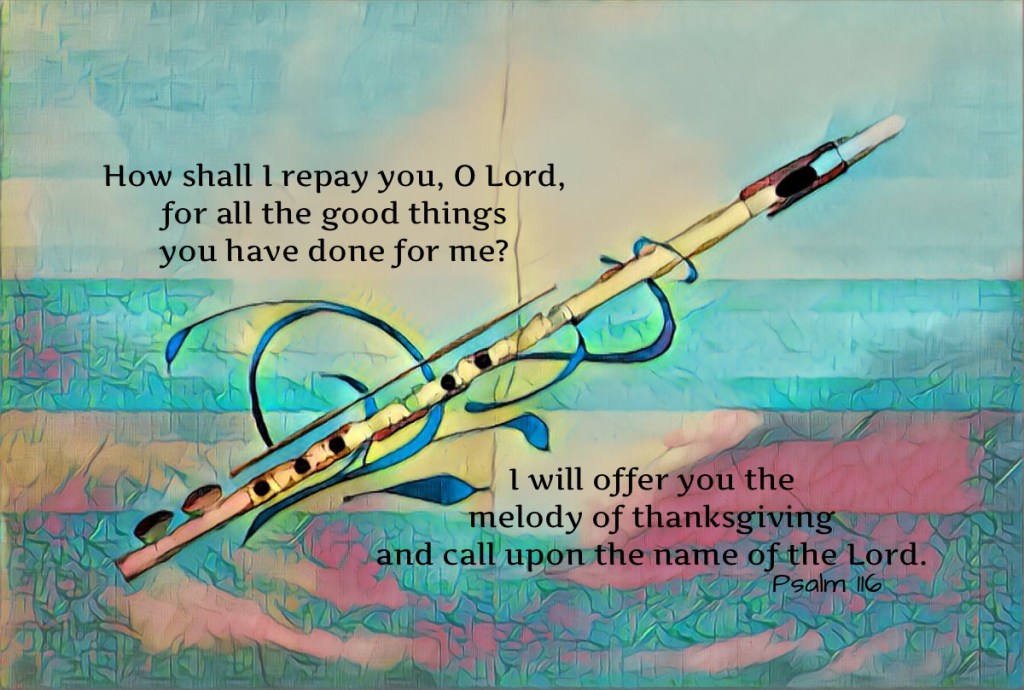
Today, in God’s Lavish Mercy, we pray with Psalm 116. Today’s verses are such a lovely prayer of recognition and thanksgiving for God’s goodness.

Praying with this phrase this morning, I realized that there is no adequate answer to the psalmist’s question. We could never repay the munificence of God.

What we can do is to allow God’s Lavish Mercy to flow through our lives returning praise for God’s love. 

My vows to the LORD I will pay
    in the presence of all his people.
Precious in your eyes, O Lord,
    is the living and dying of your faithful ones.

Psalm 116: 14-15

All that we are and have, in life and death,
is through God’s graciousness.
Living out of that understanding changes everything.


Poetry: Little Flute- Tagore

You have made me endless, 
such is Your pleasure. 
This frail vessel You empty again and again, 
and fill it ever with fresh life. 
This little flute of a reed 
You have carried over hills and dales, 
and have breathed through it 
melodies eternally new. 
At the immortal touch of Your hands,
my little heart loses its limits in joy 
and gives birth to utterance ineffable. 
Your infinite gifts come to me 
only on these very small hands of mine. 
Ages pass, and still You pour, 
and still there is room to fill.

Music: Beautiful Dream – Zamfir

Thursday of the Third Week of Easter

April 22, 2021


Today, in God’s Lavish Mercy, we pray with Psalm 66, a hymn of rousing gratitude for God’s loving and responsive protection.

Bless our God, you peoples,
    loudly sound his praise;
God has given life to our souls,
    and has not let our feet slip.

Psalm 66: 8-9

The psalmist encourages us to let people know that we recognize God’s presence and grace in our lives always. That Presence may be a gentle, otherwise imperceptible, constant unless we give it voice and honor by our actions.

Hear now, all you who fear God, while I declare
    what God has done for me.
When I appealed to God in words,
    praise was on the tip of my tongue.

Psalm 66: 16-17

Poetry: Come to Dust – Ursula Le Guin

Spirit, rehearse the journeys of the body
that are to come, the motions
of the matter that held you.
Rise up in the smoke of palo santo.
Fall to the earth in the falling rain.
Sink in, sink down to the farthest roots.
Mount slowly in the rising sap
to the branches, the crown, the leaf-tips.
Come down to earth as leaves in autumn
to lie in the patient rot of winter.
Rise again in spring’s green fountains.
Drift in sunlight with the sacred pollen
to fall in blessing.
                                   All earth’s dust
has been life, held soul, is holy.

Music: Bless Our God – John Foley, SJ – I love this beautiful hymn … definitely in my top ten.

Bless our God the Father of Jesus the Lord of our ways. 
Every gift is ours in our life, in the Lord of our days.
 
Refrain:
Praise to his name, we are made for the praise of his glorious name. 
He chose us to be those who trust in his ways.

May our God give light to the eyes of your mind for your days. 
May he give you wisdom and knowledge of him, in his ways. 

Bless our God, he grants us the gifts of our lives in his ways. 
Bless our God, he saved us he gave us the Christ for our days.

Wednesday of the Third Week of Easter

April 21, 2021

Today, in God’s Lavish Mercy, we pray with Psalm 66, the exuberant prayer of those who recognize the beauty of God in their lives. They can see Love’s sacred thread, even when it is woven in subtle tones through the fabric of their lives.

I want to be one of those people, don’t you?

But sometimes, life might not look so beautiful. Surely it didn’t for some of the persecuted  Christians in today’s first reading. And yet they remained faithful and found joy.

Now those who had been scattered went about preaching the word. …
Thus Philip went down to the city of Samaria and proclaimed the Christ to them.
With one accord, the crowds paid attention to what was said by Philip
when they heard it and saw the signs he was doing…
There was great joy in that city.

Acts 8:4-8

Joy is not dependent on circumstances. It is a foundational disposition of those convinced of God’s loving and faithful presence in our lives and in all Creation. It is a gift that accompanies faith, nurtures hope, and impels charity.

It is what our soul looks like when it shouts “Wow!” to God.

Say to God: “How awesome your deeds!
Before your great strength all contradiction cringes.
All the earth falls in worship before you;
they sing of you, sing of your name!”

Psalm 66: 3-4

We can’t just WILL ourselves into this kind of joy. But we can ask for it, pray for it, plead for it.  Such a prayer will turn and open our hearts toward our generous God Who longs to bless us with joy.


Poetry: Joy and Woe – William Blake

Joy and woe are woven fine,
A clothing for the soul divine,
Under every grief and pine,
Runs a joy with silken twine.
It is right it should be so,
We were made for joy and woe,
And when this we rightly know,
Through the world we safely go.

Music: Ode to Joy – Ludwig van Beethoven

Saturday of the Second Week of Easter

April 17, 2021

( A friend posted this on Facebook yesterday. I think it’s such a good thought to begin our prayer.)

Today, in God’s Lavish Mercy, we pray with Psalm 33 in which the psalmist calls on us to sing and dance and SHOUT because God is faithful in keeping promises.

Rejoice in the Lord, you righteous;
it is good for the just to shout praises.
Praise the Lord with the harp;
play to God upon the ten-stringed lyre.
Sing for God a new song;
sound a fanfare with all your skill upon the trumpet.
For the word of the Lord is right,
and all the works of God are sure.
God loves righteousness and justice;
the mercy of the Lord fills the whole earth.

Psalm 33:1-5

In the course of our lives, there are many moments when we want to shout praise to God Who has come through for us in a big way – some gift, resolution, deliverance, insight – that opens our eyes to new life and possibility.

The disciples, tossing about in an uncertain sea, might have felt a little shout coming on when they saw someone walking on the turbulent waters. Can’t you almost hear the astounded “Yippee”s as Jesus assured them it was he?

Translated from the Aramaic 😉

The sea was stirred up
because a strong wind was blowing.
When they had rowed about three or four miles,
they saw Jesus walking on the sea
and coming near the boat,
and they began to be afraid.

John 6:18-20

But Jesus said to them,
“It is I. Do not be afraid.”

John 6: 18-20

As we pray today, we might remember the many times God has walked, unexpected, out of the midst of our storms. We might not be praying in a place where it’s appropriate to SHOUT. So let us take up the ten-stringed lyre of our hearts and quietly sing our gratitude.

Psalm 33:2

Poetry: Where Everything is Music – Rumi

We have fallen into the place
where everything is music.

The strumming and the flute notes
rise into the atmosphere,
and if the whole world's harp
should burn up,
there will still be hidden lyres
playing, playing
 
This singing art
is sea foam.
The graceful movements
come from a pearl
somewhere
on the ocean floor.

Poems reach up like spindrift
and the edge of driftwood
along the beach
wanting, wanting

They derive from a slow
and powerful root
that we cannot see.

Stop the words now.
Open the window
in the center of your chest,
and let the spirits fly
in and out

Music: The Lyre of Megiddo – Peter Pringle

The ancient city of Megiddo is also known as Armageddon. The lyre is made after an image discovered on a piece of ivory that stems from the time of the biblical King David. King David was known to have played a harp, so it is very likely that it was an instrument much like this one.

Tuesday of the Second Week of Easter

April 13, 2021

Today, in God’s Lavish Mercy, we pray with Psalm 93, a resounding song of praise to our majestic God.

As I read the whole psalm, which is brief, I find myself standing at the Atlantic’s edge with my mother. I was just old enough to appreciate the enormity of the ocean. I asked Mom what made the waves stop at our tiptoes. She told me that God held it in place like soup in a big bowl. I remember being glad that God was in charge because the waves seemed awesome to me.


A little personal distraction: My grand-nephews enjoying the ever-awesome ocean


Today’s psalmist seems to share some of these young feelings:

The flood has raised up, LORD;
the flood has raised up its roar;
the flood has raised its pounding waves.

More powerful than the roar of many waters,
more powerful than the breakers of the sea,
powerful in the heavens is the LORD.

Psalm 93:4-5

Set between today’s two readings, our psalm invites us to entrust ourselves completely to this all-powerful God whose merciful rule goes infinitely beyond earth’s seas.

Jesus said to Nicodemus:
“‘You must be born from above.’
The wind blows where it wills, and you can hear the sound it makes,
but you do not know where it comes from or where it goes;
so it is with everyone who is born of the Spirit.”

Dear, questioning Nicodemus struggled a bit to open his heart in complete faith. But he stayed with the struggle until the power of the Resurrection transformed him.


As we pray Psalm 93, we might stand with the psalmist or with Nicodemus at the edge of any ocean which challenges, mystifies, delights or frightens us. May we grow in confidence, as they did, that our eternal, omnipotent God ever reigns with merciful love – over the vastness of Creation and the small intimate waves of our lives.

Your decrees are firmly established;
holiness befits your house, LORD,
for all the length of days.

Psalm 93:5

Poetry: A Hymn – Ann Brontë

Eternal power of earth and air,
Unseen, yet seen in all around,
Remote, but dwelling everywhere,
Though silent, heard in every sound. 

If e'er thine ear in mercy bent
When wretched mortals cried to thee,
And if indeed thy Son was sent
To save lost sinners such as me. 

Then hear me now, while kneeling here;
I lift to thee my heart and eye
And all my soul ascends in prayer;
O give me -­ give me Faith I cry. 

Without some glimmering in my heart,
I could not raise this fervent prayer;
But O a stronger light impart,
And in thy mercy fix it there! 

While Faith is with me I am blest;
It turns my darkest night to day;
But while I clasp it to my breast
I often feel it slide away. 

Then cold and dark my spirit sinks,
To see my light of life depart,
And every fiend of Hell methinks
Enjoys the anguish of my heart. 

What shall I do if all my love,
My hopes, my toil, are cast away,
And if there be no God above
To hear and bless me when I pray? 

If this be vain delusion all,
If death be an eternal sleep,
And none can hear my secret call,
Or see the silent tears I weep. 

O help me God! for thou alone
Canst my distracted soul relieve;
Forsake it not -- it is thine own,
Though weak yet longing to believe. 

O drive these cruel doubts away
And make me know that thou art God;
A Faith that shines by night and day
Will lighten every earthly load. 

If I believe that Jesus died
And waking rose to reign above,
Then surely Sorrow, Sin and Pride
Must yield to peace and hope and love. 

And all the blessed words he said
Will strength and holy joy impart,
A shield of safety o'er my head,
A spring of comfort in my heart.

Music: Here Is Love, Vast as an Ocean, beautifully sung by Huw Priday, first in Welsh then in English.

The text of this hymn was originally in Welsh, “Dyma gariad fel y moroedd,” written by William Rees (1802–1883, also known as Gwilym Hiraethog). By one account, Rees was “one of the most versatile and gifted Welshmen of the nineteenth century and exercised a powerful influence on politics, religion, poetry, and literature in Wales.”

Rees’ text played a prominent role in the Welsh revival of 1904–1905, led by evangelist Evan Roberts (1878–1951) of Glamorganshire. As with any great evangelistic movement, its success was closely associated with music and musicians. 

VERSE 1 

Here is love vast as the ocean, 

Loving-kindness as the flood, 

When the Prince of Life, our ransom, 

Shed for us His precious blood. 

Who His love will not remember? 

Who can cease to sing His praise? 

He can never be forgotten 

Throughout heav’n’s eternal days. 

VERSE 2 

On the Mount of Crucifixion, 

Fountains opened deep and wide; 

Through the flood-gates of God’s mercy 

Flowed a vast and gracious tide. 

Grace and love like mighty rivers 

Poured incessant from above; 

Heaven’s peace and perfect justice 

Kissed a guilty world in love. 

VERSE 3 

Here is love that conquered evil: 

Christ, the firstborn from the grave; 

Death has failed to be found equal 

To the life of Him Who saves. 

In the valley of our darkness 

Dawned His everlasting light; 

Perfect love in glorious radiance 

Has repelled death’s hellish night. 

VERSE 4 

That same love beyond all measure, 

Mocked and slain by hateful men, 

Lives and reigns in resurrection 

And can never die again. 

Here is love for all the ages, 

Radiant Sun of Heav’n He stands, 

Calling home His Father’s children, 

Holding forth His wounded hands. 

VERSE 5 

Here is love, vast as the heavens; 

Countless as the stars above 

Are the souls that He has ransomed, 

Precious daughters, treasured sons. 

We are called to feast forever on a love beyond our time; 

Glorious Father, Son, and Spirit 

Now with man are intertwined.

Easter Saturday

April 10, 2021

Today, in God’s Lavish Mercy, we pray again with Psalm 118, today’s verses a song of utter confidence in, and thanks for, God’s faithfulness.

Give thanks to the LORD who is is good,
    whose mercy endures forever.
My strength and my courage is the LORD,
    who has been my savior.
The joyful shout of victory
    in the tents of the just.

Psalm 118: 1, 14-15

That profound trust and gratitude are captured in the enduring word:

“Forever” is a word we tend to toss about carelessly, as in:

It took my pizza forever to get here!

I promise I’ll love you forever.

Really? Could “forever” possibly apply in both these cases????


I think, in fact, we cannot begin to conceptualize “forever”, just as we cannot possibly conceptualize God.

What we can do is 

  • to pick up the fabric of our life as it flows through time, 
  • to place it with trust in God’s enduring love, 
  • to slowly, continually become knit into God’s faithfulness, 
  • to finally become still as, in each moment, that Love carries us to “forever”.

Poetry: two selections today

Forever – is composed of Nows by Emily Dickinson

Forever – is composed of Nows –
‘Tis not a different time –
Except for Infiniteness –
And Latitude of Home –
From this – experienced Here –
Remove the Dates – to These –
Let Months dissolve in further Months –
And Years – exhale in Years –
Without Debate – or Pause –
Or Celebrated Days –
No different Our Years would be
From Anno Dominies 

From Miracles by C.S. Lewis

It is probable that Nature is not really in Time 
and almost certain that God is not. 
Time is probably (like perspective) the mode of our perception. 
There is therefore in reality no question of God's 
at one point in time (the moment of creation) 
adapting the material history of this universe 
in advance to free acts 
which you or I are to perform 
at a later point in Time.

To God
all the physical events and all the human acts 
are present in an eternal Now. 
The liberation of finite wills 
and the creation of the whole material history of the universe 
(related to the acts of those wills in all the necessary complexity) 
is to God a single operation. 
In this sense God did not create the universe long ago 
but creates it at this minute—at every minute.

Music: Swept Across Forever – Tim Janis

Easter Thursday: Psalm 8

April 8, 2021

Today, in God’s Lavish Mercy, we pray with Psalm 8 – “a unique hymn of praise of God as Creator”, according to scripture scholar Roland Murphy, O.Carm.

Murphy goes on to explain:

Normally a hymn calls upon people to praise God, but not here. A communal refrain forms an inclusio (vv.2,10) for an individual hymn of admiration (vv.3-9)

(“Inclusio” is biblical theology jargon. It means a literary device based on a concentric principle, also known as bracketing or an envelope structure, which consists of creating a frame by placing similar material at the beginning and end of a section)

We might like to use the idea of an “inclusio” in our own prayer – 

  • just taking that one phrase from the psalm which strikes our heart
  • beginning our prayer time with its rhythm
  • repeating it gently and continuously
  • letting it speak to us without further words
  • letting its images blossom in our prayer
  • letting it take us deeper into God’s heartbeat
  • closing our prayer time and entering our day with its cadence informing our spirit.

Prose: from William Butler Yeats

The purpose of rhythm …
is to prolong the moment of contemplation
– the moment when we are both asleep and awake,
which is the one moment of creation
— by hushing us with an alluring monotony,
while it holds us waking by variety…


Music: Heartbeat – Shankar Esaan Loy

Psalm 69: The Plea

Wednesday of Holy Week

Wednesday, March 31, 2021

Today, in God’s Lavish Mercy, we pray with Psalm 69. The verses offered for today’s liturgy describe someone who is abused and abandoned by the community he depended on:

Insult has broken my heart, and I am weak,
    I looked for sympathy, but there was none;
    for consolers, not one could I find.
Rather they put gall in my food,
    and in my thirst they gave me vinegar to drink.

Psalm 69: 21-22

The psalmist goes on, into today’s passage and throughout the whole psalm, to proclaim his innocence and call on God for justice – one might say even vengeance.

Heap punishment upon their punishment;
let them gain from you no vindication.
May they be blotted from the book of life;
not registered among the just!

Psalm 69: 28-29

Several Gospel writers include parts of Psalm 69 to describe Jesus’s situation throughout his Passion and Death. However, we find Jesus not invoking divine vengeance but forgiving those who persecute him.

Does Christ’s forgiveness mean that he didn’t feel heart-broken, angry, perhaps even wishing, as the psalmist does, that the tables would be turned onto his harassers? 

We don’t really know what he felt. We can only imagine. What we do know is what Jesus chose. Jesus chose forgiveness.

As we pray with Psalm 69 today, let us remember that we cannot help our feelings. They come unbidden. What we can control are our choices. In the sufferings of our lives, may we have the strength to choose as Jesus did.


Poetry: John Greenleaf Whittier, ‘Forgiveness’

My heart was heavy, for its trust had been
Abused, its kindness answered with foul wrong;
So, turning gloomily from my fellow-men,
One summer Sabbath day I strolled among
The green mounds of the village burial-place;
Where, pondering how all human love and hate
Find one sad level; and how, soon or late,
Wronged and wrongdoer, each with meekened face,
And cold hands folded over a still heart,
Pass the green threshold of our common grave,
Whither all footsteps tend, whence none depart,
Awed for myself, and pitying my race,
Our common sorrow, like a mighty wave,
Swept all my pride away, and trembling I forgave!


Music: Antonio Vivaldi – Domine ad adjuvandum me festina (Psalm 69)

Deus, in adjutorium meum intende.
Domine, ad adjuvandum me festina.
Gloria Patri et Filio et Spiritui Sancto,
sicut erat in principio et nunc et semper
et in saecula saeculorum. Amen. Alleluia

O Lord, make speed to save me:
O Lord, make haste to help me.
Glory be to the Father, and to the Son, and to the Holy Spirit:
As it was in the beginning, is now and ever shall be,
World without end, Amen. Alleluia.