Today, in God’s Lavish Mercy, we pray with Psalm 8 – “a unique hymn of praise of God as Creator”, according to scripture scholar Roland Murphy, O.Carm.
Murphy goes on to explain:
Normally a hymn calls upon people to praise God, but not here. A communal refrain forms an inclusio (vv.2,10) for an individual hymn of admiration (vv.3-9)
(“Inclusio” is biblical theology jargon. It means a literary device based on a concentric principle, also known as bracketing or an envelope structure, which consists of creating a frame by placing similar material at the beginning and end of a section)
We might like to use the idea of an “inclusio” in our own prayer –
just taking that one phrase from the psalm which strikes our heart
beginning our prayer time with its rhythm
repeating it gently and continuously
letting it speak to us without further words
letting its images blossom in our prayer
letting it take us deeper into God’s heartbeat
closing our prayer time and entering our day with its cadence informing our spirit.
Prose: from William Butler Yeats
The purpose of rhythm … is to prolong the moment of contemplation – the moment when we are both asleep and awake, which is the one moment of creation — by hushing us with an alluring monotony, while it holds us waking by variety…
Today, in God’s Lavish Mercy, we pray with Psalm 69. The verses offered for today’s liturgy describe someone who is abused and abandoned by the community he depended on:
Insult has broken my heart, and I am weak, I looked for sympathy, but there was none; for consolers, not one could I find. Rather they put gall in my food, and in my thirst they gave me vinegar to drink.
Psalm 69: 21-22
The psalmist goes on, into today’s passage and throughout the whole psalm, to proclaim his innocence and call on God for justice – one might say even vengeance.
Heap punishment upon their punishment; let them gain from you no vindication. May they be blotted from the book of life; not registered among the just!
Psalm 69: 28-29
Several Gospel writers include parts of Psalm 69 to describe Jesus’s situation throughout his Passion and Death. However, we find Jesus not invoking divine vengeance but forgiving those who persecute him.
Does Christ’s forgiveness mean that he didn’t feel heart-broken, angry, perhaps even wishing, as the psalmist does, that the tables would be turned onto his harassers?
We don’t really know what he felt. We can only imagine. What we do know is what Jesus chose. Jesus chose forgiveness.
As we pray with Psalm 69 today, let us remember that we cannot help our feelings. They come unbidden. What we can control are our choices. In the sufferings of our lives, may we have the strength to choose as Jesus did.
Poetry: John Greenleaf Whittier, ‘Forgiveness’
My heart was heavy, for its trust had been Abused, its kindness answered with foul wrong; So, turning gloomily from my fellow-men, One summer Sabbath day I strolled among The green mounds of the village burial-place; Where, pondering how all human love and hate Find one sad level; and how, soon or late, Wronged and wrongdoer, each with meekened face, And cold hands folded over a still heart, Pass the green threshold of our common grave, Whither all footsteps tend, whence none depart, Awed for myself, and pitying my race, Our common sorrow, like a mighty wave, Swept all my pride away, and trembling I forgave!
Music: Antonio Vivaldi – Domine ad adjuvandum me festina (Psalm 69)
Deus, in adjutorium meum intende. Domine, ad adjuvandum me festina. Gloria Patri et Filio et Spiritui Sancto, sicut erat in principio et nunc et semper et in saecula saeculorum. Amen. Alleluia
O Lord, make speed to save me: O Lord, make haste to help me. Glory be to the Father, and to the Son, and to the Holy Spirit: As it was in the beginning, is now and ever shall be, World without end, Amen. Alleluia.
Today, in God’s Lavish Mercy, we pray with Psalm 18. It is a royal psalm, full of triumph, praise and rejoicing. But the psalmist, presumably David, never forgets the depths from which he has been delivered. He remembers the “storm” from which he called out to God.
The psalmist imagines God, in the distant temple, hearing his cry and responding. The image brought to my mind the memory of an early morning prayer time when I was a very young nun.
An hour or so before dawn, I looked out my window to the morning star, imagining God out there in the heavens. Like David, I presumed God was distant and needed to be called into my experience. But, on that morning, I realized that God was not distant – that God was within me, my life, and the very storm I was praying about.
I still love to look out to the stars while I pray. But since that morning, I imagine God sitting beside me, enjoying the same beauty – sorting through my life with me from within my own heart. Verse 29 makes me think that David came to a similar realization:
Poetry: Go Not to the Temple – Ravindranath Tagore
Go not to the temple to put flowers upon the feet of God, First fill your ownhouse with the Fragrance of love and kindness.
Go not to the temple to light candles before the altar of God, First remove the darkness of sin , pride and ego, from your heart…
Go not to the temple to bow down your head in prayer, First learn to bow in humility before your fellowmen. And apologize to those you have wronged.
Go not to the temple to pray on bended knees, First bend down to lift someone who is down-trodden. And strengthen the young ones. Not crush them.
Go not to the temple to ask for forgiveness for your sins, First forgive from your heart those who have hurt you!
Music: Christ Be Beside Me – St. Patrick’s Breastplate adapted by Michael Foscher
Today, in God’s Lavish Mercy, we pray with the Book of Daniel both for our Responsorial Psalm and for our first reading.
As I read through today’s scripture passages, I immediately thought of my wonderful college Logic professor, Florence Fay. She was free-spirited, colorful, brilliant and clear. I loved her classes. It was Dr. Fay who implanted a love for syllogisms (if-then statements) in my young mind.
Today, multiple syllogisms popped out to me from our first reading and Gospel.
from Daniel:
If our God, whom we serve, can save us from the white-hot furnace and from your hands, O king, then may he save us!
from John:
But even if he will not, (then) know, O king, that we will not serve your god or worship the golden statue that you set up.
If you remain in my word, then you will truly be my disciples, and you will know the truth, and the truth will set you free.
If you were Abraham’s children, (then) you would be doing the works of Abraham. If God were your Father, (then) you would love me, for I came from God and am here; I did not come on my own, but he sent me.
I’ve prayed some pretty frantic “if-then” prayers at desperate times in my life. They sound like this: “Dear God, if You just get me out of this mess I made, then I promise to turn into a Saint!”
But, obviously, with such prayers, I didn’t get the sacred “logic” right. I think a lot of people don’t get it right, sometimes disastrously, as in: “If God had answered my prayer, then I would still go to church. But he didn’t, so I don’t.”
Daniel’s “Psalm” serves as a perfect instruction for how we must respond to God, no matter the outcome of our “if-then” moments. If we close ourselves to God’s presence even in our disappointments, we will never grow into God’s ever-new imagination for our lives.
Glory and praise for ever! Blessed are you, O Lord, the God of our fathers, praiseworthy and exalted above all forever; And blessed is your holy and glorious name, praiseworthy and exalted above all for all ages.
Poetry: If— by Rudyard Kipling 1865-1936
If you can keep your head when all about you Are losing theirs and blaming it on you; If you can trust yourself when all men doubt you, But make allowance for their doubting too;
If you can wait and not be tired by waiting, Or, being lied about, don’t deal in lies, Or, being hated, don’t give way to hating, And yet don’t look too good, nor talk too wise;
If you can dream—and not make dreams your master; If you can think—and not make thoughts your aim; If you can meet with triumph and disaster And treat those two impostors just the same;
If you can bear to hear the truth you’ve spoken Twisted by knaves to make a trap for fools, Or watch the things you gave your life to broken, And stoop and build ’em up with wornout tools;
If you can make one heap of all your winnings And risk it on one turn of pitch-and-toss, And lose, and start again at your beginnings And never breathe a word about your loss;
If you can force your heart and nerve and sinew To serve your turn long after they are gone, And so hold on when there is nothing in you Except the Will which says to them: “Hold on”;
If you can talk with crowds and keep your virtue, Or walk with kings—nor lose the common touch; If neither foes nor loving friends can hurt you; If all men count with you, but none too much;
If you can fill the unforgiving minute With sixty seconds’ worth of distance run— Yours is the Earth and everything that’s in it, And—which is more—you’ll be a Man, my son!
Today, in God’s Lavish Mercy, we pray with Psalm 102, the prayer of someone in the midst of suffering. The psalm is introduced with stark honesty:
The prayer of one afflicted and wasting away whose anguish is poured out before the LORD.
Psalm 102: 1
Psalm 102 speaks to those places in life’s journey where we experience intense, perhaps overwhelming suffering.
In our first reading, the Israelites suffer through what seems like a never-ending journey of homelessness. In our Gospel, Jesus begins his final journey toward his Passion and Death. These both were journeys with suffering as a constant companion
No one avoids suffering in some way. It is part of being human. Even our beloved Catherine McAuley left us this succinct maxim:
This is your life, joys and sorrow mingled, one succeeding the other.
Letter to Frances Warde (May 28, 1841)
The psalmist, in the midst of his suffering, calls out to God for a return of the promised joy.
O LORD, hear my prayer, and let my cry come to you. Hide not your face from me in the day of my distress. Incline your ear to me; in the day when I call, answer me speedily.
This prayer attests to the psalmist’s undaunted faith and to God’s unwavering fidelity.
This mutual faithfulness is where we all must stand in sorrow so that we may come, as Jesus did, to the fullness of Resurrection grace.
As we come closer to the profound mysteries of Holy Week, let us not only reverence our own joys and sorrows. Let us ask to enter more deeply into the experience of Jesus in this final unfolding of his life. May we deepen in the understanding that the suffering of Jesus is one with the suffering of our sisters and brothers.
Poetry: On Another’s Sorrow – William Blake
Can I see another's woe,
And not be in sorrow too?
Can I see another's grief,
And not seek for kind relief?

Can I see a falling tear,
And not feel my sorrow's share?
Can a father see his child
Weep, nor be with sorrow filled?

Can a mother sit and hear
An infant groan, an infant fear?
No, no!  never can it be!
Never, never can it be!

And can He who smiles on all
Hear the wren with sorrows small,
Hear the small bird's grief and care,
Hear the woes that infants bear --

And not sit beside the next,
Pouring pity in their breast,
And not sit the cradle near,
Weeping tear on infant's tear?

And not sit both night and day,
Wiping all our tears away?
Oh no! never can it be!
Never, never can it be!

He doth give his joy to all:
He becomes an infant small,
He becomes a man of woe,
He doth feel the sorrow too.

Think not thou canst sigh a sigh,
And thy Maker is not by:
Think not thou canst weep a tear,
And thy Maker is not near.

Oh He gives to us his joy,
That our grief He may destroy:
Till our grief is fled an gone
He doth sit by us and moan
Today, in God’s Lavish Mercy, we pray with Psalm 51, a psalm to inspire our spring soul-cleaning.
A clean heart create for me, O God, and a steadfast spirit renew within me.
Psalm 51:12
Happy Spring to all of you in the northern hemisphere! Blessings of new life and hope!
And for my southern friends already in your Autumn Season, blessings of change and release!
Psalm 51 can speak to our hearts in whatever season we find ourselves.
After our long winters, external or internal, we may call upon God for a fresh budding of our hearts:
Give me back the joy of your salvation, and a willing spirit sustain in me.
Psalm 51: 14-15
When bright summer wanes and vibrant trees speak of leave-taking, we may pray to remain in warmth and light:
Cast me not out from your presence, and your Holy Spirit take not from me.
Psalm 51: 13
Across our hemispheres, we all share the longings of Lent to be cleared of all that blocks us from Grace in our lives – to have the hidden corners of our small selfishness swept, polished and ready for Loving Mercy:
Have mercy on me, O God, in your goodness; in the greatness of your compassion wipe out my offense. Thoroughly wash me from my guilt and of my sin cleanse me.
Psalm 51: 3-4
The Heart Cave

       I must remember
To go down to the heart cave
& sweep it clean; make it warm
with a fire on the hearth,
& candles in their niches,
the pictures on the walls
       glowing with a quiet light.

       I must remember
To go down to the heart cave
       & make the bed
with the quilt from home,
strew
       the rushes on the floor
                                  hang
lavender and sage
                      from the corners.

           I must go down
To the heart cave & be there
           when you come.

- by Geoffrey Brown
Today, as we might take a walk under the nearly budding trees, or over their first fallen leaves, let’s ask God to walk with us:
Lord, you open my lips; and my mouth to proclaim your praise. For you do not desire sacrifice or I would give it; a burnt offering you would not accept. What you want of me, O God, is a contrite spirit; a contrite, humbled heart, O God, you will not scorn.
Psalm 51: 17-19
I open my heart, O God, to your Heart. Teach me Love.
Poetry: A Spring Poem – Luci Shaw
all the field praises Him/all
dandelions are His glory/gold
and silver/all trilliums unfold
white flames above their trinities
of leaves all wild strawberries
and massed wood violets reflects His skies’
clean blue and white
all brambles/all oxeyes
all stalks and stems lift to His light
all young windflower bells
tremble on hair
springs for His air’s
carillon touch/last year’s yarrow (raising
brittle star skeletons) tells
age is not past praising
all small low unknown
unnamed weeds show His impossible greens
all grasses sing
tone on clear tone
all mosses spread a spring-
soft velvet for His feet
and by all means all leaves/buds/all flowers cup
jewels of fire and ice
holding up
to His kind morning heat
a silver sacrifice
now
make of our hearts a field
to raise Your praise.
Music: I Come to the Garden Alone – C. Austin Miles
“In the Garden” ( – sometimes rendered by its first line “I Come to the Garden Alone”) is a gospel song written by American songwriter C. Austin Miles (1868–1946), a former pharmacist who served as editor and manager at Hall-Mack publishers for 37 years. According to Miles’ great-granddaughter, the song was written “in a cold, dreary and leaky basement in Pitman, New Jersey that didn’t even have a window in it let alone a view of a garden.” The song was first published in 1912 and popularized during the Billy Sunday evangelistic campaigns of the early twentieth century. (Source: Wikipedia)
Today, in God’s Lavish Mercy, we pray with Psalm 7 in which the psalmist’s weakness is laid before the Lord’s strength. The very first verse sets the tone:
A plaintive song of David, which he sang to the LORD… LORD my God, in you I trusted; save me; rescue me from all who pursue me
Psalm 7:1-2
At times in our lives most of us feel “pursued” by some inimical force … financial worries, relationship concerns, family upsets, health challenges, work problems, the deficits of aging …. and on and on. Life is challenging to say the least!
David felt that kind of stress too and asked the Lord to do something about it:
Do me justice, O LORD, because I am just, and because of the innocence that is mine. Let the malice of the wicked come to an end, but sustain the just, O searcher of heart and soul, O just God.
Psalm 7: 9-10
David seems to be claiming God’s favor because of his own innocence and justice. Actually, though, reading the entire psalm, we get a wider picture.
David realizes that his soul’s equanimity must be grounded in a just and reverent life. Given that, he will be able to meet life’s stresses with peace and trust in God.
A shield before me is God, who saves the upright of heart; A just judge is God, Who is not angry with us.
Psalm 7: 11-12
We can learn a lot from David’s plaintive song.😉
Poetry:No, my life is not this precipitous hour -Rainer Maria Rilke
No, my life is not this precipitous hour
through which you see me passing at a run.
I stand before my background like a tree.
Of all my many mouths I am but one,
and that which soonest chooses to be dumb.
I am the rest between two notes
which, struck together, sound discordantly,
because death’s note would claim a higher key.
But in the dark pause, trembling, the notes meet,
harmonious.
………………… And the song continues sweet.
Music: The Lord is My Strength and My Shield – Hosanna Music
Today, in God’s Lavish Mercy, we pray with Psalm 46 which celebrates the felt assurance of God’s presence no matter surrounding circumstances.
God is our refuge and our strength, an ever-present help in distress. Therefore we fear not, though the earth be shaken and mountains plunge into the depths of the sea.
Psalm 46: 2-3
That kind of faith is pretty amazing! It’s easy to celebrate God when things are going well – but earth shaking and mountains plunging? That’s something else. What’s the secret to that kind of faith?
Such believers seem to have found the “stream”:
There is a stream whose runlets gladden the city of God, the holy dwelling of the Most High. God is in its midst; it shall not be disturbed; God will help it at the break of dawn.
Psalm 46: 4-5
In her “Four Waters of Prayer”, St. Teresa of Ávila describes how we find this stream. Imagine your soul as a garden that needs to be nourished by prayer.
The first way to nourish it is like drawing water from a well. It is a very active kind of prayer in which we use our faculties to come closer to God.
The second way is like a water-wheel. As we accustom ourselves to prayer, it becomes easier to enter a sacred space.
The third way is a stream. It is the point in our spiritual lives where prayer, awareness of God, flows throughout our day.
The Fourth Water is the prayer of ecstasy when we are filled with and by God as by a luxuriant rain.
You can read St. Teresa’s descriptions here. The language is that of the 16th century but the wisdom is eternal.
Poetry: Poem for St. John of the Cross by Lisa Zimmerman
In the dark night of the soul, bright flows the river of God
John of the Cross
Saint John of the Cross,
Your father married for love
an orphan below his noble station.
Discarded by his wealthy kindred
they say your parents nurtured you in poverty—
and the bread was as sweet as any bread

and the days offered their shiny hands
and their little streams of water
singing in the glades.

I see you wandering happily as a boy,
the sun a crown on your small head,
your bare feet scuffing the dust.
God chirped like a wood lark
in the throat of afternoon
and the lonely months in prison
were far ahead beneath the great shadow
of the future.

I try to follow you there, O mystic,
to watch you defy your greedy brethren
monks who will reject your reforms, your love
of less, of days returned to prayer and fasting.

Fat and threatened, they silenced you
in a narrow stone cell, one tiny window
like the one in the soul where day after day
the voice of God pierced your suffering.

Out of emptiness, a full heart—
out of abandonment, a poem of seeking—
out of utter darkness, a gleam of pure light—
love’s last trembling boat waiting for you
to get in, and row.
Today, in God’s Lavish Mercy, we pray with Psalm 51 which, together with our other readings, tests the depths and sincerity of our prayer.
A clean heart create for me, God; renew within me a steadfast spirit.
Psalm 51:12
Our readings today put this consideration before us:
What is prayer really, and what is the quality of my prayer?
Hosea tells us
For it is love that I desire, not sacrifice, and knowledge of God rather than burnt offerings.
Luke tells us
For everyone who exalts himself will be humbled, and the one who humbles himself will be exalted.
And our psalm tells us
For you are not pleased with sacrifices; should I offer a burnt offering, you would not accept it. My sacrifice, O God, is a contrite spirit; a heart contrite and humbled, O God, you will not spurn.
To sum up our readings, here’s what prayer is NOT:
It is not a roll call of our sacrifices and righteousness.
It is not fasting, or paying tithes, or even keeping the commandments.
Then what is it?
Prayer is an intimate exchange with God with whom we are humble, honest, open, generous and grateful – with Whom we are safe, confident and in love.
Prayer is our response to God who desires our merciful hearts. … so Let us Pray.
Poetry: A Prayer from Teresa of Avila
May today there be peace within.
May you trust God that you are exactly where you are meant to be.
May you not forget the infinite possibilities that are born of faith.
May you use those gifts that you have received,
and pass on the love that has been given to you.
May you be content knowing you are a child of God.
Let this presence settle into your bones,
and allow your soul the freedom to sing, dance, praise and love.
It is there for each and every one of us.
Today, in God’s Lavish Mercy, we pray with Psalm 95, another frequent friend of our prayer.
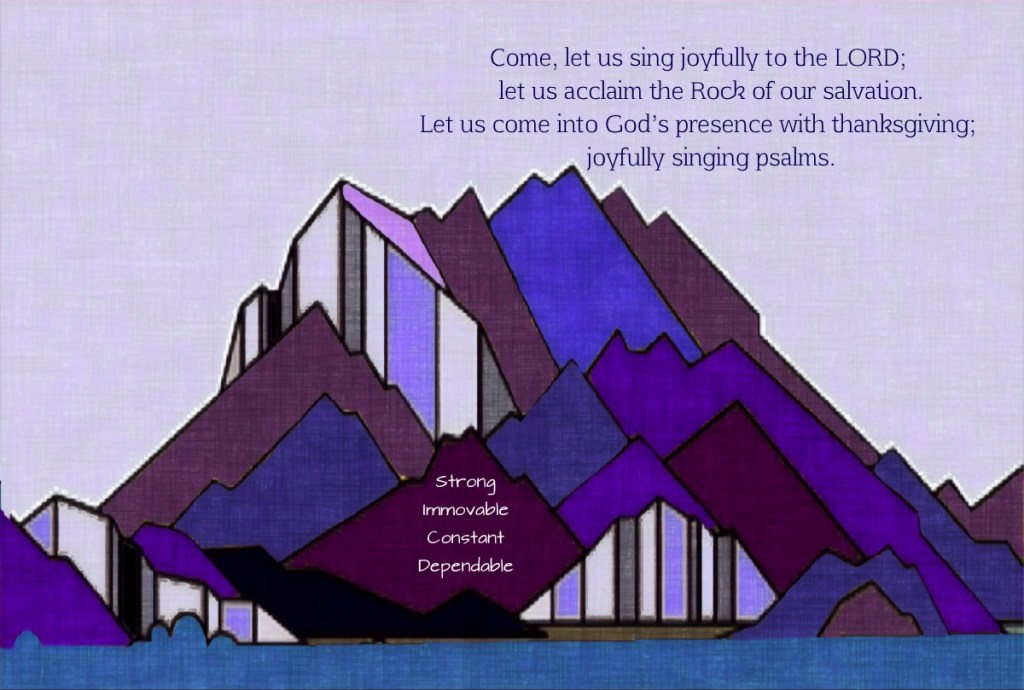
Psalm 95 is an “enthronement psalm” which calls us to worship God as Ruler. Our verses today also use the images of Rock and Shepherd as images to help us understand the nature of God’s presence in our lives.
We can know God only through images. Most of us don’t have direct revelations. 😉 The images we choose and cultivate have a profound impact on our relationship with God and on how we live our lives in God’s image.
Psalm 95 offers us two pictures of God today. These two metaphors evoke some similar sentiments. They also contrast in other ways. Praying with ikons like these can be a beneficial way to come deeply into God’s Presence by touching into our deepest spiritual needs.
Poetry: Rainer Maria Rilke, Poems from the Book of Hours
You are the future, the great sunrise red above the broad plains of eternity. You are the cock-crow when time’s night has fled, You are the dew, the matins, and the maid, the stranger and the mother, you are death. You are the changeful shape that out of Fate rears up in everlasting solitude, the unlamented and the unacclaimed, beyond describing as some savage wood. You are the deep epitome of things that keeps its being’s secret with locked lip, and shows itself to others otherwise: to the ship, a haven — to the land, a ship.
Music: Made in the Image of God – We Are Messengers
















 Lavish Mercy