Psalm 145: Prayer Answered

Memorial of Saint Monica

August 27, 2020


Today, in God’s Lavish Mercy, on this feast of St. Monica, we pray with Psalm 145.

We can almost picture the psalm’s sentiments pouring out in Monica’s prayer. For years, she had prayed for her son Augustine’s conversion. She was canonized for the level of her persevering prayer – a prayer blessed with the amazing answer of St. Augustine’s holy life.

Every day will I bless you,
and I will praise your name forever and ever.
Great is the LORD and highly to be praised;
his greatness is unsearchable.

Like the answer to most prayers, Monica’s came after the long working of God’s mysterious ways. Her own life was shaded by suffering and loss. But, she was steadfast in her hope over the nearly two decades it took to see Light dawn in Augustine.


Generation after generation praises your works
and proclaims your might.
They speak of the splendor of your glorious majesty
and tell of your wondrous works.


As we reflect on the generations of our own families, and the decades of our own lives, there are many “Monica-Augustine” stories. Whenever we pray for life to lead us and our beloveds to God, we pray like Monica.

Today, let’s bring our own “Augustines” to God in hopeful prayer. And let’s thank God for any “Monica” who has done this loving service for us over our lives.
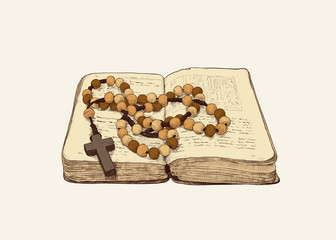
I think this morning of my mother’s well-worn prayer book. The little devotional volume had been fattened with a number of prayer cards stuffed in its thin pages. One day, just before my mother died, I noticed this one: Prayer for My Daughter, a Nun. I can’t say I was exactly surprised by it. I supposed Mom prayed for me. But the card blessed me in a vey tender way and made me confident that my life would continue to be blessed.


Discovering the card also made me aware of my responsibility to pray daily for my family, friends, and community. They are my “Augustines” in whatever challenges they may face in life – just as I hope I am somebody’s too. Because, friends, we belong to one another in the Communion of Saints, and our “family” is fed not by blood, but by the Spirit.

The generations discourse of the power of your awesome deeds
and declare your greatness.
They publish the fame of your abundant goodness
and joyfully sing of your justice.


Poetry: St. Augustine and Monica by Charles Tennyson Turner

Her weeping kiss – for years, her sorrow flowed
At last into his wilful blood; he owed
To her his after-life of truth and bliss:
And her own joy, what words, what thoughts could paint!
When o’er his soul, with sweet constraining force,
Came Penitence – a fusion from remorse –
And made her boy a glorious Christian saint.
Oh ye, who tend the young through doubtful years
Along the busy path from birth to death,
Parents and friends! forget not in your fears
The secret strength of prayer, the holy breath
That swathes your darlings! think how Austin’s faith
Rose like a star upon his mother’s tears!


Music: (something for opera fans among us) La Conversione di Sant Agostino, Oratorio by Johann Adolph Hasse

Hasse begins La Conversione di Sant’ Agostino with an orchestral introduction that establishes the work‘s tonal center in the key of B-flat major, with most arias composed within related keys. From the grandeur and dynamic intensity of the Introduction comes the first vocal entrance of the oratorio. The listener acts as a voyeur into a conversation between Simpliciano (tenor), a priest, and Monica (soprano), the mother of Saint Augustine of Hippo, in which Monica expresses her fears that her son may never change his wicked ways. This urgent desire becomes the core dramatic theme throughout the oratorio with Alipio (alto), the friend, and Navigio (bass), the brother, serving to intensify the desperate desire for conversion. The role of Saint Augustine (alto) is secondary to that of his mother, Monica. Saint Augustine only has two arias, both dealing with his desire to find release from his sinful ways. His conversion is explicitly stated in the Part Two aria in which he begs God to look upon him with compassion following the censure of his own heart.


Psalm 96: Singing in the Rain

 Tuesday of the Twenty-first Week in Ordinary Time

August 25, 2020

Today, in God’s Lavish Mercy, we pray with Psalm 96 which calls the people to praise God in music and dance because they have been chosen and confirmed as God’s People. 

The psalm may have been composed by David to mark the return of the Ark of the Covenant to Jerusalem. At that time, Israel had a sense of great victory, restoration, and security as David assumed kingship at God’s command.

But today’s particular verses have an eschatological tone. They turn the attention of the praise singer to the overarching fact that God is infinitely larger than any present small victory. They imply that the only true victory and restoration are found in complete abandonment to God’s power in our lives no matter our situation.

Say among the nations: The Lord is king.
God has made the world firm, not to be moved;
God governs the peoples with equity.


That Divine Power is easy enough to sing about when things go well for us, as they were for Israel at that time. But can we still praise God’s dominion and power when things seem bleak, when we don’t feel in control of our reality?

Psalm 96 invites us to that deep abandonment of self into God’s unfailing Mercy, no matter our life’s weather.

Declare among the nations: The LORD is king.
The world will surely stand fast, never to be shaken.
God rules the peoples with fairness.

When we struggle to find that kind of holy equanimity, Psalm 96 suggests we look to nature, and to its persistent return to Divine Balance, even after upheaval. So too will any unbalance in us be restored within the infinite arc of God’s abiding love. And that is the real reason to always sing God’s praise!

Let the heavens be glad and the earth rejoice;
let the sea and what fills it resound;
let the plains be joyful and all that is in them!
Then shall all the trees of the forest exult.

Before the Lord Who comes;
Who comes to rule the earth.
God shall rule the world with justice
and the peoples with constancy.

Poetry: To Him Who Is Feared by Eleazar Ben Kalir
Translated by Lady Katie Magnus
from the Liturgy for Rosh Hashana

To Him who is feared a Crown will I bring.
Thrice Holy each day acclaim Him my King;
At altars, ye mighty, proclaim loud His praise,
And multitudes too may whisper His lays.
Ye angels, ye men, whose good deeds He records—
Sing, He is One, His is good, our yoke is the Lord’s!
Praise Him trembling to-day, His mercy is wide—
Ye who fear for His wrath—it doth not abide!
Ye seraphim, high above storm clouds may sing;
Men and angels make music, th’ All-seeing is king. 
As ye open your lips, at His Name they shall cease—
Transgression and sin—in their place shall be peace;
And thrice shall the Shophar re-echo your song
On mountain and altar to whom both belong. 

Music: O Sing Unto the Lord – Handel

Moses’ Psalm: Light and Dark

Monday of the Twentieth Week in Ordinary Time

August 17, 2020

Today, in God’s Lavish Mercy, we pray once again with Deuteronomy 32, the Psalm of Moses. Today’s verses describe an angry God who decides to take vengeance a faithless people. 

To pray with these verses is not easy. Taken in isolation, they paint a God who contradicts our larger experience of mercy and tenderness. But the Psalm, like the jarring first reading from Ezekiel, has a lesson for us.

Ezekiel from Biblical Images by James Padgett

In that reading, Ezekiel suffers the sudden death of his beloved wife. The experience opens his prophetic spirit to more fully understand God’s relationship with Israel. He allows his life to be a witness for the people that God expects their repentance and faithfulness.

Like many Old Testament readings, these portray God by way of human analogy because that is the only context we have available to us. Therefore, the temptation when reading these passages might be to think of God solely in human terms playing tit-for-tat with us when we stray from the Law. But God is infinitely greater than any capacity we, or the scripture writers, have to describe Divinity.


The narrative provided by this prophetic book is not one of comfort; its merciless accusations and its violent imagery do not make it an easy scroll to swallow (Ezek 2:8–3:3). While much of Ezekiel’s language, imagery, and reasoning will appear foreign to modern readers, his narrative would have been clearly intelligible to his contemporaries—even though presumably it would have been hard to accept. The exile, according to this narrative, is both inevitable and deserved; it is portrayed as God’s judgement for the constant and complete failure of God’s people.

At the same time, it is not God’s last word. While resisting both optimism and despair, Ezekiel offers a narrative that sheds light on his present and arrives at an original, if peculiar, imagination of hope, founded solely on theological conviction.

Janina M. Hiebel – Hope in Exile: In Conversation with Ezekiel

So then, what might we take from today’s dark readings? For me, it is this:

God is always Light.
It is we who get caught in darkness.


God does speak to us in our circumstances, as God did to Ezekiel and Moses. By faithful prayer and sincere desire, we can deepen in our love and understanding of God through every experience of our lives, even the painful ones. When we live with that kind of faith and hope, our lives witness to God’s fidelity and love.


Poetry: two offerings today

Motto – Bertold Brecht

In the dark times 
Will there also be singing? 
Yes, there will also be singing.
About the dark times.

Light – Alice Jones

The morning when I first notice
the leaves starting to color,
early orange, and back-lit,
I think how rapture doesn't
vanish, merely fades into
the background, waits for those
moment between moments.

I think this and the door pens,
the street takes on its glistening
look, Bay fog lifting, patches of sun
on sycamore -- yellow sea.
I am in again, and swimming.

Music: Lavender Shadows – Michael Hoppé

Psalm 113: Awesome!

Wednesday of the Nineteenth Week in Ordinary Time

August 12, 2020

Today, in God’s Lavish Mercy, we pray with Psalm 113, a magnificent hymn praising God in the heavens. 

The psalm is commonly used at Vespers, the evening prayer of the Church – and no wonder. How often in the evening do we look to the glorious skies, emblazoned with the setting sun, and turn our minds to God!

Who is like the LORD, our God, who is enthroned on high,
and looks upon the heavens and the earth below?


It is in contemplating the sky’s immensity that we begin to appreciate the Divine Infinity.


Last night, I FaceTimed with my niece and her toddler boy, a joy she frequently offers me. During the call, my grandnephew carried his little tablet to the window, opened his “SkyView” app, and began exploring the heavens. Even the youngest “pueri” (Latin for “boys, children, servants”) spontaneously offer our Vespers in answer to God’s Beauty!


As we pray this psalm, at whatever time of day, we can let ourselves rest in silent awe, aware of God’s majesty – that Majesty which deigns to create, love and eternally sustain each one of us beloved “pueri”.


Poetry: Stars by Majorie Pickthall

Photo by Ruvim on Pexels.com
Now in the West the slender moon lies low, 
And now Orion glimmers through the trees, 
Clearing the earth with even pace and slow, 
And now the stately-moving Pleiades, 
In that soft infinite darkness overhead 
Hang jewel-wise upon a silver thread. 
And all the lonelier stars that have their place, 
Calm lamps within the distant southern sky, 
And planet-dust upon the edge of space, 
Look down upon the fretful world, and I 
Look up to outer vastness unafraid 
And see the stars which sang when earth was made. 

Music: Laudate Pueri – Claudio Monteverdi

Laudate, pueri, Dominum; 
laudate nomen Domini.
Sit nomen Domini benedictum 
ex hoc nunc et usque in saeculum.
A solis ortu usque ad occasum 
laudabile nomen Domini.
Excelsus super omnes gentes Dominus, 
et super caelos gloria ejus.
Quis sicut Dominus Deus noster, 
qui in altis habitat, 
et humilia respicit in caelo et in terra?
Suscitans a terra inopem, 
et de stercore erigens pauperem:
ut collocet eum cum principibus, 
cum principibus populi sui.
Qui habitare facit sterilem in domo, 
matrem filiorum laetantem.

Psalm 119: Sweet Word

Memorial of Saint Clare, Virgin

August 11, 2020


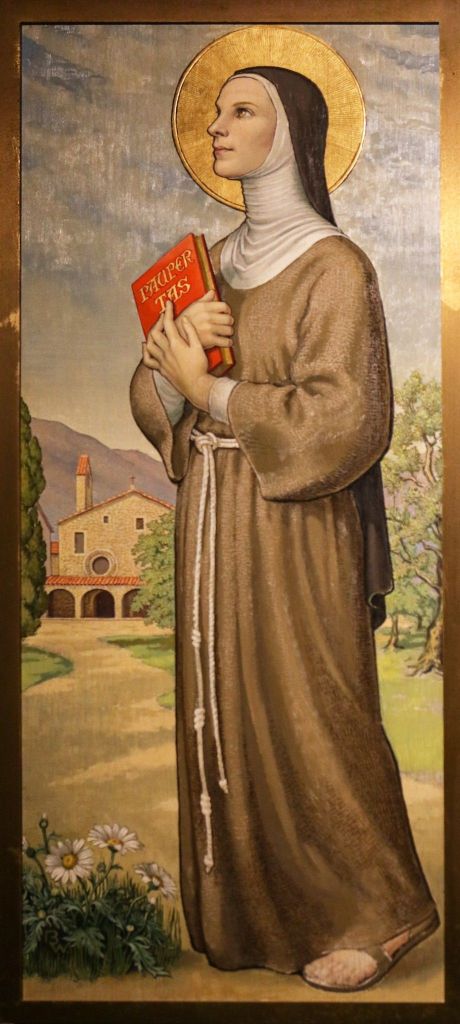
Today, in God’s Lavish Mercy, on this feast of the beautiful St. Clare, we pray with Psalm 119. How perfect is the response phrase from our psalm!

How sweet to my taste is your promise!


Last night, we watched an old Colombo movie in which one of the characters was a vintner who had developed a peerless taste for fine wine. He could identify every detail – year, grape, region, price. He was the consummate connoisseur.

As I prayed this morning’s psalm, it struck me that through the intentional practice of prayer, we become connoisseurs of the spirit. We are able to discern ever more delicately those realities which carry grace to our souls.

How sweet to my palate are your promises,
sweeter than honey to my mouth!


As we deepen in spirit, we purify our taste from all that is not peace, goodness, justice, mercy, and charity. We let go of things that distract our souls from Love.

The law of your mouth is to me more precious
than thousands of gold and silver pieces.


By our choices for what is truly precious, we build a legacy of sacred joy which sustains us throughout our lives:

Your decrees are my inheritance forever;
the joy of my heart they are.


from National Shine, Detroit

Poetry: from Clare of Assisi 

We become what we love 
and who we love shapes what we become. 
If we love things, we become a thing. 
If we love nothing, we become nothing. 
Imitation is not a literal mimicking of Christ, 
rather it means becoming the image of the beloved, 
an image disclosed through transformation. 
This means we are to become vessels
of God's compassionate love for others.

Music: Mirror of Eternity (Clare of Assisi) – sung by John Michael Talbot

Place your mind before the mirror of eternity!
Place your soul in the brilliance of glory!
Place your heart in the figure of the divine substance!
And transform your whole being into the image of the Godhead Itself
      through contemplation!
So that you too may feel what His friends feel
      as they taste the hidden sweetness
      which God Himself has reserved
      from the beginning
      for those who love Him
~ Clare of Assisi

Psalm 112: Key to Blessedness

Feast of Saint Lawrence, Deacon and Martyr

August 10, 2020


“Beatus Vir” from a 9th Century Psalter

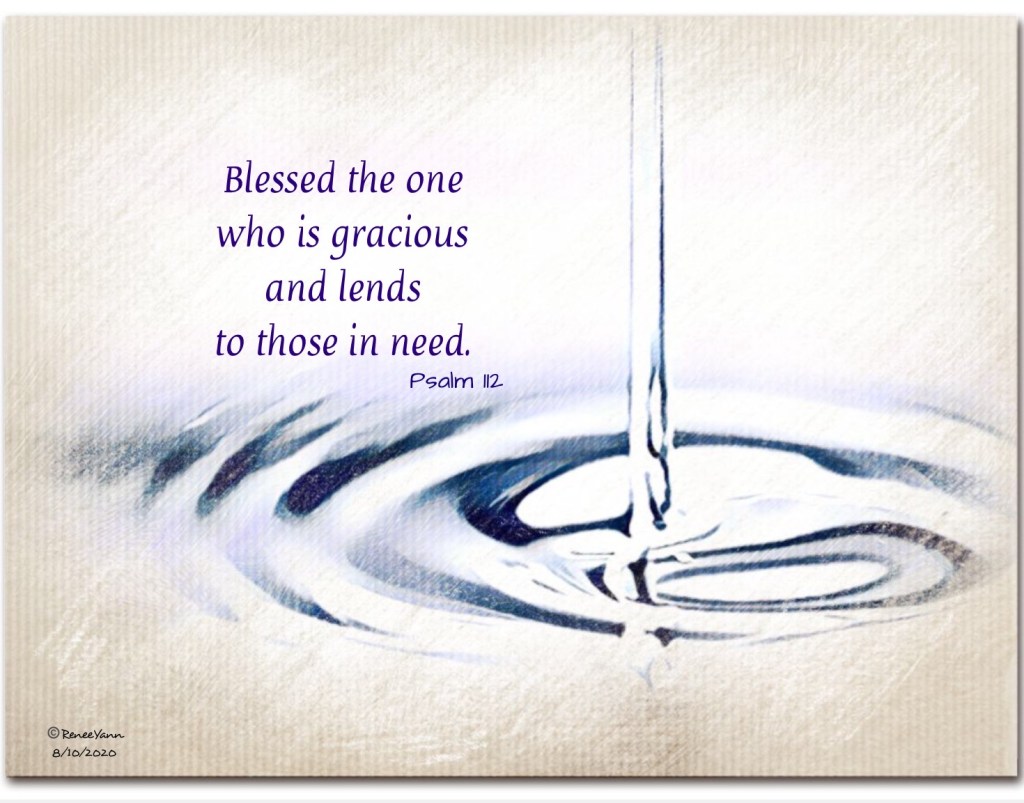
Today, in God’s Lavish Mercy, we pray with Psalm 112, a poetic description of what “holiness-in-action” looks like. The psalm’s tone is reminiscent of the beloved passage from Proverbs 31,  “Who shall find a valiant woman…” Only this passage says, “Blessed is the man… Beatus vir”.

Both these passages give us a glimpse into the righteousness expected of one who is in covenant with God. That person reflects the Divine Righteousness of God in both word and deed.

The “righteousness of God” comes down to concrete actions
that intend generous rehabilitation of those without resources.
The Psalms sing of these concrete acts.

Walter Brueggemann

A slow reading of the psalm is a good prayer today, asking God to help us open our hearts and choices to this graceful righteousness.  The heavily masculine translation can be a little off-putting for the women among us though. So you might like to use this translation as I did.


Happy are those who revere God 
    and delight in doing his will. 
Their children will be greatly honored 
    and their grandchildren greatly blessed. 
Abundance will fill their houses
     as gratitude fills their hearts. 
They conduct their affairs with justice; 
    their integrity cannot be shaken. 
They give of themselves to the poor 
    and share their wealth with the needy. 
They are patient, cheerful, compassionate, 
    generous, impeccably fair. 
They harbor no regrets for the past 
    and no worries about the future. 
Their minds are centered in God,
    and they trust him with all their hearts.
They honor themselves, and are honored; 
    they walk with their heads held high. 
Their rising is like the sunrise, 
    and their light fills heaven and earth. 
Their righteousness shines on all people; 
    their good works endure forever.
from A Book of Psalms: Selections Adapted from the Hebrew by Stephen Mitchell

Poetry: from Rumi

Your acts of kindness
are iridescent wings
of divine love
which linger and continue
to uplift others
long after your sharing.


Music:  Beatus Vir – Antonio Vivaldi

Beatus vir qui timet Dominum,
In mandatis ejus volet nimis.
Blessed the man who fears the Lord,
in his commandments he delights greatly.

Psalm 9: You Alone, O God

Memorial of Saint Dominic, Priest

August 8, 2020


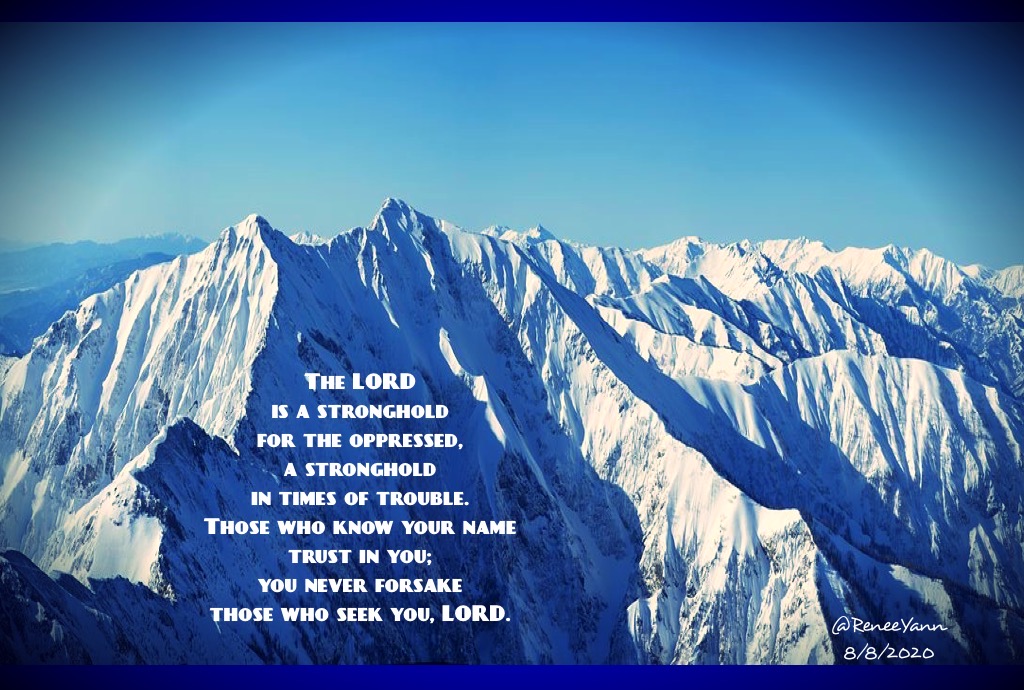
Today, in God’s Lavish Mercy, we pray with Psalm 9. It, together with Psalm 10, forms an acrostic which proclaims profound hope in God’s immutable justice, especially toward the poor and oppressed.

The LORD sits enthroned forever;
he has set up his throne for judgment.
He judges the world with justice;
he governs the peoples with equity.
When we read the entire psalm, we realize that the psalmist is in a lot of trouble:
Be gracious to me, LORD;
see how my foes afflict me!
You alone can raise me from the gates of death

Psalm 9:14

But for our verses today, the writer focuses on God and God’s power rather than on the psalmist’s own dire situation. As Walter Brueggemann writes:

In this poem [Psalms 9 & 10], the decisive party is Yahweh,
who governs powerfully and equitably. 

That kind of focus is a really good way to pray, especially when we are faced with an issue over which we have no power. In such a situation, we can spend a lot of time fretting for an inaccessible solution. It can help just to stop and place our trust in God Who abides with us in any suffering and never abandons us.

For the needy will never be forgotten,
nor will the hope of the afflicted ever fade.

Psalm 9:19

It’s not an easy task to give ourselves to such trusting prayer, but if we can, peace and healing ensue.

I will praise you, LORD, with all my heart;
I will declare all your wondrous deeds.
I will delight and rejoice in you;
I will sing hymns to your name, Most High.

When my troubles recede,
they disappear before your power.
For you upheld my right and my hope,
seated on your throne, judging justly.


Poetry: Zion by Rudyard Kipling
Kipling used the image of Zion to inspire courage during World War I.
Kipling’s son had been killed in the war, so the poem is both a lament and a rally to hope.

The Doorkeepers of Zion,
They do not always stand
In helmet and whole armour,
With halberds in their hand;
But, being sure of Zion,
And all her mysteries,
They rest awhile in Zion,
Sit down and smile in Zion;
Ay, even jest in Zion;
In Zion, at their ease.


The Gatekeepers of Baal,
They dare not sit or lean,
But fume and fret and posture
And foam and curse between;
For being bound to Baal,
Whose sacrifice is vain,
Their rest is scant with Baal,
They glare and pant for Baal,
They mouth and rant for Baal,
For Baal in their pain!


But we will go to Zion,
By choice and not through dread,
With these our present comrades
And those our present dead;
And, being free of Zion
In both her fellowships,
Sit down and sup in Zion --
Stand up and drink in Zion
Whatever cup in Zion
is offered to our lips

Music: Marching to Zion (Come, We That Love the Lord) – a wonderfully melodious old hymn written by Isaac Watts, first published in his Hymns & Sacred Songs, 1707. A great song to wake up our morning and rouse up our trust.

The song became a Gospel staple often associated with the Civil Rights marches of the 1960s. Here is a Gospel rendering by The Famous Ward Gospel Singers.

Psalm 102: For the Generations

Memorial of Saint John Vianney, Priest

August 4, 2020

The USCCB website (that you click for daily readings) has been beautifully updated. Make sure you take a look!


Today, in God’s Lavish Mercy, we pray again with Psalm 102. Today’s chosen verses proclaim the psalmist’s confidence that the Covenant Promise will endure through the generations.


The psalm really rings a bell for me today. We are expecting two new babies in my family within the next month. The excitement and joy are building throughout the family branches, scattered over several states and hundreds of miles.

Due to Covid-19, I probably won’t be with these new “grands” for a long time. That’s why I am so grateful for FaceTime to help me feel a real part of their lives.


Psalm 102 is David’s FaceTime.
Through it, he looks into a future
physically distant from him.
He has confidence that that future
is already blessed by God
through the faith which it inherits.


Thinking about this, I realize that I am someone’s “future” – my parents, grandparents and all the long line of ancestors before them. They thought about me, hoped in me, prayed for me the way I am praying for these coming babies.

Those Elders passed on to me a strong faith, hard-earned on the soils of Ireland, hard-carried over immigrant waters, hard-kept in a highly secularized culture. Like David, they wanted God’s faithfulness to be remembered by all who came after them:

Let this be written for the generation to come,
and let God’s future creatures praise the LORD …


When my Aunt Mary died last October, I became the oldest living member of our family. I take that role seriously. I pray for our entire family, by blood and law, every day.

Each day, I pick one who gets special prayers for blessing on his or her life. Sometimes I know they need it for a certain reason. Sometimes, they have no idea I am praying for them – or perhaps, if they are distant relatives, that I even know their names.


As we pray Psalm 119 today, let’s consider our place in the generations of faith, and our responsibility to give and receive the riches of that faith to one another.

The children of your servants shall abide,
and their posterity shall continue in your presence,
That the name of the LORD  and God’s praise
may be ever declared;
When the peoples gather together
and the families, to serve the LORD.


Poetry: Isaac’s Blessing by Janet Eigner whose adult daughter died young, leaving the freckled boy in this poem:

When Isaac, a small, freckled boy 
approaching seven, visits us for Family Camp, 
playing pirate with his rubber sword,

sometimes he slumps in grief, 
trudging along, his sacrifice and small violin 
in hand, his palm over his chest,

saying, Mother is here 
in my heart. Before he leaves for home, 
we ask if he’d like a Jewish blessing.

Our grandson’s handsome face ignites; 
he chirps a rousing, yes, for a long life. 
We unfold the prayer shawl,

its Hebrew letters silvering the spring light, 
hold the white tallis above his head, 
recite the blessing in its ancient language

and then the English, adding, for a long life. 
Isaac complains, the tallis didn’t 
touch his head, so he didn’t feel the blessing.

We lower its silken ceiling 
to graze his dark hair, 
repeat the prayer.

Music: As for Me and My House – a prayer for our families for the generations 

Psalm 69: Stuck!

Memorial of Saint Alphonsus Liguori, Bishop and Doctor of the Church

August 1, 2020

Today, in Mercy, we pray for the light of God’s Word in our hearts. God speaks to us in all things. Sometimes, all we need to do is ask God, “What are You saying to me in this circumstance?” Then listen for Love. The answer is always wrapped in Love – and Love is not always easy.

Thought from 2016, Friday of the 17th Week

Today, in God’s Lavish Mercy, we pray again with Psalm 69.  In today’s accompanying readings, Jeremiah and John the Baptist are living out the meaning.of the psalm.

Each of these great prophets has been ensnared by the civic evil of their times, personified in Old Testament princes and New Testament Herod and Herodias. The power structure surrounding each prophet stood in direct contradiction to their witness to God’s Word. Those structures, when confronted with a sacred truth, tried to overwhelm the messenger, like quicksand swallows an innocent traveler.

Rescue me out of the mire; may I not sink!
may I be rescued from my foes,
and from the watery depths.
Let not the flood-waters overwhelm me,
nor the abyss swallow me up,
nor the pit close its mouth over me.


The psalm raises to our prayer the reality that such struggles continue in our time. We live in a wonderful but still sinful world where every person decides, everyday, where he or she will stand in the contest between good and evil.

The decision is sometimes very clear. At other times, the waters are so muddied with lies, propaganda, greed, fear, bias. and unexamined privilege that we feel mired in confusion or resistance.

But I am afflicted and in pain;
let your saving help, O God, protect me.
I will praise the name of God in song,
and I will glorify him with thanksgiving.

Psalm 69 throws us a rescue line in today’s final verse:

See, you lowly ones, and be glad;
you who seek God, may your hearts revive!
For the LORD hears the poor,
and his own who are in bonds God spurns not.

The steady path to truth lies with those who seek God among the humble and poor. The humble are the ones through whom the Lord speaks. They are God’s own. Jeremiah and the Baptist understood this truth and preached it by their lives.

We might examine our lives today in the light of their witness and the message of this challenging psalm.


Poetry:  Beginners – Denise Levertov


‘From too much love of living,
Hope and desire set free,
Even the weariest river
Winds somewhere to the sea—‘


But we have only begun
to love the earth.
We have only begun
to imagine the fullness of life.
How could we tire of hope?
—so much is in bud.
How can desire fail?
—we have only begun
to imagine justice and mercy,
only begun to envision
how it might be
to live as siblings with beast and flower,
not as oppressors.
Surely our river
cannot already be hastening
into the sea of nonbeing?
Surely it cannot
drag, in the silt,
all that is innocent?
Not yet, not yet—
there is too much broken
that must be mended,
too much hurt we have done to each other
that cannot yet be forgiven.
We have only begun to know
the power that is in us if we would join
our solitudes in the communion of struggle.
So much is unfolding that must
complete its gesture,
so much is in bud.

Music:  The Cry of the Poor – John Foley, SJ

Psalm 59: Did Martha Pray It?

Memorial of Saint Martha

July 29, 2020


Today, in God’s Lavish Mercy, on this feast of St. Martha, we pray with Psalm 59.

The psalm is introduced with an interesting phrase: a miktam of David, when Saul sent people to watch his house and kill him. 

The meaning of the word mitkam is unclear, but the meaning of the rest of the phrase is abundantly evident. David felt threatened by the forces of King Saul who surrounded his house day and night awaiting an opportunity to attack him.

The psalm bemoans that situation. In two complementary stanzas, the psalmist asks God for victory and deliverance. Each ends with a refrain of praise and gratitude.


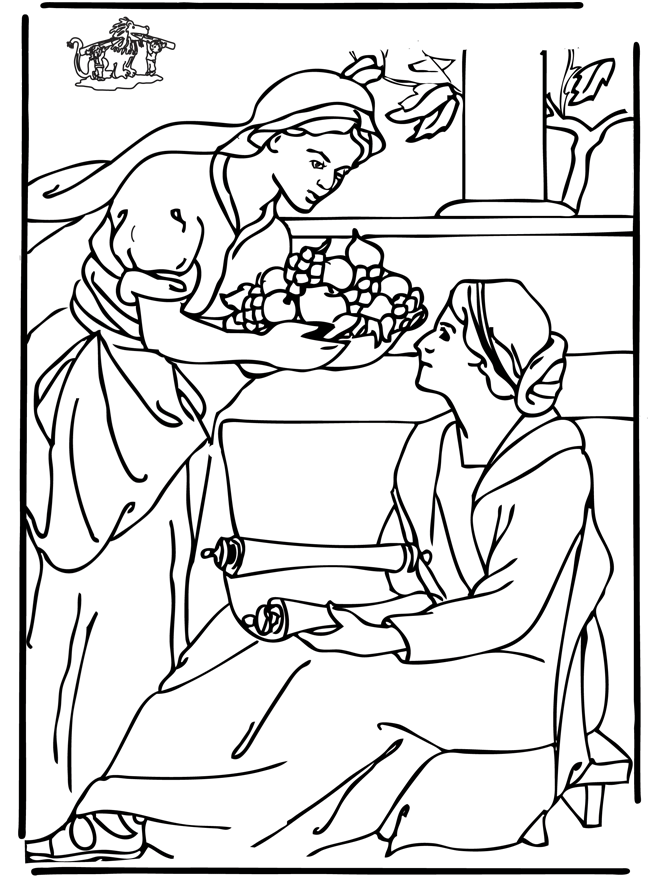
As I pray this psalm today, my mind goes to a house in Bethany. Three siblings live there who are friends of Jesus. Each loves Jesus in her or his own way, according to their personalities. 

The Gospels give us a vivid perception of Mary’s love. We can easily imagine the immensely grateful love of resurrected Lazarus. 

Then there is Martha of whom we know so little. A woman who found comfort in creating a hospitable home. A woman who commanded a well-functioning kitchen. A woman who, silent except for her famous sisterly complaint, let her works speak her love.

As their friendship with Jesus grew, and as Jesus became more notorious to the Jewish leaders, their little house no doubt became the object of inimical fascination.

Jesus’s enemies watched him, but that also watched his friends, frightening many away from Jesus’s side.

As this reality intensified, perhaps phrases of Psalm 59 rose in Martha’s heart as she prayed:

Rescue me from my enemies, O my God;
from my adversaries defend me….
… For behold, they lie in wait for my life;
mighty men come together against me,
Not for any offense or sin of mine, O LORD.

We can only guess what this little family suffered in order to be Jesus’s friends, both during his lifetime and by their witness in the subsequent early Christian Church. But by faith, we can be certain they rejoiced in the Divine Gift these sufferings brought them.

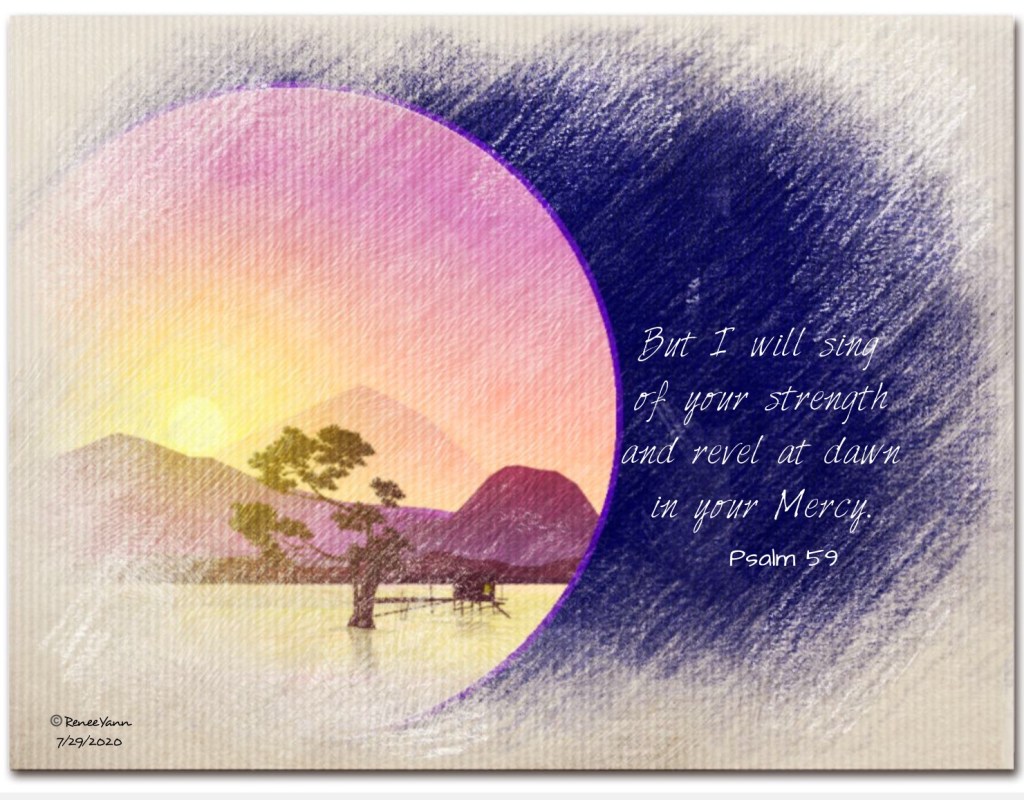
But I will sing of your strength
and revel at dawn in your mercy;
You have been my stronghold,
my refuge in the day of distress.
O my strength! your praise will I sing;
for you, O God, are my stronghold,
my merciful God!

Let us pray today to be, like Martha of Bethany, devoted friends of God.

Poetry:  You, neighbor God – Rainer Maria Rilke

You, neighbor god, if sometimes in the night
I rouse you with loud knocking, I do so
only because I seldom hear you breathe
and know: you are alone.
And should you need a drink, no one is there
to reach it to you, groping in the dark.
Always I hearken. Give but a small sign.
I am quite near.
Between us there is but a narrow wall,
and by sheer chance; for it would take
merely a call from your lips or from mine
to break it down,
and that without a sound.
The wall is builded of your images.
They stand before you hiding you like names.
And when the light within me blazes high
that in my inmost soul I know you by,
the radiance is squandered on their frames.
And then my senses, which too soon grow lame,
exiled from you, must go their homeless ways.

Music: Psalm 59 – Esther Mui