Psalm 34: Praying with Angels

Solemnity of Saints Peter and Paul, Apostles

June 29, 2020

Today, in God’s Lavish Mercy, on this special feast, we pray with Psalm 34.  

David sings. Sheep listens.

This psalm has the most delightful introduction:

Of David, when he feigned madness before the King, who drove him out and he went away.

The Psalm refers to a time when young David was fleeing from Saul who was jealous of David’s impending takeover as king. David seeks harbor with King Achish, but later realizes that was a mistake. Fearing the King, David pretends for be insane in order to be dismissed as harmless.


Serious as the situation is, picturing it makes me smile. Have you ever wanted to get away from someone who had hijacked you into a one-sided conversation? You might pretend you had an appointment, or medical necessity, or anything just to get away.
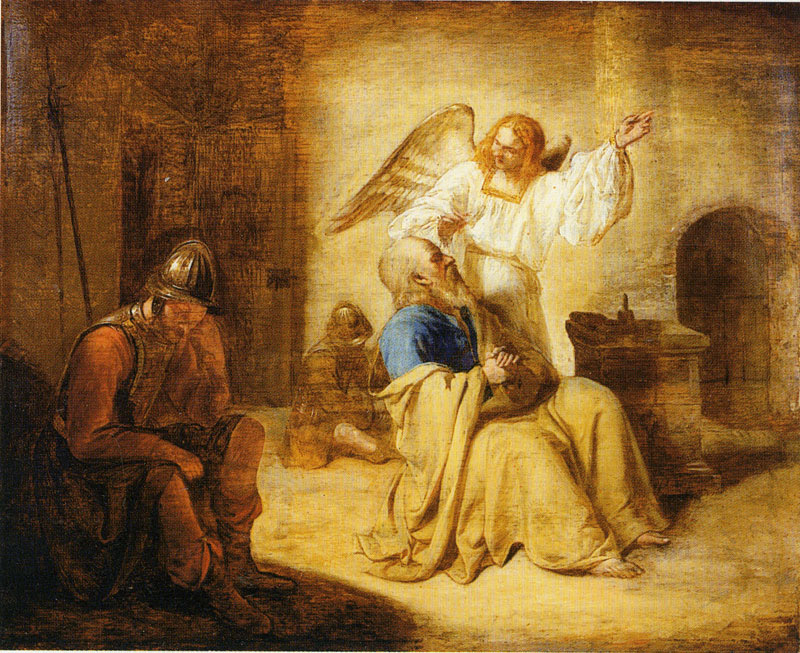

Liberation of Saint Peter from Prison by Pieter de Hooch

Peter, in our first reading, doesn’t need pretense to escape the wrathful imprisonment of King Herod. All he needs is the angel which God has sent him.

Thus, Psalm 34 is a most appropriate choice for the Feast of Sts. Peter and Paul. It is the first psalm in which an angel is mentioned and here, as in Acts, she is a rescuer.

The angel of the LORD encamps
around those who fear the LORD, and delivers them.

Taste and see how good the LORD is;
blessed the one who takes refuge in God.


I’ll be honest, I neglect my angels. I believe in them. I trust them. But basically I forget about them unless I’m scared out of my mind about something. In those situations, I call out loudly to them to make sure their “encampment” around me is still intact!

I think it would be a lot better to get to know our angels, and let them get to know us. Inviting them to accompany us in prayer might be a good way to start. And, of course, remember that prayer so many of our parents taught us. We never grow too “mature” to whisper it at night. Maybe even Peter said something like it in that dark prison long ago.

Angel of God, my guardian dear,
to whom God’s love commits me here,
Ever this night be at my side
to light, to guard, to rule, to guide.
Amen


St. Peter And The Angel
 - Denise Levertov

Delivered out of raw continual pain,
smell of darkness, groans of those others
to whom he was chained--

unchained, and led
past the sleepers,
door after door silently opening--
out!
     And along a long street's
majestic emptiness under the moon:

one hand on the angel's shoulder, one
feeling the air before him,
eyes open but fixed...

And not till he saw the angel had left him,
alone and free to resume
the ecstatic, dangerous, wearisome roads of
what he had still to do,
not till then did he recognize
this was no dream. More frightening
than arrest, than being chained to his warders:
he could hear his own footsteps suddenly.
Had the angel's feet
made any sound? He could not recall.
No one had missed him, no one was in pursuit.
He himself must be
the key, now, to the next door,
the next terrors of freedom and joy. 

Music:  Gloria in Excelcis Deo – J.S. Bach
(I thought one of the angels’ greatest hits, first recorded over the hills of Bethlehem, might be appropriate today)

Psalm 89: Hopeful Complaining

Thirteenth Sunday in Ordinary Time

June 28, 2020

I realized that I have never written a reflection on this Sunday’s readings. Here is a link to a wonderful weekly reflection by a Sister of St. Joseph of Carondolet from the National Catholic Reporter.


Today, in God’s Lavish Mercy, we pray with Psalm 89, as we did last week, but this time with earlier verses.

Psalm 89 is long and complex. It is significant to an overall understanding of the Book of Psalms because within 89 the entire cycle of Israel’s prayer life is reflected.


How we pray depends on how we see God. In our lives, as in Israel’s, external circumstances can shape that perception of God. 

How we feel physically, mentally; how we love and are loved; whether we are afraid or secure; how we succeed or fail – these and so many other realities put a face on God for us.


Psalm 89 reflects a time of oppression and confusion in Israel’s life. They had been flying high when David built the Temple. Its presence confirmed for them the truth of God’s promise to Abraham. But now, the Temple lay in ruins and the people enslaved in a foreign land. What did all that say about God and God’s Promise? What had happened to the loving face of God?

Contrary to expectation, the psalmist does not begin to pray from a position of lament or complaint. Instead, Psalm 89 begins by remembering and blessing “the good times”.

The promises of the LORD I will sing forever,
through all generations my mouth shall proclaim your faithfulness.

For you have said, “My kindness is established forever;”
in heaven you have confirmed your faithfulness.


Woman at the Well by Angelika Kauffman

It’s like Israel is sitting down beside God and saying, “You know, times are rough right now. But You’ve always been good to me, and I won’t forget that no matter what. So show me where You are taking me in these present circumstances.”

Reminds me of Jesus’ conversation with the woman at the well.

What a great way to begin a sorrowful prayer! Such an attitude opens our heart to God’s ever-present Mercy which will come to us — disguised even in our sorrow.


The saints among us never give up on God – and we are all called to be saints. Psalm 89 helps us understand how God is with us and we can be with God even when our specific “prayers” seemed ignored or rejected.

For ever I will sing the goodness of the Lord.
Blessed the people who know the joyful shout;
in the light of your Face, O LORD, they walk.


Poetry: A Psalm of Life – Henry Wadsworth Longfellow

For me, the poem voices Longfellow’s philosophy for dealing with adversity which is primarily self-reliance and bravado. I think prayer is a good deal more effective!😃

“A Psalm of Life” became a popular and oft-quoted poem, such that Longfellow biographer Charles Calhoun noted it had risen beyond being a poem and into a cultural artifact…
Calhoun also notes that “A Psalm of Life” has become one of the most frequently memorized and most ridiculed of English poems, with an ending reflecting “Victorian cheeriness at its worst”. Modern critics have dismissed its “sugar-coated pill” promoting a false sense of security…
Nevertheless, Longfellow scholar Robert L. Gale referred to “A Psalm of Life” as “the most popular poem ever written in English”.
Wikipedia
And, besides, I like it.🤓 Hope you all do.

————————————————————-

A Psalm of Life
Henry Wadsworth Longfellow

What the Heart of the Young Man Said to the Psalmist

Tell me not in mournful numbers  
Life is but an empty dream!
For the soul is dead that slumbers  
And things are not what they seem.
 
Life is real! Life is earnest!
And the grave is not its goal; 
Dust thou art to dust returnest  
Was not spoken of the soul.
 
Not enjoyment and not sorrow  
Is our destined end or way;
But to act that each to-morrow 
Find us farther than to-day.
 
Art is long and Time is fleeting  
And our hearts though stout and brave  
Still like muffled drums are beating
Funeral marches to the grave.
 
In the world's broad field of battle  
In the bivouac of Life  
Be not like dumb driven cattle! 
Be a hero in the strife!

Trust no Future howe'er pleasant! 
Let the dead Past bury its dead! 
Act, — act in the living Present! 
Heart within and God o'erhead! 

Lives of great men all remind us
We can make our lives sublime  
And departing leave behind us 
Footprints on the sands of time; 

Footprints that perhaps another  
Sailing o'er life's solemn main
A forlorn and shipwrecked brother  
Seeing shall take heart again.
 
Let us then be up and doing  
With a heart for any fate; 
Still achieving still pursuing
Learn to labor and to wait.
 

Music: Show Me Your Face – Don Potter

Psalm 79: Song Sung Blue

Thursday of the Twelfth Week in Ordinary Time

June 25, 2020

Today, in God’s Lavish Mercy, we pray with Psalm 79, a Lament Psalm so sorrowful that Brueggemann calls it one of the ”Sad Songs of Zion”.

So what’s going on in Psalm 79? 

Israel is heartbroken. They had thought they were uniquely special to God, that preference being symbolized by their magnificent Temple in Jerusalem. When the Temple was ravaged, as described in today’s first reading from Kings, the community is bereft.

The psalm demonstrates the prayer’s transformation from initial angry sadness to restored faith in God. Israel has allowed its perception of God to become institutionalized in a symbol, a building. But faithful reflection moves them to realize that God is beyond institutionalization. Through their lament, they return their hearts to the true Name of God – “I am Who am”.

Help us, O God our savior,
because of the glory of your name;
Deliver us and pardon our sins
for your name’s sake.


I think we, too, try to domesticate God into bricks and mortar, customs, national symbols, people, rules, and all kinds of other potential idols. When those things crack or crumble, as all things might, we experience a devastation like that found in Psalm 79.

  • Some of us felt that way when the clerical sex abuse scandal was revealed.
  • Some of us felt that way on 9/11, or because of the pandemic
  • Some of us experience this lament when systems we trusted turn corrupt: law enforcement, medicine, religion, government.

Because we can’t see God face-to-face, we often paint that face on representations of power in our lives. That’s what Israel did with the Temple.

When those symbols prove untrustworthy, we might use it as an excuse to stop seeking God’s true and loving Face. Let’s learn from the Psalms how to persist in faith until we finally do see God face-to-face.


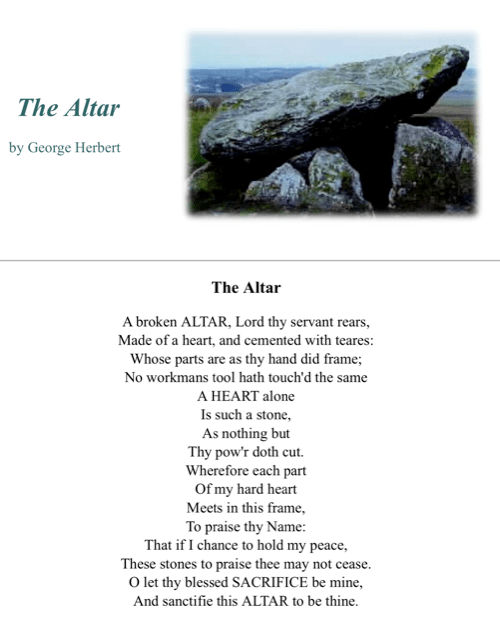
Early 17th century poet George Herbert captures the idea, I think.

Music: Shackles – by the group Mary, Mary – the song is kind of a modern Psalm 79, a movement from lament, through painful experience, to praise. Suggestion: Get up and move with it!

Psalm 60: Punch Drunk with Troubles

Monday of the Twelfth Week in Ordinary Time

June 22, 2020


It has been suggested that I make it easier to find previous reflections on the readings for the day, just in case you would like to pray with the First Reading or Gospel. I’ll try to remember to do that.


Today, in God’s Lavish Mercy, we pray with Psalm 60, and it’s a doozy. It is a hard Psalm to pray with because it contains many layers of meaning. But, in the end, I think it is worth the effort.

The Psalm emerges from a time filled with violence. David struggles to keep control both within and outside his kingdom. His own son and nephew turn against him. His nephew wreaks unspeakable mayhem in Israel’s name. Everything in David’s world is in violent disarray. He actually whines to God about the mess:

  • O God, you have rejected us and broken our defenses …
  • You have rocked the country and split it open …
  • You have made your people feel hardships …
  • You have given us stupefying wine…

Like many of you, I read these verses in the wake of another divisive political rally, in a country riven by fearful hatred, racism, biased brutality, political corruption, and poisonous propaganda. I am so tempted to immediately tie Psalm 60 to these current realities.

But I think that, when we pray the psalms, we must let them first teach us about ourselves. Once that conversion or enlightenment occurs, it may then be possible to apply their wisdom to our world.


King David by Matthias Stom

What is it that makes Psalm 60 a prayer and not a political manifesto? We find the answer in verse 7:

Help us with your right hand, O Lord, and answer us.

David realizes that he is completely out of whack. He has just put all the responsibility for his chaos in God’s lap when it is really David’s own self-serving choices that have caused the problem. 

David’s selfish, short-sighted, and sinful decisions have blinded him like “stupefying wine”. One might say he has drunk his own kool-aid. He needs God’s justice to detoxify him … that divine “right hand” which created a perfectly balanced world.

Each of David’s previously mentioned “whines” is completed with a sincere and contrite plea:

  • rally us!
  • repair the cracks in the country
  • give us aid against the foe

Once we realize, like David:

  • that the “country” is our own heart,
  • that the “foe” is any residue there of injustice, 
  • and that the “rally” must be of our own merciful love,

… only then might we be ready to pray for our fractured country and our broken, weeping world.


Poetry: Manifesto: The Mad Farmer Liberation Front – Wendell Berry’s inspired poem about conversion and recovery of the soul in a soul-killing culture.

Love the quick profit, the annual raise,
vacation with pay. Want more 
of everything ready-made. Be afraid 
to know your neighbors and to die.

And you will have a window in your head. 
Not even your future will be a mystery 
any more. Your mind will be punched in a card 
and shut away in a little drawer.
 
When they want you to buy something 
they will call you. When they want you 
to die for profit they will let you know. 
So, friends, every day do something 
that won't compute. Love the Lord. 
Love the world. Work for nothing. 
Take all that you have and be poor. 
Love someone who does not deserve it.

Denounce the government and embrace 
the flag. Hope to live in that free 
republic for which it stands. 
Give your approval to all you cannot
understand. Praise ignorance, for what man 
has not encountered he has not destroyed.

Ask the questions that have no answers. 
Invest in the millenium. Plant sequoias. 
Say that your main crop is the forest 
that you did not plant, 
that you will not live to harvest.

Say that the leaves are harvested 
when they have rotted into the mold.
Call that profit. Prophesy such returns. 
Put your faith in the two inches of humus 
that will build under the trees 
every thousand years.

Listen to carrion — put your ear 
close, and hear the faint chattering 
of the songs that are to come. 
Expect the end of the world. Laugh. 
Laughter is immeasurable. Be joyful 
though you have considered all the facts. 
So long as women do not go cheap 
for power, please women more than men.

Ask yourself: Will this satisfy 
a woman satisfied to bear a child? 
Will this disturb the sleep 
of a woman near to giving birth? 

Go with your love to the fields. 
Lie down in the shade. Rest your head 
in her lap. Swear allegiance 
to what is nighest your thoughts.

As soon as the generals and the politicos 
can predict the motions of your mind, 
lose it. Leave it as a sign 
to mark the false trail, the way 
you didn't go.

Be like the fox 
who makes more tracks than necessary, 
some in the wrong direction. 
Practice resurrection.

Music: Be Still My Soul – Exultate Singers

Psalm 103: Bless Your Sacred Heart!

Solemnity of Most Sacred Heart of Jesus

June 19, 2020

Today, in God’s Lavish Mercy, on this tender feast of the Sacred Heart, we pray with Psalm 103, a hymn of exultant and confident praise.

Walter Brueggemann calls Psalm 103 the best known and best loved of the hymns of praise. He says these hymns have a five-fold purpose, which I paraphrase here:

First, praise imagines something new. It doesn’t describe what is. We are healed to become new selves in God:

God pardons all your iniquities,
heals all your ills.


Second, hymns of praise are acts of devotion with political and controversial overtones. Human boundaries will not impede God’s Mercy.

Not according to our sins does he deal with us,
nor does he requite us according to our crimes.


Third, the Psalms refer to Israel’s whole salvation history in which God is the key character and lively agent. Our prayer is not about just this moment in our lives – it is built on a long faith-story.

Merciful and gracious is the LORD,
slow to anger and abounding in kindness.


Fourth … in singing praise, all claims for the self are given up as the self is ceded over to God. In other words, we fall in love with God.

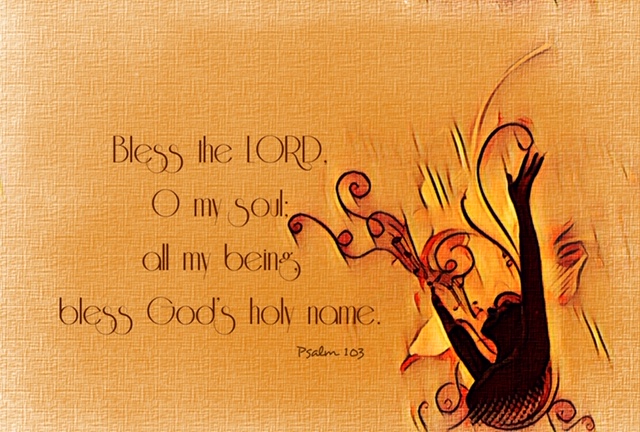
Bless the LORD, O my soul;
all my being, bless his holy name.


Fifth, the hymns of praise with their unreserved and exuberant self-abandonment into the infinity God, contrast starkly with modern “praise songs” which often revert to a narcissistic smallness. . True praise is a large prayer that includes all Creation

The Lord’s kindness is everlasting to those who fear him.


In Psalm 103, the psalmist begins by counting her own blessings. She then moves out to praise God for the blessings given to all Creation. This unfolding in prayer reminds us to enlarge our own awareness of the needs and blessings of others as we pray.

Praying this psalm, let us become amazed and delighted that God loves us completely, irrationally, perfectly and eternally. Wow!

God is so good that it just makes you want to dance. Thus, our energetic music this morning from Godspell

Music: O Bless the Lord, My Soul (based on Psalm 103)
(Lyrics below)

Oh bless the Lord my soul!
His praise to thee proclaim!
And all that is within me join,
To bless His holy name!
Oh yeah!

Oh bless the Lord my soul!
His mercies bear in mind!
Forget not all His benefits,
The Lord, to thee, is kind.
He will not always chide
He will with patience wait
His wrath is ever slow to rise

Oh bless the Lord
And ready to abate
And ready to abate
Oh yeah!

Oh bless the lord
Bless the lord my soul
Oh bless the lord my soul!
He pardons all thy sins
Prolongs thy feeble breath
He healeth thine infirmities
And ransoms thee from death
He clothes thee with his love
Upholds thee with his truth
And like an eagle he renews
The vigor of thy youth

Then bless His holy name
Whose grace hath made thee whole
Whose love and kindness crowns
Thy days


Poetry: Praise the Rain by Joy Harjo who is a member of the Muscogee (Creek) Nation. She earned her BA from the University of New Mexico and MFA from the Iowa Writers’ Workshop. Harjo draws on First Nation storytelling and histories, as well as feminist and social justice poetic traditions, and frequently incorporates indigenous myths, symbols, and values into her writing. Her

Praise the rain; the seagull dive
The curl of plant, the raven talk—
Praise the hurt, the house slack
The stand of trees, the dignity—
Praise the dark, the moon cradle
The sky fall, the bear sleep—
Praise the mist, the warrior name
The earth eclipse, the fired leap—
Praise the backwards, upward sky
The baby cry, the spirit food—
Praise canoe, the fish rush
The hole for frog, the upside-down—
Praise the day, the cloud cup
The mind flat, forget it all—

Praise crazy. Praise sad.
Praise the path on which we’re led.
Praise the roads on earth and water.
Praise the eater and the eaten.
Praise beginnings; praise the end.
Praise the song and praise the singer.

Praise the rain; it brings more rain.

Psalm 97: Who’s in Charge Here?

Thursday of the Eleventh Week in Ordinary Time

June 17, 2020

Today, in God’s Lavish Mercy, we pray with Psalm 97, one of the six “enthronement psalms”.  These hymns identify God as “king” whose power is above all. Such power evokes awe and praise which form the repeated acclamations of the psalm.

The “enthronement” of God in Israel’s worship means that all other “gods” (power, prestige, influence, money, etc.) are now subject to the policies, attitudes and judgments of Yahweh – Who REIGNS and Who is covenanted to us with irrevocable love.

Everything we encounter in life is to be received with that understanding.


We know how the psalmist feels – what it’s like to be awed by God’s power – and left with nothing but stunned silence or quiet whispering praise.

  • Both magnificent and delicate natural phenomena can inspire such a prayer. 
  • Life events over which we have no control can also bring us to humble praise like this.
  • The intricacies of a newborn’s face, the graced windings of an elder’s life story, the unfathomable reality of death, the mystery of a human love that mirrors God’s…. All such mysteries and miracles can cause us to proclaim with the psalmist:

The LORD is king; let the earth rejoice;
let the many islands be glad! …
Light dawns for the righteous, 
and joy for the upright in heart. 

Rejoice in the LORD, O you righteous, 
and give thanks to his holy name

(Ps. 97:2, 10–12)

Or, as transliterated by Minister Christine Robinson:

Highest in Heaven
Deepest in Nature
Holy One

Be Glad
Lights up the world
Purifies the heart
Gathers the peoples
Rejoice.


Whether or not we’re comfortable with “king” language, may we still embrace the image of God, invited to our heart, made at home, praised and unfailingly worshipped. Enthroned!

Today, let us praise our King, Lord, Dear One or however we inadequately attempt to name our Divine Creator.

Poetry: I Am Bending My Knee from the Carmina Gadelica, the work of Alexander Carmichael. Carmina Gadelica is a compendium of prayers, hymns, charms, incantations, blessings, literary-folkloric poems and songs, proverbs, lexical items, historical anecdotes, natural history observations, and miscellaneous lore gathered in the Gaelic-speaking regions of Scotland between 1860 and 1909. (Wikipedia)

I am bending my knee
In the eye of the Father who created me,
In the eye of the Son who purchased me,
In the eye of the Spirit who cleansed me,
In friendship and affection.
Through Thine own Anointed One, O God,
Bestow upon us fullness in our need,
Love towards God,
The affection of God,
The smile of God,
The wisdom of God,
The grace of God,
The fear of God,
And the will of God
To do on the world of the Three,
As angels and saints
Do in heaven;
Each shade and light,
Each day and night,
Each time in kindness,
Give Thou us Thy Spirit.

Music: Our God Reigns – Studio Musicians


Psalm 31: Strife of Tongues

Wednesday of the Eleventh Week in Ordinary Time

June 17, 2020

Today, in God’s Lavish Mercy, we pray with Psalm 31, just three of its twenty-five passionate verses in today’s liturgy. These three will echo in you, as will many others if you read the whole psalm. The images are so strong and yet comforting, the prayer so sincere.

  • In you, LORD, I take refuge.
  • Let me never be put to shame.
  • Incline your ear to me;
  • For you are my rock and my fortress.
  • I will rejoice and be glad in your mercy.
  • Let your face shine on your servant.
  • Save me in your mercy.
  • You hide your beloved in the shelter of your presence.
  • You heard my voice, my cry for mercy.

In my prayer, I focused on this line:

You hide your beloved in the shelter of your presence
from the plottings of evil hearts;
You screen them within your abode
from the strife of tongues.


The strife of tongues”. What a phrase! And what a reality! Our divisive culture is drowning in it – in political, religious and civic contexts. It is often very hard for us to know whom to listen to and believe. But the psalmist helps us to understand a key characteristic of destructive speech – pride and boasting:

Love the LORD, all you his faithful ones!
The LORD keeps those who are constant,
but more than requites those who act proudly.


Today, I prayed for anyone caught in a persecution of words. Specifically, I prayed for Pope Francis and for the Archbishop of Washington, DC, Wilton Gregory. Both men have been victims of “the strife of tongues”.

In a publicized letter written to Donald Trump, Pope Francis was targeted by reactionary clergyman Carlo Viganò who dabbles in conspiracy theories and misinformation in order to undermine Francis’s ministry.

Archbishop Gregory described Donald Trump’s photo op at the Shrine of St. John Paul II as “reprehensible“, condemning the politicization of religion for “manipulative” purposes. As a result, the Archbishop, who is Black, has been racially and sexually slurred by, among others, a far-right hate group claiming to be “Catholic”.


As I prayed for these good priests, and for all others condemned for truthful and compassionate testimony, I asked God to enfold them in the verse from Psalm 31, part of which Jesus prayed on the cross:

Into your hands I commend my spirit;
you will redeem me, LORD, God of truth.

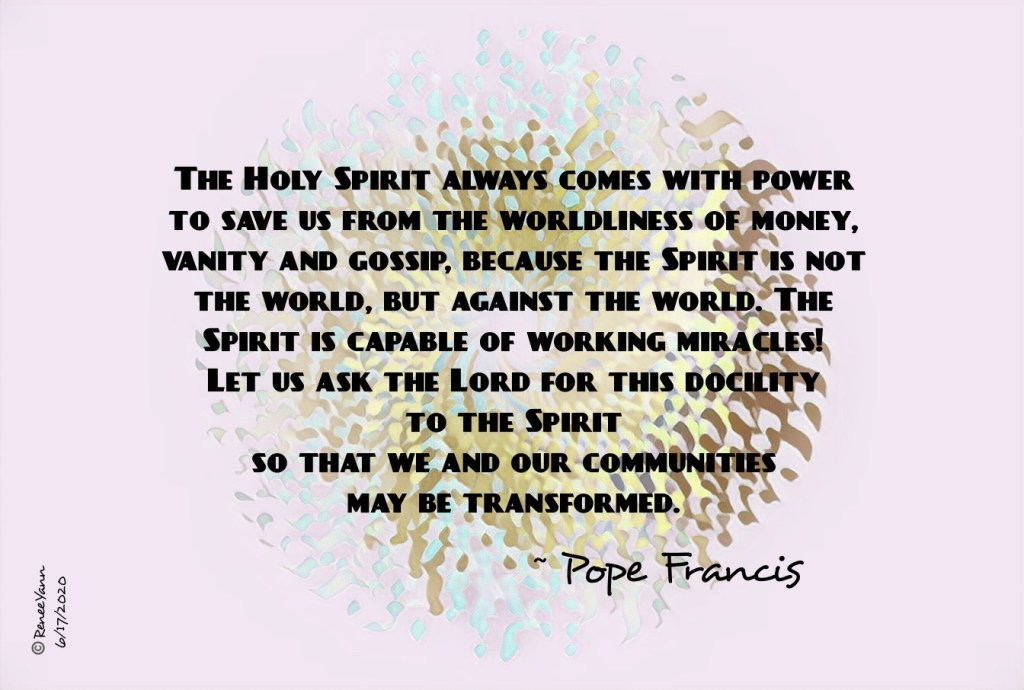
It is painful to witness this kind of sinful negativity in the Church, and the pain does enter into our prayer. Pope Francis points to a way to heal that pain:

Poetry: Our poem today is by a 19th century poet, Susan S. Button from her only book I could find which she published herself. She strikes me as an Emily Dickinson type without the same degree of literary accomplishment. There is very little information on her although she was notable enough in society to have a portrait by John Sartain (currently in the Pennsylvania Academy of Fine Arts.)

The poem, although on a serious topic, still provided a level of delight about what happens to those who slander the innocent. I offer just a few verses of the long composition and hope you enjoy it as much as I did!

Slander

What is the slander’s tongue? An arrow strong,
And sharp, and fierce, empoisoning many a word,
Such as to devil’s only do belong,
When they, by Envy and by Malice stirred,
Do contemplate dark deeds, and souls do gird
For vilest crimes, and with their deadly bane,
The good man rob of fame — with lies absurd
Asunder rend kind Friendship’s gold-linked chain,
And break the three-fold, silken cord of Love amain.
——
For though Slander’s pliant bow was newly strung,
And thick and fast her feathered arrows flew,
And through the misty air their echoes rung,
The light around his head more lustrous grew;
For Innonence forth from her treasures drew
A golden shield, and clasped it o’er his heart,
While Truth held up a golden lamp and new!
While through its lucent flame flew on the dart
From Slander’s quiver, brighter light it did impart.

It trembled on the shield of Innocence—
The good man gazed, and by its blood-stained shade
He knew full well who formed it, and from whence
It came — he plucked it from the shield and bade
The innocent “tremble not, nor be afraid.”
With force redoubled Slander drew her bow
And furious all her cruel haste betrayed,
But soon was heard a horrid shriek of woe,
As her rebounding dart did to her forehead go.

~ Susan S. Button (1858)

Music: Herr, auf dich traue ich – Otto Nicolai (1810-1849j, one of the founders of the Vienna Philharmonic

Psalm 31:1-2

Herr, auf dich traue ich,
Laß mich nimmermehr zu Schanden werden,
Errette mich nach deiner Barmherzigkeit,
Und hilf mir aus.
Neige deine Ohren zu mir, und hilf mir;
Sei mir ein starker Hort,
Ein Hort, dahin ich immer fliehen möge,
Der du hast zugesaget mir zu helfen.
Lord, I trust in you,
Let me never be ashamed;
Deliver me in your mercy And assist me.
Incline your ear to me and help me;
Be a strong refuge for me,
A refuge to which I may always flee,
Which you have promised to me for my aid.

Psalm 27: Lift the Veil

Friday of the Tenth Week in Ordinary Time

June 12, 2020

Click here for readings

Psalm 27JPG

Today, in God’s Lavish Mercy, we pray with Psalm 27, a popular psalm used often in the liturgy.

The psalm rocks back and forth between a desperate cry for light and a firm confidence that it will come. No wonder it’s so popular. Isn’t our whole life filled with that rocking?

How many times have we said or heard the plea, “God help me/us!”? I know someone who punctuates almost her entire conversation with similar exclamations. Whenever her own circumstances, or the world in general, disappoints or astounds her, some form of the aspiration arises. Often, it takes a secular form like, “Ay, ay, ay!”, but it is still the same prayer.😀


2bubble

How about you? Have you heard that kind of plea resounding in your own heart lately? The world has been pretty overwhelming recently with disease, death, brutality, anger, and hatred all spilling out like lava from a frightening volcano. And you’ve probably got your own few personal boilers to add!

Unless we’re living in some kind of bubble, it all has to have some impact on our faith, hope and joy.


Psalm 27 is made for these times. It does not fail to acknowledge the weight of circumstances:

Hear, O LORD, the sound of my call;
have pity on me, and answer me…
Hide not your face from me;
do not in anger repel your servant.
You are my helper: cast me not off...

Nevertheless, under its pleading, rests a complete and steadfast confidence in God’s favor:

I believe that I shall see the bounty of the LORD
in the land of the living.
Wait for the LORD with courage;
be stouthearted, and wait for the LORD.

The psalmist invites us to share in this honest prayer, for ourselves and for all the anxious world which may carry troubles greater than our own.

(P.S. Be sure to read today’s first reading. Elijah was looking for God’s Face/Voice too. He found it in the most delightful way. Don’t miss it.)


For poetry today, a selection from the powerful poet Denise Levertov

The Tide

Where is the Giver to whom my gratitude
rose? In this emptiness
there seems no Presence.
*
How confidently the desires
of God are spoken of!
Perhaps God wants
something quite different.
Or nothing, nothing at all.
*
Blue smoke from small
peaceable hearths ascending
without resistance in luminous
evening air.
Or eager mornings—waking
as if to a song’s call.
Easily I can conjure
a myriad images
of faith.
Remote. They pass
as I turn a page.
*
Outlying houses, and the train’s rhythm
slows, there’s a signal box,
people are taking their luggage
down from the racks.
Then you wake and discover
you have not left
to begin the journey.
*
Faith’s a tide, it seems, ebbs and flows responsive
to action and inaction.
Remain in stasis, blown sand
stings your face, anemones
shrivel in rock pools no wave renews.
Clean the littered beach, clear
the lines of a forming poem,
the waters flood inward.
Dull stones again fulfill
their glowing destinies, and emptiness
is a cup, and holds
the ocean.

Music: Psalm 27 – Choir of St. John’s College Elora

Psalm 98: Nice Job, Lord!

Memorial of Saint Barnabas, Apostle

June 11, 2020

Click here for readings

psalm 98 strings
Today, in God’s Lavish Mercy, we pray with Psalm 98, one of a small knot of psalms whose point is to shout praise over and over to God. It is a hymn psalm, and one of the ten Royal Psalms themed with “kingship”.

As we pray this exultant psalm, in Latin called “Cantate Domino” (Sing to the Lord), we can almost visualize the psalmist and fellow praisers clapping God on the back and chanting, “Great job! Nice work!”.

All the ends of the earth have seen
the salvation by our God.
Sing joyfully to the LORD, all you lands;
break into song; sing praise.


psalms
Walter Brueggemann has written extensively about the Psalms. He says this about the act of praise:

Praise articulates and embodies our capacity to yield, submit, and abandon ourselves in trust and gratitude to the One whose we are. … We have a resilient hunger to move beyond self. God is addressed not because we have need, but simply because God is God.
(Israel’s Praise: Doxology against Idolatry and Ideology)


We don’t have to be as articulate as the psalmist to weave praise into our prayer. 

Sometimes when we catch the sunrise at a morning window, we might quietly say, “Great job! Thank You, Radiant God”

When we look at the magnificence of a natural wonder like the Grand Canyon, we might abandon words and simply let our breathing be praise.

When we study the finely-aged face of a beloved elder, we might praise the monument of grace God has worked in her/his life.

When we finger the strings of our own faith history, we might, in our own words, echo the psalmist:

I sing You a new song in every moment, Lord
for You have done wondrous deeds;
Your loving hand has strung grace through my life,
your generous heart has blessed me amazingly.


Poetry today from Mary Oliver who rejoices in the redbird’s morning praise:

All night my heart makes its way
however it can over the rough ground
of uncertainties, but only until night
meets and then is overwhelmed by
morning, the light deepening, the
wind easing and just waiting, as I
too wait (and when have I ever been
disappointed?) for redbird to sing
― A Thousand Mornings

Music: Cantate Domino – Claudio Monteverdi 

Psalm 16: The Secret

Wednesday of the Tenth Week in Ordinary Time

June 10, 2020

Click here for readings

psalm16

Today, in God’s Lavish Mercy, we pray with Psalm 16.  This Psalm is introduced as “A Michtam of David”. “Michtam” can be interpreted as either “golden” or “secret” by various translators. 

For prayer this morning, I focused on “secret” because, in the psalm, David expresses what he considers the secret to a joyful, holy life even in difficulty.

O LORD, my allotted portion and cup,
you it is who hold fast my lot.
I set the LORD ever before me;
with him at my right hand I shall not be disturbed.

The last line of this verse immediately brought to mind St. Teresa of Avila’s transcendent advice:

Nada te turbe
nada te espante
Todo se pasa
Dios no we muda.
La paciencia todo alcanza.
Quien a Dios tiene
nada le falta
Solo Dios basta.

Let nothing disturb you,
Let nothing frighten you,
All things are passing.
God alone is changeless.
Patience obtains all things
Whoever has God lacks nothing;
God alone suffices.

Repeating this Psalm slowly and intentionally, let us pray for that kind of peace today:

  • for ourselves
  • our beloveds
  • our world, especially those from whom peace has been stolen by injustice, war, greed, and hate.

Music: Psalm 16 – Shane and Shane

There is fullness
Of joy
Of joy
At Your right hand
There are pleasures
Forevermore
Forevermore

My heart is glad and my soul rejoices
My flesh it dwells secure
Because You put on flesh
Lived a blameless life
My curse on the cross You bore

Then You ripped the doors off the City of Death
And the chains fell to the floor
Now the serpent’s crushed
It has been finished
And You reign forevermore

You are my portion
My cup and you make my lot secure
The lines have fallen
For me in pleasant places
A beautiful inheritance