I hear the whisperings of many: “Terror on every side! Denounce! let us denounce him!” All those who were my friends are on the watch for any misstep of mine.
Jeremiah 20:10
Oh, the deadly power of a fragile whisper! Its insidious influence seeps into souls, germinates, and grows into fictional suggestions, untested prejudices, and effective shunning by the “in” set.
Whispers are the emanations of fear – we may fear what is different, what we cannot control, what challenges us, what actually exposes pretense in us.
Jeremiah and Jesus encountered the ugly entanglement of such whispers. But they were not trapped because they believed.
Today, in God’s Lavish Mercy: We pray their prayer for ourselves and for all who suffer the persecution of “whisperings”.
The LORD is with me, like a mighty champion: my persecutors will stumble, they will not triumph. O LORD of hosts, you who test the just, who probe mind and heart, Let me witness the recompense you take on them, for to You I have entrusted my cause.
Poetry: A Word – Emily Dickinson
A word is dead
When it is said,
Some say.
I say it just
Begins to live
That day.
Music: from Handel’s Messiah: He trusted in God that He would deliver him
But Zion said, “The LORD has forsaken me; my Lord has forgotten me.” Can a mother forget her infant, be without tenderness for the child of her womb? Even should she forget, I will never forget you.
Isaiah 49: 14-15
In our Gospel, Jesus tells his questioners that he and the Creator are One. Jesus uses the imagery of “Father” to connote his oneness with the Creator. Isaiah uses the imagery of a “Mother” to convey the depth of loving relationship we are given in God.
Throughout Scripture and through the long spiritual legacy of the Church, many images of God have been offered to deepen our prayer.
Scripture gives us God as King, Suffering Servant, Rock, Fortress, Shepherd …
John of the Cross imaged God as Lover, Francis of Assisi and Hadewijch of Brabant found God in Creation. Therese of Lisieux knew herself as a child of God.
The poet Francis Thompson sees God as the Hound of Heaven, William Blake as a Lamb.
Today, in God’s Lavish Mercy:
Depending on our human relationships and experiences, some of these images help us with our prayer and some do not.
Today we might consider how we relate to our Invisible God. Our prayer can open our understanding to allow God’s Love to come nearer to us. This is something Isaiah understood when he imaged God as Mother, and that Jesus understood when he called God “Father”.
Poetry: The Divine Feminine – by Hildegard of Bingen who is only the fourth woman in history to be declared a Doctor of the Church, joining the names of Catherine of Sienna, Teresa of Avila, and Therese of Lisieux.
I heard a voice speaking to me:
‘The young woman whom you see is Love.
She has her tent in eternity…
It was love that was the source of this creation
in the beginning when God said: ‘Let it be!’
And it was.

As though in the blinking of an eye,
the whole creation was formed through love.
The young woman is radiant
in such a clear, lightning-like brilliance of countenance
that you can’t fully look at her…
She holds the sun and moon in her right hand
and embraces them tenderly…

The whole of creation calls this maiden ‘Lady.’
For it was from her that all of creation proceeded,
since Love was the first. She made everything…
Love was in eternity and brought forth,
in the beginning of all holiness,
all creatures without any admixture of evil.
Adam and Eve, as well were produced by love
from the pure nature of the Earth.”
Cursed is the one who trusts in human beings, who seeks strength in flesh, whose heart turns away from the LORD. Such a person is like a barren bush in the desert that enjoys no change of season, But stands in a lava waste, a salt and empty earth.
Jeremiah 17: 5-6
Have you encountered a person who is spiritually languishing, or even dead? The light of their spirit has gone out. There is no joy, hope, delight, or generosity in them. Sometimes their barrenness is buried under false hilarity or bravado, but after leaving them we find ourselves confused, saddened, empty, tired, or even a little angry.
Today, in God’s Lavish Mercy:
Let’s pray for any barren spirit we have encountered. They badly need our prayers. And let’s ask God for the merciful freshening of our own spirit, seeking it by prayer, loving silence, and honest reflection on our choices and actions.
Poetry: What the Fig Tree Said – Denise Levertov
Literal minds! Embarrassed humans! His friends
were blurting for Him
in secret: wouldn’t admit they were shocked.
They thought Him
petulant to curse me!—yet how could the Lord
be unfair?—so they looked away,
then and now.
But I, I knew that
helplessly barren though I was,
my day had come. I served
Christ the Poet,
who spoke in images: I was at hand,
a metaphor for their failure to bring forth
what is within them (as figs
were not within me). They who had walked
in His sunlight presence,
they could have ripened,
could have perceived His thirst and hunger,
His innocent appetite;
they could have offered
human fruits—compassion, comprehension—
without being asked,
without being told of need.
My absent fruit
stood for their barren hearts. He cursed
not me, not them, but
(ears that hear not, eyes that see not)
their dullness, that withholds
gifts unimagined.
Jesus said to his disciples: “In praying, do not babble like the pagans, who think that they will be heard because of their many words. Do not be like them. Your Father knows what you need before you ask him.
Matthew 6: 7-8
I enjoy when Jesus is bluntly funny with his followers, as in today’s “Don’t babble!“. But my enjoyment wanes when I realize that he’s talking to me too. What about the quality of my prayer? Where do I fall on the “babble scale”?
Today, in God’s Lavish Mercy:
We might consider the quality of our prayer, just as we might consider the quality of our conversation with anyone we dearly love. Do we talk with them enough? Do we listen to them well? Do we talk about things that matter? Do we say “the important things” to one another? Do we know and love each other well enough that we can communicate without even speaking?
That deep silent dialogue with God is referred to as contemplative prayer. The site below is a great place to enrich our practice of this type of prayer.
One of the most celebrated poets of the American post-war generation, Jorie Graham is the author of numerous collections of poetry, including The Dream of the Unified Field: Selected Poems 1974-1992 (1995) winner of the Pulitzer Prize for Poetry. She has taught for many years at Harvard University as the Boylston Professor of Rhetoric and Oratory, the first woman to be given this position, which was previously held by Seamus Heaney and many other writers dating back to the first Boylston Professor, John Quincy Adams.
Over a dock railing, I watch the minnows, thousands, swirl
themselves, each a minuscule muscle, but also, without the
way to create current, making of their unison (turning, re-
                                                                      infolding,
entering and exiting their own unison in unison) making of themselves a
visual current, one that cannot freight or sway by
minutest fractions the water’s downdrafts and upswirls, the
dockside cycles of finally-arriving boat-wakes, there where
they hit deeper resistance, water that seems to burst into
itself (it has those layers), a real current though mostly
invisible sending into the visible (minnows) arrowing
                                    motion that forces change

this is freedom. This is the force of faith. Nobody gets
what they want. Never again are you the same. The longing
is to be pure. What you get is to be changed. More and more by
each glistening minute, through which infinity threads itself,
also oblivion, of course, the aftershocks of something
at sea. Here, hands full of sand, letting it sift through
in the wind, I look in and say take this, this is
what I have saved, take this, hurry. And if I listen
now? Listen, I was not saying anything. It was only
something I did. I could not choose words. I am free to go.
I cannot of course come back. Not to this. Never.
It is a ghost posed on my lips. Here: never.
Music: The Prayer – written by David Foster, Carole Bayer Sager, Alberto Testa and Tony Renis
Today, in God’s Lavish Mercy, our readings might lead us to consider what we pay attention to in our spiritual lives and why.
In our first reading, Solomon prays simply and sincerely before the presence of God. It is the prayer of one who is spiritually vulnerable to God’s grace in whatever way it comes.
Solomon stood before the altar of the LORD in the presence of the whole community of Israel, and stretching forth his hands toward heaven, he said, “LORD, God of Israel, there is no God like you in heaven above or on earth below; you keep your covenant of mercy with your servants who are faithful to you with their whole heart.
1 Kings 8:22-23
Solomon’s focus in prayer is to honor and acknowledge God and to ask mercy for himself and the people for whom he is responsible.
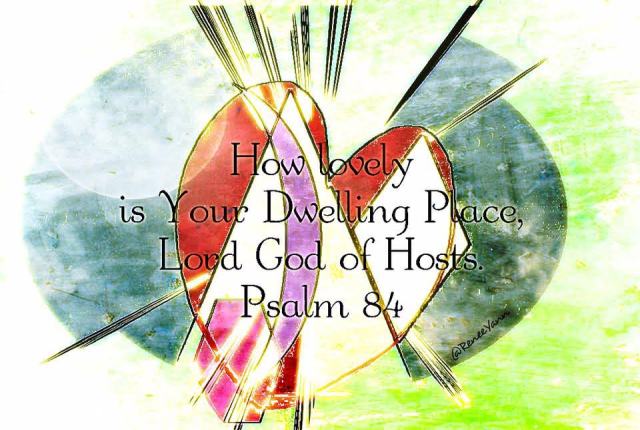
Today’s Responsorial Psalm 84
The Pharisees, on the other hand, fear the presence of God in Jesus because he threatens the collapse of their false religionism. To protect their man-made securities, they have constructed an elaborate maze of rules and judgments which hardens them to renewing grace.
Rather than listen to Jesus who offers them redemption, they focus on the lifeless particularities of the Law:
When the Pharisees with some scribes who had come from Jerusalem gathered around Jesus, they observed that some of his disciples ate their meals with unclean, that is, unwashed, hands.
Mark 7:1-2
The Pharisees’ recalcitrance disappoints and angers Jesus:
He responded, “Well did Isaiah prophesy about you hypocrites, as it is written:
This people honors me with their lips, but their hearts are far from me; In vain do they worship me, teaching as doctrines human precepts.
You disregard God’s commandment but cling to human tradition.” He went on to say, “How well you have set aside the commandment of God in order to uphold your tradition!
Mark 7:6-8
We live our lives always in the Presence of God. Do we even realize this? Do we pray, like Solomon, with an open heart for the grace to grow ever closer to God in every circumstance that is offered to us?
Do we ask for the grace to see where judgments, measurements, and definitions limit our spiritual growth?
As I read today’s Gospel, I think of Pope Francis’s recent decision to allow the blessing of same-sex couples. Francis looked beyond traditional constraints to offer healing mercy to those seeking God’s love. Some people, caught in strictures similar to those of the Pharisees, have not only resisted but condemned the Pope for his decision.
The situation is not dissimilar from that of today’s Gospel. What can we learn about our own attitudes and spiritual openness as we pray with these readings? What can Solomon teach us about sincere, humble, and transparent prayer?
Poetry: Peace Is This Moment Without Judgment – Dorothy Hunt
Do you think peace requires an end to war? Or tigers eating only vegetables? Does peace require an absence from your boss, your spouse, yourself?… Do you think peace will come some other place than here? Some other time than Now? In some other heart than yours? Peace is this moment without judgment. That is all. This moment in the Heart-space where everything that is is welcome. Peace is this moment without thinking that it should be some other way, that you should feel some other thing, that your life should unfold according to your plans. Peace is this moment without judgment, this moment in the Heart-space where everything that is is welcome.
Music: Heart of Gold – Nicholas Gunn
I think this song can be like a prayer asking God’s warmth and mercy in our judgments and prayers.
Today, in God’s Lavish Mercy, we pray with Psalm 147 which invites us to:
Praise the LORD Who is good; sing praise to our God, Who is gracious; the One it is fitting to praise.
It is a psalm for the left-brained who, like Job in our first reading, might need some explanation about just why we should praise when life seems so unpraiseworthy at times!
Job spoke, saying: Is not man’s life on earth a drudgery? Are not his days those of hirelings? He is a slave who longs for the shade, a hireling who waits for his wages. So I have been assigned months of misery, and troubled nights have been allotted to me.
Job 7: 1-4
Job, like many of us when we suffer, feels crushed under life’s burdens. However, an extended reading of the Book of Job reveals that humility and repentance allow Job to “see God”, and to rediscover the richness and flavor of his life.
Calling us to the same kind of awareness, Psalm 147 presents a series of reasons for praising God, including God’s continual attention to the city of Jerusalem, to brokenhearted and injured individuals, to the cosmos, and to nature.
For me, the most moving of these reasons comes in verse 3:
The Lord heals the brokenhearted and binds up their wounds. The Lord tells the number of the stars; calling each by name.
This is a beautiful picture of our infinitely compassionate God who is able to recognize our broken-heartedness.
This loving God, who knows the stars by name, knows us as well. We, like Job, begin to heal within the divine lullaby God patiently sings over our broken hearts.
Jesus is that Healing Song, the Word hummed over the world by the merciful Creator. In today’s Gospel, we see that Melody poured out over the suffering:
When it was evening, after sunset, they brought to him all who were ill or possessed by demons. The whole town was gathered at the door. He cured many who were sick with various diseases, and he drove out many demons, not permitting them to speak because they knew him.
Mark 1: 32-34
As we pray today, let us hear God’s song of mercy being sung over all Creation. Let us rest our own brokenness there in its compassionate chords. Let us bring the world’s pain to our prayer.
Poetry: A Cure Of Souls by Denise Levertov
The pastor
of grief and dreams
guides his flock towards
the next field
with all his care.
He has heard
the bell tolling
but the sheep
are hungry and need
the grass, today and
every day. Beautiful
his patience, his long
shadow, the rippling
sound of the flocks moving
along the valley.
Music: God Heals My Broken Heart – Patty Felker
If Job were singing his sadness today, it might sound like this song.
Today, in God’s Lavish Mercy Mercy, vigorous, grace-filled David dances with abandon before the Lord. It is a beautiful moment to imagine!
David went to bring up the ark of God from the house of Obed-edom into the City of David amid festivities. As soon as the bearers of the ark of the LORD had advanced six steps, he sacrificed an ox and a fatling. Then David, girt with a linen apron, came dancing before the LORD with abandon, as he and all the house of Israel were bringing up the ark of the LORD with shouts of joy and to the sound of the horn.
2 Samuel 6: 12-15
David dances with unselfconscious joy because he has brought the Presence of God home to the heart of the community. The joy comes from recognizing that God wants to be with the People. This joy, inexpressible in words, takes the form of a dance with the Spirit of God.
Let’s pause today with that dancing image, to consider all the ways God longs to dance with us throughout our lives, and we with God — dances of both:
joy and sorrow, faith and questioning, hope and shadow
… dances in which we must abandon ourselves to the moment’s sacred music and respond to God’s mysterious, leading step.
Whatever the emotion we bring to prayer, what matters is only that we carry it close to God’s heart, listening to our circumstances for the Divine Heartbeat. We may not be the “Fred Astaire” or “Ginger Rodgers” of prayer, but each one of us has a holy dance somewhere in their heart.
I think our children can teach us something about this kind of uninhibited prayer – one filled with trust, hope, joy, and innocence.
Poetry: T. S. Eliot
At the still point of the turning world. Neither flesh nor fleshless; Neither from nor towards; at the still point, there the dance is, But neither arrest nor movement. And do not call it fixity, Where past and future are gathered. Neither movement from nor towards, Neither ascent nor decline. Except for the point, the still point, There would be no dance, ~ T.S. Eliot
A second lovely poem, even though it is not Easter 🙂
Easter Exultet
Shake out your qualms. Shake up your dreams. Deepen your roots. Extend your branches.
Trust deep water and head for the open, even if your vision shipwrecks you.
Quit your addiction to sneer and complain. Open a lookout. Dance on a brink.
Run with your wildfire. You are closer to glory leaping an abyss than upholstering a rut.
Not dawdling. Not doubting. Intrepid all the way Walk toward clarity.
At every crossroad Be prepared to bump into wonder. Only love prevails.
Enroute to disaster insist on canticles. Lift your ineffable out of the mundane.
Nothing perishes; nothing survives; everything transforms! Honeymoon with Big Joy! ~ James Broughton
Today, in God’s Lavish Mercy, we pray with Psalm 40, the prayer of one at home with God:
I delight to do your will, my God; your law is in my inner being!
Psalm 40:9
We are reminded that we find this kind of peace by believing and listening to our experience:
Throughout our readings today, God leans over heaven’s edge to whisper into human experience.
Samuel’s Call by Joshua Reynolds
In our first reading, that whisper comes in a sacred call to a listening Samuel:
When Samuel went to sleep in his place, the LORD came and revealed his presence, calling out as before, “Samuel, Samuel!” Samuel answered, “Speak, for your servant is listening”.
1 Samuel 3: 9-10
In our second reading, Paul reminds us that the Whispering Spirit is already resident within us:
Do you not know that your body is a temple of the Holy Spirit within you, whom you have from God, and that you are not your own?
1 Corinthians 6:19
In our Gospel, Jesus – the Word, the Divine Whisper – invites us to come to him, to see his power with us in our ordinary lives.
The two disciples said to Jesus, “Rabbi, where do you live?” He said to them, “Come, and you will see”.
John 1: 39
Praying with Psalm 40 can turn our hearts to listening for God’s voice under and within our experiences.
It can wake us up, as Samuel was awakened.
It can attune us to the melody deep within our hearts.
It can reiterate God’s invitation to live our lives so fully in the Beloved’s Presence that, even without a sound, we know each other’s thoughts.
Poetry: from Whispers of the Beloved by Rumi
Do you know what the music is saying?
“Come follow me and you will find the way.
Your mistakes can also lead you to the Truth.
When you ask, the answer will be given.”
Merry Christmas, dear readers! May our sweet Jesus abundantly bless you and those you love.
Below is a video beautifully edited by our Sister Mary Kay Eichman. We both thought you might like to enjoy it, whole or in parts, over this Christmastide.
Today, in God’s Lavish Mercy, let us pray within the amazing Presence of God in our life renewed in us this Christmas.
Mary is wrapped in the cold darkness of this winter night. She is vulnerable as she waits to bring forth her child. Yet she feels wrapped in tenderness by God and supported by God’s love. She longs to welcome this Holy Child in warmth And to wrap him in the same love and tenderness.
We too want to welcome Jesus with warm tenderness. In Mercy, we have tried to bring Christ into world and to warm and comfort people with God’s presence.
Is there a person in your life, Or a place in your heart today that needs warmth, comfort and love?
Be in quiet prayer for that person or place for a while as we absorb the amazing graces offered us in the Christmas miracle.
Prayer
Today the Christ Child is born We welcome Him into our hearts We wrap Him in our adoration.
Today the Christ Child is born In the refugee who longs for home In the sick who long care In the poor who long for sustenance In the uneducated who long for hope In these, we welcome Him. We wrap them in our prayer.
Today the Christ Child in born In children who long for a future In families who long for unity In elders who long for peace In all people who long for dignity and love In these, we welcome Him. We wrap them in our prayer.
Today the Christ Child is born In our Church that longs for holiness In our community that longs for grace In our world that longs for peace In our hearts that long for God In these we welcome Him. We wrap them in our prayer.
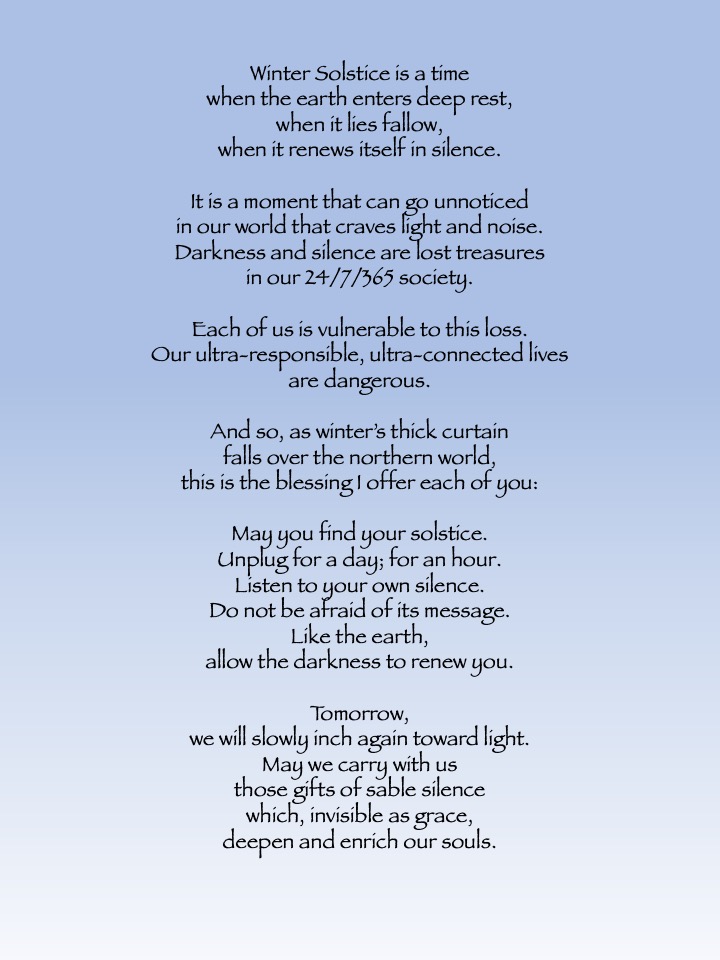
On Thursday, December 21, 2023, at 10:27 PM (EST), the northern hemisphere will experience the Winter Solstice, that moment in time of ultimate darkness. I send a prayer of blessing to you all in that sacred moment.
Music: To counterpoint your quiet, here’s a high-spirited welcome to the Solstice from Jethro Tull.
Now is the solstice of the year Winter is the glad song that you hear Seven maids move in seven time Have the lads up ready in a line Ring out these bells Ring out, ring solstice bells Ring solstice bells
Join together ‘neath the mistletoe, By the holy oak whereon it grows Seven druids dance in seven time Sing the song the bells call, loudly chiming Ring out these bells Ring out, ring solstice bells Ring solstice bells
Ring out, ring out the solstice bells Ring out, ring out the solstice bells Praise be to the distant sister sun, Joyful as the silver planets run Seven maids move in seven time Sing the song the bells call, loudly chiming Ring out these bells Ring out, ring solstice bells Ring solstice bells Ring on, ring out Ring on, ring out Ring on, ring out Ring on, ring out











 Lavish Mercy