Today, for your reflection, a poem I wrote decades go. I offer it today in memory of Judy Ward, RSM who passed away on September 27, 2025. Her life will be celebrated on October 2nd in a Mass of Christian Burialin the chapel at Mt. St. Mary, where Judy attended school, became a Sister of Mercy, and taught for many years.
Judy, a gifted artist, did so much to encourage me and to illustrate and promulgate my work. I will miss her generous kindness and her friendship.
October is a time when nature changes clothes. Leaves, like miniature volcanoes, flare up and die, ashes at the foot of a silent, seemingly immortal tree. Geese, having dawdled all summer in veiled expectation, suddenly leap into the clouds and disappear. These solemn miracles may incline us to consider our own impermanence and the gossamer phenomenon we call life.
Healing
Music: A Playlist of Autumn Music
For Your Reflection
What feelings or reactions do I have after reading this reflection?
Do my feelings or reactions remind me of any passage or event in scripture, especially in the life of Christ?
What actions might I take today because of my response to these readings?
When I was a little girl, I hated the monkey bars. I knew it was cool to be able to do them — but I wasn’t any good at it! I can remember jumping up to hang on to the first bar, and thinking, “O.K. — this is as far as I can go”! For me, it was really a challenge to loosen the grip on one of those secure, sweaty hands and reach out in both hope and anxiety for the next stabilizing bar.
I remember one particularly challenging day at the playground. It had rained heavily the night before, and the ground under the bars was a muddy mess. Big Jimmy, the neighborhood bully, had challenged me to a monkey bar duel. Within a flash of the challenge, he had powerfully swung his way from one end to the other. He stood egging me on from his place of success.
I tentatively climbed up and hung on the first bar. Painstakingly, I lurched my way to the second. My hands were slippery, nervous pools. As I stretched for the third bar, I felt my grip slipping. I tried to re-grab — but I couldn’t. I hung by the fingernails of one hand over a two-inch muddy pool. There seemed to be no hope!
Suddenly I felt two strong hands around my little waist. They lifted me so that I could regain my grasp and they supported me while I hand-over-handed my way to the end. My Uncle Joe, who had been passing by the playground, saw me struggling and had come to my assistance. Without words, he told Big Jimmy, who was three years my senior, that someday I would catch up to him. But until then, I needed a little help to negotiate some of my challenges.
We’re not little kids anymore, but we can still get unnerved by the demands of life and of the world at large. The once-lithe body that reached for the monkey bars may now struggle to get out of a chair. The “Uncle Joe” saviors may no longer magically appear to support us when we are uncertain. The “Big Jimmy” bullies may seem to have poisoned our political culture with violence and fear. Yes, sometimes growing up and growing old can be worrisome.
No matter how challenging or scary life’s passages, God accompanies and supports us. There is no circumstance so muddy that God will not carry us through. No matter how slippery our grip feels, God’s hands are at the center of our lives, holding us in unassailable grace. We can trust God infinitely more than even our “Uncle Joe”s.
Yes, life can sometimes feel like we are swinging from slippery monkey bars, but by trust and faith, we can invite God’s loving support to surprise and uplift us.
Music: You Raise Me Up – Josh Groban
For Your Reflection
What feelings or reactions do I have after reading this reflection?
Do my feelings or reactions remind me of any passage or event in scripture, especially in the life of Christ?
What actions might I take today because of my response to these readings?
Blessed be the LORD, my Rock, who trains my hands against temptation, my fingers for the struggle.
My mercy and my fortress, my stronghold, my deliverer, my shield, in whom I trust, who brings me to right relationship with all Creation
O God, I will sing a new song to you; with a ten stringed lyre I will chant your praise, -You who raise us up in mutual peace and deliver your servant from evil. ~ interpretation of Psalm 144
David, likely author of Psalm 144, had a few nicknames for God. By exploring these names, David deepened his understanding of God’s Presence in his life, and personalized his prayer in a meaningful way.
Today, in God’s Lavish Mercy: We consider the intimacy and power of our relationship with God – how it has changed over the years, how it is at this point in our lives. Do we, like David, have special names for God, reflecting those places in our hearts that are most vulnerable to grace? Perhaps we wouldn’t have a reason to call God “my Rock”. But maybe we might call God my Poet, my Song, my Patient One, my Confidence or my Beloved.
How is God most needed or most present to you today, and how do you name that awareness?
Poetry: Prayer Poem to the Names of God – Richard M. Fewkes
How shall we address thee who art the One of a thousand names yet ever nameless?
O Vishnu, Maya, Kali, Ishtar, Athene, Isis… Great Mother of Creation, Womb of the universe, The Feminine Divine…. Blessed art thou who hast given life to all And receiveth us at the end, forever thine…
Jupiter, Zeus, Apollo, Dionysius… Lord of creation, the masculine divine, In quest of the golden apples of Hesperides, God of ecstasy and wine, and reason sublime…
Amen, Horus, Aten, Ra… God of beginnings and endings, the soul, the ka, Soaring like a bird To the life-giving, light-giving power of the sun, All life is one…
Shiva-Shakti, Yin and Yang… The dance of life and death from hand to hand, In perfect balance the movement of forces, As the earth turns ‘neath the stars in their courses…
Rama, Krishna, Varuna, Bramah… God of the Upanishads and Rig Veda, mystic priests and the Bhagavadgita, Om Shanti, the lotus, a holy vow, Creating our own karma and reincarnation, here and now, And the ever present realization, that art Thou…
Buddha, Nirvana, the Enlightened One… Liberation sought and won, in daily life begun, Under a tree, in the sun, To a state of being indescribable, comparable to none…
Allah-Akbar and Ahura Mazda… There is no god but God, the All, Ah! the One, The Righteous One, purity of Fire. Goodness and Truth to inspire, Fight fire with fire, quench the evil desire, Let the call ring forth from minaret to spire…
El Shaddai, Adonai, Yahweh, Elohim The God of Peace be with you, Shalom Haveyreem Ten Commandments and the Law for Gentile and Jew The birth of conscience and a Day of Atonement To confess, to forgive, to begin anew…
Abba, Spiritus, Logos-Son… God in Three Persons, God in One, God in all persons: prophets, teachers, daughters and sons, The Kingdom of Heaven is within us, O let thy Kingdom come… How shall we address thee who art Alpha and Omega, The stars in their courses from Denib and Altair to Sirius and Vega?
Thou of a thousand names and yet ever nameless, Let us confess the mystery of thy holiness, Let us proclaim the wonder of One without a name, Let the silence praise thee, And the nine billion stars of thy namelessness.
How sweet to my taste is your promise! In the way of your decrees I rejoice, as much as in all riches. Yes, your decrees are my delight; they are my counselors. The law of your mouth is to me more precious than thousands of gold and silver pieces. How sweet to my palate are your promises, sweeter than honey to my mouth! Your decrees are my inheritance forever; the joy of my heart they are. I gasp with open mouth in my yearning for your commands. from Psalm 119
Today, I choose to pray with our Responsorial Psalm 119, a beautiful love song to God. The psalm lists everything for which we might love God.
Picture a beloved asking you, “What do you love about me? Can you make a list?” Picture God doing the same thing. Psalm 119 is one person’s list of how they love the sweetness of God. What would your list look like?
Today, in God’s Lavish Mercy: We take time in prayer to share “love talk” with God. How does the Divine Sweetness touch us, change us? How do we return that sweetness to God by our touch upon God’s Creation?
Poetry: Song Silence By Madeleva Wolff, CSC
Yes, I shall take this quiet house and keep it With kindled hearth and candle-lighted board, In singing silence garnish it and sweep it For Christ, my Lord.
My heart is filled with little songs to sing Him— I dream them into words with careful art— But this I think a better gift to bring Him, Nearer his heart.
The foxes have their holes, the wise, the clever; The birds have each a safe and secret nest; But He, my lover, walks the world with never A place to rest.
I found Him once upon a straw bed lying; (Once on His mother’s heart He laid His head) He had a bramble pillow for His dying, A stone when dead.
I think to leave off singing for this reason, Taking instead my Lord God’s house to keep, Where He may find a home in every season To wake, to sleep.
Do you not think that in this holy sweetness Of silence shared with God a whole life long Both he and I shall find divine completeness Of perfect song?
Music: Cor Dulce – Heitor Villa-Lobos (1887-1959), sung by Benedictines of Mary
Sweet heart, most loving heart; our love wounded, our love languishing; be merciful to me.
Heart of Jesus, sweeter than honey; heart purer than the sun; Holy word of God, fullness of God’s wealth.
Thy haven for a shipwrecked world; secure portion for the faithful, defender and refuge of our minds; rest for our faithful hearts.
I will give thanks to the LORD with all my heart in the company and assembly of the just. Great are the works of the LORD, exquisite in all their delights.
Psalm 111:1-2
Today’s Responsorial Psalm is a humble, beautiful prayer which places our heart in God’s awesome Presence. The passing events of this life, whether happy of sad, shrink in the realization of God’s generous Mercy.
Today, in God’s Lavish Mercy: We bring into God’s Presence our present circumstances, with their hopes, worries, regrets, and joys. We place them there, silence our hearts, and let the Mercy of God speak to us.
Poetry: The Garments of God – Jessica Powers
God sits on a chair of darkness in my soul. He is God alone, supreme in His majesty. I sit at His feet, a child in the dark beside Him; my joy is aware of His glance and my sorrow is tempted to nest on the thought that His face is turned from me. He is clothed in the robes of His mercy, voluminous garments— not velvet or silk and affable to the touch, but fabric strong for a frantic hand to clutch, and I hold to it fast with the fingers of my will. Here is my cry of faith, my deep avowal to the Divinity that I am dust. Here is the loud profession of my trust. I need not go abroad to the hills of speech or the hinterlands of music for a crier to walk in my soul where all is still. I have this potent prayer through good or ill: here in the dark I clutch the garments of God.
Music: Bach Cantata 156 – performed by Baroque oboist Leo Duarte
Lord, you have been our refuge from one generation to another. Before the mountains were brought forth, or the land and the earth were born, from age to age you are God.
You turn us back to the dust and say, “Go back, O child of earth.” For a thousand years in your sight are like yesterday when it is past and like a watch in the night….
…. Satisfy us by your loving-kindness in the morning; so shall we rejoice and be glad all the days of our life. Make us glad by the measure of the days that you afflicted us and the years in which we suffered adversity. Show your servants your works * and your splendor to their children. May the graciousness of the Lord our God be upon us; prosper the work of our hands; prosper our handiwork. Psalm 90:1-4;14-17
Our beautiful Responsorial Psalm today allows us to reflect on our grateful past and our hopeful future. God’s mercy is with every person in every age of our lives.
Today, in God’s Lavish Mercy: We ponder this infinite blessing so that we can open our hearts to its amazing grace.
Poetry: On Thy Wondrous Works I Will Meditate – Mary Oliver
Every morning I want to kneel down on the golden cloth of the sand and say some kind of musical thanks for the world that is happening again—another day— from the shawl of wind coming out of the west to the firm green
flesh of the melon lately sliced open and eaten, its chill and ample body flavored with mercy. I want to be worthy of—what? Glory? Yes, unimaginable glory. O Lord of melons, of mercy, though I am not ready, nor worthy, I am climbing toward you.
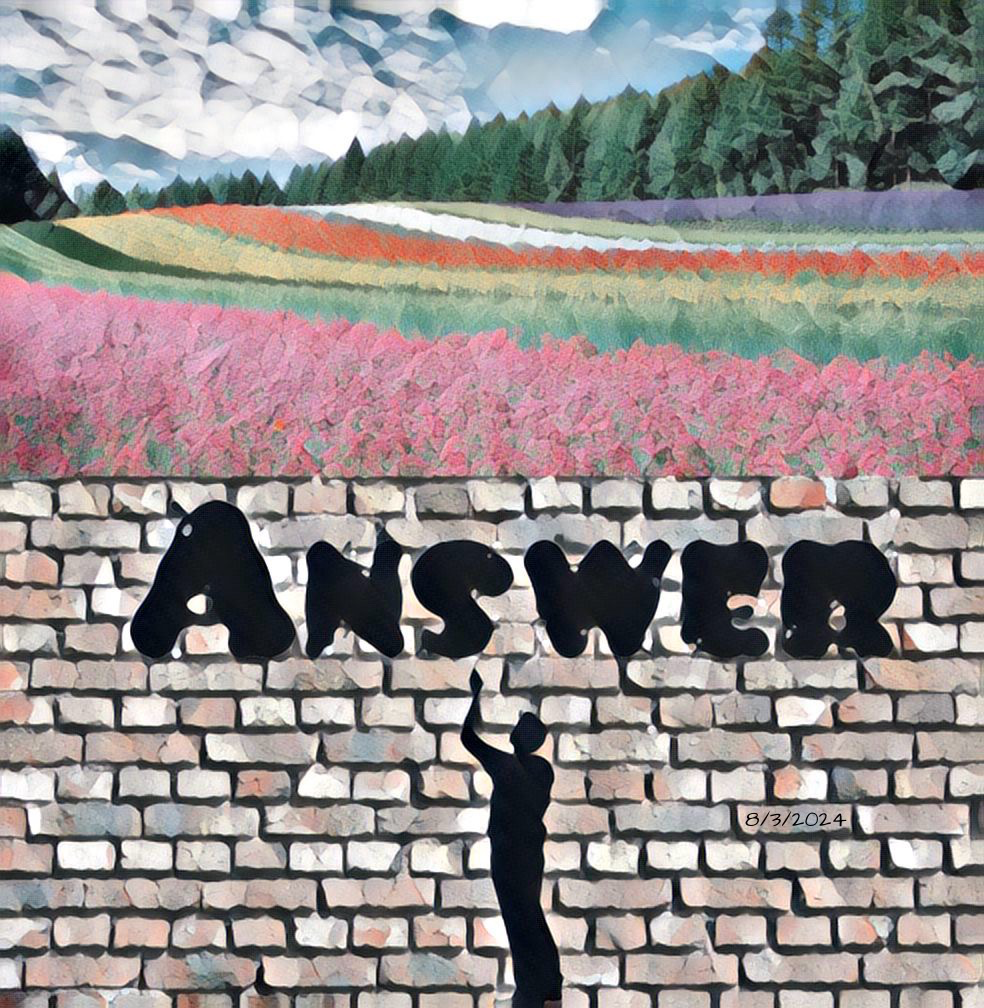
In today’s readings, both Jeremiah and John the Baptist encounter persecution. Jeremiah is saved, but John is not. Maybe both of them had questions about how, when they were so dedicated to God, evil yet pursued them. Perhaps they felt they had run into a spiritual wall. Ever felt like that?
Our Responsorial Psalm captures the longing for an answer – an understanding of how and why God works in our lives.
Lord, in your great love, answer me.
Psalm 69:14
Today, in God’s Lavish Mercy: I think it’s safe to say that we all have questions about life and death, good and evil, grace and darkness, worldly success and spiritual peace, God’s Presence and God’s apparent absence.
Poetry: The Answer – Carl Sandberg
You have spoken the answer. A child searches far sometimes Into the red dust On a dark rose leaf And so you have gone far For the answer is: Silence.
In the republic Of the winking stars and spent cataclysms Sure we are it is off there the answer is hidden and folded over, Sleeping in the sun, careless whether it is Sunday or any other day of the week,
Knowing silence will bring all one way or another.
Have we not seen Purple of the pansy out of the mulch and mold crawl into a dusk of velvet? blur of yellow? Almost we thought from nowhere but it was the silence, the future, working.
Music: Popule Meus – Motet by Tomás Luis de Victoria (1548-1611)
Ecce lignum crucis: In quo salus mundi pependit, Venite, adoremus.
Popule meus, quid feci tibi? Aut in quo contristavi te? Responde mihi.
Quia eduxi te de terra Aegypti, Parasti Crucem Salvatori tuo.
Hagios o Theos. Sanctus Deus. Hagios Ischyros. Sanctus Fortis. Hagios Athanatos, eleison himas. Sanctus Immortalis, miserere nobis.
Quia eduxi te per desertum Quadraginta annis, Et manna cibavi te, Et introduxi te in terram satis bonam, Parasti Crucem Salvatori tuo.
Hagios o Theos. Sanctus Deus. Hagios Ischyros. Sanctus Fortis. Hagios Athanatos, eleison himas. Sanctus Immortalis, miserere nobis.
Ego propter te flagellavi Aegyptum Cum primogenitis suis: Et tu me flagellatum tradidisti.
Popule meus, quid feci tibi? Aut in quo contristavi te? Responde mihi.
Ego te eduxi de Aegypto, Demerso Pharone in mare Rubrum, Et tu me tradidisti Principibus sacerdotum.
Popule meus, quid feci tibi? Aut in quo contristavi te? Responde mihi.
Ego ante te aperui mare, Et tu aperuisti lancea latus meum.
Popule meus, quid feci tibi? Aut in quo contristavi te? Responde mihi.
Behold the wood of the cross: On which hung the salvation of the world, Come, let us adore.
O my people, what have I done to you? Or wherein have I grieved you? Answer me.
Because I led you out of the land of Egypt: You have prepared a Cross for your Saviour.
O Holy God. O Holy God. O Holy Strong One. O Holy Strong One. O Holy and Immortal, have mercy upon us. O Holy and Immortal, have mercy upon us.
Because I led you through the desert, For forty years, And fed you with manna, And brought you into a land exceeding good, You have prepared a Cross for your Savior.
O Holy God. O Holy God. O Holy Strong One. O Holy Strong One. O Holy and Immortal, have mercy upon us. O Holy and Immortal, have mercy upon us.
For you I scourged Egypt, And its firstborn, And you have delivered me to be scourged.
O my people, what have I done to you? Or wherein have I grieved you? Answer me.
I brought you out of Egypt, And sank Pharaoh in the Red Sea, And you bave delivered Me To the chief priests.
O my people, what have I done to you? Or wherein have I grieved you? Answer me.
I opened the sea before you, And you have opened my side with a spear.
O my people, what have I done to you? Or wherein have I grieved you? Answer me.
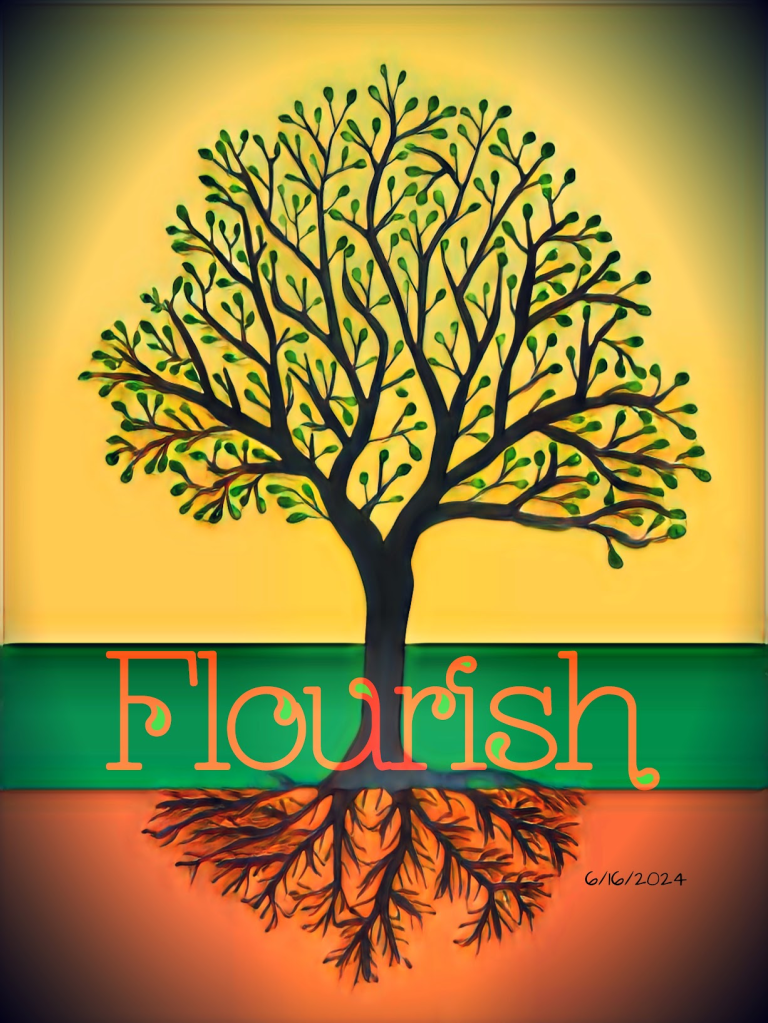
The just one shall flourish like the palm tree, like a cedar of Lebanon shall they grow. They that are planted in the house of the LORD shall flourish in the courts of our God. Psalm 92:13-14
This verse from Psalm 92 ties together all our readings for today.
In the passage from Exodus, God takes a tiny twig, protects and nourishes it, and it flourishes. The analogy describes God’s relationship with Israel and with us. We are called to flourish in the Kingdom of God.
In Corinthians, Paul expresses the conviction that we will receive our recompense according to how we flourish in response to God’s grace.
And in our Gospel, Jesus teaches that our faith – God’s gift to us – is the small seed that flourishes into eternal life, the fullness of life in God.
Today, in God’s Lavish Mercy:
We realize that each of these flourishings begins with a tiny hope – a twig, a courageous aspiration, a mustard seed.
Such is life. It is the small but consistent acts of faith, hope, and love that eventually yield abundant harvest. – embracing us with all Creation in God’s complete Love.
Poetry: Mustard Seed – Meister Eckhart
I.
In the Beginning High above understanding Is ever the Word. O rich treasure, There the Beginning always bore the Beginning. O Father’s Breast, From thy delight The Word ever flows! Yet the bosom Retains the Word, truly.
II.
From the two as one source, The fire of love. The bond of both, Known to both, Flows the All-Sweet Spirit Co-equal, Undivided The Three are One. Do you understand why? No. It best understands itself.
III.
The bond of three Causes deep fear. Of this circle There is no understanding. Here is a depth without ground. Check and mate To time, forms, place! The wondrous circle Is the Principle, Its point never moves.
IV.
The mountain of this point Ascend without activity. O intellect! The road leads you Into a marvelous desert, So broad, so wide, It stretches out immeasurably. The desert has, Neither time nor place, Its mode of being is singular.
V.
The good desert No foot disturbs it, Created being Never enters there: It is, and no one knows why.
It is here, it is there, It is far, it is near, It is deep, it is high, It is in such a way That it is neither this nor that.
VI.
It is light, it is clear, It is totally dark, It is unnamed, It is unknown, Free of beginning or end. It stands still, Pure, unclothed. Who knows its dwelling? Let him come forth And tells us what sort it is.
VII.
Become like a child, Become deaf, become blind. Your own something Must become nothing; Drive away all something, all nothing! Leave place, leave time, Avoid even image! Go without a way On the narrow path, Then you will find the desert’s track.
VIII.
O my soul, Go out, let God in! Sink all my something In God’s nothing. Sink in the bottomless flood! If I flee from You, You come to me. If I lose myself, Then I find You, O Goodness above being!
Music: The Ride of the Valkyries – Richard Wagner
I love to listen to this masterpiece when I imagine God opening heaven to all Creation at the end of time.
Sacrifice and offering you did not desire, but a body you prepared for me; in holocausts and sin offerings you took no delight. Then I said, ‘As is written of me in the scroll, behold, I come to do your will, O God.
Hebrews 10:5-7; cf: Psalm 40:7-9
On this Feast of the Annunciation, we remember Mary’s choice to love the world according to the manner of God. It was not a choice she made for the first time during the angel’s visit. Mary had always lived her young life patterned on grace and fidelity. Therefore, she was ready when the angel offered her the choice that changed the world.
Today, in God’s Lavish Mercy:
As human beings, we may be inclined to think of “God’s Will” as a pre-ordained pattern for our lives – rather like a document that, if we could get hold of it, we could follow exactly to achieve salvation. We may even mistakenly think that it is God’s Will that we, or our sisters and brothers, suffer.
We might ask ourselves instead, “What is God’s Will, really?”. The life of Christ, reflected in the Gospel, tells us this: God’s Will is Love. So when Psalm 40 interprets Mary’s Fiat as ” … behold, I come to do Your Will…”, what we might understand is this:
Your Will, O God, is Love. I open my heart to be your Love in the world, in whatever pattern your grace may come to me, whether it be through the joys or the sorrows of the human condition.
Poetry: Fiat – Robert Morneau
On her bed of doubt, in wrinkled night garment, she sat, glancing with fear at a golden shaft of streaming light, pondering perhaps, "Was this but a sequel to a dream?" The light too brief for disbelief, yet its silence eased not her trembling. Somehow she murmured a "yes" and with that the light's love and life pierced her heart and lodged in her womb. The room remained the same - rug still need smoothing - jug and paten awaiting using. Now all was different in a maiden's soft but firm fiat.
Music: O Santissima – interpreted by Andrea Montepaone
O sanctissima, o piissima, dulcis Virgo Maria! Mater amata, intemerata, ora, ora pro nobis.
Tu solatium et refugium, Virgo Mater Maria. Quidquid optamus, per te speramus; ora, ora pro nobis.
Ecce debiles, perquam flebiles; salva nos, o Maria! Tolle languores, sana dolores; ora, ora pro nobis.
Virgo, respice, Mater, aspice; audi nos, o Maria! Tu medicinam portas divinam; ora, ora pro nobis.
O most holy, o most loving, sweet Virgin Mary! Beloved Mother, undefiled, pray, pray for us.
You are solace and refuge, Virgin Mother Mary. Whatever we wish, we hope it through you; pray, pray for us.
Look, we are weak and deeply deplorable; save us, o Mary! Take away our lassitude, heal our pains; pray, pray for us.
Virgin, look at us, Mother, care for us; hear us, o Mary! You bring divine medicine; pray, pray for us.
Today, in God’s Lavish Mercy, we pray with Psalm 147 which invites us to:
Praise the LORD Who is good; sing praise to our God, Who is gracious; the One it is fitting to praise.
It is a psalm for the left-brained who, like Job in our first reading, might need some explanation about just why we should praise when life seems so unpraiseworthy at times!
Job spoke, saying: Is not man’s life on earth a drudgery? Are not his days those of hirelings? He is a slave who longs for the shade, a hireling who waits for his wages. So I have been assigned months of misery, and troubled nights have been allotted to me.
Job 7: 1-4
Job, like many of us when we suffer, feels crushed under life’s burdens. However, an extended reading of the Book of Job reveals that humility and repentance allow Job to “see God”, and to rediscover the richness and flavor of his life.
Calling us to the same kind of awareness, Psalm 147 presents a series of reasons for praising God, including God’s continual attention to the city of Jerusalem, to brokenhearted and injured individuals, to the cosmos, and to nature.
For me, the most moving of these reasons comes in verse 3:
The Lord heals the brokenhearted and binds up their wounds. The Lord tells the number of the stars; calling each by name.
This is a beautiful picture of our infinitely compassionate God who is able to recognize our broken-heartedness.
This loving God, who knows the stars by name, knows us as well. We, like Job, begin to heal within the divine lullaby God patiently sings over our broken hearts.
Jesus is that Healing Song, the Word hummed over the world by the merciful Creator. In today’s Gospel, we see that Melody poured out over the suffering:
When it was evening, after sunset, they brought to him all who were ill or possessed by demons. The whole town was gathered at the door. He cured many who were sick with various diseases, and he drove out many demons, not permitting them to speak because they knew him.
Mark 1: 32-34
As we pray today, let us hear God’s song of mercy being sung over all Creation. Let us rest our own brokenness there in its compassionate chords. Let us bring the world’s pain to our prayer.
Poetry: A Cure Of Souls by Denise Levertov
The pastor of grief and dreams guides his flock towards the next field with all his care. He has heard the bell tolling but the sheep are hungry and need the grass, today and every day. Beautiful his patience, his long shadow, the rippling sound of the flocks moving along the valley.
Music: God Heals My Broken Heart – Patty Felker
If Job were singing his sadness today, it might sound like this song.