Return Rejoicing!

Memorial of Saints Andrew Kim Tae-gŏn, Priest, and Paul Chŏng Ha-sang, and Companions, Martyrs
September 20, 2021

Today, in God’s Lavish Mercy, we pray with Psalm 126

This six-verse psalm is a regular part of Jewish, Catholic, Lutheran, Anglican and other Protestant liturgies. It is well known in Judaism as the preliminary psalm recited before the Birkat Hamazon (Grace After Meals) on Shabbat and Jewish holidays, and as such is sung to a wide variety of melodies.

Wikipedia
Shir hama'alot (Psalm 126) - cantor Yossele Rosenblatt

Psalm 126 can be described as:

 “joy remembered and joy anticipated”

James Luther Mays

The psalm is divided into two parts. 

Joys remembered: The first three verses gratefully reflect on the joy and freedom felt upon return to Jerusalem after the Babylonian exile.

Joys anticipated: The second three verses attest to the difficulties subsequent to that return. They voice a plea for restoration of joy.


This is a prayer most of us can relate to. Can you remember a time when you were so delighted to obtain a certain item, or status, or goal that you felt it was “almost like a dream” situation? 

When the LORD brought back the captives of Zion,
    we were like those dreaming.
Then our mouth was filled with laughter,
    and our tongue with rejoicing.

Psalm 126:1

But perhaps, once that reality was obtained, it wasn’t so easy to manage, or complete, or enjoy! Perhaps there were “dry spells” like the torrent-less desert of 126:

Restore our fortunes, O LORD,
    like the torrents in the southern desert.
Those that sow in tears
    shall reap rejoicing.

Psalm 126: 4-5

For example, I’ve heard a few young couples express delight upon buying their first home – a “fixer upper”. But often, the “fixing up” requires a lot more resources than expected!

Such was the situation for the Israelites who joyfully returned to Jerusalem — only to find a city in ruins, bereft of their beloved Temple, with devastated fields and vineyards.


Still, Psalm 126 is a testament to hope and resilience. It is an affirmation that we can go forward by faith, hope, trust, patience, and by drawing on the power of remembered mercies.

Although they go forth weeping,
    carrying the seed to be sown,
They shall come back rejoicing,
    carrying their sheaves.

Psalm 126:6

Poem: Blessing to Summon Rejoicing – Jan Richardson

When your weeping
has watered
the earth.
When the storm
has been long
and the night
and the season
of your sorrowing.
When you have seemed
an exile
from your life,
lost in the far country,
a long way from where
your comfort lies.
When the sound
of splintering
and fracture
haunts you.
When despair
attends you.
When lack.
When trouble.
When fear.
When pain.
When empty.
When lonely.
When too much
of what depletes you
and not enough
of what restores
and rests you.
Then let there be
rejoicing.
Then let there be
dreaming.
Let there be
laughter in your mouth
and on your tongue
shouts of joy.
Let the seeds
soaked by tears
turn to grain,
to bread,
to feasting.
Let there be
coming home.

— from Circle of Grace

Music: In the Place of Dreams – Tim Janis

Jubilate Deo!

Saturday of the Twenty-fourth Week in Ordinary Time

September 18, 2021

Today, in God’s Lavish Mercy, we pray with Psalm 100, called the “Jubilate Deo” because of its opening pronouncement:

Shout joyfully to the LORD, all you peoples;
serve the Lord with gladness;
come before the Lord with joyful song.

Psalm 100: 1-2

This is such a perfect prayer today for our Mercy community as we will gather to celebrate the Jubilee of many of our sisters this afternoon. It will be a huge celebration in which the Jubilarians of both 2020 and 2021 will be honored, due to last year’s Covid restrictions.

For many of us, the most moving parts of the celebration are the procession and recession. These celebratory passages are a testament to God’s faithfulness over many lifetimes, and to the women who have received and responded to God’s gifts.

Some sisters, who have been given the gift of long years, will process with a cane or walker to assist them. Some will move with an achieved maturity, and some still with the vigor of youth.

But our Mercy family, gathered in the pews, walks in Spirit with each of the Jubilarians, carrying her within a bond of mutual love. As we see each sister whom we have lived with, worked with, loved and learned from, our hearts indeed sing with them, “Jubilate!”


Poetry: The Neophyte – Alice Meynell

 
Who knows what days I answer for to-day:
  Giving the bud I give the flower.  I bow
  This yet unfaded and a faded brow;
Bending these knees and feeble knees, I pray.
Thoughts yet unripe in me I bend one way,
  Give one repose to pain I know not now,
  One leaven to joy that comes, I guess not how.
I dedicate my fields when Spring is grey.
Oh, rash! (I smile) to pledge my hidden wheat.
  I fold to-day at altars far apart
Hands trembling with what toils?  In their retreat
  I seal my love to-be, my folded art.
I light the tapers at my head and feet,
  And lay the crucifix on this silent heart.
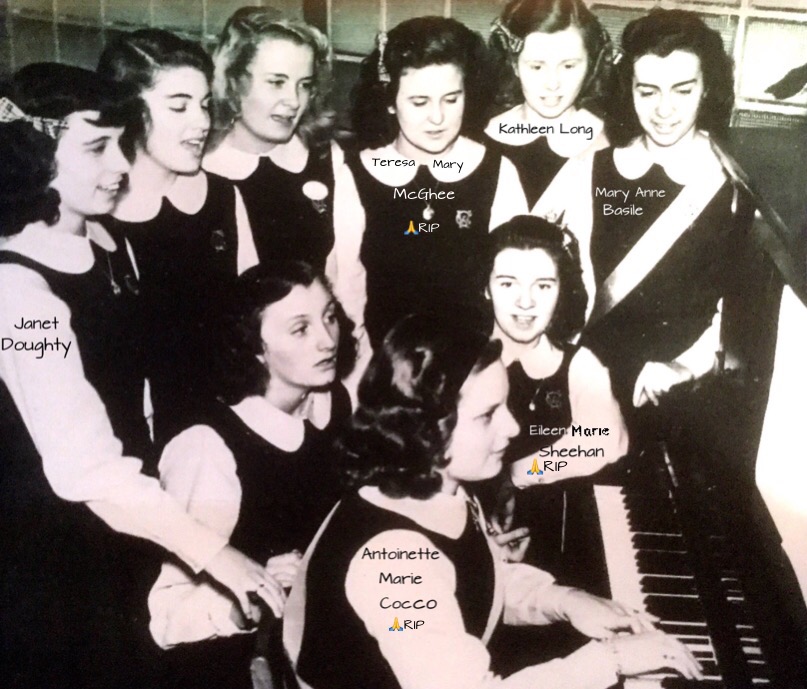
Some of 2021’s Sapphire/Diamond Jubilarians when they were true Neophytes

Please join us in your grateful prayers for these Sisters of Mercy:

Jubilarians 2020
80 years
Sister Rita Powell

70 years
Sister Mary Georgina Hasson 
Sister Mary Hentz
Sister Kathleen Kelly
Sister Marie Lynch
Sister Antoinette Medori 
Sister Clare Miriam Schrant 
Sister Marianna Walsh

60 Years
Sister Rosellen Bracken
Sister Mary Elizabeth Burke 
Sister Emily Therese Connor 
Sister Marie Michele Donnelly 
Sister Patricia Anne Flynn
Sister Kathleen Marie Fox
Sister Mary Ann Giordano
Sister Patricia Anne Kennedy 
Sister Barbara Ann MacWilliams 
Sister Kathleen McAlpin
Sister Mercedes Joan McCann 
Sister Kathleen McGovern 
Sister Josephine McGrory
Sister Mary Sarah McNally 
Sister Mary Anne Nolan
Sister Stella Mary O’Brien
Sister Frances Paglione
Sister Rose Carmel Scalone 
Sister Barbara Smiley
Sister Patricia Talone
Sister Angela Welsh

50 years
Sister Mary Beth Geraghty 
Sister Mary Jane Morrison 
Sister Katherine Bednarcik

Jubilarians 2021
75 years
Sister Mary Ann Basile 
Sister Marie Helene Bradley 
Sister Mary Janet Doughty 
Sister Kathleen Mary Long 
Sister Marita Lyons
Sister Catherine Rawley 
Sister Ethel Sweeney

70 years
Sister Therese Marie Kenny 
Sister Alice Mary Meehan 
Sister Rose Morris
Sister Kathleen Waugh 
Sister Anne Marie Berenato 
Sister Mary Anton Frick

60 years
Sister Francis Haddow 
Sister Anna Marie Lesutis 
Sister Margery Lowry
Sister Mary Mester
Sister Sheila Murphy
Sister Anne Marie Weisglass 
Sister Joanne Whitaker 
Sister Beverly Wilde

50 years
Sister Maureen Conklin 
Sister Susan Myslinski

25 Years
Sister Guia Jimenez


Music: Utrecht Jubilate – Handel

Antidote to Fear

Friday of the Twenty-fourth Week in Ordinary Time

September 17, 2021

Today, in God’s Lavish Mercy, we pray with Psalm 49, the point of which according to Walter Brueggemann is this:

The point is that death is the great equalizer,
and those who are genuinely wise
should not be impressed by or committed to
that which the world over-values.

From Whom No Secrets Are Hid

We may have heard the sentiment stated more succinctly by an anonymous scholar:

You can’t take it with you.


This is the core message Paul imparts to Timothy in our first reading:

For the love of money is the root of all evils,
and some people in their desire for it have strayed from the faith
and have pierced themselves with many pains.

1 Timothy 6:10

The advice is about more than money, or “dollar-bucks” as my 5 year old grandnephew calls them.


The instruction is about our priorities –
whom, why and what
we love, value, and sacrifice for.

The opposite of this “love of money” is an unselfish, sacrificial love for others. This is the love Jesus hopes for in his disciples as he blesses them in today’s Gospel.

It takes courage to live such discipleship. As human beings, we tend to fear any kind of deprivation. We crave security, and sometimes we think money and possessions can give us that. Our readings today redirect that all too common misperception.

The world can be a very dark place, and of course, we will have fears and worries. Paul and our psalmist direct us to the right place to calm these concerns. Jesus calls us to believe in and live in the Light which is our true security.

Our psalm reminds us to keep our eyes on the eternal promise we have all been given.

But God will redeem my life,
will take me from the hand of Darkness.

Psalm 49: 16

Poetry: Accepting This – Mark Nepo

Yes, it is true. I confess,
I have thought great thoughts,
and sung great songs—all of it
rehearsal for the majesty
of being held.
The dream is awakened
when thinking I love you
and life begins
when saying I love you
and joy moves like blood
when embracing others with love.
My efforts now turn
from trying to outrun suffering
to accepting love wherever
I can find it.
Stripped of causes and plans
and things to strive for,
I have discovered everything
I could need or ask for
is right here—
in flawed abundance.
We cannot eliminate hunger,
but we can feed each other.
We cannot eliminate loneliness,
but we can hold each other.
We cannot eliminate pain,
but we can live a life
of compassion.
Ultimately,
we are small living things
awakened in the stream,
not gods who carve out rivers.
Like human fish,
we are asked to experience
meaning in the life that moves
through the gill of our heart.
There is nothing to do
and nowhere to go.
Accepting this,
we can do everything
and go anywhere.

Music: His Eye is on the Sparrow (You might recall this version from the movie “Sister Act II”)

For fun, you might enjoy hearing how the 60s group, The O’Jays, interpreted Paul’s advice to Timothy.

Money money money money, money [Repeat: x 6]

Some people got to have it

Some people really need it

Listen to me why’all, do things, do things, do bad things with it

You want to do things, do things, do things, good things with it

Talk about cash money, money

Talk about cash money- dollar bills, why’all

For the love of money

People will steal from their mother

For the love of money

People will rob their own brother

For the love of money

People can’t even walk the street

Because they never know who in the world they’re gonna beat

For that lean, mean, mean green

Almighty dollar, money

For the love of money

People will lie, Lord, they will cheat

For the love of money

People don’t care who they hurt or beat

For the love of money

A woman will sell her precious body

For a small piece of paper it carries a lot of weight

Call it lean, mean, mean green

Almighty dollar

I know money is the root of all evil

Do funny things to some people

Give me a nickel, brother can you spare a dime

Money can drive some people out of their minds

Got to have it, I really need it

How many things have I heard you say

Some people really need it

How many things have I heard you say

Got to have it, I really need it

How many things have I heard you say

Lay down, lay down, a woman will lay down

For the love of money

All for the love of money

Don’t let, don’t let, don’t let money rule you

For the love of money

Money can change people sometimes

Don’t let, don’t let, don’t let money fool you

Money can fool people sometimes

People! Don’t let money, don’t let money change you,

It will keep on changing, changing up your mind.

Memorial of Saints Cornelius and Cyprian

Thursday, September 16, 2021

Today, in God’s Lavish Mercy, we pray with Psalm 111. Prayed in tandem with our first reading from 1 Timothy, the psalm directs our hearts to an awareness of the gifts we have received in faith.

We are all “gifted” by the Holy Spirit. Sometimes if someone tells us that we’re “gifted”, they are really referring to special talents we may have developed – like art, music, dance, writing etc.

But the gifts our readings highlight are those which are rooted in the Holy Spirit, and we receive them through our Baptism and Confirmation.


Paul tells Timothy not to neglect these gifts. And the psalmist suggests that the first step in such care is the practice of awe, wisdom and prudence.

The fear of the LORD is the beginning of wisdom;
    prudent are all who live by it.
    His praise endures forever.

Psalm 111:10

We can’t just practice these gifts for an hour or two as we might practice piano!


The Holy Spirit’s gifts must be nurtured and tended daily, through all seasons of our lives,
allowing their roots to deepen and grow in us.
This was the advice that Paul gave Timothy.
We could all use it as well.


The prophet Isaiah was the first to list the Gifts of the Holy Spirit when he described the coming Messiah:

A shoot will come up from the stump of Jesse;
    from his roots a Branch will bear fruit.
The Spirit of the Lord will rest on him—
    the Spirit of wisdom and of understanding,
    the Spirit of counsel and of might,
    the Spirit of the knowledge and fear of the Lord
and he will delight in the fear of the Lord.

Isaiah 11:1-3

We are baptized in the image of Christ. These same gifts flow, in a waterfall of grace, into our spirits. May we receive and respond!

Poetry: God’s Grandeur – Gerard Manel Hopkins

The world is charged with the grandeur of God.
    It will flame out, like shining from shook foil;
    It gathers to a greatness, like the ooze of oil
Crushed. Why do men then now not reck his rod?
Generations have trod, have trod, have trod;
    And all is seared with trade; bleared, smeared with toil;
    And wears man’s smudge and shares man’s smell: the soil
Is bare now, nor can foot feel, being shod.

And for all this, nature is never spent;
    There lives the dearest freshness deep down things;
And though the last lights off the black West went
    Oh, morning, at the brown brink eastward, springs —
Because the Holy Ghost over the bent
    World broods with warm breast and with ah! bright wings.


Feast of the Exaltation of the Holy Cross

Tuesday, September 14, 2021

Today, in God’s Lavish Mercy, we pray with Psalm 78 which commands us:

Do not forget the works of the Lord!


The psalm, in its entirety, is a recital of God’s faithfulness to Israel over time, culminating in the triumph of David/Jerusalem/Temple.

God chose David his servant,
took him from the sheepfolds.
From tending ewes God brought him,
to shepherd Jacob, the people,
Israel, God’s heritage.
He shepherded them with a pure heart;
with skilled hands he guided them.

Psalm 78: 70-73

David foreshadows Jesus, the Good Shepherd who not only tends the sheep but becomes the Lamb of God. Jesus completes our salvation by his death on the Cross. In him, the long journey of Psalm 78 is ultimately fulfilled.


Philippians’ exquisite hymn captures the profound nature of that fulfillment:

Christ Jesus, though he was in the form of God,
    did not regard equality with God something to be grasped.
    Rather, he emptied himself,
    taking the form of a slave,
    coming in human likeness;
    and found human in appearance,
    he humbled himself,
    becoming obedient to death,
    even death on a cross.

Philippians 2:5-8

Each of our lives reflects, in its own way, the salvation journey we find in scripture. We experience the same kind of twists and turns, highs and lows as those described in Psalm 78.

In each of these moments, we are held in the mystery of the Cross wherein Christ transforms all suffering to grace:

Because of this, God greatly exalted him
    and bestowed on him the name
    that is above every name,
    that at the name of Jesus
    every knee should bend,
    of those in heaven and on earth and under the earth,
    and every tongue confess that
    Jesus Christ is Lord,
    to the glory of God the Father.

Philippians 2: 9-11

Poetry: Good Friday – Christina Rossetti (1830-1894)

Am I a stone and not a sheep 
That I can stand, O Christ, beneath thy cross, 
To number drop by drop Thy blood’s slow loss, 
And yet not weep?
Not so those women loved 
Who with exceeding grief lamented thee; 
Not so fallen Peter weeping bitterly; 
Not so the thief was moved;
Not so the sun and moon 
Which hid their faces in a starless sky, 
A horror of great darkness at broad noon— 
I, only I.
Yet give not o’er, 
But seek thy sheep, true Shepherd of the flock; 
Greater than Moses, turn and look once more 
And smite a rock.

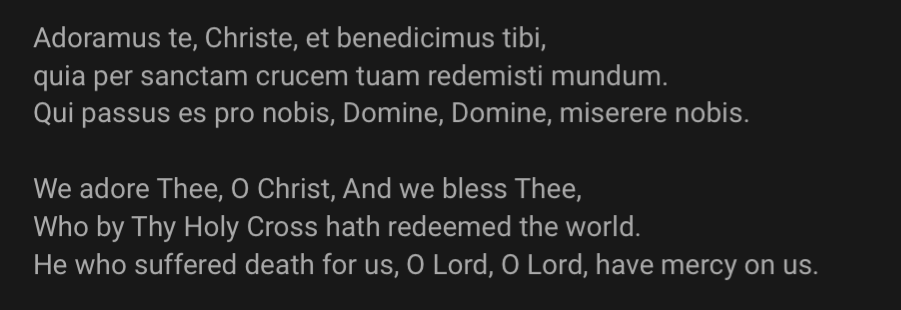
Music: Adoramus Te, Christe

Memorial Of St. John Chrysostom

Monday, September 13, 2021

Today, in God’s Lavish Mercy, we pray with Psalm 28, a prayer of nine succinct verses in which the psalmist rides a seesaw emotion.

My prayer is like that sometimes. I try to pray the way Jesus would pray — the “Our Father” type of goodness and all.

But to be honest, “Thy Will be done” and “as we forgive those who trespass” are not always easy sentiments for me. How about you?


Our psalmist seems to have some trouble too … but with points of light and redemption in the end:

O Lord, I call to you;
my rock, do not be deaf to my cry;
lest, if you do not hear me,
I become like those who go down to the pit.
FEAR
Hear the voice of my prayer when I cry out to you, 
when I lift up my hands to your holy of holies.
PLEADING
Do not snatch me away with the wicked or with the evildoers,
who speak peaceably with their neighbours,
while strife is in their hearts.
JUDGEMENT
Repay them according to their deeds,
and according to the wickedness of their actions.
According to the work of their hands repay them,
and give them their just deserts.
VENGEANCE
They have no understanding of your doings,
nor of the works of your hands;
therefore you will break them down
and not build them up.
PRIDE
Blessed are you, O Lord!
For you have heard the voice of my prayer.
FAITH
O Lord, you are my strength and my shield;
my heart trusts in you, and I have been helped;
therefore my heart dances for joy,
and in my song will I praise you.
TRUST
You are the strength of your people,
a safe refuge for your anointed.
SECURITY
Save your people and bless your inheritance;
shepherd them and carry them for ever.
PRAYER

What I learn from this psalm is to tell God the truth when I pray – but the real truth -the truth that we hear back from God when we listen in our prayer. And that listening should always be done in sync with the Gospel. It is as if we cup the Gospel around our prayer the way we bend an ear to the faint but longed-for sound.


Poetry: Lost – David Whyte

Stand still. 
The trees ahead and the bushes beside you 
Are not lost. 
Wherever you are is called Here,
And you must treat it as a powerful stranger,
Must ask permission to know it and be known.

The forest breathes. 
Listen. It answers,
I have made this place around you,
If you leave it you may come back again, saying 
Here.

No two trees are the same to Raven.
No two branches are the same to Wren.
If what a tree or a bush does is lost on you,
You are surely lost. Stand still.
The forest knows Where you are.
You must let it find you.”

Music: The Golden Forest – Tim Janis

Memorial: St. Peter Claver

Thursday, September 9, 2021

Today, in God’s Lavish Mercy, we pray with Psalm 150, an all-out summons to praise God.

Psalm 150, with its four predecessors, creates a rousing chorus of praise to God. As the closing piece of the Book of Psalms, Psalm 150 summons all Creation to unbounded praise.


The prayer of praise may not come as easily to us as other types of prayer. We find the prayer of supplication easy – asking God for something. Even the prayer of thanks is natural to us. But even Pope Francis says that the prayer of praise might not come so readily:

The prayer of praise is quite different than the prayer we normally raise to God,
the Pope continued, when “we ask something of the Lord”
or even “thank the Lord”.

“We often leave aside the prayer of praise”.
It doesn’t come so easily to us, he said.
Some might think that this kind of prayer is only
“for those who belong to the renewal in the spirit movement,
not for all Christians.

The prayer of praise is a Christian prayer for all of us.
Each day during Mass, when we sing:
‘Holy, Holy…’, this is the prayer of praise.
We praise God for his greatness, for he is great.
And we tell him beautiful things, because we like it to be so”.

And it does not matter if we are good singers, the Pope remarked.
In fact, he said, it is impossible to imagine that
“you are able to shout out when your team scores a goal
and you cannot sing the Lord’s praises,
and leave behind your composure a little to sing.

Praising God is “totally gratuitous”, Pope Francis continued.
“We do not ask, we do not thank. We praise: you are great.
‘Glory be to the Father, and to the Son, and to the Holy Spirit…’. 

L’ Osservatore Romano

Psalm 150 calls us to a prayer of pure praise:

Hallelujah! Praise the Lord in the holy temple;
praise God in the firmament of divine power.
Praise the Lord for mighty acts;
praise God for excellent greatness.
Praise the Lord with the blast of the ram’s-horn; 
praise God with lyre and harp.
Praise the Lord with timbrel and dance; 
praise God with strings and pipe.
Praise the Lord with resounding cymbals; 
praise God with loud-clanging cymbals.
Let everything that has breath praise the Lord.
Hallelujah!

Psalm 150

By the culmination of the sequence in Psalm 150, there is a total lack of any specificity, and users of the psalm are invited to dissolve in a glad self-surrender that is to be enacted in the most lyrical way imaginable. Such praise is a recognition that the wonder and splendor of this God—known in the history of Israel and in the beauty of creation—pushes beyond our explanatory categories so that there can be only a liturgical, emotive rendering of all creatures before the creator.

Walter Brueggemann

We might try to offer this type of prayer in a simple manner, by naming God’s goodness – the goodness that we love and adore. We can do this in the same way that we tell any beloved being that we love them. Some prayer phrases might be:

  • You are beautiful in all Creation – in this morning’s dawn, this evening’s sunset.
  • You are just yet everlastingly kind.
  • Your power is stunningly gentle in a bird’s wing; it is overwhelming in the storm’s roar.
  • You are so humble to live within and among us.
  • You are infinitely loving through the gift of Jesus

Thoughts like these might also inspire us to a silent awe in which we offer wordless praise to our awesome God.


Music: No poem today, but two very different musical interpretations of Psalm 150 to inspire your prayer of praise

~ from Taize

Caesar Franck

Feast of the Nativity of the Blessed Virgin Mary

Wednesday, September 8, 2021

Today, in God’s Lavish Mercy, we pray with Psalm 13. We can imagine it being sung in Mary’s voice as we celebrate her birth.

Though I trusted in your mercy,
    let my heart rejoice in your salvation.
Let me sing of the LORD 
    Who has been good to me.

Psalm 13:6

These psalm verses can bring us deeply into Mary’s generous, prophetic soul. She is, even before the Annunciation, a holy young woman, at peace and unity with God ….

I have trusted in your mercy


But when she is invited to donate her solitary peace to the infinite self-giving of God, Mary says, “Yes!”.

Let my heart rejoice in your salvation


With her “Yes”,
Mary’s sacred peace
no longer belongs to herself.
She has given it
in order to become
an agent in our salvation.


Mary realizes that the moment Israel has longed for has dawned in her little room, her little cottage, in little Nazareth. And her faith is large enough to believe that God could do such a thing!

Annunciation – Henry Osawa Tanner

Mary calls us to make our dream of salvation larger than ourselves – to allow God to release the power of mercy, astoundingly, from our small and simple lives.


In this great fiat of the little girl Mary, the strength and foundation of our life of contemplation is grounded, for it means absolute trust in God, trust which will not set us free from suffering but will set us free from anxiety, hesitation, and above all from the fear of suffering. Trust which makes us willing to be what God wants us to be, however great or however little that may prove. Trust which accepts God as illimitable Love.

Caryll Houselander – The Reed of God

Poetry: After the Annunciation- Madeleine L’Engle

This is the irrational season
when love blooms bright and wild.
Had Mary been filled with reason
there’d have been no room for the child.

From A Cry Like a Bell:Poems 


Music: Hail Mary – Boyce and Stanley

Tuesday of the Twenty-third Week in Ordinary Time

Tuesday, September 7, 2021

Today, in God’s Lavish Mercy, we pray with Psalm 145 in which the psalmist, filled with gratitude and joy, makes a prodigious promise:

Every day will I bless you,
    and I will praise your name forever and ever.
Everyday! Forever and ever!

Psalm 145:2

Such a promise requires all one’s attention, discipline and practice. We must learn to see all experience in God’s Light so that everything becomes a reason for praise.


Paul, guiding the Colossians to live that kind of life, tells them:

As you received Christ Jesus the Lord, walk in him,
rooted in him and built upon him
and established in the faith as you were taught,
abounding in thanksgiving.

Colossians 2:6-7

Powerful words:
~ walk in Christ
~ be rooted and built in Christ
~ be established in faith
~ be abundant in thanksgiving 


God is gracious and merciful toward us as we pray for the psalmist’s prayer to be fulfilled in us and in our lives:

Let all your works give you thanks, O LORD,
    and let your faithful ones bless you.
Let them discourse of the glory of your Kingdom
    and speak of your might.

Psalm 145:10-11

Poetry: from the Book of Hours – Rainer Maria Rilke

You are the future, the great sunrise red
above the broad plains of eternity.
You are the cock-crow when time’s night has fled,
You are the dew, the matins, and the maid,
the stranger and the mother, you are death.

You are the changeful shape that out of Fate
rears up in everlasting solitude,
the unlamented and the unacclaimed,
beyond describing as some savage wood.

You are the deep epitome of things
that keeps its being’s secret with locked lip,
and shows itself to others otherwise:
to the ship, a haven — to the land, a ship.

Music: Psalm 145 – Travis Cottrel

Monday of the Twenty-third Week in Ordinary Time

Monday, September 6, 2021

Today, in God’s Lavish Mercy, we pray with Psalm 62 and the heart of its prayer of confidence, verses 6-9.

Carroll Stuhlmueller, revered Old Testament scholar, places Psalm 62 among the Wisdom psalms – those which “seek the harmonious, stable order of life”. They do this by presenting a kind of curriculum for spiritual happiness.

That teaching is clear in Psalm 62: we find our soul’s fulfillment “only in God”.

Does that mean nothing else in our lives matter? That we should push all but God to the margins?
No. The psalm encourages us to look deeply at all of life and to find God in every aspect.


Often, a spiritual director will ask this question of the directee:

“Where is God in this situation, in this moment?”

The question points us to the realization that we can’t compartmentalize God to our “prayer time”, or Sundays, or “religious experiences”. 


God lives within us, and lives every moment of our lives with us. Until we align ourselves with God’s loving Presence, we will not find complete peace.

Trust in God at all times, O my people!
    Pour out your hearts before God;
    God is our refuge!

Psalm 62:9

Prose: from the Confessions of St. Augustine, Book 1, Chapter 1

Great are You, O Lord, and greatly to be praised; 
great is Your power, 
and of Your wisdom there is no end. 
And we, being a part of Your creation, 
desire to praise You….
You move us to delight in praising You; 
for You have made us for Yourself, 
and our hearts are restless until they rest in You.

Cor nostrum inquietum est donec requiescat in Te.

Lord, teach me to know and understand 
which of these should be first: 
to call on You, or to praise You; 
and likewise to know You, or to call on You.
But who calls upon You without knowing You? 
For the one that knows You not 
may call upon You as other than You are. 
Or perhaps we call on You 
that we may know You.

But how shall they call on Him 
in whom they have not believed? 
Or how shall they believe without a preacher?

Romans 10:14

And those who seek the Lord shall praise the Lord. 
For those who seek shall find God, 

Matthew 7:7

and those who find God shall praise God. 
Let me seek You, Lord, in calling on You, 
and call on You in believing in You; 
for You have been preached unto us. 
O Lord, my faith calls on You — 
that faith which You have imparted to me, 
which You have breathed into me 
through the incarnation of Your Son, 
through the ministry of Your preacher 1.
1 (Here Augustine is referring to St. Ambrose, his mentor)

Music: Only in God – John Michael Talbot