Hear God Speak Your Name

February 22, 2022
Feast of the Chair of St. Peter

Today, in God’s Lavish Mercy, our readings invite to consider God’s naming us – calling us.

We celebrate wonderful Saint Peter – so fully human, so fully holy, so fully in love with God! As we pray the Gospel of Peter’s naming, may we deepen in understanding our own naming by God.

Once, Jesus asked Peter what he believed. Peter answered, simply and magnificently:
“YOU ARE THE CHRIST, THE SON OF THE LIVING GOD.”
Peter was an ordinary man who responded to Jesus with a clear and extraordinary faith.


One June morning, nearly fifty years ago, I sat in a sun-drenched field in the Golan Heights of Israel at a spot called Caesarea Philippi. Thirty other pilgrims composed the group as we heard today’s Gospel being read. Listening, I watched the rising sun grow brilliant on the majestic rock face in the near distance.

I thought how Peter might have watched his day’s sun playing against the same powerful cliffs as Jesus spoke his name:

Jesus said to him,
You are Peter (which means “Rock”),
and upon this Rock
I will build my Church.


A few years later, I stood at the center of St. Peter’s Basilica in the Vatican. Looking up, I saw these words emblazoned around the awesome rotunda dome:

Tu es Petrus,
et super hanc petram
aedificabo ecclesiam.

On that sunlit afternoon two-thousand years ago,
Peter could never have imagined
what God already saw for him.
Yet, Peter responded – with his whole life.
This is what makes a Saint.

Jesus calls us to be saints too. He lovingly speaks our name into a sacred future we cannot even imagine. But if, like Peter, we trust and believe, God does the rest.


Poetry: Peter by John Poch.
The poem captures the transformation of Peter’s humanness into God’s hope for him – the “changing” of his name.


There are three things which are too wonderful for me,
Yes, four which I do not understand.
The way of an eagle in the air,
The way of a serpent on a rock,
The way of a ship in the heart of the sea,
And the way of a man with a maid

–Prov. 30:18, 19

I
Contagious as a yawn, denial poured
over me like a soft fall fog, a girl
on a carnation strewn parade float, waving
at everyone and no one, boring and bored.
There actually was a robed commotion parading.
I turned and turned away and turned. A swirl
of wind pulled back my hood, a fire of coal
brightened my face, and those around me whispered:
You’re one of them, aren’t you? You smell like fish.
And wine, someone else joked. That’s brutal. That’s cold,
I said, and then they knew me by my speech.
They let me stay and we told jokes like fisher-
men and houseboys. We gossiped till the cock crowed,
his head a small volcano raised to mock stone.

II
Who could believe a woman’s word, perfumed
in death? I did. I ran and was outrun
before I reached the empty tomb. I stepped
inside an empty shining shell of a room,
sans pearl. I walked back home alone and wept
again. At dinner. His face shone like the sun.
I went out into the night. I was a sailor
and my father’s nets were calling. It was high tide,
I brought the others. Nothing, the emptiness
of business, the hypnotic waves of failure.
But a voice from shore, a familiar fire, and the nets
were full. I wouldn’t be outswum, denied
this time. The coal-fire before me, the netted fish
behind. I’m carried where I will not wish.


Music: Peter’s Song – Face to Face – Michael O’Brien

I recall
something in the way
you called my name,
an ordinary fisherman you called me friend and took me in.
How everything had changed
because then I knew I’d never be the same.

Love came and rescued me.
I gave up my everything to follow.
Now I know.
All that I was before
won’t matter anymore
for I am a new man
because I have seen my Savior
face-to-face.

I recall
standing in the courtyard by the fire,
words still ringing in my head,
three times before the break of dawn
you would be denied.
And yet I saw no judgment in your eyes.

Love came and died for me.
I gave up my everything,
gave up my everything to follow.
Now I know
all that I was before
is dead and it lives no more
for I am a new man
because I have seen
my savior face-to-face.

The dark night, the new day –
The stone was rolled away –
my Savior, You are the Light
You are alive! Ascended to heaven.
I know that you will come again.

That moment I will arise
to worship before your throne,
to bow down for you alone are worthy,
so worthy
and there with saints of old,
I’ll sing a brand new song in heaven
forever
where I will see my Savior face-to-face.

Twists of Faith

February 21, 2022
Monday of the Seventh Week in Ordinary Time

Today, in God’s Lavish Mercy, the deep undercurrent of our readings is about the power and difficulties of faith.

James talks about how our faith can be choked by the weeds of “bitter jealousy and selfish ambition”. These chokers make us “boast and be false to the truth”. They fill us with a “pretend wisdom” that is not from the Holy Spirit.

Praying with this passage, I asked myself why we allow these ugly constraints to grasp our souls when the alternative James describes is so beautiful:

… the wisdom from above is first of all pure,
then peaceable, gentle, compliant,
full of mercy and good fruits,
without inconstancy or insincerity.
And the fruit of righteousness is sown in peace
for those who cultivate peace.

James 3:17-18

The Gospel helped me with an answer.

Unconditional faith is scary. It requires us to give control over to God. It asks us to let go of fear and to trust God’s Spirit within us. It needs us to empty our hearts of pretense and self-protection in order to make room for God’s transforming Mercy and Love.

This kind of faith will change us. It will make us “foolish” and insecure in worldly terms. It will cause us to live from a Wisdom the world misunderstands and mocks.

It’s hard to live that kind of faith. The dad in today’s Gospel admits it. He wants to have a faith that invites Christ’s power into his life. But he’s afraid. What if God wants something different for him and his son? What happens if he gives control over to God?

This yearning father confesses his ambivalence
in a plea for Christ’s assistance:
Lord, I do believe. Help my unbelief!

We all find ourselves within that plea sometimes in our lives. It’s a faith of “if”, “maybe”, and “but” – all of which are hardly faith at all. Unconditional faith is “Yes”, no matter what. It is the place where Faith and Love merge.


Our faithful “Yes”, as the e.e.cummings poem might describe it:

love is a place
& through this place of
love move
(with brightness of peace)
all places

yes is a world
& in this world of
yes live
(skillfully curled)
all worlds


Music: When we live this “Yes Faith”, God’s love, God’s heart lives in us. This song by Michael Hedges, based on another poem by e.e.cummings, can be a prayer for us. We may be unused to calling God “my dear”, “my darling”. But a loving name for God can be helpful to our prayer. And it is an ancient practice of mystics like St. John of the Cross. Use whatever might feel natural for you. Don’t be hesitant about being in love with God❤️

I Carry Your Heart – Michael Hedges (Lyrics below)

I carry your heart with me
I carry it in my heart
I am never without it
Anywhere i go you go, my dear
And whatever is done by only me
Is your doing, my darling.

I fear no fate
For you are my fate, my sweet
I want no world
For beautiful you are my world, my true
And it’s you are whatever a moon has always meant
And whatever a sun will always sing is you

Here is the deepest secret nobody knows
Here is the root of the root
And the bud of the bud
And the sky of the sky
Of a tree called life;
Which grows higher than the soul can hope
Or mind can hide
And this is the wonder that’s keeping the stars apart
I carry your heart
I carry it in my heart

Love and Mercy

February 20, 2022
Seventh Sunday in Ordinary Time

Today, in God’s Lavish Mercy, our reading from 1 Samuel tells the intriguing tale of David’s magnanimity toward Saul. Saul is enraged and jealous of David whom Samuel has anointed as king to replace Saul. David is continually in Saul’s crosshairs.

David Spares Saul – William Brassey Hole

But one night, David stealthily enters Saul’s camp. Even though he has a chance to kill Saul, David spares his life out of respect for his kingship.

While it’s not exactly “love for his enemies”, David does demonstrate a largeness of spirit that foretells today’s Gospel. This gracious spirit demonstrates that David is in right relationship (covenant) with God.

Our Gospel is part of Jesus’s Great Sermon in which he restates and renews the covenant of right relationship. If our spirits are true to God, we will love as God loves. We are to be merciful as God is merciful.

This Law of Love is the essence of life in Christ. It is a profoundly challenging call.

How hard it must have been for David as he stood, spear in hand, over his sleeping enemy – over the one trying to kill him!

How hard it is for us not to be vengeful, retaliatory, and parsimonious when we feel threatened or exploited.

But we are called, in Christ, to the New Covenant of love. By that call, we are endowed with a right spirit.

Today, Jesus asks us to love, forgive, and judge all others as we ourselves would want to be treated. He asks us to live with a divinely magnanimous heart.

Let us pray for the strength to respond.

Prose: from To Love as God Loves by Roberta C. Bondi, professor emerita of church history and spirituality, Candler School of Theology, Emory University.

Love as a disposition 
does not primarily act
on abstract principle.
Instead it is a way of seeing
habitually and responding
to the real, separate, individual needs
of each of the people we encounter
in our lives every single day.

Music: O Mercy – Stu Garrard, Matt Maher and Audrey Assad

No More War… Never Again

February 19, 2022
Saturday of the Sixth Week in Ordinary Time

Today, in God’s Lavish Mercy, I pause in my scriptural reflections to ask all of you to join in prayer for peace in Ukraine. As I typed today’s date, it hit me that we can’t just watch the evolution of this crisis on the news, as if it were a movie that isn’t really happening. We have a responsibility to be active peacemakers in our volatile world, and to foster a resolution that honors all human life.


I’ll tell you why Saturday’s date struck my heart so forcibly.

February 19, 1945

I was not even alive yet. I was kicking around inside my Mom and waiting to be born exactly two months later. There was joyful expectation in my family that afternoon, as you can imagine. What they did not expect was that at that very moment, my mother’s nineteen year old brother had bled to death on the shores of Iwo Jima.

When the word finally reached my family, Jimmy had already been buried at sea. The coordinates are noted in the WWII War Logs: 21°N latitude; 111° E longitude. That’s where he is buried, somewhere in the middle of the Philippine Sea. It feels so very lonely when you look at it on a map.

His death, his slaughter, wounded my mother so deeply that it reached into my incipient spirit. I never knew him, but have never forgotten, my Uncle Jim. Some of you will understand how that can be.

No young man or woman should be left alone forever at the bottom of the sea, or in an mountain gorge, or under the flaming sand. No human being should suffer and die because of war, because of the bloated egos and stunted imaginations of undraftable world leaders who pretend it is the means to peace.

It may seem that we can do little to prevent these travesties, but that’s not true. We can vote; we can lobby; we can advocate for international justice and equity that ameliorate the catalysts to war: poverty, hunger, and political and economic domination.

And we can pray.

We have the power through prayer and political action to fuel the demand for peaceful and diplomatic relationships in our world. These powerful interventions can confront our unexamined militarism and transform it.


Pope Francis has said:

“The news coming out of Ukraine is very worrying. I entrust to the intercession of the Virgin Mary, and to the conscience of political leaders, every effort on behalf of peace. Let us pray in silence.”

Mother of Sorrows – Batolome Murillo

But the responsibility belongs to us as well. Will you join me on this Saturday of the Blessed Virgin Mary to ask her powerful intercession in this outrageous situation in Ukraine?

The following prayer was very meaningful to me and you may want to pray with it:

It’s Not Easy

February 18, 2022
Friday of the Sixth Week in Ordinary Time

Today, in God’s Lavish Mercy, James actually made me chuckle out loud! In today’s celebrated passage about faith and works, James – ever direct and uncompromising – really takes it home. Get this verse:

Do you want proof, you ignoramus,
that faith without works is useless?

James 2:20

OK, James! Tell us what you really think!😂

Well, here’s what he really thinks:

For just as a body without a spirit is dead,
so also faith without works is dead.

James 2:26

In our Gospel, Jesus says that living a life of good works is hard. He did it through the Cross and says we must follow his example:

Whoever wishes to come after me must deny himself,
take up his cross, and follow me.
For whoever wishes to save his life will lose it,
but whoever loses his life for my sake
and that of the Gospel will save it.

Mark 8:34-35

The Gospel Jesus is talking about, and the “works” James refers to,  are summarized like this:

Corporal Works of Mercy

feed the hungry.
give water to the thirsty.
clothe the naked.
shelter the homeless.
visit the sick.
visit the imprisoned, ransom the captive.
bury the dead.

Spiritual Works of Mercy

instruct the ignorant.
counsel the doubtful.
admonish the sinners.
bear patiently those who wrong us.
forgive offenses.
comfort the afflicted.
pray for the living and the dead.


If we live by these admonitions,
we will find the Cross
– but we will also surely find the Crown.


Poetry: Listen to RS Thomas read his own poem about the struggle to live a Christian life:


Music: Lose My Soul – TobyMac, a multi-award winning Christian hip-hop singer.

Living the Cross

February 17, 2022
Thursday of the Sixth Week in Ordinary Time

Today, in God’s Lavish Mercy, two disciples of Jesus are our teachers. James advises us on what to do. Beloved Peter, as so often is the case, shows us what not to do.

James tells us to show no partiality. He makes clear that he is talking about impartiality toward those who are materially poor. It’s a maxim that Jesus gave us time and again in the Gospel.

James reminds us that Jesus is not just impartial toward those who are poor, he actually has a preferential love for them. So Jesus was partial to the poor, right? Hmm!

Yes, I think that’s right. In order to balance our human inclination to the richest, best, strongest, etc., Jesus teaches us to go all out in the other direction.

It’s like this great cartoon that popped up on Facebook a while ago:


Our Gospel picks up the theme.

Because of his great love for the poor and his passion for mercy, Jesus tells his followers that suffering is coming. Peter doesn’t like hearing that. Can you see Peter take Jesus aside and say, “Listen, Jesus, negative talk is going to hurt your campaign. You’re God! You can just zap suffering out of your life!”


Jesus responds to Peter definitively: “Get thee behind me, Satan!”

James Tissot: Get Thee Behind me, Satan

Wow! That must have stung! But that’s how important it was to Jesus that his followers understood his mission: to preach Mercy to the poor, sick, and broken by sharing and transforming their experience.

Jesus wants us to understand that too.


Prose: from St. Oscar Romero

It is no honor for the Church 
to be on good terms with the powerful.
The honor of the Church consists in this,
that the poor feel at home in her,
that she fulfils her mission on earth,
that she challenges everyone,
the rich as well,
to repent and work out their salvation,
but starting from the world of the poor,
for they, they alone are the ones who are blessed.

Music: Beauty for Brokenness – Graham Kendrick

Seeing Clearly

February 16, 2022
Wednesday of the Sixth Week in Ordinary Time

Today, in God’s Lavish Mercy, our readings are around the theme of our spiritual senses.

James tells us to listen, look, see, and act on the Word planted within our hearts. Once again, he gives us great images to help our understanding.

For if anyone is a hearer of the word and not a doer,
he is like a man who looks at his own face in a mirror.
He sees himself, then goes off and promptly forgets
what he looked like.

James 1:3-24

If anyone thinks he is religious
and does not bridle his tongue
but deceives his heart, his religion is vain.

James 1: 26

In our Gospel, once again our dear, earthy Jesus heals someone in a deeply human way. Jesus takes the blind man aside, holding his hand to lead him. As he did in a passage recently, Jesus spits on his fingers and massages the blind man’s eyes.

The man tries to work with Jesus, exclaiming that he sees “people like trees walking”.

I’ve always loved that line because it makes me feel like I’m right there, in that little dusty village of Bethsaida, listening like the rest of the stunned crowd to the man’s amazement!


As we pray this morning, we might wonder what Jesus said back to that overwhelmed man as they sat together, helping him to learn how to see. What might Jesus say to us as he lifts one of our many blindnesses from our hearts?


Prose: from Pilgrim at Tinker Creek by Annie Dillard

(This passage is from one of my all-time favorite books written by Annie Dillard whom I think of as the “Mary Oliver” of prose. Here’s the way wikipedia describes the book:)

Pilgrim at Tinker Creek is a 1974 nonfiction narrative book by American author Annie Dillard. Told from a first-person point of view, the book details an unnamed narrator's explorations near her home, and various contemplations on nature and life. The title refers to Tinker Creek, which is outside Roanoke in Virginia's Blue Ridge Mountains. Dillard began writing Pilgrim in the spring of 1973, using her personal journals as inspiration. Separated into four sections that signify each of the seasons, the narrative takes place over the period of one year.
The book records the narrator's thoughts on solitude, writing, and religion, as well as scientific observations on the flora and fauna she encounters. Touching upon themes of faith, nature, and awareness, Pilgrim is also noted for its study of theodicy and the inherent cruelty of the natural world. The author has described it as a "book of theology", and she rejects the label of nature writer.

I think this is a great book to pick up at the beginning of any season of nature or life. The excerpt I chose for today, in honor of the Gospel, is from a chapter entitled ” Seeing”:

A fog that won’t burn away drifts and flows across my field of vision. When you see fog move against a backdrop of deep pines, you don’t see the fog itself, but streaks of clearness floating across the air in dark shreds. So I see only tatters of clearness through a pervading obscurity. I can’t distinguish the fog from the overcast sky; I can’t be sure if the light is direct or reflected. Everywhere darkness and the presence of the unseen appalls. We estimate now that only one atom dances alone in every cubic meter of intergalactic space. I blink and squint. What planet or power yanks Halley’s Comet out of orbit? We haven’t seen that force yet; it’s a question of distance, density, and the pallor of reflected light. We rock, cradled in the swaddling band of darkness. Even the simple darkness of night whispers suggestions to the mind.

The secret of seeing is, then, the pearl of great price. If I thought he could teach me to find it and keep it forever I would stagger barefoot across and hundred deserts after any lunatic at all. But although the pearl may be found, it may not be sought. The literature of illumination reveals this above all: although it comes to those who wait for it, it is always, even to the most practiced and adept, a gift and a total surprise. I return from one walk knowing where the killdeer nests in the field by the creek and the hour the laurel blooms. I return from the same walk a day later scarcely knowing my own name. Litanies hum in my ears; my tongue flaps in my mouth Ailinon, alleluia! I cannot cause light; the most I can do is try to put myself in the path of its beam. It is possible, in deep space, to sail on solar wind. Light, be it particle or wave, has force: you rig a giant sail and go. The secret of seeing is to sail on solar wind. Hone and spread your spirit till you yourself are a sail, whetted, translucent, broadside to the merest puff.

Music: I Can See Clearly Now – Jimmy Cliff

The Greatest Sin

February 15, 2022
Tuesday of the Sixth Week in Ordinary Time

Today, in God’s Lavish Mercy, James continues with his spiritual encouragements.

For one thing, he makes it clear that God doesn’t tempt us. Some of us make the mistake of thinking that, saying things like, “God is testing me.”

James, outlining a perfect way to examine one’s conscience, says this:

No one experiencing temptation should say,
“I am being tempted by God”;
for God is not subject to temptation to evil,
and God himself tempts no one.
Rather, each person is tempted when lured and enticed by his own desire.
Then desire conceives and brings forth sin,
and when sin reaches maturity it gives birth to death.

James 1:13-15

Sin is an uncomfortable topic, and it’s an elusive one. Most of us aren’t outright blatant sinners. I think most of our sins are quiet indifferences, failures to love, unacknowledged greeds, self-imposed blindnesses to our responsibilities toward one another. These generate excuses that allow us to gossip, judge, blame, ignore, hurt and even use others both in our immediate world and in the larger global community.

In my experience, these desires are usually disguised, pretending to be beneficial for us at first sight. But underneath, they are rooted in selfishness and excess, diverting us from our center in God.

So if we have some little labyrinths of temptation and sinful habits ensnaring us, we should listen to James. He encourages us to examine and check our own concupiscent desires as they are the seeds of our spiritual undoing.


In the second part of this passage, James takes the tone up a notch. He reminds us that, once centered on God, we realize that only good things come from God.

All good giving and every perfect gift is from above,
coming down from the Father of lights,
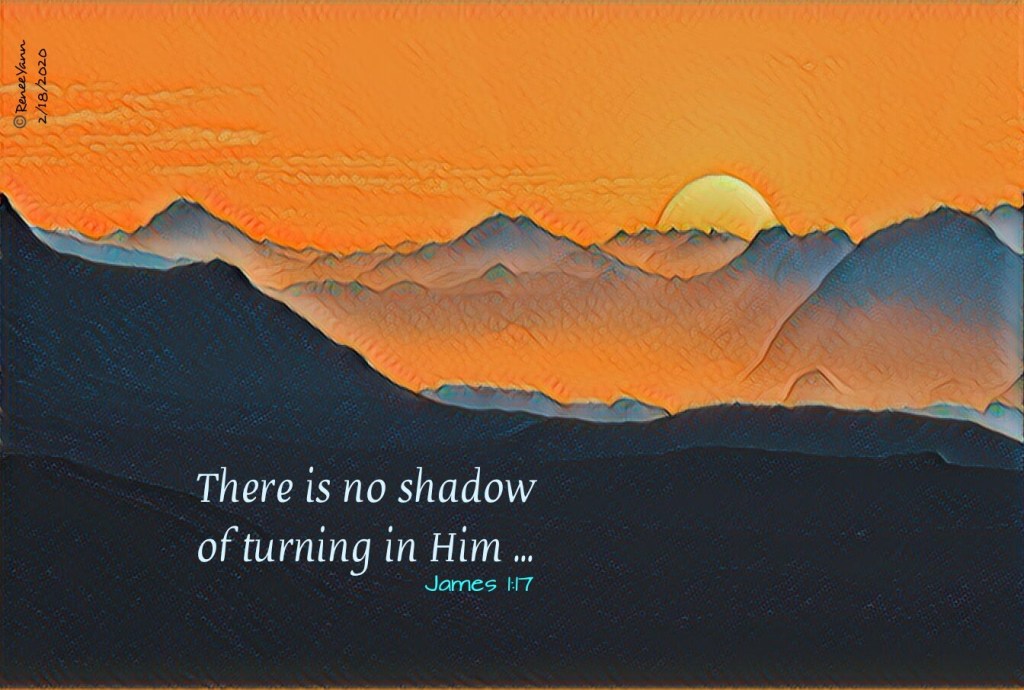
with whom there is no alteration or shadow caused by change.

James :17

I particularly love that last phrase, rendered in our hymn today like this:

It’s beautiful to see how James, as a real spiritual leader, is so aware of his flock’s human struggles. No doubt, he shares them. What a blessing that his wise and loving guidance has come down through the ages to us!


Prose: from Carl Jung

The worst sin is unconsciousness,
but it is indulged in with the greatest piety
even by those who should serve humankind
as teachers and examples.


Music: Great Is Thy Faithfulness – sung by Chris Rice

Joyful Calculation

February 14, 2022
Monday of the Sixth Week in Ordinary Time

Today, in God’s Lavish Mercy, Lent is just a little over two weeks away. We will spend the intervening time in good company with daily insights from James, Peter and Mark. Today we begin the Epistle of James.

The Epistle of James- Chapter 1: Illustration provided to Wikimedia Commons by Distant Shores Media/Sweet Publishing as part of a cooperation project. Sweet Publishing released these images, which are taken from now-out-of-print Read’n Grow Picture Bible Illustrations (Biblical illustrations by Jim Padgett, courtesy of Sweet Publishing, Ft. Worth, TX, and Gospel Light, Ventura, CA. Copyright 1984.), under new license, CC-BY-SA 3.0

This letter is one of the very earliest of the New Testament. Scholars are mixed about exactly which “James” wrote it, but agree that it was one of several who were very close to Jesus – perhaps one of “the brothers of Jesus” mentioned in several New Testament passages:

  • Matthew 12:46-50
  • Mark 3:31
  • Luke 8:19
  • John 2:12
  • Acts 1:14
  • 1 Corinthians 9:5
  • and specifically “the Lord’s brother James” in Galatians 1:19

James writes in the style of Wisdom Literature, those Old Testament books that give advice, proverbs, and insights for living a holy life. His immediate audience was a community of dispersed Christian Jews whose world was filled with increasing upheaval and persecution.


When I read the following description I thought how germane James’s letter could be for our world today. His themes echo the teachings of Pope Francis for our chaotic time:

The epistle is renowned for exhortions on fighting poverty and caring for the poor in practical ways (1:26–27; 2:1-4; 2:14-19; 5:1-6), standing up for the oppressed (2:1-4; 5:1-6) and not being “like the world” in the way one responds to evil in the world (1:26-27; 2:11; 3:13-18; 4:1-10). Worldly wisdom is rejected and people are exhorted to embrace heavenly wisdom, which includes peacemaking and pursuing righteousness and justice (3:13-18).

Jim Reiher, “Violent Language – a clue to the Historical Occasion of James.”Evangelical Quarterly. Vol. LXXXV No. 3. July 2013

Here is the golden advice James gives us today:

  • Be joyful in trials.
  • Let trials increase your perseverance not discourage you.
  • Doing this is a sign of wisdom.
  • When your wisdom is depleted, ask God for more with an open and trusting heart.
  • Honor all people, high or low in circumstances
  • Don’t be fooled by riches. They fade away.

In our Gospel, Jesus is frustrated with the Pharisees who insincerely demand a magical sign from him. They demonstrate none of the spiritual wisdom and openness to grace that James describes.

When we think about our own faith, where does it fall on the scale of sincerity, on the spectrum joy, justice, and faithful perseverance?


Poetry: On Joy and Sorrow – Kahlil Gibran

Then a woman said, Speak to us of Joy and Sorrow.
And he answered:
Your joy is your sorrow unmasked.
And the selfsame well from which your laughter rises 
was oftentimes filled with your tears.
And how else can it be?
The deeper that sorrow carves into your being, 
the more joy you can contain.
Is not the cup that holds your wine 
the very cup that was burned in the potter’s oven?
And is not the lute that soothes your spirit, 
the very wood that was hollowed with knives?
When you are joyous, look deep into your heart 
and you shall find it is only that which has given you sorrow 
that is giving you joy.
When you are sorrowful look again in your heart, 
and you shall see that in truth you are weeping for 
that which has been your delight.
Some of you say, “Joy is greater than sorrow,” 
and others say, “Nay, sorrow is the greater.”
But I say unto you, they are inseparable.
Together they come, 
and when one sits alone with you at your board, 
remember that the other is asleep upon your bed.
Verily you are suspended like scales 
between your sorrow and your joy.
Only when you are empty 
are you at standstill and balanced.
When the treasure-keeper lifts you 
to weigh his gold and his silver, 
needs must your joy or your sorrow rise or fall.

Music: Count It All Joy

Three Holy Secrets

February 13, 2022
Sixth Sunday in Ordinary Time

Today, in God’s Lavish Mercy, hidden in our readings, are three challenges:

Where do we place our FAITH?
How do we fire our HOPE?
How do we LOVE?


In our Jeremiah reading, an unfortunate person has placed faith in an untrustworthy “friend”, and the results – typical of Jeremiah – are dire. But the prophet goes on to say that the one who puts trust and faith in the Lord will flourish like a tree near running water.

In the reading from Corinthians, Paul has some strong words about hope:

If for this life only we have hoped in Christ,
we are the most pitiable people of all.

1 Corinthians 15:19

That sentence is powerful! It can be a life-long meditation.

In other words, where is our hope focused? Do we hope for comfort, success, healing, peace only for this earthly life? If so, we are missing the point, Paul says. Our one true hope is to be united with God in eternal life and our choices should lead to that fulfillment.


In our Gospel, Jesus shows us how to love by placing before us the “least ones” whom he loves best. We too are to love and comfort those who are poor, hungry, bereaved and despised by the heartless.


Today’s readings invite us to look at our life. Is it blossoming with joy, grace and spiritual vitality? Or are we struggling with all the doubts, worries, dramas and depression that come from a self-absorbed life?

Maybe, like me, you sometimes look at a person carrying great difficulty in their lives and wonder at their joy. How can they maintain that trust and joy in the midst of their challenges? These readings offer an answer. They have put their faith and hope in the right place. They have learned to love like God loves.


St. John of the Cross

Poetry: Bernard of Clairvaux, On the Song of Songs, vol. 4, 83.2.4.

I love because I love:
I love that I may love…
Love is the only one of the motions of the soul,
of its senses and affections,
in which the creature can respond to its Creator,
even if not as an equal,
and repay God’s favor in some similar way …


Music: Faith, Hope and Love ~ David Ogden ( Lyrics below)

Faith, hope, and love: let these remain among you.
Faith, hope, and love: the greatest of these is love.

The love of Christ has gathered us together; let us rejoice and be glad in him.
Let us fear and love the living God, and love each other from the depths of the heart.

When we are together, we should not be divided in mind;
Let there be an end to bitterness and quarrels, and in our midst be Christ our God.

In company with the blessed, may we see your face in glory,
pure and unbounded joy for ever and ever.

I give you a new commandment, love one another as I have loved you.
Faith, hope, and love, let these remain among you.
Faith, hope and love; the greatest of these is love.