Today, in God’s Lavish Mercy, we pray with Psalm 9. It, together with Psalm 10, forms an acrostic which ultimately proclaims profound hope in God’s immutable justice, especially toward the poor and oppressed. But it takes us through a lot fire and brimstone to get there!
When we read the entire Psalm 9, we realize that the psalmist starts out in a lot of trouble:
Be gracious to me, LORD; see how my foes afflict me! You alone can raise me from the gates of death
Psalm 9:14
Match that with Joel’s community which is in the midst of a terrible drought. Joel uses the situation to teach that we must withstand many evils in life — not just droughts — in order to keep faith with God.
Blow the trumpet in Zion, sound the alarm on my holy mountain! Let all who dwell in the land tremble, for the day of the LORD is coming; Yes, it is near, a day of darkness and of gloom, a day of clouds and somberness!
Joel 2:1-2
In the end however, Joel assures the community — as does the psalmist — that God is present even in treacherous circumstances and will finally bring “right-balance” or justice to all things.
The LORD sits enthroned forever; setting up a throne for judgment. God judges the world with justice; and governs the peoples with equity.
Psalm 9:8-9
I think these readings are difficult to pray with, but it’s worth a try. How we respond to challenge in our personal circumstances – and even evil in the world at large – depends a lot on how we view God’s Presence in our lives. Both Joel and the psalmist ask us to hold fast to our confidence in God.
Praying with these readings may provoke questions like this for us: Do I believe God’s justice and mercy truly will prevail in Creation? And how will I help bring about this holy “equity”?
Poetry: Faith is the Pierless Bridge – Emily Dickinson
Faith is the Pierless Bridge Supporting what We see Unto the Scene that We do not Too slender for the eye It bears the Soul as bold As it were rocked in Steel With Arms of Steel at either side It joins behind the Veil To what, could We presume The Bridge would cease to be To Our far, vacillating Feet A first Necessity.
Music: Bridge Over Troubled Waters – Simon and Garfunkel
Today, in God’s Lavish Mercy, we pray with Psalm 1, its very opening verses.
Blessed the one who follows not the counsel of the wicked Nor walks in the way of sinners, nor sits in the company of the insolent, But delights in the law of the LORD and meditates on God’s law day and night.
Psalm 1:1-3
Scripture scholar James L. Mays says that the psalm’s primacy is not accidental:
The Book of Psalms begins with a beatitude. Not a prayer or a hymn, but a statement about human existence. Here at the threshold of the Psalter we are asked to consider the teaching that the way life is lived is decisive for how it turns out. This opening beatitude also serves as an introduction to the book. Its location as the first psalm is not accidental; the psalm is there to invite us to read and use the entire book as a guide to a blessed life.
Psalms: Interpretation: A Bible Commentary for Teaching and Preaching
Psalm 1 helps us to understand that praying the Psalter is a tool for spiritual guidance. It is not just about the people and times it mentions. It is about us and our lifelong journey with God.
In a sense the rosary, which we think about today as we pray with Mary, is a similar tool. And I’ll be honest with you, it’s a tool I didn’t appreciate until much later in my life.
Most Catholics have a history with the rosary. It’s a form of prayer we learned as children at our grandmother’s or first grade teacher’s knee. But for me as a six-year old, it was just too long. I became bored mid-second decade. I even used to cheat, drop the rosary on the floor, and pick it up a few decades further down the beads!
Me – on the right! 🙂
Of course, as a young nun, I prayed the rosary. I even wore the rosary at my hip and fingered its cool beads throughout the day. But I still didn’t appreciate or love it. Not until I was 36 years old and my father died.
My Dad lived an extremely simple, and I think holy, life. He didn’t vow it, but he practiced the evangelical counsel of poverty beautifully. He possessed very little that was his alone. When he died, almost everything important and precious to him (besides his family) could be found in the bottom drawer of our old China closet. That’s where I found his rosary on the day after his funeral.
It was cuddled in a wrinkled pouch imprinted with the phrase “My Rosary”. I smiled when I read that, thinking one didn’t really need to be reminded what was inside! But there was actually more inside than I expected.
Dad always loved the poems of James Metcalfe, published daily in the Philadelphia Evening Bulletin. One little poem was folded neatly inside the pouch:
A Dad’s Prayer
Almighty Father help me be . . . A good and loving dad . . . That my dear children may enjoy . . . The blessings I have had . . . Give me the wisdom I should use . . . To teach them right from wrong . . . And how to keep on going when . . . The road is rough and long . . . To do the duty that is theirs . . . Until its very end . . . To look for lasting beauty and . . . Appreciate a friend . . . Endow me with the grace I need . . . To mold their gentle youth . . . According to the measurements . . . Of loyalty and truth . . . Enable me to comfort them . . . Whenever they are sad . . . And O my Father, grant that they . . . Will always love their dad.
Every morning after I discovered Dad’s rosary, I ran the beads through my fingers, wanting in some way to touch Dad again.
I began to read about the rosary and its purpose as a means of meditation on the life of Christ. I began to pray it differently, slowly – eventually using the vocal prayers only as a rhythm underneath the thought of Jesus’s experiences.
Sometimes, rather than rushing through a decade as I had before, I couldn’t stay long enough to absorb all that Jesus or Mary chose to share with me in one of the rosary’s mysteries.
Maybe on this feast of Our Lady of the Rosary, we might renew our love, understanding,and appreciation of this beautiful means of prayer. Online, I found this guide created by the Knights of Columbus which I liked. You might find it helpful. (I didn’t check, but I think it might be printable.)
Today, in God’s Lavish Mercy, we pray with Psalm 86 which, following our first reading about vindictive Jonah, shows us a heart converted to mercy.
These readings are so powerful. I think a little “Jonah” lives in most of us – that part of us that wants “them” to get what they deserve. We can’t quite get ourselves to want “them”, instead, to receive the unmerited mercy of God.
In our first reading, God tries to help stingy-hearted Jonah face his unforgiveness toward the Ninevites.
Our psalm, on the other hand, is prayed by a humble servant who understands forgiveness because they need it themselves.
Have mercy on me, O Lord, for to you I call all the day. Gladden the soul of your servant, for to you, O Lord, I lift up my soul. For you, O Lord, are good and forgiving, abounding in kindness to all who call upon you. Hearken, O LORD, to my prayer and attend to the sound of my pleading.
Psalm 86: 3-6
Psalm 86 invites us to grow in our spiritual life in two ways:
to recognize our need for forgiveness because we are not without sin
to extend that forgiving desire to those who have sinned against us
It is the lesson Jesus affirms in today’s Gospel:
Jesus said to them, “When you pray, say: Father, hallowed be your name, your Kingdom come. Give us each day our daily bread and forgive us our sins for we ourselves forgive everyone in debt to us, and do not subject us to the final test.”
Poetry: Forgiveness – John Greenleaf Whittier
My heart was heavy, for its trust had been
Abused, its kindness answered with foul wrong;
So, turning gloomily from my fellow-men,
One summer Sabbath day I strolled among
The green mounds of the village burial-place;
Where, pondering how all human love and hate
Find one sad level; and how, soon or late,
Wronged and wrongdoer, each with meekened face,
And cold hands folded over a still heart,
Pass the green threshold of our common grave,
Whither all footsteps tend, whence none depart,
Awed for myself, and pitying my race,
Our common sorrow, like a mighty wave,
Swept all my pride away, and trembling I forgave!
Music: Lord, Teach Us to Pray – Joe Wise
Lord, teach us to pray…
It’s been a long and cold December kind of day. With our hearts and hands all busy in our private little wars. We stand and watch each other now from separate shores. We lose the way.
I need to know today the way things should be in my head. I need to know for once now the things that should be said. I’ve got to learn to walk around as if I were not dead. I’ve got to find a way to learn to live. (Refrain)
I still get so distracted by the color of my skin. I still get so upset now when I find that I don’t win. I meet so many strangers—I’m slow to take them in. I’ve got to find a way to really live. (Refrain)
I stand so safe and sterile as I watch a man fall flat. I’m silent with a man who’d like to know just where I’m at. With the aged and the lonely I can barely tip my hat. I need to see the sin of “I don’t care.” (Refrain)
I stand so smug and sure before the people I’ve out-guessed. To let a man be who he is I still see as a test. And when it all comes down to “must,” I’m sure my way is best. I’ve got to find what “room” means in my heart. (Refrain)
Lord, teach us to pray. We believe that we can find a better way. Teach us to pray. We lose the way. Teach us to pray.
Today, in God’s Lavish Mercy, we pray with Psalm 130, a “Psalm of Ascents” in which the whole community joined in a prayer of intense supplication as they gathered at the Temple.
Although prayed as a community, the psalm is written in an individual voice, helping us to connect our times of personal desperation to the prayer.
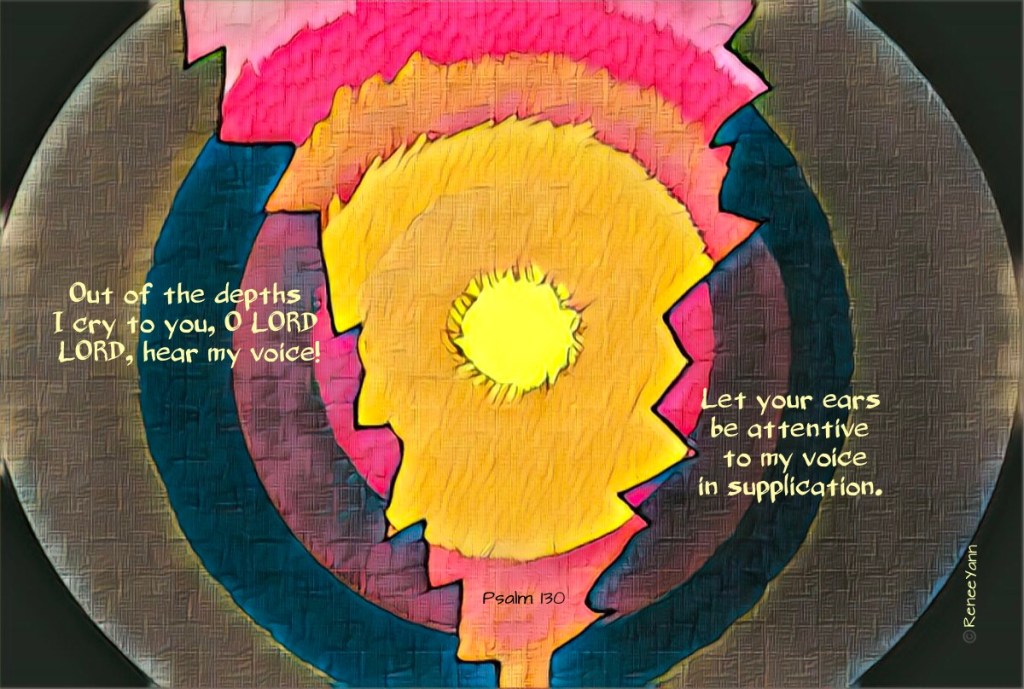
Out of the depths I cry to you, O LORD LORD, hear my voice! Let your ears be attentive to my voice in supplication.
Psalm 130: 1-2
Jonah, in the chapter before today’s first reading, gives us a graphic image of what “the depths” feel like. Not only is Jonah swallowed by the sea, but also by a whale which carries him – imprisoned – to the very bottom of the ocean!
Jonah prayed to the LORD, his God, from the belly of the fish: Out of my distress I called to the LORD, Who answered me; From the womb of Sheol I cried for help, and you heard my voice.
Jonah 2:2-3
“Sheol” is a Hebrew term which could be translated as “place of the dead spirits”. It is different from the grave, which harbors the body. In other words, “Sheol” is a place where our spirits can die before we physically die.
We can experience this kind of spiritual death in so many ways. Some come upon us not by our own choice. Certainly in the illness of depression we feel this darkness. Profound bereavement and debilitating sickness can overwhelm us as well. Praying Psalm 130 may help at such times. But they also call for reaching out to friends, counselors, and professional support to help in our healing.
But the psalm more specifically addresses those times when we get caught in a deadly spiral due to our own sinful and selfish choices – by allowing prejudice, hate, willful ignorance or any of the seven deadly sins to overtake us.
Lord, hear my cry! May your ears be attentive to my cry for mercy. If you, LORD, keep account of sins, Lord, who can stand? But with you is forgiveness and so you are revered.
Psalm 130: 2-4
Psalm 130 tells us that God is present to us in both situations- whether our suffering is brought on by our own choices or not. God will walk us through to the Light when we open ourselves to Grace:
Let us wait patiently to discern God’s way, For with God is kindness and plenteous redemption; God will restore us from every darkness; God’s way is mercy.
Psalm 130: 7-8
Let’s pray for that kind of faith in our hearts, and the hearts of those we love, especially for anyone suffering “the depths” right now.
Poetry: De Profundis – Christina Rossetti
Oh why is heaven built so far,
Oh why is earth set so remote?
I cannot reach the nearest star
That hangs afloat.
I would not care to reach the moon,
One round monotonous of change;
Yet even she repeats her tune
Beyond my range.
I never watch the scatter'd fire
Of stars, or sun's far-trailing train,
But all my heart is one desire,
And all in vain:
For I am bound with fleshly bands,
Joy, beauty, lie beyond my scope;
I strain my heart, I stretch my hands,
And catch at hope.
Music: Out of the Deep – John Rutter
Psalm 130, ‘Out of the deep have I called unto thee O Lord’ begins darkly with an unaccompanied cello solo in C minor, later giving way to a more positive C major at the words ‘for with the Lord there is mercy, and with him is plenteous redemption’.
Out of the deep have I called unto thee, O Lord; Lord, hear my voice. O let thine ears consider well the voice of my complaint. If thou, Lord, wilt be extreme to mark what is done amiss, O Lord, who may abide it? For there is mercy with thee: therefore shalt thou be feared. I look for the Lord; my soul doth wait for him; and in his word is my trust. My soul fleeth unto the Lord before the morning watch; I say, before the morning watch. O Israel, trust in the Lord; for with the Lord there is mercy, and with him is plenteous redemption. And he shall redeem Israel from all his sins.
Today, in God’s Lavish Mercy, we pray with Psalm 16 whose words beautifully capture the spirit of St. Francis of Assisi:
Keep me, O God, for in you I take refuge. I say to God, “My Lord are you.” O God, my allotted portion and my cup, you it is who hold fast my lot.
Psalm 16:1-2
Saint Francis by Sano DiPietro
Francis is among the most venerated Saints in Christianity.
We are deeply moved by his utter embrace of poverty out of love for the poor.
We are inspired to reverence Creation by his love for all living things.
We are deepened in sacramental devotion by his dedication to Christ in the Eucharist.
But above all, Francis speaks to us because he was a person who fell completely in love with God. His way and his words encourage us toward the same kind of unconditional love.
I bless my God who counsels me; even in the night my heart exhorts me. I set God ever before me; with God at my right hand I shall not be disturbed.
Psalm 16:7-8
Francis can teach us so much and companion us as we grow deeper in our love for God, Creation, and all our sisters and brothers.
We pray in blessing and gratitude today for all our Franciscan sisters and brothers who bless our time with the spirit of their beloved founder – especially for our wonderful Sisters of St. Francis in Aston, PA.
Poem-Prayer: Fall in Love – Pedro Arrupe, SJ
Nothing is more practical than finding God,
than falling in Love
in a quite absolute, final way.
What you are in love with,
what seizes your imagination,
will affect everything.
It will decide
what will get you out of bed in the morning,
what you do with your evenings,
how you spend your weekends,
what you read,
whom you know,
what breaks your heart,
and what amazes you with joy and gratitude.
Fall in Love,
stay in love,and it will decide everything.
Music: Make Me a Channel of Your Peace written by Sebastian Temple, sung by Susan Boyle
Over twenty years ago, I started a tradition in our family. My oldest niece was graduating from 8th grade and I had thought long and hard about an appropriate gift. Finally, I decided to part with something very symbolic to me.
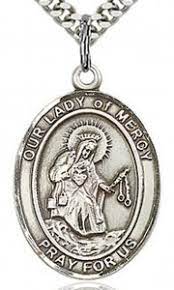
Forty years earlier, my mother had given me a religious medal which attached to the long rosary I wore at my side when I first became a Sister of Mercy. It was a beautiful representation of Our Lady of Mercy. I cherished it as a precious gift from my mother.
Well, the years passed quickly after 1966. My mother had long since gone home to God — and my old religious habit (dress) was a thing of the past! But that very special medal remained as a cherished reminder of the love, faith and pride my mother invested in me. It rested in a small wooden box on my bureau, with three other medals given at the same time: from my father, my only brother and the Sister of Mercy who first mentored me in my religious vocation.
One morning, glancing into the box, I realized that there were four medals — and I have four nieces and nephews. Here was the beginning of a solution to my search for a graduation gift– for the coming 8 years!
My oldest niece Maureen got the first medal. With it, she received a “certificate” from me. It said:
My dearest Maureen,
This medal was given to me by your Grandmother when I first became a sister long ago. I pass it on to you now to show you that we are very proud of you and that we love you. You are the cherished hope of our family for this generation. All of your ancestors, living and dead, stand behind you with love and encouragement. Thank you for the beauty, strength and hope you bring to our family and to the world around you. May this medal carry with it all the blessings you need for your life.
Eight years later, my youngest niece, Patty, received her “Medal of the Ancestors” — the one given to me by my dear sister friend in 1966. Patty had been looking forward to the conferment with great anticipation for those eight intervening years.
I share the story with you to encourage you to remember all those in your life who, whether by symbol, gift or quiet presence, have “certified” you as loved, hope-filled and strong. Remember those in your own life now who look to you for that “certification”. Of all the degrees, diplomas, and certificates we pursue in our lives, nothing is more precious than to know we are loved and believed in by those closest to us.
Today, in God’s Lavish Mercy, we pray with Psalm 128 which offers us a tender blessing. One of the most striking phrases of the blessing is “May you see your children’s children.”
Behold, thus is the one blessed who lives in awe of the LORD. The LORD bless you: may you see the prosperity of heart all the days of your life. May you see your children’s children. Peace be upon you always! May the Lord bless us all the days of our lives.
based on Psalm 128
Indeed, how grateful we are for the children in our families — no matter how old they are! What a gift to be renewed by their simplicity, openness, courage and dearness.
My Three Nieces and Nephew about 2001
What a joy to watch these next generations rise to their adulthood in grace and honor. What a particular blessing to live to see their children claim a heritage of life and goodness.
My Great-nephews and Niece with their Uber Aunt, the young one on the left in the 2001 photo above!
How important it is to let our younger family and friends know how we love them, what great hope and joy we find in them, how grateful we are for them. We should pray constantly for their life in the Spirit, for their strength in this shifting world, and for their friendship with God. We should be light for them, as our elders have been for us.
May we never take for granted what we have been given by the ones who come after us, who carry our hope and life into the future.
(In a separate post today, I offer a story you might enjoy about one way I tried to live by my own counsel in this regard.)
Poetry: Testament by Carolyn M. Rodgers
child,
in the august of your life
you come barefoot to me
the blisters of events
having worn through to the
soles of your shoes.
it is not the time
this is not the time
there is no such time
to tell you
that some pains ease away
on the ebb & toll of
themselves.
there is no such dream that
can not fail, nor is hope our
only conquest.
we can stand boldly in burdening places (like earth here)
in our blunderings, our bloomings
our palms, flattened upward or pressed,
an unyielding down.
Music: – sung by the inimitable Bob Dylan, winner of the Nobel Prize for Literature – a singer whom one either loves or hates. I hope you love his rendition of Forever Young.
Today, in God’s Lavish Mercy, we pray with Psalm 91 from the readings for the Mass of the Guardian Angels – those magnificent beings who carry God’s Presence to us in every situation of our lives.
The Lord shall deliver you from the snare of the hunter and from the deadly pestilence. The wings of the Lord shall cover you, and you shall find refuge under them; the faithfulness of God shall be a shield and buckler.
Psalm 91:3-4
Maybe the only angels we ever think about are chubby little cherubs on Christmas cards. The cultural tendency to represent angels in that way diminishes the real power of these mighty and loving beings to inspire and guide us. Today might be a day to rethink our relationship with our Guardian Angels – to talk with them and to listen to the good things they tell us even without words.
Poem: Touched by an Angel by Maya Angelou
We, unaccustomed to courage,
exiles from delight,
live coiled in shells of loneliness
until love leaves its high holy temple
and comes into our sight
to liberate us into life.
Love arrives
and in its train come ecstasies
old memories of pleasure
ancient histories of pain.
Yet if we are bold,
love strikes away the chains of fear
from our souls.
We are weaned from our timidity
In the flush of love's light
we dare be brave
And suddenly we see
that love costs all we are
and will ever be.
Yet it is only love
which sets us free
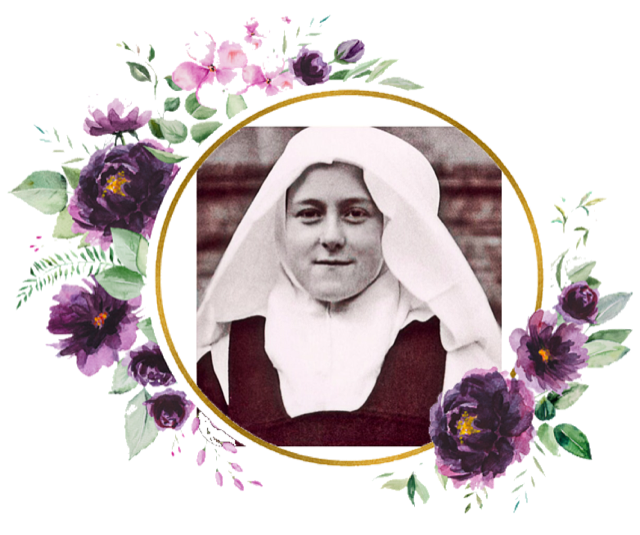
Thérèse of Lisieux (2 January 1873 – 30 September 1897)
was a French Catholic Discalced Carmelite nun
who is widely venerated in modern times.
She is popularly known in English as "The Little Flower”.
In her short life, she radiated a sacred simplicity,
often referred to as “The Little Way”
which has inspired generations of spiritual seekers.
Pope Pius X called her the greatest saint of modern times.
Today, in God’s Lavish Mercy, in place of the dour readings of the day, we pray with some thoughts from the Little Flower herself:
For me, prayer is a surge of the heart; it is a simple look turned toward heaven, it is a cry of recognition and of love, embracing both trial and joy.
When one loves, one does not calculate.
The world’s your ship and not your home.
Poetry: To Live in Love by Thérèse of the Child Jesus – a beautiful long prayer-poem. You may wish to use just a stanza or two, or to pray with the musical version below.
If any one love Me, they will keep My word and My Father will love them and We will come to them and make Our abode with them… My peace I give unto you … Abide in My love.” (John 14, 23,27,-15:9)
The eve His life of love drew near its end, Thus Jesus spoke: “Whoever loveth Me, And keeps My word as Mine own faithful friend, My Father, then and I his guests will be; Within his heart will make Our dwelling above. Our palace home, true type of heaven above. There, filled with peace, We will that he shall rest, With us, in love.
Incarnate Word! Thou Word of God alone! To live of love, ’tis to abide with Thee. Thou knowest I love Thee, Jesus Christ, my Own! Thy Spirit’s fire of love enkindleth me. By loving Thee, I draw the Father here Down to my heart, to stay with me always. Blest Trinity! Thou art my prisoner dear, Of love, to-day.
To live of love, ’tis by Thy life to live, O glorious King, my chosen, sole Delight! Hid in the Host, how often Thou dost give Thyself to those who seek Thy radiant light. Then hid shall be my life, unmarked, unknown, That I may have Thee heart to heart with me; For loving souls desire to be alone, With love, and Thee!
To live of love, ’tis not to fix one’s tent On Tabor’s height and there with Thee remain. ‘Tis to climb Calvary with strength nigh spent, And count Thy heavy cross our truest gain. In heaven, my life a life of joy shall be, The heavy cross shall then be gone for aye. Here upon earth, in suffering with Thee, Love! let me stay.
To live of love, ’tis without stint to give, An never count the cost, nor ask reward; So, counting not the cost, I long to live And show my dauntless love for Thee, dear Lord! O Heart Divine, o’erflowing with tenderness, How swift I run, who all to Thee has given! Naught but Thy love I need, my life to bless. That love is heaven!
To live of love, it is to know no fear; No memory of past faults can I recall; No imprint of my sins remaineth here; The fire of Love divine effaces all. O sacred flames! O furnace of delight! I sing my safe sweet happiness to prove. In these mild fires I dwell by day, by night. I live of love!
To live of love, ’tis in my heart to guard A mighty treasure in a fragile vase. Weak, weak, am I, O well beloved Lord! Nor have I yet an angel’s perfect grace. But, if I fall each hour that hurries by, Thou com’st to me from Thy bright home above, And, raising me, dost give me strength to cry: I live of love!
To live of love it is to sail afar And bring both peace and joy where’er I be. 0 Pilot blest! love is my guiding star; In every soul I meet, Thyself I see. Safe sail I on, through wind or rain or ice; Love urges me, love conquers every gale. High on my mast behold is my device: “By love I sail!”
To live of love, it is when Jesus sleeps To sleep near Him, though stormy waves beat nigh. Deem not I shall awake Him! On these deeps Peace reigns, like that the Blessed know on high. To Hope, the voyage seems one little day; Faith’s hand shall soon the veil between remove; ‘Tis Charity that swells my sail always. I live of love!
To live of love, 0 Master dearest, best! It is to beg Thee light Thy holiest fires Within the soul of each anointed priest, Till he shall feel the Seraphim’s desires; It is to beg Thee guard Thy Church, 0 Christ! For this I plead with Thee by night, by day; And give myself, in sacrifice unpriced, With love always!
To live of love, it is to dry Thy tears, To seek for pardon for each sinful soul, To strive to save all men from doubts and fears, And bring them home to Thy benign control. Comes to my ear sin’s wild and blasphemous roar; So, to efface each day, that burning shame, I cry: ” 0 Jesus Christ! I Thee adore. I love Thy Name!”
To live of love, ’tis Mary’s part to share, To bathe with tears and odorous perfume Thy holy feet, to wipe them with my hair, To kiss them; then still loftier lot assume, To rise, and by Thy side to take my place, And pour my ointments on Thy holy head. But with no balsams I embalm Thy Face! ‘Tis love, instead!
“To live of love, what foolishness she sings!” So cries the world. “Renounce such idle joy! Waste not thy perfumes on such trivial things. In useful arts thy talents now employ!” To love Thee, Jesus! Ah, this loss is gain; For all my perfumes no reward seek I. Quitting the world, I sing in death’s sweet pain: Of love I die!
To die of love, O martyrdom most blest! For this I long, this is my heart’s desire; My exile ends; I soon will be at rest. Ye Cherubim, lend, lend to me your lyre! O dart of Seraphim, O flame of love, Consume me wholly; hear my ardent cry! Jesu, make real my dream! Come Holy Dove! Of love I die!
To die of love, behold my life’s long hope! God is my one exceeding great reward. He of my wishes forms the end and scope; Him only do I seek; my dearest Lord. With passionate love for Him my heart is riven. O may He quickly come! He draweth nigh! Behold my destiny, behold my heaven, OF LOVE TO DIE.
February 25, 1895
Music: St. Thérèse’s Canticle of Love – Sister Marie Thérèse Sokol, OCD
Memorial of Saint Jerome, Priest and Doctor of the Church Thursday, September 30, 2021
St. Jerome in His Study by Domenico Ghirlandaio
Jerome is best known for his translation of most of the Bible into Latin (the translation that became known as the Vulgate) and his commentaries on the whole Bible.
Today, in God’s Lavish Mercy, we pray with Psalm 19 which Charles Spurgeon, noted 19th century preacher, calls “the study of God’s two great books—nature and Scripture”.
Psalm 19 is a beautiful prayer for this time of year when nature erupts in unparalleled beauty. It is also perfect for this day when we celebrate Jerome who shaped our scriptures into the form we cherish today.
The psalm concludes with a wholehearted confession of faith and hope. It is a prayer all of us long to offer God in the sincerity of our hearts.
Scripture scholar James L. Mays notes that to comprehend this final expression of faith, we must pray with the whole psalm.
The psalm is divided into three parts
Creation’s testimony to the Creator (vv. 1–6),
the incomparable value of the law of the LORD (vv. 7–10),
the human need for divine forgiveness and protection (vv. 11–13).
Two poems and a song captured the flow of my prayer today.
As I pray the first part of the psalm , my spirit is opened to Creation’s power and beauty – an expression of God’s omnipotence and glory.
The heavens declare the glory of God; the firmament proclaims the works of his hands. Day unto day pours forth speech; night unto night whispers knowledge.
Psalm 19:1-3
To Autumn – William Blake
Motherhouse Front Lawn – Merion, PA
O Autumn, laden with fruit, and stain’d
With the blood of the grape, pass not, but sit
Beneath my shady roof; there thou may’st rest,
And tune thy jolly voice to my fresh pipe,
And all the daughters of the year shall dance!
Sing now the lusty song of fruits and flowers.
The narrow bud opens her beauties to
The sun, and love runs in her thrilling veins;
Blossoms hang round the brows of Morning, and
Flourish down the bright cheek of modest Eve,
Till clust’ring Summer breaks forth into singing,
And feather’d clouds strew flowers round her head.
The spirits of the air live in the smells
Of fruit; and Joy, with pinions light, roves round
The gardens, or sits singing in the trees.”
Thus sang the jolly Autumn as he sat,
Then rose, girded himself, and o’er the bleak
Hills fled from our sight; but left his golden load.
The narrow bud opens her beauties to
The sun, and love runs in her thrilling veins;
Blossoms hang round the brows of Morning, and
Flourish down the bright cheek of modest Eve,
Till clust’ring Summer breaks forth into singing,
And feather’d clouds strew flowers round her head.
The spirits of the air live in the smells
Of fruit; and Joy, with pinions light, roves round
The gardens, or sits singing in the trees.”
Thus sang the jolly Autumn as he sat,
Then rose, girded himself, and o’er the bleak
Hills fled from our sight; but left his golden load.
2. Praying the second part of Psalm 19, I think about the gift of the scriptures, and how I turn to them in all the seasons of my life.
The law of the LORD is perfect, refreshing the soul. The decree of the LORD is trustworthy, giving wisdom to the simple. The precepts of the LORD are right, rejoicing the heart.
Psalm 19: 8-9
After Her Death – Mary Oliver
I am trying to find the lesson
for tomorrow. Matthew something.
Which lectionary? I have not
forgotten the Way, but, a little,
the way to the Way. The trees keep whispering
peace, peace, and the birds
in the shallows are full of the
bodies of small fish and are
content. They open their wings
so easily, and fly. It is still
possible.
           I open the book
which the strange, difficult, beautiful church
has given me. To Matthew. Anywhere.
And praying the third part of Psalm 19, I hear this hymn echoing in my spirit.


















 Lavish Mercy