Psalm 145: Laudato Sí

Eighteenth Sunday In Ordinary Time

August 2, 2020

For my prayer this morning, I re-read Pope Francis magnificent encyclical Laudato Si’ which instructs us and begs us to cherish the gift of our Common Home. – a world which God has so loved that God gave the only begotten Son that we should not perish.
This sacred document has become even more meaningful as a global pandemic exposes the fragmentations we have wrought upon the earth.

from Reflection for Earth Day 2020

Today, in God’s Lavish Mercy, we pray with Psalm 145, a song of complete confidence that God will sustain us.

Set like diamond amidst our three beautiful readings, Psalm 145 offers us a rich and melodious way to praise our Creator and to recognize the glory of God’s gift of Creation.

St. Francis of Assisi used this psalm to inspire his own well-known Canticle of the Sun – which, in turn, inspired Pope Francis’s magnificent encyclical Laudato Sí.

For our prayer today, we might choose any of these texts, even a small taste, and savor it with thanksgiving and hope, letting our hearts sing on this Sunday morning.

Poetry:  Canticle of the Sun – Francis of Assisi

Original text in Umbrian dialect:

Altissimu, omnipotente bon Signore,
Tue so le laude, la gloria e l’honore et onne benedictione.
Ad Te solo, Altissimo, se konfano,
et nullu homo ène dignu te mentouare.
Laudato sie, mi Signore cum tucte le Tue creature,
spetialmente messor lo frate Sole,
lo qual è iorno, et allumini noi per lui.
Et ellu è bellu e radiante cum grande splendore:
de Te, Altissimo, porta significatione.
Laudato si, mi Signore, per sora Luna e le stelle:
in celu l’ài formate clarite et pretiose et belle.
Laudato si, mi Signore, per frate Uento
et per aere et nubilo et sereno et onne tempo,
per lo quale, a le Tue creature dài sustentamento.
Laudato si, mi Signore, per sor’Acqua,
la quale è multo utile et humile et pretiosa et casta.
Laudato si, mi Signore, per frate Focu,
per lo quale ennallumini la nocte:
ed ello è bello et iucundo et robustoso et forte.
Laudato si, mi Signore, per sora nostra matre Terra,
la quale ne sustenta et gouerna,
et produce diuersi fructi con coloriti fior et herba.
Laudato si, mi Signore, per quelli ke perdonano per lo Tuo amore
et sostengono infirmitate et tribulatione.
Beati quelli ke ‘l sosterranno in pace,
ka da Te, Altissimo, sirano incoronati.
Laudato si mi Signore, per sora nostra Morte corporale,
da la quale nullu homo uiuente pò skappare:
guai a quelli ke morrano ne le peccata mortali;
beati quelli ke trouarà ne le Tue sanctissime uoluntati,
ka la morte secunda no ‘l farrà male.
Laudate et benedicete mi Signore et rengratiate
e seruiteli cum grande humilitate.

English Translation:
Most High, all powerful, good Lord, 
Yours are the praises, the glory, the honor, and all blessing.
To You alone, Most High, do they belong, 
and no man is worthy to mention Your name.
Be praised, my Lord, through all your creatures, 
especially through my lord Brother Sun, 
who brings the day; and you give light through him. 
And he is beautiful and radiant in all his splendor! 
Of you, Most High, he bears the likeness.
Praised be You, my Lord, through Sister Moon and the stars, 
in heaven you formed them clear and precious and beautiful.
Praised be You, my Lord, through Brother Wind, 
and through the air, cloudy and serene, 
and every kind of weather through which 
You give sustenance to Your creatures.
Praised be You, my Lord, through Sister Water,
which is very useful and humble and precious and chaste.
Praised be You, my Lord, through Brother Fire, 
through whom you light the night and he is beautiful 
and playful and robust and strong.
Praised be You, my Lord, through Sister Mother Earth, 
who sustains us and governs us and who produces 
varied fruits with coloured flowers and herbs.
Praised be You, my Lord, 
through those who give pardon for Your love, 
and bear infirmity and tribulation.
Blessed are those who endure in peace 
for by You, Most High, they shall be crowned.
Praised be You, my Lord, 
through our Sister Bodily Death, 
from whom no living man can escape.
Woe to those who die in mortal sin. 
Blessed are those whom death will 
find in Your most holy will, 
for the second death shall do them no harm.
Praise and bless my Lord, 
and give Him thanks 
and serve Him with great humility.

Music: Biblical Songs, Op.99, No.5 (Psalm 145) by Antonín Dvořák and, an added selection, a populair hymn based on Psalm 145. Remember, to sing is to pray twice! 🙂
Psalm 126: The Rhythm of Life

Feast of Saint James, Apostle

July 25, 2020 

Today, in God’s Lavish Mercy, we pray with Psalm 126, one of fifteen Psalms of Ascent, which meant it would be sung in gratitude when “ascending” for prayer.

You may enjoy listening to the Psalm read accompanied by music.
Psalm 126 – Milken Archive, Jewish Choral Art in America.


Psalm 126 is popular and immediately recognizable to Jews and Christians. Thought to be written by either Ezra or the prophets at the return from the Babylonian Captivity, the psalm celebrates restoration while remembering the lessons of exile.

Israel is overwhelmed with gratitude at their deliverance, barely able to comprehend God’s goodness.

When the LORD brought back the captives of Zion,
we were like men dreaming.
Then our mouth was filled with laughter,
and our tongue with rejoicing.


Have you ever had a feeling like that, perhaps when you’ve gotten to the other side of a really rough patch in your life? Feeling like we’ve come through a dream – maybe a bad one – we can’t even find the words to thank God for helping us. We might simply laugh or cry for joy.

Psalm 126 reminds us not to let that tumultuous gratitude dissipate. The repetition of the psalm inscribes that gratitude on our hearts, transforming it to renewed hope and trust in God. As Catherine McAuley reminds us, life is a series of joys and sorrows. Both cycles can deepen our faith when we receive them in union with God.

This is your life,
joys and sorrow mingled,
one succeeding the other.

Letter to Francis Warde – May 28, 1841

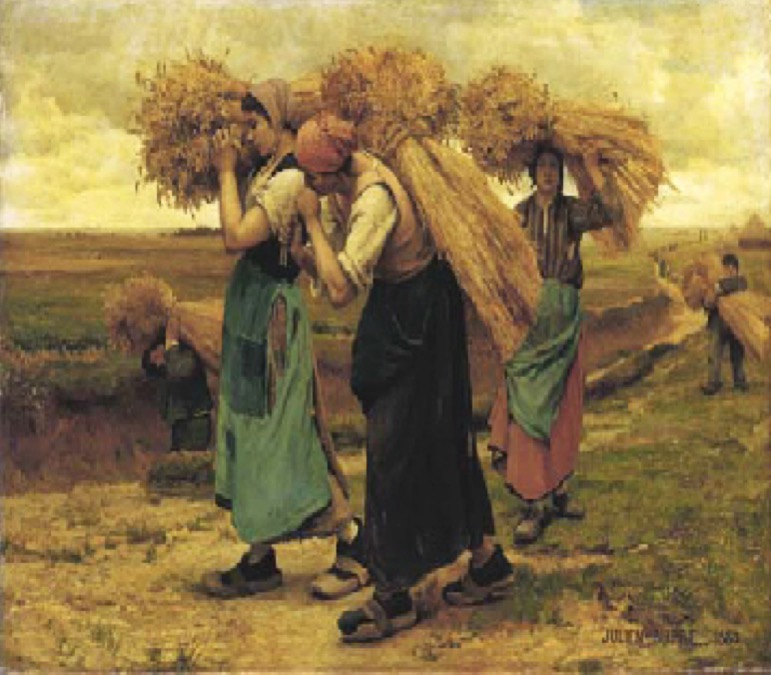
Julien Dupré (French, 1851-1910)

Psalm 126 assures us that we can meet our life experiences with hope and trust because God is faithful. Within both our “comings” and our “goings”, God abides with us and will deliver us to joy.

Although they go forth weeping,
carrying the seed to be sown,
They shall come back rejoicing,
carrying their sheaves.


Poetry:  A Short Testament by Anne Porter

Whatever harm I may have done 
In all my life in all your wide creation creation
If I cannot repair it 
I beg you to repair it, 

And then there are all the wounded 
The poor the deaf the lonely and the old
Whom I have roughly dismissed 
As if I were not one of them. 
Where I have wronged them by it 
And cannot make amends 
I ask you 
To comfort them to overflowing,

And where there are lives I may have withered around me,
Or lives of strangers far or near 
That I've destroyed in blind complicity, 
And if I cannot find them 
Or have no way to serve them,

Remember them. I beg you to remember them

When winter is over 
And all your unimaginable promises
Burst into song on death's bare branches.

Music: Hallelujah- Leonard Cohen

Psalm 50 Redux: Sacrifice of Praise

Monday of the Fifteenth Week in Ordinary Time

July 13, 2020

I have no past reflection on today’s readings since in 2016 they came on the Feast of Our Lady of Mt. Carmel, and in 2018 on the Feast of St. Benedict – both of whom I chose to highlight on those days. So here is a reflection from the Creighton University archives:


Today, in God’s Lavish Mercy, we pray again with Psalm 50. Today’s passage is what I call the “empty words” section where God leaves no doubt about what does and does not please him.

Why do you recite my statutes,
and profess my covenant with your mouth,
Though you hate discipline
and cast my words behind you?


We all know people who talk a good game about religion but they’re mean, selfish, and miserable to be around (present company excluded of course 🙄) And we all know people who actually distort religion to promote themselves while debasing and marginalizing others.

In Psalm 50, God says, “Cut it out!”. God doesn’t want burnt offerings or empty words. God wants “a sacrifice of praise”. So what exactly might that mean?


Walter Brueggemann, in talking about the similar Psalm 51, describes a sacrifice of praise like this:

It must be an intimate, yielding act of trustful submission of “spirit and heart,” not “sacrifice and burnt offerings”. The speaker (psalmist), now situated in glad praise, can imagine an intimacy and communion in which contact between God and self is available and in which the distinction between the two parties is clear and acknowledged—God in splendor, the self in “brokenness”.


When we pray from a humble understanding such as Bruggemann describes, our souls open to God’s love for us and for all Creation. We move from being the center of an insecure, self-absorbed universe to seeing ourselves in inextricable communion with all Life whose Center and Source is Love itself.

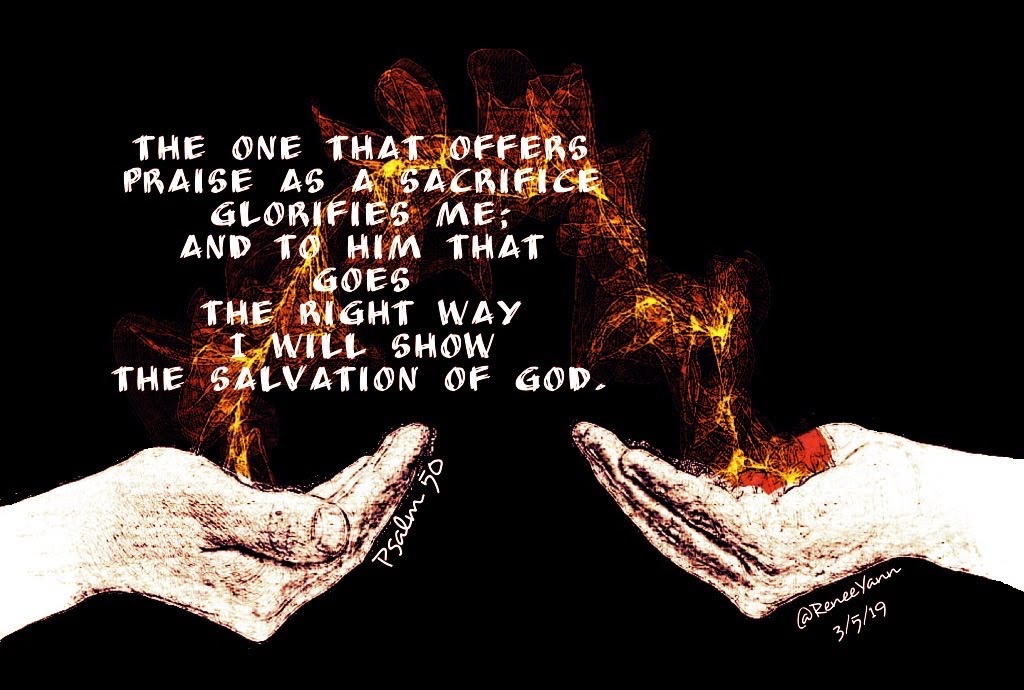
The one that offers praise as a sacrifice glorifies me;
and to the one who goes the right way I will show the salvation of God.


Poetry: one of mine today.

Praise
is the place
where I am lost
in You,
the exchange 
that
has only 
You speaking
without sound, with nothing
but my awed
silence.

Music: Alvin Slaughter – Sacrifice of Praise

Lord I lift a song of worship
For Your glory and Your grace
Let my heart reveal all my words fail to say
Lord receive this sacrifice of praise
(Repeat)
On the mountains, in the valley
As I wait in my secret place
I will trust,trust in the name of the Lord
Now receive this sacrifice of praise
You're my shield You're my shelter
From the storm and from the rain
Cover me beneath the shadow of Your wings
Lord receive this sacrifice of praise
Hallelujah hallelujah
Hallelujah to Your name
For all You've done
You are and evermore will be
Lord receive this sacrifice of praise
Of praise
Of praise----

Psalm 65: Word-Seed

Fifteenth Sunday in Ordinary Time
July 12, 2020

From 2017:

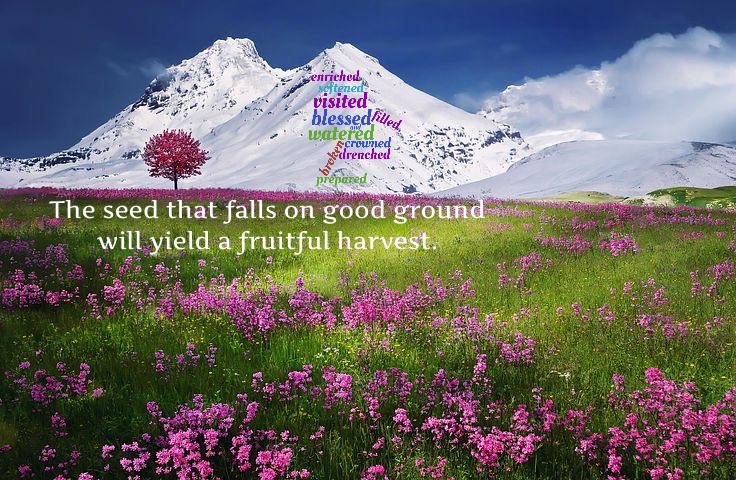
Today, in Mercy, we pray with the powerful and mysterious readings of today’s liturgy. They tell us that God breathes eternal inspiration into us and all Creation. The gift, like seed, is intended to bear fruit that is returned to God in love and praise. By participating in that return, we become children of God. May the seed of God’s Word fall on good ground in our spirits.

Today, in God’s Lavish Mercy, we pray with Psalm 65, a song poem probably written to celebrate the harvest season. The psalm describes an abundantly fruitful earth, filled with life and produce.

Though humans labor for these blessings, God is the bounty’s true agent. The power of that agency is found in the array of words used to describe God’s actions.

God has: 

  • visited 
    • watered
      • enriched
        • filled
          • prepared
  • drenched
    • broken up
      • softened
        • blessed and
          • crowned

What is it that has drawn all this intervention from God? Our readings tell us. It is the Word-Seed which is God’s own life.

Just as from the heavens
the rain and snow come down….
so shall my Word be. (Isaiah 55)
For creation awaits with eager expectation
the revealing Word of the children of God… (Romans 8)
The seed sown on rich soil
is the one who hears the Word and understands it,
who indeed bears fruit and 
yields a hundred or sixty or thirtyfold. (Matthew 13)

By our dedicated prayer with scripture and trusted spiritual reading, the Word works on our spirits just as the psalm describes.  Our understanding, too, is visited, watered, enriched, filled, prepared, drenched, broken up, softened and ultimately blessed and crowned.

As we pray with Psalm 65 today, we can picture David looking out from hilltop over the abundance of his fields. His heart is filled with awe and praise for God’s generosity.

We all want to live in a spiritual landscape akin to the psalm’s bountiful picture. Inviting God’s Word, in humility, gratitude, and awe is a true path to such blessing.


Poetry: A Word Is Dead – Emily Dickinson


Music: Aria by Secret Garden

Psalm 115: Not To Us

Tuesday of the Fourteenth Week in Ordinary Time

July 7, 2020

Today, in God’s Lavish Mercy, we pray with Psalm 115. The first verse, not included in today’s passage, is perhaps the most familiar:

Not to us, LORD, not to us
but to your name give glory
because of your mercy and faithfulness.

This verse sets the tone for the whole psalm by establishing that it is only in humility that we will experience God’s faithful mercy.


The psalm sections offered today show how hard it is to keep humble attention on God in a world full of idols. While the psalmist mocked these idolatrous gods and their worshippers, his descriptions indicate the significant space they occupy in his own imagination.

There are lots of distracting “gods” in our world too. As a matter of fact, it is sometimes difficult to find the real God because our culture cloaks God in its own distorting devices. 

For example, we encounter ideologies which promote a “god” who:

  • loves America more than other nations
  • loves white people more than black and brown people
  • loves war as long as we are the victors
  • loves my prosperity over other people’s justice
  • tolerates, or even blesses, violence for the sake of superiority
  • isolates, stereotypes, and discriminates over who deserves blessings

Some of these idolatries work to convince us that we are more important to God if we are white, rich, male, heterosexual, healthy, armed, not too old, and American – because these deifications paint their “god” with those strokes.

The more we match up with this “god” – the molten image of a greedy, elitist, militaristic culture – the more we tend to take glory to ourselves. And the more others might legitimately question, “Where is their God?”.

This becomes all the more disorienting when influencers who benefit from such misguided idolatry and fundamentalism use them to promote themselves and their personal and political agendas.


Psalm 115 says, “Stop that!”.


Our Gospel shows us what God is really like — Jesus, who:

  • sought out those suffering
  • loved the poor and abandoned
  • was moved with pity for others’ pain
  • taught, proclaimed and healed in the name of God’s Mercy

Living in the light of this merciful God both humbles and exalts us so that we may wholeheartedly proclaim by our lives:

Not to us, LORD, not to us
but to your name give glory

because of your mercy and faithfulness.

Non nobis, Domine, non nobis ; 
sed nomini tuo da gloriam,
super misericordia tua et veritate tua.


Poetry: Non Nobis Domine! – Rudyard Kipling
(Written for “The Pageant of Parliament,” 1934)

NON nobis Domine!—
    Not unto us, O Lord!
The Praise or Glory be
    Of any deed or word;
For in Thy Judgment lies
    To crown or bring to nought
All knowledge or device
    That Man has reached or wrought.
And we confess our blame—
    How all too high we hold
That noise which men call Fame,
    That dross which men call Gold.
For these we undergo
    Our hot and godless days,
But in our hearts we know
    Not unto us the Praise.
O Power by Whom we live—
    Creator, Judge, and Friend,
Upholdingly forgive
    Nor fail us at the end:
But grant us well to see
    In all our piteous ways—
Non nobis Domine!—
    Not unto us the Praise

Music: Non Nobis Domine

Psalm 79: Song Sung Blue

Thursday of the Twelfth Week in Ordinary Time

June 25, 2020

Today, in God’s Lavish Mercy, we pray with Psalm 79, a Lament Psalm so sorrowful that Brueggemann calls it one of the ”Sad Songs of Zion”.

So what’s going on in Psalm 79? 

Israel is heartbroken. They had thought they were uniquely special to God, that preference being symbolized by their magnificent Temple in Jerusalem. When the Temple was ravaged, as described in today’s first reading from Kings, the community is bereft.

The psalm demonstrates the prayer’s transformation from initial angry sadness to restored faith in God. Israel has allowed its perception of God to become institutionalized in a symbol, a building. But faithful reflection moves them to realize that God is beyond institutionalization. Through their lament, they return their hearts to the true Name of God – “I am Who am”.

Help us, O God our savior,
because of the glory of your name;
Deliver us and pardon our sins
for your name’s sake.


I think we, too, try to domesticate God into bricks and mortar, customs, national symbols, people, rules, and all kinds of other potential idols. When those things crack or crumble, as all things might, we experience a devastation like that found in Psalm 79.

  • Some of us felt that way when the clerical sex abuse scandal was revealed.
  • Some of us felt that way on 9/11, or because of the pandemic
  • Some of us experience this lament when systems we trusted turn corrupt: law enforcement, medicine, religion, government.

Because we can’t see God face-to-face, we often paint that face on representations of power in our lives. That’s what Israel did with the Temple.

When those symbols prove untrustworthy, we might use it as an excuse to stop seeking God’s true and loving Face. Let’s learn from the Psalms how to persist in faith until we finally do see God face-to-face.


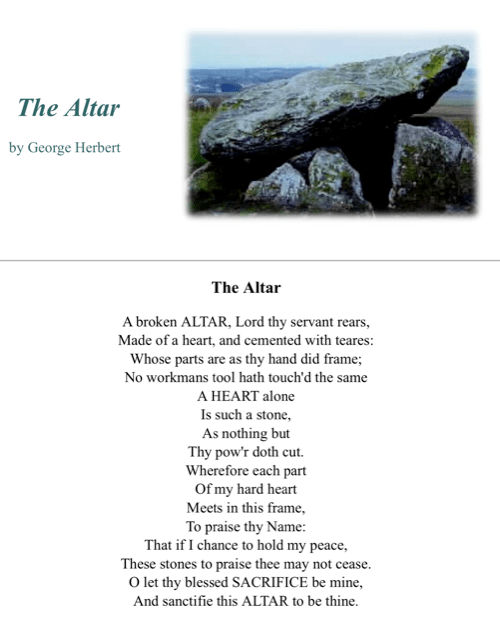
Early 17th century poet George Herbert captures the idea, I think.

Music: Shackles – by the group Mary, Mary – the song is kind of a modern Psalm 79, a movement from lament, through painful experience, to praise. Suggestion: Get up and move with it!

Psalm 89: Mary’s Echo

Memorial of the Immaculate Heart of the Blessed Virgin Mary

June 20, 2020

Today, in God’s Lavish Mercy, we pray with Psalm 89, as the Church celebrates the blessed humanity of Mary.

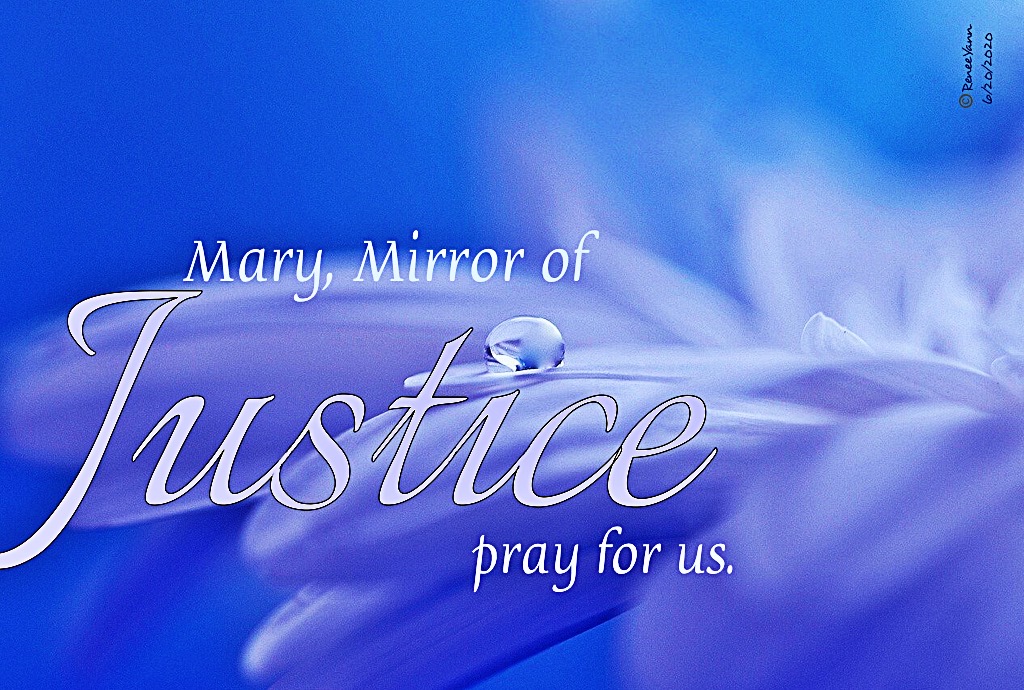
Yesterday and today, these beautiful “heart” feasts follow one upon the other, reminding us that both Jesus and Mary loved with human hearts like ours – Jesus as God, and Mary as God’s transformed Mirror.

As we pray with Mary today. Psalm 89 offers us a perfect context. The psalm was likely composed during a difficult time, when Israel began to doubt Yahweh’s enduring promise to care for them – some say during the Babylonian Captivity.

The psalm reminds the People of the Covenant and the Promise:

I have made a covenant with my chosen one,
I have sworn to David my servant:
Forever will I confirm your posterity
and establish your throne for all generations.

Forever I will maintain my kindness toward him,
and my covenant with him stands firm.
I will make his posterity endure forever
and his throne as the days of heaven.


Mary, born of the House of David, is the ultimate deliverer of that Promise in the person of her son, Jesus Christ. When, just before Jesus’ birth, Mary prays the Magnificat, we can hear echoes of Psalm 89:

And Mary said, 
My soul proclaims the greatness of the Lord;
my spirit rejoices in God my savior….

He has shown might with his arm,
dispersed the arrogant of mind and heart.
He has thrown down the rulers from their thrones
but lifted up the lowly….

He has helped Israel his servant,
remembering his mercy,
according to his promise to our fathers,
to Abraham and to his descendants forever.


An extra song for Mary today, written in 1961 for a Firemen’s Choir

In our own times of trouble, or when a long endurance is required of us, our faith in God’s promises might waver too. Mary is a good one to talk to in such times. Her faith was refined from all need to place stipulations on God’s timing. She believed. Period.

And she wants to nurture that gift in us.


Poetry: I think Mary and psalmist would have liked this poem by Kahlil Gibran. I hope you do too. For me, it speaks of how faith deepens, as Mary’s did.

God
In the ancient days, when the first quiver of speech came to my lips,
I ascended the holy mountain and spoke unto God, saying, 
“Master, I am thy servant.  Thy hidden will 
is my law and I shall obey thee for ever more.”
 
But God made no answer, and like a mighty tempest passed away.
 
And after a thousand years I ascended the holy mountain and again
spoke unto God, saying, “Creator, I am thy creation.  
Out of clay hast thou fashioned me and to thee I owe mine all.”
 
And God made no answer, but like a thousand swift wings passed
away.
 
And after a thousand years I climbed the holy mountain 
and spoke unto God again, saying, “Father, I am thy child.  
In pity and love thou hast given me birth, 
and through love and worship I shall inherit thy kingdom.”
 
And God made no answer, and like the mist that veils the distant
hills he passed away.
 
And after a thousand years I climbed the sacred mountain 
and again spoke unto God, saying, “My God, my aim and my fulfillment; 
I am thy yesterday and thou are my tomorrow.  
I am thy root in the earth and thou art my flower in the sky, 
and together we grow before the face of the sun.”
 
Then God leaned over me, and in my ears whispered words of sweetness,
and even as the sea that enfoldeth a brook that runneth down to
her, God enfolded me.
 
And when I descended to the valleys and the plains God was there
also.

Music: Psalm 89: Forever I Will Sing the Goodness of the Lord – Brian J. Nelson; cantor David Adams

Psalm 97: Who’s in Charge Here?

Thursday of the Eleventh Week in Ordinary Time

June 17, 2020

Today, in God’s Lavish Mercy, we pray with Psalm 97, one of the six “enthronement psalms”.  These hymns identify God as “king” whose power is above all. Such power evokes awe and praise which form the repeated acclamations of the psalm.

The “enthronement” of God in Israel’s worship means that all other “gods” (power, prestige, influence, money, etc.) are now subject to the policies, attitudes and judgments of Yahweh – Who REIGNS and Who is covenanted to us with irrevocable love.

Everything we encounter in life is to be received with that understanding.


We know how the psalmist feels – what it’s like to be awed by God’s power – and left with nothing but stunned silence or quiet whispering praise.

  • Both magnificent and delicate natural phenomena can inspire such a prayer. 
  • Life events over which we have no control can also bring us to humble praise like this.
  • The intricacies of a newborn’s face, the graced windings of an elder’s life story, the unfathomable reality of death, the mystery of a human love that mirrors God’s…. All such mysteries and miracles can cause us to proclaim with the psalmist:

The LORD is king; let the earth rejoice;
let the many islands be glad! …
Light dawns for the righteous, 
and joy for the upright in heart. 

Rejoice in the LORD, O you righteous, 
and give thanks to his holy name

(Ps. 97:2, 10–12)

Or, as transliterated by Minister Christine Robinson:

Highest in Heaven
Deepest in Nature
Holy One

Be Glad
Lights up the world
Purifies the heart
Gathers the peoples
Rejoice.


Whether or not we’re comfortable with “king” language, may we still embrace the image of God, invited to our heart, made at home, praised and unfailingly worshipped. Enthroned!

Today, let us praise our King, Lord, Dear One or however we inadequately attempt to name our Divine Creator.

Poetry: I Am Bending My Knee from the Carmina Gadelica, the work of Alexander Carmichael. Carmina Gadelica is a compendium of prayers, hymns, charms, incantations, blessings, literary-folkloric poems and songs, proverbs, lexical items, historical anecdotes, natural history observations, and miscellaneous lore gathered in the Gaelic-speaking regions of Scotland between 1860 and 1909. (Wikipedia)

I am bending my knee
In the eye of the Father who created me,
In the eye of the Son who purchased me,
In the eye of the Spirit who cleansed me,
In friendship and affection.
Through Thine own Anointed One, O God,
Bestow upon us fullness in our need,
Love towards God,
The affection of God,
The smile of God,
The wisdom of God,
The grace of God,
The fear of God,
And the will of God
To do on the world of the Three,
As angels and saints
Do in heaven;
Each shade and light,
Each day and night,
Each time in kindness,
Give Thou us Thy Spirit.

Music: Our God Reigns – Studio Musicians


Psalm 16: The Secret

Wednesday of the Tenth Week in Ordinary Time

June 10, 2020

Click here for readings

psalm16

Today, in God’s Lavish Mercy, we pray with Psalm 16.  This Psalm is introduced as “A Michtam of David”. “Michtam” can be interpreted as either “golden” or “secret” by various translators. 

For prayer this morning, I focused on “secret” because, in the psalm, David expresses what he considers the secret to a joyful, holy life even in difficulty.

O LORD, my allotted portion and cup,
you it is who hold fast my lot.
I set the LORD ever before me;
with him at my right hand I shall not be disturbed.

The last line of this verse immediately brought to mind St. Teresa of Avila’s transcendent advice:

Nada te turbe
nada te espante
Todo se pasa
Dios no we muda.
La paciencia todo alcanza.
Quien a Dios tiene
nada le falta
Solo Dios basta.

Let nothing disturb you,
Let nothing frighten you,
All things are passing.
God alone is changeless.
Patience obtains all things
Whoever has God lacks nothing;
God alone suffices.

Repeating this Psalm slowly and intentionally, let us pray for that kind of peace today:

  • for ourselves
  • our beloveds
  • our world, especially those from whom peace has been stolen by injustice, war, greed, and hate.

Music: Psalm 16 – Shane and Shane

There is fullness
Of joy
Of joy
At Your right hand
There are pleasures
Forevermore
Forevermore

My heart is glad and my soul rejoices
My flesh it dwells secure
Because You put on flesh
Lived a blameless life
My curse on the cross You bore

Then You ripped the doors off the City of Death
And the chains fell to the floor
Now the serpent’s crushed
It has been finished
And You reign forevermore

You are my portion
My cup and you make my lot secure
The lines have fallen
For me in pleasant places
A beautiful inheritance

Psalm 121: A Climbing Song

Monday of the Tenth Week in Ordinary Time

June 8, 2020

Click here for readings

Today, in God’s Lavish Mercy, we pray with Psalm 121, another of the fifteen Psalms of Ascent.

(Placing the hymn early today. You might want to play it as you read the psalm.)
Waldorf Davies: Psalm 121 St. John’s College Choir Cambridge


climber

Picture the ancient pilgrims on their way up to Jerusalem. They carry in their hearts all the joys and burdens of their lives, just like everyone else in the world.

Psalm 121 eyes
What blesses them particularly is that they have turned their eyes toward God as they journey, singing both their griefs and their delights in hope and thanksgiving.


The psalm moves from a plea for help in the beginning: 

I lift up my eyes toward the mountains;
whence shall help come to me?

To, at the close, a triumphant confidence in that help in perpetuity:

The LORD will guard you from all evil;
he will guard your life.
The LORD will guard your coming and your going,
both now and forever.


May we, too, fix our eyes on God,
vigilantly seeking God’s truth
at the core of our experiences.

May our faithful, lifelong dialogue with God
lead us, like the psalmist,
to the same blessed assurance.


Just for a little added joy, here is the glorious hymn Blessed Assurance
– sung by CeCe Winans honoring Cicely Tyson at the Kennedy Center Honors.


Poem: Prayer by David Gioia

(In this poem, we glimpse one particular pilgrim and the prayer he is carrying. The poet addresses God in lovely ways, ( I really loved “Jeweller of the spiderweb”). Finally he prays for protection for a beloved. I think we’ve all prayed that kind of prayer.)

Echo of the clocktower, footstep
in the alleyway, sweep
of the wind sifting the leaves.
Jeweller of the spiderweb, connoisseur
of autumn’s opulence, blade of lightning
harvesting the sky.
Keeper of the small gate, choreographer
of entrances and exits, midnight
whisper traveling the wires.
Seducer, healer, deity or thief,
I will see you soon enough—
in the shadow of the rainfall,
in the brief violet darkening a sunset—
but until then I pray watch over him
as a mountain guards its covert ore
and the harsh falcon its flightless young.