Today, in God’s Lavish Mercy, we pray with Psalm 16.This Psalm is introduced as “A Michtam of David”. “Michtam” can be interpreted as either “golden” or “secret” by various translators.
For prayer this morning, I focused on “secret” because, in the psalm, David expresses what he considers the secret to a joyful, holy life even in difficulty.
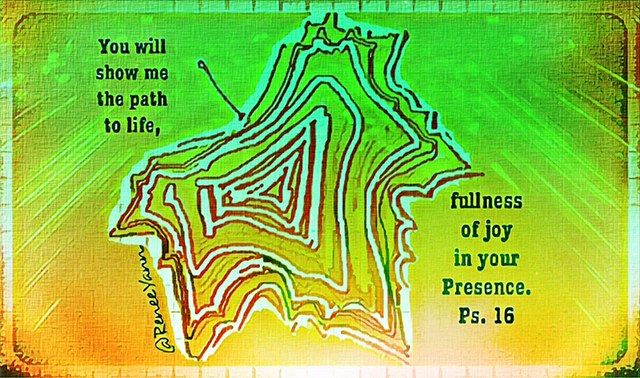
O LORD, my allotted portion and cup, you it is who hold fast my lot. I set the LORD ever before me; with him at my right hand I shall not be disturbed.
The last line of this verse immediately brought to mind St. Teresa of Avila’s transcendent advice:
Nada te turbe nada te espante Todo se pasa Dios no we muda. La paciencia todo alcanza. Quien a Dios tiene nada le falta Solo Dios basta.
Let nothing disturb you, Let nothing frighten you, All things are passing. God alone is changeless. Patience obtains all things Whoever has God lacks nothing; God alone suffices.
Repeating this Psalm slowly and intentionally, let us pray for that kind of peace today:
for ourselves
our beloveds
our world, especially those from whom peace has been stolen by injustice, war, greed, and hate.
Music: Psalm 16 – Shane and Shane
There is fullness
Of joy
Of joy
At Your right hand
There are pleasures
Forevermore
Forevermore
My heart is glad and my soul rejoices
My flesh it dwells secure
Because You put on flesh
Lived a blameless life
My curse on the cross You bore
Then You ripped the doors off the City of Death
And the chains fell to the floor
Now the serpent’s crushed
It has been finished
And You reign forevermore
You are my portion
My cup and you make my lot secure
The lines have fallen
For me in pleasant places
A beautiful inheritance
Today, in God’s Lavish Mercy, we pray with Psalm 121, another of the fifteen Psalms of Ascent.
(Placing the hymn early today. You might want to play it as you read the psalm.) Waldorf Davies: Psalm 121 St. John’s College Choir Cambridge
Picture the ancient pilgrims on their way up to Jerusalem. They carry in their hearts all the joys and burdens of their lives, just like everyone else in the world.
What blesses them particularly is that they have turned their eyes toward God as they journey, singing both their griefs and their delights in hope and thanksgiving.
The psalm moves from a plea for help in the beginning:
I lift up my eyes toward the mountains; whence shall help come to me?
To, at the close, a triumphant confidence in that help in perpetuity:
The LORD will guard you from all evil; he will guard your life. The LORD will guard your coming and your going, both now and forever.
May we, too, fix our eyes on God, vigilantly seeking God’s truth
at the core of our experiences. May our faithful, lifelong dialogue with God lead us, like the psalmist,
to the same blessed assurance.
Just for a little added joy, here is the glorious hymn Blessed Assurance
– sung by CeCe Winans honoring Cicely Tyson at the Kennedy Center Honors.
Poem: Prayer by David Gioia
(In this poem, we glimpse one particular pilgrim and the prayer he is carrying. The poet addresses God in lovely ways, ( I really loved “Jeweller of the spiderweb”). Finally he prays for protection for a beloved. I think we’ve all prayed that kind of prayer.)
Echo of the clocktower, footstep in the alleyway, sweep of the wind sifting the leaves. Jeweller of the spiderweb, connoisseur of autumn’s opulence, blade of lightning harvesting the sky. Keeper of the small gate, choreographer of entrances and exits, midnight whisper traveling the wires. Seducer, healer, deity or thief, I will see you soon enough— in the shadow of the rainfall, in the brief violet darkening a sunset— but until then I pray watch over him as a mountain guards its covert ore and the harsh falcon its flightless young.
Today, in God’s Lavish Mercy, we pray with Psalm 90. As we re-enter Ordinary Time, I was so happy to see this beautiful psalm as the first in our new reflective approach!
Psalm 90 is the only psalm attributed to Moses. Reading it, one can imagine him in his older years, considering his long relationship with God. As the story of his graced life unfolds in prayer, Moses prays too for the community with whom his years have been intwined.
Some of his same sentiments may fill our hearts as we pray for our own communities in the troubled times:
Relent, O LORD! How long? Have pity on your servants! Fill us at daybreak with your mercy, that all our days we may sing for joy.
Sister Beatrice Brennan, RSCJ wrote an article entitled, “Praying at 93”. Sister reminded me of Moses when she wrote:
To live this long is an amazing grace. One of its unexpected joys is how alive one can feel spiritually as the slow dismantling of other human processes goes on.
The Bible speaks of “laughing in the latter day.” Prayer, for me, is like that at times. And always, a song of gratitude and joy.
I think Psalm 90 is that kind of prayer, one marinated in a long fidelity and trust. As Sister Beatrice goes on to say:
At a deeper, quieter level of consciousness runs an undefined awareness of God’s presence, similar, I think, to that union of old married couples who may rarely or never put love into words. It has become their life. So prayer becomes a steady underlying trust bearing me along.
Two poems that I hope will enrich your reflection:
Now I Become Myself Now I become myself. It’s taken Time, many years and places;
I have been dissolved and shaken,
Worn other people’s faces,
Run madly, as if Time were there,
Terribly old, crying a warning,
“Hurry, you will be dead before—”
(What? Before you reach the morning?
Or the end of the poem is clear?
Or love safe in the walled city?)
Now to stand still, to be here,
Feel my own weight and density!
The black shadow on the paper
Is my hand; the shadow of a word
As thought shapes the shaper
Falls heavy on the page, is heard.
All fuses now, falls into place
From wish to action, word to silence,
My work, my love, my time, my face
Gathered into one intense
Gesture of growing like a plant.
As slowly as the ripening fruit
Fertile, detached, and always spent,
Falls but does not exhaust the root,
So all the poem is, can give,
Grows in me to become the song,
Made so and rooted by love.
Now there is time and Time is young.
O, in this single hour I live
All of myself and do not move.
I, the pursued, who madly ran,
Stand still, stand still, and stop the sun!
~ May Sarton
A Long Faith This is the way of love, perhaps
near the late summer,
when the fruit is full
and the air is still and warm,
when the passion of lovers
no longer rests against
the easy trigger
of adolescent spring,
but lumbers in the drowsy silence
where the bees hum—
where it is enough
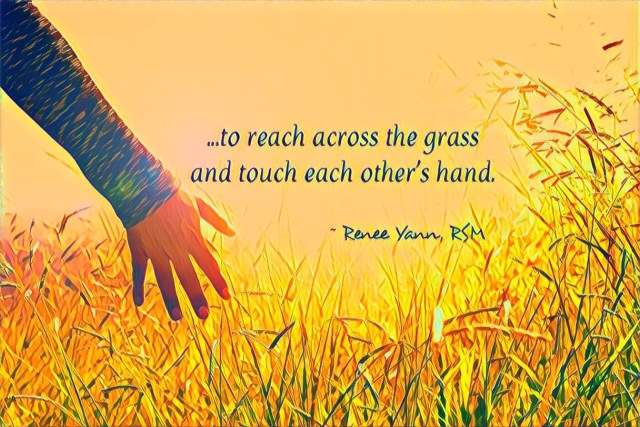
to reach across the grass
and touch each other’s hand.
~ Renee Yann, RSM
Today, in Mercy, Jesus once again instructs his disciples to pray “in my Name”.
Amen, amen, I say to you, whatever you ask the Father in my name he will give you. Until now you have not asked anything in my name; ask and you will receive, so that your joy may be complete.
What does Jesus really mean by,:
“Ask in My Name”.
There is an idiomatic phrase popular in culture today, “just asking for a friend”. It is used when the questioner feels embarrassed or unsure about the question, or unworthy of posing it oneself, for example: Can you really go to jail for not paying your taxes, just asking for a friend?
What might happen if we prayed like this, taking Jesus seriously in his offer to intervene for us, to stand in the place of our fear, hesitation, confusion, or unworthiness:
Dear God, please forgive me for this sinful choice I made. I ask you in the Name of Jesus, my friend.
Dear God, will you please comfort my dear one who is suffering. I ask you in the Name of Jesus, my friend.
Dear God, will you please intervene to stop the suffering in the world. I ask you in the Name of Jesus, my friend.
How would the addition of this little phrase change my prayer?
The words are not a magic formula for working miracles. They won’t allow us to cure the sick or raise the dead in visible ways. But they will allow us to heal ourselves and others in ways beyond human calculation.
I think the words are a key to unlock our understanding that when we pray in the Name of Jesus, the miracle happens in us, not in our surroundings.
We realize that Jesus, in whose Name we pray, changed the world not by magic but by sacrificial love. Becoming his friend and praying in his name demands that we too live our experiences with that kind of unquestioning love.
Such love unveils the glorious mystery of the Cross to us. Even under its shadow, we see through to the triumph of the Resurrection as Jesus did.
Certainly, suffering was not removed from Jesus’ life nor from that of his followers.
But what was given was abiding faith, hope, love, and the trustworthy promise of eternal life.
Let’s ask for these precious gifts, in the Name of Jesus.
Music: In Jesus’ Name I Pray – Charley Pride
(Lyrics below)
In Jesus’ Name I Pray
Father give me strength, to do what I must do.
Father give me courage, to say what I must say.
Let that spirit move me.
I’m nothing on my own.
Father stand by me, I can not stand alone, in Jesus name I pray.
Father open up my eyes to your wonders all around.
Father let me see the good and beauty of this day.
Fill my heart with love, for my fellow man.
And if I’m tempted Father.
Father take my hand, in Jesus name I pray.
Father help me through the troubled days that lie ahead.
Let your life stand before me, that I may find a way.
So let me stumble Father, or fall beneath my load.
Father guide my footsteps.
Hold me to the road, in Jesus name I pray.
Let not hunger be my guide, nor fear be my master.
Father let not envy, be a part of me in any way.
Father search my soul, take away my fear and doubt.
Any moment that you find this,
Father cast it out, in Jesus name I pray.
Ah ah ah Amen.
For today’s reflection, though, our focus will be John 6 which is the beginning of a week-long journey into the discourse on the Bread of Life (Jn 6:22-71). These passages, going from today until Friday, are like a “faith boot camp” for Jesus’s followers. They contain the core message of who Jesus is and how we are brought into communion with him.
The reading seems so meaningful in these days when we are kept from shared communion and community in the Eucharist, when we long to be gathered again around that table of love.
John’s Gospel does not include an account of the Last Supper and institution of the Eucharist. The Bread of Life Discourse is where Jesus proclaims those teachings in John. It is a more detailed instruction and, as we pray with it over the course of the week, we may trace our own past and current awakening in faith.
Limbourg Brothers, Très Riches Heures du duc de Berry, Jesus Feeding the 5,000 Source Wikimedia Commons
Today’s verses offer very basic training. Jesus has just fed 5000 people in the miracle of the loaves and fishes. The crowds, not having a global view of the miracle like we do, are confused. They know they got plenty to eat, but did everybody? They heard many people ate, but they saw only their nearby neighbors. What really happened out on the green field?
Finding Jesus the next day, they are ready for another meal. They’re more interested in matzoh than miracles. Their basic hunger for physical sustenance consumes them. Jesus begins the task of opening their hearts to their deeper hungers and his desire to meet them:
Jesus said, “You are looking for me not because you saw signs but because you ate the loaves and were filled. Do not work for food that perishes but for the food that endures for eternal life.”
Praying with today’s Gospel, we might ask ourselves some basic questions about our own faith.
When we go looking for God, as these hungry people did, what is it that we are looking for?
Do we talk to God only when we need something the way these folks needed another loaf or fish?
Jesus is inviting us to Eucharist, to Communion with him. To what degree have we opened our hearts to that invitation by our reflective prayer and acts of mercy?
Jesus’s basic message to his flock today is this:
Don’t be satisfied by a tasty roll, a fat fish,
(or a fancy car, a good job, a comfortable life.)
God made you for much more than these things.
Come to Me and feed your deepest hunger.
Maybe, as we pray, we can ask the question posed at end of today’s Gospel and listen intently to Jesus’s answer:
So they said to him, “What can we do to accomplish the works of God?” Jesus answered and said to them, “This is the work of God, that you believe in the one he sent.”
Today, in Mercy, I’m going to tell you a story. But first …
In our first reading, the passionate prophet Hosea offers us this quintessential Lenten advice:
Return, O Israel, to the LORD, your God; you have collapsed through your guilt. Take with you words, and return to the LORD
In our Gospel, Jesus is giving advice too. A sincere scribe seeks out Jesus’ wisdom:
One of the scribes came to Jesus and asked him, “Which is the greatest of all the commandments?”
Jesus instructs the scribe:
The Lord our God is Lord alone!
You shall love the Lord your God with all your heart,
with all your soul,
with all your mind,
and with all your strength.
Then Jesus goes on to tell him the second greatest commandment:
You shall love your neighbor as yourself.
Assessing the scribe’s sincerity, Jesus promises him:
“You are not far from the Kingdom of God.”
Praying with these passages on this particular date took me back to March 20, 1963, Wednesday of the 3rd week of Lent that year. I was almost 18 years old and, while not wise as a scribe, I too sought answers to guide my faith.
One place I found thatwisdom was at the desk of a wonderful Sister of Mercy, Sister Mary Giovanni. Like many high school girls back then, I hung around Sister’s homeroom after school. Her good humor, gentle interest, and kind encouragement nourished all of us still slightly silly but ever-so-earnest young women.
On that particular afternoon, an unusual white book sat on Sister’s desk. Its gold letters attracted me and I asked what it was. Sister said it was her community’s centenary book and that, if I wanted, I could borrow it to read.
That little book changed my life. Well, I guess what it actually did was to capture many loose threads running through my mind and heart, and to tie them into a conviction.
I had been toying with a religious vocation ever since third grade. I did love God with my whole heart, just like the young scribe in today’s Gospel. And I loved the nuns and I always wanted to be like them. But actually becoming like them was another story.
That little white book gave me the courage and will to make that commitment. Here’s what it said:
The Sisters of Mercy, in addition to the vows of poverty, chastity and obedience, take a fourth vow of service of the poor, sick, and ignorant.
That was it! That short sentence opened my understanding to see that loving God had to be demonstrated in love of neighbor. The two great commandments are always interdependent.
So I decided to “take my words”, as Hosea encourages, and to ask God if He would have me as a Sister of Mercy.
Less than a week after reading that book, I signed up to become a Sister of Mercy. And I have continued to become one every day for almost 60 years. Because just as Jesus said to the scribe, I believe I am “not far from the Kingdom of Heaven”. But I’m not there yet. Everyday is a chance to grow deeper into the glorious gift that was opened to me back in March 1963.
As you pray with these passages today, take a long view of God’s continuing call in your life. You may have been called to marriage and parenthood, priesthood, a generous single life, a profession which allowed you to serve others.
In each individual call, we are invited to love God with all our hearts and to love others as God loves them. Let’s pray for one another’s continuing deepening in our particular call.
Music: The Call – written by Vaughn Williams from the poetry of George Herbert
(Lyrics below)
Today, in Mercy, on this day between the feasts of St. Patrick and St. Joseph, it seems a very good day to thank God for our heritage of faith. Our readings today remind us how precious that heritage is.
Moses, after reiterating the history of God’s goodness to Israel, enjoins the People:
Take care and be earnestly on your guard not to forget the things which your own eyes have seen, nor let them slip from your memory as long as you live, but teach them to your children and to your children’s children.
Jesus, too, acknowledges the importance of his religious heritage:
Do not think that I have come to abolish the law or the prophets. I have come not to abolish but to fulfill. Amen, I say to you, until heaven and earth pass away, not the smallest letter or the smallest part of a letter will pass from the law, until all things have taken place.
This day between St. Patrick’s and St. Joseph’s always takes me back to my grade school days – a time when my “faith family” gifted me with the seeds that now sustain my life.
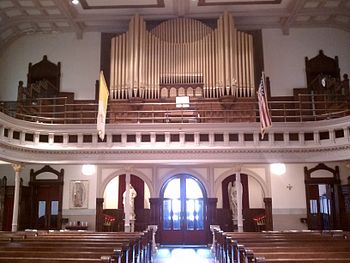
Beautiful St. Michael’s Church, 2nd and Jefferson, Philadelphia – built in 1846, now much as it look in the mid-1950s
I can still see our straight-from-Ireland pastor, old as the hills, standing in the pulpit to bless us with water from the Shrine at Knock. We school kids had waited all year for a chance to belt out the hymn “Great and Glorious Saint Patrick” to the accompaniment of a thundering organ. We held our breath at the final blessing, anxiously awaiting the word to go home. It was inevitably a school holiday but we were always innocently surprised to receive it!
St. Michael’s magnificent organ
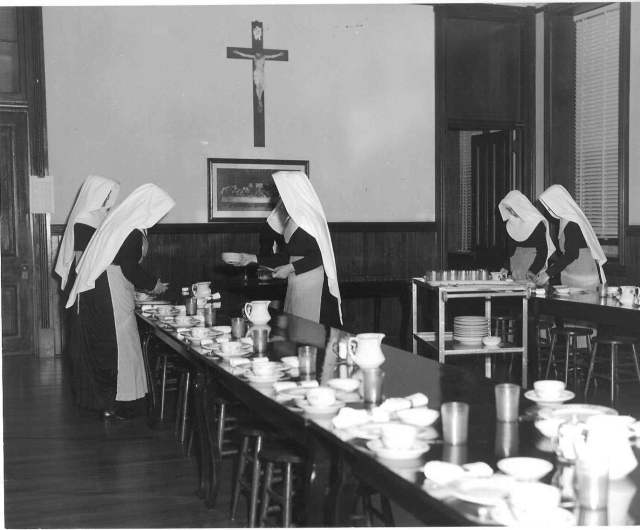
Then, we gathered for 8 o’clock Mass again on the 19th to celebrate St. Joseph, patron of our beloved Sisters who taught us. If we had the means to give them feastday gifts, we were asked to give canned goods. That request never struck me as a kid, but as I grew up, I realized how dependent these Sisters were on those donations – how close to poverty they lived for the sake of transmitting the faith to us.
So I count these days of mid-March as Foundation of Faith Days. Perhaps today’s reading might incline you to think about your own faith story and who planted the early seeds in your heart. Let’s give these beloveds our grateful prayers of remembrance.
Music:Faith of Our Fathers – another oldie that we loved to sing voce piena
Today, in Mercy, our readings could confuse us with their threads of legalistic logic. We see several examples of “if-then” admonitions that can make us picture God as an accountant measuring every choice we make.
If the wicked man turns, … then he shall surely live
If the virtuous man turns, … then none of his good deeds shall be remembered.
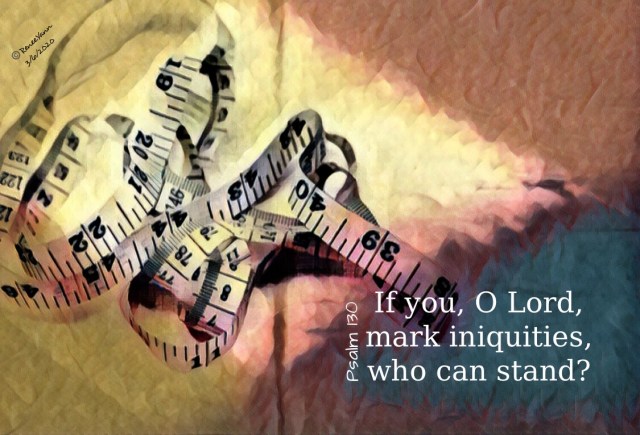
If you, O Lord, Mark iniquities … then who can stand.
If you go to the altar unreconciled … then leave and be reconciled.
Sometimes, we can get obsessive about the “if-then” aspects of religion. And IF we do, THEN we probably miss the whole point. Because folded in today’s “if-then” seesaws is the truth of these passages: that the Lord does NOT sit miserly in Heaven to mark our iniquities.
The Lord measures the righteousness of love.
“Thus says the LORD, “Let not a wise man boast of his wisdom, and let not the mighty man boast of his might, let not a rich man boast of his riches; but let him who boasts boast of this, that he understands and knows Me, that I am the LORD who exercises lovingkindness, justice and righteousness on earth; for I delight in these things,” declares the LORD.—Jeremiah 9:23-24
Today’s Responsorial Psalm offers us a beautiful prayer for this morning as we pray in the embrace of God’s Lavish Mercy:
I trust in the LORD; my soul trusts in his word. My soul waits for the LORD more than sentinels wait for the dawn. Let Israel wait for the LORD. For with the LORD is kindness and with him is plenteous redemption; And he will redeem Israel from all their iniquities.
Let’s wait for the Lord today to see where God’s Grace invites us to the righteousness of Love.
Music: Everlasting Love – Mark Hendrickson & Family (Lyrics below)
Chorus
With an everlasting love
I love you I love you
With an everlasting love
a love that’ll never end
a love that’ll never end
I love you.
Till the stars lose their way
In the heavens up above
And the oceans all run dry
Till the clouds in the sky
Keep the rain all to themselves
Even longer I’ll love you
This I promise I’ll love you
My word I give it’s true
I love you
Till the morning sun ceases to arise
And the moon forgets to shine
Until heaven’s blue is erased from the sky Even longer I’ll love you
This I promise I’ll love you
My word I give it’s true
I love you
Today, in Mercy, one line from our readings hit me like a lightening bolt:
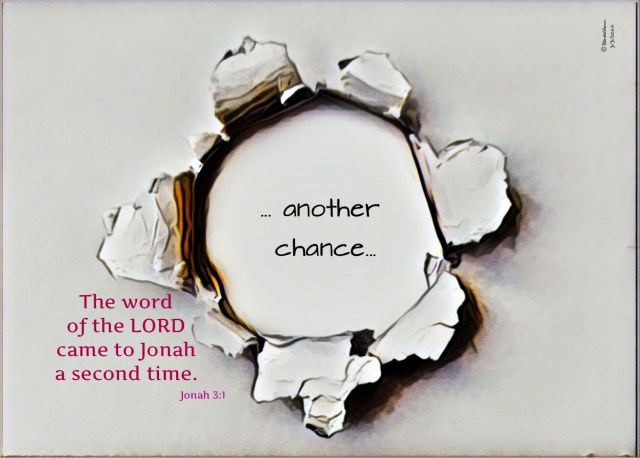
The word of the LORD came to Jonah a second time.
Yes, it’s the truth! God will keep coming back again and again to encourage us to hear his true message for our lives.
Our Gospel gives us a hint about how resistant we sometimes are to this deep listening:
This generation is an evil generation; it seeks a sign, but no sign will be given it, except the sign of Jonah.
What is the sign of Jonah anyway?
To put it simply, it is the witness of the Resurrection – that overarching event that changed everything for believers. For just as Jonah was able to return from certain death in the whale’s belly, so Christ conquered death and rose to new life, promising us the same power.
This is the central, life-changing belief for Christians. It should make a difference in how we live.
By our Lenten repentance, we can be like Jonah, grasping the second chance God always gives us to respond to our life circumstances with faith, hope, and love.
I would bet there is something in your life right now that is calling you to such a response. Someplace in your life, you may be caught in a bit of a “whale’s belly 🐳” about some issue, am I right?
God makes us ask ourselves questions most often when He intends to resolve them. He gives us needs that He alone can satisfy, and awakens capacities that He means to fulfill. Any perplexity is liable to be a spiritual gestation, leading to a new birth and a mystical regeneration.”― Thomas Merton, The Sign of Jonas
Today’s readings remind us that we already have the glorious sign of the Resurrection to inspire us to leap from that dark “belly” into God’s hope for us!
Music:a fun song “In the Belly ofWhale” – The Newsboys
Today, in Mercy, as I pray with today’s readings, I ask myself two questions:
“What has God’s Word accomplished in me?”
“What does God’s Word yet want to accomplish in me?”
If you’re like me, you’re always thinking about what you haven’t done, still must do, wish you had done.
STOP
Let’s STOP and praise our gracious God for the good accomplished through our lives. I know every one of you reading this blog is an amazingly good person. God has already done beautiful things through you. Thank God. Give God the glory.
Lyrics:
How can I say thanks
For the things You have done for me?
Things so undeserved,
Yet You gave to prove Your love for me;
The voices of a million angels
Could not express my gratitude.
All that I am and ever hope to be,
I owe it all to Thee.
To God be the glory,
To God be the glory,
To God be the glory
For the things He has done.
With His blood He has saved me,
With His power He has raised me;
To God be the glory
For the things He has done.
Just let me live my life,
Let it pleasing, Lord to Thee,
And if I gain any praise,
Let it go to Calvary.
And then ask to go on, to open up your heart, to see God’s next desire for your precious life.
For my young readers, give your dynamism to God’s imagination for you. There are great and holy things around every corner! Trust! Ride the grace-filled wave! Do not be afraid! Be a waterfall for God’s Word.
For some of us, as we get older, we do not have the physical energy to DO all that we once did. But oh, my dears, we can now BE more wonderful for God because of the long accumulation of his generous grace. Be a Well for God’s Word! Sink into grace! Do not be afraid!
For thus says the LORD: Just as from the heavens the rain and snow come down And do not return there till they have watered the earth, making it fertile and fruitful, Giving seed to the one who sows and bread to the one who eats, So shall my word be that goes forth from my mouth; It shall not return to me void, but shall do my will, achieving the end for which I sent it.
How amazing that promise is! Trust it! Let the Word transform you every day of your life.
Let’s consciously pray for one another today as today’s Gospel encourages us:
Our Father who art in heaven, hallowed be thy name, thy Kingdom come, thy will be done, on earth as it is in heaven. Give us this day our daily bread; and forgive us our trespasses, as we forgive those who trespass against us; and lead us not into temptation, but deliver us from evil.













 For some of us, as we get older, we do not have the physical energy to DO all that we once did. But oh, my dears, we can now BE more wonderful for God because of the long accumulation of his generous grace. Be a Well for God’s Word! Sink into grace! Do not be afraid!
 Lavish Mercy