Enduring Journey

Monday of the Eighteenth Week in Ordinary Time

August 5, 2019

Click here for readings

Today, in Mercy, we have the first of a few readings from the Book of Numbers. Numbers is basically about two themes: journeying and maturing as a community of faith.

roots


Numbers is the fourth book of the Bible, part of the five which comprise the Pentateuch, or Hebrew Torah. We can think of these books as a kind of Jewish “Roots”, for those who are familiar with the Alex Haley classic.


In the Pentateuch, both Jews and Christian find the foundational bedrock of their faith story. Today’s chapter focuses on two realities of faith and community: leadership and fidelity.

The People are having trouble staying committed to the journey. They are tired, hungry and walking around in circles. They are hungry for something besides manna, the way we become hungry for more than our dailyness.
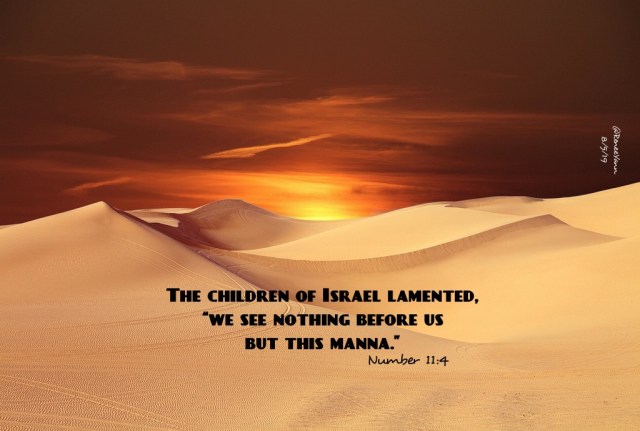
Numbers11_4 complain

Like most frustrated groups, they start busting on their leader – Moses. Moses, unwilling to carry their burdens alone, starts busting on God. Watch any TV drama for a similar plot/theme. As a matter of fact, let’s examine our lives for it.

Enduring commitment is hard, especially when it is tested. When our commitment seems meaningless, or ignored, or misinterpreted, or otherwise futile, what do we do? How do we re-examine and re-define the fundamental relationship of faith which informs that commitment.

This re-examination and deeper re-commitment is what the Israelites experience through their desert journey, until they are ready to pass into the Promised Land as God’s People.

It is what we experience as a person of faith and as a faith community. Commitment is never static. In life’s test chamber, it either grows or diminishes. Praying with these passages from the Sacred Scripture may help us to grow deeper in our faith and trust. They may help us find the center if we feel a little hungry and lost in the desert too.

Music: Guide Me, Thou, O Great Redeemer

This hymn is the English version of a melody written by the Welshman John Hughes in 1909. The text was composed in 1745 by William Williams, considered Wales’ most famous hymnist. As a writer of poetry and prose,he is also considered today as one of the great literary figures of Wales. For an interesting history of the hymn, click here.

Who Do You See in the Mirror?

Eighteenth Sunday in Ordinary Time

August 4, 2019

Click here for reading

Today, in Mercy, our readings focus on “vanity” – its threats and remedies.

Often, we think of vanity as a physical emotion – that Narcissistic self-absorption that keeps us in front of a mirror for inordinate amounts of time. Our culture promotes this kind of vanity by working endlessly to convince us that without certain products we are “not enough” on our own. 

mirror statue

Historically, this kind of rhetoric was directed primarily toward women, spawning a nearly $500 billion global cosmetic market! But men are catching up! The men’s market is forecasted to reach nearly $30 billion by 2023.

Several years ago, while flying home from a business trip, I was seated across from two young women. As we approached home, the one nearest me, began to prepare for landing. She initiated an elaborate cosmetic ritual that involved no fewer than ten brushes plus an array of tubes and compacts. At first, it struck me really funny. Then I realized how very sad it was.

This maturing child was no more than eighteen. She was naturally beautiful with the vigor of youth. But she had obviously spent a lot of money and time not believing in her natural beauty.

Society considers vanity as a kind of pride and pomposity. I think just the opposite. I think vanity is really fear, self-dissatisfaction, anxiety and pain because something has convinced us that we are inadequate.

Vanity damages souls as well as bodies. It makes us behave in greedy, self-absorbed and careless ways toward our neighbors. It makes us pretend we are more than we think we are. It saps us of the strength to be generous, trusting and hopeful.

Paul, in his letter to the Colossians, tells us to get over this kind of vanity:

Put to death, then, the parts of you that are earthly:
immorality, impurity, passion, evil desire,
and the greed that is idolatry.
Stop lying to one another,

since you have taken off the old self with its practices
and have put on the new self,
which is being renewed, for knowledge,
in the image of its creator. 

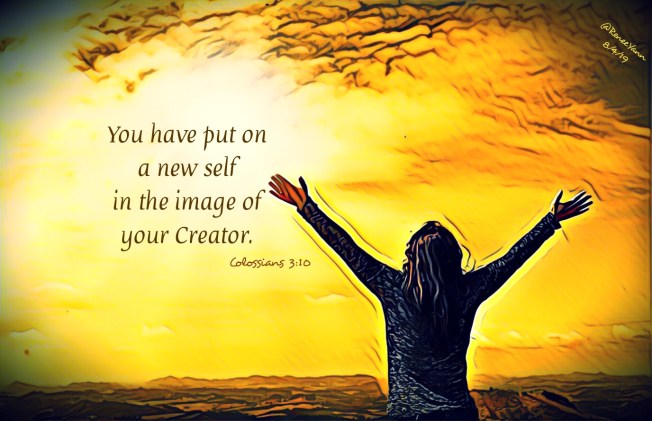
Col3_10 new image

What if that sweet girl on Flight 419 had been able to look in her mirror and see the image of her Creator? What if we could all do that? How might we spend our time and money differently if we were convinced of how beautiful we are to God?

Music: How Could Anyone Ever Tell You – Shaina Nell

I have added two versions of this beautiful song. Let God sing it to you in your prayer today.


Dwelling Place for God

Memorial of Saint Alphonsus Liguori, Bishop and Doctor of the Church

August 1, 2019

Click here for today’s readings

Today, in Mercy, we finish our several weeks’ journey through Exodus. Like all great books, this one closes with a powerful final chapter – one that assures us that the story has not ended.

Have you ever read a book that you wish would never end? Of course, they all do – but bits of some live in us forever.

fav books

With sacred scripture, the Living Word remains with us by inspiring us to live out its spirit in our lives. That Holy Word bonds with the Spirit already dwelling within us through our Creation and Baptism.

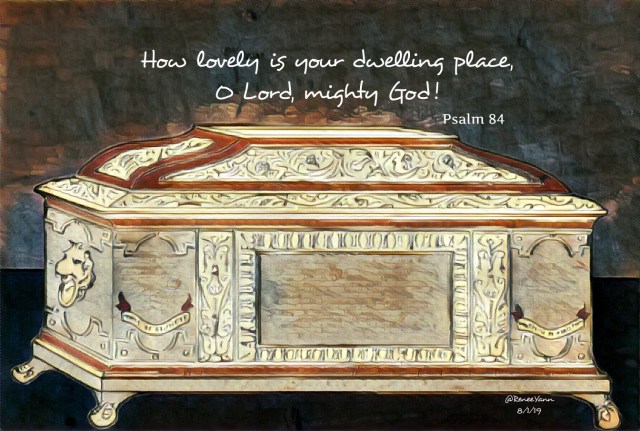
Psalm 84_Ark

For the Exodus community, this Indwelling was given visible expression in the tabernacle Moses built. God chose to fill that tabernacle with Abiding Presence.

Each one of us, and every human being, is a dwelling place of God’s love and hope for us. We are tabernacles of God’s Spirit, breathed into us in an act of divine desire for us to be God’s eternal beloved.

Pretty overwhelming, isn’t it! 

So much so that, just as for the Israelites, our vision of God’s Presence is often clouded by the frenzy of our lives. It is only when we still our souls in worship that we recognize God living with and within us!

Music: This Alone – Tim Manion, SJ ( Photos are The Abbey of Mont-Saint-Michel / Normandy, in the Manche department in France.)

Radical Joy

Memorial of Saint Ignatius of Loyola, Priest

Ignatius
by Francisco de Zubarán (1598–1664)

July 31, 2019

Click here for readings


Today, in Mercy, Exodus tells us:

Exodus34_29 Radiant

Obviously, I haven’t met Moses personally. 😂 But I have met many wonderful human beings who have reflected a similar radiance.

It is a mirrored glory that comes from friendship with God. 

It glows in the innocence of children and the layered wisdom of the elderly. It blazes in those seeking social justice and in those silently, unwaveringly praying for it. It lights the hope of the living and the dying. It is that mysterious, unquenchable candle shining in both joy and sorrow. Its other holy names are Faith, Hope and Love.

 No one need tell us. We know when we are in the presence of such Light. It needs no words.

Rumi radiant

Today, let’s pray for the blessing of this Radiance all over our shadowed world. Let’s pray for it to shine within us.

Music: Radiant God – Hannah Ford

Unconditional Love

Tuesday of the Seventeenth Week in Ordinary Time

July 30, 2019

Click here for readings

Today, in Mercy, we consider God’s unconditional love.

God and Moses and the People have been through it. The trail of complaints, the golden calf, the shattered tablets – these are relational dramas to the extreme! Exodus is definitely soap opera material! Does it feel a little bit like your life, or your family’s, or the families you read about in the news?

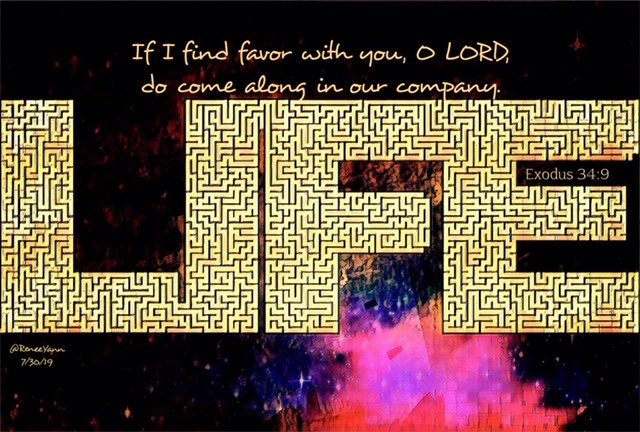
Ex34_9 Life

Life is indeed a drama! And our relationship with God is highlighted and shadowed with its twists and turns. For that reason, today’s passage offers us so much comfort and confidence. Even after all that has happened, God reveals himself to Moses like this:

The LORD, the LORD, a merciful and gracious God,
slow to anger and rich in kindness and fidelity,
continuing his kindness for a thousand generations.

Moses is so moved by this new knowledge of God’s unconditional love, that he welcomes God as part of their community:

If I find favor with you, O LORD,
do come along in our company.
This is indeed a stiff-necked people;
yet pardon our wickedness and sins,

and receive us as your own.

We are invited by this reading to open ourselves to that same unconditional love, to thank God for journeying with us through life’s convolutions. Stiff-necked at times, repentant at others, we are always God’s beloved.

As we negotiate the intricacies of our life today, we might trustingly say like Moses:

Lord, do come along in my company.

Music: Outrageous Grace – Godfrey Birtill

Idols!

Memorial of Saint Martha

July 29, 2019

Click here for readings

Today, in Mercy, our readings offer us a central question for our faith and spirituality: What do we really worship?

Ex32_19 calf

As we continue the Exodus story, Moses has been on the mountain receiving the Law from God. Meanwhile, back at the ranch, delegated leader Aaron is blowing his assignment. The Israelites tire of waiting for Moses. They want another god to lead them onward. Aaron comes up with idea of fashioning such a idol from all their molten jewelry.

When Moses descends the mountain with the newly-minted tablets in hand, he burns in anger at the scene, smashing the holy stones at his feet. More than a flared temper, this act symbolizes a fractured relationship with God.

The story suggests this for our prayer: we are in ever-deepening relationship with God through our own covenants – our creation, our baptism, our further professions of faith and commitment, our sacramental encounters. These are all living relationships, inviting us to new and deeper life in God.

Still, there may be times in our lives when our hearts lose focus on these covenants 

  • when we try to move somewhere without God’s companionship
  • when we substitute old baubles for moral or spiritual truth
  • when we return to weakening comforts rather than grow into a challenging grace
  • when we just get really mixed up about what is most important in our lives

The calf-worshippers had a big fail in this regard. Exodus tells the story of a merciful God trying to deal with their disloyalty and refashion them as God’s chosen people.

Our Gospel shows us Martha, also a little off target in terms of her spiritual priorities. While she is no where near idol worship, she still allows needless distractions to keep her from fully enjoying relationship with God.

Martha

Gentle, merciful Jesus turns her eyes toward him and she understands. Maybe that beautiful grace is what we want to pray for today.

Music:  You Alone – Sarah Hart

Our Story is God’s Story

Saturday of the Sixteenth Week in Ordinary Time

July 27, 2019

Click here for readings

Today, in Mercy, our Exodus reading describes momentous events in Israel’s life.

tabletsJPG

God has just invited Moses and several others up the mountain for a Divine conflab.  Moses returns to the people to announce “all the words and ordinances of the Lord”.The People receive these words wholeheartedly:

“We will do everything that the LORD has told us.”

Thus, a community of persons is formed with God at its heart.

Moses then engages the community in a series of formal rituals to highlight the significance and permanence of this deeper step in relationship with God.


The passage contains multiple points for our prayerful consideration.

The community of Israel is not unlike our own faith communities, those that gather in specific religious houses, or those we share in the universal community of all Creation. We are Catholics, Lutherans, Jews, Hindus, Muslims, Sikhs sharing a story of God in our particular religious traditions. We are also all children of the same God sharing that experience in our Common Home of Creation.

Just as with the ancient Israelites, God communicates and relates with us through the experiences of our lives. In our communities, that Divine Word is interpreted, codified, ritualized, and responded to. These actions create a story which is alive, deepening with each new generation, and still always rooted in the long history of promise and grace.

Today’s reading contains many elements of story and ritual which we can recognize in our own faith practice: written and announced word, altar or worship place, sacrifice or offering to God, acts of covenant, and celebratory meals.

Exodus24_3 sinai

These are the human ways in which we access relationship with God. These are the ways in which we keep our faith vital. We strengthen our faith by one another’s stories of love, mercy and hope. We commit to a shared law of love, not legalism – a heart-law which calls us to be life for one another, just as God is Life for us. In community, we reveal the face of God within ourselves.

For those of us who share the practice of a Eucharistic faith, the parallels in today’s reading call us to deeper awareness of how God becomes present in our lives.

May all of us – of whatever spirituality – who share life in God’s continuing Creation, obediently hear the command to cherish every human being as a revelation of God, as a critical and precious part of my own faith story – a part for whom I share the responsibility for life.

Music: Song of the Body of Christ – David Haas (Lyrics below)

Song of the Body of Christ
Refrain: We come to share our story. We come to break the bread.
We come to know our rising from the dead.
1. We come as your people. We come as your own.
United with each other, love finds a home.
2. We are called to heal the broken, to be hope for the poor.
We are called to feed the hungry at our door.
3. Bread of life and cup of promise, In this meal we all are one.
In our dying and our rising, may your kingdom come.
4. You will lead and we shall follow.
ou will be the breath of life; living water, we are thirsting for your light.

Honor Those Who Bore You Life

Memorial of Saints Joachim and Anne, Parents of the Blessed Virgin Mary

July 26, 2019

Click here for readings

Today, in Mercy, our Exodus reading coincides perfectly with today’s Memorial Feast for Anne and Joachim, grandparents of Jesus.

Exodus20_5

In the passage, we have one of many Old Testament formulations of the Ten Commandments. We learned these codes as children, and perhaps have always interpreted them as laws which, when broken, marked us as sinners.

While this is one approach, a more mature and life-giving one is offered by the Biblical scholar Terence E. Fretheim:

The focus (of these directives) is on
protecting the health of the community,

to which end the individual plays such an important role.
Exodus: Interpretation: A Biblical Commentary for Teaching and Preaching

The command to honor one’s father and mother clearly demonstrates this approach. It is a command not only for children to be docile and obedient. Rather it denotes a life-long responsibility to care for parents and other  nurturers of our lives. The command also suggests the responsibility of these nurturers to live honorably so that their children may respond to their example with equal honor.

Today is a day to pray for our own families and for all families, for the young and the elderly, and for those walking the tenuous bridge in between.  It is a day to assess how well we carry our responsibilities to honor, obey, bless and foster life for one another.

It is a day to be deeply grateful for the love of family which we are blessed to experience; a day to pray for healing for those not equally blessed. Let us pray for families distressed by the necessity to migrate, and further burdened by nations’ failures to keep the commandment of neighborly love.

Like Mary, may we embrace the elders in our lives who love and need us, be these parents, mentors, community members, or neighbors. Scripture promises us that, in doing so, we shall have “mercy bestowed on us down to the thousandth generation.”

Music: Love Remains – Hillary Scott

It’s Raining Bread!

Wednesday of the Sixteenth Week in Ordinary Time

July 24, 2019

Click here for readings

Today, in Mercy, our readings are all about food in the many forms and senses of that word.

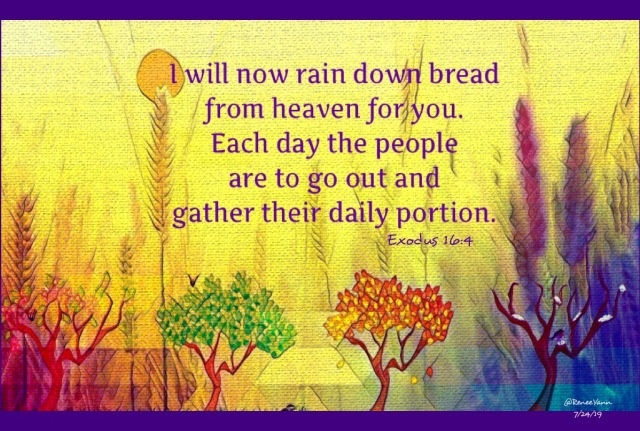
Exodus16_4

The Israelites have been in the desert for a while.  The burden of travel is beginning to weigh upon them.  Food is short, tempers even shorter.  Things seem so bad that, in a fit of stupendous forgetfulness, they tell Moses they were better off as slaves in Egypt.

Moses asks God to intervene, which God does with the gifts of manna and quail.

The folks in today’s reading remind me a lot of people I know — even myself.  Haven’t we all heard, and maybe uttered, the complaint that things were so much better in “the old days”.  Haven’t we critiqued a challenging situation with the unhelpful assessment, “Well, it’s not like it used to be!”

But the God of Exodus is so patient, as is Moses.  God doesn’t become angry with the complainers. Instead God promises to take care of them and to stay with them forever on their journey. God makes good on this word by initiating the naturally occurring phenomena of morning manna and migrating quail so that the community is fed.

Some areas to focus on as we pray with this passage:

God does not deliver the Israelites immediately to their destination. Life is a journey, not an arrival.

God intervenes to meet their needs, but through ordinary occurrences rather than miracles. God uses manna and quail, surprising but nonetheless naturally occurring events in the Sinai desert.

God expects the Israelites to interact with grace, to recognize that God is about the continuing work of Creation and Covenant, even within the natural circumstances of our lives.

For us, the profound reminder that God accompanies us in drought and abundance, in joy and sorrow, in wilderness and stability; that God is listening under our hungers; that God is sustaining us in graces we may be slow to recognize.

Music: Panis Angelicus – Luciano Pavarotti

Panis angelicus
fit panis hominum;
Dat panis caelicus
figuris terminum:
O res mirabilis!
manducat Dominum
Pauper, servus, et humilis. 

Te trina Deitas
unaque poscimus:
Sic nos tu visita,
sicut te colimus;
Per tuas semitas
duc nos quo tendimus,
Ad lucem quam inhabitas.
Amen.

Bread of Angels,
made the bread of men;
The Bread of heaven
puts an end to all symbols:
A thing wonderful!
The Lord becomes our food:
poor, a servant, and humble.

We beseech Thee,
Godhead One in Three
That Thou wilt visit us,
as we worship Thee,
lead us through Thy ways,
We who wish to reach the light
in which Thou dwellest.
Amen.

Exultet!

Tuesday of the Sixteenth Week in Ordinary Time

July 23, 2019

Click here for readings

Ex15_1chariots

Today, in Mercy, we read that triumphant Exodus passage in which the Israelites pass through the walled-up waters of the Red Sea. The images and exultations abound!

Here are the obvious ones:

  • Sea (the agent of delivery/salvation)
  • Wind (the grace of change)
  • Chariots (the inevitable challenges/obstacles)
  • Night (the mystery in which faith operates)
  • Fiery Cloud/The Lord’s Glance (God’s intervention)
  • Song (humble acknowledgement and thanksgiving)

Just as the newborn is carried through the birth canal on the waters of life, so too God’s neonate people finally begin the fullness of life promised to Abraham. God accomplishes this great “delivery” by a masterful intertwining of omnipotence, human choices, and natural phenomena. The result is breathtaking!

Just as it is in our lives!

Like any great Bible story, this one invites us to find ourselves somewhere within it. At the least, we are all making a sometimes treacherous passage through life. And at particular times, maybe even now, the threats may be intense.


At times, we stand at the edge of intimidating seas, wondering how we will make it to the other side. But if we reflect on our history, we must acknowledge that – with prayer and patience – the parting wind does come. Those “chariots” at our heels become mired in our resilience, hope and trust in God. Even through the dark night of faith, the Bright Mystery speaks to us. In moments of astounding though quiet grace, we catch the glance of God. And we sing in thanksgiving.


The glory of this magnificent reading is captured in the Exultet, sung at the Easter Vigil. You may wish to pray with it today. (sung Latin version in interesting article below)

English text

Exult, let them exult, the hosts of heaven,

exult, let Angel ministers of God exult,

let the trumpet of salvation

sound aloud our mighty King’s triumph!

Be glad, let earth be glad, as glory floods her,

ablaze with light from her eternal King,

let all corners of the earth be glad,

knowing an end to gloom and darkness.

Rejoice, let Mother Church also rejoice,

arrayed with the lightning of his glory,

let this holy building shake with joy,

filled with the mighty voices of the peoples.

(Therefore, dearest friends,

standing in the awesome glory of this holy light,

invoke with me, I ask you,

the mercy of God almighty,

that he, who has been pleased to number me,

though unworthy, among the Levites,

may pour into me his light unshadowed,

that I may sing this candle’s perfect praises).

(Deacon: The Lord be with you.

People: And with your spirit.)

Deacon: Lift up your hearts.

People: We lift them up to the Lord.

Deacon: Let us give thanks to the Lord our God.

People: It is right and just. 

It is truly right and just,

with ardent love of mind and heart

and with devoted service of our voice,

to acclaim our God invisible, the almighty Father,

and Jesus Christ, our Lord, his Son, his Only Begotten.

Who for our sake paid Adam’s debt to the eternal Father,

and, pouring out his own dear Blood,

wiped clean the record of our ancient sinfulness.

These, then, are the feasts of Passover,

in which is slain the Lamb, the one true Lamb,

whose Blood anoints the doorposts of believers.

This is the night,

when once you led our forebears, Israel’s children,

from slavery in Egypt

and made them pass dry-shod through the Red Sea.

This is the night

that with a pillar of fire

banished the darkness of sin.

This is the night

that even now throughout the world,

sets Christian believers apart from worldly vices

and from the gloom of sin,

leading them to grace

and joining them to his holy ones.

This is the night

when Christ broke the prison-bars of death

and rose victorious from the underworld.

Our birth would have been no gain,

had we not been redeemed.

O wonder of your humble care for us!

O love, O charity beyond all telling,

to ransom a slave you gave away your Son!

O truly necessary sin of Adam,

destroyed completely by the Death of Christ!

O Happy Fault

that earned for us so great, so glorious a Redeemer!

O truly blessed night,

worthy alone to know the time and hour

when Christ rose from the underworld!

This is the night

of which it is written:

The night shall be as bright as day,

dazzling is the night for me, and full of gladness.

The sanctifying power of this night

dispels wickedness, washes faults away,

restores innocence to the fallen, and joy to mourners,

drives out hatred, fosters concord, and brings down the mighty.

On this, your night of grace, O holy Father,

accept this candle, a solemn offering,

the work of bees and of your servants’ hands,

an evening sacrifice of praise,

this gift from your most holy Church.

But now we know the praises of this pillar,

which glowing fire ignites for God’s honour,

a fire into many flames divided,

yet never dimmed by sharing of its light,

for it is fed by melting wax,

drawn out by mother bees

to build a torch so precious.

O truly blessed night,

when things of heaven are wed to those of earth,

and divine to the human.

Therefore, O Lord,

we pray you that this candle,

hallowed to the honour of your name,

may persevere undimmed,

to overcome the darkness of this night.

Receive it as a pleasing fragrance,

and let it mingle with the lights of heaven.

May this flame be found still burning

by the Morning Star:

the one Morning Star who never sets,

Christ your Son,

who, coming back from death’s domain,

has shed his peaceful light on humanity,

and lives and reigns for ever and ever.

Amen.

Click here for Latin version and article