Today, in Mercy, on this Solemnity of All Saints, let us pray especially for our recent saints and martyrs – victims of hate, violence and irresponsible policy. Let us know them to be now in the arms of Love, a Love Whom we beg to heal us who remain, impelling us to true justice and mercy.
As we pray, let us reflect on the following hymn for the Holy Innocents, resolving to protect sacred life in ALL its manifold ages and expressions.
1.Salvete, flores Martyrum,
In lucis ipso lumine
Quos sevus ensis messuit,
Ceu turbo nascentes rosas.
2.Vos prima Christi victima,
Grex immolatorum tener,
Aram sub ipsam simplices
Palma et coronis luditis.
3.Qui natus es de Virgine
Jesu, tibi sit gloria,
Cum Patre, cumque Spiritu,
In sempiterna secula.
1. Flowers of martyrdom, all hail!
Smitten by the tyrant foe On life’s threshold – as the gale Strews the roses ere they blow.
2. First to bleed for God, sweet lambs! In innocence you died!
Rising with your wreath and palms At the very altar-side!
3. Honor, glory, virtue, merit, Be to Thee, O Living God, With Creator, and the Spirit While eternal ages run. – Amen.
Music: Salvete, Flores Martyrum -Tomás Luis de Victoria · Lluis Vich
Today, in Mercy, our Gospel presents the blind man, Bartimeus. He is an otherwise unknown character in scripture. Yet this short passage suggests so much about him.
It is stated that he was the son of Timeus, apparently someone of note in the community – otherwise, why mention his name? And yet this notable man’s blind son is left to begging on the side of the road. Had disability driven father and son apart? Was Dad unable to accept a son with a physical challenge?
The passage also reveals that Bartimeus knew about Jesus. Perhaps while begging in the public square, he talked and listened. He daydreamed about what he planned to do if he should ever have a chance to meet Jesus!
His cronies in the marketplace were not very supportive. They told him to shut up, even as he pathetically cried for Jesus’s mercy. Still, Bartimues persisted and Jesus heard him.
When he comes to Jesus, Jesus asks, “What do you want me to do for you?” It has always struck me as a strange question. The man is obviously blind, stumbling through the crowd on some disciple’s arm. Why did Jesus bother to ask what Bartimeus wanted?
This might be the lesson hidden in this Gospel. We need to name and claim our needs before God can reach through and transform them. If we don’t even know we’re “blind”, how can we know we’re cured? If we don’t present our needs to God, how can we believe that it is God Who has healed us?
The freshly cured Bartimeus, eyes wide open in grace, now follows along the path with Jesus. All the “shut-uppers” are silenced. Perhaps, Timeus weeps off in a doorway to see the power of his son’s faith and Jesus’s love.
How might our lives be changed if we had that kind of faith… that kind of love?
Music: Don’t Pass Me By – Fred Hammond (lyrics below)
There was a blind man on the road side, and he heard a commotion
It was Jesus passing by with a crowd and it stirred his emotions
He’d been displaced his whole life, should he even try
Don’t bother Jesus (they say you have nothing)
You have nothing to offer (stay in your place)
Right then he knew(he had to choose)
He had nothing to lose
So he cried Jesus (Jesus), I need you, please don’t pass me by
He cried out Jesus, I’m not ashamed(to tell you) I need you in my life
(I need you in my life)
I’m not much different from that man, and this is the honest truth
Could this sinful one, with this messed up life, could I ever serve you
people and things clutter my mind, should I even try
Don’t bother Jesus (they say you have nothing)
You have nothing to offer (stay in your place)
Right then he knew (he had to choose)
He had nothing to lose
So I cry Jesus(Jesus), I need you
Please don’t pass me by
I’m crying out Jesus, I’m not ashamed to tell you I need you in my life
As the deer (as the deer panted)
Thirsty for the water yeah(thirsty for the water)
My soul desires and longs to be(to be with you)
Jesus, I need you, please don’t pass me by
I don’t mean to waste your time but I can’t listen to the crowd, Situations in my life telling me to keep it down
But I need you
I know I’m broken, but you can heal me, Jesus, Jesus I’m calling you
(I might not be worth much)might not be worth much, but I’m still willing Jesus, Jesus, I’m calling you
Songwriters: Fred Hammond / Kim Rutherford / Tommie Walker
Today, in Mercy, our readings from Isaiah and Mark sound almost Lenten in tone. Isaiah gives us the image of a broken Jesus, crushed by a “suffering that justifies many”.
Mark recounts the story of the two rather oblivious disciples asking to sit in glory beside Jesus. They do not realize that the path to this glory is through Gethsemane and Calvary.
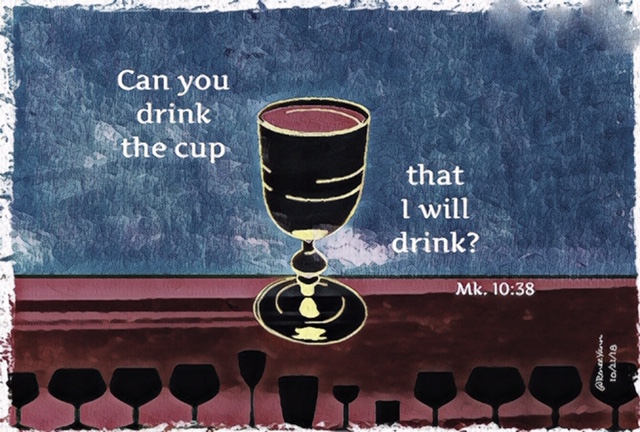
Jesus asks them the same question he asks us throughout our lives:
“Can you drink the cup that I will drink?”
We know that there are sacrificial cups of many sizes and shapes among us. Just this past week, with the canonization of St. Oscar Romero, we were reminded of the immense sacrifices of Romero and the Salvador people to practice their faith in dignity.
Each of our sufferings and sacrifices may seem so much smaller by comparison. But when they are united with Christ in faith and hope, they too are redemptive.
We will be asked, as Jesus was, to lay down our life.
It may be in the unselfish raising of a family, or the humble pastoring of a church community.
It may be in the long-term care of an elderly parent or neighbor.
It may be in a ministry of healing, teaching, or encouragement where another requires our labor, patience and mercy.
It may be as a public servant who actually serves, or as a private nurse who tenderly nurses.
It may be as a community member who builds life by respect, responsibility, and mutuality.
We will come to realize, as did the ambitious sons of Zebedee, that true discipleship is not flash and glam. It is the daily choice to quietly lift the cup we have been given, and raise it to the honor of God – in openness, trust, joy and delight that we are called to share in the life of Christ.
Music: The Cup of Salvation ~Shane & Shane (Lyrics below.)
I love the Lord for He heard my voice
And answered my cry for mercy
Because He listened to me
I will call upon Him as long as I live
CHORUS
What shall I render to the Giver of life and who all things are made What shall I render to the One who paints the oceans blue Jesus Christ
I will lift up a cup of salvation Call on the Name of the Lord How do I repay the life that You gave I’ll call on the Name of the Lord Lift up a cup, You have already poured
What kind of rendering is found in this taking
Found in this drinking of love
Love so abundant He meets me in depravity
With one thing to give
CHORUS
You have delivered my soul from death
My eyes from tears
My feet from stumbling
And I will walk before the Lord
In the land of the living
Today, in Mercy, Wow! Job is as distraught as anybody I’ve ever seen! He is sorry he was ever born, that’s how terrible his circumstances are.
Hopefully, none of us has ever been at such a “Job Point”. But we’ve had our own small brinks where we’ve stood and yelled into the silence, “Why?”
Why me?
Why my family?
Why someone so good?
Why now?
Why like this?
All these “whys” are fragments of the essential question of the Book of Job: How can a good God allow evil to exist? The question even has its own name: theodicy – defined as the vindication of divine goodness and providence in view of the existence of evil.
Philosophers and theologians have proposed an array of explanations. But these fall short of satisfying us when we are the ones at the brink.
When we try to balance the concepts of evil with God’s goodness, we are wrestling with a mystery, not a problem. Problems, like unsolved math equations, have answers – even though we may not have found them yet.
Mysteries do not have finite answers. Sacred mysteries engage our faith to grow deeper in relationship with God, Who shares our life and suffering beyond our human understanding.
On this Feast of the Guardian Angels, whom we ask to be at our side through good and evil, we pray for ever-deepening faith that all will be made whole for Creation in the Infinity of God.
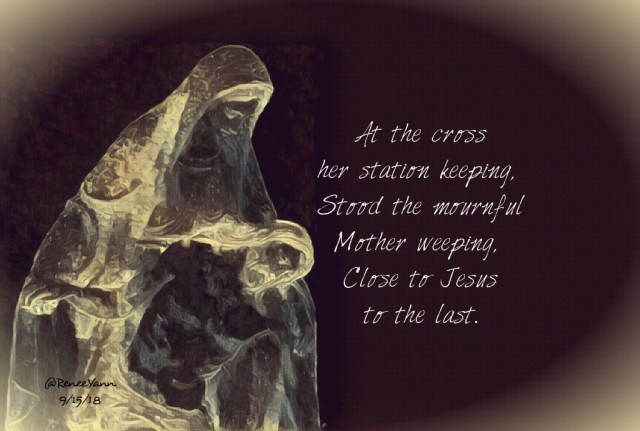
Today, in Mercy, we pray with Our Mother of Sorrows.
Mary’s greatest sorrows came, not from circumstances she bore personally, but from her anguish at the sufferings of Jesus. Like so many mothers, fathers, spouses, children and friends, Mary suffered because she loved.
It is so hard to watch someone we love endure pain. We feel helpless, lost and perhaps angry. We may be tempted to turn away from our beloved’s pain because it empties us as well as them.
This is the beauty and power of Mary’s love: it did not turn. Mary’s devotion accompanied Jesus – even through crucifixion and death – for the sake of our salvation.
Today’s liturgy offers us the powerful sequence “Stabat Mater”.
Stabat Mater Dolorosa is considered one of the seven greatest Latin hymns of all time. It is based upon the prophecy of Simeon that a sword was to pierce the heart of His mother, Mary (Lk 2:35). The hymn originated in the 13th century during the peak of Franciscan devotion to the crucified Jesus and has been attributed to Pope Innocent III (d. 1216), St. Bonaventure, or more commonly, Jacopone da Todi (1230-1306), who is considered by most to be the real author.
The hymn is often associated with the Stations of the Cross. In 1727 it was prescribed as a Sequence for the Mass of the Seven Sorrows of Mary (September 15) where it is still used today. (preces-latinae.org)
Music: Stabat Mater Dolorosa – Giovanni Battista Pergolesi (1710-1736) This is a glorious rendition. If you have time, you might listen to it on a rainy afternoon or evening as you pray.
Today, in Mercy, our readings might lead us to wonder, “Does God have favorites?”
I think Luke’s Gospel today says, “Well, yes, kinda’!”
This passage from Luke is a parallel to Matthew’s Sermon on the Mount. Matthew includes the familiar Eight Beatitudes, delivered in spiritual tones which allow most of us find ourselves somewhere among them. Matthew talks about the “poor in spirit”, the meek, mourning and merciful. At least once in our lives, we probably fall into one of Matthew’s “blessed” categories. Doing so let’s us think we might be among God’s favorites or blessed ones — at least sometimes, right?
But hold up, here comes Luke with a whole different take on blessedness. Luke says just the plain poor, hungry, weeping and hated are blessed. Luke’s sanctifying suffering is material, not just spiritual. Luke suggests that the destitute, bereft and ostracized are clearly God’s favorites.
What does that say to us? I don’t know about you, but I’m not real anxious to join Luke’s blessed group. I don’t like the feeling of poor, hungry, weeping and hated! On the other hand, I do want to be one of God’s favorites, don’t you?
What I think we can do is this:
to love the poor and materially broken as God loves them
to do all we can to bring them comfort and healing, mercy and justice
to learn from them what it is like to stand before God with nothing between us but longing and hope
to look at our own materially abundant life with a critical eye and discerning heart
to see any darkness we endure in the light of God’s illuminating promise
to be grateful, humble, and open to the transforming graces God might offer us even in suffering
Today, in Mercy, in our first reading, Paul assures the Corinthians that his primary mission is preaching the cross of Jesus. This awesome calling required great grace because the message of the cross sounds like foolishness to the faithless heart.
Indeed, the cross is incomprehensible in human terms. How can agony and death bring us all eternal life? Why does the truth of the cross need to be rooted in my life if I am to be fully enfolded into Christ?
These questions can’t be answered in a catechism — or even on Google! These answers blossom in us in a wordless relationship with Jesus through prayer, loving sacrifice, and merciful tending of Creation.
A half century ago, when I first came to the Convent, we had a communal practice called “Three O’clock Prayer”. Every Friday at 3:00 PM, those Sisters not engaged in ministry gathered in chapel for this brief prayer to ponder Christ’s death. It was during that prayer, on November 22, 1963, that word came to us of President Kennedy’s assassination. It was a day we all desperately reached for the deep mystery of the cross.
On many Fridays over these decades, I have returned to this time of prayer, asking God to hold our crucified world in his resurrected arms. On this last day of August, we may want to think about such a prayer. Our world surely needs it.
Music: Jesus the Lord – John Foley, SJ & Roc O’Connor, SJ
Let this magnificent hymn take you into the depth of Christ’s heart.
Today, in Mercy, on the feast of St. Monica, I think of all the good priests and religious throughout the world, whose hearts weep with victimized children, whose souls rage at the treachery of their brethren, and whose dreams of fealty with the People of God lie wounded at their feet.
In our first reading, Paul speaks to these religious and to all of us who love the Church:
We ought to thank God always for you, brothers and sisters, as is fitting, because your faith flourishes ever more, and the love of every one of you for one another grows ever greater. Accordingly, we ourselves boast of you in the churches of God regarding your endurance and faith in all your persecutions and the afflictions you endure. This is evidence of the just judgment of God, so that you may be considered worthy of the Kingdom of God for which you are suffering.
Let us encourage each other, servants of God and of God’s People – in this time of suffering but also of renewal – not only to remain true, but to become truer. For as Jesus says in the Gospel:
” One who swears by the altar swears by it and all that is upon it; one who swears by the temple swears by it and by him who dwells in it; one who swears by heaven swears by the throne of God and by him who is seated on it.”
St. Monica, who prayed incessantly for the deep conversion of your son Augustine, pray for us in our time of testing. Amen.
Today, in Mercy, our readings leave us wondering, “Can God get angry?” It’s hard for us, who think of God as Lavish Mercy, to imagine that God would be irrevocably angry with us.
Today’s readings are examples of the ways in which both the Hebrew prophets and Jesus tried to describe the Indescribable God in words we might understand. Sometimes in scripture we find an angry God, an impatient God, a frustrated God, a vengeful God- even a bullying God. All these stories make God seem very human. But God is not like us, just as many other scripture passages assure us.
“For my thoughts are not your thoughts, neither are your ways my ways,” declares the Lord. “As the heavens are higher than the earth, so are my ways higher than your ways and my thoughts than your thoughts.” Isaiah 55:8-9
What we do know for certain is that God is Love, because only Love could have breathed forth Creation. All the other descriptions are our imaginative struggles to comprehend how God might react to our human situation.
Today, as the news describes the Pennsylvania Grand Jury report on over 300 abusive priests, I cannot imagine how God is not heartbroken and angry. Can there be a greater sacrilege than the savaging of innocence by those proclaiming to sanctify it?
Let us pray for Mercy today for victims and survivors, that they may find some healing in the telling of their tragedies and the affirmation of their courage.
Let us pray for ourselves, a broken Church, where an idolatrous “priesthood” has killed the image of Christ it was thought to represent, where the façade of trust lies dissolved in the tears of children, and the hope of transformation is elusive.
Let our spirits weep with the God of Love, and ask for Mercy to show us the way back to the pure heart of our faith.
Today, in Mercy, we have a rare appearance from the prophet Habakkuk, whose contribution to the Hebrew Scriptures is brief — three short chapters. The first two chapters are known as the First and Second Complaint of Habakkuk.
In his first complaint, Habakkuk is upset with the way the world is going. You know what he feels like. He saw the political infrastructure rife with corruption, enemies attacking the heart of Jewish religion, and economic deadlock. Habakkuk asks God to explain why this is happening.
God says that Habakkuk has to have faith, that ultimately God will work things out.
That doesn’t float with Habakkuk, so he complains again. He basically tells God that, as the all-Powerful One, God should be able to do better.
Have you ever talked to God like that in your prayer – just so frustrated with your life or the world situation that you pour it all out in one massive complaint?
The fullness of Habakkuk’s faith evolved over time, because God abided with him, telling Habakkuk to be patient:
Write down the vision Clearly upon the tablets, so that one can read it readily. For the vision still has its time, presses on to fulfillment, and will not disappoint; If it delays, wait for it, it will surely come, it will not be late. The rash man has no integrity; but the just man, because of his faith, shall live.
This passage is a good incentive to maintain a spiritual journal. When we go back over past challenges, we are often amazed to see how God did, indeed, abide with us — just as God did with Habakkuk.
Ready for some haunting beautiful Gaelic? (English lyrics below.)
Music: Bi Thusa Mo Shuile (Be Thou My Vision) ( Be Thou My Vision is a traditional hymn from Ireland. The words are based on a Middle Irish poem often attributed to the sixth-century Irish Christian poet Dallán Forgaill. The best-known English version was translated by Eleanor Hull and published in 1912. Since 1919 it has been commonly sung to the Irish folk tune “Slane”.)
Be Thou my Vision, O Lord of my heart
Naught be all else to me, save that Thou art
Thou my best Thought, by day or by night
Waking or sleeping, Thy presence my light
Be Thou my Wisdom, and Thou my true Word
I ever with Thee and Thou with me, Lord
Thou my great Father, I Thy true son
Thou in me dwelling, and I with Thee one
Riches I heed not, nor man’s empty praise
Thou mine Inheritance, now and always
Thou and Thou only, first in my heart
High King of Heaven, my Treasure Thou art








 Lavish Mercy