Today, in Mercy, our readings could be so reassuring about the power of our prayer, except …..
How often have you prayed for something that you didn’t get?
In our reading from the Book of Esther, Esther certainly puts everything she has into her prayer for deliverance:
Queen Esther – By Jean-François Portaels
She lay prostrate upon the ground, together with her handmaids, from morning until evening, and said: “God of Abraham, God of Isaac, and God of Jacob, blessed are you. Help me, who am alone and have no help but you, for I am taking my life in my hand.
The passage, in isolation from the rest of the Book, might lead us to conclude that Esther’s prayer is simply about her asking for, and receiving, what she wants from God. It’s about much more.
Esther, like Christ, is in a position to save her people. She must risk her life to do so. She is praying for the courage to do God’s will, to look past her own comfort and become an agent of grace in her circumstances.
Now that’s some kind of prayer!
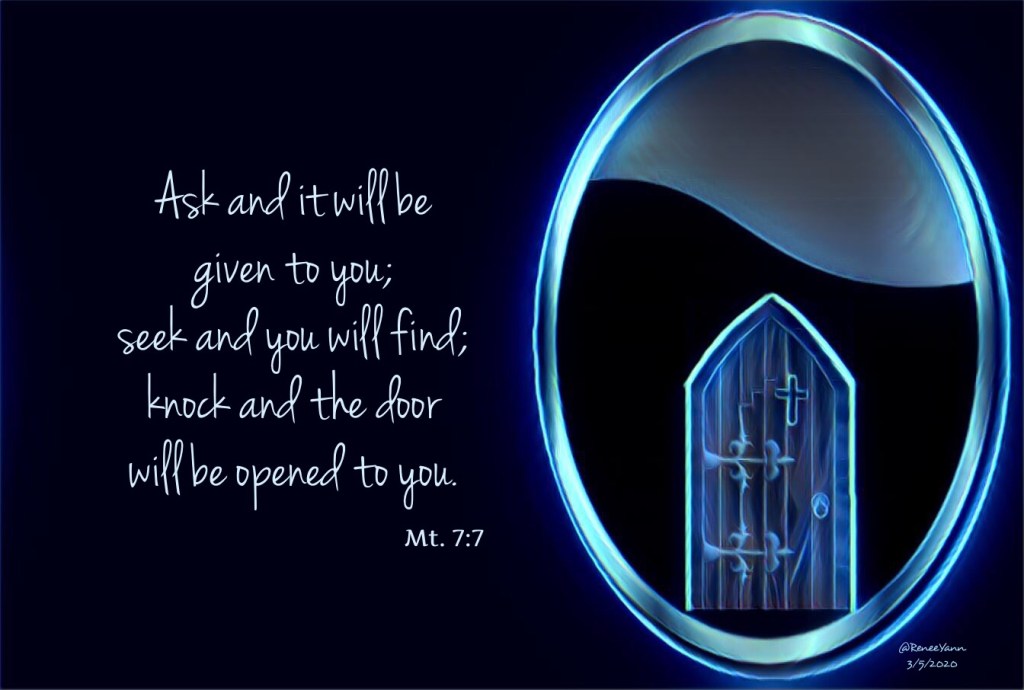
Prayer can be like looking in a mirror. All we see reflected back is our own need and desire. We don’t pray honestly and openly enough to let God open a door in the mirror – a door into God’s own will and hope for us.
That’s the door Jesus is talking about in today’s Gospel.
What we ASK is not just for something we want, but rather to know God’s heart.
What we SEEK is not our own satisfaction, but the grace to embrace God’s mysterious energy in our lives no matter how it comes to us.
What we KNOCK for and desire to be opened to us is deeper love and fuller relationship with our loving God.
Sometimes, the problem with prayer is that we think it’s like asking our rich uncle for a permanent loan. It’s only when we comprehend that prayer is a relationship that the RECEIVE, FIND, and OPENED parts become real for us.
I walk the earth, soft from yesterday’s long rain. Mists ascend like incense under my indulgent footfalls. Birdsongs thin themselves between the early light; chanting, contrapuntal, in the well-laved trees.
Nothing grey is left now in the wide sky. Rinsed in light it spreads to dry in sere, blue wind.
Momentarily, earth is wholly God’s; deep, true colors fall to it, rich, unshadowed. Your Word, Creator, WaterGod, has penetrated. It returns to You in crystal images from a finally uncomplicated world.
As if within a lucent globe I hold You still, in perfect, silent love, clear, inexplicable like sunlit rain.
Music: two offerings today. One is old-time revival. The other is classic beauty. Enjoy.
Prayer Is the Key to Heaven – Alan Brewster
Music: Overture from Esther – George Frideric Handel
Today, in God’s Lavish Mercy, one line from our readings hit me like a lightening bolt:
The word of the LORD came to Jonah a second time.
Jonah 3:1
Yes, it’s the truth! God will keep coming back again and again to encourage us to hear the true message for our lives.
Our Gospel gives us a hint about how resistant we sometimes are to do this deep listening:
This generation is an evil generation; it seeks a sign, but no sign will be given it, except the sign of Jonah.
Luke 11:29
What is the sign of Jonah anyway?
To put it simply, it is the witness of the Resurrection – that overarching event that changed everything for believers. For just as Jonah was able to return from certain death in the whale’s belly, so Christ conquered death and rose to new life, promising us the same power.
This is the central, life-changing belief for Christians. It should make a difference in how we live.
By our Lenten repentance, we can be like Jonah, grasping the second chance God always gives us to respond to our life circumstances with faith, hope, and love.
I would bet there is something in your life right now that is calling you to such a response. Someplace in your life, you may be caught in a bit of a “whale’s belly 🐳” about some issue, am I right?
God makes us ask ourselves questions most often when He intends to resolve them. He gives us needs that He alone can satisfy, and awakens capacities that He means to fulfill. Any perplexity is liable to be a spiritual gestation, leading to a new birth and a mystical regeneration.
Thomas Merton, The Sign of Jonas
Today’s readings remind us that we already have the glorious sign of the Resurrection to inspire us to leap from that dark “belly” into God’s hope for us!
Poetry: WE ARE JONAH – Rabbi Rachel Barenblat
In Rabbi Eliezer’s vision Jonah entered the whale’s mouth as we enter a synagogue. Light streamed in through its eyes. Jonah approached the bimah, the whale’s head. Show me wonders, he said, as though his own life weren’t a miracle.
The whale obliged, swimming down to the foundation stone, the navel of creation fixed deep beneath the land. Tsk tsk, chided the fish: you’re beneath God’s temple — you should pray.
Prayer requires stillness. Running away had always been so easy. Sitting silent in self-judgement — forget it! But waves only churn the surface. In the deep beneath the deep Jonah was wholly present.
We all flee from uncomfortable conversations the drip of a hospital IV the truths we don’t want to own the work we don’t want to do. Now we’re in the belly of the whale, someplace deep and strange.
God calls us to awareness: to stand our ground in the place where we are, to do the work which needs doing. To bring kindness and mercy even to those who are unlike us. Are we listening?
Music: a fun song “In the Belly of Whale” – The Newsboys
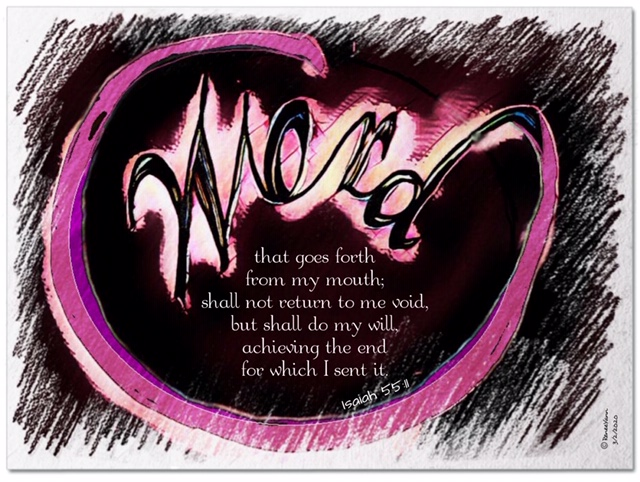
So shall my word be that goes forth from my mouth; It shall not return to me void, but shall do my will, achieving the end for which I sent it.
Isaiah 55:11
Today, in God’s Lavish Mercy, as I pray with today’s readings, I ask myself two questions:
“What has God’s Word accomplished in me?” “What does God’s Word yet want to accomplish in me?”
If you’re like me, you’re always thinking about what you haven’t done, still must do, wish you had done.
Let’s just STOP that and, instead, praise our gracious God for the good accomplished through our lives. I know every one of you reading this blog is an amazingly good person. God has already done beautiful things in you and through you. Thank God. Give God the glory.
Let’s consciously pray for one another today as today’s Gospel encourages us:
Our Father who art in heaven, hallowed be thy name, thy Kingdom come, thy will be done, on earth as it is in heaven. Give us this day our daily bread; and forgive us our trespasses, as we forgive those who trespass against us; and lead us not into temptation, but deliver us from evil.
Poetry: My Psalm – Renee Yann, RSM
May my life be its own psalm of praise to You.
Within its melody, my whole being
bows to you in gratitude.
You chose to breathe your soul into me,
to warm my name in your cupped hands,
to wind your Divine Heart into the notes of my life.
Thank You.
My years have unfolded like flowers,
slowly warming to your grace.
The petals of my years have each been kissed by You.
Whether in joy or sorrow,
silence or song, seen or unseen,
You have been with me.
Thank You.
You loved the child I once was and You played within me.
You loved the young girl who walked toward your call
along the precious, winding path of mercy.
You loved the woman I became, over and over,
as I learned to find You hiding in the world.
Thank You.
Now, as years deepen and with them,
our comfort in each other's love,
let my trust also deepen.
Let my faith reflect You,
like the face of a well-polished rock,
fully turned to your steadfast Light,
fully afire in your Abiding.
Thank You.
Music: My Tribute ( To God Be the Glory)
How can I say thanks For the things You have done for me? Things so undeserved, Yet You gave to prove Your love for me; The voices of a million angels Could not express my gratitude. All that I am and ever hope to be, I owe it all to Thee.
To God be the glory, To God be the glory, To God be the glory For the things He has done.
With His blood He has saved me, With His power He has raised me; To God be the glory For the things He has done.
Just let me live my life, Let it pleasing, Lord to Thee, And if I gain any praise, Let it go to Calvary.
Today, in God’s Lavish Mercy, we are invited to be like God:
The LORD said to Moses, “Speak to the whole assembly of the children of Israel and tell them: Be holy, for I, the LORD, your God, am holy.
Leviticus 19:1
Our first reading goes on to tell us how to be a decent person.
Don’t steal, lie, or cheat Pay just wages Respect and help those physically burdened Be impartial and just Defend life Don’t slander, hate, take revenge, or hold a grudge
Basically, the message is about kindness … deep kindness, the type that comes from realizing how infinitely kind God is to us.
Leviticus, after a long list of practical examples, sums it up:
You shall love your neighbor as yourself. I am the LORD.
Leviticus 19:18
Our Gospel tells us what happens when we make the choice to take the Old Testament advice — or not.
We are all familiar with the parable of the sheep and the goats. And we all hope our scorecard gets us into the right herd “When the Son of Man comes in his glory, and all the angels with him …”
In this parable, Jesus puts the advice of Leviticus into practical form for his followers. But he adds one dynamic element that not only invites but impels our wholehearted response:
Amen, I say to you, what you did not do for one of these least ones, you did not do for me.
Matthew 25:40
Leviticus invites us to become holy as God is holy. But Jesus reveals the secret that this Holy God lives in the poor, hungry, homeless, imprisoned and sick. By embracing these most beloved of God, we find the path to holiness.
Poetry: When Did I See You – Renee Yann, RSM
When Did I See You … (Woman Who Is Homeless)
In the bitter rain of February I sat inside a sunlit room, and offered You warm prayer.
Then, she passed outside my window dressed too lightly for the wind, steadied on a cane, though she was young.
She seemed searching for a comfort, unavailable and undefined. The wound of that impossibility
fell over her the way it falls on every tender thing that cries but is not gathered to a caring breast.
Suddenly she was a single anguished seed of You, fallen into all created things.
Gathering my fallen prayer, I wear the thought of her like cracked earth wears fresh rain.
I’ve misconstrued You, Holy One, to whom I spread my heart
as if it were a yearning field… Holy One, already ripe within her barest, leanest yearning.
Today, in God’s Lavish Mercy, our reading from Romans tells us:
The word is near you, in your mouth and in your heart.
How is the Word of God near us, with us?
Certainly, our sincere study and prayer with scripture is one way. Sitting quietly with scriptural passages, letting them speak to us, and inviting them to inform our lives is a life-giving discipline.
Sometimes, we might choose just one word or phrase from a beloved reading, turning it over and over, gently in our prayer. How has this precious word informed our lives, inspired us, called us, comforted us? How is it speaking to us in this moment?
As we move more deeply into the “words” of scripture, we move closer to theWord – the Incarnate God. John writes:
In the beginning was the Word, and the Word was with God, and the Word was God. He was with God in the beginning. Through him all things were made; without him nothing was made that has been made.
John 1:1
Today in our prayer, we might recommit ourselves to a deepening love of scripture, of the Word given to us there.
In his book, “The Bible Makes Sense”, Walter Bruggemann says this:
The Bible is not an “object” for us to study but a partner with whom we may dialogue. It is usual in our modern world to regard any “thing” as an object that will yield its secrets to us if we are diligent and discerning. And certainly this is true of a book that is finished, printed, bound, and that we can buy, sell, shelve, and carry in a briefcase or place on a coffee table…[But] reading the Bible requires that we abandon the subject-object way of perceiving things… [If we do,] the text will continue to contain surprises for us, and conversely we discover that not only do we interpret the text but we in turn are interpreted by the text… We may analyze, but we must also listen and expect to be addressed.
Poetry: God – by Khalil Gibran
In the ancient days, when the first quiver of speech came to my lips, I ascended the holy mountain and spoke unto God, saying, 'Master, I am thy slave. Thy hidden will is my law and I shall obey thee for ever more.'
But God made no answer, and like a mighty tempest passed away.
And after a thousand years I ascended the holy mountain and again spoke unto God, saying, 'Creator, I am thy creation. Out of clay hast thou fashioned me and to thee I owe mine all.'
And God made no answer, but like a thousand swift wings passed away.
And after a thousand years I climbed the holy mountain and spoke unto God again, saying, 'Father, I am thy son. In pity and love thou hast given me birth, and through love and worship I shall inherit thy kingdom.'
And God made no answer, and like the mist that veils the distant hills he passed away.
And after a thousand years I climbed the sacred mountain and again spoke unto God, saying, 'My God, my aim and my fulfilment; I am thy yesterday and thou art my tomorrow. I am thy root in the earth and thou art my flower in the sky, and together we grow before the face of the sun.'
Then God leaned over me, and in my ears whispered words of sweetness, and even as the sea that enfoldeth a brook that runneth down to her, he enfolded me.
And when I descended to the valleys and the plains, God was there also.
Today, in God’s Lavish Mercy, Isaiah continues his advice begun in yesterday’s reading. When he finishes the list of things we should and should not do, Isaiah tells us how God will respond:
Then light shall rise for you in the darkness, and the gloom shall become for you like midday; Then the LORD will guide you always and give you plenty even on the parched land. God will renew your strength, and you shall be like a watered garden, like a spring whose water never fails. The ancient ruins shall be rebuilt for your sake, and the foundations from ages past you shall raise up ~
Isaiah 58: 8-12
Oh, who can resist these glorious Isaiahan lines. It’s a beautiful picture, isn’t it? To imagine it offers us great encouragement as we limp out of winter toward a spring horizon.
Each of our readings today carries a sense of shaking off old and lifeless ways to stretch toward a new promise.
The psalmist asks for God’s help in that stretching.
Teach me your way, O Lord, that I may walk in your truth.
Psalm 86:11
As I thought about “stretching” in prayer this morning, an image came to me of an experience some of you might share. After my knee replacement, I had to learn to streeeeetch my old ligaments around the new implant. It wasn’t exactly “hell” to do so, but it was at least the edge of purgatory! My perseverance paid off though when I began to walk freely and painlessly.
Stretching into the depths of God also takes a full measure of willpower and HOPE. We can hear these pleas in the rest of Psalm 86:
Incline your ear, O LORD; answer me, for I am afflicted and poor. Keep my life, for I am devoted to you; save your servant who trusts in you. You are my God.
Have mercy on me, O Lord, for to you I call all the day. Gladden the soul of your servant, for to you, O Lord, I lift up my soul.
They say that rehabbing from knee replacement surgery is a lot easier if you have exercised and kept in fair shape beforehand. In our Gospel, dear Matthew does a total , full-hearted stretch — one that he must have been preparing for all his life. Otherwise, how could he have been so immediately responsive to Christ’s unexpected invitation?
Jesus saw a tax collector named Levi sitting at the customs post. He said to him, “Follow me.” And leaving everything behind, he got up and followed him.
Luke 5:27
Visualizing this scene, we can almost see Matthew not only get up — but his spirit actually jump up at the amazing invitation of God!
Lent is a time for us to do some jumping into grace — so many invitations come to us in this season’s beautiful scriptures and rituals. So many inspirations to grow come to us in our changing seasons! Let’s not be so distracted by our daily un-importances that we miss the call to streeeetch!
Poetry: St. Matthew by John Keble – this is a section of the poem which reflects on today’s Gospel passage.Matthew is the “meek publican” of the second stanza below. Amid all the clamor of the world around him, Keble’s Matthew has a clear eye and heart for Christ. John Keble, (1792 – 1866) was an English churchman and poet, one of the leaders of the Oxford Movement. Keble College, Oxford, was named after him.
There are in this loud stunning tide
Of human care and crime,
With whom the melodies abide
Of th' everlasting chime;
Who carry music in their heart
Through dusky lane and wrangling mart,
Plying their daily task with busier feet,
Because their secret souls a holy strain repeat.
How sweet to them, in such brief rest
As thronging cares afford,
In thought to wander, fancy-blest,
To where their gracious Lord,
In vain, to win proud Pharisees,
Spake, and was heard by fell disease-
But not in vain, beside yon breezy lake,
Bade the meek Publican his gainful seat forsake:
At once he rose, and left his gold;
His treasure and his heart
Transferred, where he shall safe behold
Earth and her idols part;
While he beside his endless store
Shall sit, and floods unceasing pour
Of Christ's true riches o'er all time and space,
First angel of His Church, first steward of His Grace.
Nor can ye not delight to think
Where He vouchsafed to eat,
How the Most Holy did not shrink
From touch of sinner's meat;
What worldly hearts and hearts impure
Went with Him through the rich man's door,
That we might learn of Him lost souls to love,
And view His least and worst with hope to meet above.
These gracious lines shed Gospel light
On Mammon's gloomiest cells,
As on some city's cheerless night
The tide of sunrise swells,
Till tower, and dome, and bridge-way proud
Are mantled with a golden cloud,
And to wise hearts this certain hope us given;
“No mist that man may raise, shall hide the eye of Heaven.”
And oh! if e'en on Babel shine
Such gleams of Paradise,
Should not their peace be peace divine,
Who day by day arise
To look on clearer heavens, and scan
The work of God untouch'd by man?
Shame on us, who about us Babel bear,
And live in Paradise, as if God was not there!
Music: Stretch Out – Gospel/Soul song by the Institutional Radio Choir
The Institutional Radio Choir was a gospel choir that recorded between 1962-2003. The choir began in 1954 at the Institutional COGIC in Brooklyn, NY, under Bishop Carl E Williams Sr. After recording an album entitled: “Well Done,” the choir backed up Shirley Caesar on her two albums, I’ll Go and My Testimony. Caesar allotted the choir’s director two songs on the album, one of which was entitled (When Trouble Comes) Stretch Out. The song went on to become a gospel standard, especially in Pentecostal circles. The choir went on to record over 20 albums, most of which charted in the Top 10 on the Gospel Billboard charts.
When troubles come and storms begin to rise Hold on and learn to stretch out Oh keep on fasting, keep on praying Hold on and learn to stretch out
When Satan get on your track And tries to turn me back I won’t worry, i won’t fret. i just stretch out Stretch out, oh stretch out
When days are dark and cloudy are my skies I hold on and learn to stretch out Oh keep on fasting, keep on believing Hold on and learn to stretch out
Cause the race isn’t given to the swift Neither is it given to the strong But to him that endureth to the end Stretch out, oh stretch out
When troubles come and storms begin to rise Hold on and learn to stretch out Oh keep on fasting keep on believing Hold on and learn to stretch out
Cause the race isn’t given to the swift Neither is it given to the strong But to him that endureth to the end Stretch out, oh stretch out
When i am lost, when i am sad Jesus is there, he’ll make me glad The Lord won’t deceive you The Lord he won’t leave you
Stretch out
Stretch out Stretch out Stretch out on his word
Stretch out Stretch out Stretch out Oh, stretch out
Today, in God’s Lavish Mercy, Isaiah cuts his listeners no slack — and, remember, we too are his listeners.
In this powerful passage, the prophet shatters the pretenses of those who make a show of religion. Speaking with God’s voice, Isaiah lambastes those who fast and pray but practice no works of justice and mercy.
Lo, on your fast day you carry out your own pursuits, and drive all your laborers. Yes, your fast ends in quarreling and fighting, striking with wicked claw.
These “fake fasters” are left wondering why God doesn’t answer their prayers. The prophet tells them that God isn’t fooled by their pretenses:
Is this the manner of fasting I wish, of keeping a day of penance: That a man bow his head like a reed and lie in sackcloth and ashes?
Isaiah says that God’s not into sackcloth and ashes. God’s into good works of mercy and justice. These are the actions that change our hearts, opening us to deeper relationship with God.
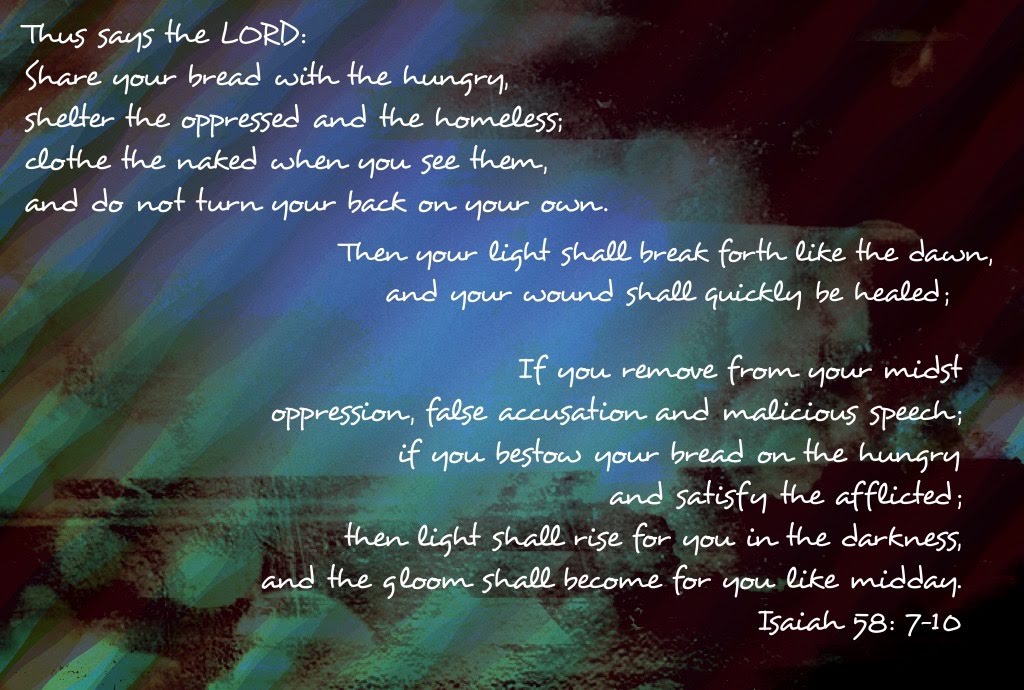
This, rather, is the fasting that I wish: releasing those bound unjustly, untying the thongs of the yoke; Setting free the oppressed, breaking every yoke; Sharing your bread with the hungry, sheltering the oppressed and the homeless; Clothing the naked when you see them, and not turning your back on your own.
Listen, dear friends. It can’t be clearer than that.
In a world full of “prosperity gospels”, false piety and pretend religion – used to justify all kinds of injustice – we may get mixed up sometimes about what pleases God.
Let’s really open our hearts to Isaiah’s message and try to rid our own lives of any pretense about these things.
Let’s confront such hypocrisy when we see it used to subtly oppress rather than to lift up others.
Then your light shall break forth like the dawn, and your wound shall quickly be healed.
Perhaps we might spend sometime today thinking about that “wound” we need healed. Might there be some harbored prejudice, indifference, fear, or ignorance that distances us from others who are different, vulnerable, or in need?
Isaiah cautions that until that wound is healed, we will never hear God’s true answer to our prayers.
Poetry: from Gitanjali by Rabindranath Tagore
Then said a rich man, “Speak to us of Giving”.
And he answered: “You give but little when you give of your possessions. It is when you give of yourself that you truly give. For what are your possessions but things you keep and guard for fear you may need them tomorrow? And tomorrow, what shall tomorrow bring to the overprudent dog burying bones in the trackless sand as he follows the pilgrims to the holy city?
And what is fear of need but need itself? Is not dread of thirst when your well is full, thirst that is unquenchable?
There are those who give little of the much which they have
and they give it for recognition and their hidden desire makes their gifts unwholesome. And there are those who have little and give it all. These are the believers in life and the bounty of life, and their coffer is never empty.
There are those who give with joy, and that joy is their reward. And there are those who give with pain, and that pain is their baptism. And there are those who give and know not pain in giving, nor do they seek joy, nor give with mindfulness of virtue; They give as in yonder valley the myrtle breathes its fragrance into space. Through the hands of such as these God speaks, and from behind their eyes He smiles upon the earth.
It is well to give when asked, but it is better to give unasked, through understanding; And to the open-handed the search for one who shall receive is joy greater than giving.
And is there aught you would withhold? All you have shall some day be given; Therefore give now, that the season of giving may be yours and not your inheritors’.
You often say, “I would give, but only to the deserving.” The trees in your orchard say not so, nor the flocks in your pasture. They give that they may live, for to withhold is to perish.
Surely he who is worthy to receive his days and his nights is worthy of all else from you. And he who has deserved to drink from the ocean of life deserves to fill his cup from your little stream. And what desert greater shall there be than that which lies in the courage and the confidence, nay the charity, of receiving?
And who are you that men should rend their bosom and unveil their pride, that you may see their worth naked and their pride unabashed? See first that you yourself deserve to be a giver, and an instrument of giving. For in truth it is life that gives unto life – while you, who deem yourself a giver, are but a witness.
And you receivers – and you are all receivers – assume no weight of gratitude, lest you lay a yoke upon yourself and upon him who gives. Rather rise together with the giver on his gifts as on wings; For to be overmindful of your debt, is to doubt his generosity who has the free-hearted earth for mother, and God for father.
Music: Respond – Collin Campbell (Lyrics below)
Oh how long will you cry out And never truly seek my face You come to me with heavy hearts But you ignore what makes mine break
I see your thoughts, I hear your words And I have watched you as you’ve prayed I’ve told you my desires But you don’t follow all the way
Children, I’m crying out Break the chains Let the oppressed go free Empty yourselves to those in need Be my hands Be my feet What you do unto them You do unto Me
Every day you lift your voice And await my swift response But I see only what’s inside And it’s (what i see on the inside) an offering I don’t want
Children, I’m crying out Break the chains Let the oppressed go free Empty yourselves to those in need Be my hands Be my feet What you do unto them You do unto Me
Then your Salvation will come like the dawn And my glory will be your shield When you call on My name I will not turn away I am Your God And I am here And your light it will shine from the dark You will be like a free flowing stream And when you call on My name I will not turn away I am your God And I am here
Today, in God’s Lavish Mercy, our readings confirm that a life patterned on Christ contradicts worldly definitions.
Deuteronomy gives us stark, either-or, advice:
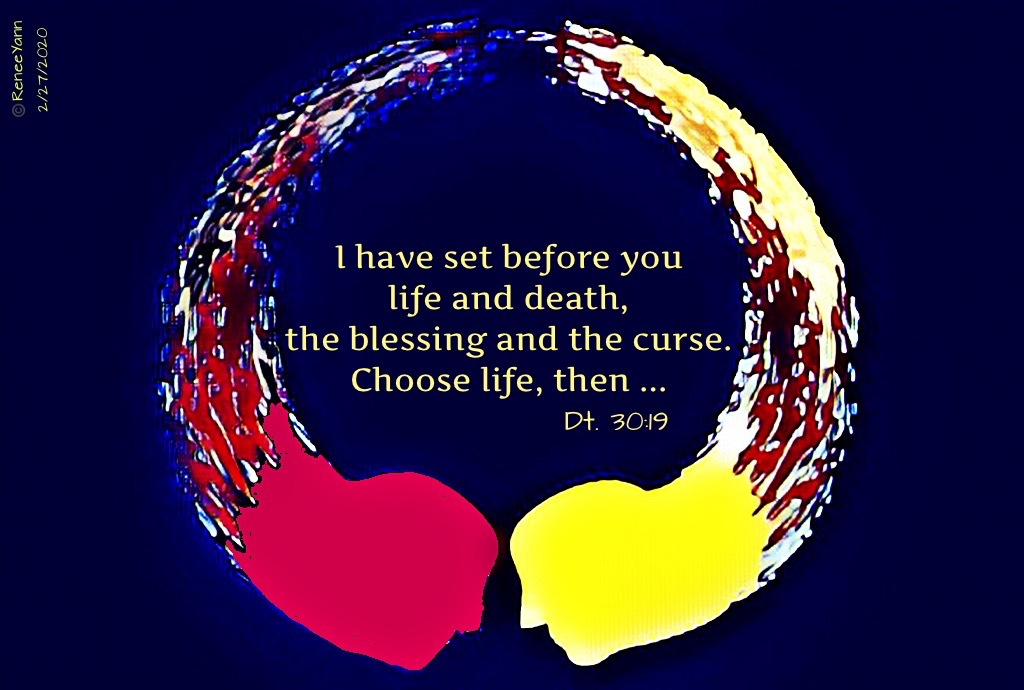
I have set before you life and death, the blessing and the curse. Choose life, then, that you and your descendants may live, by loving the LORD, your God, heeding his voice, and holding fast to him.
Deuteronomy 30: 15-16
It’s definitive advice, but we could probably do these things, right?
Choose life
Love God
Heed God’s voice
Hold fast to God
Sounds OK, doesn’t it?
It’s when Jesus comes along that it begins to sound difficult. Jesus tells us, “Here’s how you choose life:
“Whoever wishes to save his life will lose it, but whoever loses his life for my sake will save it.”
Jesus tells us, “Here’s the God you must love, one who:
“suffers greatly, is rejected, and is killed.”
Jesus tells us, “Here’s what my voice says to you :
“What profit is there for you to gain the whole world yet lose or forfeit yourself?”
Jesus tells us, “Here’s how you hold fast to me:
‘Take up your cross daily and follow me.”
The deep love of the Holy Cross was the sacred gift of Catherine McAuley to her Mercy Family. Let us listen to her counsel.
Some have huge crosses to carry in their lives – war, famine, enslavement, untended illness, homelessness, persecution, poverty. Those who carry such crosses are singularly loved by God who dwells with them.
But if we don’t have big, obvious crosses in our lives – if we are among those the world deems fortunate – how do we follow the crucified Jesus to find our way to eternal life?
How do we really CHOOSE LIFE?
We need to get close to the ones God singularly loves. We need to walk beside them and lift some of their heavy crosses. We need to help their voices be heard, their needs be met, their rights be honored.
Not all of us can do this by direct service. But we can do it by our advocacy, our material contributions, and our articulated support for justice.
We need to make these choices for LIFE all the time. But Lent is a great time to examine the vigor and commitment of our choices, a time to take a closer walk with our suffering Christ and ask him to inspire our courage.
Poetry: Simon the Cyrenian Speaks – Countée Cullen, an American poet, novelist, children’s writer, and playwright, particularly well known during the Harlem Renaissance. I picked his poem today because Simon of Cyrene is someone who chose to carry the cross just as we are asked to do.
He never spoke a word to me, And yet He called my name; He never gave a sign to me, And yet I knew and came.
At first I said, “I will not bear His cross upon my back; He only seeks to place it there Because my skin is black.”
But He was dying for a dream, And He was very meek, And in His eyes there shone a gleam Men journey far to seek.
It was Himself my pity bought; I did for Christ alone What all of Rome could not have wrought With bruise of lash or stone.
Music: Just a Closer Walk with Thee – Patsy Cline and Willie Nelson
Today, in God’s Lavish Mercy, we resolve to turn our hearts more fully to God. The sacred journey of Lent, one we have traveled so often over the years, invites us each time to go deeper into the Well of Mercy.
Joel’s pregnant phrase summons us:
Think of the “even now” moments of your life, those times when, despite darkness and cold, you turned toward light and warmth. Think of a time when, in contradiction to all negativity, your soul proclaimed:
Even now I hope
Even now I believe
Even now I love
Even now I care
Even now I repent
Even now I forgive
Even now I begin again
The rise of an “Even Now” moment in our souls is like the hint of spring pushing its head through the winter snow.
It is the reddish-green thread suggesting life at the tip of the brown, cold-cracked branch.
It is the moment we believe that what we desire and love will turn toward us and embrace us.
Can you imagine God having such moments, longing for our attention, love, presence, catching a glimpse of our turning?
Our reading from Joel describes such a God.
Even now, says the LORD, return to me with your whole heart… These words suggest God’s longing for us, for our devotion and love.
But our holy intentions weaken and we often drift away from our “first fervors”. Our hearts attach to distractions from God. So God says:
Rend your hearts … and return to the LORD, your God. For I am gracious and merciful, slow to anger, rich in kindness … Come back to Me, with all your heart.
Joel 2: 13-14
This is what Lent is all about. Each of us knows where our hearts have wandered. Each of knows what we must turn from — even now — to return to God’s embrace.
If we can hear God’s longing in this haunting reading from Joel perhaps the true turning will begin. A blessed Lent, a holy listening, my friends.
Poetry: God’s Longing – from Rumi
All night, a man called out “God! God!” Until his lips were bleeding. Then the Adversary of mankind said, “Hey! Mr Gullible! … How come you’ve been calling all night And never once heard God say, “Here, I AM”? You call out so earnestly and, in reply, what? I’ll tell you what. Nothing!”
The man suddenly felt empty and abandoned. Depressed, he threw himself on the ground And fell into a deep sleep. In a dream, he met an angel, who asked, “Why are you regretting calling out to God?”
The man said, “ I called and called But God never replied, “Here I AM.”
The Angel explained, “God has said, “Your calling my name is My reply. Your longing for Me is My message to you. All your attempts to reach Me Are in reality My attempts to reach you. Your fear and love are a noose to catch Me. In the silence surrounding every call of “God” Waits a thousand replies of “Here I AM.”
Music: Come Back to Me – Gregory Norbet, sung by John Michael Talbot
Today, in God’s Lavish Mercy, as we prepare to launch into Lent, we receive wonderful advice from Peter.
Peter talks about the Hebrew prophets who, even before the birth of Jesus, shared in the same Holy Spirit with Whom Jesus is One God. Peter says that the Spirit testifies that Christ’s suffering will lead to glory and will, at the same time, transform us:
Concerning the salvation of our souls … … the Spirit of Christ within the prophets indicated when it testified in advance to the sufferings destined for Christ and the glories to follow them.
1 Peter 1: 10-13
Peter says, basically, “Don’t be dopes! Jump on that blessing and make the most of it!”
Lent offers us a great opportunity to do just what Peter encourages. By our sincere, thoughtful and open prayer with the Lenten scriptures, we can come closer to the Christ Who loves and redeems us.
Peter puts it very simply – simply enough that I am going to leave it at this profound invitation:
There comes a holy
and transparent time
when every touch
of beauty
opens the heart
to tears.
This is the time
the Beloved of heaven
is brought tenderly on earth.
This is the time
of the opening
of the ROSE.
Music: The Rose – Bette Midler
As I prayed with this beautiful song, I thought of the Rose as the Resurrected Jesus.
















 Lavish Mercy