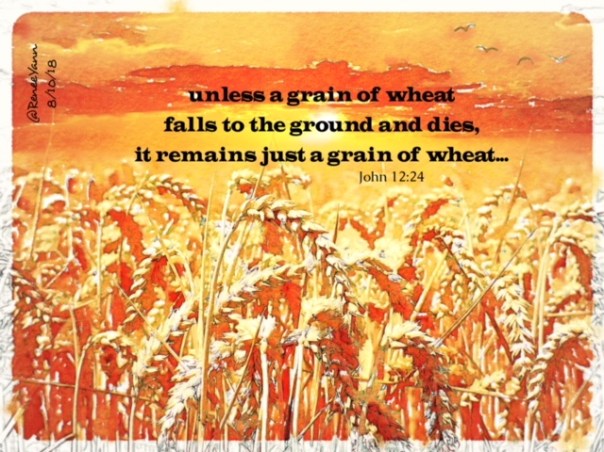
Today, in Mercy, on this feast of St. Lawrence, our readings are all about wheat. Then, again, they’re really not.
The readings, of course, are about eternal life – lessons taught in symbols the listeners could relate to. The agrarian community of Jesus’ time understood clearly what happened to a grain of wheat when buried in the rich soil. They understood, too, how a single grain, fallen on the barn floor and lost underfoot, had no hope of life.
It is a powerful lesson about community, selflessness, and what we need to do to live a full and meaningful life.
We have to die —to our isolation, self-absorption, greed, objectification and domination over others, “me-firstness”.
Basically, we have to resist the Seven Deadly Sins that make life “all about me”:
Self-adulating pride
Vengeful anger
Depersonalizing lust
Ungrateful envy
Consumeristic gluttony
Mean Greed
Irresponsible laziness
To move beyond these sins, we must recognize, respect and care for others – all others – as children of God.
If we can do that, our grain of wheat will land in harmony with the faith community and will contribute to its abundant life – and to our own. That faith community might be as small as my family or as big as the world. But unless I live there in selflessness, I will never come to my full potential a human being.
Musical reflection: A Grain of Wheat ~ Torchbearers
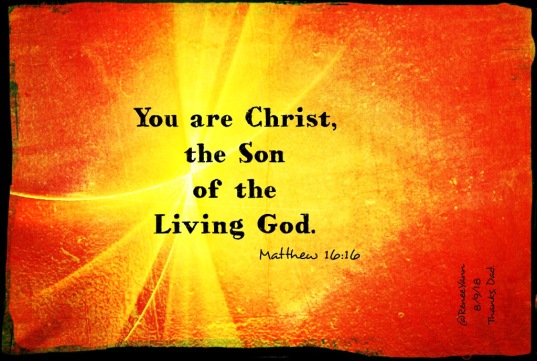
Today, in Mercy, our Gospel reading offers us Peter’s magnificent profession of faith.
This profession might cause us to consider our own faith and how we profess it in our daily lives.
I think about that today in the context of my father’s life. Today is his birthday.
My father, gone to God nearly forty years ago, would have been 103 years old today.
He was born in the midst of the World War — called only that, because we never expected a second one.
His 28- year-old mother died when he was just two years old.
He grew up into a Depression which causedhim to cease his schooling at 7th grade and work the farm with the uncle who raised him.
By the tragic Second World War, he had grown to a man andwould fight in the fields and cities of Europe. He came home with pictures in his head that he would never talk about. And he never traveled again, at least not beyond Wildwood, New Jersey.
With not even a grade school diploma, he was a self-educated man in the skills of plumbing, electricity, painting, paper-hanging, and cement work.Don’t undervalue this unless you have attempted these tasks yourself!
He was a hard-working, blue collar, salt-of-the-earth man who never owned his home but raised a family whose hearts he owned completely.
He suffered a heart injury at work when he was in his 50s and eventually – despite a valiant struggle – became disabled. After several heart attacks, he died a relatively early death at age sixty-six. In the intervening years, he read, prayed, and loved my mother, brother and me without reservation. He never missed a Sunday or Holy Day at Church. He prayed his devotions and novenas every day. He never put a single person down by his words or actions.
Some may read this short synopsis of his life and think it a little tragic. I read it and remember an everyday saint. He was made so by his resolute faith and trust in God; by his honest, inclusive patriotism, by his immense selflessness, and by his abundant kindness. These traits characterized many of “The Greatest Generation”.We should never underestimate the contribution of their character to our national historical wealth.
My Dad died completely fulfilled and happy, leaving a heritage of faith, loyalty, generosity and love. That was his profession of faith, and I take great joy in it today. I think in many ways, Dad was a lot like Peter and I like to think of him that way as I pray this morning .
My dear readers, in your own family trees, I hope you are blessed to have such people- rough, tender-hearted heroes who carried you into the fullness of your life. Think of them, learn from them, and bless them today. Be them – if you have the courage.
Dad loved music. Toward the end of his life, this free and beautiful melody was one of his favorites. You might enjoy it as you pray this morning.
Today, in Mercy,our readings focus on the infinite mercy of God — the Lavish Mercy of God.
Jeremiah speaks God’s voice to the ancient Israelites, forgiving them, consoling them, encouraging them. He promises that, delivered from their captivity, they will rejoice and “come streaming into the Lord’s blessings”.
In our Gospel, even an outcast woman receives the mercy of Jesus. She received this for two reasons: her faith was both extraordinary and unrelenting for her daughter.
Both Israel and the Canaanite woman are in desolate situations. They are bereft of nearly everything but hope and faith. We may have felt like that sometimes. Certainly there are people throughout our world who feel like that today.
As we pray today, we can place any desolation we are carrying, and the desolation of suffering people across the world, into the open arms of God. God has and will always love us and, even though unseen, is guiding us to the fullness of life. May our faith be extraordinary and unrelenting.
Do you ever have trouble sleeping at night? Or do you wake too early and fight to go back to sleep?
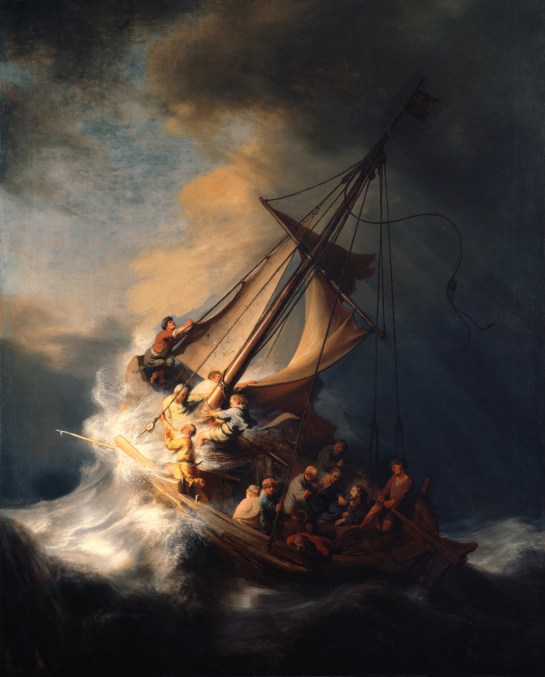
The disciples in today’s Gospel understand your plight. They had worked hard all day and were exhausted. Nestled in various of the boat’s nooks, each one settled to his own slumber. At first, the Sea of Galilee was gently rolling, almost like a lullaby of waves.
But …
“Set in the hills of northern Israel, the Sea of Galilee is nearly 700 feet below sea level. … The sea’s location makes it subject to sudden and violent storms as the wind comes over the eastern mountains and drops suddenly onto the sea.” (Ray Vander Laan)
The Storm on the Sea of Galilee~ Rembrandt
We’re not unlike these men. The storms of life come suddenly to disturb our sleep too. Sorrows, worries, frustrations, deadlines, aches and pains — all kinds of winds howl into our sleep during “the fourth watch of the night.”
What if, rather than resisting these little twisters, we looked deeply into them for the face of God. As we struggle with whatever it is disturbing us, God is always approaching us with a message of hope, courage and spiritual growth. Often, it is our resistance to that message which creates the storm.
That night, on the Sea of Galilee, the disciples sensed the rising winds of resentment against Jesus. The knew in their depths that the storm clouds were gathering in the dark hearts of Christ’s enemies. But they probably resisted their growing fears.
Most of them had not witnessed the Transfiguration. But they too, like Peter, James and John, needed some bolstering! Walking across the water, Jesus brings each of them a blessed assurance that He has the storms in hand.
In our own night watches, God is waiting to calm and assure us. Let us be still in the darkness and trust God.
Today, in Mercy, we celebrate the Feast of the Transfiguration of the Lord.
Peter, James, and John – those whom the Lord would most heavily depend on at the time of the Crucifixion – these three were given a sacred privilege. They witnessed Christ transformed by his Divinity, shining before the Father whose voice came down from heaven.
Icon of Transfiguration by Alexander Ainetdinov
Peter’s account in today’s second reading might seem almost too much to believe. Yet, Peter’s very human telling of the event is most convincing. He doesn’t wax eloquent about how privileged the three were. He simply describes the event and says, “We were terrified.” — as indeed we all might be if we came face to face with God’s glory.
Perhaps they received this gift in order to bolster them through the Passion and Death of Christ, or to open their hearts to believe in the Resurrection. These men were the key leaders who would pick up the message of Jesus when it appeared to fall to the earth at the foot of Cross. They needed a deeply confirmed faith.
So do we. We face a lot of faith-sapping realities in our world. And God does give us “Transfiguration Moments” too – times when the thin veil of hard reality is lifted and we glimpse the face of God. These moments may come at the birth of a child, the devotion of a beloved, the majesty of nature, the simplicity of silence, the deliverance from harm, the momentary awareness that our breath belongs to God.
We must savor and store these Lights, like the three disciples did, to strengthen ourselves for the shadows. As Peter says in his epistle:
… we possess the prophetic message that is altogether reliable. You will do well to be attentive to it, as to a lamp shining in a dark place, until day dawns and the morning star rises in your hearts.
Music: Transfiguration by Carey Landry
We behold the splendor of God shining on the face of Jesus. We behold the splendor of God shining on the face of the Son.
And oh, how his beauty transforms us, the wonder of presence abiding. Transparent hearts give reflection of Tabor’s light within, of Tabor’s light within.
Jesus, Lord of Glory, Jesus, Beloved Son, oh, how good to be with you; how good to share your light; how good to share your light.
“Don’t we have anything decent to eat around here?”“There’s nothing to eat in this house !”
How many times do parents hear these complaints from their growing teenagers! The problem? They’re not looking for the apples, or eggs, or yogurt, or avocados which actually are in the fridge. They’re looking for junk!
Today’s first reading reflects a similar situation with the Jews in the desert. They are hungry, but not for the spiritual food Yahweh is offering them. They complain continuously. So God relents, feeding them manna and quail. But God is clear. He says, “I have done this so that you may know I am the Lord, your God.”
In the Gospel, Jesus admonishes his listeners, “Do not work for food that perishes but for the food that endures for eternal life.” Jesus doesn’t mean we should stop eating. He knows that we need food and other things in order to live. What He wants us to understand is that these things have only secondary importance to the food for our soul, a sustenance which we often relegate to inferior status, to “when we have time”.
In his advice to the Ephesians, Paul says that to live without spiritual awareness is “to live in the futility of our minds”. It’s a powerful phrase, generating an image of us running around in our heads after all sorts of vain worries and goals — junk.
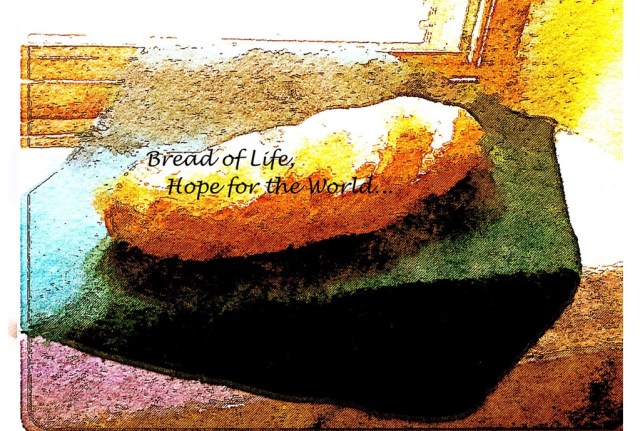
At our essence, we are hungry for the Bread of Life. Nothing else will fill that emptiness.
Music: Bread of Life ~ Bernadette Farrell
Bread of life, hope of the world,
Jesus Christ, our brother:
feed us now, give us life,
lead us to one another.
As we proclaim your death,
as we recall your life,
we remember your promise
to return again.
Bread of life, hope of the world,
Jesus Christ, our brother:
feed us now, give us life,
lead us to one another.
The bread we break and share
was scattered once as grain:
just as now it is gathered,
make your people one.
Bread of life, hope of the world,
Jesus Christ, our brother:
feed us now, give us life,
lead us to one another.
We eat this living bread,
we drink this saving cup:
sign of hope in our broken world,
source of lasting love.
Hold us in unity,
in love for all to see;
that the world may believe in you,
God of all who live.
You are the bread of peace,
you are the wine of joy,
broken now for your people,
poured in endless love.
Today, in Mercy, we hear again about John the Baptist, the greatest prophet and preacher of all time, other than Jesus. John was so powerful that Herod thought he had come back from the dead to punish Herod’s sins.
Today is also the feast of St. John Vianney, popularly known as the “Curé d’Ars”. John was a simple and vibrantly devout parish priest in 19th century France. His humble holiness so transformed souls that he is considered the model and patron saint of all priests. St. John Vianney not only said, but lived, this statement:
“The priesthood is the love of the heart of Jesus. When you see a priest, think of our Lord Jesus Christ.”
God knows we need the influence of this saintly man today in the Catholic Church. It is a time when many have lost faith in the priesthood because of the heinous sins of some. That loss of faith is inevitably tied to our sacramental life. It is a tragic and profound bereavement.
Our society suffers a similar foundational trauma in so many other areas. When people of my age were young, we could trust our priests, our doctors, our police officers, our bankers, our government to safeguard our good. That trust has eroded in this time of exposure of deep-rooted, extensive corruption in once trusted institutions.
How do we restore our faith in the Church and other service institutions we have loved? We have already begun some of the work in the Church, but there is still much to be done. The work may serve as a model for other institutions:
Name and confront the corruption
Remove the structures, myths and attitudes which allow corruption to thrive
Declericalize and humanize the priesthood – flatten the “power tower”
Support the full participation of women in all societal roles.
Redefine “priest” as simply one in the community of believers.
Pray for the many good priests who are suffering from the stigma of their errant peers and support them by our vital commitment to true Christian community.
Today, let’s pray together the prayer of St. John Vianney:
God, please give to your Church today many more priests after your own heart. May they be worthy representatives of Christ the Good Shepherd. May they wholeheartedly devote themselves to prayer and penance; be examples of humility and poverty; shining models of holiness; tireless and powerful preachers of the Word of God; zealous dispensers of your grace in the sacraments. May their loving devotion to your Son Jesus in the Eucharist and to Mary his Mother be the twin fountains of fruitfulness for their ministry. Amen.
Music: Philippians Canticle ~ John Michael Talbot
This hymn reflects the true nature of the priesthood of Jesus Christ
Today, in Mercy,Jesus returns to his hometown to speak with his neighbors in the synagogue.We can imagine the scene – maybe a few buddies who grew up with Jesus, kicking a ball around the dusty streets of Nazareth. Maybe there were neighbor ladies who went to the well daily with Mary., or a few older guys who had exchanged the secrets of woodworking with Joseph.
They might have come to the synagogue expecting little but to hear the old scriptures interpreted in the old way. They could live with that.They had become entrenched in their ordinary lives and, despite its drudgeries, it was comfortable for them.
We can understand these people. In many ways, we might be like them.We might go to church on Sunday and pray everyday, but we don’t want our faith to get too mixed up in our lives. We certainly don’t want some preacher telling us we have to change our comfortable ways because “the Kingdom of God is at hand”.
But that’s what Jesus did that Sabbath in the hometown synagogue.
You see their reaction. “Who the heck is this guy to tell us what to do? Isn’t he merely one of us?”
Their defenses and prejudices bar them from hearing the liberating word of Jesus.He asks them to break open their ordinary lives to find the call to grace hidden within. He doesn’t want them to abandon their lives. He wants them to transform their lives by recognizing the presence of God in the everyday miracles of human life, love, mercy and forgiveness. He challenges them to welcome the same miracles in the poor, the stranger, even the enemy.Now wait a minute!!!!
There may have been some who heard and responded to him that day. But their voices were drowned out by those whose souls had atrophied with comfort, selfishness, ignorance and fear.
We don’t have to go too far to find such scenes today.It may be at a church, a political event, a family conversation, an exchange among friends. These situations may confront us with the stark difference, in ourselves and in others, between truth and opinion, between faith and religion, between justice and law.
In these common situations of our lives, can we find the miracles God is offering us? Can we listen beyond the words with a faith-filled heart and hear God’s Word? Can we allow our thinking to be transformed by the challenging graces of our ordinary lives? Can we ask ourselves sincerely, “If Jesus were here for this moment, what would he want to happen in my heart and actions?”
Today, in Mercy, Jeremiah provides us with the memorable image of the potter and the clay.
If you have ever worked in ceramics or sculpting, you know how the artist becomes one with her work. A shapeless lump of earth takes on an identity within your hands. Ever so delicately, you work to find the potential beauty in the clay. We might begin over and over until we find the perfect dynamic between our hands and the malleable clay.
Just the right touch, the perfect pressure, and something new – never here before – emerges. The new creation, while existing itself, holds the Potter’s character. It embodies her effort and hope. It is a physical testimony to her dream.
In this scripture passage, God is telling Jeremiah that this is how it is with Israel (and in place of Israel, we can read our own names.) Through the circumstances and opportunities of our lives, God is shaping his dream – the Divine hope for a loving creature who reflects the beauty of God.
As we deepen in our spiritual life, we become more sensitive to God’s touch, more aware of God’s creative presence in our lives. God reworks us, offering us the perfection of grace over the course of our lifetimes. May we have the wisdom to yield to God’s intention in our lives – to make, as Mother Theresa says, “something beautiful for God”.
Today, in Mercy, Jeremiah continues in a plaintive conversation with God. Things are not going well for Jeremiah. His message has met complete resistance. But Jeremiah doesn’t give up. He keeps talking things over with God, and God patiently leads Jeremiah to deeper relationship and understanding.
In Matthew’s Gospel, Jesus confirms that the journey into God’s deep heart is a challenging one. It is like looking for a treasure or finding a precious pearl. Not everyone is successful in the “treasure hunt”! It takes openness, trust, perseverance and love.
St. Alphonsus Liguori gives this advice about growing closer to God:
Acquire the habit of speaking to God as if you were alone with Him, familiarly and with confidence and love, as to the dearest and most loving of friends.
Music: Tu Scendi dalle Stelle ~ written by St. Alphonsus Liguori Who, as well as being a renowned moral theologian and Doctor of Church, was a brilliant composer and poet.
Tu scendi dalle stelle
(Italian)
Tu scendi dalle stelle
O Re del Cielo
E vieni in una grotta
Al freddo al gelo.
E vieni in una grotta
Al freddo al gelo.
O Bambino mio Divino
Io ti vedo qui a tremar,
O Dio Beato
Ah, quanto ti costò
L’avermi amato.
Ah, quanto ti costò
L’avermi amato.
A te che sei del mondo,
Il creatore
Mancano panni e fuoco,
O mio Signore.
Mancano panni e fuoco,
O mio Signore.
Caro eletto, Pargoletto,
Quanto questa povertà,
Piu m’innamora
Giacche ti fece amor
Povero ancora.
Giacche ti fece amor
Povero ancora.
(Translation)
You Come Down from the Stars
You come down from the star
Oh King of Heavens,
And you come in a cave
In the cold, in the frost.
And you come in a cave
In the cold, in the frost.
Oh my Divine Baby
I see you trembling here,
Oh Blessed God,
Ah, how much it cost you,
Your loving me.
Ah, how much it cost you,
Your loving me.
For you, who are of all the world
The creator,
No robes and fire,
Oh my Lord.
No robes and fire,
Oh my Lord.
Dear chosen one, little infant
This dire poverty,
Makes me love you more
Since Love made you
Poor now.
Since Love made you
Poor now.






 Lavish Mercy