The Passover of the Lord

Friday of the Fifteenth Week in Ordinary Time
July 21, 2023

Today’s Readings:

https://bible.usccb.org/bible/readings/072123.cfm


Today, in God’s Lavish Mercy, we hear the familiar tones of the central Exodus story.
Waiting for Easter Vigil

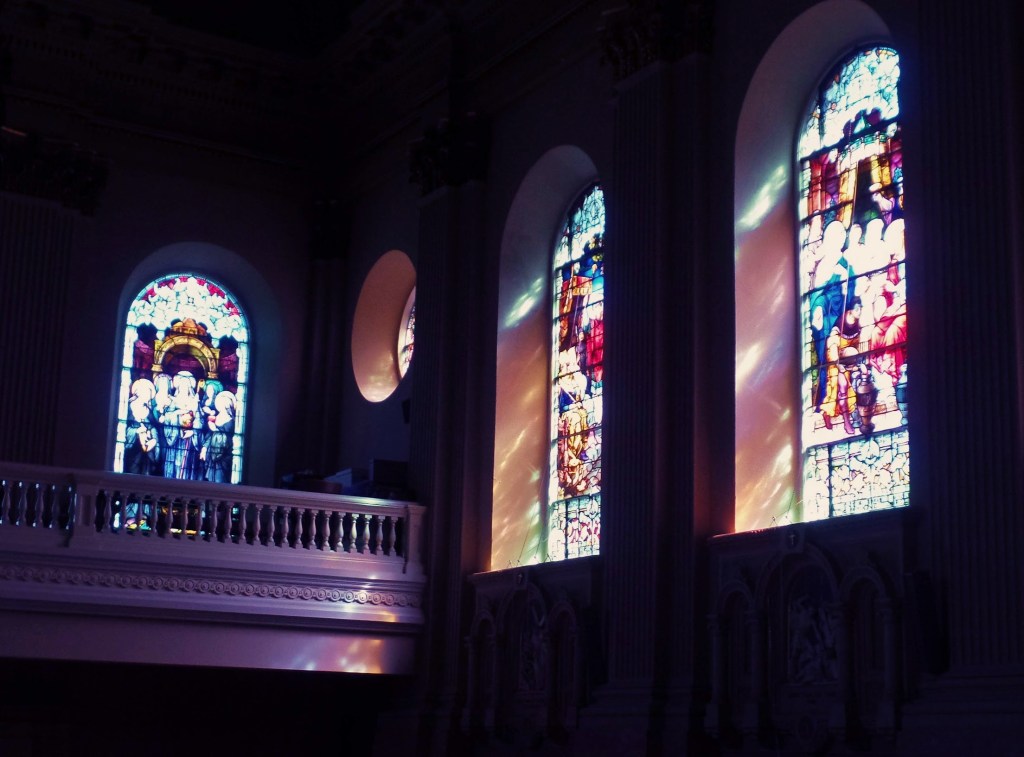
As we prayerfully read this passage, we may be carried back to the many Holy Saturday liturgies we have attended in our lives. In our memories, it is early spring, the evenings are still dark, and chapel is barely lit. We know the momentous story we are about to hear and re-enact. We believe it is brought to fruition in the sacramental liturgy we are about to offer. And, within all the memories, all the rituals, and all the words, one phrase stands out:

It is the Passover of the Lord.

“This is how you are to eat the lamb:
with your loins girt, sandals on your feet

and your staff in hand,
you shall eat like those who are in flight.
It is the Passover of the LORD.


Walter Brueggemann says that, in the act of “passover”, the community chooses to move on from its prohibitive existence to a new way of being. It chooses an alternative that requires “departure”:

That alternative is not easy or obvious or automatic. It requires a departure, an intentional departure from that system that the Bible terms “exodus.” In that ancient narrative the Israelites did not want to go, and once they had gone they wished to resubmit to Pharaoh. The departure is a piece of demanding, sustained work. The capacity to think and imagine and act and live beyond that system requires imagination that has dimensions of the psychological, the economic, and the liturgical. Indeed, the core liturgy of Israel (Passover) and the derivative liturgies of the church are practiced departures that now and then take on reality in the world.

Walter Brueggemann: Journey to the Common Good

In our reading from Matthew, and continually throughout the Gospel, Jesus invites his community to a profound “departure” – to a new understanding of the Law as love not requirement.

When the Pharisees criticize the hungry disciples for plucking and eating grain heads on the Sabbath, Jesus confronts them:

I say to you, something greater than the temple is here.
If you knew what this meant, I desire mercy, not sacrifice,
you would not have condemned these innocent men.
For the Son of Man is Lord of the sabbath.”

Matthew 12:7-8

Something greater than the Temple?????? The Pharisees stare at Jesus in stunned amazement! Could such a thing be possible?

Our Gospel tells us that not only is it possible, it is reality. The “Temple” and the old Law had lost their heart to the belief that personal power and affluence trumped human need. Their “systems” for becoming holy had become vacuous.

Jesus teaches that gaining sanctity requires that we live in mercy toward ourselves and others. Rituals, Temples, Churches and codes of conduct are meaningless unless they direct us always to act in mercy. When these same institutions and practices contradict God’s Mercy, we must have the courage for “departure” and “passover”.

“Departure” though does not mean abandonment. It means ceasing the merciless practices condoned by institutionalization, and having the courageous perseverance to build new paths to meaning.


It is clear in the Jewish practice of Passover that the exodus memory became a paradigmatic narrative through which all social reality is described and re-experienced. That is, the narrative pertains to a one-time remembered social upheaval caused by God’s holiness; but the narrative looks beyond that one-time memory to see that the same transactions of oppression and emancipation continue everywhere to evoke holy power.

Walter Brueggemann, Journey to the Common Good

Every day of our lives, we are called to “passover” into greater spiritual awareness, merciful practice, and just living. We may hear the call in small personal interactions, or in the larger context of our fragmented world.

We are faced constantly with alternatives between (just to name a few):

  • selfishness or generosity
  • forgiveness or vengefulness
  • honesty or pretense
  • peacemaking or rabble-rousing
  • addiction or freedom
  • informed decision-making or arrogant ignorance
  • gossip or respect
  • action for the poor or indifferent comfort
  • political and economic elitism or social justice
  • respect fro Creation or utilitarian ignorance

The sacred bridge in each of these passovers is the Gospel of Jesus Christ. Choosing it wholeheartedly, we will arrive on the right side of God.


Poetry: Journey – by Mary Oliver

One day you finally knew
what you had to do, and began,
though the voices around you
kept shouting
their bad advice--
though the whole house
began to tremble
and you felt the old tug
at your ankles.
"Mend my life!"
each voice cried.
But you didn't stop.
You knew what you had to do,
though the wind pried
with its stiff fingers
at the very foundations,
though their melancholy
was terrible.
It was already late
enough, and a wild night,
and the road full of fallen
branches and stones.
But little by little,
as you left their voices behind,
the stars began to burn
through the sheets of clouds,
and there was a new voice
which you slowly
recognized as your own,
that kept you company
as you strode deeper and deeper
into the world,
determined to do
the only thing you could do--
determined to save
the only life you could save.

Music: Took Me Out of Egypt – David Baroni (lyrics below)

Lord I’m feel so empty seems like we’re so far apart
Even tho’ some may applaud me
You alone can see my heart
You don’t look at my achievements or my ability
All You really wants is all of me
And though it frightens me to give my control
There is only room for one King
In the throne room of my soul

Lord You took me out of Egypt
Now take Egypt out of me
You delivered me from Pharaoh
now set me free from me
Let my heart become a promised land
Where the desert used to be
Lord You took me out of Egypt
Now take Egypt out of me

Blessed are the pure in heart
For they shall see the Lord
But eyes that only look to earth
Will lose the rich reward
Of the fellowship eternal the blissful unity
Of the ones who live in Jesus
And no longer serve King Me

Lord You took me out of Egypt…….

Lord I love the gifts You’ve given me
But I love the Giver more
And to worship You more perfectly
That’s what those gifts are for

Lord You took me out of Egypt…….

Me? A Prophet?

Thirteenth Sunday in Ordinary Time
July 2, 2023

Today’s Readings:

https://bible.usccb.org/bible/readings/070223.cfm

Today, in God’s Lavish Mercy, our readings instruct us on the nature of prophecy.


Walter Bruggemann, in his transformational book “The Prophetic Imagination” writes about prophets. He indicates that prophets emerge in the context of “totalism” – those paralyzing systems which attempt to control and dominate all freedom and possibility.

Totalism kills ideas, hope, freedom, choice, self-determination, and creativity for the sake of controlling reality for its own advantage. Totalism is the ultimate “abusive relationship“. Examples in our society include cults, hate groups, mob rule, or any relationship that subjugates another’s free will.

Brueggemann defines the prophet as one engaged in these three tasks to restore hope and freedom:

  • the prophet is clear on the force and illegitimacy of the totalism.
  • the prophet pronounces the truth about the force of the totalism that contradicts the purpose of God.
  • the prophet articulates the alternative world that God has promised, and that God is actually creating within the chaos around us.

Our first reading comes from the Second Book of Kings which was written about 600 years before Christ. The Jewish people experienced the totalism of the Babylonian Captivity.. First and Second Kings was written to help the people understand their situation, to remain faithful to God, and to move toward freedom.


These two books are full of powerful figures pulling the people both toward and away from God – biblical Baddies and Goodies who carried profound messages about faith or its abandonment.


One of the Goodies is Elisha the Prophet whom we meet in today’s verses. Elisha confronts barrenness and death with the transformative power of faith. The Summanite woman is able to benefit from this power because she believes.


In our second reading, Paul doesn’t use the word “prophet” but he talks about the Resurrection Power we receive through our Baptism. This power calls us and confirms us as bearers of God’s transformative Word in a hostile and unfree world.


In our Gospel, Jesus is direct with his disciples about the rewards which fall to those who have prophetic faith:

“Whoever receives you receives me,
and whoever receives me receives the one who sent me.
Whoever receives a prophet because he is a prophet
will receive a prophet’s reward,
and whoever receives a righteous man
because he is a righteous man
will receive a righteous man’s reward.
And whoever gives only a cup of cold water
to one of these little ones to drink
because the little one is a disciple—
amen, I say to you, he will surely not lose his reward.”

Matthew 10:40-42

So, are we actually called to be prophets? The answer is YES. We are called by the Gospel and through our Baptism to do what Walter Brueggemann describes above:

  • to name the structures of unfreedom in our lives and in our world
  • to speak truth and stand against those things which contradict God’s Mercy and Love
  • to witness hope and courage by the joyous, generous service of our lives

Photo by Ashley Batz on Unsplash


Poetry: Onto a Vast Plane – Rainer Maria Rilke

You are not surprised at the force of the storm—
you have seen it growing.
The trees flee. Their flight
sets the boulevards streaming. And you know:
he whom they flee is the one
you move toward. All your senses
sing him, as you stand at the window.

The weeks stood still in summer.
The trees’ blood rose. Now you feel
it wants to sink back
into the source of everything. You thought
you could trust that power
when you plucked the fruit:
now it becomes a riddle again
and you again a stranger.

Summer was like your house: you know
where each thing stood.
Now you must go out into your heart
as onto a vast plain. Now
the immense loneliness begins.

The days go numb, the wind
sucks the world from your senses like withered leaves.

Through the empty branches the sky remains.
It is what you have.
Be earth now, and evensong.
Be the ground lying under that sky.
Be modest now, like a thing
ripened until it is real,
so that he who began it all
can feel you when he reaches for you.


Music: When the Prophet Speaks – Van Morrison (lyrics below)

When the prophet speaks, mostly no one listens
When the prophet speaks and no one hears
Only those who have ears to listen
Only those that are trained to hear

Come closer now, I'll tell you what they whisper
Closer now, we'll whisper it in your ear
What big ears you've got when you get the details
Do you understand, do I make it clear?

When the prophet speaks, yeah, no one listens
When the prophet speaks, mostly no one hears
Only those that are trained to listen
Only those who have ears to hear

When the prophet speaks, yeah, no one listens
Baby, baby, baby, baby, baby
Don't you have no fear
You gotta get the truth on what is happening

When the prophet speaks, have to make it clear
Come closer now and I will whisper
Whisper the secret in your ear
What thick ears you've got when you get all the details

Do you understand, do I make myself clear?
When the prophet speaks, you've got to listen
When the prophet speaks, you've got to get the truth
When the prophet speaks, don't need no explanation

When the prophet speaks, have to make it move
Prophet speaks, no one listens
When the prophet speaks, mainly nobody hears
Only those that are trained to listen

Only those who have ears to hear

Alleluia: Called

Memorial of Saint Dominic, Priest
August 8, 2022

Today’s Readings:

https://bible.usccb.org/bible/readings/080822.cfm

Alleluia, alleluia.
God has called you through the Gospel
to possess the glory of our Lord Jesus Christ.


by Michelangelo on the ceiling of the Sistine Chapel in the Vatican between 1508 to 1512

Today, in God’s Lavish Mercy, we begin nearly two weeks of first readings from the prophet Ezekiel, and this first one is a real WOW!

As I looked, a stormwind came from the North,
a huge cloud with flashing fire enveloped in brightness,
from the midst of which (the midst of the fire)
something gleamed like electrum.
Within it were figures resembling four living creatures
that looked like this: their form was human.

Ezekiel 1:4-6

Walter Brueggemann calls Ezekiel “the prophet who had fantasies and hallucinations”. Nevertheless, Ezekiel is considered a prophet because like all prophets, Ezekiel “noticed what no one else noticed” — Ezekiel “saw death coming” to Israel.

Ezekiel did not blame the king, the government, the military or the war planners for this terrible death to come. He blamed the religious community, the clergy, the prophets: “My hands will be against the prophets who see delusive visions and give lying messages” (13:9). Ezekiel blamed the religious community because that community is responsible for truth-telling.

Truth-Telling and Peacemaking: A Reflection on Ezekiel
by Walter Brueggemann

I think it might be safe to say that most religious communities – and the people who comprise them – do not want to hear such things about themselves. Abraham Heschel, one of the greatest theologians and philosophers of the 20th century said this:

The prophets had disdain for those to whom God was comfort and security; to them God was a challenge, an incessant demand. He is compassion, but not a compromise; justice, but not inclemency. Tranquility is unknown to the soul of a prophet. The miseries of the world give him no rest. While others are callous, and even callous to their callousness and unaware of their insensitivity, the prophets remain examples of supreme impatience with evil, distracted by neither might nor applause, by neither success nor beauty. Their intense sensitivity to right and wrong is due to their intense sensitivity to God’s concern for right and wrong. They feel fiercely because they hear deeply.

from: What Are Prophets For?

By Abraham Joshua Heschel
MARCH 25, 2020

In today’s Gospel, Jesus informs his disciples that he too will endure a prophet’s suffering:

As Jesus and his disciples were gathering in Galilee,
Jesus said to them,
“The Son of Man is to be handed over to men,
and they will kill him, and he will be raised on the third day.”
And they were overwhelmed with grief.

Matthew 17:22-23

As we reflect on what these readings mean for us in our lives, our Alleluia Verse offers a key phrase:

Alleluia, alleluia.
God has called you through the Gospel
To possess the glory of our Lord Jesus Christ.

…through the Gospel

Unless we know and cherish the Gospel, we Christians cannot hear our call.


Poetry: The Call of a Christian – John Greenleaf Whittier

Not always as the whirlwind's rush 
On Horeb's mount of fear, 
Not always as the burning bush 
To Midian's shepherd seer, 
Nor as the awful voice which came 
To Israel's prophet bards, 
Nor as the tongues of cloven flame, 
Nor gift of fearful words,-- 
Not always thus, with outward sign 
Of fire or voice from Heaven,
The message of a truth divine, 
The call of Godis given! 
Awaking in the human heart 
Love for the true and right,-- 
Zeal for the Christian's better part, 
Strength for the Christian's fight. 
Nor unto manhood's heart alone
The holy influence steals 
Warm with a rapture not its own, 
The heart of woman feels! 
As she who by Samaria's wall
The Saviour's errand sought,-- 
As those who with the fervent Paul 
And meek Aquila wrought: 
Or those meek ones whose martyrdom 
Rome's gathered grandeur saw 
Or those who in their Alpine home
Braved the Crusader's war, 
When the green Vaudois, trembling, heard, 
Through all its vales of death, 
The martyr's song of triumph poured 
From woman's failing breath. 
And gently, by a thousand things 
Which o'er our spirits pass, 
Like breezes o'er the harp's fine strings, 
Or vapors o'er a glass, 
Leaving their token strange and new 
Of music or of shade, 
The summons to the right and true 
And merciful is made. 
Oh, then, if gleams of truth and light
Flash o'er thy waiting mind, 
Unfolding to thy mental sight 
The wants of human-kind; 
If, brooding over human grief,
The earnest wish is known 
To soothe and gladden with relief 
An anguish not thine own; 
Though heralded with naught of fear, 
Or outward sign or show; 
Though only to the inward ear 
It whispers soft and low; 
Though dropping, as the manna fell, 
Unseen, yet from above, 
Noiseless as dew-fall, heed it well,--- 
Thy Father's call of love!

Music: God is Calling through the Whisper

Alleluia: Righteousness

Memorial of Saint Benedict, Abbot
July 11, 2022

Today’s Readings

https://bible.usccb.org/bible/readings/071122.cfm

Today, in God’s Lavish Mercy, our Alleluia Verse repeats one of the treasured yet challenging Beatitudes:

Alleluia, alleluia.
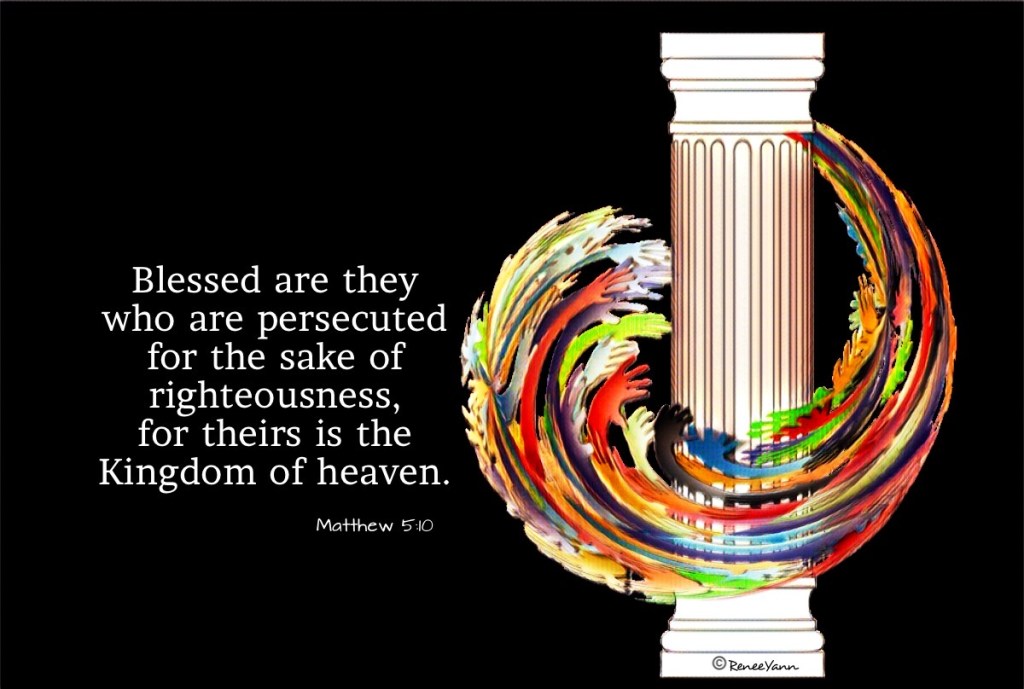
Blessed are they who are persecuted
for the sake of righteousness,
for theirs is the Kingdom of heaven.


Sometimes, the word “righteous” can fall harshly on the mind. Over the years, it has acquired a tinge of Bible-banging fundamentalism. Even in secular culture, a “self-righteous” person is repellent.

But the “righteousness” which is our heritage from both the Hebrew and Christian scriptures is a caring and dynamic discernment born of Wisdom and Mercy. It is a virtue the disciple seeks in imitation of the Beloved.


From Walter Brueggemann’s Theology of the Old Testament:

Israel’s characteristic grammar in speaking of Yahweh, governed by active verbs, regularly insisted that Yahweh is a major player in Israel’s life and in the life of the world. Yahweh’s characteristic presentation in Israel’s rhetoric is that Yahweh acts powerfully, decisively, and transformatively. Yahweh is morally serious and demanding, so that Yahweh is endlessly attentive to distinctions of good and evil, justice and injustice. Indeed, it is palpable power and moral seriousness that distinguish Yahweh from all rival gods, who have no power to act decisively and no capacity for moral distinctions.


In our first reading, we meet this righteous God who is fed up with the people’s dissembling.

When you come in to visit me,
who asks these things of you?
Trample my courts no more!
Bring no more worthless offerings;
your incense is loathsome to me.

Isaiah 1: 12-13

Instead, Isaiah’s God states clearly what makes one righteous:

Put away your misdeeds from before my eyes;
cease doing evil; learn to do good.
Make justice your aim: redress the wronged,
hear the orphan’s plea, defend the widow.

Isaiah 1: 16-17

Jesus tells us that it’s not easy to be such a person. You’re going to suffer for your acts of justice and mercy because we live in a world that honors vengeance and oppression instead. You’re going to be insulted, mocked and ostracized for your righteousness – for your desire to “right-balance” life for all human beings.

Brueggemann tells us that, nevertheless, this is our call:

The purpose of human life, a life of vocation, fellowship, and witness is to attest the truth of God’s solidarity with is, that is in justice, righteousness, compassion, steadfast love, and faithfulness.

Poetry: A Psalm of Life – Henry Wadsworth Longfellow

Anyone with a little interest in English poetry, must have had this poem etched into memory; hence no guesses about Longfellow’s best poem. Such is its evocative eloquence, such is its superior effect on every person regardless of class, religion and nationality that it transcends the boundaries of a mere song, and in the right sense, transforms into a psalm – a path to be followed for glorified and righteous life. Recited at Senate meetings, public gatherings and even at churches, this poem is sometimes speculated to have inspired Longfellow after he had come across a board in a German graveyard. Certainly his greatest, ‘Psalm of Life’ seems to have varied ideas where each quatrain is a guideline in itself. (from classical poets.org)

A Psalm of Life – (1839)
What the Heart of the Young Man Said to the Psalmist

Tell me not, in mournful numbers,
Life is but an empty dream!
For the soul is dead that slumbers,
And things are not what they seem.

Life is real! Life is earnest!
And the grave is not its goal;
Dust thou art, to dust returnest,
Was not spoken of the soul.

Not enjoyment, and not sorrow,
Is our destined end or way;
But to act, that each to-morrow
Find us farther than to-day.

Art is long, and Time is fleeting,
And our hearts, though stout and brave,
Still, like muffled drums, are beating
Funeral marches to the grave.

In the world’s broad field of battle,
In the bivouac of Life,
Be not like dumb, driven cattle!
Be a hero in the strife!

Trust no Future, howe’er pleasant!
Let the dead Past bury its dead!
Act,—act in the living Present!
Heart within, and God o’erhead!

Lives of great men all remind us
We can make our lives sublime,
And, departing, leave behind us
Footprints on the sands of time;

Footprints, that perhaps another,
Sailing o’er life’s solemn main,
A forlorn and shipwrecked brother,
Seeing, shall take heart again.

Let us, then, be up and doing,
With a heart for any fate;
Still achieving, still pursuing,
Learn to labor and to wait.


Music: I just had to offer a beautiful song from the Righteous Brothers on this “righteous” day. 🙂

I believe for every drop of rain that falls
A flower grows
I believe that somewhere in the darkest night
A candle glows
I believe for everyone who goes astray
Someone will come
To show the way
I believe, I believe

I believe above a storm the smallest prayer
Can still be heard
I believe that someone in the great somewhere
Hears every word

Every time I hear a new born baby cry
Or touch a leaf or see the sky
Then I know why, I believe

Psalm 34: Together

Tuesday of the First Week of Lent

February 23, 2021


Today, in God’s Lavish Mercy, we pray with Psalm 34, thought to be a young David’s thanksgiving prayer after God saved him from one of his many dangerous escapades.

In telling his deliverance story, David invites his friends to celebrate with him and to learn the faith-lesson he has learned:

Glorify the LORD with me,
    let us together extol his name.
I sought the LORD, and he answered me
    and delivered me from all my fears. 


I picture myself sitting in David’s audience, absorbing the words of his prayer. This line strikes me:

The LORD has eyes for the just,
    and ears for their cry.

Ah, the Lord has eyes for me….for ME! It conjures up sounds of The Flamingos, doesn’t it? (Sorry for the transcriber’s misspelling 😀)

Most of us want to think that we are individually special to God. This desire is at the core of the Protestant Evangelical model, “a personal relationship with Jesus Christ”. But for some, this model has become confused with a prosperity gospel that is quite misleading.

The only prosperity we should seek from God is the gift of grace because:

Yahweh’s peculiar inclinations are with the broken-hearted and the ones with crushed spirit. That is, Yahweh’s solidarity is not with the ones who go from success to success, but the ones denied success.

Walter Brueggemann The Message of the Psalms A Theological Commentary Ausberg Publishing House 1984

Still, such a personal relationship is not alien to a full and complete faith:

Faith is above all a personal, intimate encounter with Jesus, and to experience his closeness, his friendship, his love; only in this way does one learn to know him ever more, and to love and follow him ever more. May this happen to each one of us.

Pope Benedict XVI, General Audience, 2009

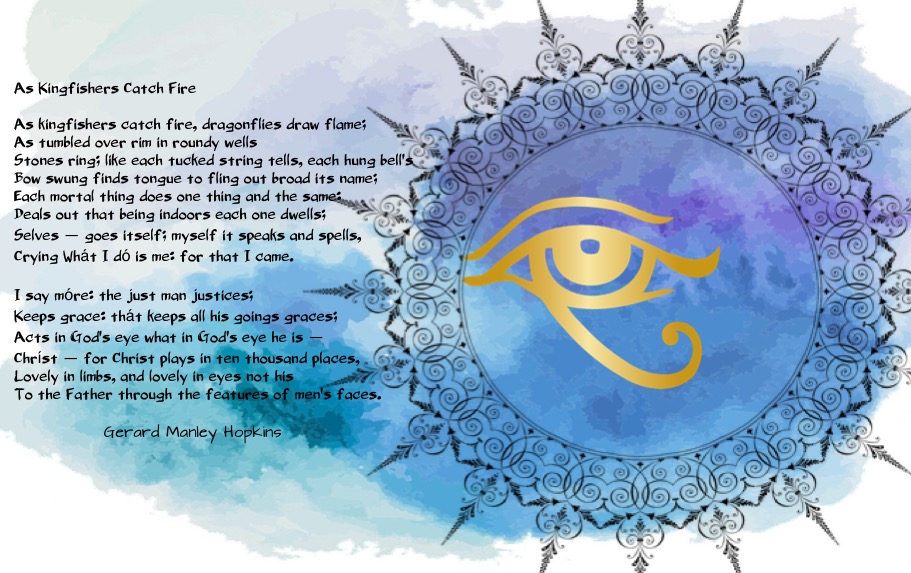
(Look for an extra prayer about “The Eye of God” in another post today.)


However, our psalm alerts us that this deeply personal dimension is only part of relationship with God.

When the just cry out, the LORD hears them,
    and from all their distress he rescues them.
The LORD is close to the brokenhearted;
   and those who are crushed in spirit he saves.

To be seen and heard by God, one must be part of the just community. To be close to God, one must feel the brokenheartedness of the poor. We come to the psalmist’s exuberant praise only by walking with suffering, either in our own lives, or beside others who bear distress.

From all their distress
God rescues the just.

Psalm 34 teaches us that our personal relationship with God is interdependent with our relationship with the whole community. David calls his community to share in his praise-song because they- together -recognize God’s mercy and share it in concern for one another.

The LORD has eyes for the just,
    and ears for their cry.


Our Gospel today confirms that a personal love for God thrives only within a communal love. The prayer Jesus shares is not “My Father”. It is “Our Father”. We come to the depths of God’s merciful heart with our sisters and brothers.


Poetry: An Inclusive Lord’s Prayer – Author unknown

Loving God, 
in whom is heaven, 
may Your name be honored everywhere.
May Your Mercy reign.
May the desire of Your heart for the world 
be done, 
in us, by us and through us.
Give us each and all
the bread we need for the day.
Forgive us.
Free us to forgive others.
Keep us from all anxiety, fear, and selfishness.
For You reign in the power that comes from love 
which is Your glory
forever and ever.
Amen.

Music: Our Father – Joe Wise

Psalm 128: Fear?

Thursday of the Fifth Week in Ordinary Time

February 11, 2021


Today, in God’s Lavish Mercy, we pray with Psalm 128 which some describe as a blueprint for a happy home.

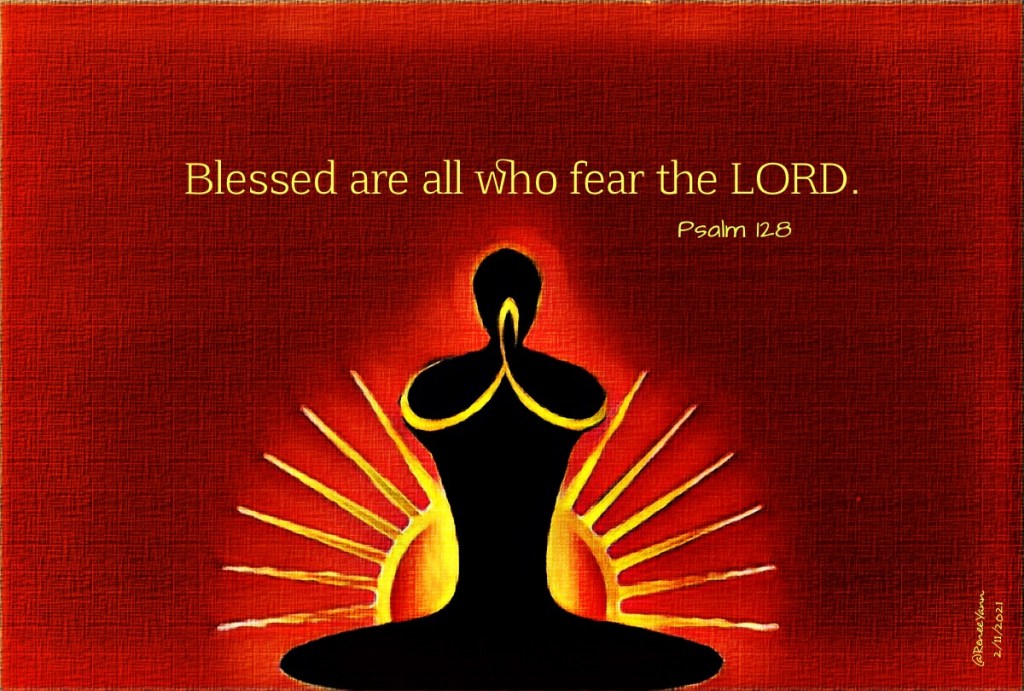
Happy are they all who fear the Lord, 
and who follow in the ways of God!
You shall eat the fruit of your labor;
happiness and prosperity shall be yours.
Your wife shall be like a fruitful vine 
within your house, 
your children like olive shoots 
round about your table.

Psalm 128, Canadian Inclusive Psalter

As lovely as it is, this interpretation may be overly simple. 


Psalm 128, written in the post-exilic period, is the people’s song of gratitude for the chance to return to their homeland after the Babylonian captivity.

For Israel, the captivity was the result of their faithlessness to their covenant with God. The core sentiment of the psalm is awareness, repentance, and conviction to live life more intentionally – to live in fear of the Lord and thus preserve oneself from future calamity:

Blessed are you who fear the LORD,
    who walk in the Lord’s ways!


For us, that word “fear” is a tough one. It seems to contradict our desired relationship with the God who is Love, the God we have met in the person of Jesus Christ. How do we reconcile the contradiction?

Proverbs tells us this:

The fear of the LORD is the beginning of wisdom,
and knowledge of the Holy One is understanding.

Proverbs 9:10

So this “fear” is significantly different from the emotion we might feel when, for example, we hear an unfamiliar noise in our darkened house.

Thus the ‘fear of the Lord’ is a relational term signifying the Israelites’ response to God’s grace displayed in salvation (especially the Exodus). As Walter Brueggemann has aptly written, it means: to take God with utmost seriousness as the premise and perspective from which life is to be discerned and lived. That ‘utmost seriousness’ requires attentiveness to some things rather than others, to spend one’s energies in response to this God who has initiated our life.

Mark J. Boda, Professor of Old Testament, McMaster Divinity College

This, in fact, is the rich sentiment underlying Psalm 128, and that will yield the security of an intimate relationship with God

May the LORD bless you from Zion;
may you see Jerusalem’s prosperity
all the days of your life,
and live to see your children’s children.
Peace upon Israel!

Psalm 128: 4-5
…as our life unfolds in God’s grace.

The psalmist’s “fear” might be more akin to awe, reverence, glad obedience to our God who loves us and wills our good. It is a virtue rooted in our search for a holy awe and wisdom as our life unfolds in God’s Grace:

Old Testament scholar, Walter Brueggemann, says we live in a technological society that has grossly confused knowledge and wisdom. He says wisdom is the mystery, held by God, about how and why life works…how creation holds together…and how human reason has its limits. Wisdom is God’s secret and even our bold Enlightenment expectations barely lay a finger on that secret. Wisdom involves recognizing limits before the mystery of God. Knowledge has to do with control, says Brueggemann. Wisdom has to do with awe.

William M. Klein, Pastor, Lexington Presbyterian Church

Poem: I Am Bending My Knee
Originally from the Carmina Gadelica I, 3. Taken from Esther de Waal, editor, The Celtic Vision (Liguori, MO: Liguori/Triumph, 1988, 2001), p. 7.

I am bending my knee
In the eye of the Father who created me,
In the eye of the Son who purchased me,
In the eye of the Spirit who cleansed me,
In friendship and affection.
Through Thine own Anointed One, O God,
Bestow upon us fullness in our need,
Love towards God,
The affection of God,
The smile of God,
The wisdom of God,
The grace of God,
The fear of God,
And the will of God
To do on the world of the Three,
As angels and saints
Do in heaven;
Each shade and light,
Each day and night,
Each time in kindness,
Give Thou us Thy Spirit.

Music: The Fear of the Lord – First Baptist Dallas (Wow! How about this music ministry!)

Psalm 104: Beautiful Creator

Monday of the Fifth Week in Ordinary Time

Monday, February 8, 2021


Today, in God’s Lavish Mercy, we pray with Psalm 104, a lyrical hymn of praise for the wonders of Creation. As I write this morning, an ermine snow coats the evergreens in soft white feathers. There is a quiet whisper in the trees, like God might make while sleeping

To prepare for prayer, I turn to my favorite theologian who writes extensively about Psalm 104 in his book, From Whom No Secrets Are Hid: Introducing the Psalms.

I have outlined my reading here for those who might like to approach Psalm 104 from Brueggemann’s perspective. If you benefit from his work, I highly recommend his book:

From Walter Brueggemann:

Psalm 104 divides roughly into two parts. The first part (vv. 1–24) provides an inventory of the components of creation, framed by a doxological formula. I suggest that inventory framed by doxology (praise prayer) is a good way to begin our thinking about creation.


In the second half of the poem, verses 25–35, we are offered four themes that may serve as reference points as we trace the paradigmatic power and significance of creation:

  1. Creation and Chaos
    These verses attest to the reliable, generative ordering of creation that makes use of all available creaturely possibilities.

There is the sea, great and wide!
It teems with countless beings,
living things both large and small.
There ships ply their course
and Leviathan,* whom you formed to play with.

Psalm 104: 25-26
  1. Creation and Provision

The creator “gives, gives, opens”; the creatures “gather, receive, eat,” and “are filled.” This transaction between the giver and the recipients is endless, reliable, and necessary. The creatures are always on the receiving end of the generous giving of the creator.

These all look to you to give them their food in due season;
when you give it to them, they gather it up;
when you open your hand,
they are filled with good things.

Psalm 104: 27-28
  1. Creation and Ruach

“Rauch” is a Hebrew word which images God as a breath, a wind, or a life force that sustains all living things, human beings included. in Psalm 104, “rauch” describes God’s generous, life-initiating, life-sustaining gift of vitality without which no creature can live:

When you hide your face, they panic.
Take away their breath, they perish
and return to the dust.
Send forth your spirit, they are created
and you renew the face of the earth.

Psalm 104: 29-30
  1. Creation and Righteous Judgement 

Righteousness is glad acceptance of the good ordering of reality given and guaranteed by the creator, an ordering that culminates in confident Sabbath from all our destructive drives for self-worth.

May sinners vanish from the earth,
and the wicked be no more.
Bless the LORD, my soul! Hallelujah!

Psalm 104: 35

My humble prayer, wrought in light of Brueggemann’s elegant theology is this:

I praise and thank You, God, for the wonder of Creation.
I am in awe of your Power to order all things toward Beauty.
From that balance of beauty and power,
you offer me the joys and challenges of life.
You sustain and nourish me, even in the overwhelming times.
I want to respond fully and gratefully
to your creative power in my life and in our world.
Please give me clarity and courage
to live within your life-giving creative Grace.

Amen


Poetry: The Creation by James Weldon Johnson (1871-1938)


And God stepped out on space,
And he looked around and said:
I’m lonely—
I’ll make me a world.

And far as the eye of God could see
Darkness covered everything,
Blacker than a hundred midnights
Down in a cypress swamp.

Then God smiled,
And the light broke,
And the darkness rolled up on one side,
And the light stood shining on the other,
And God said: That’s good!

Then God reached out and took the light in his hands,
And God rolled the light around in his hands
Until he made the sun;
And he set that sun a-blazing in the heavens.
And the light that was left from making the sun
God gathered it up in a shining ball
And flung it against the darkness,
Spangling the night with the moon and stars.
Then down between
The darkness and the light
He hurled the world;
And God said: That’s good!

Then God himself stepped down—

And the sun was on his right hand,
And the moon was on his left;
The stars were clustered about his head,
And the earth was under his feet.
And God walked, and where he trod
His footsteps hollowed the valleys out
And bulged the mountains up.

Then he stopped and looked and saw
That the earth was hot and barren.
So God stepped over to the edge of the world
And he spat out the seven seas—
He batted his eyes, and the lightnings flashed—
He clapped his hands, and the thunders rolled—
And the waters above the earth came down,
The cooling waters came down.

Then the green grass sprouted,
And the little red flowers blossomed,
The pine tree pointed his finger to the sky,
And the oak spread out his arms,
The lakes cuddled down in the hollows of the ground,
And the rivers ran down to the sea;
And God smiled again,
And the rainbow appeared,
And curled itself around his shoulder.

Then God raised his arm and he waved his hand
Over the sea and over the land,
And he said: Bring forth! Bring forth!
And quicker than God could drop his hand,
Fishes and fowls
And beasts and birds
Swam the rivers and the seas,
Roamed the forests and the woods,
And split the air with their wings.
And God said: That’s good!

Then God walked around,
And God looked around
On all that he had made.
He looked at his sun,
And he looked at his moon,
And he looked at his little stars;
He looked on his world
With all its living things,
And God said: I’m lonely still.

Then God sat down—
On the side of a hill where he could think;
By a deep, wide river he sat down;
With his head in his hands,
God thought and thought,
Till he thought: I’ll make me a man!

Up from the bed of the river
God scooped the clay;
And by the bank of the river
He kneeled him down;
And there the great God Almighty
Who lit the sun and fixed it in the sky,
Who flung the stars to the most far corner of the night,
Who rounded the earth in the middle of his hand;
This great God,
Like a mammy bending over her baby,
Kneeled down in the dust
Toiling over a lump of clay
Till he shaped it in is his own image;

Then into it he blew the breath of life,
And man became a living soul.
Amen. Amen.

Music: Creation Song – Fernando Ortega

Psalm 96: There Are No Others

Memorial of Saints Timothy and Titus, bishops

January 26, 2021


Today, in God’s Lavish Mercy, we pray with Psalm 96, a call to witness God’s sovereignty over and faithfulness to the whole world.

The tone of Psalm 96 is slightly different from some other psalms which call for national rejoicing. It does not suggest that God loves Israel better than other nations, therefore taking their side in history. Psalm 96 simply encourages gratitude for and witness to God’s saving power:

Sing to the LORD a new song;
    sing to the LORD, all you lands.
Sing to the LORD; bless his name.
R.    Proclaim God’s marvelous deeds to all the nations.
Announce his salvation, day after day.
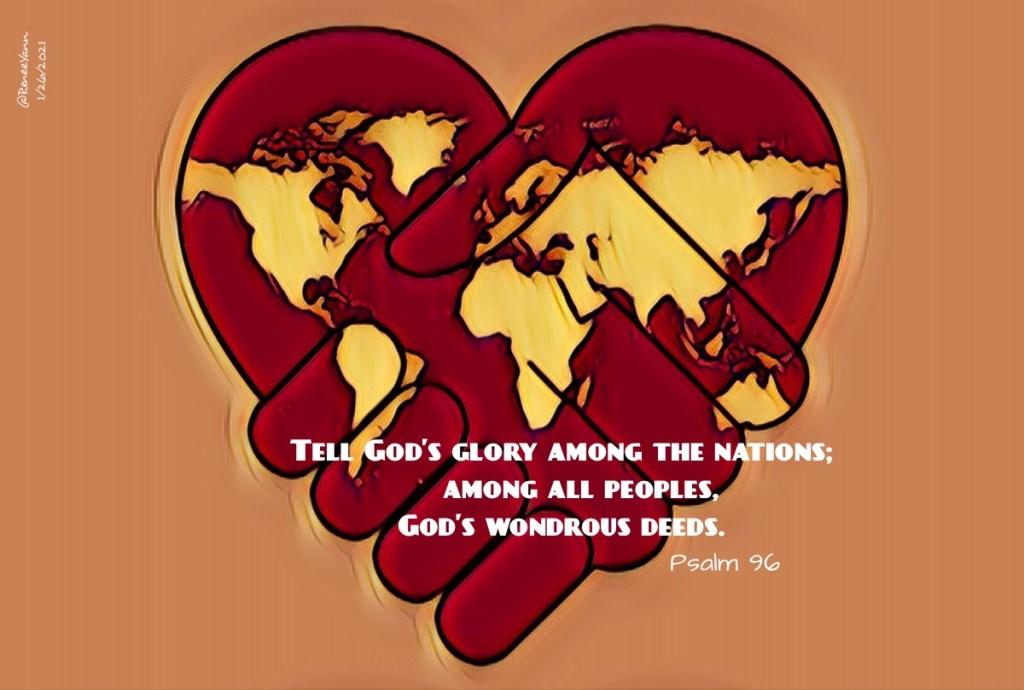
Tell his glory among the nations;
    among all peoples, his wondrous deeds.

Psalm 96: 1-3

Like Israel, we walk a fine line in discerning how God loves us, both individually and as a member of the many “tribes” with which we align ourselves. Does God love Americans more? Or white people? Or Black people? Or Italians? Or the Irish? Or straight people? Or Christians? Or the wealthy? Or Phillies fans? (Well, yeah, probably Phillies fans 🙂 )


Ramana Maharshi (1879 – 1950) was an Indian Hindu sage. He is regarded by many as an outstanding enlightened being. He was a charismatic person, and attracted many devotees,
some of whom saw him as an avatar and the embodiment of Shiva.

He was once asked,
“How should we treat others?”
He replied,
“There are no others.”


It seems that we have some innate need to compare ourselves favorably against “others”. That need, unchecked and fed by fear, is at the root of any oppressive nationalism, such as the white Christian nationalism we saw displayed in the assault on the U.S. Capitol.

Jason Meyer, Pastor for Preaching and Vision in Minneapolis, writes this:
” We must always reject any attempt to fuse together one’s national/political identity with one’s Christian identity in a way that equates or conflates allegiance to country with allegiance to God.”


In an excellent article from Sojourners, Walter Brueggemann elucidates the prophet’s role in contradicting the forces that enshrine the totalism which leads to idolatries like distorted nationalism.
(totalism: the practice of a dictatorial one-party state that regulates every form of life such as that which existed under King Solomon in ancient Israel)


Psalm 96 gives us another view of what really made Israel “chosen” – their example to all nations to praise our shared Creator as the Source of all stability and equity.

Give to the LORD, you families of nations,
    give to the LORD glory and praise;
    give to the LORD the glory due his name!
R.    Proclaim God’s marvelous deeds to all the nations.
Say among the nations: The LORD is king.
Who made the world firm, not to be moved;
    who governs the peoples with equity.

Psalm 96: 7-8

Poetry: For Whom the Bell Tolls – John Donne

No man is an island,
Entire of itself.
Each is a piece of the continent,
A part of the main.
If a clod be washed away by the sea,
Europe is the less.
As well as if a promontory were.
As well as if a manor of thine own
Or of thine friend's were.
Each man's death diminishes me,
For I am involved in mankind.
Therefore, send not to know
For whom the bell tolls,
It tolls for thee.

Music: Imagine – John Lennon

Psalm 27: How to Wait!

Friday of the First Week of Advent

December 4, 2020


Today, in God’s Lavish Mercy, we pray with Psalm 27 with its glorious opening salvo:

The Lord is my light and my salvation.
Of whom should I be afraid?


 Psalm 27 reminds us that, amidst all the fluster of life, there is only one thing that matters:

One thing I ask of the LORD;
this I seek:
To dwell in the house of the LORD
all the days of my life,
That I may gaze on the loveliness of the LORD
and contemplate his temple.

Psalm 27:4

The hard part, as the psalmist tells us, is to wait – not just to wait for heaven at the end of it all – but to wait to discover God in each moment. 

I find waiting to be pretty challenging, especially when I’m waiting for something over which I have no control.

Sometimes God seems pretty buried in our lives and in the clamor of the world. It’s tough to wait with hope when we just can’t see the Beloved.


But our psalm charges us to practice hopeful waiting for the grace that comes to us in every moment.

May we wait with courage, hope, and confidence for the gift God eternally gives us.


Poem: from Awed to Heaven, Rooted to Earth by Walter Brueggemann 

In our secret yearnings
we wait for your coming,
and in our grinding despair
we doubt that you will.

And in this privileged place
we are surrounded by witnesses who yearn more than do we
and by those who despair more deeply than do we.

Look upon your church and its pastors
in this season of hope
which runs so quickly to fatigue
and this season of yearning
which becomes so easily quarrelsome.

Give us the grace and the impatience
to wait for your coming to the bottom of our toes,
to the edge of our finger tips.

We do not want our several worlds to end.
Come in your power
and come in your weakness
in any case and make all things new.
Amen.

Music: Waiting – by Isisip

Psalm 19: Declare God’s Glory

Feast of Saint Matthew, Apostle and Evangelist

September 21, 2020


Today, in God’s Lavish Mercy, we pray with Psalm 19, one of the unique “Torah Psalms” (1, 19, 119) in which Israel celebrates the divine structure of life in all Creation, including ourselves.

James Luther Mays, in his article The Place of the Torah-Psalms in the Psalter, suggests that these psalms serve as a guide to how all the other psalms are to be read, interpreted and prayed.


Walter Brueggemann describes life without God as “normless” – without the structure of grace and relationship with God that holds all Creation in abundant Life. He refers to the Torah as a “norming” dynamism, and writes:

And when Israel … used the term “Torah” (never meaning simply or simplistically “law”), it refers to the entire legacy of norming that is elastic, dynamic, fluid, and summoning. The outcome of that legacy in the Psalter is the great Torah Psalms in which Israel celebrates, with joy, that the creator God has not left the world as a normless blob but has instilled in the very structure of creation the transformative capacity for enacted fidelity. That is why Psalm 19 juxtaposes the glory of creation that attests the creator (vv. 1–6) with the commandments that are the source of life.


Our verses today for the Feast of St. Matthew include this phrase…

Their message goes out through all the earth.

… perhaps equating the universal ministry of the Apostles to the transformative power and witness of the heavens to God’s immutable glory.

The heavens declare the glory of God;
and the firmament proclaims his handiwork.
Day pours out the word to day,
and night to night imparts knowledge.
Not a word nor a discourse
whose voice is not heard;
Through all the earth their voice resounds,
and to the ends of the world, their message.


The teaching of the Apostles is codified for Catholics in the Apostles Creed. We might want to pray it slowly today, attentive to those “norming ” beliefs – our sort of fundamental “Torah” – which hold our lives in graceful relationship with God through Jesus Christ.

Apostles Creed

I believe in God, the Father Almighty, 
Creator of Heaven and earth;
and in Jesus Christ, His only Son Our Lord,
Who was conceived by the Holy Spirit, 
born of the Virgin Mary, 
suffered under Pontius Pilate, 
was crucified, died, and was buried.
He descended into Hell; 
the third day He rose again from the dead;
He ascended into Heaven, 
and sits at the right hand of God, the Father almighty; 
from thence He shall come to judge the living and the dead.
I believe in the Holy Spirit, 
the holy Catholic Church, 
the communion of saints, 
the forgiveness of sins, 
the resurrection of the body 
and life everlasting.
Amen.

Poetry: XIX Caeli Ennarant by Malcolm Guite

In that still place where earth and heaven meet
Under mysterious starlight, raise your head
And gaze up at their glory:  ‘the complete

Consort dancing’ as a poet said
Of his own words. But these are all God’s words;
A shining poem, waiting to be read

Afresh in every heart. Now look towards
The brightening east, and see the splendid sun
Rise and rejoice, the icon of his lord’s

True light. Be joyful with him, watch him run
His course, receive the gift and treasure of his light
Pouring like honeyed gold till day is done

As sweet and strong as all God’s laws, as right
As all his judgements and as clean and pure,
All given for your growth, and your delight!


Music: Wonderland – David Nevis