A Love in Troubled Times

Friday of the Fifth Week of Lent

April 3, 2020

Click here for readings

Today, in Mercy, as we inch closer to Holy Week, we meet both a very troubled Jeremiah and Jesus.

V0034343 The prophet Jeremiah wailing alone on a hill. Engraving.
The Prophet Jeremiah Weeping Alone on a Hill (from the Wellcome Trust)

Jeremiah, the Old Testament mirror of Jesus’s sufferings, bewails the treachery even of his friends:

I hear the whisperings of many:
“Terror on every side!
Denounce! let us denounce him!”
All those who were my friends
are on the watch for any misstep of mine.

That’s really raw, because you can get through almost anything in the company of true friends.



Jesus weeps
Jesus Weeping Over Jerusalem by Ary Scheffer (1795-1858)

Jesus came as a Friend and hoped to find Friends of God by his ministry. And he did find many. But not all.

It takes some work to be a true friend of Jesus. Some didn’t have the courage, or generosity, or passion, or hopeful imagination to reach past their self-protective boundaries – to step into eternal life even as they walked the time-bound earth.

In today’s Gospel this band of resisters project their fears and doubts to the crowds around them. The evil sparks light the ready tinder of human selfishness. The mob turns on Jesus, spiritual misers scoffing at the generous challenge to believe.

Jesus pleads with them to realize what they are doing:

If I do not perform my Father’s works, do not believe me;
but if I perform them, even if you do not believe me,
believe the works, so that you may realize and understand
that the Father is in me and I am in the Father.

But Jesus and Jeremiah, though troubled, are grounded in God. Our Responsorial Psalm captures what might have been their silent prayer:

Psalm18 distress

The following transliteration of Psalm 18, composed by Christine Robinson, might help us to be with Jesus in his moment, and in our own moments of fear, anxiety, or doubt.

I open my heart to you, O God
for you are my strength, my fortress,
the rock on whom I build my life.

I have been lost in my fears and my angers
caught up in falseness, fearful, and furious
I cried to you in my anguish.
You have brought me to an open space.
You saved me because you took delight in me.
I try to be good, to be just, to be generous
to walk in your ways.
I fail, but you are my lamp.
You make my darkness bright
With your help, I continue to scale the walls
and break down the barriers that fragment me.
I would be whole, and happy, and wise
and know your love
Always.

Music: Overcome – Psalm 18 by James Block

Hard-Hearted?

Saturday of the Fourth Week of Lent

March 28, 2020

Click here for readings

Today, in Mercy, danger continues to escalate for Jesus.

Our first reading from Jeremiah foreshadows Jesus’s situation. Some powerful people didn’t want to hear what Jeremiah preached. And we can understand why: Jeremiah prophesied the destruction of Jerusalem because of Israel’s unfaithfulness. It’s a message that was hard to swallow.

jeremiah


The core of Jeremiah’s teaching was this:
You people have to change. This is not the way God created the world to be.

But the people couldn’t listen. They had let the skewed reality of their lives become normal and needed. They couldn’t accept the world of mutual love and justice that God imagined for them.


Jesus meets the same kind of stonewalling.

In today’s passage, the hard-hearted rationalize their resistance:

“The Christ will not come from Galilee, will he?
Does not Scripture say that the Christ will be of David’s family
and come from Bethlehem, the village where David lived?”

But their antagonism isn’t really about geography and lineage. It’s about blind comfort in a world balanced toward their advantage. It’s about the fear of grace-inspired change.


Lk8_generous heart
Isn’t it the truth that we’ll use almost any argument to resist what demands our conversion? I understand why these guys “each went to his own house”, as the Gospel says in closing. They took refuge from grace in the little pretense of their own control.

They didn’t have the courage to open their hearts to Jesus. Do we?

Music:  Spirit, Open My Heart –  Alfred V. Fedak

(P.S. For those who grew up with classic rock and roll, check out the second song below.)


Second Song:
While I was drawing today’s picture, I was listening to my 50s playlist. Please don’t think me irreverent, but I was struck how this song (written by Hank Williams and sung by Jerry Lee Lewis) could really be God singing to cold-hearted humanity. I also thought some of you might need a little rock and roll as much as I do right now 🙂 Lyrics below.

Cold Cold Heart
I tried so hard my dear to show that you’re my every dream.
Yet you’re afraid each thing I do is just some evil scheme
A memory from your lonesome past keeps us so far apart
Why can’t I free your doubtful mind and melt your cold cold heart

Another love before my time made your heart sad and blue
And so my heart is paying now for things I didn’t do
In anger unkind words are said that make the teardrops start
Why can’t I free your doubtful mind, and melt your cold cold heart
You’ll never know how much it hurts to see you sit and cry
You know you need and want my love yet you’re afraid to try
Why do you run and hide from life, to try it just ain’t smart
Why can’t I free your doubtful mind and melt your cold cold heart
There was a time when I believed that you belonged to me
But now I know your heart is shackled to a memory
The more I learn to care for you, the more we drift apart
Why can’t I free your doubtful mind and melt your cold cold heart

Turn and See

Thursday of the Second Week of Lent

March 12, 2020

Click here for readings

Today, in Mercy, our readings offer us studies in dramatic contrasts.

the barren bush in a lava waste
vs.
the tree planted beside the waters

that turns its roots to the stream

Jere17_7barrentree


a rich man who dressed in purple garments and fine linen

vs.
a poor man named Lazarus, covered with sores

Gustave_Dore_Lazarus_and_the_Rich_Man
Lazarus and the Rich Man by Gustave Dore (1891)


What are Jeremiah and Jesus teaching us with these unforgettable images?

Jeremiah summarizes his point in the very first verse:

Cursed is the one who trusts in human beings,
who seeks strength in flesh,
whose heart turns away from the LORD.

In his parable, Jesus has Abraham deliver the point:

You received what was good during your lifetime
while Lazarus likewise received what was bad;
but now he is comforted here, whereas you are tormented.


Praying with these passages, we might determine to make sure we don’t end up like the barren bush or the ultimately tormented rich person. 

But how can we do that?

I think the key lies in Jeremiah’s phrase, “one whose heart turns away from the LORD.” 

In his parable, Jesus shows us what that “turning” looks like. It is any blind indifference in us that allows us to ignore another’s suffering. 

Most of us don’t consciously choose that indifference. We simply fail to turn from our own comfort … plans, needs, agenda … to observe the pain or need around us.

So as we leave our prayer today, perhaps we can do so determined to turn from our self-interests … to see if there is a “Lazarus” right beside us whom we had failed to notice.

Music: Turn My Heart – Lynn DeShazo (Lyrics below)

Turn my heart O Lord
Like rivers of water
Turn my heart O Lord
By Your hand
‘Til my whole life flows
In the river of Your Spirit
And my name
Bring honor to the Lamb

Lord I surrender to
Your work in me
I rest my life within
Your loving hands

(Repeat chorus 3 times)

‘Til my name brings honor
To the Lamb

The Lamb of God

Saturday, April 6, 2019

Click here for readings

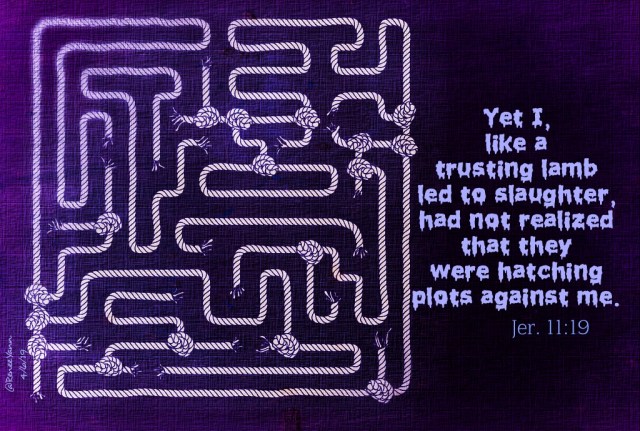
Today, in Mercy, our hearts begin to break for Jesus. He is the good, sweet Lamb being led to slaughter. And he knows it. He knows that the hard hearts he had so hoped to soften are recalcitrant. He knows that the souls he has longed to open to Love have turned to hate. He knows that the energy he had wished to turn to generous service has instead turned inward, fearful and self- protective.

How his heart must have ached in these days before Calvary! Jeremiah gives us an insight in to the pain in today’s first reading. 

Jeremiah’s experience is a foreshadowing of Christ’s. As we pray with the passage, we might allow ourselves simply to share that pain as we look at our own grace-resistant world.

Jer.11_19 plot

Where do we find the opportunity to comfort Jesus today?

On a global basis, we see the persecution of innocence and vulnerability in our own world. We see corrupted laws used as an excuse to extinguish the human spirit. We see people coerced into the maze of power and political domination. We see the poor slaughtered on the altar of indifferent greed.

In our closer daily experience, we see people lost, isolated, infirm, bereaved, lonely and broken, even in small places. We may be tempted to leave their suffering for another caring touch. But we can do much to comfort by our listening, presence and honesty.

When we see these things, we see the Passion of Christ in our time. Let us listen to His suffering. Let us not pretend we care if we don’t act to comfort Him.

Music: Handel’s Messiah: Behold the Lamb of God


Got Troubles? Try These!

Sunday, February  17, 2019

Click here for readings

Today, in Mercy, hidden in our readings, are three challenges.

Where do we put our

faith

and

hope

How do we

love

?


In our Jeremiah reading, an unfortunate person has placed faith in an untrustworthy “friend”, and the results – typical of Jeremiah – are dire. But the prophet goes on to say that the one who puts trust and faith in the Lord will flourish like a tree near running water.

Jer17_7 tree

In the reading from Corinthians, Paul has some strong words about hope:

If for this life only we have hoped in Christ,
we are the most pitiable people of all.

That sentence is powerful! It can be a life-long meditation.

In other words, where is our hope focused? Do we hope for comfort, success, healing, peace only for this earthly life? If so, we are missing the point, Paul says. Our one true hope is to be united with God in eternal life and our choices should lead to that fulfillment.

In our Gospel, Jesus shows us how to love by placing before us the “least ones” whom he loves best. We too are to love and comfort those who are poor, hungry, bereaved and despised by the heartless.

Today’s readings invite us to look at our life. Is it blossoming with joy, grace and spiritual vitality? Or are we struggling with all the doubts, worries, dramas and depression that come from a self-absorbed life?

Maybe, like me, you sometimes look at a person carrying great difficulty in their lives and wonder at their joy. How can they maintain that trust and joy in the midst of their challenges? These readings offer an answer. They have put their faith and hope in the right place. They have learned to love like God.

Music: Faith, Hope and Love ~ David Ogden ( Lyrics below.)

Faith, hope, and love: let these remain among you.
Faith, hope, and love: the greatest of these is love.

The love of Christ has gathered us together; let us rejoice and be glad in him.
Let us fear and love the living God, and love each other from the depths of the heart.

When we are together, we should not be divided in mind;
Let there be an end to bitterness and quarrels, and in our midst be Christ our God.

In company with the blessed, may we see your face in glory,
pure and unbounded joy for ever and ever.

I give you a new commandment, love one another as I have loved you.
Faith, hope, and love, let these remain among you.
Faith, hope and love; the greatest of these is love.

Walk the Bridge

Sunday, February 3, 2019

Click here for readings

Today, in Mercy,  we begin our readings with God’s stern but magnificent commission to the prophet Jeremiah: 

… stand up and tell them
all that I command you.

What Jeremiah had to tell the Israelites was not good news. He prophesied that if they didn’t repent from their idolatry, Jerusalem would fall into the hands of foreign oppressors. Nobody wanted to hear it. They led Jeremiah a life, to the point that he is often referred to as “The Weeping Prophet”. Over the course of forty years and reign of five Judean kings, Jeremiah’s message continues until, in the end, it comes to fulfillment in the Babylonian Captivity.

How did Jeremiah sustain such confrontational preaching in the face of intractable resistance?

love is the bridgeJPG

Perhaps the answer lies in our second reading. He did it out of love.

Arthur Cundall, a British scripture scholar writes:

“God wanted a person
with a very gentle and tender heart
for this unrewarding ministry of condemnation.
Jeremiah’s subsequent career shows that
he had this quality in full measure.”

Jeremiah is a living example of the loving, humble, truth-seeking, hope-impelled soul described in 1 Corinthians, our second reading.

In Luke’s Gospel today, we see Jesus rejected in the same manner as Jeremiah. Jesus’s message asks his listeners for deep conversion of heart in order to be redeemed. Like the ancient Israelites, they don’t want to hear it. They cannot break through their comfortable existence to acknowledge its emptiness.

The message for us today? Is there an emptiness somewhere in our hearts that we have not yet given over to God? Are we filling it with “false gods”, rather than the loving virtues described in Corinthians?

We know where our “dead spaces” are, and we deeply intend them to come alive again. Today, let’s begin to walk the bridge from intention to practice.

Music:  Can’t help it. I love it.

This Ancient Love

Wednesday, August 8, 2018

Readings: http://www.usccb.org/bible/readings/080818.cfm

Today, in Mercy,  our readings focus on the infinite mercy of God — the Lavish Mercy of God.

ancient love Jer 31_3

Jeremiah speaks God’s voice to the ancient Israelites, forgiving them, consoling them, encouraging them. He promises that, delivered from their captivity, they will rejoice and “come streaming into the Lord’s blessings”.

In our Gospel, even an outcast woman receives the mercy of Jesus. She received this for two reasons: her faith was both extraordinary and unrelenting for her daughter.

Both Israel and the Canaanite woman are in desolate situations. They are bereft of nearly everything but hope and faith. We may have felt like that sometimes. Certainly there are people throughout our world who feel like that today.

As we pray today, we can place any desolation we are carrying, and the desolation of suffering people across the world, into the open arms of God. God has and will always love us and, even though unseen, is guiding us to the fullness of life. May our faith be extraordinary and unrelenting.

Music: This Ancient Love ~ Carolyn McDade

The Work of God’s Hands

Thursday, August 2, 2018

Readings: http://www.usccb.org/bible/readings/080218.cfm

Today, in Mercy, Jeremiah provides us with the memorable image of the potter and the clay.

If you have ever worked in ceramics or sculpting, you know how the artist becomes one with her work. A shapeless lump of earth takes on an identity within your hands. Ever so delicately, you work to find the potential beauty in the clay. We might begin over and over until we find the perfect dynamic between our hands and the malleable clay.

Jer18_5 potter

Just the right touch, the perfect pressure, and something new – never here before – emerges. The new creation, while existing itself, holds the Potter’s character. It embodies her effort and hope. It is a physical testimony to her dream.

In this scripture passage, God is telling Jeremiah that this is how it is with Israel (and in place of Israel, we can read our own names.) Through the circumstances and opportunities of our lives, God is shaping his dream – the Divine hope for a loving creature who reflects the beauty of God.

As we deepen in our spiritual life, we become more sensitive to God’s touch, more aware of God’s creative presence in our lives. God reworks us, offering us the perfection of grace over the course of our lifetimes. May we have the wisdom to yield to God’s intention in our lives – to make, as Mother Theresa says, “something beautiful for God”.

Music: Abba, Father ~ John Michael Talbot

How Does God Think We Are Doing?

Tuesday, July 31, 2018

Readings: http://www.usccb.org/bible/readings/073118.cfm

Today, in Mercy, the readings from Jeremiah and Matthew squarely place the reality of sin in our sight. Nobody likes to talk about sin, at least if they’re normal. We like to talk about fun, success, winning, freedom, prosperity. But when the distortion of these things get in the way of our relationship with God and neighbor, then we’re talking about sin.

Ps79 Deliver usJPG

How do you feel about our world today? The small area of my world is abundantly blessed and happy, as I hope yours is. The inhabitants of Jeremiah’s world felt the same way — until the devastation touched them! Then they realized that their “comfortable “ world was woefully out of line with God’s hope.

They had been blind to the sin around them, and their –  perhaps –  unwitting part in it. Ultimately, they were visited with destruction. We might read their plight and say, “Oh well, they worshipped false idols.  No wonder God was displeased with them.”

A better read might be:

  • Are there any false gods in my life? Who or what do I really worship above all things?
  • Are there false gods in our world? How do I respond to them- in the political arena, in the workplace, in my social sets?

The world is so much bigger than our  living rooms or offices. And we are called to be faithful witnesses to God in that bigger world. How are we doing? Today, Jeremiah and Jesus offer us an examination of conscience.

Today is also the feast of St. Ignatius Loyola. This is a version of the five-step Daily Examen that St. Ignatius practiced.

  1. Become aware of God’s presence.
  2. Review the day with gratitude. 
  3. Pay attention to your emotions.
  4. Choose one feature of the day and pray from it.
  5. Look toward tomorrow.

For more on Ignatian spirituality see:

Click here to go to Ignatian Spirituality website

Music: Take, Lord, Receive – The Prayer of St. Ignatius by John Foley

Would God Divorce Us?

Saturday, July 28, 2018

Readings:  http://www.usccb.org/bible/readings/072818.cfm

Today, in Mercy, we hear from Jeremiah, a “sock-it-to-‘em” prophet. He lived in a disastrous time for Judah, and had to deliver some difficult challenges to the people. Today’s passage is called the Temple Sermon. It confronts his listeners with the fact that there is a big difference between their professed faith and their daily practice. In other words, they are living a lie.

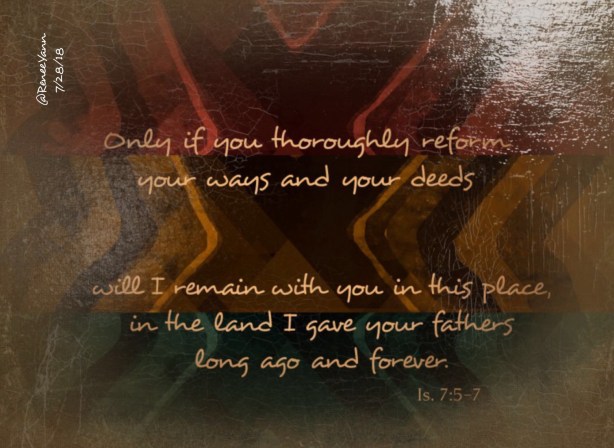
Jeremiah7_5

The people seem to think that no matter how idolatrous or immoral their choices are, the Temple building will protect them from God’s anger. It’s a mentality that might remind us of the film “The Godfather”, where the mafioso kill and cheat all week but always fulfill their sacramental obligations.

God tells Jeremiah to go stand at the Temple gate and tell the people that their fake piety won’t work. Instead they are to:

  • thoroughly reform their ways and deeds
  • deal justly with their neighbor
  • no longer oppress the resident alien, the orphan, and the widow
  • no longer shed innocent blood in this place (cease human sacrifice)
  • or follow strange gods to their own harm

Otherwise, Jeremiah says, they risk losing God because God will not live in a desecrated Temple.

The message to us that comes wrapped in the ancient words of Jeremiah?

  • Examine your life.
  • Is our faith sincere, proven by our practices?
  • Do we give others not only the benefit of the doubt, but also the benefit of our kindness?
  • Do we support and foster immigrants, orphans, widows … in other words the vulnerable?
  • Do we stand against the suffering of innocents caused by war and unjust policy?
  • Do we resist the “gods” competing for our souls — all the destructive isms and addictions of our time?

Otherwise, Jeremiah says, we risk losing God because God will not live in a heart-temple that is desecrated.

Music: Fill This Temple – Don Moen

https://m.youtube.com/watch?v=r1CIpLFywdc