Today, in God’s Lavish Mercy, we pray with Psalm 57, a prayer of fervent praise to our awesome God.
Photo credit: Neil Rosenstech @neilrst
The act of prayerful praise can be hard to understand . The concept of human praise can get in our way.
Prayerful praise in not flattery, or compliments, or the giving of deserved admiration to a distant God. Rather, as Psalm 57 shows us, it is an outpouring of reverent gratitude before Unimaginable Love.
Be exalted above the heavens, O God; above all the earth be your glory!
Psalm 57:12
Such a prayer rises from our heart’s awestruck silence not only to be in the Presence of, but to be loved by such Divine Wonder.
We may not be able to stand before a majestic mountain today to image God’s magnificence as we pray. But we can bow our hearts before the abundant evidence of God’s love for us. God created us and holds us in love with every breath we take.
Today, we may simply want to breathe our praise.
Poetry:Why I Wake Early by Mary Oliver
Hello, sun in my face.
Hello, you who make the morning
and spread it over the fields
and into the faces of the tulips
and the nodding morning glories,
and into the windows of, even, the
miserable and crotchety–
best preacher that ever was,
dear star, that just happens
to be where you are in the universe
to keep us from ever-darkness,
to ease us with warm touching,
to hold us in the great hands of light–
good morning, good morning, good morning.
Watch, now, how I start the day
in happiness, in kindness.
Today, in God’s Lavish Mercy, we pray with Psalm 118.
“This psalm is centered on God, in a movement that expresses gratitude, admiration, joy and praise. In the King James Version, the Lord is mentioned in almost every verse.” (Wikipedia)
Give thanks to the LORD who is good, whose mercy endures forever. It is better to take refuge in the LORD than to trust in humans. It is better to take refuge in the LORD than to trust in princes.
Psalm 118: 1, 8-9
Following our first reading today, the psalm focuses me on God’s Name – often “Lord”, as in the psalm – but also so many other Names of God from the riches of scripture and tradition.
… in the Name of Jesus, this man stands before you healed. He is the stone rejected by you, the builders, which has become the cornerstone. There is no salvation through anyone else, nor is there any other name under heaven given to the human race by which we are to be saved.
Acts 4: 10-12
The fact that we have so many names for God reminds me of how accommodating God is to my need as I pray.
One day I need “My Rock”.
Another day I delight in “My Dayspring”.
As I wake up each morning and allow the day to embrace me, I often greet God with a special name, depending on the mood and circumstances of my heart:
Good morning, Beautiful Light. Take any darkness from our world this day.
I greet You, Sweet Lord. Thank you for the delicious gift of life.
Cloudy God, you have been hiding from me. Bring me into your Sunshine today.
God, my Strong Shoulder, stand by me today.
Chilly God, seeming to ignore my prayer, unfreeze my spirit to hear your answer.
Jesus invites us to pray with images that speak to our hearts. In our Gospel, He names himself a Shepherd, an image so accessible to his agrarian listeners, and which said it all without the need for theology!
Jesus said: “I am the good shepherd. A good shepherd lays down his life for the sheep.”
John 10:11
As we pray today, within what image is God coming to us? May we let the Holy One speak a sanctifying and special Name over us in our prayer. May it free us just as it freed the man healed in today’s passage from Acts.
Poetry: Six Recognitions of the Lord – Mary Oliver
1.
I know a lot of fancy words.
I tear them from my heart and my tongue.
Then I pray…..
3 I lounge on the grass, that’s all. So simple. Then I lie back until I am inside the cloud that is just above me but very high, and shaped like a fish. Or, perhaps not. Then I enter the place of not-thinking, not-remembering, not- wanting. When the blue jay cries out his riddle, in his carping voice, I return. But I go back, the threshold is always near. Over and back, over and back. Then I rise. Maybe I rub my face as though I have been asleep. But I have not been asleep. I have been, as I say, inside the cloud, or, perhaps, the lily floating on the water. Then I go back to town to my own house, my own life, which has now become brighter and simpler, some-where I have never been before….
4.
Of course I have always known you
Are present in the clouds, and the
Black oak I especially adore, and the
Wings of birds. But you are present
Too in the body, listening to the body,
Teaching it to live, instead of all
That touching, with disembodied joy.
We do not do this easily….
6.
Every summer the lilies rise and open their white hands until they almost cover the black waters of the pond. And I give thanks but it does not seem like adequate thanks, it doesn’t seem festive enough or constant enough, nor does the name of the Lord or the words of thanksgiving come into it often enough Everywhere I go I am treated like royalty, which I am not. I thirst and am given water. My eyes thirst and I am given the white lilies on the black water. My heart sings but the apparatus of singing doesn’t convey half what it feels and means. In spring there’s hope, in fall the exquisite, necessary diminishing, in winter I am as sleepy as any beast in its leafy cave, but in summer there is everywhere the luminous sprawl of gifts, the hospitality of the Lord and my inadequate answers as I row my beautiful, temporary body through this water-lily world.
Music: Two Songs for today
Kyrie – Michael Hoppé
Kyrie Eleison Lord, have Mercy
For those who might want to take it up a notch: Kyrie – Mr. Mister
Today, in God’s Lavish Mercy, we pray with Psalm 130, the De Profundis. This is a transformative prayer whose power we may not fully realize.
Have you ever been disappointed with God? Have you ever let God know it in your prayer?
Psalm 130 is the psalmist’s complaint to God that things are as bad as they can get and God doesn’t appear to care. It is a plea – even a demand- for God to pay attention and do something. (See my poem, sent a little later, called “These Things”.)
Out of the depths I cry to you, O LORD; LORD, hear my voice! Let your ears be attentive to my voice in supplication.
But Psalm 130 is not just a private complaint. As well as being a penitential psalm, 130 is marked as a “Psalm of Ascent”. This means that it was sung by the community as they went to the Temple to worship.
Psalm 130 carries the tone of a national or global lament. It has the feeling of a deeply bruised people bearing a desperate hope mixed with some bewilderment. It is a feeling we all recognize.
Remembrance of Lives Lost to Covid 19
Yesterday in my neighborhood, we had our first hint of spring weather. On a short walk, I met a few people whose winter-weary eyes, above their masks, held a spark of resurrection hope.
With distribution of COVID vaccines, hope for deliverance from the pandemic surfaces like a tentative bud. We are starting the slow ascent from the depths we have all shared. We are on our way to the temple of thanksgiving and praise.
But Psalm 130 reminds that, on that ascent, fully voicing our lament is imperative for true healing. In reference to the pandemic, and to any other devastation we face in life, we must be honest with God about our fear, confusion, sadness, hopelessness, and shaken faith … about our disappointment in God, our splintered expectations which need healing.
If you, O LORD, mark iniquities, LORD, who can stand?
It is only by asking God how these things – whatever they might be – could be allowed to happen to us, or to any of God’s beloved, that we will open ourselves to the Divine answer – a mystery too deep for words.
I trust you, LORD; my soul trusts in your word. My soul waits for you more than sentinels wait for the dawn. Let me wait for the LORD.
Such prayer heals, leading us to a deeper, truer relationship with God.
For with the LORD is kindness and plenteous redemption; And the Lord will redeem Israel from all their suffering and sin.
Poetry: Spring – Mary Oliver
Somewhere
a black bear
has just risen from sleep
and is staring

down the mountain.
All night
in the brisk and shallow restlessness
of early spring

I think of her,
her four black fists
flicking the gravel,
her tongue

like a red fire
touching the grass,
the cold water.
There is only one question:

how to love this world.
I think of her
rising
like a black and leafy ledge

to sharpen her claws against
the silence
of the trees.
Whatever else

my life is
with its poems
and its music
and its cities,

it is also this dazzling darkness
coming
down the mountain,
breathing and tasting;

all day I think of her –
her white teeth,
her wordlessness,
her perfect love.
Today, in God’s Lavish Mercy, we pray with Psalm 111, a song of reassurance and hope.
God, renowned for grace and mercy, Who gives to those living in awe, will forever be mindful of the covenant once promised.
Psalm 111: 4-5
It is a wonderful thing when we can trust someone to remember a promise made to us. Psalm 111 tells us we can trust God like that.
Maybe some of you share this experience. When I was a little girl, my Dad often did the food shopping. Sometimes, he went to the new “big store” (supermarkets were the new thing in the early ‘50s). When he did, I always asked him to remember to bring me a surprise, and he never forgot.
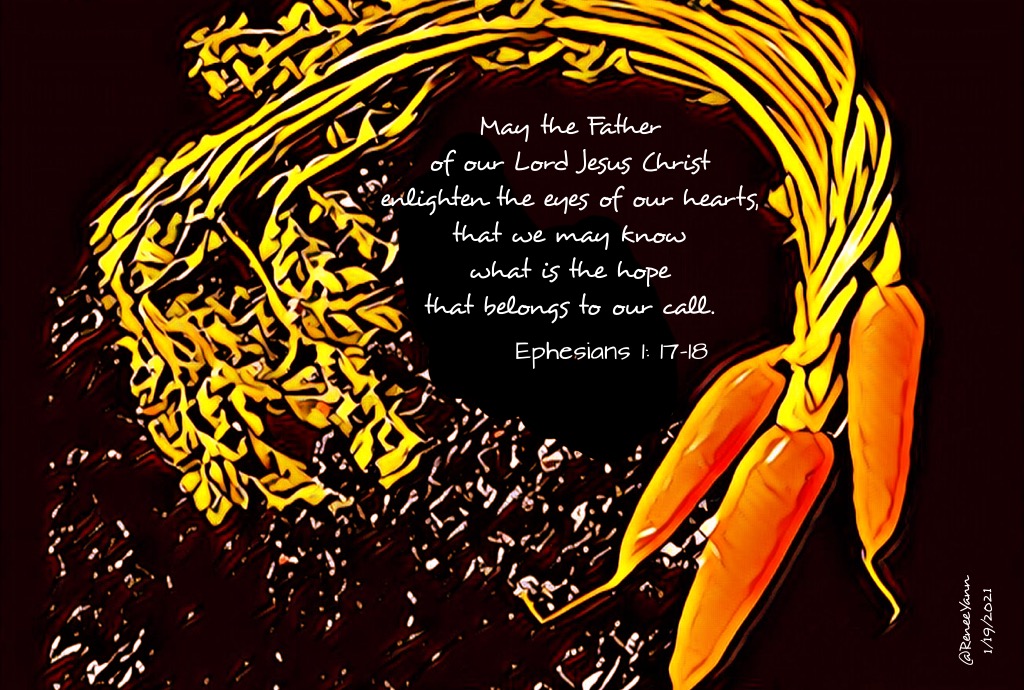
Usually the surprise would be a little bag of M&Ms or Hershey kisses. But once it was a carrot- remarkably like the carrots he bought for the week’s cooking!
Had Dad forgotten his promise, or was he just in to a healthier form of surprise?😂😉
Sometimes it feels like that with God’s Promise. Its fulfillment doesn’t always come to us in the ways we expect or pray for. Instead of special, surprising sweetness, God’s signs feel like carrots … ordinary carrots that we see every day, that we mix into the soup of our daily unsurprising lives.
Our Alleluia Verse today is a good prayer when our life seems full of “carrots”:
May the Father of our Lord Jesus Christ enlighten the eyes of our hearts, that we may know what is the hope that belongs to our call.
Ephesians 1: 17-18
May our eyes be enlightened to see God’s Promise fulfilled in the amazing blessings of our lives:
I will give thanks to the LORD with all my heart in the company and assembly of the just. Great are the works of the LORD, exquisite in all their delights.
Psalm 111: 1-2
My Dad loved me with all his heart and would have given me anything good that was in his power to give.
We can be assured, as in Psalm 111, that all- powerful God is like that too. It’s just that sometimes those good things look like ordinary carrots and we need enlightened eyes to recognize their exquisiteness.
Poetry: Mindful – Mary Oliver
Everyday
I see or hear
something
that more or less

kills me
with delight,
that leaves me
like a needle

in the haystack
of light.
It was what I was born for —
to look, to listen,

to lose myself
inside this soft world —
to instruct myself
over and over

in joy,
and acclamation.
Nor am I talking
about the exceptional,

the fearful, the dreadful,
the very extravagant —
but of the ordinary,
the common, the very drab,

the daily presentations.
Oh, good scholar,
I say to myself,
how can you help

but grow wise
with such teachings
as these —
the untrimmable light

of the world,
the ocean’s shine,
the prayers that are made
out of grass?
Music: Blessed Assurance
Blessed assurance, Jesus is mine!
Oh, what a foretaste of glory divine!
Heir of salvation, purchase of God,
Born of His Spirit, washed in His blood
Chorus:
This is my story, this is my song,
Praising my Savior all the day long;
This is my story, this is my song,
Praising my Savior all the day long.
Perfect submission, perfect delight,
Visions of rapture now burst on my sight;
Angels, descending, bring from above
Echoes of mercy, whispers of love.
Perfect submission, all is at rest,
I in my Savior am happy and blest,
Watching and waiting, looking above,
Filled with His goodness, lost in His love.
Today, in God’s Lavish Mercy, we pray with Psalm 85 – a song filled with urgency and expectation!
When we pray this psalm:
We are desperately thirsty nomads who hear promise in the hint of thunder.
We are the parched leaves stretching up to catch the first rain.
We are the foundered boat lifted on the gathering flume.
Tomorrow, we begin the exclamations of our answered hopes — the great O Antiphons.
But for today, let us relax into the certainty that, indeed, the Savior is coming – just as sure as the clouds turn silver with the weight of rain.
What is it in your heart today that reaches for the cloudburst of grace?
Poetry: Last Night, the Rain Spoke to Me – Mary Oliver
Last night
the rain
spoke to me
slowly, saying,
what joy
to come falling
out of the brisk cloud,
to be happy again
in a new way
on the earth!
That’s what it said
as it dropped,
smelling of iron,
and vanished
like a dream of the ocean
into the branches
and the grass below.
Then it was over.
The sky cleared.
I was standing
under a tree.
The tree was a tree
with happy leaves,
and I was myself,
and there were stars in the sky
that were also themselves
at the moment,
at which moment
my right hand
was holding my left hand
which was holding the tree
which was filled with stars
and the soft rain—
imagine! imagine!
the wild and wondrous journeys
still to be ours.
Today, in God’s Lavish Mercy, we pray with Psalm 1 and its confident responsorial verse.
Last night we watched a public television Christmas special, “Rick Steves’s European Christmas“. From its many beautiful scenes, one in particular remained with me: a little group of friends tobogganing down a snow covered hill at night. Their only lights came from the small lanterns they held and the full moon’s generous luster against the white snow.
My first reaction to the scene was to wonder, “What if their light goes out?”. Then I realized that there was a light beyond them which would guide their way.
There are times in our lives when the light, if it doesn’t go out, at least flickers. I wrote about that awareness in this story a few years ago:
She had arranged to visit with an old college friend. They had been separated too long by the distancing choices that life often demands. She wanted to reconnect to that rare experience of shared transparency found just once or twice in a lifetime – the gift of a real friend.
They sat on a porch overlooking a gentle pond. The day was bright, the coffee hot, the chairs comfortable. But the magic was gone. Only half her friend had arrived for the cherished conversation. The other half – joy, adventure and the excess of youthful hope – had been lost. Somewhere in the intervening years, the light had gone out. Her friend had suffered a wound she did not share. This one afternoon would be too short a time to give that wound a name.
During our Advent journey, God is waiting in the seeming darkness to guide us. God already knows the wounds we carry. God sees where our heart’s light has dimmed. Holding our half-heartedness next to the Divine Heart, God yearns to rekindle us.
Today’s psalm reminds us that there is a always Light waiting beyond us to guide our way.
Blessed the one follows not the counsel of darkness nor walks in it ways, nor remains in the company of the insolent, But delights in the law of the LORD and meditates on its Light day and night.
Psalm 1:1-2
Poetry: from Mary Oliver
When I am among the trees,
especially the willows and the honey locust,
equally the beech, the oaks and the pines,
they give off such hints of gladness.

I would almost say that they save me, and daily.
I am so distant from the hope of myself,
in which I have goodness, and discernment,
and never hurry through the world
but walk slowly, and bow often.

Around me the trees stir in their leaves
and call out, “Stay awhile.”
The light flows from their branches.
And they call again, “It’s simple,” they say,
“and you too have come
into the world to do this, to go easy, to be filled
with light, and to shine.”
Today, in God’s Lavish Mercy, we pray with Psalm 117 which is the shortest of all the Psalms. But 117, also called the Laudate Dominum, still packs a huge spiritual punch.
The psalm is called a “doxology” which simply means it is a short prayer of praise, the type we often add at the end of longer prayers. We are very familiar with the following doxology:
Glory be to the Father, and to the Son, and to the Holy Spirit. As it was in the beginning, is now, and ever shall be, world without end. Amen
Psalm 117 follows the same pattern in that it has two complementary parts.
The first invites us to praise God: Praise the LORD, all you nations; glorify God, all you peoples!
The second tells us why God deserves our praise: For steadfast is God’s kindness for us, and the fidelity of the LORD endures forever.
Notable about Psalm 117 is the fact that this Old Testament invitation to praise goes out “to ALL nations”. Scholars interpret this as pointing to the fulfillment, in Jesus, of God’s promise that Abraham would be the father in faith of many nations. Psalm 117 is a treasured and often repeated prayer throughout the Judea-Christian traditions.
Practicing this pattern of prayer can enrich our personal prayer life as well. I like to pray like this as soon as I wake each morning. Glancing out my window, I might say,
“I praise You in the sunrise, my Beautiful Creator. Thank you for the gift of my life.”
Beginning the day with our own “doxology” gives us a head start on living joyfully and gratefully in the Presence of God for our next circuit of the sun.
Poetry: Morning Poem – Mary Oliver
Every morning
the world
is created.
Under the orange
sticks of the sun
the heaped
ashes of the night
turn into leaves again
and fasten themselves to the high branches—
and the ponds appear
like black cloth
on which are painted islands
of summer lilies.
If it is your nature
to be happy
you will swim away along the soft trails
for hours, your imagination
alighting everywhere.
And if your spirit
carries within it
the thorn
that is heavier than lead—
if it's all you can do
to keep on trudging—
there is still
somewhere deep within you
a beast shouting that the earth
is exactly what it wanted—
each pond with its blazing lilies
is a prayer heard and answered
lavishly,
every morning,
whether or not
you have ever dared to be happy,
whether or not
you have ever dared to pray
Music: Laudate Dominum – Mozart, sung by Barbara Hendricks
Today, in God’s Lavish Mercy, we pray with Psalm 98, one of a small knot of psalms whose point is to shout praise over and over to God. It is a hymn psalm, and one of the ten Royal Psalms themed with “kingship”.
As we pray this exultant psalm, in Latin called “Cantate Domino” (Sing to the Lord), we can almost visualize the psalmist and fellow praisers clapping God on the back and chanting, “Great job! Nice work!”.
All the ends of the earth have seen the salvation by our God. Sing joyfully to the LORD, all you lands; break into song; sing praise.
Walter Brueggemann has written extensively about the Psalms. He says this about the act of praise:
Praise articulates and embodies our capacity to yield, submit, and abandon ourselves in trust and gratitude to the One whose we are. … We have a resilient hunger to move beyond self. God is addressed not because we have need, but simply because God is God. (Israel’s Praise: Doxology against Idolatry and Ideology)
We don’t have to be as articulate as the psalmist to weave praise into our prayer.
Sometimes when we catch the sunrise at a morning window, we might quietly say, “Great job! Thank You, Radiant God”
When we look at the magnificence of a natural wonder like the Grand Canyon, we might abandon words and simply let our breathing be praise.
When we study the finely-aged face of a beloved elder, we might praise the monument of grace God has worked in her/his life.
When we finger the strings of our own faith history, we might, in our own words, echo the psalmist:
I sing You a new song in every moment, Lord for You have done wondrous deeds; Your loving hand has strung grace through my life, your generous heart has blessed me amazingly.
Poetry today from Mary Oliver who rejoices in the redbird’s morning praise:
All night my heart makes its way however it can over the rough ground of uncertainties, but only until night meets and then is overwhelmed by morning, the light deepening, the wind easing and just waiting, as I too wait (and when have I ever been disappointed?) for redbird to sing
― A Thousand Mornings
1.
All day up and down the shore the
fine points of the waves keep on
tapping whatever is there: scatter of broken
clams, empty jingles, old
oyster shells thick and castellated that held
once the pale jewel of their bodies, such sweet
tongue and juice. And who do you
think you are sauntering along
five feet up in the air, the ocean a blue fire
around your ankles, the sun
on your face on your shoulders its golden mouth whispering
(so it seems) you! you! you!
2.
Now the afternoon wind
all frill and no apparent purpose
takes her cloud-shaped
hand and touches every one of the
waves so that rapidly
they stir the wings of the eiders they blur
the boats on their moorings; not even the rocks
black and blunt interrupt the waves on their
way to the shore and one last swimmer (is it you?) rides
their salty infoldings and outfoldings until,
peaked, their blue sides heaving, they pause; and God
whistles them back; and you glide safely to shore.
3.
One morning
a hundred pink and cylindrical
squid lay beached their lacy faces,
their gnarls of dimples and ropy tentacles
limp and powerless; as I watched
the big gulls went down upon
this sweetest trash rolling
like the arms of babies through the
swash—in a feathered dash,
a snarl of delight the beaks fell
grabbing and snapping; then was left
only the empty beach, the birds floating back over the waves.
4.
How many mysteries have you seen in your
lifetime? How many nets pulled
full over the boat’s side, each silver body
ready or not falling into
submission? How many roses in early summer
uncurling above the pale sands then
falling back in unfathomable
willingness? And what can you say? Glory
to the rose and the leaf, to the seed, to the
silver fish. Glory to time and the wild fields,
and to joy. And to grief’s shock and torpor, its near swoon.
5.
So it is not hard to understand
where God’s body is, it is
everywhere and everything; shore and the vast
fields of water, the accidental and the intended
over here, over there. And I bow down
participate and attentive
it is so dense and apparent. And all the same I am still
unsatisfied. Standing
here, now, I am thinking
not of His thick wrists and His blue
shoulders but, still, of Him. Where, do you suppose, is His
sage and wonderful mind?
6.
I would be good—oh, I would be upright and good.
To what purpose? To be shining not
sinful, not wringing out of the hours
petulance, heaviness, ashes. To what purpose?
Hope of heaven? Not that. But to enter
the other kingdom: grace, and imagination,
and the multiple sympathies: to be as a leaf, a rose,
a dolphin, a wave rising
slowly then briskly out of the darkness to touch
the limpid air, to be God’s mind’s
servant, loving with the body’s sweet mouth—its kisses, its words—
everything.
7.
I know a man of such
mildness and kindness it is trying to
change my life. He does not
preach, teach, but simply is. It is
astonishing, for he is Christ’s ambassador
truly, by rule and act. But, more,
he is kind with the sort of kindness that shines
out, but is resolute, not fooled. He has
eaten the dark hours and could also, I think,
soldier for God, riding out
under the storm clouds, against the world’s pride and unkindness,
with both unassailable sweetness, and tempering word.
8.
Every morning I want to kneel down on the golden
cloth of the sand and say
some kind of musical thanks for
the world that is happening again—another day—
from the shawl of wind coming out of the
west to the firm green
flesh of the melon lately sliced open and
eaten, its chill and ample body
flavored with mercy. I want
to be worthy—of what? Glory? Yes, unimaginable glory.
O Lord of melons, of mercy, though I am
not ready, nor worthy, I am climbing toward you.
Today, in Mercy, Paul, follows on yesterday’s magnificent passage about
the Gospel of the glory of Christ, who is the image of God.
The power of this Gospel is the “treasure” about which Paul writes in today’s first reading.
In this passage, Paul describes the miracle of contradiction in us who believe. We carry theinfinite light of God’s Glory in the fragile, imperfect vessels of our existence. By the power of God, the omnipotent sublime shines from within the ordinary.
We see, in these lines, Paul the humble and tested preacher. He has grown in his deep understanding of himself as God’s imperfect instrument.
All of us who want to live the Gospel are called to experience a deepening like Paul’s. The poet Mary Oliver reflects such a transformation in her poem On Thy Wondrous Works I Will Meditate (Psalm 145). Here is the last delightful stanza, which may inspire our prayer today. (I will send the full poem a little later.)
Every morning I want to kneel down on the golden cloth of the sand and say some kind of musical thanks for the world that is happening again—another day— from the shawl of wind coming out of the west to the firm green flesh of the melon lately sliced open and eaten, its chill and ample body flavored with mercy. I want to be worthy—of what? Glory? Yes, unimaginable glory. O Lord of melons, of mercy, though I am not ready, nor worthy, I am climbing toward you.










 Lavish Mercy