Living Gratitude

Memorial of Saint Francis of Assisi
October 4, 2023

Today’s Readings:

https://bible.usccb.org/bible/readings/1004-memorial-francis-assisi.cfm

(I chose to offer a reflection on the readings for the Memorial of St. Francis rather than for Wednesday of the Twenty-sixth Week)


Today, in God’s Lavish Mercy, we pray with St. Francis of Assisi (1181-1226) , one of the most revered figures in Christianity, an Italian mystic and Catholic friar who founded the Franciscans.

The simple holiness of St. Francis has had an immeasurable effect not only on Christianity but even on secular culture. No matter their religious interest, most people would recognize this humble, medieval itinerant preacher and understand the witness of his life.


Our current Holy Father, in a surprise move, chose St. Francis as his patron and model:

When the former Cardinal Jorge Mario Bergoglio went over the 77 votes needed to become pope, he said that his friend Cardinal Hummes “hugged me, kissed me and said, ‘Don’t forget the poor.’”
At the time of his election, Pope Francis told thousands of journalists that he took to heart the words of his friend and chose to be called after St. Francis of Assisi, “the man of poverty, the man of peace, the man who loves and protects creation.”


In our readings today, both the Responsorial Psalm and the Gospel echo a spirituality deeply compatible with the Franciscan spirit.

Francis, who renounced his wealthy lifestyle and inheritance for the riches of Christ, surely found inspiration when he prayed Psalm 16:

You are my inheritance, O Lord.
Keep me, O God, for in you I take refuge.
I say to the LORD, “My Lord are you.”
O LORD, my allotted portion and my cup,
you it is who hold fast my lot.

I bless the LORD who counsels me;
even in the night my heart exhorts me.
I set the LORD ever before me;
with him at my right hand I shall not be disturbed.

You will show me the path to life,
fullness of joys in your presence,
the delights at your right hand forever.


Most of us reading this reflection have so much in life. We are blessed beyond description with everything we need and even want. Praying in the spirit of St. Francis can help us discern how to honor and use what we have in a way that pleases God.

Keep a clear eye toward life’s end. Do not forget your purpose and destiny as God’s creature. What you are in God’s sight is what you are and nothing more. Remember that when you leave this earth, you can take nothing that you have received…but only what you have given; a full heart enriched by honest service, love, sacrifice, and courage.

Francis of Assisi

Poetry: ST. FRANCIS OF ASSISI – A SERMON TO THE BIRDS
Francis made his deep spirituality and radical teaching easily accessible with unpretentious parables like this one. He imitated Jesus himself who taught us how to live by telling simple stories in which we could find ourselves. So let’s learn from this one, my little “birds”.

My little sisters the birds,
Ye owe much to God, your Creator,
And ye ought to sing his praise at all times and in all places, 
Because he has given you liberty to fly about into all places; 
And though ye neither spin nor sew,
He has given you a twofold and a threefold clothing
For yourselves and for your offspring.
Two of all your species He sent into the Ark with Noah
That you might not be lost to the world;
Besides which, He feeds you, though ye neither sow nor reap.
He has given you fountains and rivers to quench your thirst, 
Mountains and valleys in which to take refuge,
And trees in which to build your nests;
So that your Creator loves you much,
Having thus favored you with such bounties.
Beware, my little sisters, of the sin of ingratitude, 
And study always to give praise to God.” Amen

Music: St. Francis of Assisi by Mendoza Musicals
Turn to Tenderness, Turn to God

Thursday of the Twenty-fifth Week in Ordinary Time
September 28, 2023

Today’s Readings:

https://bible.usccb.org/bible/readings/092823.cfm


Today, in God’s Lavish Mercy – and tomorrow – we will hear from Haggai, one of the twelve minor prophets of the Hebrew Scriptures. These dozen writers are referred to as “minor” because of the length of their writings, not their value.

So Haggai, even though many of us have never heard of him, has something important to say for Judeo-Christian tradition and for each of us who read him. Let’s see what that might be.

Hag1_9JPG

Haggai is prophesying during the Persian period of Jewish history, around the middle of the 6th century, BC. The Jewish people had been back home from the Babylonian captivity for almost 20 years. When they first returned they were passionate about rebuilding the Temple. But as the decades passed, and opposition from their non-Jewish neighbors increased, their commitment waned.


The building of worship places has always been an activity with fans on both sides of the aisle. Some argue that God needs a spot where the Divine Presence can be recognized and revered. Others believe that the effort and resources expended in such building could better be used in human services for God’s poor and needy people. Haggai’s community had people in both camps. (Sound familiar?)

Haggai offers a turning point for their arguments. He tells the people they are a mess. The absence of a central symbol for their faith has weakened and scattered them to their own selfish pursuits. He tells them to look at themselves:

Consider your ways!
You have sown much, but have brought in little;
you have eaten, but have not been satisfied;
You have drunk, but have not been exhilarated;
have clothed yourselves, but not been warmed;
And whoever earned wages
earned them for a bag with holes in it.


The Temple, while it is important, isn’t the most important part of Haggai’s prophecy. He tells the people they have lost their souls. The lack of a central, shared faith has caused them to forget who they are. They will remember only when they remember God’s centrality in their lives.

Haggai appeals to the people to restore a public life which gives honor to God. For their time and circumstance, such a return is symbolized by the rebuilding of the Temple which had been destroyed at the time of their enslavement by Babylon.


We humans often forget what’s important. We chip away at, and ultimately destroy, what makes us who we are by little acts of faithlessness, deceit, covetousness, and envy. These small treacheries grow into big ones redeemable only by an impeachment of the soul and the renewal of a common moral purpose. Haggai offered that conversion to Israel. Pope Francis is offering it to us today.


Video: TED Talk by Pope Francis given at the Annual TED Conference in 2017 and pleading for a “Revolution of Tenderness”. (Yes, it’s long, but it is profound. When he delivered this talk, the Pope was given a standing ovation by some of the most prestigious business people of our time.)

https://www.npr.org/sections/thetwo-way/2017/04/26/525699847/in-surprise-ted-talk-pope-francis-asks-the-powerful-for-revolution-of-tenderness


Music: Come Back to Me – by Gregory Norbet, sung by John Michael Talbot

Athanasius in Spring

Memorial of Saint Athanasius, Bishop and Doctor of the Church
May 2, 2023

Today’s Readings:

https://bible.usccb.org/bible/readings/050223.cfm

Today, in God’s Lavish Mercy, we celebrate the feast of St. Athanasius, and since our readings repeat themes we have prayed with for a few days, I thought we might focus our prayer today on Athanasius.

Living in 4th century Egypt, Athanasius was a Church Father – one of the ancient and influential Christian theologians and writers who established the intellectual and doctrinal foundations of Christianity. (For insight into the often uncelebrated Church Mothers, see this excellent article: https://www.ncronline.org/news/opinion/simply-spirit/honor-mothers-early-christianity-during-womens-history-month )


During his lifetime, the Church struggled with the heresy of Arianism which questioned whether Jesus was really God. Athanasius was named a Doctor of the Church for his steadfast defense of the doctrine of the divinity of Christ. Some of Athanasius’s writings are suggestive of the theology of our great modern theologians, and so necessary for our spirituality today.

The Self-revealing of the Word
is in every dimension –
above, in creation;
below, in the Incarnation;
in the depth, in Hades;
in the breadth, throughout the world.
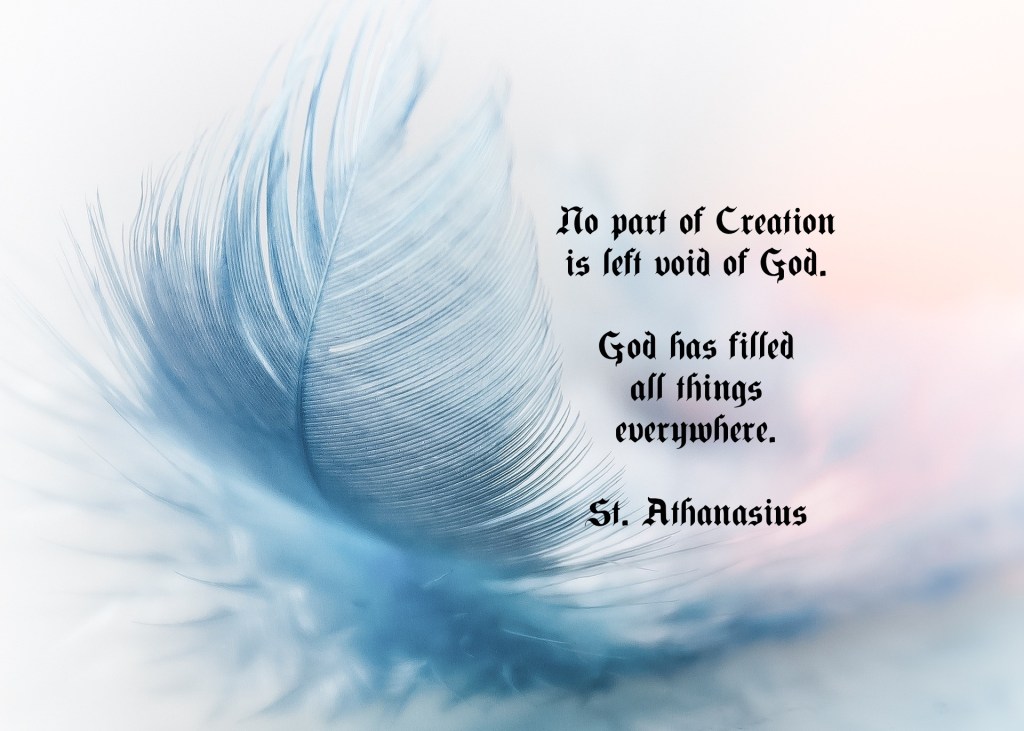
All things have been filled
with the knowledge of God.

St. Athanasius

Pierre Teilhard de Chardin, the revered Jesuit theologian of the early 20th century, writes in a tone suggestive of Athanasius:

If we live at a distance from God, the universe remains neutral or hostile to us. But if believe in God, immediately all around us the elements, even the irksome, organize themselves into a friendly whole, ordered to the ultimate success of life.

Pierre de Chardin, SJ in Christianity and Evolution

More recently, beloved Pope Francis teaches with the same sacred appreciation of the “mystical” depths of Creation:

The universe unfolds in God, who fills it completely. Hence, there is a mystical meaning to be found in a leaf, in a mountain trail, in a dewdrop, in a poor person’s face. The ideal is not only to pass from the exterior to the interior to discover the action of God in the soul, but also to discover God in all things.

Pope Francis in Laudato Sí, 84)

As we pray in these early days of May, still drenched in the glory of Easter, may we hear God speaking to us in the infinitely new and ever-evolving power and beauty of all Creation.

The occurrence of chance in the world in its own finite way reflects the infinite creativity of the living God, endless source of fresh possibilities. The indwelling Creator Spirit grounds not only life’s regularities but also the novel occurrences that open up the status quo, igniting what is unexpected, interruptive, genuinely uncontrolled, and unimaginably possible. As boundless love at work in the universe, the Spirit embraces the chanciness of random mutations, being the source not only of order but also of the unexpected breaks in order that ensure freshness. Divine creativity is much more closely allied to the outbreak of novelty than our older order-oriented theology ever imagined

Elizabeth Johnson, CSJ – Distinguished Professor of Theology at Fordham University in her book, Ask the Beasts: Darwin and the God of Love

Poetry: Spring – Mary Oliver

Somewhere
a black bear
has just risen from sleep
and is staring
down the mountain.
All night
in the brisk and shallow restlessness
of early spring
I think of her,
her four black fists
flicking the gravel,
her tongue
like a red fire
touching the grass,
the cold water.
There is only one question:
how to love this world.
I think of her
rising
like a black and leafy ledge
to sharpen her claws against
the silence
of the trees.
Whatever else
my life is
with its poems
and its music
and its glass cities,
it is also this dazzling darkness
coming
down the mountain,
breathing and tasting;
all day I think of her -—
her white teeth,
her wordlessness,
her perfect love.

Music: Spring from The Four Seasons – Antonio Vivaldi

Pepper and Salt

February 24, 2022
Thursday of the Seventh Week in Ordinary Time

Today, in God’s Lavish Mercy, both James and Jesus pepper us with some fire and brimstone.

James is preaching against the sin of exploitation, especially as it relates to economic justice, the sanctity of work, and reverence for the worker.

Come now, you rich, weep and wail over your impending miseries…
Behold, the wages you withheld from the workers who harvested your fields are crying aloud; and the cries of the harvesters have reached the ears of the Lord of hosts.

James 5: 1;4

James, in his time, is condemning a sin that has endured throughout history. In a 2020 address, Pope Francis confronted the same evil:

The pandemic has exposed and aggravated social problems, above all that of inequality…These symptoms of inequality reveal a social illness; it is a virus that comes from a sick economy. And we must say it simply: the economy is sick. It has become ill. It is the fruit of unequal economic growth — this is the illness: the fruit of unequal economic growth — that disregards fundamental human values. In today’s world, a few wealthy people possess more than all the rest of humanity. I will repeat this so that it makes us think: a few wealthy people, a small group, possess more than all the rest of humanity. This is pure statistics. This is an injustice that cries out to heaven!

General Audience, August 26, 2020

James and Francis – speaking the same message for different times.


In our Gospel, Jesus teaches that the rewards of a well-lived life are measured in mutuality and generosity, not dollars:


In concluding his above referenced address, Pope Francis, like Jesus, focused on children:

Let us think about the children. Read the statistics: how many children today are dying of hunger because of broken distribution of riches, because of a sick economic system; and how many children today do not have the right to education for the same reason. May this image of children in want due to hunger and the lack of education help us understand that after this pandemic crisis we must learn and do better.


Jesus too measured a soul’s health by its effect on children:

Whoever causes one of these little ones who believe in me to sin,  it would be better for him if a great millstone were put around his neck and he were thrown into the sea.

Mark 9:42

These readings teach hard lessons, lessons which society still seems unable to learn. Let’s ask for the grace to see our own role in helping to realize the sacred balance of goods that Jesus, James, and Francis call for.

Let us not tire in advocating for social Justice because, as our Gospel warns:

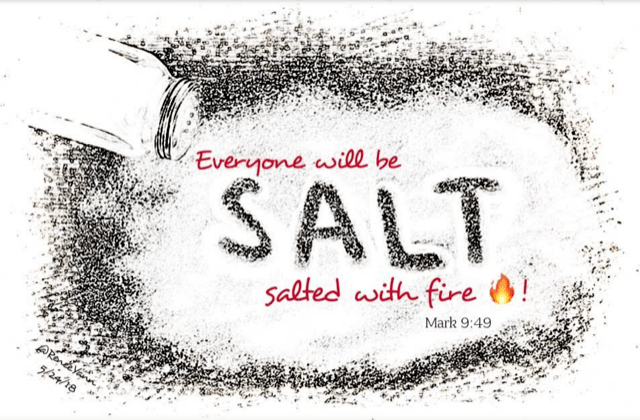
Everyone will be salted with fire. Salt is good,
but if salt becomes insipid,
with what will you restore its flavor?

Mark 9:49

Poetry and Music: Salt of the Earth – The Rolling Stones
In this song, Mick Jagger writes an anthem to the working class. But in a twice-repeated stanza, the singer professes a distance from this very group, perhaps loosing touch because of his own material success:

And when I search a faceless crowd
A swirling mass of grey and black and white
They don’t look real to meIn fact, they look so strange

The song uses a quote that refers to a passage in the Bible where Jesus encourages people to give the best of themselves:

You are the salt of the earth; but if the salt loses its flavor, how shall it be seasoned ? It is then good for nothing but to be thrown out and trampled underfoot.

Matthew 5:13

Sing Mercy in the Sadness

December 7, 2021
Tuesday of the Second Week of Advent
Memorial of St. Ambrose

Today, in God’s Lavish Mercy, we are blessed, once again, with magnificent readings!

Our psalm coaches us to rejoice and sing – a song that will heal the nations.

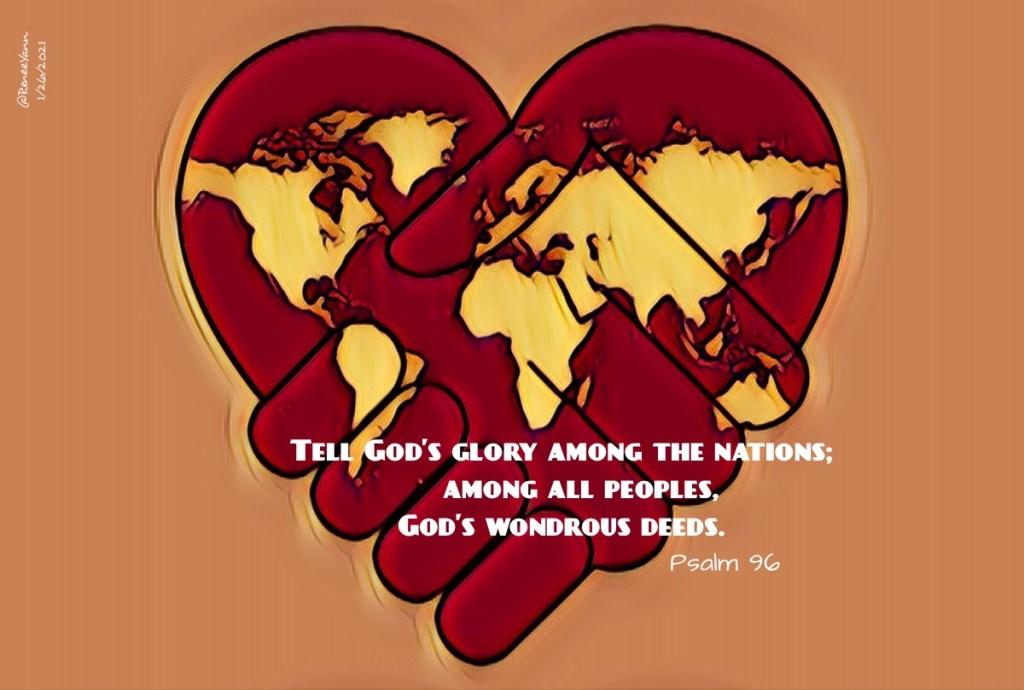
Sing to the LORD a new song;
    sing to the LORD, all you lands.
Sing to the LORD; bless the LORD’s name;
    announce God’s salvation, day after day.

Psalm 96:1-2

Our first reading is the exquisite “Comfort” passage from Isaiah. And our Gospel gives us Jesus tenderly seeking the single lost lamb.

The first and last words of these two readings – COMFORT, LOST – capture the whole intent of today’s message:


Life is a maze whose walls are heightened
by our incivility to one another.
Isaiah calls us to be a leveler of walls,
a straightener of twists, a bridge over deadly valleys.
Jesus calls us to seek and carry the lost sheep.
We are called to be Mercy in a suffering world.


These beautiful and challenging readings come to us this year at a time when Pope Francis has offered a clear and similar challenge to the world. Last week, during his visit to the refugee encampment on the Greek island of Lesbos, Francis voiced his profound pain at the international immigration tragedy:

“Let us not let our sea (mare nostrum) be transformed into a desolate sea of death (mare mortuum),” the Pope concluded.  “Let us not allow this place of encounter to become a theatre of conflict.  Let us not permit this “sea of memories” to be transformed into a “sea of forgetfulness”.  Please, let us stop this shipwreck of civilization.”

“It is an illusion to think it is enough to keep ourselves safe, to defend ourselves from those in greater need who knock at our door”, Pope Francis said.  “In the future, we will have more and more contact with others.  To turn it to the good, what is needed are not unilateral actions but wide-ranging policies.  History teaches this lesson, yet we have not learned it.” 

Source for quotes: Vatican News – vaticannews.va

During his address, the Pope asked every man and woman, “to overcome the paralysis of fear, the indifference that kills, the cynical disregard that nonchalantly condemns to death those on the fringes.” 


Resource: To learn about and reflect on the issue of immigration, here is a link to NETWORK. Founded by Catholic Sisters in the progressive spirit of Vatican II, NETWORK works to create a society that promotes justice and the dignity of all in the shared abundance of God’s creation.


Music: Comfort Ye from Handel’s Messiah – sung by Jerry Hadley

As we pray this glorious music today, let us ask for the strength and courage to be Mercy for the world, to find the ways to comfort God’s people, close by and at life’s borders.

Memorial: St. Peter Claver

Thursday, September 9, 2021

Today, in God’s Lavish Mercy, we pray with Psalm 150, an all-out summons to praise God.

Psalm 150, with its four predecessors, creates a rousing chorus of praise to God. As the closing piece of the Book of Psalms, Psalm 150 summons all Creation to unbounded praise.


The prayer of praise may not come as easily to us as other types of prayer. We find the prayer of supplication easy – asking God for something. Even the prayer of thanks is natural to us. But even Pope Francis says that the prayer of praise might not come so readily:

The prayer of praise is quite different than the prayer we normally raise to God,
the Pope continued, when “we ask something of the Lord”
or even “thank the Lord”.

“We often leave aside the prayer of praise”.
It doesn’t come so easily to us, he said.
Some might think that this kind of prayer is only
“for those who belong to the renewal in the spirit movement,
not for all Christians.

The prayer of praise is a Christian prayer for all of us.
Each day during Mass, when we sing:
‘Holy, Holy…’, this is the prayer of praise.
We praise God for his greatness, for he is great.
And we tell him beautiful things, because we like it to be so”.

And it does not matter if we are good singers, the Pope remarked.
In fact, he said, it is impossible to imagine that
“you are able to shout out when your team scores a goal
and you cannot sing the Lord’s praises,
and leave behind your composure a little to sing.

Praising God is “totally gratuitous”, Pope Francis continued.
“We do not ask, we do not thank. We praise: you are great.
‘Glory be to the Father, and to the Son, and to the Holy Spirit…’. 

L’ Osservatore Romano

Psalm 150 calls us to a prayer of pure praise:

Hallelujah! Praise the Lord in the holy temple;
praise God in the firmament of divine power.
Praise the Lord for mighty acts;
praise God for excellent greatness.
Praise the Lord with the blast of the ram’s-horn; 
praise God with lyre and harp.
Praise the Lord with timbrel and dance; 
praise God with strings and pipe.
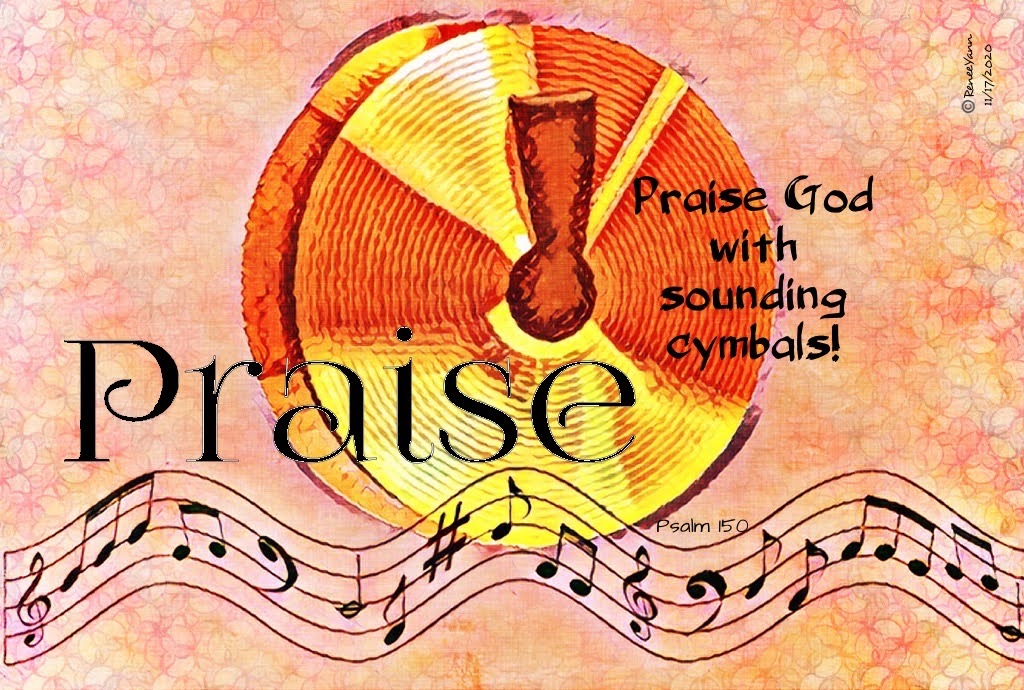
Praise the Lord with resounding cymbals; 
praise God with loud-clanging cymbals.
Let everything that has breath praise the Lord.
Hallelujah!

Psalm 150

By the culmination of the sequence in Psalm 150, there is a total lack of any specificity, and users of the psalm are invited to dissolve in a glad self-surrender that is to be enacted in the most lyrical way imaginable. Such praise is a recognition that the wonder and splendor of this God—known in the history of Israel and in the beauty of creation—pushes beyond our explanatory categories so that there can be only a liturgical, emotive rendering of all creatures before the creator.

Walter Brueggemann

We might try to offer this type of prayer in a simple manner, by naming God’s goodness – the goodness that we love and adore. We can do this in the same way that we tell any beloved being that we love them. Some prayer phrases might be:

  • You are beautiful in all Creation – in this morning’s dawn, this evening’s sunset.
  • You are just yet everlastingly kind.
  • Your power is stunningly gentle in a bird’s wing; it is overwhelming in the storm’s roar.
  • You are so humble to live within and among us.
  • You are infinitely loving through the gift of Jesus

Thoughts like these might also inspire us to a silent awe in which we offer wordless praise to our awesome God.


Music: No poem today, but two very different musical interpretations of Psalm 150 to inspire your prayer of praise

~ from Taize

Caesar Franck

Friday of the Sixteenth Week in Ordinary Time

Friday, June 23, 2021

Today, in God’s Lavish Mercy, we pray with Psalm 19, a testament to God’s Word as living and real in our lives. This psalm foreshadows the beautiful words from John’s Gospel.

Our first reading recounts God’s presentation of the Ten Commandments on Sinai. This code was the basic framework for the community’s response to God’s gift of relationship. God was saying, “Here’s what I need from you to make this thing work.”

Psalm 19 shows us that even though this “Law” was “carved in stone”, it was lived in the hearts of the faithful. It was dynamic, required nuance and interpretation, needed human engagement to fully come to life.

In other words, the “Law” had to live, come off the stone, and into hearts.


When this happens, we grow in the essence of “law”, which is love, reverence, mutuality, and generosity. We experience God’s Word as gift and delight. We long to learn more perfectly what, in our choices and actions, can bring us closer to God.

Then the law becomes, as Psalm 19 tells us:

  • perfect, refreshing the soul
  • trustworthy, giving wisdom to the simple
  • right, rejoicing the heart
  • clear, enlightening the eye.
  • pure, enduring forever;
  • true,
  • just
  • more precious than gold
  • sweeter also than syrup
  • or honey from the comb.

We all know people who claim to live by a static, lifeless but recite-able law. They can readily quote some out-of-context scripture to judge, reprimand, or condemn. It’s sad because the Word has died in them.

The Law of Love grows in the rich soil of today’s Gospel. It meets life with an honest, open, and loving spirit to find the unique adventure of grace God wants for each of us.

Pope Francis, when speaking of the Law, said this:

Our God is the God of nearness, a God who is near, who walks with his people. That image in the desert, in Exodus: the cloud and the pillar of fire to protect the people: He walks with his people. He is not a God who leaves the written prescriptions and says, “Go ahead.” He makes the prescriptions, writes them with his own hands on the stone, gives them to Moses, hands them to Moses, but does not leave the prescriptions and leaves: He walks, He is close. “Which nation has such a close God?” It’s the nearness. Ours is a God of nearness.


Poetry: What is the Root? – Hafiz

What
Is the
Root of all these
Words?

One thing: love.
But a love so deep and sweet
It needed to express itself
With scents, sounds, colors
That never before
Existed.

Music: Your Word is Life to Me – Travis Cottrell

I am a stranger in this place

This world is not my home

I want more than it can give

I am a desert needing rain

I’m thirsty for Your voice

The very reason that I live

You are the Word, my one desire

And all consuming Holy fire

The very breath that I am longing for

My heart is desperate for Your ways

Refine me in Your holy blaze

If that is what it takes to know You more

You are the Truth that sets me free

Your word is life to me

Only the power of Your Word

Can melt away these chains

That have held me far too long

So light the fire and let it burn

These shackles and restraints

And I will sing this freedom song

You are the Word, my one desire

And all consuming Holy fire

The very breath that I am longing for

My heart is desperate for Your ways

Refine me in Your holy blaze

If that is what it takes to know You more

You are the Truth that sets me free

Your word is life to me

Lamp unto my feet, light unto my path

Shine, shine on

Lamp unto my feet, light unto my path

Shine, shine on

Lamp unto my feet, light unto my path

Shine, shine on

Lamp unto my feet, light unto my path

Shine, shine on

You are the Word, my one desire

And all consuming Holy fire

The very breath that I am longing for

My heart is desperate for Your ways

Refine me in Your holy blaze

If that is what it takes to know You more

You are the Truth that sets me free

Your word is life to me

Psalm 79: Prisoners

Monday of the Second Week in Lent

March 1, 2021


Today, in God’s Lavish Mercy, we pray with Psalm 79, marked in some translations as “A Prayer for Jerusalem”. The psalm is also considered one of the “Sad Songs of Zion” which lament the destruction of the Temple and the ensuing Babylonian Captivity.

We might compare the context for Psalm 79 to what Americans felt on 9/11 or Pearl Harbor. All serenity, confidence, and trust were shattered. The world was broken and we didn’t know if it could be mended.


Praying Psalm 79, I think of the experience of prisoners – prisoners of all kinds. I think of those whose bodies are in jail, and of those whose minds, hearts and souls are similarly confined. Their worlds have been broken, as has their victim’s, even if the victim was themselves.

Let the prisoners’ sighing come before you;
    with your great power free those doomed to death.

Psalm 79:11

I think how our crimes, or addictions, or hateful prejudices – or whatever shape our sinfulness takes – eventually incarcerate us.

And I think of James.


I remember being presented with the “opportunity”. I was about 12 years old and I hero-worshipped my 7th grade teacher, Sister Helen Carmel, SSJ. But I wasn’t so sure about what she was inviting us to do.

Sister had a list of prisoners in Eastern State Penitentiary. She painted a picture of them as lonely and often abandoned people who needed prayers and kindness. She wondered if some of us might like to take a prisoner as a pen pal.

Now, I’ll be honest, the last thing I wanted was a prisoner pen pal! I was becoming a teenager! I wanted new ice skates, an A on my math test, and Jimmy Danvers to hold my hand and treat me to pizza some Friday night.

But because I loved Sister Helen Carmel like a second mother, I got a pen pal. And, maybe because she loved me like a daughter, she gave me a doozie: James, who was on death row.

James and I corresponded occasionally for about three years until he wrote to say there would be no more letters. He didn’t say why, but I knew his time had come either for release or execution. I never learned which. I didn’t want to.


Around the time that James and I corresponded, a teenage girl was brutally raped and murdered, her ravaged body left in the mud of Fairmount Park. 

She went to Catholic high school like I did! She was a teenager like I was! She liked movies and friends and Friday nights like I did! I realized that what had happened to her could have happened to me! Her name, Mary Anne, was perpetually sealed in my mind. When her killer was apprehended and eventually sentenced to death, I was glad. 

But because of James, my gladness was conflicted. These two men have fought a tug of war in my soul ever since. 

Does a human being ever really forfeit the right to life because of their heinous actions? Does society ever have the right to take a life in retribution for crime? I still struggle with the feelings these questions generate. I have spent decades trying to learn how to change my heart from a retributive to a restorative model of justice.

It doesn’t just happen. It takes prayer, education, and right choices. It has taken me the help of more enlightened spirits like St. Joseph Sister Helen Prejean  and Mercy Sister Mary Healy.


Today we state clearly that ‘the death penalty is inadmissible’ and the Church is firmly committed
to calling for its abolition worldwide.

Pope Francis

The Pope has revised the Catechism
of the Roman Catholic Church to state that, 
“The death penalty is an attack
on the inviolability and dignity of the person
that is inadmissible in all cases.”

As we pray with Psalm 79 today, may we have the charity and courage to pray for condemned prisoners, their victim’s beloveds, and for a society that can create effective reform to heal the root causes of major crime.

Help us, O God our savior,
    because of the glory of your name;
Deliver us and pardon our sins
  for your name’s sake.

Psalm 79:9

No poem today. Some music though: The Prisoners’ Chorus from Beethoven’s opera “Fidelio”

Psalm 23: The Shepherd

Feast of the Chair of Saint Peter, Apostle

February 22, 2021


Today, in God’s Lavish Mercy, on this Feast of St. Peter we pray with Psalm 23 – the Good Shepherd.

The LORD is my shepherd; I shall not want.
    In verdant pastures I am given repose;
Beside restful waters the Lord leads me;
    refreshing my soul.

Psalm 23

The history and devotion intrinsic to this feast can inspire us to pray especially today for our dear Pope Francis who carries Peter’s grace and burden in our time. He carries, in Primacy, the charge reflected in our first reading:

Tend the flock of God in your midst,
overseeing not by constraint but willingly,
as God would have it, not for shameful profit but eagerly.
Do not lord it over those assigned to you,
but be examples to the flock.
And when the chief Shepherd is revealed,
you will receive the unfading crown of glory.


Pope Francis faces resistances just as Peter did. There are always forces within a community who pull its energy in contradictory directions. When rooted in love and reverent dialogue, that counteraction can generate growth. But when born of selfishness and obstinance, such opposition poisons the whole Body.

Francis needs our prayer. The Church needs our prayer. According to Teresa of Avila, Saint and Doctor of the Church, that prayer should be scriptural:

All the troubles of the Church,
all the evils in the world,
flow from this source:
that human beings do not
by clear and sound knowledge
and serious consideration
penetrate into the truths
of Sacred Scripture.

St. Teresa of Avila

Today, Psalm 23 inspires our prayer for our Pope:

Even in the dark valley
    may you fear no evil; for you are at God’s side
Whose rod and staff
    give you courage.
May God spread graces before you
    in the sight of your troubles;
and anoint your head with oil;
    your cup overflowing.
May goodness and kindness follow you
    all the days of your life;
May you dwell in the LORD’s sanctuary
    for all your days.


Poetry: When I was a boy … (Da ich ein Knabe war …) – Friedrich Hölderlin

Pope Francis’s favorite poet is said to be the German writer Friedrich Hölderlin. Perhaps Francis, composer of the lyrical Laudato Sí and Fratelli Tutti, loves this rhapsodic poem.

When I was a boy
Often a god would save me
From the shouts and blows of men;
I played safely and well
With the flowers of the fields
And the winds of heaven
Played with me.

As you make happy
The hearts of plants
When they extend to you
Their delicate tendrils,
So you make my heart happy,
Father Sun, and like Endymion
I was your favorite,
Holy Moon!

All true and neighborly gods!
If only you knew
How much I loved you then!
True, at that time, I didn’t
Know your names, and you
Never bothered to name me, like men
Who only pretend to know one another.

Yet I know you better
Than I’ve ever known anyone,
I understood the silence of the upper air,
But I’ve never understood the words of men.
I was raised by the sounds
Of the rustling grove
And learned to love
Among the flowers.
I grew up in the arms of the gods.

Music: Psalm 23 with Bach’s Sheep May Safely Graze

Psalm 25: Let Your Word Teach Me

Third Sunday in Ordinary Time 

Sunday of the Word of God

January 24, 2021


Today, in God’s Lavish Mercy, we pray with Psalm 25, a simple, heartfelt plea to learn God’s ways and to be blessed by that learning.

Your ways, O LORD, make known to me;
    teach me your paths,
Guide me in your truth and teach me,
    for you are God my savior.

Psalm 25: 4-5

The psalmist’s prayer is so fitting
for this special Sunday
which is dedicated as the
“Sunday of the Word of God”.

Pope Francis called for this commemoration with his Apostolic Letter “Aperuit illis”. The Latin words come from Luke 24:45, referring to Jesus’s post-Resurrection appearance to his confused disciples.

Then he opened their minds
to understand the scriptures.

While they were still speaking about this, he stood in their midst and said to them, “Peace be with you.” But they were startled and terrified and thought that they were seeing a ghost.
Then he said to them, “Why are you troubled? And why do questions arise in your hearts?
Look at my hands and my feet, that it is I myself. Touch me and see, because a ghost does not have flesh and bones as you can see I have.” And as he said this, he showed them his hands and his feet.

While they were still incredulous for joy and were amazed, he asked them, “Have you anything here to eat?” They gave him a piece of baked fish; he took it and ate it in front of them.
He said to them, “These are my words that I spoke to you while I was still with you, that everything written about me in the law of Moses and in the prophets and psalms must be fulfilled.”
Then he opened their minds to understand the scriptures.

Luke 24: 36-45

The Pope’s letter institutes the annual observance
of the 3rd Sunday of Ordinary Time
as “Sunday of the Word of God”,
devoted to the celebration, study and
dissemination of the Word of God.

Pope Francis wrote this:

A profound bond links sacred Scripture and the faith of believers. Since faith comes from hearing, and what is heard is based on the word of Christ (cf. Rom 10:17), believers are bound to listen attentively to the word of the Lord, both in the celebration of the liturgy and in their personal prayer and reflection.

Aperuit Illis, 7

If you are reading this blog, you already seek an ever deeper, more loving relationship with God through sacred scripture. But with our Infinite God, there is always more.

Let us use today’s Psalm 25 to reflect on and reaffirm that core relationship in our lives. Let’s re-examine the dedicated time we give to scriptural prayer and “lectio divina” to make it more intentional, quiet, and consistent.


For a good explanation of lectio divina, see the Transforming Center’s website:


In the spirit of Psalm 25, we pray to always be held in God’s merciful attention, and to hold God in ours through prayer and desire.

Remember that your compassion, O LORD,
    and your love are from of old.
In your kindness remember me,
    because of your goodness, O LORD.

Psalm 25: 6-7

These are two books that I love, and have mentioned before, to help deepen our scriptural prayer:

Too Deep for Words – Thelma Hall

The Flowing Grace of Now – Macrina Wiederkehr – (Kindle edition on sale now for just $2.99)


Poetry: The Opening of Eyes – David Whyte

That day I saw beneath dark clouds 
the passing light over the water
and I heard the voice of the world speak out,
I knew then, as I had before
life is no passing memory of what has been
nor the remaining pages in a great book
waiting to be read.
It is the opening of eyes long closed.
It is the vision of far off things
seen for the silence they hold.
It is the heart after years
of secret conversing
speaking out loud in the clear air.
It is Moses in the desert
fallen to his knees before the lit bush.
It is the man throwing away his shoes
as if to enter heaven
and finding himself astonished,
opened at last,
fallen in love with solid ground.

Music: Word of God Speak – MercyMe