Living Gratitude

Memorial of Saint Francis of Assisi
October 4, 2023

Today’s Readings:

https://bible.usccb.org/bible/readings/1004-memorial-francis-assisi.cfm

(I chose to offer a reflection on the readings for the Memorial of St. Francis rather than for Wednesday of the Twenty-sixth Week)


Today, in God’s Lavish Mercy, we pray with St. Francis of Assisi (1181-1226) , one of the most revered figures in Christianity, an Italian mystic and Catholic friar who founded the Franciscans.

The simple holiness of St. Francis has had an immeasurable effect not only on Christianity but even on secular culture. No matter their religious interest, most people would recognize this humble, medieval itinerant preacher and understand the witness of his life.


Our current Holy Father, in a surprise move, chose St. Francis as his patron and model:

When the former Cardinal Jorge Mario Bergoglio went over the 77 votes needed to become pope, he said that his friend Cardinal Hummes “hugged me, kissed me and said, ‘Don’t forget the poor.’”
At the time of his election, Pope Francis told thousands of journalists that he took to heart the words of his friend and chose to be called after St. Francis of Assisi, “the man of poverty, the man of peace, the man who loves and protects creation.”


In our readings today, both the Responsorial Psalm and the Gospel echo a spirituality deeply compatible with the Franciscan spirit.

Francis, who renounced his wealthy lifestyle and inheritance for the riches of Christ, surely found inspiration when he prayed Psalm 16:

You are my inheritance, O Lord.
Keep me, O God, for in you I take refuge.
I say to the LORD, “My Lord are you.”
O LORD, my allotted portion and my cup,
you it is who hold fast my lot.

I bless the LORD who counsels me;
even in the night my heart exhorts me.
I set the LORD ever before me;
with him at my right hand I shall not be disturbed.

You will show me the path to life,
fullness of joys in your presence,
the delights at your right hand forever.


Most of us reading this reflection have so much in life. We are blessed beyond description with everything we need and even want. Praying in the spirit of St. Francis can help us discern how to honor and use what we have in a way that pleases God.

Keep a clear eye toward life’s end. Do not forget your purpose and destiny as God’s creature. What you are in God’s sight is what you are and nothing more. Remember that when you leave this earth, you can take nothing that you have received…but only what you have given; a full heart enriched by honest service, love, sacrifice, and courage.

Francis of Assisi

Poetry: ST. FRANCIS OF ASSISI – A SERMON TO THE BIRDS
Francis made his deep spirituality and radical teaching easily accessible with unpretentious parables like this one. He imitated Jesus himself who taught us how to live by telling simple stories in which we could find ourselves. So let’s learn from this one, my little “birds”.

My little sisters the birds,
Ye owe much to God, your Creator,
And ye ought to sing his praise at all times and in all places, 
Because he has given you liberty to fly about into all places; 
And though ye neither spin nor sew,
He has given you a twofold and a threefold clothing
For yourselves and for your offspring.
Two of all your species He sent into the Ark with Noah
That you might not be lost to the world;
Besides which, He feeds you, though ye neither sow nor reap.
He has given you fountains and rivers to quench your thirst, 
Mountains and valleys in which to take refuge,
And trees in which to build your nests;
So that your Creator loves you much,
Having thus favored you with such bounties.
Beware, my little sisters, of the sin of ingratitude, 
And study always to give praise to God.” Amen

Music: St. Francis of Assisi by Mendoza Musicals
Turn to Tenderness, Turn to God

Thursday of the Twenty-fifth Week in Ordinary Time
September 28, 2023

Today’s Readings:

https://bible.usccb.org/bible/readings/092823.cfm


Today, in God’s Lavish Mercy – and tomorrow – we will hear from Haggai, one of the twelve minor prophets of the Hebrew Scriptures. These dozen writers are referred to as “minor” because of the length of their writings, not their value.

So Haggai, even though many of us have never heard of him, has something important to say for Judeo-Christian tradition and for each of us who read him. Let’s see what that might be.

Hag1_9JPG

Haggai is prophesying during the Persian period of Jewish history, around the middle of the 6th century, BC. The Jewish people had been back home from the Babylonian captivity for almost 20 years. When they first returned they were passionate about rebuilding the Temple. But as the decades passed, and opposition from their non-Jewish neighbors increased, their commitment waned.


The building of worship places has always been an activity with fans on both sides of the aisle. Some argue that God needs a spot where the Divine Presence can be recognized and revered. Others believe that the effort and resources expended in such building could better be used in human services for God’s poor and needy people. Haggai’s community had people in both camps. (Sound familiar?)

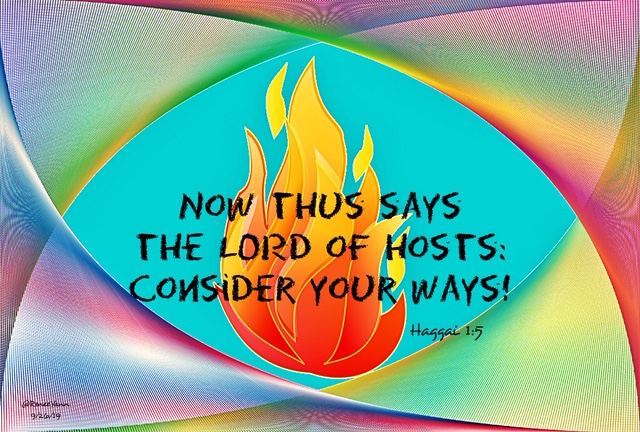
Haggai offers a turning point for their arguments. He tells the people they are a mess. The absence of a central symbol for their faith has weakened and scattered them to their own selfish pursuits. He tells them to look at themselves:

Consider your ways!
You have sown much, but have brought in little;
you have eaten, but have not been satisfied;
You have drunk, but have not been exhilarated;
have clothed yourselves, but not been warmed;
And whoever earned wages
earned them for a bag with holes in it.


The Temple, while it is important, isn’t the most important part of Haggai’s prophecy. He tells the people they have lost their souls. The lack of a central, shared faith has caused them to forget who they are. They will remember only when they remember God’s centrality in their lives.

Haggai appeals to the people to restore a public life which gives honor to God. For their time and circumstance, such a return is symbolized by the rebuilding of the Temple which had been destroyed at the time of their enslavement by Babylon.


We humans often forget what’s important. We chip away at, and ultimately destroy, what makes us who we are by little acts of faithlessness, deceit, covetousness, and envy. These small treacheries grow into big ones redeemable only by an impeachment of the soul and the renewal of a common moral purpose. Haggai offered that conversion to Israel. Pope Francis is offering it to us today.


Video: TED Talk by Pope Francis given at the Annual TED Conference in 2017 and pleading for a “Revolution of Tenderness”. (Yes, it’s long, but it is profound. When he delivered this talk, the Pope was given a standing ovation by some of the most prestigious business people of our time.)

https://www.npr.org/sections/thetwo-way/2017/04/26/525699847/in-surprise-ted-talk-pope-francis-asks-the-powerful-for-revolution-of-tenderness


Music: Come Back to Me – by Gregory Norbet, sung by John Michael Talbot

Athanasius in Spring

Memorial of Saint Athanasius, Bishop and Doctor of the Church
May 2, 2023

Today’s Readings:

https://bible.usccb.org/bible/readings/050223.cfm

Today, in God’s Lavish Mercy, we celebrate the feast of St. Athanasius, and since our readings repeat themes we have prayed with for a few days, I thought we might focus our prayer today on Athanasius.

Living in 4th century Egypt, Athanasius was a Church Father – one of the ancient and influential Christian theologians and writers who established the intellectual and doctrinal foundations of Christianity. (For insight into the often uncelebrated Church Mothers, see this excellent article: https://www.ncronline.org/news/opinion/simply-spirit/honor-mothers-early-christianity-during-womens-history-month )


During his lifetime, the Church struggled with the heresy of Arianism which questioned whether Jesus was really God. Athanasius was named a Doctor of the Church for his steadfast defense of the doctrine of the divinity of Christ. Some of Athanasius’s writings are suggestive of the theology of our great modern theologians, and so necessary for our spirituality today.

The Self-revealing of the Word
is in every dimension –
above, in creation;
below, in the Incarnation;
in the depth, in Hades;
in the breadth, throughout the world.
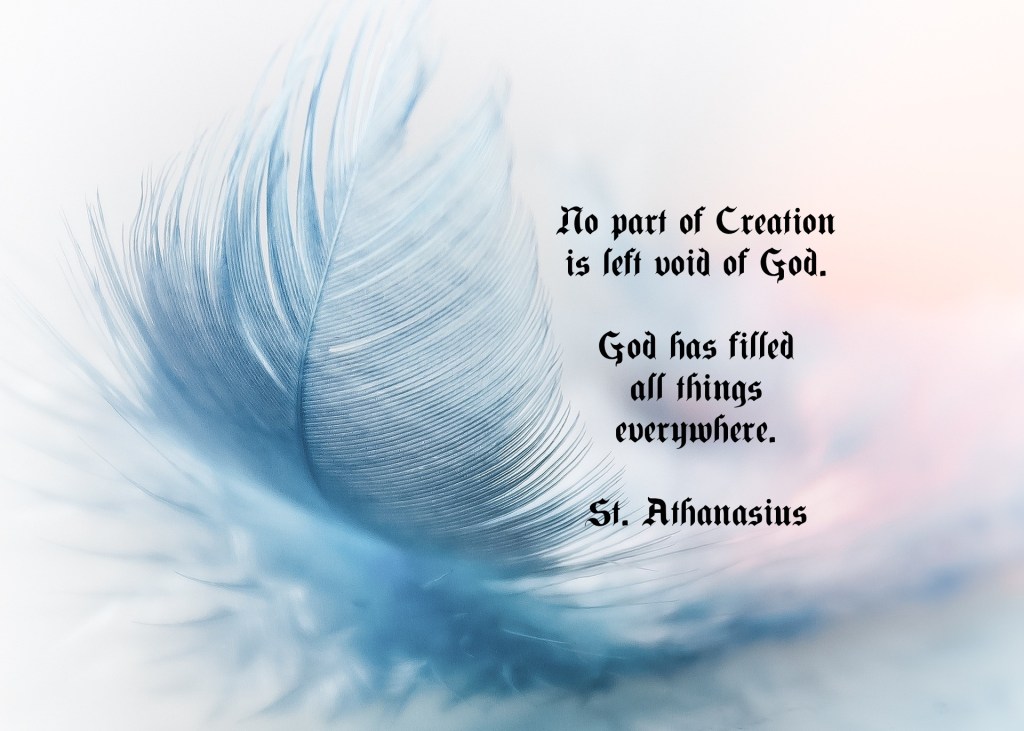
All things have been filled
with the knowledge of God.

St. Athanasius

Pierre Teilhard de Chardin, the revered Jesuit theologian of the early 20th century, writes in a tone suggestive of Athanasius:

If we live at a distance from God, the universe remains neutral or hostile to us. But if believe in God, immediately all around us the elements, even the irksome, organize themselves into a friendly whole, ordered to the ultimate success of life.

Pierre de Chardin, SJ in Christianity and Evolution

More recently, beloved Pope Francis teaches with the same sacred appreciation of the “mystical” depths of Creation:

The universe unfolds in God, who fills it completely. Hence, there is a mystical meaning to be found in a leaf, in a mountain trail, in a dewdrop, in a poor person’s face. The ideal is not only to pass from the exterior to the interior to discover the action of God in the soul, but also to discover God in all things.

Pope Francis in Laudato Sí, 84)

As we pray in these early days of May, still drenched in the glory of Easter, may we hear God speaking to us in the infinitely new and ever-evolving power and beauty of all Creation.

The occurrence of chance in the world in its own finite way reflects the infinite creativity of the living God, endless source of fresh possibilities. The indwelling Creator Spirit grounds not only life’s regularities but also the novel occurrences that open up the status quo, igniting what is unexpected, interruptive, genuinely uncontrolled, and unimaginably possible. As boundless love at work in the universe, the Spirit embraces the chanciness of random mutations, being the source not only of order but also of the unexpected breaks in order that ensure freshness. Divine creativity is much more closely allied to the outbreak of novelty than our older order-oriented theology ever imagined

Elizabeth Johnson, CSJ – Distinguished Professor of Theology at Fordham University in her book, Ask the Beasts: Darwin and the God of Love

Poetry: Spring – Mary Oliver

Somewhere
a black bear
has just risen from sleep
and is staring
down the mountain.
All night
in the brisk and shallow restlessness
of early spring
I think of her,
her four black fists
flicking the gravel,
her tongue
like a red fire
touching the grass,
the cold water.
There is only one question:
how to love this world.
I think of her
rising
like a black and leafy ledge
to sharpen her claws against
the silence
of the trees.
Whatever else
my life is
with its poems
and its music
and its glass cities,
it is also this dazzling darkness
coming
down the mountain,
breathing and tasting;
all day I think of her -—
her white teeth,
her wordlessness,
her perfect love.

Music: Spring from The Four Seasons – Antonio Vivaldi