Haggai Impeaches Israel

Thursday of the Twenty-fifth Week in Ordinary Time

September 26, 2010

Click here for readings

Today, in Mercy – and tomorrow – we will hear from Haggai, one of the twelve minor prophets of the Hebrew Scriptures. These dozen writers are referred to as “minor” because of the length of their writings, not their value.

So Haggai, even though many of us have never heard of him, has something important to say for Judeo-Christian tradition and for each of us who read him. Let’s see what that might be.
Hag1_9JPG

Haggai is prophesying during the Persian period of Jewish history, around the middle of the 6th century, BC. The Jewish people had been back home from the Babylonian captivity for almost 20 years. When they first returned they were passionate about rebuilding the Temple. But as the decades passed, and opposition from their non-Jewish neighbors increased, their commitment waned.

The building of worship places has always been an activity with fans on both sides of the aisle. Some argue that God needs a spot where the Divine Presence can be recognized and revered. Others believe that the effort and resources expended in such building could better be used in human services for God’s poor and needy people. Haggai’s community had people in both camps. (Sound familiar?)

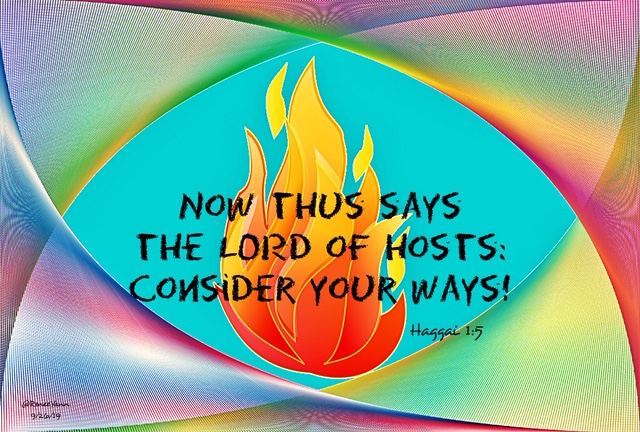
Haggai offers a turning point for their arguments. He tells the people they are a mess. The absence of a central symbol for their faith has weakened and scattered them to their own selfish pursuits. He tells them to look at themselves:

Consider your ways!
You have sown much, but have brought in little;
you have eaten, but have not been satisfied;
You have drunk, but have not been exhilarated;
have clothed yourselves, but not been warmed;
And whoever earned wages
earned them for a bag with holes in it.

The Temple, while it is important, isn’t the most important part of Haggai’s prophecy. He tells the people they have lost their souls. The lack of a central, shared faith has caused them to forget who they are. They will remember only when they remember God’s centrality in their lives.

Haggai appeals to the people to restore a public life which gives honor to God. For their time and circumstance, such a return is symbolized by the rebuilding of the Temple which had been destroyed at the time of their enslavement by Babylon.

We humans often forget what’s important. We chip away at, and ultimately destroy, what makes us who we are by little acts of faithlessness, deceit, covetousness and envy. These small treacheries grow into big ones redeemable only by an impeachment of the soul and the renewal of a common moral purpose.

If the message strikes you as extremely germane to current day realities, I’m glad.

Music: Come Back to Me – by Gregory Norbet, sung by John Michael Talbot
Law or Love?

Tuesday, April 2, 2019

Click here for readings

Today, in Mercy, our readings bring to mind the role of religion in our spiritual life.

take up mat 2

The dictionary defines religion as a particular system of faith and worship. The origin of the word “religion” is from the Latin “religare”: to bind.

In the magnificent passage from Ezekiel, we are given a metaphorical description of grace flowing from the Temple, the locus of faith for Israel. Ezekiel is led by a radiant vision to this source of abundant life symbolized by water. Slowly and incrementally, this abundance deepens for Ezekiel, until he is swimming in its grace. 

Ezekiel’s vision demonstrates what happens in us when religion, ritual and law enhance grace. The beauty, power and architectural symmetry of the Temple symbolize the great benefits of religious practice.

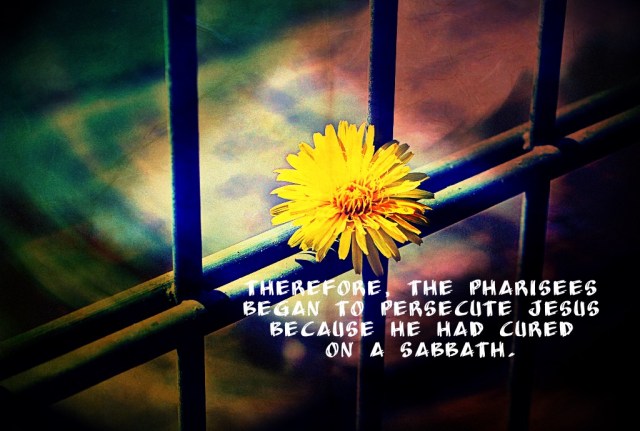
Our Gospel, on the other hand, shows us a Pharisaical religion built on empty practice and bereft of heart. When Jesus cures on the Sabbath, he moves beyond these skeletal boundaries to mercy, which is the reason for all religious practices.

take up mat
Jesus Cures on the Sabbath

Jesus shows us that when religion – and its ensuing ritual and law – bind grace, it needs to be set aside. His whole life was predicated on a faith which generated mercy, not sacrifice. The alleviation of suffering and need always supersede observance – even on the Sabbath.

When we see any so-called faith or religion which places law over mercy, we see an empty temple where the river of grace has run dry. Our culture is filled with fake holiness that measures, condemns and ostracizes others. We see religion distorted into political bullying. We see it redefined as an excuse for excessive wealth. We even see it used as legitimization for nationalism, violence, racism, and war.

Today’s readings tell us to be on guard. The forces which twist religion are very subtle and pervasive in our culture. They dress themselves in impressive words and practices, just like the Pharisees did, but their costumes hide an ugly hate and fear.

To the fearful and weak, these forces preach power – but it is a power over not for others.

Jesus has shown us what faithful practice looks like: mercy and love. It is vulnerable, courageous, inclusive, and humble. It sees the suffering of others and responds. It waters the Temple of our hearts to make them verdant with hope, joy and generosity.

Music: Come to the Water – John Foley, SJ and Matt Maher

We Are God’s Temple

Friday, November 9, 2018

Readings: http://www.usccb.org/bible/readings/110918.cfm

psalm46 stream

Today, in Mercy, we celebrate the Feast of the Dedication of the Lateran Basilica in Rome.  It’s a big deal feast and, as a young religious, I never really understood why. I thought to myself, “It’s a building, right? Why are we celebrating a building.” As I matured, I learned. 

Perhaps some of you are familiar with Ken Follett’s book “The Pillars of the Earth”. Or perhaps others of you have visited the Sagrada Familia Cathedral in Barcelona, Spain. You may have been, as I was, overwhelmed at the sheer enormity and span of these cathedral-building endeavors which reflect our desire to enshrine God.

What is it in us, as human beings, that will move us to give lifetimes and centuries to capturing God? What is it in us that will try to concretize our awe at the Almighty?

It was just such an inner drive that motivated the builders of the Lateran, the oldest and highest ranking of the four major basilicas in Rome.  This “temple of stones” was understood by its builders to represent the living Church – you and me, who together are built up by Christ into his own Body.

What kind of  temple are we, sisters and brothers – we who are all too aware now of the cracks in our structure? 

We are, as Ezekiel visions and the psalmist confirms in today’s readings, a temple fed by the life waters of God.

Our Gospel shows that Jesus knew and believed this. He cleansed the temple in Jerusalem of its weaknesses. He then compared it to his own body, which is the true dwelling place of grace among us. He asked us to imitate him in the way we treasure and live our lives in this world because we too are Temples of God’s Grace.

A living fountain of grace flows through this living temple. God is in our midst as we build, and rebuild, the Church – brick by human brick.

May this feast renew our hope for our Church, cause us to call upon God for deeper courage, and witness to all the enduring power of faith.

Music:  We Are God’s People – Fred Bock

This is a recently written hymn with an old time kind of sound. 

English hymn text writer, Bryan Jeffery Leech, took the primary theme from Johannes Brahms’ 1st Symphony, 4th movement and wrote lyrics which have become a hymn standard. We Are God’s People is a majestic statement befitting Brahm’s regal theme. Allan Robert Petker has created an anthem setting and has intertwined many of the other themes that Brahms utilized in his 1st symphony.