In Wisdom …

Thursday of the Thirty-second Week in Ordinary Time
November 16, 2023

Today’s Readings:

https://bible.usccb.org/bible/readings/111623.cfm


Today, in God’s Lavish Mercy, we have two beautiful readings. Like rich fruit from a fructuous tree, each word and phrase can be savored long and separately.

Our first reading offers the consummate description of Wisdom, the Spirit Who is of and with God. If you can, take time to mentally finger the words in the first reading, the way you would your rosary beads. Let the power of each syllable sink into your heart as you imagine the Unimaginable Beauty who is God:

In Wisdom is a spirit:


And then listen to Jesus as he speaks to the Pharisees (and to us) in our Gospel.

Asked by the Pharisees when the Kingdom of God would come,
Jesus said in reply,
“The coming of the Kingdom of God cannot be observed,
and no one will announce, ‘Look, here it is,’ or, ‘There it is.’
For behold, the Kingdom of God is among you.”

Luke 17:20-21

Jesus tells us that this Incomprehensible Divinity, this Reign of Wisdom, is already among us in the Person of Jesus Christ made flesh among us. We are to look clearly and deeply into our lives to find the Face of God.


Prose: from Evolutionary Faith by Diarmuid O’Murchu

“It is time to outgrow . . .

our rational anthropocentric need to impose order, structure, and closure on every sphere of experience. Our fear of wild eroticism, of creative chaos, and of the radically new possibilities often condemns us to the imprisonment of our fretful imaginations, which then drive us to impulsive action and an irrational desire to dominate and control.

“It is time to embrace . . .

horizons that stretch our minds and hearts to their very limits, trusting that the creative Spirit, who breaks down all rigid boundaries and barriers, will spearhead a new relationality in which we and every other organism will rediscover its true cosmic and planetary identity.”


Music: yen of the Universe – Tim Janis
Good Ground for Hope

Sixteenth Sunday in Ordinary Time
July 23, 2023

Today’s Readings:

https://bible.usccb.org/bible/readings/072323.cfm


Today, in God’s Lavish Mercy, our readings revolve around the dynamic of hope – God’s hope planted in our spirits and our hope entrusted to God’s Mercy.

As we pray with these passages, it helps to remind ourselves of the true definition of “hope”. It is a word that many of us use carelessly to the point that we may have lost the power of its meaning – as in when we say things like, “I hope it doesn’t rain”. What we really mean is that we wish it wouldn’t rain.

Hope is not the same as wishing. Wishing is a mental activity that has no power to make its object come true. Hope, on the other hand, is a resident condition of our spirits that frees us to live with enthusiasm and gratitude despite whatever outcome may arise.

Wishing dissapates when conclusions pass. Hope is eternal because it draws its energy from faith in God’s Infinite Mercy and the promise of eternal life.


The Book of Wisdom’s author understood the Source from which hope springs:

Though you are master of might, you judge with clemency,
and with much lenience you govern us;
for power, whenever you will, attends you.
And you taught your people, by your deeds,
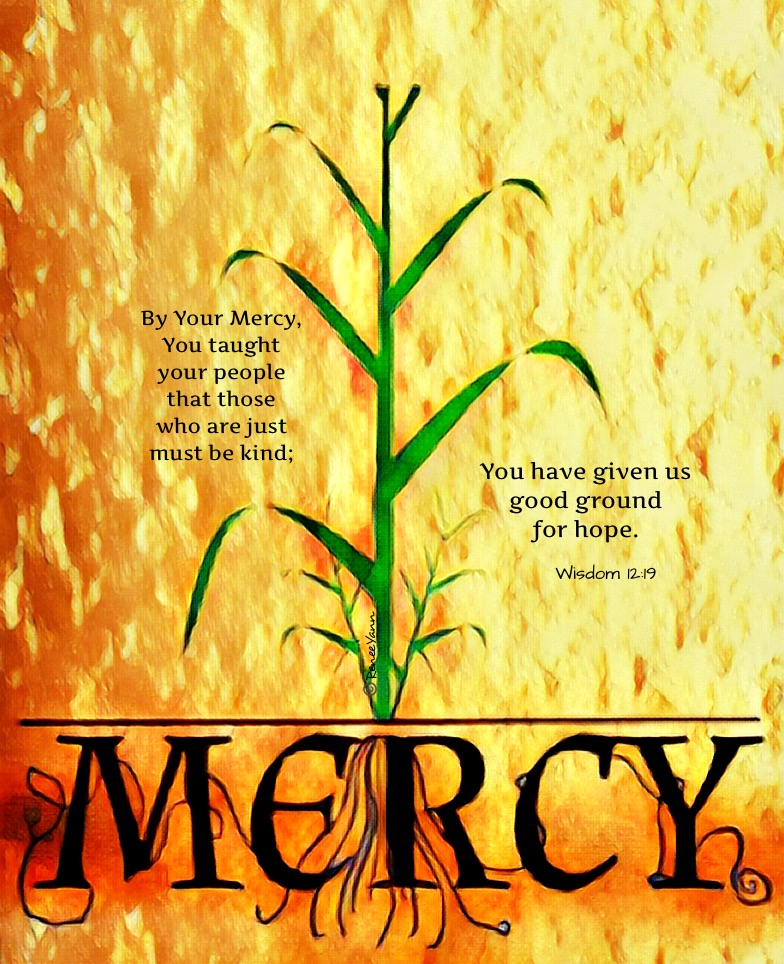
that those who are just must be kind;
and you gave your children good ground for hope
that you would permit repentance for their sins.

Wisdom 12:18-19

Paul, in another passage from magnificent Romans 8, acknowledges that we can sustain hopeful hearts only by the power of the Holy Spirit who lifts us up and prays within us when we are too overwhelmed to do so ourselves.

The Spirit comes to the aid of our weakness;
for we do not know how to pray as we ought,
but the Spirit intercedes with inexpressible groanings. 
And the one who searches hearts
knows what is the intention of the Spirit,
because Spirit intercedes for the holy ones
according to God’s will.

Romans 8:26-27

Jesus gives us a great parable for understanding hope. How discouraged might that farmer have been when the enemy tried to ruin his crop! But instead, the farmer realized that his field, like life, can sustain both the wheat and the weeds. If we live hopefully and faithfully, the wheat can be gathered from the harvest, and the weeds ultimately cast aside.


How many times in our own lives have we nearly been overwhelmed by the weeds! There is no life which passes without its hurts, disappointments, confusions, and dashed wishes! Some experience a sparse scattering of these weeds, and some lives are thick with difficulty. How surprising that it is often in the latter circumstance that hope rises up and sustains hearts.


As our Responsorial Psalm reminds us, those who live simply and sincerely are most able to tap deeply into the mysterious power of hope.

Blessed are you, Father, Lord of heaven and earth;
you have revealed to little ones the mysteries of the kingdom.


Poetry: From “Odes” – George Santayana was a Spanish-American philosopher known more for his aphorisms than his poetry. He came up with lines like, ‘Those who cannot remember the past are doomed to repeat it”, and “Fanaticism consists in redoubling your effort when you have forgotten your aim.”

IV

Slowly the black earth gains upon the yellow,
And the caked hill-side is ribbed soft with furrows.
Turn now again, with voice and staff, my ploughman,
Guiding thy oxen.
Lift the great ploughshare, clear the stones and brambles,
Plant it the deeper, with thy foot upon it,
Uprooting all the flowering weeds that bring not
Food to thy children.
Patience is good for man and beast, and labour
Hardens to sorrow and the frost of winter.
Turn then again, in the brave hope of harvest,
Singing to heaven.

Music: Weed and Wheat – Silayio Kirisua is a Maasi woman who represented Kenya in the Voice of Holland singing competition. After winning the competition, she has become an international sensation.

A Grape Soon Ripe

Saint Charles Lwanga and Companions, Martyrs
June 3, 2023

Today’s Readings:

https://bible.usccb.org/bible/readings/060323.cfm

Today, in God’s Lavish Mercy, we pray with our final passage from the Book of Sirach. We will read Sirach only five or six times again scattered throughout the liturgical year.

In today’s reading, Sirach offers a grateful reflection on the early blessing of wisdom and pursuit of holiness in his life.

I thank the LORD and I praise him;
I bless the name of the LORD.
When I was young and innocent,
I sought wisdom openly in my prayer
I prayed for her before the temple…

Sirach 51:13-14

Sirach’s prayer will resonate with many of us whose earliest days were blessed with faithful parents and grandparents. These wisdom figures taught us to love and seek God in our lives. As we pray today, we think of them with gratitude, as well as of the many teachers who guided our young spirits into God’s Light.

Even if we have moved far from the parish church of our youth, we may recall the graces we received within her walls. We might prayerfully recollect our beloved grade school and high school where we were guided in the pursuit of a meaningful and reverent life.


Hopefully, our prayer brings us to realize how blessed we have been from the beginning of our lives. This is the kind of prayer Sirach prays in today’s reading. He is filled with gratitude and praise because he understands that it is all a gratuitous and undeserved blessing:

My heart delighted in Wisdom,
My feet kept to the level path
because from earliest youth I was familiar with her.
In the short time I paid heed,
I met with great instruction.
Since in this way I have profited,
I will give my teacher grateful praise.

Sirach 51:15-17

Sirach’s prayer brings him to that still and holy place deep in his heart — that place where he touches the Wisdom of God. He describes it like this:

I sought Wisdom openly in my prayer
I prayed for her before the temple,
and I will seek her until the end,
and she flourished as a grape soon ripe.

Sirach 51:13-15

Many of us are so busy and intent on living our lives forward – trying to make it through this day to the next. We may not take the time to consider and appreciate the “ripe grape” our life has already become.

I look around me in our convent chapel and realize that I am living with holy people. Of course, like me, they have their personal twists and trademarks. Still each one of them has walked through their roundabout years into the heart of God. Every day they live into a deeper goodness – aging like fine wine, unaware that the grape has already ripened and is blessing the world around them.

The Great Vintner accomplishes this holy transformation in us by a slow accumulation of blessings which saturate our hearts in God. Pausing, like Sirach, to recognize and give thanks fills us with generous gratitude and a confident courage for the days to come.


Take time to look at the holy people in your own life today, the ones through whom God’s Wisdom has poured into your life. They are the ones who love you into a better person by their goodness, honesty, humility, and generosity. You meet them in your family, friends and workplace. Or you may have met them only in a book, poem, song or story.

I met with great instruction.
Since in this way I have profited,
I will give my teacher grateful praise.

Sirach 51:16-17

Poetry: Our Responsorial Psalm 19 today beautifully complements Sirach’s prayer and can serve as a perfect poetic refletion for us.


The law of the LORD is perfect,
refreshing the soul.
The decree of the LORD is trustworthy,
giving wisdom to the simple.

The precepts of the LORD are right,
rejoicing the heart.
The command of the LORD is clear,
enlightening the eye.

Awe of the LORD is pure,
enduring forever;
The ordinances of the LORD are true,
all of them just.

They are more precious than gold,
than a heap of purest gold;
Sweeter also than syrup
or honey from the comb.


Music: Psalm 19 – Jess Ray

Wisdom, please ….

Twenty-third Sunday in Ordinary Time
September 4, 2022

Today, in God’s Lavish Mercy, we continue to move into the final segments of Luke’s Gospel which we have been reading on Sundays throughout this liturgical year.

Today, the Church links three readings which, at first glance, might seem unrelated.

  • Our first reading from Wisdom reminds us of God’s infinite wisdom, incomprehensible to our human minds.
  • Paul, in his letter to Philemon, begs for the loving inclusion of Onesimus, an enslaved person, into the Colossian community.
  • In our Gospel, Jesus makes this harsh pronouncement:

If anyone comes to me without hating his father and mother,
wife and children, brothers and sisters,
and even his own life,
he cannot be my disciple.


How might we interpret these disparate passages to find a message of wholeness for our prayer?

Wis9_13 gods mind

Let’s start with Jesus. In no uncertain terms, he challenges his disciples to move out of their small worlds into God’s big world. That Godly world is not defined by family, nor by any condition other than our common Creaturehood in God … not by:

word gram

Jesus says the sacred community is defined only by shared and irrevocable commitment to the Gospel of love and mercy.


Paul knows and loves Onesimus, the slave, as a brother in this community. In his letter, Paul encourages Philemon to do the same.


Sometimes as human beings, filled with all kinds of insecurities, we tend to build enclaves that make us feel safe. We like to be with “our kind”. We invent borders to filter out those whose differences we don’t understand. We allow fear to grow with that lack of understanding. Within the enclosure of our self-protectionism, we eventually forget that we are all one, equal, precious, beautiful and beloved by God.

Such toxic attitudes are the soil for slavery, war, ethnic cleansing, racial supremacy, human trafficking, destructive nationalism, and all the other sacrileges committed by humans against the human family.

Wisdom reminds us that only God can open
the tight circle of our fears, judgments and isolations
– only God whose infinite love encompasses all.
Jesus tells us that we find that love
only by lifting up the cross and following him.

Wisdom tells us to put it in God’s hands, and to respond to God’s challenge in the preaching of Jesus Christ.

Who can know your way of thinking, O God
… except you give us wisdom

 and send your Holy Spirit from on high
 thus stretching the hearts of those on earth

Today I pray, may God do this for me,
and for all our tight, convoluted
and troubled world.


Poetic Prayer of Hildegard of Bingen

Hildegard of Bingen (c. 1098 – 17 September 1179), was a German Benedictine abbess and polymath active as a writer, composer, philosopher, mystic, visionary, and as a medical writer and practitioner during the High Middle Ages. She is one of the best-known composers of sacred monophony, as well as the most recorded in modern history. She has been considered by scholars to be the founder of scientific natural history in Germany.

I am Wisdom. 
Mine is the blast of the resounding Word 
through which all creation came to be, 
and I quickened all things with my breath 
so that not one of them is mortal in its kind; 
for I am Life.

Indeed I am Life, whole and undivided 
-- not hewn from any stone, 
or budded from branches, 
or rooted in virile strength; 
but all that lives has its root in Me.
 
For Wisdom is the root 
whose blossom is the resounding Word....
I flame above the beauty of the fields 
to signify the earth 
-- the matter from which humanity was made.

I shine in the waters to indicate the soul, 
for, as water suffuses the whole earth, 
the soul pervades the whole body. 

I burn in the sun and the moon to denote Wisdom, 
and the stars are the innumerable words of Wisdom.

Music: Who Has Known (an Advent hymn, but perfect I think for today’s readings)

Darkness to Light

November 13, 2021
Saturday of the Thirty-second Week in Ordinary Time

Today, in God’s Lavish Mercy, we are blessed with some of the most

Psalm 105 invites us to sing praise as we confidently seek God in our lives, and to always remember God’s merciful goodness to us:

Sing to God, sing praise,
    proclaim all God’s wondrous deeds.
Glory in the holy name;
    rejoice, O hearts that seek the LORD!
Remember the marvels the Lord has done!

Psalm 105: 2-3

Our first reading from Wisdom gives us one of the most gloriously imaginative images in Scripture.

Although the passage is a poetic recounting of the Exodus experience, it always makes me think of Christmas. 

  • Midnight on a starry night
  • Peaceful stillness over the earth
  • The all-powerful Word transformed 
  • Appearing among us like a comet in our darkness
  • Hope renewed for an otherwise doomed land

Praying with the passage this morning, I realize that my “Christmas lens” on the reading is right on target.

The Christmas event begins our Exodus story, a story completed in the Passion, Death and Resurrection of Christ.

Just as the God of Moses reached into ancient Israel’s life to free them, transform them and make them God’s People, so God reaches into our lives. God does this not only on Christmas, but in every moment of our experience.


As our media and consumer culture bombards us, all too early, with all the secularized images of Christmas, let today’s verses bring us back to the true startling grace of our own Christ/Exodus stories:

We are not alone in the midnights of our lives. 
Listen underneath all the distractions 
to the, at first, softly emerging sound of Love 
humming under all things. 
Watch for the small lights of heaven 
longing to break into our human darkness. 
Give yourself to their Light.

No matter where we are in our lives right now, 
no matter the joy or pain of our present circumstances, 
God wants to use these realities to be with us 
and to teach us Love. 
Let us invite God 
into our willingness
to learn that Love, 

to become that Love.


Music: Winter Cold Night – John Foley, SJ

Lyrics below (yes, it is an Advent/ Christmas song. But it fits so perfectly. Please forgive me if I am rushing the season too. 😉

Delight in Wisdom

November 11, 2021
Thursday of the Thirty-second Week in Ordinary Time

Today, in God’s Lavish Mercy, our beautiful reading from Wisdom requires no further words from me. I highly recommend that we savor each of its elegant phrases, turning them over in our hearts and souls – like the rich colors of a vibrant Autumn or Spring day.

In Wisdom is a spirit
intelligent, holy, unique,
Manifold, subtle, agile,
clear, unstained, certain,
Not baneful, loving the good, keen,
unhampered, beneficent, kindly,
Firm, secure, tranquil,
all-powerful, all-seeing,
And pervading all spirits,
though they be intelligent, pure and very subtle.

For Wisdom is mobile beyond all motion,
and she penetrates and pervades all things by reason of her purity.
For she is an aura of the might of God
and a pure effusion of the glory of the Almighty;
therefore nought that is sullied enters into her.

For she is the refulgence of eternal light,
the spotless mirror of the power of God,
the image of his goodness.
And she, who is one, can do all things,
and renews everything while herself perduring;
And passing into holy souls from age to age,
she produces friends of God and prophets.

For there is nought God loves, be it not one who dwells with Wisdom.
For she is fairer than the sun
and surpasses every constellation of the stars.
Compared to light, she takes precedence;
for that, indeed, night supplants,
but wickedness prevails not over Wisdom.
Indeed, she reaches from end to end mightily
and governs all things well.


Instrumental Music: Poéme by Secret Garden

As we listen, 
let us carry to the arms of
Wisdom and Mercy
any bright hope 
or shadowed care 
we have in our hearts.


On this special anniversary of the death
of the foundress of the Sisters of Mercy,
Catherine McAuley,
you may be interested in
this beautiful article and prayer service
from Mercy International Association:

https://www.mercyworld.org/newsroom/enews/issue-940/

God Knows My Truth

November 8, 2021
Monday of the Thirty-second Week in Ordinary Time

Today, in God’s Lavish Mercy, we pray with the comforting yet challenging Psalm 139, a prayer of awareness, intimacy, and trust.

O LORD, you have probed me and you know me;
    you know when I sit and when I stand;
    you understand my thoughts from afar.
My journeys and my rest you scrutinize,
    with all my ways you are familiar.

Psalm 139:1-3

The thought that God knows us so intimately might be both assuring and/or scary — depending on how we know and understand ourselves. The psalmist describes an overwhelming wonder at the thought of God’s closeness:

Even before a word is on my tongue,
    behold, O LORD, you know the whole of it.
Behind me and before, you hem me in
    and rest your hand upon me.
Such knowledge is too wonderful for me;
    too lofty for me to attain.

Psalm 139:4-6

As we pray Psalm 139, the awe settles into a deep awareness that God’s penetrating Presence in our spirits is ever beneficent and merciful. We pray to yield to its Love and seek its Wisdom.

Where can I go from your spirit?
    From your presence where can I flee?
If I go up to the heavens, you are there;
    if I sink to the nether world, you are present there.
If I take the wings of the dawn,
    if I settle at the farthest limits of the sea,
Even there your hand shall guide me,
    and your right hand hold me fast.

Psalm 139:7-10

On this 32nd Monday, we begin a week of readings from the Book of Wisdom. Written in the century surrounding the birth of Christ, Wisdom is the work of a poet, theologian, philosopher, and moralist. 

Today’s passage alerts us, as does our Gospel, that holding God’s Presence within us, we must live lives that bear it witness:

For wisdom is a kindly spirit,
yet she acquits not blasphemers of their guilty lips;
Because God is the witness of the inmost self
and the sure observer of the heart
and the listener to the tongue.
For the Spirit of the Lord fills the world,
is all-embracing, and knows what the person truly bespeaks by their lives.

Wisdom 1:6-7

A millstone at someone’s feet …

For as our Gospel tells us today:

Jesus said to his disciples,
“Things that cause sin will inevitably occur,
but woe to the one through whom they occur.  
It would be better to have a millstone hung around the neck
and be thrown into the sea
than to cause one of these little ones to sin.”

Luke 17:1-2

Poetry: Wisdom – Tagore

The small wisdom 
is like water in a glass:
clear, transparent, pure.

The great wisdom 
is like the water in the sea:
dark, mysterious, impenetrable.

Music: The Perfect Wisdom of Our God – The Gettys

Which Way to Turn?

The Twenty-eighth Sunday in Ordinary Time
October 10, 2021

Today, in God’s Lavish Mercy, we pray with Psalm 90 along with readings that are both beautiful and poignant.  

In our first passage, we drink from Wisdom’s sweet nectar. This book, written about fifty years before Christ’s birth, is the work of an unnamed Jewish poet and scholar. At points, as in today’s segment, the writer assumes the persona of Solomon, speaking in his name.


We know from the Book of Kings, chapter 3, that Solomon, as a young king, led a faithful and righteous life. Because of this, God offered Solomon “whatever you want me to give you.”

Think of the possibilities for this young man, just on the cusp of kingship! Power, wealth, longevity, peace, prosperity, political dominance – all the things we are inclined to covet in this world.

But Solomon prays instead for wisdom, as described in today’s reading:

Beyond health and comeliness I loved her,
and I chose to have her rather than the light,
because the splendor of her never yields to sleep.


Our Gospel tells of a young man offered an opportunity similar to Solomon’s. Already living a faithful life, he wants to go deeper into God’s heart. 

Jesus, looking at him, loved him and said to him,

“You are lacking in one thing.
Go, sell what you have, and give to the poor
and you will have treasure in heaven;
then come, follow me.” 

But this young man, unlike Solomon, cannot accept the invitation to this deep place of love and devotion. Instead, he goes away sad. It makes me sad, too, whenever I read these verses. I always wish that, after a few steps, he had turned around and shouted, “Yes! I will do what you ask. I love God that much. Help me!”


Like these young men, we have a deep desire to live within God’s love. But are we walking toward that love or away from it? Most of us don’t say an outright “No” to God’s invitation. Instead, we are distracted, lazy, or just not paying attention to the the whispers of grace.

Let’s pray today’s powerful Psalm 90 to open our minds and hearts to God’s hope for us.


Poetry: Based on Psalm 90 – Christine Robinson

We have come out of the Earth
and to the Earth we return
Our lives are but a flash in the light of Eternity.
We are like beautiful flowers which live only a day.
We might live 70 years—more if our strength holds.
So much work and hardship!
How quickly the time passes.

Teach us then, to value our days
to treat each one as a sacred trust.
Fill our hearts with wisdom.
and a love for our lives.
In spite of all the grief and suffering
May we be always glad of this precious gift
And hallow the good in each day.


Music: Fill Us With Your Love ~ Ephrem Feeley

Psalm 63: So Thirsty!

Thirty-second Sunday in Ordinary Time

November 8, 2020

( A bit late today in publishing as I was distracted by the breaking U.S. election results! I would like to say one word on that before the reflection. Here is that word:

ALLELUIA!


Today, in God’s Lavish Mercy, we pray with Psalm 63, a prayer of deep longing and faithful intimacy. 

The psalm is complemented by the lyrical passage from the Book of Wisdom which immediately reminded me of my favorite verse for the Christmas season:

For while gentle silence enveloped all things,
and night had now run half its swift course,
Wisdom’s all-powerful Word leapt down from heaven, 
from the royal throne,
into the midst of the shadowed land.

Wisdom 18: 14-15

Using delicate feminine images, our first reading from Wisdom describes the God for whom we long – a God who longs for us as eagerly:

Resplendent and unfading is Wisdom,
and she is readily perceived by those who love her,
and found by those who seek her.
She hastens to make herself known in anticipation of their desire –


This reading forms a sort of dance with our Psalm – the first describing God’s desire, the second describing ours:

O God, you are my God whom I seek;
for you my flesh pines and my soul thirsts
like the earth, parched, lifeless and without water.

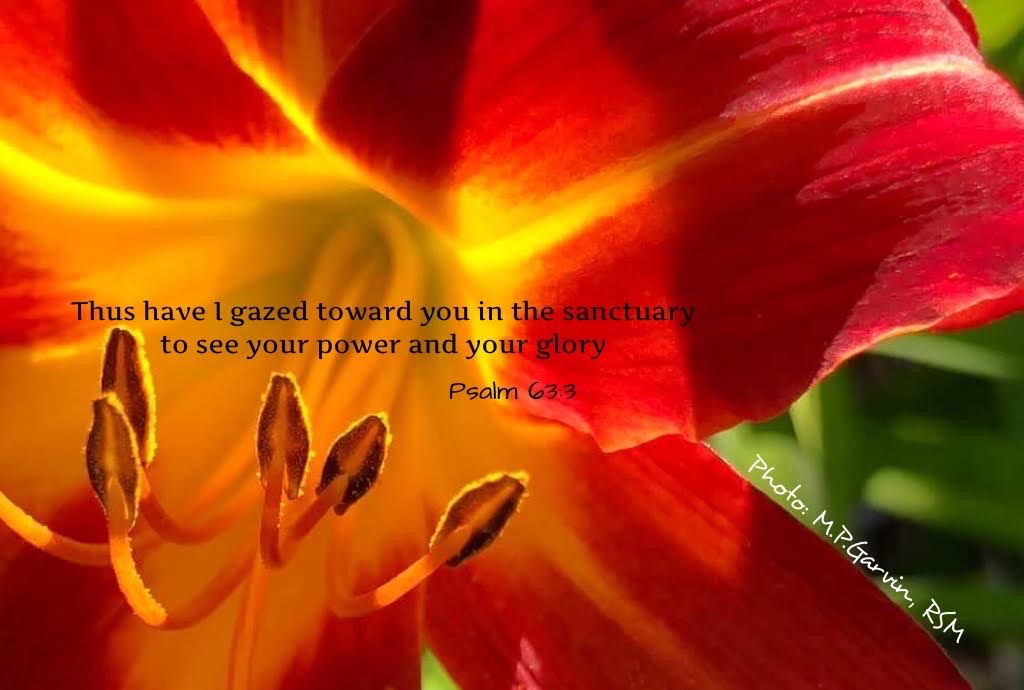
Thus have I gazed toward you in the sanctuary
to see your power and your glory,
For your kindness is a greater good than life;
my lips shall glorify you.


Our reading assures us that God readily meets our gaze:

Whoever watches for Wisdom at dawn shall not be disappointed,
for they shall find her sitting by their heart’s gate.
For taking thought of wisdom is the perfection of prudence,
and whoever for her sake keeps vigil
shall quickly be free from care;
because she makes her own rounds, seeking those worthy of her,
and graciously appears to them in the ways,
and meets them with all solicitude.


In our prayer today, let us open our deepest hearts to this Wisdom God who seeks us. Let our thirsty souls be satisfied in that loving Sacred Bliss.

Thus will I bless you while I live;
lifting up my hands, I will call upon your name.
As with the riches of a banquet shall my soul be satisfied,
and with exultant lips my mouth shall praise you.


Music: I Long for You, O Lord – The Dameans

I long for you, O Lord
With all my soul, I thirst for You.

God, my God, you I seek
for You my soul is thirsting,
Like a dry and weary land,
my spirit longs for You.

I have sought for Presence, Lord
to see your power and your glory.
Lord, your love means more than life.
I shall sing your praise.

Thus will I bless you while I live,
and I will call your name, O Lord.
As with the riches of a feast
shall my soul be satisfied.

Through the night, I remember You
for You have been my Savior.
In the shadow of your wings,
I will shout for joy.

Psalm 119:Acrostic Prayer

Seventeenth Sunday in Ordinary Time

July 26, 2020


Today, in Mercy, we pray with young Solomon, as God asks him to carry the weight of leadership. Of all that Solomon might have asked from God, he requested only wisdom, which is described in James 3:17. “But the wisdom that comes from heaven is first of all pure; then peace-loving, considerate, teachable, full of mercy and good fruit, impartial and sincere.” We pray for wisdom for ourselves in the discharge of our responsibilities. We pray for this gift for all who hold power in our world.

from 2017 – 17th Sunday in Ordinary Time

Today, in God’s Lavish Mercy, we pray with Psalm 119, the longest psalm, and a meticulously constructed poem. It is one of about twelve acrostic poems in the Bible, employing the twenty-two characters of the Hebrew alphabet to teach a lesson about love of the Torah, the Law.

Acrostic poems have been popular throughout history because they let the reader examine a theme from multiple, memorable perspectives. Although often tricky to compose, they are simple to read, and sometimes so commonplace as to be transparent.

Here is an example of an acrostic poem from 19th century America


So why did the psalmist take the trouble to compose a complicated verse like Psalm 119? The answer seems apparent, I think. The love of the Law was that important to the writer. It was the one true treasure, and he wanted others to share the treasure.

The theme of “treasure” ties together all of our Sunday readings.

In our first reading, young Solomon could have asked God for anything. But Solomon already treasures the Wisdom of God:

The LORD was pleased that Solomon made this request.
So God said to him:
“Because you have asked for this—
not for a long life for yourself,
nor for riches,
nor for the life of your enemies,
but for understanding so that you may know what is right—
I do as you requested.


Our second reading confirms that those who love God, like Solomon did, are blessed with the treasure of confidence and peace:

We know that all things work for good
for those who love God.


Matthew’s Gospel tells us to seek that treasure buried in the field of our lives. When we find it, we should give everything to make it our own:

When he finds a pearl of great price,
he goes and sells all that he has and buys it.


Praying Psalm 119 allows us to appreciate the treasure of God’s Law, God’s heartbeat, in our lives. It holds the Word up before us, facet by facet, the way we would lift a diamond to the Light. When we come to love Wisdom/Word/Law as Solomon did, we give everything to possess it fully.


Poetry: Last Hike Before Leaving Montana by Patricia Traxler.
In this poem, the poet is ostensibly talking about a bear, but listen a little deeper and she is talking about God.

Late winter, almost spring. It's like finding a diamond;
now I don't want to leave. I sit in the dirt and put my hands
in your tracks. For the first time in a long time I don't
doubt. Now I know I always knew you were here. You
are the beginning of disclosure, the long-felt presence

Suddenly incarnate. Behind me my friend warns, If we
see the bear, get into a fetal position. No problem,
I tell her, I'm always in a fetal position—I was born
in a fetal position. Did you know, she says, the body
of a shaved bear looks exactly like a human man?
I skip a stone, feel a sudden bloat of grief, then laugh.
I ask her, Who would shave a bear? We climb

Farther up Rattlesnake Creek, watch winter sun glitter
off dark water. No matter how high we go I look higher.
Sometimes absence can prove presence. That's not exactly
faith, I know. All day, everywhere, I feel you near at hand.
There's so much to understand, and everything to prove.
Up high the air is thin and hard, roars in the ears like love.

Music: Lord, You Are More Precious Than Silver – Divine Hymns