Mission: Eternal

Thursday of the Fourth Week of Easter

May 7, 2020

Click here for readings


Southover, St John the Baptist Church
Barnabas, Paul and Mark window St. Patrick’s Church, Sussex, England

Today, in Mercy, and for much of this and next week, we travel with Paul on his first missionary journey. Acts 13 and 14 make for some interesting historical reading, revealing how the early Church took form, how leadership emerged, and how various congregations sparked the spread of the Gospel.


These passages also offer at least two important thoughts to enrich our faith and spiritual life:

  1. They recount a compact synthesis of Salvation History, the story of God’s faithfulness to Israel and, through Jesus Christ, to us. It is a truly marvelous story. Praying with it can make us amazed and grateful that we are now a living part of its continuing grace.
  1. They clearly establish the Christian life as a missionary life – one meant to receive but also to share the Good News of the Gospel.

John13_16 wash

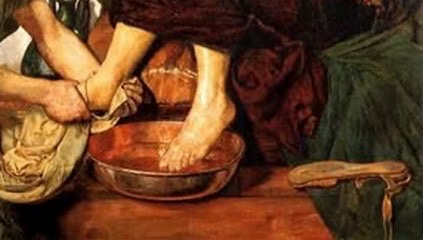
In our Gospel, Jesus, by washing the feet of his companions, clearly demonstrates the key characteristic of a true missionary disciple — sacrificial love rendered in humble service.

Amen, amen, I say to you, no slave is greater than his master
nor any messenger greater than the one who sent him.
If you understand this, blessed are you if you do it.

Jesus commissions his disciples to imitate his love. He promises to be present with them as they minister in his name:

Amen, amen, I say to you,
whoever receives the one I send receives me,
and whoever receives me receives the one who sent me.

Jesus wasn’t just talking to a little dinner party gathered long ago. He was talking to us. For our time and place in history, we are the ones commissioned for Love. 


Our service of the Gospel may take us on exciting journeys like Paul. Or we may be missionaries of prayer and charity, like Thérèse of Lisieux who, though she never left her cloister, was declared Patroness of the Missions by Pope Pius XI.


therese
O Jesus, my Love, my Life … I would like to travel over the whole earth to preach Your Name and to plant Your glorious Cross on infidel soil. But O my Beloved, one mission alone would not be sufficient for me. I would want to preach the Gospel on all five continents simultaneously and even to the most remote isles. I would be a missionary, not for a few years only but from the beginning of creation until the consummation of the ages.” (Thérèse of Lisieux – Story of a Soul) 


In our prayer today, perhaps we might ask Paul, Barnabas, Thérèse or another of our favorite saints to help us see more clearly our own call to carry the mission in our lives.

Music: Here I Am, Lord – St. Louis Jesuits

You Are Mine

Monday of the Fourth Week of Easter

May 4, 2020

Click here for readings

800px-Domenico_Fetti_-_Peter's_vision_of_a_sheet_with_animals_-_Kunsthistorisches_Museum_Wien
Peter’s Vision of the Sheet – By Domenico Fetti – Kunsthistorisches Museum Wien, Bilddatenbank., Public Domain

Today, in Mercy, we have the long story and explanation by Peter of who can be welcomed into the Community. The earliest Christians were all Jews. Their beginning Christian rituals had deep roots in Jewish tradition. Their entire expectation of a Messiah was wrapped in the garment of the Old Testament. So it was hard for them to comprehend that Gentiles might also be saved by the Blood of Christ.

We might be tempted to consider these Jewish Christians very provincial, parochial, or even prejudiced. But maybe we should just look in the mirror!

It seems to be an enduring human inclination and, rather than – like Peter – to seek a road to inclusion, we claim privilege for ourselves and exclude others on all kinds of bases:

  • She’s a woman, so she can’t…. whatever…
  • He’s gay, so he can’t …
  • She’s divorced, so she can’t…
  • He’s pro-life, or pro-choice, so he can’t…
  • She’s a Muslim, an atheist, and (irony of ironies) a Jew, so she can’t…

Maybe in your own life, you have felt the pain of some of these suggested or blatant exclusions.


Jn10_4 Mine

Jesus, in our Gospel, has a whole different approach to whom he loves. All creatures belong to him and will be brought to the Father in love.

I am the good shepherd,
and I know mine and mine know me,
just as the Father knows me and I know the Father;
and I will lay down my life for the sheep.
I have other sheep that do not belong to this fold.
These also I must lead, and they will hear my voice,
and there will be one flock, one shepherd.

Let us pray today to know and love our God ever more intensely. Let us ask to experience God’s infinite love and knowledge of us so that our unquenchable joy, humble gratitude, and limitless charity grow more evident.

Let us pray these gifts for all our sisters and brothers, no matter by what gate they come to the sheep fold.

Music: You are Mine – David Haas

Holy Thursday 2020

Holy Thursday 

April 9, 2020

Click here for readings

Eucharist

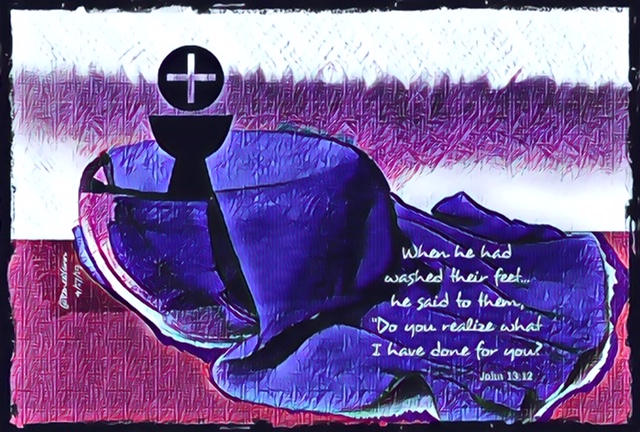
Today, in Mercy, we celebrate the gift of Eucharist, the real and enduring Presence of Christ in  the world.

It is both ironic and instructive that on this “Corona” Holy Thursday, we are quarantined from the sacred Bread and Wine. 

Today, as supper time falls slowly from east to west over the Earth, so will a palpable sadness that pandemic keeps us from physical communion with Christ and the believing community.

There will instead flow a great surge of virtual communion as we join an irrepressible wave of faith. The evening skies will echo with the precious words that, despite circumstances, gather us from whatever distances prevent us:

Jesus took bread, and, after he had given thanks,
broke it and said, “This is my body that is for you.
Do this in remembrance of me.”
In the same way also the cup, after supper, saying,
“This cup is the new covenant in my blood.
Do this, as often as you drink it, in remembrance of me.

Our Gospel reminds us of something which seems even more important this year – there are two equally significant dimensions to a full understanding of Eucharist:

  • the Body and Blood we share at Mass
  • the sacrificial service we live daily among the People of God
    who are the living Body of Christ for us.

In these times of stark loss and need, that second dimension sustains us.

foot

Eucharist is offered when we wash the feet of our sisters and brothers:

  • by the medical and support personnel who tend and comfort the sick, who feed them, clean for them, pray for them
  • by the sick themselves who endure in faith and hope 
  • by those who strive to keep others well
  • by those who serve our essential needs for sustenance and safety
  • by those who pray for the healing, courage and restoration of all Creation 
  • by each one of us as we turn from self toward the good of the whole

As Jesus leans to wash the feet of his disciples, so may we lean in service over our suffering world. Jesus asks us:

Do you realize what I, your Lord and Master, have done for you?

Not fully, Lord, but we are learning a new depth of understanding.

bowl

The realization rises like a slow dawn over the shadows of our selfishness. It is a sunrise which continues throughout our lives. Please help us to rise with You no matter how the darkness weighs on us.

Like the fragile bread and fluid wine which hide your Omnipotent Presence, may we become holy nourishment and joy for one another – a true and living memorial to your infinite act of love for us.

Music: Pange Lingua – Chant of the Mystics.
Written by St. Thomas Aquinas in the 13th century
English lyrics below


Sing, my tongue, the Saviour’s glory,
Of His Flesh, the mystery sing;
Of the Blood, all price exceeding,
Shed by our Immortal King,
Destined, for the world’s redemption,
From a noble Womb to spring.

Of a pure and spotless Virgin
Born for us on earth below,
He, as Man, with man conversing,
Stayed, the seeds of truth to sow;
Then He closed in solemn order
Wondrously His Life of woe.

On the night of that Last Supper,
Seated with His chosen band,
He, the Paschal Victim eating,
First fulfils the Law’s command;
Then as Food to all his brethren
Gives Himself with His own Hand.

Word-made-Flesh, the bread of nature
By His Word to Flesh He turns;
Wine into His Blood He changes:
What though sense no change discerns.
Only be the heart in earnest,
Faith her lesson quickly learns.

Down in adoration falling,
Lo, the sacred Host we hail,
Lo, o’er ancient forms departing
Newer rites of grace prevail:
Faith for all defects supplying,
When the feeble senses fail.

To the Everlasting Father
And the Son who comes on high
With the Holy Ghost proceeding
Forth from each eternally,
Be salvation, honor, blessing,
Might and endless majesty.
Amen.

Rejected

Friday of the Second Week of Lent

March 13, 2020

Click here for readings

Mt21_42rejected

Today, in Mercy, there is a great sadness in our readings.

The poignant opening line from Genesis immediately strikes us:

Israel loved Joseph best of all his sons,
for he was the child of his old age

Joseph

We picture young Joseph in his beautiful rainbow coat and, under an olive tree’s shade, old Jacob(Israel) proudly, tenderly, watching him play.

As the story ensues to reveal the later betrayal of Joseph’s jealous brothers, we are left astounded. Such treachery, especially among brothers, sickens the heart.


Our Gospel picks up the sad theme because Joseph and his brothers are archetypes of Christ’s story with humankind.

800px-The_Wicked_Husbandman_(The_Parables_of_Our_Lord_and_Saviour_Jesus_Christ)_MET_DP835802
The Wicked Husbandman by John Everett Millais shows the owner’s murdered son

Jesus tells a parable in which he is actually the unnamed main character. He is the Son sent by a loving Father. He is the one rejected, beaten and killed by the treacherous tenants of his Father’s garden.

We know from our familiarity with Scripture that both these stories ultimately come to glorious conclusions. But today’s readings do not take us there. They leave us standing, mouths dropped open, at the dense meanness of the human heart, at the soul’s imperviousness to grace, at the profound sadness Jesus felt at this point in his ministry.

In our prayer today, let’s just be with Jesus, sharing his sadness for the meanness still hardening our world. Let us comfort him with our desire to be open to God’s Grace and Mercy.

Music:  Handel:Messiah – He was despised and rejected – Alfred Deller

Turn and See

Thursday of the Second Week of Lent

March 12, 2020

Click here for readings

Today, in Mercy, our readings offer us studies in dramatic contrasts.

the barren bush in a lava waste
vs.
the tree planted beside the waters

that turns its roots to the stream

Jere17_7barrentree


a rich man who dressed in purple garments and fine linen

vs.
a poor man named Lazarus, covered with sores

Gustave_Dore_Lazarus_and_the_Rich_Man
Lazarus and the Rich Man by Gustave Dore (1891)


What are Jeremiah and Jesus teaching us with these unforgettable images?

Jeremiah summarizes his point in the very first verse:

Cursed is the one who trusts in human beings,
who seeks strength in flesh,
whose heart turns away from the LORD.

In his parable, Jesus has Abraham deliver the point:

You received what was good during your lifetime
while Lazarus likewise received what was bad;
but now he is comforted here, whereas you are tormented.


Praying with these passages, we might determine to make sure we don’t end up like the barren bush or the ultimately tormented rich person. 

But how can we do that?

I think the key lies in Jeremiah’s phrase, “one whose heart turns away from the LORD.” 

In his parable, Jesus shows us what that “turning” looks like. It is any blind indifference in us that allows us to ignore another’s suffering. 

Most of us don’t consciously choose that indifference. We simply fail to turn from our own comfort … plans, needs, agenda … to observe the pain or need around us.

So as we leave our prayer today, perhaps we can do so determined to turn from our self-interests … to see if there is a “Lazarus” right beside us whom we had failed to notice.

Music: Turn My Heart – Lynn DeShazo (Lyrics below)

Turn my heart O Lord
Like rivers of water
Turn my heart O Lord
By Your hand
‘Til my whole life flows
In the river of Your Spirit
And my name
Bring honor to the Lamb

Lord I surrender to
Your work in me
I rest my life within
Your loving hands

(Repeat chorus 3 times)

‘Til my name brings honor
To the Lamb

Sheep or Goat?

Monday of the First Week of Lent

March 2, 2020

Click here for readings

sheep mosaic

Today, in Mercy, we are invited to be like God:

The LORD said to Moses,
“Speak to the whole assembly of the children of Israel
and tell them:
Be holy, for I, the LORD, your God, am holy.

Our first reading goes on to tell us how: be a decent person.

  • Don’t steal, lie, or cheat
  • Pay just wages
  • Respect and help those physically burdened
  • Be impartial and just
  • Defend life
  • Don’t slander, hate, take revenge, or hold a grudge

Basically, the message is about kindness … deep kindness, the type that comes from realizing how infinitely kind God is to us.

Leviticus, after a long list of practical examples, sums it up:

You shall love your neighbor as yourself.
I am the LORD.


Our Gospel tells us what happens when we make the choice to take the Old Testament advice — or not.

little lamb

We are all familiar with the parable of the sheep and the goats. And we all hope our scorecard gets us in the right herd “When the Son of Man comes in his glory, and all the angels with him …”


Basically, in this parable, Jesus puts the advice of Leviticus into practical form for his followers. But he adds one dynamic element that not only invites but impels our wholehearted response:

Amen, I say to you,
what you did not do for one of these least ones,
you did not do for me.

Leviticus invites us to become holy as God is holy. But Jesus reveals the secret that this Holy God lives in the poor, hungry, homeless, imprisoned and sick. By embracing these most beloved of God, we find the pattern of Holiness.

Music: The Least of These – Karl Kohlhase

Lent: A Closer Walk

Thursday after Ash Wednesday

February 27, 2020

Click here for readings

Today, in Mercy, our readings confirm that a life patterned on Christ contradicts worldly definitions.

Dt.30_19 Chhose

Deuteronomy gives us stark, either-or, advice:

I have set before you life and death,
the blessing and the curse.
Choose life, then,
that you and your descendants may live,
by loving the LORD, your God,
heeding his voice,
and holding fast to him.

It’s definitive, but we could probably do that, right? Choose life, love God, heed God’s voice, hold fast to God? Sounds OK, doesn’t it?


It’s when Jesus comes along that it sounds difficult. 

Jesus tells us, “Here’s how you choose life –

“Whoever wishes to save his life will lose it,
but whoever loses his life for my sake will save it.”


Jesus tells us, “Here’s the God you must love, one who

“suffers greatly, is rejected, and is killed.”


Jesus tells us, “Here’s what my voice says to you –

“What profit is there for you to gain the whole world
yet lose or forfeit yourself?”


Jesus tells us, “Here’s how you hold fast to me –

‘Take up your cross daily and follow me.”

mcA Cross


Some have huge crosses to carry in their lives – perhaps famine, enslavement, untended illness, homelessness, persecution, poverty. Those who carry such crosses are singularly loved by God who dwells with them.

But if we don’t have big, obvious crosses in our lives – if we are among those the world deems fortunate – how do we follow the crucified Jesus to find our way to eternal life?

How do we really CHOOSE LIFE?


cross icon WP

We need to get close to the ones God singularly loves. We need to walk beside them and lift some of their heavy crosses. We need to help their voices be heard, their needs be met, their rights be honored.

Not all of us can do this by direct service. But we can do it by our advocacy, our material contributions, and our articulated support for justice.

We need to make these choices for life all the time. But Lent is a great time to examine the vigor and commitment of our choices, a time to take a closer walk with our suffering Christ and ask him to inspire our courage.

Music:  Just a Closer Walk with Thee – Patsy Cline and Willie Nelson

Be Impartial, or Not?

Thursday of the Sixth Week in Ordinary Time

February 20, 2020

Click here for readings

Today, in Mercy, two Apostles of Jesus are our teachers. James advises us on what to do. Beloved Peter, as so often is the case, shows us what not to do.

James tells us to show no partiality. He makes clear that he is talking about impartiality toward those who are materially poor. It’s a maxim that Jesus gave us time and again in the Gospel.

James2_1 partiality

James reminds us that Jesus is not just impartial toward the poor, he actually has a preferential love for them. So Jesus was partial to the poor, right? Hmm!

Yes, I think that’s right. In order to balance our human inclination to the richest, best, strongest, etc., Jesus teaches us to go all out in the other direction.

It’s like this great cartoon that’s popped up on Facebook recently:

equity


Our Gospel picks up the theme.

Because of his great love for the poor and his passion for mercy, Jesus tells his followers that suffering is coming. Peter doesn’t like hearing that. Can you see Peter take Jesus aside and say, “Listen, Jesus, negative talk is going to hurt you campaign. You’re God! You can just zap suffering out of your life!


behind me satan

Jesus responds to Peter definitively: “Get thee behind me, Satan!

Wow! That must have stung! But that’s how important it was to Jesus that his followers understood his mission: to preach Mercy to the poor, sick, and broken by sharing and transforming their experience.

Jesus wants us to understand that too.


Music: Beauty for Brokenness – Graham Kendrick

Count It All Joy!

Monday of the Sixth Week in Ordinary Time

February 17, 2020

Click here for readings

Today, in Mercy, in this week and a half before Ash Wednesday, we begin the Epistle of James.

800px-Epistle_of_James_Chapter_1-2_(Bible_Illustrations_by_Sweet_Media)
The Epistle of James- Chapter 1: Illustration provided to Wikimedia Commons by Distant Shores Media/Sweet Publishing as part of a cooperation project. Sweet Publishing released these images, which are taken from now-out-of-print Read’n Grow Picture Bible Illustrations (Biblical illustrations by Jim Padgett, courtesy of Sweet Publishing, Ft. Worth, TX, and Gospel Light, Ventura, CA. Copyright 1984.), under new license, CC-BY-SA 3.0

This letter is one of the very earliest of the New Testament. Scholars are mixed about exactly which “James” wrote it, but agree that it was one of several who were very close to Jesus – perhaps one of “the brothers of Jesus” mentioned in several New Testament passages:

  • Matthew 12:46-50
  • Mark 3:31
  • Luke 8:19
  • John 2:12
  • Acts 1:14
  • 1 Corinthians 9:5
  • and specifically “the Lord’s brother James” in Galatians 1:19

James writes in the style of Wisdom Literature, those Old Testament books that give advice, proverbs, and insights for living a holy life. His immediate audience was a community of dispersed Christian Jews whose world was filled with increasing upheaval and persecution.

When I read the following description I thought how germane James’s letter could be for our world today. His themes echo the teachings of Pope Francis for our chaotic time:


The epistle is renowned for exhortions on fighting poverty and caring for the poor in practical ways (1:26–27; 2:1-4; 2:14-19; 5:1-6), standing up for the oppressed (2:1-4; 5:1-6) and not being “like the world” in the way one responds to evil in the world (1:26-27; 2:11; 3:13-18; 4:1-10). Worldly wisdom is rejected and people are exhorted to embrace heavenly wisdom, which includes peacemaking and pursuing righteousness and justice (3:13-18).
(Jim Reiher, “Violent Language – a clue to the Historical Occasion of James.”Evangelical Quarterly. Vol. LXXXV No. 3. July 2013)


  • Be joyful in trials. (Wait! What!)
  • Let trials increase your perseverance not discourage you.
  • Doing this is a sign of wisdom.
  • When your wisdom is depleted, ask God for more with an open and trusting heart.
  • Honor all people, high or low in circumstances
  • Don’t be fooled by riches. They fade away.

In our Gospel, Jesus is frustrated with the Pharisees who insincerely demand a magical sign from him. They demonstrate none of the spiritual wisdom and openness to grace that James describes.

scale

When we think about our own faith, where does it fall on the scale of sincerity, on the spectrum of counter-culturalism?

Music: Count It All Joy – Scripture Memory Songs

Deep Law of the Heart

Sixth Sunday in Ordinary Time

February 16, 2020

Click here for readings

Ps119 Law


Today, in Mercy, our readings are all about LAW.

It’s a word we hear a lot about today, isn’t it? 

  • Rule of Law. 
  • Breaking the Law. 
  • Immigration Law.
  • Mother-in-Law.

You name it, LAW is all around us. So we should already know all about what today’s scripture passages describe – right?

Not really. 

230-2303502_law-clipart-law-and-order-clip-art.png


The “law” we are accustomed to discussing is about agreements constructed by human beings – some of those “agreements” better than others. They are interpreted, stretched, amended, honored, ignored, bypassed, and dissolved by human beings as well.

Sometimes, we equate these “laws” with justice which, at their best, we hope they are. But the LAW of today’s readings is above and beyond these humanly defined agreements. 


This LAW emanates from God. It is pure, whole, complete and holy. It is derived from the perfect nature of God which is, at once, both justice and mercy.

Sirach invites us to thrive in the perfection of God’s Law:

If you choose you can keep the commandments,
they will save you;

if you trust in God, you too shall live.

Paul tells the Corinthians that those “mature” in grace are able to receive the mystery of this Divine Law.

We speak a wisdom to those who are mature,
not a wisdom of this age,
nor of the rulers of this age who are passing away.

It is a “mysterious and hidden” Wisdom which the rulers/law makers of Paul’s age did not understand. Because when the Perfect Law became flesh in Jesus Christ, they could not comprehend him.


In our Gospel, Jesus is very clear. He is the fulfillment, not the abolishment of the Law. To live truly within that fulfillment, his disciples must go the extra mile – that is, they must infuse their practice of law/justice with the essence of Love and Mercy.


soup

In the five years since I retired, I’ve gotten pretty good at making soup. When I’m a little lazy, I use a commercial stock for my broth. But when I want to make a soup extra special – truly my own – I make my own bone broth. It makes all the difference.


I think growing in our understanding of God’s Law is a little bit like that. It is the “perfect broth” that requires us to put our whole hearts into it. When we consume it, we are nourished, sustained, changed.

Paul says that we can’t even imagine the “broth” God has prepared for us when we live, delight, and become transformed in God’s Law:

Eye has not seen, and ear has not heard,
and what has not entered the human heart,
what God has prepared for those who love him,

Music:  Eye HAs Not Seen – Marty Haugen