Count It All Joy!

Monday of the Sixth Week in Ordinary Time

February 17, 2020

Click here for readings

Today, in Mercy, in this week and a half before Ash Wednesday, we begin the Epistle of James.

800px-Epistle_of_James_Chapter_1-2_(Bible_Illustrations_by_Sweet_Media)
The Epistle of James- Chapter 1: Illustration provided to Wikimedia Commons by Distant Shores Media/Sweet Publishing as part of a cooperation project. Sweet Publishing released these images, which are taken from now-out-of-print Read’n Grow Picture Bible Illustrations (Biblical illustrations by Jim Padgett, courtesy of Sweet Publishing, Ft. Worth, TX, and Gospel Light, Ventura, CA. Copyright 1984.), under new license, CC-BY-SA 3.0

This letter is one of the very earliest of the New Testament. Scholars are mixed about exactly which “James” wrote it, but agree that it was one of several who were very close to Jesus – perhaps one of “the brothers of Jesus” mentioned in several New Testament passages:

  • Matthew 12:46-50
  • Mark 3:31
  • Luke 8:19
  • John 2:12
  • Acts 1:14
  • 1 Corinthians 9:5
  • and specifically “the Lord’s brother James” in Galatians 1:19

James writes in the style of Wisdom Literature, those Old Testament books that give advice, proverbs, and insights for living a holy life. His immediate audience was a community of dispersed Christian Jews whose world was filled with increasing upheaval and persecution.

When I read the following description I thought how germane James’s letter could be for our world today. His themes echo the teachings of Pope Francis for our chaotic time:


The epistle is renowned for exhortions on fighting poverty and caring for the poor in practical ways (1:26–27; 2:1-4; 2:14-19; 5:1-6), standing up for the oppressed (2:1-4; 5:1-6) and not being “like the world” in the way one responds to evil in the world (1:26-27; 2:11; 3:13-18; 4:1-10). Worldly wisdom is rejected and people are exhorted to embrace heavenly wisdom, which includes peacemaking and pursuing righteousness and justice (3:13-18).
(Jim Reiher, “Violent Language – a clue to the Historical Occasion of James.”Evangelical Quarterly. Vol. LXXXV No. 3. July 2013)


  • Be joyful in trials. (Wait! What!)
  • Let trials increase your perseverance not discourage you.
  • Doing this is a sign of wisdom.
  • When your wisdom is depleted, ask God for more with an open and trusting heart.
  • Honor all people, high or low in circumstances
  • Don’t be fooled by riches. They fade away.

In our Gospel, Jesus is frustrated with the Pharisees who insincerely demand a magical sign from him. They demonstrate none of the spiritual wisdom and openness to grace that James describes.

scale

When we think about our own faith, where does it fall on the scale of sincerity, on the spectrum of counter-culturalism?

Music: Count It All Joy – Scripture Memory Songs

Deep Law of the Heart

Sixth Sunday in Ordinary Time

February 16, 2020

Click here for readings

Ps119 Law


Today, in Mercy, our readings are all about LAW.

It’s a word we hear a lot about today, isn’t it? 

  • Rule of Law. 
  • Breaking the Law. 
  • Immigration Law.
  • Mother-in-Law.

You name it, LAW is all around us. So we should already know all about what today’s scripture passages describe – right?

Not really. 

230-2303502_law-clipart-law-and-order-clip-art.png


The “law” we are accustomed to discussing is about agreements constructed by human beings – some of those “agreements” better than others. They are interpreted, stretched, amended, honored, ignored, bypassed, and dissolved by human beings as well.

Sometimes, we equate these “laws” with justice which, at their best, we hope they are. But the LAW of today’s readings is above and beyond these humanly defined agreements. 


This LAW emanates from God. It is pure, whole, complete and holy. It is derived from the perfect nature of God which is, at once, both justice and mercy.

Sirach invites us to thrive in the perfection of God’s Law:

If you choose you can keep the commandments,
they will save you;

if you trust in God, you too shall live.

Paul tells the Corinthians that those “mature” in grace are able to receive the mystery of this Divine Law.

We speak a wisdom to those who are mature,
not a wisdom of this age,
nor of the rulers of this age who are passing away.

It is a “mysterious and hidden” Wisdom which the rulers/law makers of Paul’s age did not understand. Because when the Perfect Law became flesh in Jesus Christ, they could not comprehend him.


In our Gospel, Jesus is very clear. He is the fulfillment, not the abolishment of the Law. To live truly within that fulfillment, his disciples must go the extra mile – that is, they must infuse their practice of law/justice with the essence of Love and Mercy.


soup

In the five years since I retired, I’ve gotten pretty good at making soup. When I’m a little lazy, I use a commercial stock for my broth. But when I want to make a soup extra special – truly my own – I make my own bone broth. It makes all the difference.


I think growing in our understanding of God’s Law is a little bit like that. It is the “perfect broth” that requires us to put our whole hearts into it. When we consume it, we are nourished, sustained, changed.

Paul says that we can’t even imagine the “broth” God has prepared for us when we live, delight, and become transformed in God’s Law:

Eye has not seen, and ear has not heard,
and what has not entered the human heart,
what God has prepared for those who love him,

Music:  Eye HAs Not Seen – Marty Haugen

A Queenly Message

Wednesday of the Fifth Week in Ordinary Time

February 12, 2020

Click here for readings

Today, in Mercy, the Queen of Sheba visits Solomon. It’s another Solomon story worthy of the big screen where, in fact, it has been loosely fictionalized and adulterated many times.

sheba

Many trusted scripture scholars question the historicity of the story. Several agree that Solomon never rose to the kind of material glory described in the passage. The two books of Kings were written 500 years after Solomon lived. In many aspects, the writings offer a reflection on the meaning of his reign in Israel’s covenanted life rather than a strict account of his life.

So what might we glean from today’s passage on the mysterious queen. The story demonstrates that Solomon is so accomplished that a revered leader will come to learn from him. Once she arrives, she is overwhelmed by his material successes and strength. Solomon has constructed a dominant, rich and subservient culture.

But wait. Is there a bit of ironic judgement and, perhaps, prophetic reminder woven into the Queen’s accolades? Shifting the focus from an increasingly arrogant Solomon back to Israel’s God, she says:

Blessed be the LORD, your God,
whom it has pleased to place you on the throne of Israel.
In his enduring love for Israel,
the LORD has made you king to carry out judgment and justice

In fact, the great wealth and power of Solomon’s kingdom was built, not on justice and judgement, but on the backs of the poor and excluded. For example, Walter Brueggemann says this:

(Solomon’s kingdom) … was an economy of extraction that regularly transferred wealth from subsistence farmers to the elite in Jerusalem, who lived off the surplus and the device and the strategy for that extraction was an exploitative tax system.

When the Biblical scribe puts the words judgment and justice into the Queen’s remarks, it may be intended to forecast the miserable end Solomon will meet because he has abandoned his responsibilities to care for all the people according the the Lord’s covenant.

This glorious, shining realm which so impressed the Queen is a kingdom built on corruption, greed, militarism, and manipulation of the poor.

The lessons for our world are obvious.


As Jesus tells us in today’s Gospel, it doesn’t matter whether we’re gilded in gold on the outside and spin our words in glorious promises. What matters are the true intentions of our hearts and the compassionate actions they inspire:

But what comes out of the person, that is what defiles him.
From within, from the heart,
come evil thoughts, unchastity, theft, murder,
adultery, greed, malice, deceit,
licentiousness, envy, blasphemy, arrogance, folly.

Ultimately, the great Solomon misses the boat on this. May his story help us not to do the same.


Also, as we pray, we may want to remember the devastated people of Yemen, the land identified as the historical Sheba. For some background on the current crisis in Yemen, see this article from Catholic Bishops


Music: La Reine de Saba – Raymond LeFevre

God Won’t Be Boxed!

Tuesday of the Fifth Week in Ordinary Time

February 11, 2020

Click here for readings

Today, in Mercy, our readings talk about how we try to “house” God.

Because God is bigger than BIG, our minds struggle. More than struggle, they actually fail, repeatedly, to define God. Yet we still try, don’t we?

Mk7_13 box god

We try to picture, describe, paint, quote, and interpret God. We even decide what God wants and create laws to insure God gets that.

We dilute Divinity to our human dimensions. We just can’t take it straight. We mix it and bottle it in our laws, and box it in our rituals — because we can’t manage Omnipotence. 

And let’s face it, most of us like to manage things. 😉At least the Pharisees in today’s Gospel liked that kind of control. And Jesus challenges them on it.


Praying with these thoughts today, I think of my Dad. He liked an occasional jigger of really fine bourbon – savored in its unadulterated state, without water or soda – what today’s purists call “sipping whisky”.

When the doctor informed him, unfortunately in my mother’s presence, that whisky was a no-no, Dad didn’t like it. But he acquiesced. At least we thought he did. 

After Dad died, my brother and I found his bottle of Kentucky bourbon wrapped in a towel in the basement dryer. You see, only Dad did the wash. Mom never liked machines.

I think Jesus would have really enjoyed my Dad as one of his original disciples. Dad liked life “straight”. His faith was simple, direct, complete and undiluted. Sitting with Jesus that Gospel day, Dad wouldn’t have washed his hands either. He would have been too busy listening to the pure, unbottled Word pouring over him.

The message I took from today’s prayer: 

  • Be very wary of anyone who thinks they know exactly what God wants.
  • Let God out of the boxes I put Him in.
  • Invite God’s Spirit to run free through my heart.
  • Don’t bottle God up; don’t box God in.
  • Enjoy sipping God’s surprising and infinite grace.

Music:  New Pharisees – Charlie Daniels Band (Lyrics below)

New Pharisees

They go walking into church every Sunday morning
They the self-appointed sin patrol
Well they whisper and they gossip behind the back
Of anybody that they can’t control

See that girl in the choir she’s got evil desires
She must be drinking from the devil’s well
She’s a downright disgrace with that paint on her face
She looks just like a Jezebel

And they’re running around putting everybody down
What are you trying to do?
You need to pick up the Book and take another look
‘Cause brother I’ve got the news for you

You know Jesus was sent with a new covenant
And he even died for you
New pharisees like a fatal disease
Always flapping your jaws trying to live by the law

You see that boy over there with that long shaggy hair
Ought to be ashamed of his self
He wearing hip-hop clothes got a ring in his nose
Don’t he know he going straight to hell

And then yesterday morning me and sister Johnson
Were talkin’ on the party line
She said that Deacon Brown was having dinner downtown
Somebody seen him with a glass of wine

And you act so righteous and you look so pious
You always pay your tithe
But there’s a rock in your heart and a fire on your tongue
And there ain’t no love in your eyes

Bad news is begotten and the devil is smiling
You gossip and you criticize
New pharisees like a fatal disease
Always flapping your jaws trying to live by the law

Well you can’t get by the law so quit flapping your jaws
New pharisees yes, you’re a lot like me

Shine!

Fifth Sunday in Ordinary Time

February 9, 2020

Click here for readings

Today, in Mercy, our readings are threaded on a theme of light, justice, and healing.

Is58_8wound

Isaiah writes to a formerly exiled community trying to restore itself after returning to Jerusalem. Tensions, meanness, and dissatisfactions tear at the community. Focus on religious rituals becomes excessive while communitarian practices are ignored.

It is a sad and fractious time for Israel.

Isaiah tells them they are missing the whole point.  The path to healing their national soul is not through empty religious words and practices.

If you remove from your midst
oppression, false accusation and malicious speech;
if you bestow your bread on the hungry
and satisfy the afflicted;
then light shall rise for you in the darkness,
and the gloom shall become for you like midday.


In our second reading, Paul writes to the Corinthian community similarly disturbed. He reminds the Corinthians that he came to build Christian community among them humbly and open to the Holy Spirit. Like Isaiah in the first reading, Paul now reminds his community not to miss the point:

I came to you in weakness …
so that your faith might rest
not on human wisdom

but on the power of God.


Jesus tells his disciples to let that power of God shine in them by virtue of their good deeds — the very same deeds Isaiah recommends to his listeners:

Share your bread with the hungry,
shelter the oppressed and the homeless;
clothe the naked when you see them,
and do not turn your back on your own.


In sum, our readings caution us that failures in charity and mercy wound us, both as individuals and as a community. Meanness kills – not only its object, but its subject as well.

When we remove all meanness from our actions, the Light shines, healing all our wounds.

Music:  Let Your Light Shine – Mike Balhoff and Darryl Ducote

Fill the World with Love

Memorial of Saint Francis de Sales, bishop and doctor of the Church

January 24, 2020

Click here for readings

Today, in Mercy, David spares Saul’s life even though Saul is in murderous pursuit of him. (Here is a video for kids featuring the moment. But I thought it was pretty cool. Maybe you will too.)

Is David noble or naïve? Is he magnanimous or stupid? As I pray this morning, I ask myself what it is that God might be saying to me through this passage.

Two things rise up:

  1. Above all else, David is motivated by a deep respect for God’s Will and Presence in his life.

David said to his men,
“The LORD forbid that I should do such a thing to my master,
the LORD’s anointed, as to lay a hand on him,
for he is the LORD’s anointed.”

    2.  David engages Saul directly and respectfully in the hope of reaching a resolution of    their issues.

When David finished saying these things to Saul, Saul answered,
“Is that your voice, my son David?”
And Saul wept aloud.

Reverence and honesty rooted in sincere love and respect for one another! What a world we would live in if each of us practiced these things unfailingly!


In our Gospel, Jesus calls his disciples to live in the world in just such a way – to bring healing and wholeness in the Name of Christ, for the sake of Love.

Our Alleluia Verse today captures the essence of Christ’s call to them —- and to us:

God was reconciling the world to himself in Christ,
and entrusting to us the message of that reconciliation.


Music: To Fill the World with Love sung by Richard Harris
(Lyrics below, but you will no doubt recall them from the fabulous film “Goodbye Mr. Chips”.)

In the morning of my life I shall look to the sunrise.
At a moment in my life when the world is new.
And the blessing I shall ask is that God will grant me,
To be brave and strong and true,
And to fill the world with love my whole life through.

And to fill the world with love
And to fill the world with love my whole life through

In the noontime of my life I shall look to the sunshine,
At a moment in my life when the sky is blue.
And the blessing I shall ask shall remain unchanging.
To be brave and strong and true,
And to fill the world with love my whole life through

In the evening of my life I shall look to the sunset,
At a moment in my life when the night is due.
And the question I shall ask only You can answer.
Was I brave and strong and true?
Did I fill the world with love my whole life through?

The Green-Eyed Monster

Thursday of the Second Week in Ordinary Time

January 23, 2020

Click here for readings

Today, in Mercy, both David and Jesus deal with the effects of immense popularity.

jealous

In David’s case, Saul is so jealous and threatened by David’s military success that he plots to murder him. Saul’s son Jonathan, David’s dear friend intervenes to turn his father’s evil intention. Ultimately though, Saul remains a man destroyed by jealousy.


green eye

Jealousy is aptly characterized as the “Green-Eyed Monster”:

The phrase ‘green-eyed jealousy’ was used by, and possibly coined by, Shakespeare to denote jealousy, in The Merchant of Venice, 1596.

In Othello, 1604, Shakespeare refers explicitly to the ‘green-eyed monster’ as jealousy when treacherous Iago counsels Othello:

O, beware, my lord, of jealousy;
It is the green-eyed monster which doth mock
The meat it feeds on; that cuckold lives in bliss
Who, certain of his fate, loves not his wronger;
But, O, what damned minutes tells he o’er
Who dotes, yet doubts, suspects, yet strongly loves!


These powerful words capture what it is like to feel, or to be the object of, jealousy – a feeling which grows out of one’s own insecurity. But since it is a feeling, it is not a sin. It is when we act on our jealousy, as Saul planned to do, that we sin.

I think, at sometime in our lives, most of us have experienced jealousy- either as donor or recipient. How we responded either fortified or eroded our character. Sincere reflection on those responses can continue to help us grow in charity.

Thinking about that, I benefitted from reading this passage from the Catholic Encyclopedia:

Jealousy is here taken to be synonymous with envy. It is defined to be a sorrow which one entertains at another’s well-being because of a view that one’s own excellence is in consequence lessened. Its distinctive malice comes from the opposition it implies to the supreme virtue of charity. The law of love constrains us to rejoice rather than to be distressed at the good fortune of our neighbor.

Our daily prayer and ever-deepening relationship with God can free us to face any “green-eyed monsters” we encounter, turning them into occasions of grace. Let’s pray for that!

Music:  Envy and Jealousy – Sweet Comfort Band (Lyrics below)

Anointed

Saturday of the First Week in Ordinary Time

January 18, 2020

Click here for readings

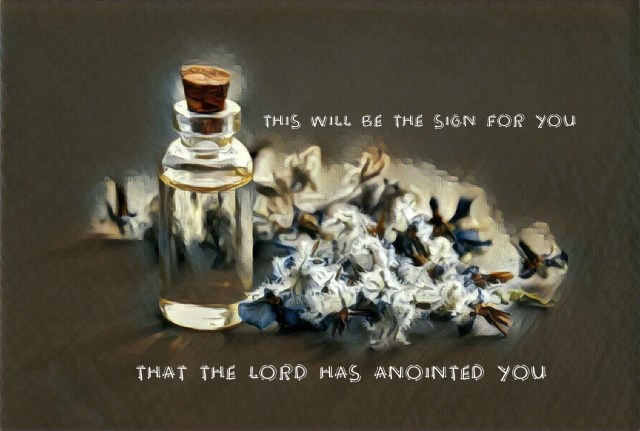
Today, in Mercy, Samuel anoints Saul King of Israel.

Then, from a flask he had with him, Samuel poured oil on Saul’s head;
he also kissed him, saying:
“The LORD anoints you commander over his heritage.
You are to govern the LORD’s people Israel,
and to save them from the grasp of their enemies.

1Sam10_1

Throughout Scripture, the act of anointing signifies being blessed, commissioned by grace. The sacred oil heals and strengthens the anointed to do the work of God.

We share in the grace of anointing through the sacraments – Baptism, Confirmation and Anointing of the Sick. We may not think about the power these rituals give us to live our lives in the pattern of Christ. But it is an amazing power which creates saints out of ordinary human beings like you and me!


Caritas_Bruegel
Caritas, The Seven Acts of Mercy, pen and ink drawing by Pieter Bruegel the Elder, 1559. Counter-clockwise from lower right: feed the hungry, give drink to the thirsty, ransom the captive, bury the dead, shelter the stranger, comfort the sick, and clothe the naked

In a less formal way, we can anoint one another by our acts of generosity, honesty, justice and love. Think of the woman who anointed Jesus with nard from her alabaster jar. How that act strengthened him for the suffering he had to face!

There are so many chaffed and sore places in our world awaiting the oil of mercy!

works of Mercy

We can also “anoint” our own life by gratefully remembering God’s presence in our lives:  the blessings we have received, the challenges we have gracefully met, the love we have both given and received – all that strengthened us to do the work of God over our lifetime.

Music:  Holy, Anointed One – Vineyard Worship

Comfort the Lost

Tuesday of the Second Week of Advent

December 10, 2019

Click here for readings

Today, in Mercy, we have the exquisite “Comfort” passage from Isaiah. Our Gospel gives us Jesus tenderly seeking the single lost lamb.

Isaiah40_1_11

The first and last words of these two readings – COMFORT, LOST – capture the whole intent of God’s message:
Life is a maze whose walls are heightened by our incivility to one another. Isaiah calls to be a leveler of walls, a straightener of twists, a bridge over deadly valleys; Jesus calls us to seek and carry the lost sheep. They call us to be Mercy.

The US southern border is one of the many places in our world crying out for these acts of mercy. Please listen to our Sister Anne Connolly describe the cry:


Music: Comfort Ye from Handel’s Messiah – sung by Jerry Hadley

As we pray this glorious music today, let us ask for the strength and courage to be Mercy for the world, to find the ways to comfort God’s people, close by and at life’s borders.

To See Ourselves As Others See Us

Wednesday of the Twenty-eighth Week in Ordinary Time

October 16, 2019

Click here for readings

Today, in Mercy … Oh boy, Paul and Jesus stick it to hypocrites in today’s readings. And I’m like, “Yeah! Go get those rotten, lying hypocrites” – and I have a whole slew of people in mind!

Then, WHOA!  I see Paul’s no-nonsense warning:

For by the standard by which you judge another
you condemn yourself,

since you, the judge, do the very same things.

This is a definite “clean up your act” reading. And don’t deflect your own sinfulness on to the people around you!

Jesus takes the same advice to the Pharisees by throwing a couple of serious “woes” at them:

Lk11_44graves

  • Woe to you Pharisees! You pay tithes of mint and of rue and of every garden herb, but you pay no attention to judgment and to love for God. These you should have done, without overlooking the others.
  • Woe to you Pharisees! You love the seat of honor in synagoguesand greetings in marketplaces.
  • Woe to you! You are like unseen graves over which people unknowingly walk.

Oh wow! I don’t want to be like an unseen grave, do you?! Neither did one of the scholars who responded to Jesus, “Teacher, by saying this you are insulting us too!

But Jesus is undeterred: 

Woe also to you scholars of the law!
You impose on people burdens hard to carry,
but you yourselves do not lift one finger to touch them.

Today’s readings offer us a clear message to take a good look at ourselves. Are we guilty of the very uglinesses that we condemn in others?


The Scottish poet Robert Burns got the picture in his poem
“To A Louse”

O would some Power the gift to give us
To see ourselves as others see us!


For fun, here is the Standard English Translation

Ha! Where are you going, you crawling wonder? Your impudence protects you sorely,
I can not say but you swagger rarely
Over gauze and lace,
Though faith! I fear you dine but sparingly On such a place

You ugly, creeping, blasted wonder, Detested, shunned by saint and sinner, How dare you set your foot upon her – Such fine a lady!
Go somewhere else and seek your dinner On some poor body
Off! in some beggar’s temples squat:

There you may creep, and sprawl, and scramble, With other kindred, jumping cattle,
In shoals and nations;
Where horn nor bone never dare unsettle
Your thick plantations

Now hold you there! you are out of sight, Below the falderals, snug and tight;
No, faith you yet! you will not be right, Until you have got on it —
The very topmost, towering height Of misses bonnet.
My sooth! right bold you set your nose out, As plump and gray as any gooseberry:

O for some rank, mercurial resin,
Or deadly, red powder,
I would give you such a hearty dose of it, Would dress your breech!
I would not have been surprised to spy You on an old wife’s flannel cap:

Or maybe some small ragged boy,
On his undervest;
But Miss’s fine balloon bonnet! fye! How dare you do it.
O Jenny do not toss your head,
And set your beauties all abroad! You little know what cursed speed The blastie’s making!

Those winks and finger-ends, I dread, Are notice takiing!
O would some Power the gift to give us To see ourselves as others see us!
It would from many a blunder free us, And foolish notion:
What airs in dress and gait would leave us, And even devotion.

Music: Britt Nicole – Through Your Eyes (a chance to think about how our loving God sees us, and everyone else/)