Power of the Keys

Friday, February 22, 2019

Click here for readings

Peter_keys

Today, in Mercy, we celebrate  the Feast of the Chair of Saint Peter, Apostle. It seems both fitting and painfully ironic that this feast should coincide with the Pope’s Summit on Protection of Minors in the Church. When He handed the “keys” to Peter, could Christ ever have foreseen that his beloved church would descend to this shame?

Factions in the Catholic Church argue over where to place the blame for this horror. Some point to the entitlements of clericalism. Some point to more liberal stances on sexuality. The most vocal factions use their voices to blame others rather than look to their own faults. 

But today’s Gospel suggests that none of these explanations goes to the root of the crisis.

What Christ handed Peter was POWER. Our Gospel says that this power was to be used to map the journey to heaven for the rest of us – appropriately “binding” and “loosening” the guidelines of that journey.

That’s a lot of power!

Unfortunately, the famous quote of John Dalberg-Acton, a 19th century Catholic writer, too often proves true. He said:

Power tends to corrupt.
And absolute power corrupts absolutely.

What was it that Jesus saw in Peter to give him hope for Peter’s incorruptibility?

  • Peter, who abandoned his livelihood in full devotion to the call. 
  • Peter, who tried to protect his beloved Lord from the wrath of the Pharisees
  • Peter who, defending Jesus in the Garden, cut off the ear of Malchus
  • Peter, who recognized and begged forgiveness for his weakness
  • Peter, who chose an inverted crucifixion because he deemed himself unworthy to die as his master did.

Power fueled by this kind of single-hearted devotion and humility is the true “Power of the Keys”. It suffers no shadow of greed, self-importance, domination, or lust. It is always “power for” not “power over” others.

Until our church structures foster this kind of mutual, non-exclusionary power in our leaders AND members, we have little hope of transformation.

Let us pray for true insight and courage for those gathered in Rome.

Music: (Maybe the Cardinals could sing this song in their hearts on the way to their meetings? Maybe we could sing it too sometimes?)

Lay It Down – Moxie Gibson

No Explanation Necessary

Monday, January 28, 2019

Click here for readings for St. Thomas Aquinas Liturgy

Today, in Mercy, we  celebrate the Memorial of Saint Thomas Aquinas, Priest and Doctor of the Church.

theology

The influence of Aquinas on Catholic theology and resultant culture cannot be overstated.  He is considered by many to be the foremost articulator of the Catholic tradition of reason and of divine revelation. For centuries, his thought became the underlying curriculum for priestly and religious training, universally influencing Catholic education, preaching, and theology.

Thomistic thought has been a great blessing to the Church. On the other hand, there are concerns about those who enshrine 13th century concepts without ongoing theological examination and development.

St. Anselm, outstanding theologians of the 11th century said, “Theology is faith seeking understanding.” It is trying to know all we can about God, but it always falls short of knowing God.

Many modern theologians develop emerging thought using Aquinas as their foundation, while deconstructing the unhelpful medieval constrictions of his work. Elizabeth Johnson, CSJ is one of my favorites. She has been noted as offering “new ways to think and speak about God within the framework of traditional Catholic beliefs and motifs.

As well as his immense body of theology, Thomas Aquinas was the composer of many treasured hymns. You might enjoy this one today.

Music: Adorote Devote ~ Thomas Aquinas 

See below for both Latin and English lyrics

1. Adoro te devote, latens Deitas,
Quae sub his figuris vere latitas;
Tibi se cor meum totum subiicit,
Quia te contemplans, totum deficit. 

2. Visus, tactus, gustus in te fallitur,
Sed auditu solo tuto creditur;
Credo quidquid dixit Dei Filius,
Nil hoc verbo veritatis verius. 

3. In Cruce latebat sola Deitas.
At hic latet simul et humanitas:
Ambo tamen credens, atque confitens,
Peto quod petivit latro paenitens. 

4. Plagas, sicut Thomas, non intueor,
Deum tamen meum te confiteor:
Fac me tibi semper magis credere,
In te spem habere, te diligere. 

5. O memoriale mortis Domini,
Panis vivus vitam praestans homini:
Praesta meae menti de te vivere,
Et te illi semper dulce sapere. 

6. Pie pellicane Iesu Domine,
Me immundum munda tuo Sanguine:
Cuius una stilla salvum facere
Totum mundum quit ab omni scelere. 

7. Iesu, quem velatum nunc aspicio,
Oro, fiat illud, quod tam sitio,
Ut te revelata cernens facie,
Visu sim beatus tuae gloriae.
Amen.

1.Godhead here in hiding, whom I do adore,
Masked by these bare shadows, shape and nothing more,
See, Lord, at thy service low lies here a heart
Lost, all lost in wonder at the God thou art.

2. Seeing, touching, tasting are in thee deceived:
How says trusty hearing? that shall be believed;
What God’s Son has told me, take for truth I do;
Truth himself speaks truly or there’s nothing true.

3. On the cross thy godhead made no sign to men,
Here thy very manhood steals from human ken:
Both are my confession, both are my belief,
And I pray the prayer of the dying thief.

4. I am not like Thomas, wounds I cannot see,
But can plainly call thee Lord and God as he;
Let me to a deeper faith daily nearer move,
Daily make me harder hope and dearer love.

5. O thou our reminder of Christ crucified,
Living Bread, the life of us for whom he died,
Lend this life to me then: feed and feast my mind,
There be thou the sweetness man was meant to find.

6. Bring the tender tale true of the Pelican;
Bathe me, Jesu Lord, in what thy bosom ran—
Blood whereof a single drop has power to win
All the world forgiveness of its world of sin.

7. Jesu, whom I look at shrouded here below,
I beseech thee send me what I thirst for so,
Some day to gaze on thee face to face in light
And be blest for ever with thy glory’s sight.
Amen.

The WHOLE World

Friday, January 25, 2019

Click here for readings

Today, in Mercy,  Acts paints a detailed picture of Saul’s conversion and call on the road to Damascus. It’s a colorful and dramatic account befitting the biography of the  great “Apostle to the Gentiles”.

mk16_15 whole world

Think about this. Almost all the very first Christians (and Christ himself) were Jews. Early Christian ritual grew out of Jewish ritual. In the immediate post-Resurrection period, there were few, of any, Gentile Christians.

This is one of the reasons Paul is such a big deal. As a Roman citizen and a devout Jew, he lived with a foot in two worlds, as opposed to the Jewish fishermen who composed the original Twelve. They were local guys with minimal exposure to the non-Jewish world.

When the original Twelve (eventually Eleven) heard Jesus’s Apostolic Commission, “Go out to all the world and tell the Good News…”, they may have felt that world was confined to Israel’s borders! Paul, the post-Resurrection Apostle, demonstrated otherwise.


Paul traveled over 10,000 miles proclaiming the gospel of Jesus Christ. His journeys on land and sea took him primarily through present day Israel, Syria, Turkey, and Greece.
(from Loyola Press. See website for great summary of Paul’s journeys.

Click here for Paul’s Journeys 


How encompassing is our vision of “the whole world”, that world which hungers for the message, mercy and love of Christ?

Our Gospel today impels us with the same apostolic call as these early disciples. God’s love and fullness of life belong to all. What can I do to make that a greater reality?

Music:  Facing a Task Unfinished-~ Lyrics:Frank Houghton. Performed by the Gettys 

Lady

Friday, November 16, 2018

Readings: http://www.usccb.org/bible/readings/111618.cfm

Today, in Mercy, our first reading is from John’s very brief second epistle.

This is a fascinating passage. It is addressed to “Kyria”, Greek for “Lady”. The contents encourage this revered lady to keep herself and her household true to Christ.

Reading the passage, one wonders who “Kyria” is. At least three theories exist among scholars:

  • an actual religious leader 
  • a metaphor for the Church 
  • Mary, Mother of Jesus

The letter is beautifully personal in tone, so I like to think that Kyria was, indeed, an influential church leader and John’s beloved friend. So often, the names of early Christian women leaders are lost to history. Whether they were omitted in the original texts, or erased by subsequent misogynistic translators, we can only surmise. But the absence has served to support the misperception that women are of lesser consequence in the Church.

As we read 2 John, we can be aware of the major themes he entrusted to dear “Kyria”, whoever she might have been, to be transmitted to her household:

  • Truth is expressed through love, modeled to us in Jesus.
  • Obedience to God is expressed through service in His name.
  • Guard against any who distract you from these teachings.

Music: Kyria (Lady) is the feminine form of Kyrie , as in “Kyrie eleison” (Lord, have mercy).

So the music I thought of for today is the magnificent Kyrie Eleison from Charles Gounod’s Mass for St. Cecilia.

The First American Saint Was An Immigrant

Tuesday, November 13, 2018

 Click here for today’s readings

Today, in Mercy, we celebrate the feast of St. Frances Xavier Cabrini, who from a very young age, was filled with the missionary spirit.

11_12 Cabrini

When she went to visit to her uncle, Don Luigi Oldini of Livagra,
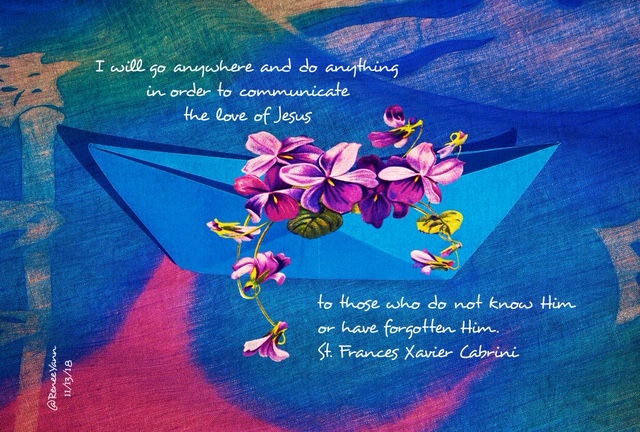
a priest who lived beside a swift canal, she made little boats of paper,
dropped violets in them, called the flowers missionaries,
and launched them to sail off to India and China
.
~ Lives of the Saints – John J. Cauley ~

Frail as a young woman, she was at first rejected for religious life. But eventually, through the often labyrinthine ways of God’s grace, Frances founded the Missionary Sisters of the Sacred Heart of Jesus.

Still desiring to be a missionary to China, Frances petitioned the Pope for approval. He, instead, requested that she and her sisters go to the USA to minister to the massive influx of Italian immigrants there.

She did this with an extraordinary and holy distinction. In 1945, Frances became the first citizen of the USA to be canonized a Saint.

To learn more about her life and legacy, see the website of her community:

Click here for Cabrini Sisters webpage

Or this very complete entry in Wikipedia

Click here for full wikipedia article

Not Music today. Instead a short video on Mother Cabrini’s influence, not only in New York, but as far as New Orleans:

Increase Our Faith

Monday, November 12, 2019

Click here for Readings

Lk17_5

Today, in Mercy,  we commemorate the Feast of St. Josaphat, not one of your common household saints. I actually never heard the name used, except for the expression “Jumpin’ Josaphat” (commonly invoked by Robin in the Batman series, in case you require documentation. 😀)

But Josaphat was quite a Saint. A deeply devout and holy monk, he lived in 16th century Lithuania, then part of the Polish Kingdom. At that time, the political variabilities of Europe were firmly intertwined with the bureaucracy of the Church, both Roman and Orthodox. This led to civic power struggles masquerading as religious conflicts.

Through the Union of Brest, the bishops who lived within the Polish-Lithuanian Commonwealth voted to unite with Rome. Many people were not happy with this decision – to the point of riots and mob violence. Josaphat worked tirelessly to realize this union and ultimately paid with his life at the hands of such a mob.

Even today we find, within the Church, divisions driven by politics and power clashes. Often expressed as the desire for ritual purity and historical rectitude, they cloak the fear and inability to grow in grace and mutuality.

We see these kinds of struggles in the factions trying to undermine Pope Francis. We can recognize them by their criticism without charity, their pronouncements without dialogue, and their own controlling hierarchies.

In our first reading, Paul writes to Titus who shepherds the nascent Church in Crete. Paul instructs him on the best ways to build a worshipping community without these infighting flaws.

In our Gospel, Jesus instructs the disciples on sin, repentance and forgiveness — all of which we encounter within the struggling community of faith. Hearing him, the  disciples immediately realize what it is they most need to engage the challenges before them:

Lord, increase our faith!

Let us join their prayer today for unity and love in the Christian Churches.

Music:  Increase Our Faith – David Haas

God Knows Our Hearts

Saturday, November 10, 2018

Click here for readings

Lk 16_45 knows heart

Today, in Mercy, we celebrate the Memorial of Pope St. Leo the Great.  He was a remarkable 5th century leader who consolidated essential elements of theology and administration for the yet emerging Church.

Our first reading today reflects Paul doing the same thing in the very early days of Christianity.  His ministry throughout the Mediterranean basin guided early Christians as the Church planted its first harvest.

Paul lets us know that this ministry of leadership is not easy – that he relies on the good will of the communities he serves:

You were, of course, concerned about me but lacked an opportunity.
Not that I say this because of need,
for I have learned, in whatever situation I find myself,
to be self-sufficient.

Paul seems to refer specifically to material help,  but certainly he values even more the spiritual and moral loyalty of his followers.

In our Gospel, Jesus offers us a sermonette that can, at first, seem a little confusing. His tone, as he speaks to a group of Pharisees, is somewhat ironic. But his bottomline message is this: loyalty to God, not to material things.

The thread running through all these passages?  The work of the Church needs both our spiritual and material loyalty to thrive  – whether in Paul’s time, or Christ’s, or our own.

The Pharisees pretended such loyalty, but Jesus challenged them:

You justify yourselves in the sight of others,
but God knows your hearts …

A sobering challenge against which to measure ourselves!

Music: Thank You for Giving to the Lord _ Ray Boltz

We Are God’s Temple

Friday, November 9, 2018

Readings: http://www.usccb.org/bible/readings/110918.cfm

psalm46 stream

Today, in Mercy, we celebrate the Feast of the Dedication of the Lateran Basilica in Rome.  It’s a big deal feast and, as a young religious, I never really understood why. I thought to myself, “It’s a building, right? Why are we celebrating a building.” As I matured, I learned. 

Perhaps some of you are familiar with Ken Follett’s book “The Pillars of the Earth”. Or perhaps others of you have visited the Sagrada Familia Cathedral in Barcelona, Spain. You may have been, as I was, overwhelmed at the sheer enormity and span of these cathedral-building endeavors which reflect our desire to enshrine God.

What is it in us, as human beings, that will move us to give lifetimes and centuries to capturing God? What is it in us that will try to concretize our awe at the Almighty?

It was just such an inner drive that motivated the builders of the Lateran, the oldest and highest ranking of the four major basilicas in Rome.  This “temple of stones” was understood by its builders to represent the living Church – you and me, who together are built up by Christ into his own Body.

What kind of  temple are we, sisters and brothers – we who are all too aware now of the cracks in our structure? 

We are, as Ezekiel visions and the psalmist confirms in today’s readings, a temple fed by the life waters of God.

Our Gospel shows that Jesus knew and believed this. He cleansed the temple in Jerusalem of its weaknesses. He then compared it to his own body, which is the true dwelling place of grace among us. He asked us to imitate him in the way we treasure and live our lives in this world because we too are Temples of God’s Grace.

A living fountain of grace flows through this living temple. God is in our midst as we build, and rebuild, the Church – brick by human brick.

May this feast renew our hope for our Church, cause us to call upon God for deeper courage, and witness to all the enduring power of faith.

Music:  We Are God’s People – Fred Bock

This is a recently written hymn with an old time kind of sound. 

English hymn text writer, Bryan Jeffery Leech, took the primary theme from Johannes Brahms’ 1st Symphony, 4th movement and wrote lyrics which have become a hymn standard. We Are God’s People is a majestic statement befitting Brahm’s regal theme. Allan Robert Petker has created an anthem setting and has intertwined many of the other themes that Brahms utilized in his 1st symphony.

St. Oscar Romero

Monday, October 15, 2018

Reading: Final Homily of Archbishop Romero

Yesterday in Vatican City, St. Oscar Romero was canonized. This holy man was Archbishop of San Salvador from 1977 until his assassination while offering Mass on March 24, 1980. After Archbishop Romero’s death, a twelve-year civil war ensued in El Salvador, killing an estimated 75,000 people.


The Catholic Church in El Salvador, during these years, became deeply involved in protecting the lives and land rights of the poor who were severely oppressed by a militaristic government. This corrupt government engaged the assistance of the United States to suppress the people by interpreting their struggle as “communism”.

For years, the Salvadoran government received US supplied arms and military training at the School of the Americas in Ft. Benning, Georgia.  It was someone trained with these arms who martyred St. Oscar Romero – and thousands of his poor, over many years.

Romero was not a politician. He averted confrontation wherever possible. But he could not stand by as thousands of his flock were slaughtered  because their human rights threatened the status and greed of the powerful.

Sometimes we hear the empty adage that religion should never mix with politics.
St. Oscar Romero is one of hundreds of women and men who became saints because they believed the opposite.

Our faith is irrevocably entwined with the rest of our lives. Our Gospel demands that we embrace and honor the poor, the oppressed and the marginalized. We may not be called to the level of witness that Oscar Romero was. But we, each in our own way, are called to understand issues of justice, and to act as Jesus would.

We are called to challenge our government, as did many activists during these years, when it is blind to its own sins. The USA is still selling arms to oppressive governments, still supporting regimes and practices that ignore human rights. Our voices and our votes need to be informed, clear, and faith-filled. I find Network and excellent source of education for me on these issues:

Click for Network’s Website

Music: El Salvador ~ Peter, Paul and Mary

Please read the lyrics below first, as they are a little difficult to understand. The images in the video are painful to view, but offer testament to the gross injustices the Salvadoran people endured.

There’s a sunny little country south of Mexico
Where the winds are gentle and the waters flow
But breezes aren’t the only things that blow
In El Salvador

If you took the little lady for a moonlight drive
Odds are still good you’d come back alive
But everyone is innocent until they arrive
In El Salvador

If the rebels take a bus on the grand highway
The government destroys a village miles away
The man on the radio says ‘now we’ll play South of the Border’

And in the morning the natives say,
We’re happy you have lived another day
Last night a thousand more passed away
In El Salvador

There’s a television crew here from ABC
Filming Rio Lempe and the refugees
Calling murdered children the ‘tragedy’
Of El Salvador

Before the government cameras 20 feet away
Another man is asking for continued aid
Food and medicine and hand grenades
For El Salvador

There’s a thump, a rumble, and the buildings sway
A soldier fires the acid spray
The public address system starts to play South of the Border

You run for cover and hide your eyes
You hear the screams from paradise
They’ve fallen further than you realize
In El Salvador

Just like Poland is ‘protected’ by her Russian friends
The junta is ‘assisted’ by Americans
And if 60 million dollars seems too much to spend
In El Salvador

They say for half a billion they could do it right
Bomb all day, burn all night
Until there’s not a living thing upright
In El Salvador

They’ll continue training troops in the USA
And watch the nuns that got away
And teach the military bands to play South of the Border

And kill the people to set them free
Who put this price on their liberty?
Don’t you think it’s time to leave
El Salvador?
Songwriters: Jim Wallis / Noel Paul Stookey

Teach Us to Pray

Wednesday, October 10, 2018

Readings: http://www.usccb.org/bible/readings/101018.cfm

Today, in Mercy, Paul and Peter have a big fight – two of the Greats take it to the mat over an issue of inclusivity in the early Church.

To put the episode in a nutshell, Peter had succumbed to political pressure from Jewish Christians to isolate non-Jewish Christians from full participation in the Church. The pressure was rooted in nationalism, religious prejudice and unexamined fear. Peter, in an attempt to manage these forces, made a huge misstep.

Paul, seeing that Peter’s actions would set a dangerous and divisive precedent in the emerging Church, confronted him before the whole community. For a moment in time, these two pillars of Christianity stood on separate shores.

Lk11_2 Pray

Ultimately, through prayer, respect and discernment, Peter and Paul continued together to shepherd the embryonic Church toward a new reality – one built on, but beyond, the Judaism in which they both had been raised.

The Church, as a living reality, will always be challenged by issues of growth, identity, inclusion and other concerns. But as soon as we define ourselves as anything other than simply Christians, we run the risk of moving to our own “separate shores”. 

We are not conservative or liberal Christians. We are not American, or European or Asian Christians. We are not gay or straight, Black or White, male or female, rich or poor Christians.

We are all sisters and brothers in the Gospel of Christ, standing on the same shore with Him, praying to our one Father. May this shared prayer help us to become who we are called to be.

Music: Lord, Teach Us to Pray ~ Joe Wise