Nothing Can Harm You

Tuesday of Fifth Week of Easter
May 9, 2023

Today’s Readings:

https://bible.usccb.org/bible/readings/050923.cfm

Today, in God’s Lavish Mercy, the stone-throwers finally get to Paul, but their acted-out fear is ineffective:

In those days, some Jews from Antioch and Iconium
arrived and won over the crowds. 
They stoned Paul and dragged him out of the city,
supposing that he was dead.
But when the disciples gathered around him,
he got up and entered the city. 
On the following day he left with Barnabas for Derbe.

Acts 14:19-20

Paul is amazingly resilient. He just got the stuffing beaten out of him to the point of appearing DOA, but he departs on a preaching pilgrimage the very next day! So what’s the story?


I think it is unlikely that Paul just “got up and entered the city'” after the vicious assault upon him.

The supernatural presence of the Holy Spirit permeated that little Lycaonian alleyway. Note the “disciples gathered around him“. Imagine a reiki-like power eminating from these ardent believers. Visualize that power drawing Paul back to his full self in the Name of Jesus Christ.


We believers today are not unlike those gathered disciples. I’ll bet every one of us, after some devasting blow to our spirit, has had our heart put back by someone who loved and believed in us.

And I hope that every one of us has been that person who gathers with the fallen, failed, and frustrated to lift and remind them of Love’s Promise to those who believe.

That’s the kind of community Jesus wants us to be, drawing our strength for it from his awesome promise in today’s Gospel:

“Peace I leave with you; my peace I give to you.
Not as the world gives do I give it to you.
Do not let your hearts be troubled or afraid.
You heard me tell you,
‘I am going away and I will come back to you.’

John 14:27-28

Jesus faced a very dismal future as he finished these consoling words at the Last Supper. Judas had already gone out to pursue his dark agenda. Jesus knew what would come next:

And now I have told you this before it happens,
so that when it happens you may believe.
I will no longer speak much with you,
for the ruler of the world is coming.
He has no power over me,
but the world must know that I love the Father
and that I do just as the Father has commanded me.”

John 14:29-31

We will face our own Gethsemane’s as we try to live and to share Gospel Truth. Sometimes, our lights will dim from both internal and external shadows. But Jesus has anointed us with his profound assurance that God, Creator-Redeemer-Spirit, hovers over us in eternal rekindling.


Poetry: The Peace of Wild Things – Wendell Berry

When despair for the world grows in me
and I wake in the night at the least sound
in fear of what my life and my children’s lives may be,
I go and lie down where the wood drake
rests in his beauty on the water, and the great heron feeds.
I come into the peace of wild things
who do not tax their lives with forethought
of grief. I come into the presence of still water.
And I feel above me the day-blind stars
waiting with their light. For a time
I rest in the grace of the world, and am free.

Music: My Peace I Give Unto You

Becoming “Gospel Real”

Monday of the Fifth Week of Easter
May 8, 2023

Today’s Readings:

https://bible.usccb.org/bible/readings/050823.cfm

Today, in God’s Lavish Mercy, Paul and Barnabas get into a bit of a pickle – actually two pickles.

1- The passage from Acts opens with a planned attempt on their lives:

There was an attempt in Iconium
by both the Gentiles and the Jews,
together with their leaders,
to attack and stone Paul and Barnabas.

Acts 14:5

2- They escape that attempt and flee to Lycaonia where the residents, rather than stoning them, want to idolize them:

When the crowds saw what Paul had done,
they cried out in Lycaonian,
“The gods have come down to us in human form.” 
They called Barnabas “Zeus” and Paul “Hermes,”
because he was the chief speaker.
And the priest of Zeus, whose temple was at the entrance to the city,
brought oxen and garlands to the gates,
for he together with the people intended to offer sacrifice.

Acts 14: 11-13

In both these situations, the listeners cannot accept the good news being preached to them – One Living God who indwells them and all Creation:

We proclaim to you good news
that you should turn from these idols to the living God,
who made heaven and earth and sea and all that is in them.

Acts 14:15

In our Gospel, Jude asks Jesus about this. He wants to know why he has received the gift of faith and others haven’t:

Jesus said to his disciples:
“”Whoever has my commandments and observes them
is the one who loves me.
Whoever loves me will be loved by my Father,
and I will love him and reveal myself to him.””
Judas, not the Iscariot, said to him,
“”Master, then what happened that you will reveal yourself to us
and not to the world?””

John 14:21-22

Jesus tells Jude that it’s pretty simple. You have to love God and do God’s work. If you don’t, no deal:

Jesus answered and said to him,
“”Whoever loves me will keep my word,
and my Father will love him,
and we will come to him and make our dwelling with him.
Whoever does not love me does not keep my words;
yet the word you hear is not mine
but that of the Father who sent me.

John 14:23-24

In Acts, the two resistant crowds resort to stones as means to reject the invitation to a Gospel life.

  • The gang from Iconium would use stones to kill the bearers of the Word.
  • The Lystra crowd wants to “idolize” Paul and Barnabas, a word which means “to convert to an image”, like a stone statue.

When we try to kill or to idolize something or someone, we distance ourselves from it. We make it “other”, unlike us, unattainable to relationship.


Jesus is real, not stone. He wants to live in us, not be enshrined.

The Gospel is real and needs to be expressed in our real lives – in our actions, choices and relationships.

We must look deep into ourselves for even the smallest place where we kill or petrify the Infinite Love that calls us to become Real within It’s Heart.


Prose: ― Margery Williams Bianco, The Velveteen Rabbit

“Real isn’t how you are made,’ said the Skin Horse.
‘It’s a thing that happens to you.
When a child loves you for a long, long time,
not just to play with, but REALLY loves you,
then you become Real.’

‘Does it hurt?’ asked the Rabbit.

‘Sometimes,’ said the Skin Horse,
for he was always truthful.
‘When you are Real you don’t mind being hurt.’

‘Does it happen all at once,
like being wound up,’ he asked, ‘or bit by bit?’

‘It doesn’t happen all at once,’ said the Skin Horse.
‘You become. It takes a long time.
That’s why it doesn’t happen often to people who break easily,
or have sharp edges,
or who have to be carefully kept.
Generally, by the time you are Real,
most of your hair has been loved off,
and your eyes drop out
and you get loose in the joints and very shabby.
But these things don’t matter at all,
because once you are Real you can’t be ugly,
except to people who don’t understand.”


Music:What Is Real – adapted by Glyn Lehman form The Velveteen Rabbit by Margery Williams

Velveteen Rabbit
What is real?
What is real?
And how does it feel?
Does it happen all at once?
Does it happen all at once, or bit by bit?
What is real?
What is real?

Skin Horse
Real is when somebody cares
And you feel alive for the very first time
It won’t happen at once
You will slowly become
You will see yourself through their eyes
See yourself through their eyes

Velveteen Rabbit
What is real?
What is real?
And how does it feel?
Does it hurt a little bit?
Does it hurt a little bit to make that change?
To be real
To be real

Skin Horse
Real is when somebody cares
And you feel alive for the very first time
Sometimes real can hurt
But you really won’t mind
If that’s what it takes to be real
What it takes to be real

It’s like magic when you are loved
Though you are worn, your seams are torn
There’s a glow inside
That is real

Velveteen Rabbit
That is real

Skin Horse, Velveteen Rabbit
That is real

Plug In!

Fifth Sunday of Easter
May 7, 2023

Today’s readings:

https://bible.usccb.org/bible/readings/050723.cfm

Today, in God’s Lavish Mercy, and as we come closer to the end of the Easter season, our Sunday readings repeat essential themes which invite us to the Beloved Community:

  • In Acts, the nascent Christian community grows, organizes, reflects and preaches the Good News.
  • In John’s Gospel, Jesus reiterates his enduring presence and love for all who live in his Word.
  • In his letter, Peter calls the growing community to recognize themselves as God’s dwelling place whose foundation has been secured in Christ.

This Sunday’s readings invite us, for the sake of the whole Church, to draw power for our Christian lives today:

They ask us to reflect on the experience of the early Church
and to learn from the way these Christians grew
in their understanding of faith and discipleship.

As the number of disciples continued to grow…
the Twelve called together the community of the disciples….
The proposal was acceptable to the whole community…
The word of God continued to spread,
and the number of the disciples in Jerusalem increased greatly

Acts 6

They ask us to respond to the timeless call
to be God’s Presence in the world.

Come to him, a living stone, rejected by human beings
but chosen and precious in the sight of God,
and, like living stones,
let yourselves be built into a spiritual house…
acceptable to God through Jesus Christ.

1 Peter 2:4-5

They assure us that Jesus indwells and blesses
our faithful commitment to this call.

Do not let your hearts be troubled.
You have faith in God; have faith also in me.
In my Father’s house there are many dwelling places…

Amen, amen, I say to you,
whoever believes in me will do the works that I do,
and will do greater ones than these,
because I am going to the Father.

John 14:1-2;12

Let’s face it, we live a long way in time from that bubbling little faith community described in Acts. Peter’s and Jesus’ encouragement have to echo down two thousand years to reach us! It’s not easy to stay plugged in to the dynamic power offered in today’s readings. How do we do that?

We have these amazing gifts to draw on:

  • the capacity to pray
  • the indwelling of the Holy Spirit resident in our souls
  • the blessing of a sacramental life
  • the living Word of the scriptures
  • the rich legacy of spiritual writings stored up through history
  • the current library of spiritual and theological literature
  • the sacred gifts of poetry, music and art
  • the beauty of God’s Creation in nature
  • the witness of our surrounding faith communities both living and dead

How unfortunate if we fail to recognize these gifts, given as means to open our hearts to our shared call to holiness!


Poetry: Mysteries, Yes – Mary Oliver

Truly, we live with mysteries too marvelous
to be understood.
How grass can be nourishing in the
mouths of the lambs.
How rivers and stones are forever
in allegiance with gravity
while we ourselves dream of rising.
How two hands touch and the bonds will
never be broken.
How people come, from delight or the
scars of damage,
to the comfort of a poem.

Let me keep my distance, always, from those
who think they have the answers.

Let me keep company always with those who say
“Look!” and laugh in astonishment,
and bow their heads.

Music: One Love – Bob Marley

The Noble Shepherd

Monday of the Fourth Week of Easter
May 1, 2023

Today’s Readings:

https://bible.usccb.org/bible/readings/050123.cfm

Today, in God’s Lavish Mercy, our Gospel invites us, once again, to pray in the company of the Good Shepherd. (The Greek phrase could better be translated as “The Noble Shepherd“)


Just a bit earlier in his sermon, Jesus delivered this blockbuster to the gathered crowd:

I came so that you might have life
and have it more abundantly.

John 10:10

I don’t know how those on the ancient hillside received this stunning announcement, but I know that I have heard and read it a thousand times with a dull and stupid heart.


We let ourselves get used to the scriptures. We hear the priest humdrumming the words while we entertain a tumble of distractions in our foggy heads. We pray the words in our quiet rooms while sleep nibbles away at their astounding meaning.

But here’s what our Gospel shouts to us this morning:

I am here to give you abundant life!
For heaven’s sake, let your heart and soul stand up,
open your arms, and embrace the gift I offer you.


Several deep lessons reside within today’s reading, but we might choose to focus on this:

I am the good shepherd,
and I know mine and mine know me,
just as the Father knows me and I know the Father;
and I will lay down my life for the sheep.

John 10: 11-12

Jesus is telling us
that he is our “good shepherd” for this reason:
because he knows and loves us with the same intensity
that he and the Father know and love each other.

In other words, Jesus loves us with a love that absorbs us into the heart of God. There, we are fed with that love and given an infinitely abundant life – a life that demands to be given and shared.


Jesus tells us that he will lay down his life for his sheep, because this is the nature of Divine Love — it is fully self-giving. The Creator gave everything for us in the gift of Jesus. Jesus gave everything for us in the Paschal Gift. We, recipients of these infinite gifts, are called to give everything for the sake of God’s love in the world.

Does this mean we all have to run out and try to be martyrs? Certainly not. It might be even harder to respond to this call with consistent dailyness than it would be to do so with martyrish abandon.


Our reading from Acts helps us understand what this divine love looks like in an ordinary life. It looks like openness to the Holy Spirit, willingness to change for the sake of others’ good, inclusion of all people in the loving community, actions that build unity and reverence for one another.


The Good Shepherd is a Giving Shepherd who teaches us that we have such an abundance of life in him that we are safe giving our small portion of life for others. We do not need to bury, fortify, protect, and squirrel away our life like misers and hoarders – because, in God, all that we give is continually replaced with even greater plentitude.

We do not have to be first, smartest, prettiest, richest, most powerful, always right or all the other perfectionisms we sometimes are deluded by.

What we have to be is kind, merciful, open, forgiving, honest, generous and humble. These are the true currencies of abundant life in Christ. With the amazing gift we have been given, we are called to allow God to “shepherd” through us in our own particular “sheepfold”.


In his transcendent love, Jesus laid his life down willingly for our sake, and that utter willingness allowed him to take it up again in glory. We might be invited to do a little “life-laying down” ourselves today. Can we find Christ’s invitation, promise, and power within that ordinariness?


The Good Shepherd by James Tissot


Poetry: On Generosity – Walter Brueggemann

On our own, we conclude:
there is not enough to go around
we are going to run short
of money
of love
of grades
of publications
of sex
of beer
of members
of years
of life
we should seize the day
seize our goods
seize our neighbours goods
because there is not enough to go around
and in the midst of our perceived deficit
you come
you come giving bread in the wilderness
you come giving children at the 11th hour
you come giving homes to exiles
you come giving futures to the shut down
you come giving easter joy to the dead
you come – fleshed in Jesus.
and we watch while
the blind receive their sight
the lame walk
the lepers are cleansed
the deaf hear
the dead are raised
the poor dance and sing
we watch
and we take food we did not grow and
life we did not invent and
future that is gift and gift and gift and
families and neighbours who sustain us
when we did not deserve it.
It dawns on us – late rather than soon-
that you “give food in due season
you open your hand
and satisfy the desire of every living thing.”
By your giving, break our cycles of imagined scarcity
override our presumed deficits
quiet our anxieties of lack
transform our perceptual field to see
the abundance………mercy upon mercy
blessing upon blessing.
Sink your generosity deep into our lives
that your muchness may expose our false lack
that endlessly receiving we may endlessly give
so that the world may be made Easter new,
without greedy lack, but only wonder,
without coercive need but only love,
without destructive greed but only praise
without aggression and invasiveness….
all things Easter new…..
all around us, toward us and
by us
all things Easter new.
Finish your creation, in wonder, love and praise. Amen.

Music: The Lonely Shepherd – written by James Last and played here by Louis Grosari

Water and Pork Chops

Saturday of the Second Week of Easter
April 22, 2023

Today’s Readings:

https://bible.usccb.org/bible/readings/042223.cfm

Today, in God’s Lavish Mercy, little “disruptions” pop up in the center of both our readings.

In Acts, some of the Greek Christians think they are getting the short end of the stick when it comes to food distribution.

Believe me, I can picture the situation using personal experience. When I was an 18 year old postulant, I was a tall, skinny athlete — and I ate a lot of food. I wasn’t used to living in community, and I hadn’t noticed how my voracious appetite might be affecting those around me at the table.

In those “olden days”, the fifty-two of us freshly minted mini-nuns sat “in rank”, i.e according to age. The food was passed down the table from oldest to youngest. When I came to supper one night, the sister below me in rank had moved up a seat to be before me. I thought she just got mixed up about where her chair was so I asked her about it.

She told me she moved up in order to get a pork chop before I took them all!


Well, that’s what the Hellenists are doing in today’s reading which illustrates that living in community is a practical exercise as well as a spiritual one. That practicality calls upon us to make prudent arrangements for the community such as the disciples did in appointing more presbyters led by Stephen.

For us in our various communities today, the reading reminds us to think about the “pork chops” – who needs what and are they getting what they need. This principle holds for both spiritual and material needs and goods. Like the new presbyters, we each have a part to play in achieving that equity within our communities – including families, neighborhoods, churches, workplaces, and the world we share with all Creation.


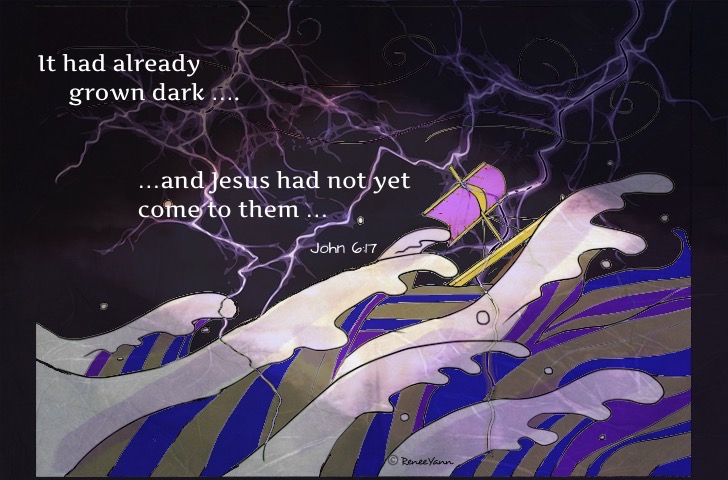
While our Gospel event is narrated in both Matthew and Mark, John gives us his own colorful version of the story of Jesus walking on the water. John highlights the conditions of the sea and atmosphere: darkness, the gusty wind, a turbulent ocean, and the absence of Jesus from the boat:

When it was evening, the disciples of Jesus went down to the sea,
embarked in a boat, and went across the sea to Capernaum.
It had already grown dark, and Jesus had not yet come to them.
The sea was stirred up because a strong wind was blowing.

John 6:16-18

So John makes it clear that it was the customary “dark and scary night“. But the disciples, tossed in the tumult, never express fear until they see Jesus walking across the water toward them. It seems they are less afraid of nature’s power than they are of the power of God!

Jesus sees their fear and tells them not to be afraid. In a phrase reminiscent of God’s self-revelation to Moses ( I am Who am), Jesus simply says, “It is I” — I am God. I am with you. Do not be afraid.


The disciples are still a little nervous and seem to prefer a less omnipotent Jesus . They ask him to get into the boat (in other words, “Be normal – not a Water-Walker”). But Jesus ignores the invitation and simply transports the boat to shore. One might picture the Twelve, tossed up on the shore, mouths agape and beginning to realize that their whole world was being turned upside-down in Christ!


Maybe we’re a little bit like the disciples sometimes. Sometimes we like God in small doses – not in a brilliant revelation or an irresistible call. Jesus snoozing beside us in the boat is comfortable. A radiant God coming to us in our life’s storms is a little harder to adjust to.

Our readings today remind us that God is present in every aspect of our lives – the daily practicalities and the topsy-turvy revelations. God may sit beside us in the boat, or might drag us stunned into another graced shore. But we should not be afraid in any case. Just prayerfully listen for the assurance, “It is I!”


Poetry: Walking on Water – Mark Jarmon

       Always the same message out of Matthew.
The water Jesus walks on is life’s turbulence.
        He calms our trouble and lifts us up again.

To walk on water? That’s what’s puzzling—
        that feat of antimatter, defeat of physics,
those beautiful unshod feet of cosmic truth

        for whom the whole performance is child’s play.
And unless one becomes as a little child
        the kingdom’s inaccessible by any route.

That water, then, its broken surface tension,
        collision of fracturing waves, apparent chaos,
its fractals turning infinite and weaving

        the netted skin between worlds, that web
of light and gravity which underpins our faith,
        water, a substance, stormy or pacific,

we know a myriad ways to get across it.
        But simply walking on it? Literally?
How far do you think you’d go before you fell

        through that convergence between time and space?
The water Jesus walked on wasn’t water
        only. It was the storm that made it rock.

Music: Walk on Water – Elevation Rhythm

Not So Easy to Be Born Again!

Tuesday of the Second Week of Easter
April 18, 2023

Today’s Readings:

https://bible.usccb.org/bible/readings/041823.cfm

The words in today’s readings are little explosives camouflaged in familiarity.

We are used to reading how the earliest Christians formed a loving and mutual community. We might admire how they held everything in common. We might think how nice and comforting that must have been for everyone.

The community of believers was of one heart and mind,
and no one claimed that any of his possessions was his own,
but they had everything in common.
With great power the Apostles bore witness
to the resurrection of the Lord Jesus,
and great favor was accorded them all.

Acts 4:32

But, friends, I don’t think it was all that comforting! I think it was hard! People who had worked tirelessly to build secure lives had to rethink that security. Whether in material goods or established reputations, they had to give up houses, businesses, rabbi-ships, and political offices to truly be part of this radical new “community”.

They had to split the last two matzah balls with some dude who never worked a day in his life. It’s not easy!


Picture the heated conversations between someone choosing this “community” and a spouse who preferred to keep their big boat and villa by the seaside.

Imagine the rumbling synagogue crowd when the beloved old rabbi told them just to call him “brother”! Hear the distressed uproar when he announced that the Holy Law he had confidently taught them now must be rethought in Gospel light!

I’m pretty sure it wasn’t as smooth as Acts seems to imply. There is a small acknowledgment of that in the notoriety given to astoundingly generous Joseph. He stood out for buying in completely to this new community. ( We’ll hear more about him later under his new name “Barnabas”).

Thus Joseph, also named by the Apostles Barnabas
(which is translated “”son of encouragement””),
a Levite, a Cypriot by birth,
sold a piece of property that he owned,
then brought the money and put it at the feet of the Apostles.

Acts 4:36-37

By Henry Ossawa Tanner

The Gospel story of Nicodemus confirms the struggle to really become a Gospel person. It should be profoundly unsettling to those of us  -and I think that is ALL of us – who sometimes thrive on security, status, and control.

Nicodemus had “made it” in Jewish society. He was considered a good, learned, influential and wealthy man. But Jesus challenges him on every level of his success to test what he values and builds his life on.

  • Is Nicodemus really “good” in light of the Beatitudes?
  • Is he really “learned” in living the law of radical love?
  • Is he really “rich” in holy grace?

  • Or is his “goodness” tinged with judgement?
  • His “learning” mired in self-righteousness?
  • His “wealth” rooted in complacency with systemic injustice?

Jesus tells Nicodemus that the Spirit of God will not be tamed or controlled by these supposed “successes” of his life. Rather, Nicodemus must start all over again to be transformed in God:

Jesus said to Nicodemus:
“‘You must be born from above.’
The wind blows where it wills, and you can hear the sound it makes,
but you do not know where it comes from or where it goes;
so it is with everyone who is born of the Spirit.”

John 3:7-8

And here’s the really hard thing. We must make the “Nicodemus Choice” every day of our lives. Every circumstance invites us either to be “born again” or to choose the old securities we are so falsely comfortable with. Those securities can blind us with the complacency of one who has forgotten how to see.

Jesus answered and said to him,
“You are the teacher of Israel and you do not understand this?
Amen, amen, I say to you,
we speak of what we know and we testify to what we have seen,
but you people do not accept our testimony.
If I tell you about earthly things and you do not believe,
how will you believe if I tell you about heavenly things?

John 3:10-12

Poetry: Nicodemus – Mary Elizabeth Coleridge (1861-1907) 

With slow and stealthy steps he trod 
— The darkening and deserted streets; 
— And no one in the market greets 
The man upon his way to God. 

By night he left the splendid home 
— That sheltered many a sleeping guest. 
— One and another lay at rest — 
The master of the house would roam. 

Was there a single soul that knew? 
— No! For he feared the eye of scorn, 
— The crooked laugh of anger born. 
Only the bats about him flew. 

The broidered borders of his gown 
— He covered o’er, that none might see. 
— Shall good come out of Galilee? 
This were the mock of all the town. 

But in the City named for Peace 
— No peace his weary heart had known, 
— And ever in the crowd alone 
He waged a war that would not cease. 

He came by night — and yet he came. 
— And He that was Himself the Way 
— Shall own him in the Judgment Day, 
And to the world confess his name.


Music: Nicodemus – Graham Kendrick

On the Road Together

Wednesday in the Octave of Easter
April 12, 2023

Today’s Readings:

https://bible.usccb.org/bible/readings/041223.cfm

Today, in God’s Lavish Mercy, we enfold ourselves in some of our favorite post-Easter stories. They warm our hearts with their humanness. They help us understand how people just like us processed the astounding news of the Resurrection.

Two of our beloved senior sisters … on the road together with Him…


In Acts, we find Peter and John, the same ones Mary had summoned to the empty tomb. Now, in place of their tentative searching, ministerial confidence pours out of them. The long-crippled man wants only a coin but Peter yearns to give the treasure he now knows he possesses. 

By faith, Peter’s heart has risen from death with Christ, and he is compelled to share that redemption with the world:

Peter said, “I have neither silver nor gold,
but what I do have I give you: 
in the name of Jesus Christ the Nazorean, rise and walk.”

Acts 3: 6-7

Listen, this is the same guy who, on the way to Jerusalem, begged Jesus not even to mention Calvary. This is the guy who, on Good Friday eve, cowered by the fire and denied he even knew Jesus. 

Look what Easter faith can do
for a doubtful, frightened heart!

ALLELUIA!

In our beautiful Gospel, a miracle dose of this faith was given to two journeying friends. Can’t you see them – perhaps two old men or women. Arm in arm, they trudge along the dusty road, gabbing their weary heads off. As evening falls, they are slowly wrapped in all kinds of inner and outer shadows:

  • Has this all really happened?
  • Wasn’t He the One we thought he might be?
  • Have our dearest hopes all been in vain?

When Jesus joins them, he wants to hear their mumbled questions. By his abiding, honest,and patient Presence, he walks them out of doubtful logic into faith’s freedom:

He asked them, 
“What are you discussing as you walk along?”
They stopped, looking downcast.
One of them, named Cleopas, said to him in reply,
“Are you the only visitor to Jerusalem
who does not know of the things
that have taken place there in these days?”….

And he said to them, “Oh, how foolish you are!
How slow of heart to believe all that the prophets spoke!
Was it not necessary that the Christ should suffer these things
and enter into his glory?”
Then beginning with Moses and all the prophets,
he interpreted to them what referred to him
in all the Scriptures.

Luke 24: 17-18; 25-27

Jesus is listening and walking with us too. He wants to give us the same confidence Peter had as we proclaim our faith by the merciful actions of our life. Just like the Emmaus friends, let’s invite him to stay with us as evening falls.


Poetry: The Servant Girl at Emmaus (A Painting by Velázquez) by Denise Levertov

The Kitchen Maid, Diego Velazquez, National Gallery of Ireland

She listens, listens, holding
her breath. Surely that voice
is his—the one
who had looked at her, once, across the crowd,
as no one ever had looked?
Had seen her? Had spoken as if to her?
Surely those hands were his,
taking the platter of bread from hers just now?
Hands he'd laid on the dying and made them well?
Surely that face—?
The man they'd crucified for sedition and blasphemy.
The man whose body disappeared from its tomb.
The man it was rumoured now some women had seen this morning, alive?
Those who had brought this stranger home to their table
don't recognise yet with whom they sit.
But she in the kitchen, absently touching
           the winejug she's to take in,
a young Black servant intently listening,
swings round and sees
the light around him
and is sure.

Music: I Can See (The Road To Emmaus) Steve Green

The Other Side of Light

April 1, 2023

Dear Friends,

It feels appropriate that, before we resume gathering together in Lavish Mercy tomorrow, I comment a bit on my time away from the blog.

First, I sincerely thank you all for your prayers and encouragement. In a shadowy time, you gave me the generous lights of comfort and joy. I am deeply grateful.

Now, as I continue to heal from a time of unexpected vulnerability, I have the advantage of being able to reflect in peace on what has happened to me. 

Part of that peace and healing has been a move to our Motherhouse, a loving community where I have the support and care I need right now. I am blessed beyond words by this gift.


This photo was taken in the early 1900s for the Merion Historical Society


My new room is on the very western end of the building (See blue arrow above.) However, I look out my ample windows not to a sunset horizon – but instead to the imposing wall of our magnificent chapel. Some were concerned that the “wall view” might not be optimal. They didn’t realize that the wall housed an unexpected gift – a bird’s eye view of the glorious rose window that, for over a century, has blessed our chapel with dawn Light.

And I am now on the other side of that Light as it flows over my beloved community – a place that feels ever closer to God with each sunrise.


Sometimes, especially in the evening, I will catch a lovely glow within chapel on one of the several stained glass windows. I consider these my own special sunsets given only to me for my unique reflection. These windows are icons for me as I pray and learn from my own little “passover experience” this winter. 

Evening Window from the Outside!

During times of suffering, loss, or unchosen change in our lives, it is hard to turn to the Light. As we begin our Holy Week walk, consider that Jesus faced this struggle in the shadows of Gethsemane. There, he taught us what it takes not only to turn toward Light, but to become It.

Then going out he went, as was his custom, to the Mount of Olives, and the disciples followed him. 

When he arrived at the place he said to them, “Pray that you may not undergo the test.”

After withdrawing about a stone’s throw from them and kneeling, he prayed, saying, “Father, if you are willing, take this cup away from me; still, not my will but yours be done.”

And to strengthen him an angel from heaven appeared to him.

Matthew 22: 40-43

As it was with Jesus, a “Gethsemane moment” in any of our lives is an invitation to abandon ourselves in trust to God’s inscrutable Love — a falling helplessly, but hopefully, into a Love that changes everything.

For Jesus, his embrace of God’s Will in that tenebrous garden opened his heart to the glory of the Resurrection and led him to the other side of Light. How might such self-giving open and lead us?


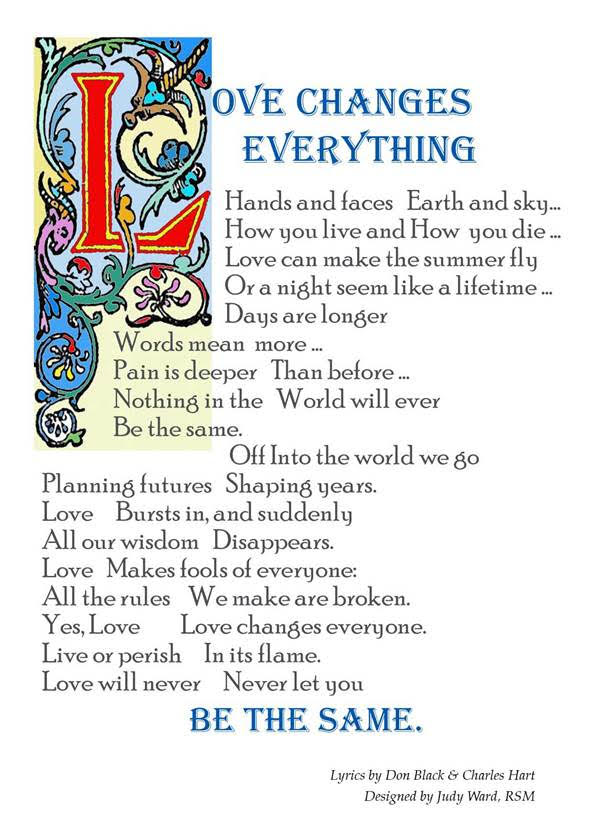
Love Changes Everything – Andrew Lloyd Webber, Don Black, and Charles Hart

Pure Gold

Friday of the Fourth Week of Advent
December 23, 2022

Today’s Readings:

https://bible.usccb.org/bible/readings/122322.cfm

Today, in God’s Lavish Mercy, Malachi preaches the news of God’s Coming with dramatic authority! He tells us that the Lord is sending a messenger, somewhat in the mode of John the Baptist, to prepare the Lord’s way.

 Thus says the Lord GOD:
Lo, I am sending my messenger
    to prepare the way before me;
And suddenly there will come to the temple
    the LORD whom you seek,
And the messenger of the covenant whom you desire.
    Yes, he is coming, says the LORD of hosts.
But who will endure the day of his coming?
    And who can stand when he appears?

Malachi 3:1-4

The passage is so dramatic that it inspired Handel to include it in his magnificent “Messiah”. Handel captures Malachi’s ominous tone, asking the key question: Who shall abide the day of his coming?

These are words of purification and judgement, with tiny tinges of fire and brimstone! Indeed the Lord’s coming is often stunningly fast and awesome. Just last week, our dear Sister Rosemary Herron passed away suddenly and unexpectedly while enjoying a holiday evening. Her death left all who knew her in a state of utter shock and heartbreak.


As we read Malachi today, we might wonder, “Was she ready?” Could she “withstand the Day of His Coming”? What was it like to have her world spun from earth to heaven in the matter of a few moments?

The second part of our reading gives us an answer.

Lo, I will send you
    Elijah, the prophet,
Before the day of the LORD comes,
    the great and terrible day,
To turn the hearts of the parents to their children,
    and the hearts of the children to their parents,

Lest I come and strike
    the land with doom.

Malachi 3:23-24

If our hearts have been turned toward one another in this world, and if our time on earth has been spent in so turning others, then the Lord’s coming is not a “terrible day”. As Malachi alludes, our lives refine us like gold or silver. At the Lord’s coming, these precious elements will be tested.

  • Did we love inclusively?
  • Did we turn others toward love?
  • Did we try to turn the selfish worldly tide toward love?

All who knew Sister Rosemary know that she was pure gold, already refined by her lifelong choice to be Mercy in the world. That’s what makes her sudden passing so very difficult to cope with. But for Rosemary, that Divine Coming must have been a glorious surprise when she no doubt heard the words of Matthew’s Gospel:

Then the King will say to those on his right,
‘Come, you who are blessed by my Father; take your inheritance,
the kingdom prepared for you since the creation of the world.
For I was hungry and you gave me something to eat,
I was thirsty and you gave me something to drink,
I was a stranger and you invited me in,
I needed clothes and you clothed me,
I was sick and you looked after me,
I was in prison and you came to visit me.

Matthew 25:34-36

Perhaps all of you kind readers would offer a prayer of consolation today for our Sister Rosemary’s family and friends, for her beloved school community at Mercy Career and Technical High School, for her religious community – the Sisters of Mercy, and for the many people she influenced throughout her very generous life.


R. Alleluia, alleluia.
O King of all nations and keystone of the Church;
come and save your beloved, whom you formed from the dust!
R. Alleluia, alleluia.


Poetry: Good-bye Poem – Meg Bowman

Life is but weak if we waste it in weeping:
So, she has left you, she would soon or late.
Death from our lives takes all in her keeping,
Nothing we do can our sorrow abate.
Love, be it ever so deep and entire,
Asks that we strive for the end that she sought:
Catch the tossed torch! Take up the fire!
Light up our world, and teach as she taught.

Music: We Miss You by Eternity

Living Justice

Memorial of St. Josaphat
Saturday, November 12, 2022

Today’s Readings

https://bible.usccb.org/bible/readings/111222.cfm

Today, in God’s Lavish Mercy, our readings carry the themes of perseverance in prayer and commitment to Gospel justice.

Familiar Psalm 112 draws the theme forward for us.

That theme is justice, 
and what it really means for us in our daily lives.

Wealth and riches shall be in the blessed one’s house;
where generosity shall endure forever.
Light shines through the darkness for the upright;
who is gracious and merciful and just.

Psalm 112:3-4

In secular culture, the words “justice” and “law” carry very different interpretations from biblical meanings. In the Bible, justice is that right-balance of Creation in which all beings support one another in the fullness of God’s love.

It is a balance which we all must help achieve, as we see in our first reading from John. In this unique letter, addressed to only one person – a Christian named Gaius, – John requests material help for his early missionaries.

Beloved, you are faithful in all you do for the brothers and sisters,
especially for strangers;
they have testified to your love before the Church.
Please help them in a way worthy of God to continue their journey.

Such requests mark the life of the Church throughout the ages, because our call in Christian community is about helping one another to live a full life in Christ. We could easily read John’s plea as a plea to us, especially in these times of seeking just global immigration and economic policies.


In our Gospel, Jesus tells a parable which is overtly about prayer. But it carries deep themes of the justice God desires for all people, especially the vulnerable:

Will not God then secure the rights of God’s chosen ones
who call out day and night? 
Will God be slow to answer them? 
I tell you, God will see to it that justice is done for them speedily. 
But when the Son of Man comes, will he find justice on the earth?

Luke 18: 7-8

Practicing justice and righteousness means active advocacy for the vulnerable. It means doing the works of mercy as a way to love God.

Light shines through the darkness for the upright;
that person is gracious and merciful and just.
It is well for the one who is gracious and lends,
who lives a graceful justice;
they shall never be moved;
the just ones shall be in everlasting remembrance.

Psalm 112: 3-6

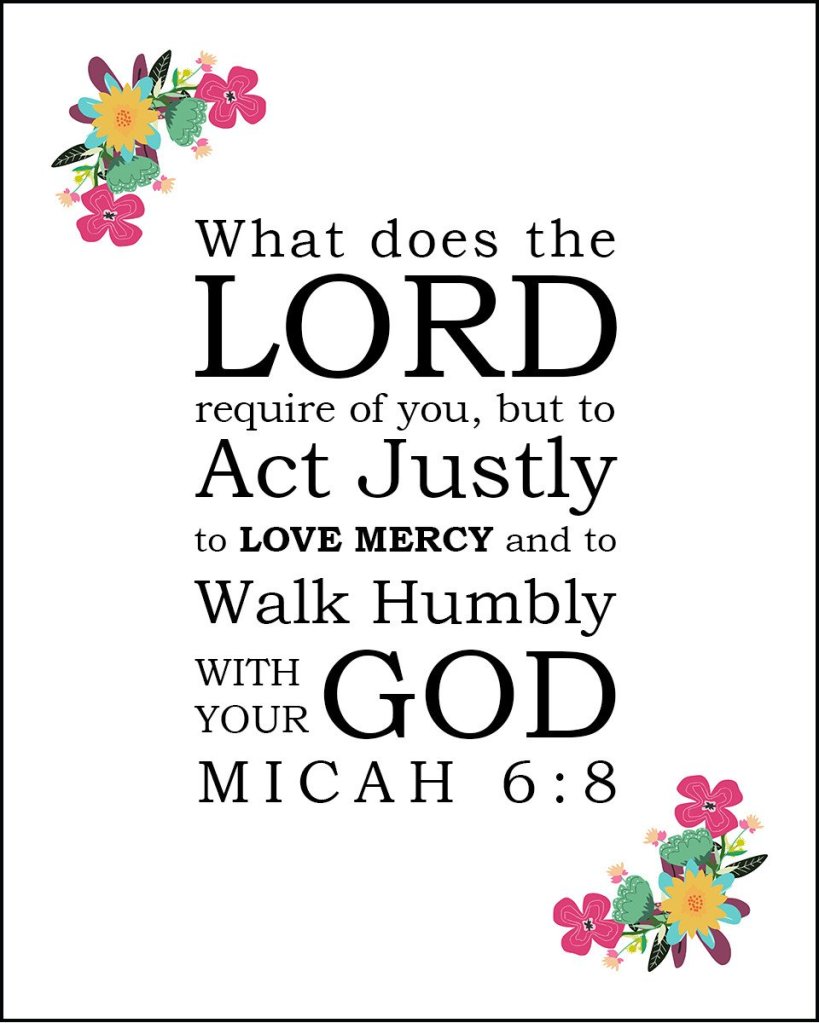
Poetry from Micah 6:8


Music: Seek Justice; Love Mercy – by Me in Motion

 Renee