Wide Mercy

Memorial of Saint Pius X, Pope

August 21, 2019

Click here for readings

Today, in Mercy,  in our reading from Judges, we meet two guys who are polar opposites of each other: Jotham and Abimelech.

Jotham was the youngest of the 70 sons of Gideon (yes, 70 – not a typo. Makes one think of The King and I.) Abimelech is his half-brother, son of Gideon’s Shechemite concubine.

To put the story in a nutshell, Jotham is the goodie and Abimelech is the baddie. Abimelech, lusting to be king, engages his Shechemite family to kill the 70 sons of Gideon. Only Jotham survives. So in our reading, Jotham  prophesies by parable, warning the people that they have made a serious mistake in allowing Abimelech to grasp the kingship.

Praying with this reading, we may realize that some things never change. Human beings still jockey for political power and economic domination. Nations still slaughter and suppress other nations in that pursuit. Some leaders still commandeer control by deception and pretense. The voting populace still allows itself to be hoodwinked by tyrants in disguise.

Jotham doesn’t accept the old adage that religion and politics don’t mix (or however they may have phrased it in his day). He says true leadership must grow from the good faith of both leaders and followers. He says, in parable form, that leaders must be willing to set their own pursuits aside for the good of the people. Otherwise, an avaricious fire burns up the heart of the people.

The landowner in Matthew’s Gospel is a leader in the pattern of God. He administers his charge in such a way that all find benefit. His methods are contradictory and irrational to anyone who fails to see the universal creaturehood of the human family. He reigns from mercy not merit, because he knows that all have full merit in God.
wide mercy

Certainly, my prayer leads me to consider how these principles affect my own leadership responsibilities whether within family, community, workplace, or world.

I am also led to consider how I must respond, just as Jotham did, to any leader or administration that stands in contradiction to these principles.

Faith and morality not only mix with politics, they are its core. Bereft of these, politics becomes nothing but a power game in which the poorest and weakest are the chips.

But, in this Gospel parable, Jesus says his “game” is just the opposite. At his table, the first shall be last and the last first.

These readings have much to offer us as we daily try to right our hearts with the God of infinite mercy.

Music: There’s a Wideness in God’s Mercy – written by Frederick Faber in 1862
Rendered here by Nate Macy
https://youtu.be/l5LN1ZvwWfs

Bearer of Hope

Nineteenth Sunday in Ordinary Time

August 11, 2019

Click here for readings

Hebrews11_1 Fith_hope

Today, in Mercy, we have a few slightly complex readings. But, as with all Sunday lectionary choices, they are strung together by a single theme. 

Upon first reading, we might think that theme is FAITH since the word is mentioned at least eight times. And, indeed, “faith” is the foundation of these readings – the faith of Abraham, Isaac, Jacob, the Desert Jews, the disciples, and the new Christian community. 

It is the testimony of this ancient and enduring faith that encourages us to be ready, as Jesus says in today’s Gospel:

Do not be afraid any longer, little flock,
for your Father is pleased to give you the kingdom.

This phrase of Jesus reveals another, deeper, theme: courageous hope.

How awesome that God, in covenant with God’s People, could keep alive – for 400 years- the hope of salvation! How miraculous that these ordinary farmers, milkmaids, herdsman, and shepherds could sustain their hope through numerous generations!

Today’s readings are sending us this message:


Be courageous!
You are the Bearer of Hope
to this generation!


It may seem in our world, and in our individual lives, that God tarries beyond tolerance in answering our hope – for peace, civility, equality, security, goodness.  But we must remember that with God there is no time. God is already responding within the long fidelity of our hope. (Our clocks and Apple watches just are obscuring our view. 😉)

That faithful hope creates the space for charity. And charity is the human face of Divine Love already Abiding.

Faith, Hope, and Charity – the theological virtues (Remember that from your Baltimore Catechism?). 

Virtues
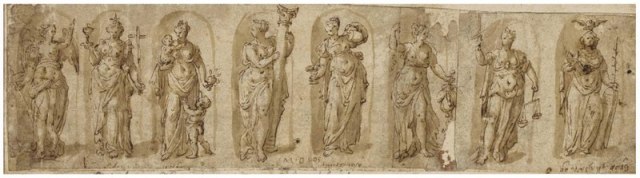
The Theological and Cardinal Virtues with Wisdom: Hope, Faith, Charity, Fortitude, Temperance, Liberality, Justice and Sapientia by Maarten de Vos (1532-1603)

These virtues are the foundation of the spiritual life. Contemporary theology ties these irrevocably to the virtue of justice – the seeking of right relationship in all Creation.

Anselm Min, Professor of Religion at Claremont Graduate University, has edited a powerful book on this subject. (Unfortunately, now out print and thus hugely expensive). One reviewer of the book, Lameck Banda, Professor at Justo Mwale University in Lusaka, Zambia, offers this insight into Min’s collection:

“The running thread throughout this book is that, whichever way the contemporary culture may seek to view and treat faith, hope, and love, the ultimate goal of these virtues is to radically and comprehensively address issues which tend to undermine the agenda of justice.”

That summary in itself gave me a lot to think and pray about. I hope it inspires you as well. God bless your Sunday!

Rohr

Music: Hymn of Hope from The Secret Garden by Rolf Lovland

Unless…

Feast of Saint Lawrence, Deacon and Martyr

August 10, 2019

Click here for readings

St. Lawrence
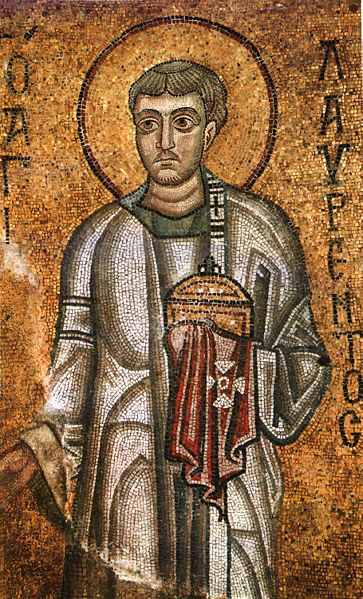
Saint Lawrence. Mosaic from the Saint Sophia Cathedral in Kiev.

Today, in Mercy, we celebrate the feast of St. Lawrence who is noted for his love for those who were poor. Legend has it that Lawrence was demanded, before his martyrdom, to turn over the Church’s riches to the emperor Valerian. Instead, he distributed all the resources among the poor. Lawrence then gathered all these people, presenting them before Valerian with these words:

Behold in these poor persons
the treasures which I promised to show you –
these are the true treasures of the Church.

Lawrence was likely inspired by readings like today’s. In Corinthians, Paul encourages us to be cheerful givers. He says this delights God, the Giver of Divine Abundance, whom we are imitating.

John12_24 grain wheat

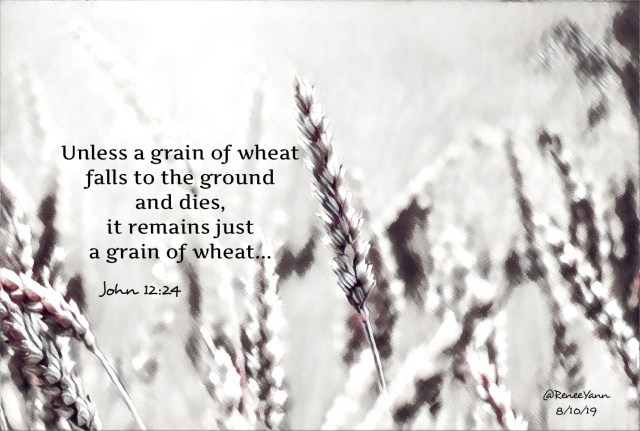
In our reading from John, Jesus says that only in dying to ourselves do we live – the ultimate generosity. He says that only by doing this can we truly follow him.

While these readings are clear and simple, they are so profound that we can hardly take in their message. What they ask of us is daunting! The encouragement Jesus gives us to respond to his challenge is this:

The Father will honor whoever serves me.

St. Lawrence believed and lived this promise. What about us?

Music: Before the Bread – Elizabeth Alexander

We all want our lives to be full and complete – to be “bread”. But there are many steps before the grain of wheat becomes bread, as captured in this elegant acapella canon.

Let the Light In

Friday of the Eighteenth Week in Ordinary Time

August 9, 2019

Click here for readings

Today, in Mercy, we have the first of a few readings from the Book of Deuteronomy. In today’s passage, Moses gives the first of three speeches to the community. These speeches are a sort of manifesto a family patriarch might give before he dies, framing the family history and code to direct coming generations.

Ps77 crack


Dad


The reading falls on a most appropriate day for me.
Today would be my Dad’s 104th birthday.
The occasion invites me to recount all the blessings
given to him, me, and our family.


When we, as people of faith, step back from our lives in reverence, we realize God’s immense goodness to us. Moses encourages his people to do just such stepping back:

Ask now of the days of old, before your time,
ever since God created man upon the earth;
ask from one end of the sky to the other:
Did anything so great ever happen before?

We might ask ourselves the same thing. 

  • How has God been with me and my family through our lifetimes, and through the generations that preceded us?
  • In both our lights and darknesses, how has God continually called us to relationship?
  • How have we revealed God’s voice to one another by our love, honesty, support, patient accompaniment, generous correction and forgiveness?
  • How have these gifts to one another allowed us to become gifts to the larger world?
  • What am I passing on to the next generation of the fidelity and sacrifice which has blessed me?

When I think of my Dad, there are so many symbols that show how he answered those questions with his life. They aren’t big manifestos like those of Moses. Instead: 

  • a frayed prayer book that I watched him finger daily
  • an old receipt for my bicycle bought in incremental payments he could barely afford
  • his sincere distress one Assumption Day when he had forgotten to go to Mass
  • his steadfast attempt to work even when illness weakened him and his humble trust in God when that weakness appeared to triumph
  • a treasured conversation about his hope for heaven
  • the appreciation now, in my maturity, of his thousand quiet acts of faith and love

All of us might spend some time in gratitude for the legacy of faith and love we have received. No family is perfect, and the grace may come to us in clarity or in disguise. But it comes. 

There are fractures and tears in every family. There were some even in Moses’ “family” and Moses himself! And we cannot magically heal them all. But God asks us to remember that God abides with us even in any fragmentation. Just as the poet Leonard Cohen sings:

There is a crack in everything.
That’s how the light gets in.

Click here to listen to Cohen’s moving song

If what we remember in our family history are weaknesses, how have they made us stronger? If what we remember are strengths, how have they made us more generous? In either case, how have we heard God’s voice in our story? How have we let the Light in?

As Moses tells his people:

This is why you must now know, and fix in your heart,
that the LORD is God
in the heavens above and on earth below,

and that there is no other.

Music: As for Me and My House – Promise Keepers

Failure Is An Option!

Memorial of Saint Dominic, Priest

August 8, 2019

Click here for readings

Today, in Mercy, on this Memorial of St. Domenic, our first reading gives us a lesson in failure. It is a situation we all face in life. If you haven’t, then you aren’t trying hard enough.

Numbers20_13_Failure

In our reading today, even the great Moses fails. But, you might ask, hasn’t he failed a number of times already? The smashed commandments, the golden calf, the complaints about manna? These were all human frustrations and inadequacies Moses would not have chosen.

Today’s failure is different. It is a failure in leadership. Any leadership role we hold, we hold in the name of God. We are parents, employers, teachers, pastors, religious leaders, supervisors, captains, managers…and so on. The cloak of responsibility covers each one of us at various times in our lives. Wearing it, we put on God’s trust in us to honor Him and those he has given us.

Dore_Rock
Moses Striking the Rock in Horeb, engraving by Gustave Doré from “La Sainte Bible”

When Moses and Aaron asked God to give the people water, God said, 

Take your staff and assemble the community,
you and your brother Aaron,
and in their presence order the rock to yield its waters.
From the rock you shall bring forth water for the congregation
and their livestock to drink.

Moses, caught in his own frustrations, did as God said but not before castigating the community and striking the rock twice.

So what?, you might say. 

Here’s the “What”. These acts betray Moses’ failure to trust God and to give God honor before the community. Perhaps unwittingly, Moses made it look like he was the one who summoned the water.

This reading calls us to always give God the glory. We are never really in charge of anything. We just do our best to make a path for life, goodness, love and wholeness.

If, through a leadership role, we are called to assist God in re-creating the world, let us do it with exquisite humility, trust, reverence, intentionality and praise.

Music: Humble – Audrey Assad

Crossing the Line

Wednesday of the Eighteenth Week in Ordinary Time

August 7, 2019

Click here for readings

Today, in Mercy, our reading from Numbers is about trust versus fear.  The Israelites have finally made it to the front door of the Promised Land. But they hesitate to go in. They get Moses to bargain with God to allow scouts to go ahead of them, checking out the lay of the land. These scouts return with a mixed report: arable land, but ferocious current residents! The community freezes in fear, refusing to go farther.

Israelites into Canaan
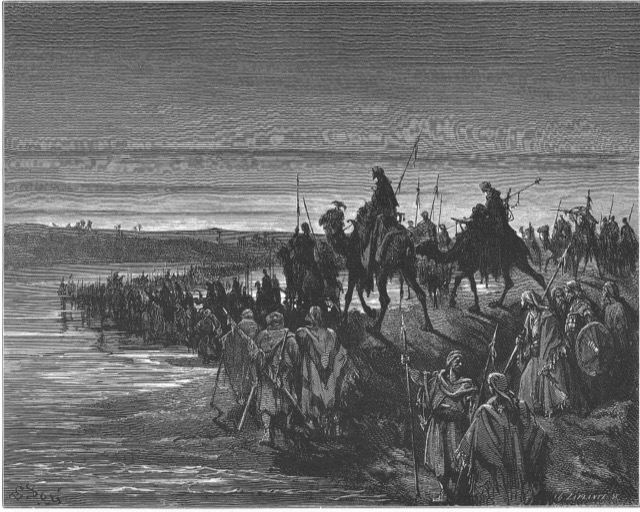
The Israelites Cross the Jordan River by Gustave Doré 1832-1883

So what’s this all about for us? Is it wrong for us to be deliberate about our decisions, reversing them when the situation becomes threatening? No, of course not. So what’s the difference here in our Numbers community?

At this moment in Israel’s history, God has made clear what is expected of them. They are in covenant with God – “all in” to follow God’s plan for their lives. God has demonstrated his commitment to them in numerous ways, and forgiven earlier disloyalties. 

The question before them now is have they given God their whole hearts.

Or will this be a sham covenant in which they pick and choose when they will be for God and when they will be just for themselves?

The life of deep spiritual commitment to God is not always smooth. We get really mixed up sometimes in our self-concerns and fears. Many years ago, one of my eighth grade students asked me this: what if there really is no God and you’ve wasted your life believing there was?

It was quite a question, and I’ll bet you want to know my answer.

I said that I wouldn’t change a thing about how I have chosen to live my life. Trusting God and giving my life to him has given me a freedom beyond the limits of this world. Even if, at the end, her doubt proved true, I would have had a blessed and joyous life.

Psalm 106

The fact is that we, just like those Israelites standing on the edge of Canaan, don’t know what will happen to us if we trust God. Life and the future is an intimidating open border that challenges our faith and resolve.

But if we constantly hedge our self-gift to God, we will never be capable of receiving the fullness of God’s gift in return.

Today, let’s pray for the trust to step over into God’s country by our acts of faith, hope, love, mercy, generosity, truthfulness, hospitality and courage.

This beautiful reinterpretation of today’s Responsorial Psalm may inspire you as it did me. It is from the website of Christine Robinson, a Unitarian Universalist minister: Click here for Psalm renderings

Psalm 106: Returning
“Give thanks to God, who is good
whose mercy endures forever.”

We stand in awe of an infinity
which we cannot begin to comprehend
We set ourselves to live in tune with the universe—
that we may be glad with the gladness of people of faith.
Yes, time and time again we have gone astray,

We have despoiled this beautiful, wonderful world
dealt unjustly with our compadres
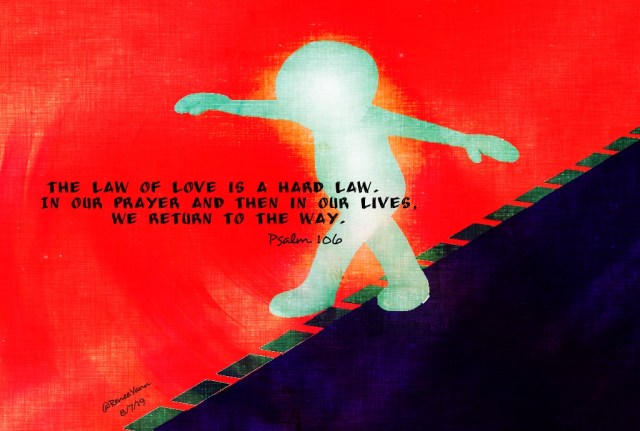
The law of love is a hard law.
In our prayer and then in our lives,
we return to the Way.

Music: Trust God – Rick Muchow 

Enduring Journey

Monday of the Eighteenth Week in Ordinary Time

August 5, 2019

Click here for readings

Today, in Mercy, we have the first of a few readings from the Book of Numbers. Numbers is basically about two themes: journeying and maturing as a community of faith.

roots


Numbers is the fourth book of the Bible, part of the five which comprise the Pentateuch, or Hebrew Torah. We can think of these books as a kind of Jewish “Roots”, for those who are familiar with the Alex Haley classic.


In the Pentateuch, both Jews and Christian find the foundational bedrock of their faith story. Today’s chapter focuses on two realities of faith and community: leadership and fidelity.

The People are having trouble staying committed to the journey. They are tired, hungry and walking around in circles. They are hungry for something besides manna, the way we become hungry for more than our dailyness.

Numbers11_4 complain

Like most frustrated groups, they start busting on their leader – Moses. Moses, unwilling to carry their burdens alone, starts busting on God. Watch any TV drama for a similar plot/theme. As a matter of fact, let’s examine our lives for it.

Enduring commitment is hard, especially when it is tested. When our commitment seems meaningless, or ignored, or misinterpreted, or otherwise futile, what do we do? How do we re-examine and re-define the fundamental relationship of faith which informs that commitment.

This re-examination and deeper re-commitment is what the Israelites experience through their desert journey, until they are ready to pass into the Promised Land as God’s People.

It is what we experience as a person of faith and as a faith community. Commitment is never static. In life’s test chamber, it either grows or diminishes. Praying with these passages from the Sacred Scripture may help us to grow deeper in our faith and trust. They may help us find the center if we feel a little hungry and lost in the desert too.

Music: Guide Me, Thou, O Great Redeemer

This hymn is the English version of a melody written by the Welshman John Hughes in 1909. The text was composed in 1745 by William Williams, considered Wales’ most famous hymnist. As a writer of poetry and prose,he is also considered today as one of the great literary figures of Wales. For an interesting history of the hymn, click here.

Sabbath and Jubilee

Saturday of the Seventeenth Week in Ordinary Time

August 3, 2019

Click here for readings

Sabbath-Should-We


Today, in Mercy, our reading from Leviticus may seem pastoral and peaceful in tone as it describes the days and years of rest and jubilee. Don’t let that tone fool you. This is perhaps one of the most radical, transformative passages in Scripture!

These verses from Leviticus describe and mandate an economic system based on respect and care for neighbor and earth. They require the community to take significant, reflective pauses in what might be an otherwise relentless drive to personal prosperity.

These commands are rooted in the understanding that God is the Creator, and therefore “owner” of all – people, animals, the land and its produce. We are to use these resources with reverent mutuality. If we do not, we become caught in an economy that inflates some at the expense of others – that is, an extractive economy.

Lv25_17_extraction

In an extractive economy, those with power and money siphon resources from the weak and vulnerable. This cycle grows ever more greedy because the “haves” can never have enough. Eventually, both human and natural resources are exhausted and the faulty, actually sinful, economy fails.

Sabbath and Jubilee are meant to restore balance by causing us to reflect on and reverse the pitfalls of a greedy, extractive system.

The parallels to present day realities are stunning! We live in a world where everything is a commodity at the disposal of those who control money. Walter Brueggemann calls this “the oligarchy of concentrated wealth…the network of the wealthy and powerful in the U.S. and around the world who basically outflank or control governmental structures.”

This unmitigated imbalance eventually creates impoverished nations whose citizens are plagued by violence, who must flee their homeland simply to survive. It spawns a culture of “disposability” where even human beings are bought and sold into exploitation. It creates a system where you may be sold anything, even if it kills you like tobacco, opioids and carcinogenic products. You may buy anything, even if it kills the people who provided it, even if it kills the earth for future generations.

So we simply cannot read Leviticus today as an ancient writing meant to organize a long-ago agrarian society. This scripture is speaking to us, demanding that we pause to consider how we contribute to or stand against such systems.

The reading is asking us to develop a deep, sacred awareness of all human beings as “neighbor”, and to live, unflinchingly, out of that awareness.

Music: The Workingman’s Hymn – Joshua Davis (Lyrics below)

Some people hunger for the greenback bill
Some folks hunger for the top of the hill
Some people just tryin’ to get a decent meal
Well I know that we can turn it around

Some people sleepin’ in a fine feather bed
Some folks are dreamin’ of an old homestead
Some just need a place to lay their head
Well I know that we can turn it around

[Chorus]
I know that we can turn it around
There’s one thing that I’ve found
If there’s a force in the dim singin’ a workingman’s hymn
I know that we can turn it around

River bottom up to home on high
In the light of the endless sky
Jetsettin’ or just gettin’ by
I know that we can turn it around

[Chorus]   [Bridge]

From the 9th Ward up to Patoka Lake
One man’s joy’s been another man’s pain
But the sun keeps shinin’ through the drivin’ rain
And I know that we can turn it around

Marking the Hours

Friday of the Seventeenth Week in Ordinary Time

August 2, 2019

Click here for readings

Today, in Mercy, we begin a few days of reading Leviticus. The reading today provides a long list of when and how the community should gather to worship. It is a lexicon on how to honor the sacred presence in their lives. Such honoring includes aspects of celebration, decoration, sharing, remembering and hoping together.

Lv23_37 hoursJPG

While the particular enjoinments detailed in Leviticus might not pertain to us, their spirit does. It is a spirit that encourages us to cherish the gift of time – moments, days, years – as precious opportunities to encounter God.

Down through the ages, people seeking holiness have used various, ritualized practices to remember and honor God’s omnipresence in their lives. They include morning and nighttime prayers, Grace before Meals, the Blessing of the Hour, the Angelus at noontime, the great liturgical practices of Advent and Lent, and the Divine Office. Each of these spiritual practices helps us to be more intentional about the true meaning and purpose of our daily life. 

Macrina Wiederkehr, a Benedictan monastic, has published a beautiful book to help people mark the hours of their day. She says this in Seven Sacred Pauses:


When I speak of “the hours” I am referring to those times of the day that the earth’s turning offers us: midnight, dawn, midmorning, noon, midafternoon, evening, and night. Although every hour is sacred, these special times have been hallowed by centuries of devotion and prayer…..

The daily and nightly dance of the hours is a universal way of honoring the earth’s turning as well as the sacred mysteries that flow out of our Christian heritage.


I think this is exactly what our Leviticus passage is doing as well. Our time is so precious and it flows so quickly! What a tragedy if we fail to stop and realize that it is the holy river on which we are meant to float to God!

robson-hatsukami-morgan-454S_xB0ReA-unsplash
Photo by Robson Hatsukami Morgan on Unsplash

Music: Teach Us to Number Our Days – Marty Goetz

Dwelling Place for God

Memorial of Saint Alphonsus Liguori, Bishop and Doctor of the Church

August 1, 2019

Click here for today’s readings

Today, in Mercy, we finish our several weeks’ journey through Exodus. Like all great books, this one closes with a powerful final chapter – one that assures us that the story has not ended.

Have you ever read a book that you wish would never end? Of course, they all do – but bits of some live in us forever.

fav books

With sacred scripture, the Living Word remains with us by inspiring us to live out its spirit in our lives. That Holy Word bonds with the Spirit already dwelling within us through our Creation and Baptism.

Psalm 84_Ark

For the Exodus community, this Indwelling was given visible expression in the tabernacle Moses built. God chose to fill that tabernacle with Abiding Presence.

Each one of us, and every human being, is a dwelling place of God’s love and hope for us. We are tabernacles of God’s Spirit, breathed into us in an act of divine desire for us to be God’s eternal beloved.

Pretty overwhelming, isn’t it! 

So much so that, just as for the Israelites, our vision of God’s Presence is often clouded by the frenzy of our lives. It is only when we still our souls in worship that we recognize God living with and within us!

Music: This Alone – Tim Manion, SJ ( Photos are The Abbey of Mont-Saint-Michel / Normandy, in the Manche department in France.)