Failure Is An Option!

Memorial of Saint Dominic, Priest

August 8, 2019

Click here for readings

Today, in Mercy, on this Memorial of St. Domenic, our first reading gives us a lesson in failure. It is a situation we all face in life. If you haven’t, then you aren’t trying hard enough.

Numbers20_13_Failure

In our reading today, even the great Moses fails. But, you might ask, hasn’t he failed a number of times already? The smashed commandments, the golden calf, the complaints about manna? These were all human frustrations and inadequacies Moses would not have chosen.

Today’s failure is different. It is a failure in leadership. Any leadership role we hold, we hold in the name of God. We are parents, employers, teachers, pastors, religious leaders, supervisors, captains, managers…and so on. The cloak of responsibility covers each one of us at various times in our lives. Wearing it, we put on God’s trust in us to honor Him and those he has given us.

Dore_Rock
Moses Striking the Rock in Horeb, engraving by Gustave Doré from “La Sainte Bible”

When Moses and Aaron asked God to give the people water, God said, 

Take your staff and assemble the community,
you and your brother Aaron,
and in their presence order the rock to yield its waters.
From the rock you shall bring forth water for the congregation
and their livestock to drink.

Moses, caught in his own frustrations, did as God said but not before castigating the community and striking the rock twice.

So what?, you might say. 

Here’s the “What”. These acts betray Moses’ failure to trust God and to give God honor before the community. Perhaps unwittingly, Moses made it look like he was the one who summoned the water.

This reading calls us to always give God the glory. We are never really in charge of anything. We just do our best to make a path for life, goodness, love and wholeness.

If, through a leadership role, we are called to assist God in re-creating the world, let us do it with exquisite humility, trust, reverence, intentionality and praise.

Music: Humble – Audrey Assad
Crossing the Line

Wednesday of the Eighteenth Week in Ordinary Time

August 7, 2019

Click here for readings

Today, in Mercy, our reading from Numbers is about trust versus fear.  The Israelites have finally made it to the front door of the Promised Land. But they hesitate to go in. They get Moses to bargain with God to allow scouts to go ahead of them, checking out the lay of the land. These scouts return with a mixed report: arable land, but ferocious current residents! The community freezes in fear, refusing to go farther.

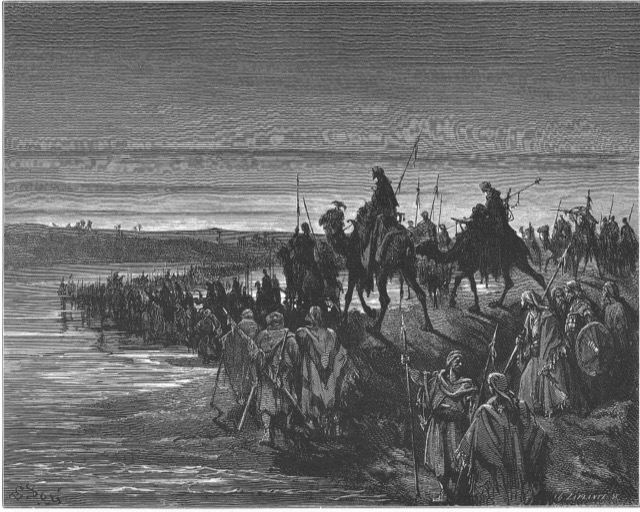
Israelites into Canaan
The Israelites Cross the Jordan River by Gustave Doré 1832-1883

So what’s this all about for us? Is it wrong for us to be deliberate about our decisions, reversing them when the situation becomes threatening? No, of course not. So what’s the difference here in our Numbers community?

At this moment in Israel’s history, God has made clear what is expected of them. They are in covenant with God – “all in” to follow God’s plan for their lives. God has demonstrated his commitment to them in numerous ways, and forgiven earlier disloyalties. 

The question before them now is have they given God their whole hearts.

Or will this be a sham covenant in which they pick and choose when they will be for God and when they will be just for themselves?

The life of deep spiritual commitment to God is not always smooth. We get really mixed up sometimes in our self-concerns and fears. Many years ago, one of my eighth grade students asked me this: what if there really is no God and you’ve wasted your life believing there was?

It was quite a question, and I’ll bet you want to know my answer.

I said that I wouldn’t change a thing about how I have chosen to live my life. Trusting God and giving my life to him has given me a freedom beyond the limits of this world. Even if, at the end, her doubt proved true, I would have had a blessed and joyous life.

Psalm 106

The fact is that we, just like those Israelites standing on the edge of Canaan, don’t know what will happen to us if we trust God. Life and the future is an intimidating open border that challenges our faith and resolve.

But if we constantly hedge our self-gift to God, we will never be capable of receiving the fullness of God’s gift in return.

Today, let’s pray for the trust to step over into God’s country by our acts of faith, hope, love, mercy, generosity, truthfulness, hospitality and courage.

This beautiful reinterpretation of today’s Responsorial Psalm may inspire you as it did me. It is from the website of Christine Robinson, a Unitarian Universalist minister: Click here for Psalm renderings

Psalm 106: Returning
“Give thanks to God, who is good
whose mercy endures forever.”

We stand in awe of an infinity
which we cannot begin to comprehend
We set ourselves to live in tune with the universe—
that we may be glad with the gladness of people of faith.
Yes, time and time again we have gone astray,

We have despoiled this beautiful, wonderful world
dealt unjustly with our compadres
The law of love is a hard law.
In our prayer and then in our lives,
we return to the Way.

Music: Trust God – Rick Muchow 

Enduring Journey

Monday of the Eighteenth Week in Ordinary Time

August 5, 2019

Click here for readings

Today, in Mercy, we have the first of a few readings from the Book of Numbers. Numbers is basically about two themes: journeying and maturing as a community of faith.

roots


Numbers is the fourth book of the Bible, part of the five which comprise the Pentateuch, or Hebrew Torah. We can think of these books as a kind of Jewish “Roots”, for those who are familiar with the Alex Haley classic.


In the Pentateuch, both Jews and Christian find the foundational bedrock of their faith story. Today’s chapter focuses on two realities of faith and community: leadership and fidelity.

The People are having trouble staying committed to the journey. They are tired, hungry and walking around in circles. They are hungry for something besides manna, the way we become hungry for more than our dailyness.

Numbers11_4 complain

Like most frustrated groups, they start busting on their leader – Moses. Moses, unwilling to carry their burdens alone, starts busting on God. Watch any TV drama for a similar plot/theme. As a matter of fact, let’s examine our lives for it.

Enduring commitment is hard, especially when it is tested. When our commitment seems meaningless, or ignored, or misinterpreted, or otherwise futile, what do we do? How do we re-examine and re-define the fundamental relationship of faith which informs that commitment.

This re-examination and deeper re-commitment is what the Israelites experience through their desert journey, until they are ready to pass into the Promised Land as God’s People.

It is what we experience as a person of faith and as a faith community. Commitment is never static. In life’s test chamber, it either grows or diminishes. Praying with these passages from the Sacred Scripture may help us to grow deeper in our faith and trust. They may help us find the center if we feel a little hungry and lost in the desert too.

Music: Guide Me, Thou, O Great Redeemer

This hymn is the English version of a melody written by the Welshman John Hughes in 1909. The text was composed in 1745 by William Williams, considered Wales’ most famous hymnist. As a writer of poetry and prose,he is also considered today as one of the great literary figures of Wales. For an interesting history of the hymn, click here.

Sabbath and Jubilee

Saturday of the Seventeenth Week in Ordinary Time

August 3, 2019

Click here for readings

Sabbath-Should-We


Today, in Mercy, our reading from Leviticus may seem pastoral and peaceful in tone as it describes the days and years of rest and jubilee. Don’t let that tone fool you. This is perhaps one of the most radical, transformative passages in Scripture!

These verses from Leviticus describe and mandate an economic system based on respect and care for neighbor and earth. They require the community to take significant, reflective pauses in what might be an otherwise relentless drive to personal prosperity.

These commands are rooted in the understanding that God is the Creator, and therefore “owner” of all – people, animals, the land and its produce. We are to use these resources with reverent mutuality. If we do not, we become caught in an economy that inflates some at the expense of others – that is, an extractive economy.

Lv25_17_extraction

In an extractive economy, those with power and money siphon resources from the weak and vulnerable. This cycle grows ever more greedy because the “haves” can never have enough. Eventually, both human and natural resources are exhausted and the faulty, actually sinful, economy fails.

Sabbath and Jubilee are meant to restore balance by causing us to reflect on and reverse the pitfalls of a greedy, extractive system.

The parallels to present day realities are stunning! We live in a world where everything is a commodity at the disposal of those who control money. Walter Brueggemann calls this “the oligarchy of concentrated wealth…the network of the wealthy and powerful in the U.S. and around the world who basically outflank or control governmental structures.”

This unmitigated imbalance eventually creates impoverished nations whose citizens are plagued by violence, who must flee their homeland simply to survive. It spawns a culture of “disposability” where even human beings are bought and sold into exploitation. It creates a system where you may be sold anything, even if it kills you like tobacco, opioids and carcinogenic products. You may buy anything, even if it kills the people who provided it, even if it kills the earth for future generations.

So we simply cannot read Leviticus today as an ancient writing meant to organize a long-ago agrarian society. This scripture is speaking to us, demanding that we pause to consider how we contribute to or stand against such systems.

The reading is asking us to develop a deep, sacred awareness of all human beings as “neighbor”, and to live, unflinchingly, out of that awareness.

Music: The Workingman’s Hymn – Joshua Davis (Lyrics below)

Some people hunger for the greenback bill
Some folks hunger for the top of the hill
Some people just tryin’ to get a decent meal
Well I know that we can turn it around

Some people sleepin’ in a fine feather bed
Some folks are dreamin’ of an old homestead
Some just need a place to lay their head
Well I know that we can turn it around

[Chorus]
I know that we can turn it around
There’s one thing that I’ve found
If there’s a force in the dim singin’ a workingman’s hymn
I know that we can turn it around

River bottom up to home on high
In the light of the endless sky
Jetsettin’ or just gettin’ by
I know that we can turn it around

[Chorus]   [Bridge]

From the 9th Ward up to Patoka Lake
One man’s joy’s been another man’s pain
But the sun keeps shinin’ through the drivin’ rain
And I know that we can turn it around

Marking the Hours

Friday of the Seventeenth Week in Ordinary Time

August 2, 2019

Click here for readings

Today, in Mercy, we begin a few days of reading Leviticus. The reading today provides a long list of when and how the community should gather to worship. It is a lexicon on how to honor the sacred presence in their lives. Such honoring includes aspects of celebration, decoration, sharing, remembering and hoping together.

Lv23_37 hoursJPG

While the particular enjoinments detailed in Leviticus might not pertain to us, their spirit does. It is a spirit that encourages us to cherish the gift of time – moments, days, years – as precious opportunities to encounter God.

Down through the ages, people seeking holiness have used various, ritualized practices to remember and honor God’s omnipresence in their lives. They include morning and nighttime prayers, Grace before Meals, the Blessing of the Hour, the Angelus at noontime, the great liturgical practices of Advent and Lent, and the Divine Office. Each of these spiritual practices helps us to be more intentional about the true meaning and purpose of our daily life. 

Macrina Wiederkehr, a Benedictan monastic, has published a beautiful book to help people mark the hours of their day. She says this in Seven Sacred Pauses:


When I speak of “the hours” I am referring to those times of the day that the earth’s turning offers us: midnight, dawn, midmorning, noon, midafternoon, evening, and night. Although every hour is sacred, these special times have been hallowed by centuries of devotion and prayer…..

The daily and nightly dance of the hours is a universal way of honoring the earth’s turning as well as the sacred mysteries that flow out of our Christian heritage.


I think this is exactly what our Leviticus passage is doing as well. Our time is so precious and it flows so quickly! What a tragedy if we fail to stop and realize that it is the holy river on which we are meant to float to God!

robson-hatsukami-morgan-454S_xB0ReA-unsplash
Photo by Robson Hatsukami Morgan on Unsplash

Music: Teach Us to Number Our Days – Marty Goetz

Dwelling Place for God

Memorial of Saint Alphonsus Liguori, Bishop and Doctor of the Church

August 1, 2019

Click here for today’s readings

Today, in Mercy, we finish our several weeks’ journey through Exodus. Like all great books, this one closes with a powerful final chapter – one that assures us that the story has not ended.

Have you ever read a book that you wish would never end? Of course, they all do – but bits of some live in us forever.

fav books

With sacred scripture, the Living Word remains with us by inspiring us to live out its spirit in our lives. That Holy Word bonds with the Spirit already dwelling within us through our Creation and Baptism.

Psalm 84_Ark

For the Exodus community, this Indwelling was given visible expression in the tabernacle Moses built. God chose to fill that tabernacle with Abiding Presence.

Each one of us, and every human being, is a dwelling place of God’s love and hope for us. We are tabernacles of God’s Spirit, breathed into us in an act of divine desire for us to be God’s eternal beloved.

Pretty overwhelming, isn’t it! 

So much so that, just as for the Israelites, our vision of God’s Presence is often clouded by the frenzy of our lives. It is only when we still our souls in worship that we recognize God living with and within us!

Music: This Alone – Tim Manion, SJ ( Photos are The Abbey of Mont-Saint-Michel / Normandy, in the Manche department in France.)

Unconditional Love

Tuesday of the Seventeenth Week in Ordinary Time

July 30, 2019

Click here for readings

Today, in Mercy, we consider God’s unconditional love.

God and Moses and the People have been through it. The trail of complaints, the golden calf, the shattered tablets – these are relational dramas to the extreme! Exodus is definitely soap opera material! Does it feel a little bit like your life, or your family’s, or the families you read about in the news?

Ex34_9 Life

Life is indeed a drama! And our relationship with God is highlighted and shadowed with its twists and turns. For that reason, today’s passage offers us so much comfort and confidence. Even after all that has happened, God reveals himself to Moses like this:

The LORD, the LORD, a merciful and gracious God,
slow to anger and rich in kindness and fidelity,
continuing his kindness for a thousand generations.

Moses is so moved by this new knowledge of God’s unconditional love, that he welcomes God as part of their community:

If I find favor with you, O LORD,
do come along in our company.
This is indeed a stiff-necked people;
yet pardon our wickedness and sins,

and receive us as your own.

We are invited by this reading to open ourselves to that same unconditional love, to thank God for journeying with us through life’s convolutions. Stiff-necked at times, repentant at others, we are always God’s beloved.

As we negotiate the intricacies of our life today, we might trustingly say like Moses:

Lord, do come along in my company.

Music: Outrageous Grace – Godfrey Birtill

Idols!

Memorial of Saint Martha

July 29, 2019

Click here for readings

Today, in Mercy, our readings offer us a central question for our faith and spirituality: What do we really worship?

Ex32_19 calf

As we continue the Exodus story, Moses has been on the mountain receiving the Law from God. Meanwhile, back at the ranch, delegated leader Aaron is blowing his assignment. The Israelites tire of waiting for Moses. They want another god to lead them onward. Aaron comes up with idea of fashioning such a idol from all their molten jewelry.

When Moses descends the mountain with the newly-minted tablets in hand, he burns in anger at the scene, smashing the holy stones at his feet. More than a flared temper, this act symbolizes a fractured relationship with God.

The story suggests this for our prayer: we are in ever-deepening relationship with God through our own covenants – our creation, our baptism, our further professions of faith and commitment, our sacramental encounters. These are all living relationships, inviting us to new and deeper life in God.

Still, there may be times in our lives when our hearts lose focus on these covenants 

  • when we try to move somewhere without God’s companionship
  • when we substitute old baubles for moral or spiritual truth
  • when we return to weakening comforts rather than grow into a challenging grace
  • when we just get really mixed up about what is most important in our lives

The calf-worshippers had a big fail in this regard. Exodus tells the story of a merciful God trying to deal with their disloyalty and refashion them as God’s chosen people.

Our Gospel shows us Martha, also a little off target in terms of her spiritual priorities. While she is no where near idol worship, she still allows needless distractions to keep her from fully enjoying relationship with God.

Martha

Gentle, merciful Jesus turns her eyes toward him and she understands. Maybe that beautiful grace is what we want to pray for today.

Music:  You Alone – Sarah Hart

Our Story is God’s Story

Saturday of the Sixteenth Week in Ordinary Time

July 27, 2019

Click here for readings

Today, in Mercy, our Exodus reading describes momentous events in Israel’s life.

tabletsJPG

God has just invited Moses and several others up the mountain for a Divine conflab.  Moses returns to the people to announce “all the words and ordinances of the Lord”.The People receive these words wholeheartedly:

“We will do everything that the LORD has told us.”

Thus, a community of persons is formed with God at its heart.

Moses then engages the community in a series of formal rituals to highlight the significance and permanence of this deeper step in relationship with God.


The passage contains multiple points for our prayerful consideration.

The community of Israel is not unlike our own faith communities, those that gather in specific religious houses, or those we share in the universal community of all Creation. We are Catholics, Lutherans, Jews, Hindus, Muslims, Sikhs sharing a story of God in our particular religious traditions. We are also all children of the same God sharing that experience in our Common Home of Creation.

Just as with the ancient Israelites, God communicates and relates with us through the experiences of our lives. In our communities, that Divine Word is interpreted, codified, ritualized, and responded to. These actions create a story which is alive, deepening with each new generation, and still always rooted in the long history of promise and grace.

Today’s reading contains many elements of story and ritual which we can recognize in our own faith practice: written and announced word, altar or worship place, sacrifice or offering to God, acts of covenant, and celebratory meals.

Exodus24_3 sinai

These are the human ways in which we access relationship with God. These are the ways in which we keep our faith vital. We strengthen our faith by one another’s stories of love, mercy and hope. We commit to a shared law of love, not legalism – a heart-law which calls us to be life for one another, just as God is Life for us. In community, we reveal the face of God within ourselves.

For those of us who share the practice of a Eucharistic faith, the parallels in today’s reading call us to deeper awareness of how God becomes present in our lives.

May all of us – of whatever spirituality – who share life in God’s continuing Creation, obediently hear the command to cherish every human being as a revelation of God, as a critical and precious part of my own faith story – a part for whom I share the responsibility for life.

Music: Song of the Body of Christ – David Haas (Lyrics below)

Song of the Body of Christ
Refrain: We come to share our story. We come to break the bread.
We come to know our rising from the dead.
1. We come as your people. We come as your own.
United with each other, love finds a home.
2. We are called to heal the broken, to be hope for the poor.
We are called to feed the hungry at our door.
3. Bread of life and cup of promise, In this meal we all are one.
In our dying and our rising, may your kingdom come.
4. You will lead and we shall follow.
ou will be the breath of life; living water, we are thirsting for your light.

Honor Those Who Bore You Life

Memorial of Saints Joachim and Anne, Parents of the Blessed Virgin Mary

July 26, 2019

Click here for readings

Today, in Mercy, our Exodus reading coincides perfectly with today’s Memorial Feast for Anne and Joachim, grandparents of Jesus.

Exodus20_5

In the passage, we have one of many Old Testament formulations of the Ten Commandments. We learned these codes as children, and perhaps have always interpreted them as laws which, when broken, marked us as sinners.

While this is one approach, a more mature and life-giving one is offered by the Biblical scholar Terence E. Fretheim:

The focus (of these directives) is on
protecting the health of the community,

to which end the individual plays such an important role.
Exodus: Interpretation: A Biblical Commentary for Teaching and Preaching

The command to honor one’s father and mother clearly demonstrates this approach. It is a command not only for children to be docile and obedient. Rather it denotes a life-long responsibility to care for parents and other  nurturers of our lives. The command also suggests the responsibility of these nurturers to live honorably so that their children may respond to their example with equal honor.

Today is a day to pray for our own families and for all families, for the young and the elderly, and for those walking the tenuous bridge in between.  It is a day to assess how well we carry our responsibilities to honor, obey, bless and foster life for one another.

It is a day to be deeply grateful for the love of family which we are blessed to experience; a day to pray for healing for those not equally blessed. Let us pray for families distressed by the necessity to migrate, and further burdened by nations’ failures to keep the commandment of neighborly love.

Like Mary, may we embrace the elders in our lives who love and need us, be these parents, mentors, community members, or neighbors. Scripture promises us that, in doing so, we shall have “mercy bestowed on us down to the thousandth generation.”

Music: Love Remains – Hillary Scott