Unconditional Love

Tuesday of the Seventeenth Week in Ordinary Time

July 30, 2019

Click here for readings

Today, in Mercy, we consider God’s unconditional love.

God and Moses and the People have been through it. The trail of complaints, the golden calf, the shattered tablets – these are relational dramas to the extreme! Exodus is definitely soap opera material! Does it feel a little bit like your life, or your family’s, or the families you read about in the news?

Ex34_9 Life

Life is indeed a drama! And our relationship with God is highlighted and shadowed with its twists and turns. For that reason, today’s passage offers us so much comfort and confidence. Even after all that has happened, God reveals himself to Moses like this:

The LORD, the LORD, a merciful and gracious God,
slow to anger and rich in kindness and fidelity,
continuing his kindness for a thousand generations.

Moses is so moved by this new knowledge of God’s unconditional love, that he welcomes God as part of their community:

If I find favor with you, O LORD,
do come along in our company.
This is indeed a stiff-necked people;
yet pardon our wickedness and sins,

and receive us as your own.

We are invited by this reading to open ourselves to that same unconditional love, to thank God for journeying with us through life’s convolutions. Stiff-necked at times, repentant at others, we are always God’s beloved.

As we negotiate the intricacies of our life today, we might trustingly say like Moses:

Lord, do come along in my company.

Music: Outrageous Grace – Godfrey Birtill

Idols!

Memorial of Saint Martha

July 29, 2019

Click here for readings

Today, in Mercy, our readings offer us a central question for our faith and spirituality: What do we really worship?

Ex32_19 calf

As we continue the Exodus story, Moses has been on the mountain receiving the Law from God. Meanwhile, back at the ranch, delegated leader Aaron is blowing his assignment. The Israelites tire of waiting for Moses. They want another god to lead them onward. Aaron comes up with idea of fashioning such a idol from all their molten jewelry.

When Moses descends the mountain with the newly-minted tablets in hand, he burns in anger at the scene, smashing the holy stones at his feet. More than a flared temper, this act symbolizes a fractured relationship with God.

The story suggests this for our prayer: we are in ever-deepening relationship with God through our own covenants – our creation, our baptism, our further professions of faith and commitment, our sacramental encounters. These are all living relationships, inviting us to new and deeper life in God.

Still, there may be times in our lives when our hearts lose focus on these covenants 

  • when we try to move somewhere without God’s companionship
  • when we substitute old baubles for moral or spiritual truth
  • when we return to weakening comforts rather than grow into a challenging grace
  • when we just get really mixed up about what is most important in our lives

The calf-worshippers had a big fail in this regard. Exodus tells the story of a merciful God trying to deal with their disloyalty and refashion them as God’s chosen people.

Our Gospel shows us Martha, also a little off target in terms of her spiritual priorities. While she is no where near idol worship, she still allows needless distractions to keep her from fully enjoying relationship with God.

Martha

Gentle, merciful Jesus turns her eyes toward him and she understands. Maybe that beautiful grace is what we want to pray for today.

Music:  You Alone – Sarah Hart

Our Story is God’s Story

Saturday of the Sixteenth Week in Ordinary Time

July 27, 2019

Click here for readings

Today, in Mercy, our Exodus reading describes momentous events in Israel’s life.

tabletsJPG

God has just invited Moses and several others up the mountain for a Divine conflab.  Moses returns to the people to announce “all the words and ordinances of the Lord”.The People receive these words wholeheartedly:

“We will do everything that the LORD has told us.”

Thus, a community of persons is formed with God at its heart.

Moses then engages the community in a series of formal rituals to highlight the significance and permanence of this deeper step in relationship with God.


The passage contains multiple points for our prayerful consideration.

The community of Israel is not unlike our own faith communities, those that gather in specific religious houses, or those we share in the universal community of all Creation. We are Catholics, Lutherans, Jews, Hindus, Muslims, Sikhs sharing a story of God in our particular religious traditions. We are also all children of the same God sharing that experience in our Common Home of Creation.

Just as with the ancient Israelites, God communicates and relates with us through the experiences of our lives. In our communities, that Divine Word is interpreted, codified, ritualized, and responded to. These actions create a story which is alive, deepening with each new generation, and still always rooted in the long history of promise and grace.

Today’s reading contains many elements of story and ritual which we can recognize in our own faith practice: written and announced word, altar or worship place, sacrifice or offering to God, acts of covenant, and celebratory meals.

Exodus24_3 sinai

These are the human ways in which we access relationship with God. These are the ways in which we keep our faith vital. We strengthen our faith by one another’s stories of love, mercy and hope. We commit to a shared law of love, not legalism – a heart-law which calls us to be life for one another, just as God is Life for us. In community, we reveal the face of God within ourselves.

For those of us who share the practice of a Eucharistic faith, the parallels in today’s reading call us to deeper awareness of how God becomes present in our lives.

May all of us – of whatever spirituality – who share life in God’s continuing Creation, obediently hear the command to cherish every human being as a revelation of God, as a critical and precious part of my own faith story – a part for whom I share the responsibility for life.

Music: Song of the Body of Christ – David Haas (Lyrics below)

Song of the Body of Christ
Refrain: We come to share our story. We come to break the bread.
We come to know our rising from the dead.
1. We come as your people. We come as your own.
United with each other, love finds a home.
2. We are called to heal the broken, to be hope for the poor.
We are called to feed the hungry at our door.
3. Bread of life and cup of promise, In this meal we all are one.
In our dying and our rising, may your kingdom come.
4. You will lead and we shall follow.
ou will be the breath of life; living water, we are thirsting for your light.

Honor Those Who Bore You Life

Memorial of Saints Joachim and Anne, Parents of the Blessed Virgin Mary

July 26, 2019

Click here for readings

Today, in Mercy, our Exodus reading coincides perfectly with today’s Memorial Feast for Anne and Joachim, grandparents of Jesus.

Exodus20_5

In the passage, we have one of many Old Testament formulations of the Ten Commandments. We learned these codes as children, and perhaps have always interpreted them as laws which, when broken, marked us as sinners.

While this is one approach, a more mature and life-giving one is offered by the Biblical scholar Terence E. Fretheim:

The focus (of these directives) is on
protecting the health of the community,

to which end the individual plays such an important role.
Exodus: Interpretation: A Biblical Commentary for Teaching and Preaching

The command to honor one’s father and mother clearly demonstrates this approach. It is a command not only for children to be docile and obedient. Rather it denotes a life-long responsibility to care for parents and other  nurturers of our lives. The command also suggests the responsibility of these nurturers to live honorably so that their children may respond to their example with equal honor.

Today is a day to pray for our own families and for all families, for the young and the elderly, and for those walking the tenuous bridge in between.  It is a day to assess how well we carry our responsibilities to honor, obey, bless and foster life for one another.

It is a day to be deeply grateful for the love of family which we are blessed to experience; a day to pray for healing for those not equally blessed. Let us pray for families distressed by the necessity to migrate, and further burdened by nations’ failures to keep the commandment of neighborly love.

Like Mary, may we embrace the elders in our lives who love and need us, be these parents, mentors, community members, or neighbors. Scripture promises us that, in doing so, we shall have “mercy bestowed on us down to the thousandth generation.”

Music: Love Remains – Hillary Scott

Vigil

Saturday of the Fifteenth Week in Ordinary Time

July 20, 2019

Click here for readings

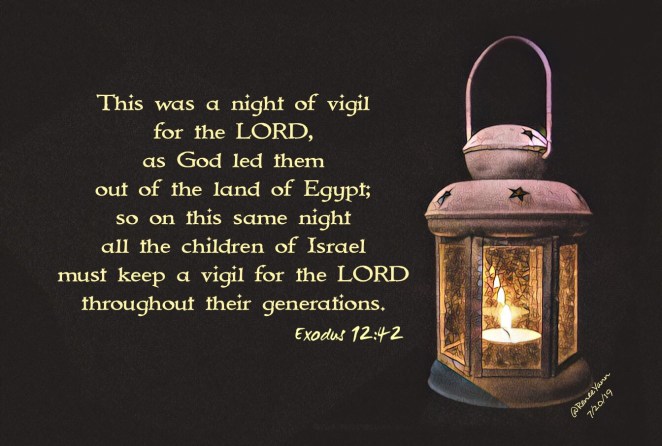
Today, in Mercy, we keep vigil with the “Children of Israel” as they begin the great Exodus.

Ex12_42 Vigil

Even the youngest of us understands what it means to “keep vigil”. Toddlers, on Christmas Eve, keep vigil for the sound of Santa’s footsteps on the roof.

Throughout our lives, the kinds of vigils we keep deepen in meaning. Any given night holds an array of vigil-keepers:

  • A nervous student pulls an all-nighter before a big exam.
  • An anxious parent watches over a feverish child.
  • A faith-filled soul sits in pre-dawn prayer.
  • A vigilant elder prays quietly at the death bed of a long-beloved.

As families and communities, we wait together for each other’s lives.

  • Together, we expect the births of each generation’s babies.
  • We wait and hope for college acceptances and new jobs.
  • We wait for test results of all kinds.
  • We wait to listen to one another’s stories of success or disappointment.
  • We wait and prepare for the dawning of great feasts like Christmas and Easter

When we keep vigil, we live in expectation of something or someone coming to us. But there is another important aspect to every vigil.

As we wait, something is also happening within us.
In the deep quiet of our waiting, we are transformed.

Thomas Merton, monk of Gethsemane, was assigned to keep a particular type of vigil at the abbey. It was called “fire watch”, a night-long lookout to ensure that no fire erupted in the old wooden buildings as the other monks slept.  Merton writes about that watch at the end of his book The Sign of Jonas:

The fire watch is an examination of conscience in which your task as watchman suddenly appears in its true light:  a pretext devised by God to isolate you, and to search your soul with lamps and questions, in the heart of darkness.
“Fire Watch, July 4, 1952”

Today, as we pray with Israel’s Passover vigil, let us consider our own vigils – current or past. Beyond their apparent meaning, to what secret transformation might God be inviting us? What is happening deep in our soul as we watch far out to the horizon of our hope?

Music: Firewatch – Chris Remo

The Basket … The Women

Tuesday of the Fifteenth Week in Ordinary Time

July 15, 2019

Click here for readings

Today, in Mercy, little Moses is saved from the Pharaoh’s wrath against the Israelites. It is a theme we are familiar with, notably repeated in the New Testament when Herod orders the slaughter of the Holy Innocents. In that event Jesus, like Moses, is spared by clandestine human intervention.

Exodus2_3 basket

The interveners in Exodus are all women – Moses’ mother, sister, Pharaoh’s daughter, and maid. Each of them decides to practice what we, today, call “civil disobedience“ – to stand and act against an immoral government order. Each woman becomes an agent through whom God actualizes the promise of life and freedom. And their choices are interdependent. They need to be a community of holy resistance in order to succeed.

An apt symbol for this agency is the papyrus basket, fortified with bitumen and pitch, and set afloat in the very river where Pharaoh had ordered the babies to be drowned. The basket is reminiscent of Noah’s ark, that vessel which preserved the diversity of life for future generations.

Sadly, history often has repeated the drama in which soulless leaders set a policy to extinguish the innocent. Many perish in that savagery. But many also rise up to bravely weave a “basket” of solidarity and compassion for the persecuted. Even in our own time, we see this story unfolding on the borders of xenophobic nations, whose leaders are indifferent to shaping just and moral policies.

But God is always at work in the world to accomplish the Promise of Life for God’s Creatures. Often, as in the story of infant Moses, God is not named – but rather is  evident as a relentless, compassionate force in the courageous choices of caring human beings.

As we pray today, might we find ourselves somewhere in this story? How might this finding inspire us to be God’s agents for life in our own time?

Video Clip from “The Prince of Egypt” (Lyrics below)

Hush now, my baby. Be still love, don’t cry
Sleep as you’re rocked by the stream
Sleep and remember my last lullaby
So I’ll be with you when you dream
Drift on a river
That flows through my arms
Drift as I’m singing to you

I see you smiling
So peaceful and calm
And holding you, I’m smiling, too
Here in my arms
Safe from all harm
Holding you, I’m smiling, too

Hush now, my baby
Be still, love, don’t cry
Sleep like you’re rocked by the stream
Sleep and remember this river lullaby
So I’ll be with you when you dream
Here in my arms
Safe from all harm
Holding you, I’m smiling, too

Sleep and remember this river lullaby
And I’ll be with you when you dream
Sleep and remember this river lullaby
And I’ll be with you when you dream

Journey through Exodus

Memorial of Saint Bonaventure, Bishop and Doctor of the Church

July 15, 2019

Click here for readings

Today, in Mercy, we begin a three-week journey through the Book of Exodus. The word “journey” is used purposefully because the Book not only narrates a journey in history, it invites us to move with it into a deeper spiritual freedom within ourselves.

It also impresses me that these weeks of reading come to us during a time when the world witnesses oppressed peoples exiting their ravished homelands in search of a sustainable life. Our prayerful reading of these Exodus passages may bring us deeper understanding, compassion, and advocacy courage for these struggling sisters and brothers.

In today’s introduction to Exodus, the narrator provides a transition from the closing of Genesis to the new situation in Egypt. Many years have passed. Favored Joseph is long dead. A “new king”, never named perhaps from contempt of his evilness, “knows nothing” of Joseph. If we don’t care enough to “know” another, we can never care enough to respect and foster their life.

Ex1_10_oppress

This Pharaoh’s sole preoccupation is to preserve Egyptian dominance . He was a man driven by irrational fears. To allay those fears, he was willing to suppress the life of a people who had lived peacefully in Egypt for hundreds of years. 

The Pharaoh begins by objectifying the Israelites as potential enemies and terrorists.

He orders their containment and oppression, moving them to encampments. Ironically, these encampment cities had originally been built, at Joseph’s direction, to contain surplus grain before the famine so that Egypt would not starve!

Still, the Israelites thrive and grow. They are the children of God’s Promise. This growth further threatens Pharaoh, spinning him into more desperate and ineffective attempts to retain domination. His systemic oppression doesn’t work. His fears – and his projection of them on to the Egyptian populace – consume both him and his people.


As the oppressors dehumanize others and violate their rights, they themselves also become dehumanized. … Once a situation of violence and oppression has been established, it engenders an entire way of life and behavior for those caught up in it—oppressor and oppressed alike. Both are submerged in the situation, and both bear the marks of oppression.
PAULO FREIRE, Pedagogy of the Oppressed, pp. 43-44)


Today’s readings offer us so much to consider in terms of a culture of domination versus one of right relationship. These balances and imbalances occur in exchanges as small as a word between two people, or as large as a policy between two nations. The parallels to our current world are painfully obvious. There may be parallels in our personal relationships as well that we might place into the power of prayer.

May we have eyes to see, a heart to care, and the courage to act – both personally and globally.

Music:  Hymn to Our Alien God – Maryknoll Father’s and Brothers

(Background music is the hymn “Eternal Father, Strong to Save” by William Whiting

Be the Neighbor!

Fifteenth Sunday in Ordinary Time

July 14, 2019

Click here for readings

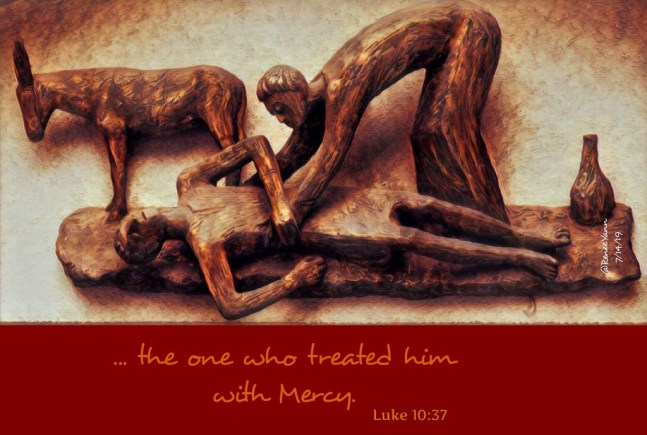
Today, in Mercy, dear friends, we have heard this Gospel from our youth. Even those without faith know the story.

Lk10_37 Samaritan

Let us deeply examine our daily lives today as we pray.

What more is there to say? This is what I hear in my prayer today:

Always be the neighbor.
Just do it.
This is Mercy.

do it1JPG

Music: I Will Love You, Lord! – Dale Sechrest

This wonderful mantra! Let yourself sing it!

That Family Reunion!

Friday of the Fourteenth Week in Ordinary Time

July 12, 2019

Click here for readings

Today, in Mercy, we read about a family reunion of biblical proportions!  After many years, Joseph – long-thought dead- is reunited with his grieving father, deceitful half-siblings, and beloved younger brother. Wow!

For better or worse, “Family” is a powerful force in every one of our lives. It both nurtures and siphons us; both exalts and critiques us; frees us and binds us.

Genesis46_30 family reunion

In many ways, family makes us who we are – by blood and genes – but more importantly by the hope and promise it places in us.  This was the case with Joseph, the great hope of his father Jacob and the misunderstood threat to his jealous brothers.

Today’s reading shows us a family who has made it through their devastating conflicts, not by their own effort, but by the abiding promise of God.

So many fractured families wish they could tell the same story of redeeming wholeness! What were the openings in this family’s brokenness that allowed God to enter and heal?

As so often in our human story, God comes dressed in ordinary clothes.  God wears the garments of our grief, repentance, forgiveness, hope and longing. He is disguised in our memories, cherished or painful. He peeks through our unresolved regrets, and dances in our acts of kindness, patience, and understanding.

We reach through to touch this God of Hope by our smallest mercy, our offered reconciling word, our tendered apology for a slight grown bigger with the years. And sometimes, we must simply let go of that which is unreconcilable, of those human hurts that can’t be healed because of time’s passage or unreachable hearts.

We let this God of Promise live in our families by honestly loving one another, supporting one another, thanking one another, and anticipating one another’s needs.

Being a strong family takes courage and sacrifice – something Joseph’s brothers were lucky to learn, however late. Let us pray in hope and thanksgiving for our own families – and for all families —  that God may give us that kind of self-sacrificing courage. Let us pray especially for young families, in today’s very inhospitable world, that they may grow strong in God’s and each other’s love.

Music: Family Prayer Song – The Promise Keepers

Oh, Brother!

Wednesday of the Fourteenth Week in Ordinary Time

July 10, 2019

Click here for readings

Today, in Mercy, our journey through Genesis leads us into the thick of the Joseph narrative. This is a long and intricate story, covering thirteen chapters in Genesis. The drama is rich in theological and psychological themes. Even outside the Bible, its scenes would stand the test of literary craftsmanship. Today’s reading offers us just one example.

Ford_Madox_Brown_-_The_Coat_of_Many_Colours_-_Google_Art_Project
Joseph’s Bloodstained Coat by Ford Maddox Brown

We enter the story a little later in the action. Joseph, the favored son of Jacob and thus hated by his jealous brothers, has been sold by them to a band of Midianite merchants. Ending up as a slave In Egypt, Joseph, by means of a series of dreams, saves the Egyptians from a terrible famine. He is greatly honored for this, becoming almost the equal of the grateful Pharaoh.

During the widespread famine, Joseph’s treacherous brothers come to Egypt seeking grain. He recognizes them although they are unaware of who he is. After leading them through a series of trials, Joseph ultimately forgives and reconciles with them. He brings his whole family to live in Egypt, protected by the aura of his unexpected prosperity.

One of the many suggestions for our prayer today might center on the inevitable dramas within families and communities fueled by favoritism, jealousy, even treachery. But reading Joseph’s story, we must consider these inevitabilities in the long-term light of God’s abiding grace, the power of forgiveness, and God’s will to give us new life even as we stand in our concupiscent ashes.

At times in our own life story, we may act as, or be impacted by, behaviors like those of doting Jacob, the envious brothers, or entitled Joseph. We might find ourselves entangled in a drama to rival this dysfunctional family of Jacob! Our prayer leads us to ask, “How were they ultimately delivered to freedom, restored to love?” 

The controlling, underlying theme of the Joseph narrative is that our hidden God remains with us in all of life’s roller coaster episodes. This God longs to grace us with the redemptive powers of repentance, forgiveness, hope, renewal and generosity. These graces can heal our bruised human story, letting it announce the saving power of God if we but open our hopes, choices, and dreams to it.

Music: Any Dream Will Do – from Joseph and the Amazing, Technicolor Dreamcoat, Andrew Lloyd Weber