Vigil

Saturday of the Fifteenth Week in Ordinary Time

July 20, 2019

Click here for readings

Today, in Mercy, we keep vigil with the “Children of Israel” as they begin the great Exodus.
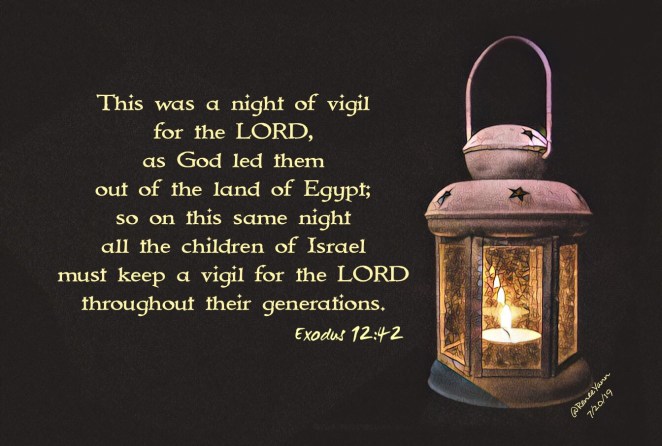
Ex12_42 Vigil

Even the youngest of us understands what it means to “keep vigil”. Toddlers, on Christmas Eve, keep vigil for the sound of Santa’s footsteps on the roof.

Throughout our lives, the kinds of vigils we keep deepen in meaning. Any given night holds an array of vigil-keepers:

  • A nervous student pulls an all-nighter before a big exam.
  • An anxious parent watches over a feverish child.
  • A faith-filled soul sits in pre-dawn prayer.
  • A vigilant elder prays quietly at the death bed of a long-beloved.

As families and communities, we wait together for each other’s lives.

  • Together, we expect the births of each generation’s babies.
  • We wait and hope for college acceptances and new jobs.
  • We wait for test results of all kinds.
  • We wait to listen to one another’s stories of success or disappointment.
  • We wait and prepare for the dawning of great feasts like Christmas and Easter

When we keep vigil, we live in expectation of something or someone coming to us. But there is another important aspect to every vigil.

As we wait, something is also happening within us.
In the deep quiet of our waiting, we are transformed.

Thomas Merton, monk of Gethsemane, was assigned to keep a particular type of vigil at the abbey. It was called “fire watch”, a night-long lookout to ensure that no fire erupted in the old wooden buildings as the other monks slept.  Merton writes about that watch at the end of his book The Sign of Jonas:

The fire watch is an examination of conscience in which your task as watchman suddenly appears in its true light:  a pretext devised by God to isolate you, and to search your soul with lamps and questions, in the heart of darkness.
“Fire Watch, July 4, 1952”

Today, as we pray with Israel’s Passover vigil, let us consider our own vigils – current or past. Beyond their apparent meaning, to what secret transformation might God be inviting us? What is happening deep in our soul as we watch far out to the horizon of our hope?

Music: Firewatch – Chris Remo

The Basket … The Women

Tuesday of the Fifteenth Week in Ordinary Time

July 15, 2019

Click here for readings

Today, in Mercy, little Moses is saved from the Pharaoh’s wrath against the Israelites. It is a theme we are familiar with, notably repeated in the New Testament when Herod orders the slaughter of the Holy Innocents. In that event Jesus, like Moses, is spared by clandestine human intervention.

Exodus2_3 basket

The interveners in Exodus are all women – Moses’ mother, sister, Pharaoh’s daughter, and maid. Each of them decides to practice what we, today, call “civil disobedience“ – to stand and act against an immoral government order. Each woman becomes an agent through whom God actualizes the promise of life and freedom. And their choices are interdependent. They need to be a community of holy resistance in order to succeed.

An apt symbol for this agency is the papyrus basket, fortified with bitumen and pitch, and set afloat in the very river where Pharaoh had ordered the babies to be drowned. The basket is reminiscent of Noah’s ark, that vessel which preserved the diversity of life for future generations.

Sadly, history often has repeated the drama in which soulless leaders set a policy to extinguish the innocent. Many perish in that savagery. But many also rise up to bravely weave a “basket” of solidarity and compassion for the persecuted. Even in our own time, we see this story unfolding on the borders of xenophobic nations, whose leaders are indifferent to shaping just and moral policies.

But God is always at work in the world to accomplish the Promise of Life for God’s Creatures. Often, as in the story of infant Moses, God is not named – but rather is  evident as a relentless, compassionate force in the courageous choices of caring human beings.

As we pray today, might we find ourselves somewhere in this story? How might this finding inspire us to be God’s agents for life in our own time?

Video Clip from “The Prince of Egypt” (Lyrics below)

Hush now, my baby. Be still love, don’t cry
Sleep as you’re rocked by the stream
Sleep and remember my last lullaby
So I’ll be with you when you dream
Drift on a river
That flows through my arms
Drift as I’m singing to you

I see you smiling
So peaceful and calm
And holding you, I’m smiling, too
Here in my arms
Safe from all harm
Holding you, I’m smiling, too

Hush now, my baby
Be still, love, don’t cry
Sleep like you’re rocked by the stream
Sleep and remember this river lullaby
So I’ll be with you when you dream
Here in my arms
Safe from all harm
Holding you, I’m smiling, too

Sleep and remember this river lullaby
And I’ll be with you when you dream
Sleep and remember this river lullaby
And I’ll be with you when you dream

Journey through Exodus

Memorial of Saint Bonaventure, Bishop and Doctor of the Church

July 15, 2019

Click here for readings

Today, in Mercy, we begin a three-week journey through the Book of Exodus. The word “journey” is used purposefully because the Book not only narrates a journey in history, it invites us to move with it into a deeper spiritual freedom within ourselves.

It also impresses me that these weeks of reading come to us during a time when the world witnesses oppressed peoples exiting their ravished homelands in search of a sustainable life. Our prayerful reading of these Exodus passages may bring us deeper understanding, compassion, and advocacy courage for these struggling sisters and brothers.

In today’s introduction to Exodus, the narrator provides a transition from the closing of Genesis to the new situation in Egypt. Many years have passed. Favored Joseph is long dead. A “new king”, never named perhaps from contempt of his evilness, “knows nothing” of Joseph. If we don’t care enough to “know” another, we can never care enough to respect and foster their life.

Ex1_10_oppress

This Pharaoh’s sole preoccupation is to preserve Egyptian dominance . He was a man driven by irrational fears. To allay those fears, he was willing to suppress the life of a people who had lived peacefully in Egypt for hundreds of years. 

The Pharaoh begins by objectifying the Israelites as potential enemies and terrorists.

He orders their containment and oppression, moving them to encampments. Ironically, these encampment cities had originally been built, at Joseph’s direction, to contain surplus grain before the famine so that Egypt would not starve!

Still, the Israelites thrive and grow. They are the children of God’s Promise. This growth further threatens Pharaoh, spinning him into more desperate and ineffective attempts to retain domination. His systemic oppression doesn’t work. His fears – and his projection of them on to the Egyptian populace – consume both him and his people.


As the oppressors dehumanize others and violate their rights, they themselves also become dehumanized. … Once a situation of violence and oppression has been established, it engenders an entire way of life and behavior for those caught up in it—oppressor and oppressed alike. Both are submerged in the situation, and both bear the marks of oppression.
PAULO FREIRE, Pedagogy of the Oppressed, pp. 43-44)


Today’s readings offer us so much to consider in terms of a culture of domination versus one of right relationship. These balances and imbalances occur in exchanges as small as a word between two people, or as large as a policy between two nations. The parallels to our current world are painfully obvious. There may be parallels in our personal relationships as well that we might place into the power of prayer.

May we have eyes to see, a heart to care, and the courage to act – both personally and globally.

Music:  Hymn to Our Alien God – Maryknoll Father’s and Brothers

(Background music is the hymn “Eternal Father, Strong to Save” by William Whiting

Be the Neighbor!

Fifteenth Sunday in Ordinary Time

July 14, 2019

Click here for readings

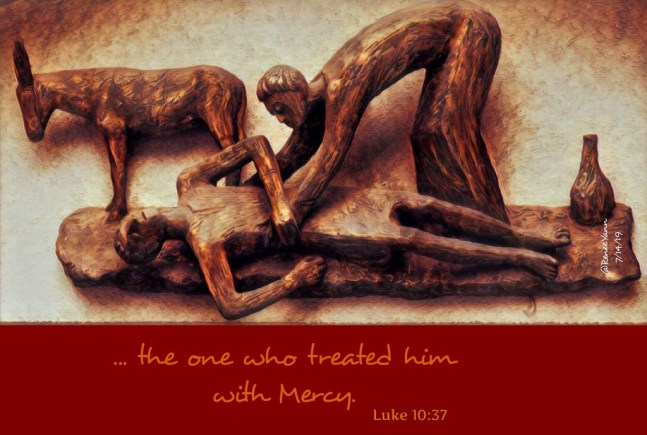
Today, in Mercy, dear friends, we have heard this Gospel from our youth. Even those without faith know the story.

Lk10_37 Samaritan

Let us deeply examine our daily lives today as we pray.

What more is there to say? This is what I hear in my prayer today:

Always be the neighbor.
Just do it.
This is Mercy.

do it1JPG

Music: I Will Love You, Lord! – Dale Sechrest

This wonderful mantra! Let yourself sing it!

That Family Reunion!

Friday of the Fourteenth Week in Ordinary Time

July 12, 2019

Click here for readings

Today, in Mercy, we read about a family reunion of biblical proportions!  After many years, Joseph – long-thought dead- is reunited with his grieving father, deceitful half-siblings, and beloved younger brother. Wow!

For better or worse, “Family” is a powerful force in every one of our lives. It both nurtures and siphons us; both exalts and critiques us; frees us and binds us.

Genesis46_30 family reunion

In many ways, family makes us who we are – by blood and genes – but more importantly by the hope and promise it places in us.  This was the case with Joseph, the great hope of his father Jacob and the misunderstood threat to his jealous brothers.

Today’s reading shows us a family who has made it through their devastating conflicts, not by their own effort, but by the abiding promise of God.

So many fractured families wish they could tell the same story of redeeming wholeness! What were the openings in this family’s brokenness that allowed God to enter and heal?

As so often in our human story, God comes dressed in ordinary clothes.  God wears the garments of our grief, repentance, forgiveness, hope and longing. He is disguised in our memories, cherished or painful. He peeks through our unresolved regrets, and dances in our acts of kindness, patience, and understanding.

We reach through to touch this God of Hope by our smallest mercy, our offered reconciling word, our tendered apology for a slight grown bigger with the years. And sometimes, we must simply let go of that which is unreconcilable, of those human hurts that can’t be healed because of time’s passage or unreachable hearts.

We let this God of Promise live in our families by honestly loving one another, supporting one another, thanking one another, and anticipating one another’s needs.

Being a strong family takes courage and sacrifice – something Joseph’s brothers were lucky to learn, however late. Let us pray in hope and thanksgiving for our own families – and for all families —  that God may give us that kind of self-sacrificing courage. Let us pray especially for young families, in today’s very inhospitable world, that they may grow strong in God’s and each other’s love.

Music: Family Prayer Song – The Promise Keepers

Oh, Brother!

Wednesday of the Fourteenth Week in Ordinary Time

July 10, 2019

Click here for readings

Today, in Mercy, our journey through Genesis leads us into the thick of the Joseph narrative. This is a long and intricate story, covering thirteen chapters in Genesis. The drama is rich in theological and psychological themes. Even outside the Bible, its scenes would stand the test of literary craftsmanship. Today’s reading offers us just one example.

Ford_Madox_Brown_-_The_Coat_of_Many_Colours_-_Google_Art_Project
Joseph’s Bloodstained Coat by Ford Maddox Brown

We enter the story a little later in the action. Joseph, the favored son of Jacob and thus hated by his jealous brothers, has been sold by them to a band of Midianite merchants. Ending up as a slave In Egypt, Joseph, by means of a series of dreams, saves the Egyptians from a terrible famine. He is greatly honored for this, becoming almost the equal of the grateful Pharaoh.

During the widespread famine, Joseph’s treacherous brothers come to Egypt seeking grain. He recognizes them although they are unaware of who he is. After leading them through a series of trials, Joseph ultimately forgives and reconciles with them. He brings his whole family to live in Egypt, protected by the aura of his unexpected prosperity.

One of the many suggestions for our prayer today might center on the inevitable dramas within families and communities fueled by favoritism, jealousy, even treachery. But reading Joseph’s story, we must consider these inevitabilities in the long-term light of God’s abiding grace, the power of forgiveness, and God’s will to give us new life even as we stand in our concupiscent ashes.

At times in our own life story, we may act as, or be impacted by, behaviors like those of doting Jacob, the envious brothers, or entitled Joseph. We might find ourselves entangled in a drama to rival this dysfunctional family of Jacob! Our prayer leads us to ask, “How were they ultimately delivered to freedom, restored to love?” 

The controlling, underlying theme of the Joseph narrative is that our hidden God remains with us in all of life’s roller coaster episodes. This God longs to grace us with the redemptive powers of repentance, forgiveness, hope, renewal and generosity. These graces can heal our bruised human story, letting it announce the saving power of God if we but open our hopes, choices, and dreams to it.

Music: Any Dream Will Do – from Joseph and the Amazing, Technicolor Dreamcoat, Andrew Lloyd Weber

Twisted Blessing

 Saturday of the Thirteenth Week in Ordinary Time

July 6, 2019

Click here for readings

Today, in Mercy, we move on to the next great Genesis drama – the story of Jacob and Esau.

Gen27_esau_Jacob

We remember the circumstances. Isaac, grown old and blind, wants to pass the inherited Promise to his firstborn and favorite son – swarthy, earthy Esau (a definite Robert Mitchum role😀) Rebekah, inclined to her son Jacob, helps him disguise himself as Esau to steal the birthright blessing.

Their deceptive success is one of the greatest Biblical examples of how God turns our lives upside down – imparting grace and blessing, even in the disguise of life’s adverse experiences. The story, ripe with Biblical theology and human psychology, is just plain fun to read. See which character you most sympathize with in the drama- and maybe ask yourself why!

But beyond the reading, we might pray with an awareness of God’s unexpected, even amazing, interventions in our own lives. We might ask for that steadfast faith which reveres all circumstances as an unfolding dialogue with this Giver of Grace. As we consider Jacob’s call and promise, we might thank God for our own Baptismal call, and renew our own promise of enduring faith.

Music: Hymn of Promise – Debra Nesgoda

The 5th of July!

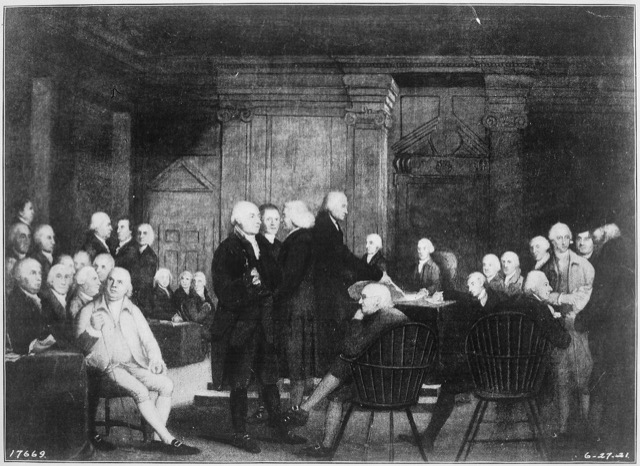
After all the speeches, sparklers and spectaculars, the “Next Day” dawns. I wonder what it was like for Jefferson, Franklin and Adams on the fifth of July in 1776. Did they wake up thinking, “Declaration of Independence – signed. Now, make it happen!”?

congress

When you get right down to it, most of our days are 5th, 6th, 7th and 8ths of July. They are the days after graduation when we need to get a job. They are the days after the honeymoon when somebody needs to cook dinner and take out the trash. They are the days after the promotion when the first deadline looms and a bunch of faces are looking to you for the plan.

If the 4th of July is Independence Day, the 5th is Dependability Day, a day to celebrate the people we can always count on. They are there for the parades but they are there for the clean up afterward. They light the spark for the fireworks, but they have a hose nearby just in case. They put their “John Hancock” on the brave new dream and they show up the next morning to design its daunting execution.

WIP

The 5th of July is a day to celebrate our own sense of responsibility or “Dependability” – to realize that most of us really do try to be good spouses, parents, employees, neighbors, sons, daughters and friends – that we do keep making the effort every day to be someone for others and not just for ourselves. It is a day to look around at the people in our lives and be grateful that most of them are trying to do the same thing.

Like Jefferson, Franklin and Adams, we all need to wake up the next day, consider the “dependabilities” in our lives and put our shoulders to the task of making a better world. Each of our lives is its own small country where the future really depends on how we show up on our “5th of Julys”. The fact that you get up every day and engage that challenge is cause for its own celebration. So if you have a little sparkler left in your back yard, light it for yourself tonight – and for your spouse, your boss, your kids, your co-workers – who all showed up today to do the best they could on the 5th of July.

Thanks for that and have a great day!

Music: A Morning After – Maureen McGovern

The Flag

Independence Day

July 4, 2019

Suggested Reading for the Day

Today, in Mercy, I offer this opinion piece.


flag

In some ways, it’s hard to be an American today. We live in a country confused about its identity, a country enmeshed in questions about “who we really are” – about both the good and the evil we are capable of. Those questions, on days like July 4th, get all tangled up in symbols like our beautiful flag.

I don’t have the answers but, as usual, I have an opinion. I think we all do. And I’ll share mine for those who might want to read it.

Our flag, cobbled together on a narrow Philadelphia street, has run with the Massachusetts 54th up the Fort Wagner rampart, and has been hoisted on a bloody hill in Iwo Jima. It has been raised over singing, saluting schoolchildren, and wrapped around the caskets of our heroes. It has wafted from the shoulders of Olympians, and stretched – supersized -across our nation’s stadiums.

Woven into its stately stripes is our desire for human freedom, strength, pride, happiness, and peace. For me, our flag stands for this ideal and thus I will always respect and value it.

What I will not salute is the hijacking of our beloved symbol to stand for militarism, white nationalism, religious extremism, isolationism, imperialism, or racial and ethnic exceptionalism. These poisonous misappropriations have so clouded our flag that we struggle to retain the purity of its original call to us:

We hold these truths to be self-evident, that all men are created equal, that they are endowed by their Creator with certain unalienable Rights, that among these are Life, Liberty and the pursuit of Happiness.

The men who wrote these lofty words didn’t fully comprehend or achieve their reach. They ignored whole segments of people – women, people of color, Native Americans – who should have been immediately embraced within the nascent ideal.

And now, after centuries, we still struggle to secure the full promise of these words for all people. In many ways we have even regressed in our efforts, retreating to the deadly “isms” mentioned above.

Whenever an ideology is used to suppress and control the legitimate freedoms of others, a malignant force is unleashed. And when that force conceals itself with our flag, we all suffer.

I believe that’s why Americans like Colin Kaepernick and Megan Rapinoe protest the flag as they do. They are protesting the poisons poured into our flag  by these toxic ideologies. Rather than immortalizing or demonizing such protesters, we would do well to listen to them, discerning the truth they attempt to reveal to us.

But, as we face these challenges, let us not blame the flag. Let us blame ourselves and, in that honesty, resolve to go forward in the strength of our common humanity.

Today, let the flag do what it was intended to do. Let it call us to a determined commitment to freedom and mutual responsibility for one another’s well-being. Let the flag make us brave to face where we have failed one another – often grievously- in this pursuit. But let it also make us confident that the courage it has drawn from us over centuries will strengthen us as a just, compassionate, inclusive, free and strong nation.

Music: The Star-Spangled Banner- sung by The Voices of Gwynedd; arranged and conducted by Musical Director Carol Evans.

Fount of Love and Mercy

Solemnity of Most Sacred Heart of Jesus 

Friday, June 28, 2019

Clcik here for readings

Today, in Mercy, we celebrate the feast of the Sacred Heart, a day of deep devotion and gratitude for God’s lavish mercy to us.

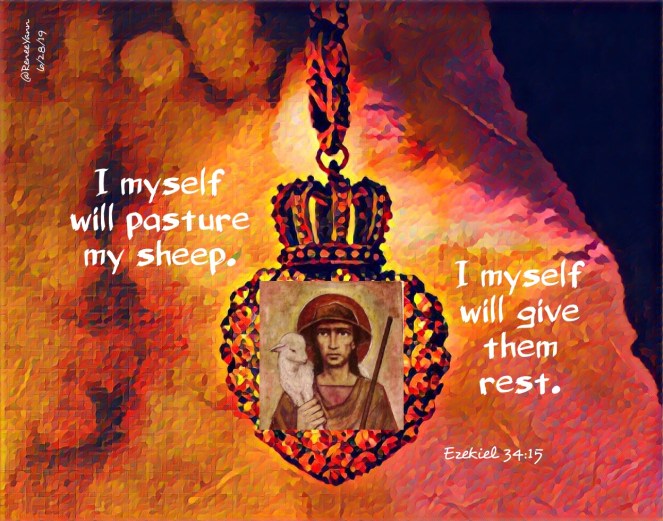
All of our readings today suggest the image of a good shepherd caring for his sheep. This metaphor, perhaps more meaningful for the agrarian society in which these scriptures were written, still retains for us the imagery of tenderness, attentive responsibility, strength, protection, and vigilant presence.

Ez34_15 shepherd

Our first reading comes from Ezekiel whose ministry occurred in Babylon during the second captivity there. God calls Ezekiel to prophesy against Israel’s leaders who have forgotten their defenseless sheep, who have fed themselves instead of their flock. Today’s particular verses have God speaking, taking over the shepherding duties, because the human “shepherds” (kings and priests) have so badly failed their sheep. 

The Lord makes clear who will be the beneficiaries of his tenderness:

The lost I will seek out,
the strayed I will bring back,
the injured I will bind up,
the sick I will heal,
but the sleek and the strong I will destroy,
shepherding them rightly.

As I prayed with this passage, I was struck by the awareness of how some things never change. The parallels to our Church and society are painfully evident. Immorally self-indulgent “pastors” and self-serving, indifferent leaders still plague their “flocks”. The poor and weak are still abandoned by those they had depended on.

Our reading from Romans and Matthew raise before us the model of Jesus Christ, the Good Shepherd who both renders us infinite compassion, and teaches us how to dispense it as his disciples. We are invited to become one with the sacred, compassionate Heart of Jesus, being healed ourselves to become healers.

Take my yoke upon you, says the Lord,
and learn from me,
for I am meek and humble of heart.

Our world aches for this healing. Let us pray together today for God to inspire and energize us to be Mercy for our world.

Music: Sweet Heart of Jesus – sung by the Irish soprano Maureen Hegarty

(I know this hymn is tinged with a bit of the old, sentimental spirituality. Still, I have loved it from my long-ago youth and it touches me deeply. I hope it will touch you as well.❤️ Lyrics below.)

Sweet Heart of Jesus!
Fount of love and mercy,
Today we come,
thy blessings to implore;
Oh touch our hearts, so
cold and so ungrateful,
And make them Lord,
Thine own for evermore.

Sweet Heart of Jesus!
We implore
Oh, make us love Thee
more and more.

Sweet Heart of Jesus!
Make us know and love thee.
Unfold to us
the treasures of thy grace.
That so our hearts, from
things of earth uplifted,
May long alone
to gaze upon Thy face.