Today, in Mercy, we begin several weeks of readings from the Book of Genesis.
Some people think of Genesis as a literal history. Others think of it more as a myth. Was there a real Adam and Eve? A real apple? A real snake?
When we get caught up in these ambivalences about Genesis, we are likely to miss the whole point. And the whole point, according to Hebrew Scripture scholar Walter Brueggemann is this:
… these texts should be taken neither as history nor as myth.
Rather, we insist that the text is a proclamation
of God’s decisive dealings with his creation.
“God’s decisive dealings with God’s Creation…”
What a powerful phrase! So over the next few weeks, here is our opportunity:
How does God want to be with us, to love us, and to share the ongoing Creation with us?
Today’s reading, according to Brueggemann, is the second part of a four-part drama:
Genesis 11: 30—25: 18 “The Embraced Call of God” Will Abraham live by faith?
This second segment poses a profound question to us, and to our Church:
Have we embraced God’s call in our lives and will we live our faith OUT LOUD!
Jesus asks us the same question in today’s Gospel: Will we live our faith OUT LOUD?
Will we: “Do to others whatever you would have them do to you.”
How to help children at the border and in inhuman detention centers:
Today, in Mercy, we celebrate a glorious feast, one through which we can trace the continuing evolution of Eucharistic theology.
Some of us will remember celebrating the Feast of Corpus Christi, perhaps as children. The Host, carried in a beautiful monstrance, was processed through the neighborhood, bringing blessing to all who gathered.
Where did they get all those men!!!!
While a rare occurrence today, and considered by some a saccharine expression of devotionalism, the practice was intended to convey a central belief of our faith. It is a belief whose theology continues to evolve and deepen with the passing years:
In the gift of Eucharist, Jesus Christ has made us
one Body with Him. We are One Body in Christ.
A significant step in the evolution of this theology occured with the issuing of the encyclical MYSTICI CORPORIS CHRISTI ( Pope Pius XII, 1943). In this letter, we see a theology beginning to unfold to include not only Christ’s presence on the altar and in the Host, but in the very lives of the faithful.
The Sacrament of the Eucharist is itself a striking and wonderful figure of the unity of the Church, if we consider how in the bread to be consecrated many grains go to form one whole,and that in it the very Author of supernatural grace is given to us, so that through Him we may receive the spirit of charity in which we are bidden to live now no longer our own life but the life of Christ, and to love the Redeemer Himself in all the members of His social Body.
In his encyclical, ECCLESIA DE EUCHARISTIA (2003), Pope John Paul II, expands this teaching:
By the gift of the Holy Spirit at Pentecost the Church was born and set out upon the pathways of the world, yet a decisive moment in her taking shape was certainly the institution of the Eucharist in the Upper Room. Her foundation and wellspring is the whole Triduum paschale, but this is as it were gathered up, foreshadowed and “concentrated’ for ever in the gift of the Eucharist. In this gift Jesus Christ entrusted to his Church the perennial making present of the paschal mystery. With it he brought about a mysterious “oneness in time” between that Triduum and the passage of the centuries.
The infinite mystery of God’s relationship with us in Jesus Christ continues to call us to deeper understanding of our relationship with one another. Let us pray today for greater love and fuller surrender of our hearts to this awesome, self-emptying mystery.
At the heart of the Christian faith shines an open table without exclusion, where Christ is the chef, the host, and the food of life. The broken bread and the pouring wine manifests the Divine attitude to welcome especially the ones who are brokenhearted, neglected, rejected and crushed. And we are transformed into the body and blood of boundless and creative love, incorporated into the same divine DNA as everyone else – regardless of species, ethnicity, religion, gender, nationality, appearance, or social class. (Ivan Nicolleto)
Today, in Mercy,Jesus addresses the confounding problem of spiritual schizophrenia.
No one can serve two masters. He will either hate one and love the other, or be devoted to one and despise the other. You cannot serve God and mammon.
Mammon (μαμωνᾷ), a concept that is rather simplistically translated as “money”, actually connotes a much more complex meaning. Strong’s Concordance of the Bible offers related words that help enrich our understanding of the word “mammon”:
Excess
Dis-ease
Unrighteousness
Imbalance
This is the dissonance Jesus speaks to in today’s Gospel. “Money”, or possessions, – like good wine – in excess can dehumanize us. We can become entangled, addicted and covetous of it. We can forget who we truly are when we allow ourselves to drown in it. We can lose connection to the community in which we exist.
But we need “money”, don’t we? Very few people desire real material poverty. How does Jesus guide us to face this internal dichotomy?
Jesus says that our FIRST concern must be the Kingdom of God. Motivated by that core intention, the rest of our concerns will fall into proper place.Pope Francis reiterates this truth for our times in the encyclical “Laudato Sì”. Let’s pray with it today:
Christian spirituality proposes an alternative understanding of the quality of life, and encourages a prophetic and contemplative lifestyle, one capable of deep enjoyment free of the obsession with consumption. We need to take up an ancient lesson, found in different religious traditions and also in the Bible. It is the conviction that “less is more”. A constant flood of new consumer goods can baffle the heart and prevent us from cherishing each thing and each moment. To be serenely present to each reality, however small it may be, opens us to much greater horizons of understanding and personal fulfilment. Christian spirituality proposes a growth marked by moderation and the capacity to be happy with little. It is a return to that simplicity which allows us to stop and appreciate the small things, to be grateful for the opportunities which life affords us, to be spiritually detached from what we possess, and not to succumb to sadness for what we lack. This implies avoiding the dynamic of dominion and the mere accumulation of pleasures. (223)
Today, in Mercy, we continue to read from Paul’s ardent letter to the Corinthians.
Second Corinthians gives us Paul, preaching at his passionate height. Paul loves the Corinthian community. I think the city’s personality was a good bit like his own.
A dynamic cosmopolitan center, Corinth is situated on the southern side of an isthmus between two gulfs. This geography predisposed the site to become an active shipping center, highly populated with merchants and travelers from all over the known world.
An informative article on preachingsource.com quotes Leon Morris, noted New Testament scholar, in describing the city as “intellectually alert, materially prosperous, and morally corrupt.”
This population would present just the kind of challenge to motivate Paul. His intellectual acuity, familiarity with prosperity, and repented moral challenges made him the perfect evangelist for this morally hungry community.
And he is highly successful in giving them the Gospel.
It is after he departs to continue the mission elsewhere that problems arise. New preachers come behind him, distorting the core message of the Cross and Resurrection. In today’s letter, Paul begs his beloved community not too be wooed by this diluted preaching.
Today’s Church is not immune from such dilution. Some preachers bend the Holy Word to fit their own agendas. We have, for example, the errancy of the “prosperity gospel”, the divisiveness of strident tradionalism, and the distortions of a flawed fundamentalism which equates faith with nationalism, ethnic supremacy, and economic domination.
When Paul speaks of loving the Corinthian community with the “jealousy” of God, he fore-echoes Pope Francis in his first Apostolic Exhortation, “Evangelii Gaudium”, (The Joy of the Gospel). Here are a few compelling excerpts for our prayer today as we consider what the Gospel means to us:
“The Gospel, radiant with the glory of Christ’s cross, constantly invites us to rejoice.”
“Before all else, the Gospel invites us to respond to the God of love who saves us, to see God in others and to go forth from ourselves to seek the good of others.”
“On the lips of the catechist the first proclamation must ring out over and over: ‘Jesus Christ loves you; he gave his life to save you; and now he is living at your side every day to enlighten, strengthen and free you.’”
Today, in Mercy, both Jesus and Paul teach us about the true meaning of charity and community.
Throughout his journey among the Gentile Christians, Paul conducts a collection for the poor of the Jerusalem Church.
Galatians 2:9-10
James, Cephas, and John, those esteemed as pillars, gave me and Barnabas the right hand of fellowship when they recognized the grace given to me. They agreed that we should go to the Gentiles, and they to the circumcised. All they asked was that we should continue to remember the poor, the very thing I had been eager to do all along.
Romans 15:25-26
Now, however, I am on my way to Jerusalem in the service of the Lord’s people there. For Macedonia and Achaia were pleased to make a contribution for the poor among the Lord’s people in Jerusalem.
In today’s passage, Paul encourages the Corinthians to contribute by holding up to them the generosity of the churches of Macedonia. Great strategy, eh?
In our Gospel, Jesus shows how deep our generosity, hospitality, mercy, forgiveness,and love should be: boundless. He gives such a reasonable argument:
For if you love those who love you,
what recompense will you have? Do not the tax collectors do the same?
Jesus tells us that we must far exceed the tax collectors, that we must be “perfect as our Heavenly Father is perfect” – perfected, whole, and completed by Mercy and Love.
For Paul, this meant embracing both the Jewish and Gentile Christians as one community.
For Jesus, it means loving all Creation as God Loves.
Beloved friends, what does it mean for us?
Music: In Perfect Charity – Randall deBruyn (Lyrics below)
Verse 1
O most high and glorious God, Cast your light into the darkness of my heart. Give me right faith, and certain hope, And perfect, perfect charity. Give me true insight, Lord, and wisdom, That I may always live within your ever holy will, Lord may your light within me burn, Shining out in perfect charity.
Verse 2
O most high and glorious God, Open wide the door that leads me to your love. Give me your firm, yet gentle strength; May I live that perfect charity. Lord, may your peace be ever in me, That I may always seek to serve your children here on earth; That I may find my home in you, And live in perfect charity.
Verse 3
Then most high and thankful praise I will sing unto the glory of your name: To Father, Son, and Spirit bright, Living Presence, Perfect Charity. Praise to the Love that shines in splendour, That lights the pathways of my heart, And brings me close to you. O Holy One, Invite me in, where you live in perfect charity.
Today, in Mercy, we celebrate the feast of the Blessed Trinity, a mystery of our faith beyond full human comprehension. Clearly realizing this, John Wesley, founder of the Methodist religion said this:
Bring me a worm that can comprehend a man, and then I will show you a man that can comprehend the Triune God.
Still, as we pray, we have some limited conceptualization of this Divine Mystery. We reshape it into human terms we can relate to:
Father, Son, Spirit Creator, Redeemer, Sanctifier
These give us some insight into the heart of the Triune God, but only from the limits of our human perspective. It is a mystery so infinite that even in heaven we may not plumb its depths.
Many theologians and philosophers have tried to stretch our perspectives. The great Swiss Catholic theologian Hans Urs von Balthasar writes:
The One, the Good, the True, and the Beautiful, these are
what we call the transcendental attributes of Being,
because they surpass all the limits of essences
and are coextensive with Being.
It may be helpful in our prayer to think of the Trinity in these terms- The Good, The True, and the Beautiful. These concepts, while we can experience them clearly in an individual or an object, far surpass that one particular presence or circumstance.
So it is with the nature of the Trinity. We perceive it simply in glimpses. Though Its totality far surpasses our comprehension, perhaps these glimpses are enough:
C.S. Lewis puts it this way:
Any patch of sunlight in a wood will show you something about the sun
which you could never get from reading books on astronomy.
These pure and spontaneous pleasures are ‘patches of Godlight’
in the woods of our experience.
What does all this mean in our daily spirituality? How can we find a Trinitarian spirituality in our daily encounter with God? How can we find the “patches of Godlight”?
Pope Francis brings it down to our experience of family:
All of the love that God has in Himself,
all the beauty that God has in Himself,
all the truth that God has in Himself,
He gives to the family.
So, in the sincere love – given and received – of a family or community, we find the reflection of this immense mystery.
And St. Catherine of Siena confidently prays about this truth in this way:
You, Eternal Trinity, are my Creator,
and I am the work of Your hands,
and I know through the new creation
which You have given me in the blood of Your Son,
that You are enamored of the beauty of Your workmanship.
Music: Amazing Love – Billy Martin, Peggy Dequesnel, Steve Hall
Today, in Mercy, ah — here we are, back in Ordinary Time. Our journey through Lent and Eastertide has been completed and we now return to the “dailyness” of our spiritual lives and Liturgical Year. Really?
For the next two weeks, we will learn from 2 Corinthians. And from now, throughout the summer (or winter, depending on your hemisphere), we will listen to Matthew’s account of the life Christ. ( Some of you may want to pick up a good commentary on Matthew’s Gospel. My longtime favorite was The Gospel of Matthew by Daniel J. Harrington, SJ. It is out of print now but some good passages are available for free from Google booksby clicking here.)
What we find in 2 Corinthians is Paul – when the rubber meets the road. Some of the first enthusiasm after the Resurrection has worn thin. The hard work of preaching the Gospel has spun strains of exhaustion in Paul. The very important Corinthian community proves difficult and resistant. Paul has already tried to deal with this dissonance in 1 Corinthians. But now, he has to raise some issues again.
In 2 Corinthians, we see a community hanging on to old definitions of godliness. Paul does not condemn the old, rather he challenges his people to fully put on the New Christ – the Christ of Mercy, Forgiveness, Calvary and Resurrected Hope. It’s a lofty challenge, particularly when one’s feet are stuck in the mud of “ordinary time” and old comforts.
In our Gospel, Jesus preaches the same message. He tells his followers that he has not come to abolish the Law, but to perfect it in the Spirit.
For some of us, it is a lot more comforting to hang on to the tried and the true, the words “written in stone”. But the Spirit of God will never be confined to stone.
The Spirit is always free, astonishing and alive. In the inspiration of these passages, let us ask God what new Pentecostal courage and hope God asks of us. It may be as small as a personal act of forgiveness, or as large as a Church welcoming previously alienated individuals and communities.
How can we announce God’s merciful heart for all people by the gracious exercise of our “ordinary” time?
Music: perhaps, if Paul were preaching today, this is the way he would speak to the Corinthians (Apologies to English teachers🧐)
Today, in Mercy, we celebrate the feast of St. Barnabas, “a good man”. Reading about his call in Acts, that phrase struck me.
“Barnabas … was a good man, filled with the Holy Spirit and faith.”
Some of you classic jazz/blues fans may remember an old classic by Bessie Smith, “A Good Man Is Hard to Find.”
That’s a pretty sad song, but apparently it does not reflect the experience of the early disciples. They found several good men in Acts 11:
Now there were in the Church at Antioch prophets and teachers: Barnabas, Symeon who was called Niger, Lucius of Cyrene, Manaen who was a close friend of Herod the tetrarch, and Saul.
What makes someone a “good man (or woman)? I can remember my Dad, a good man himself, using that phrase on occasion about someone he knew. It was a rare benediction – only someone of exceptional character earned it from my Dad.
All of Dad’s designees had these things in common: humble, hard-working, honest, generous, simple and respectful people. They had shown up for life, with a loyalty to those around them. They were God-loving, salt-of-the-earth fellas who would be shocked to think they were special. Barnabas was such a guy.
Jesus loved this kind of soul too. In our Gospel he says
“You are the salt of the earth. You are the light of the world… Just so, your light must shine before others, that they may see your good deeds and glorify your heavenly Father.”
…or, in Godspell terms:
As we pray these Scripture passages today, let us be inspired by Barnabas to hear Jesus speaking these words to us – because we are good men and good women.
Music: People Let Your Light Shine – Jesse Colin Young
Today, in Mercy, Jesus asks the quintessential question of Peter, “Do you love me more than these?”
The setting is by the morning-dappled sea. Jesus has just cooked his disciples breakfast. Ordinary enough, right?
What is extraordinary is that Jesus has already died, risen from the dead, and is sitting with his buddies once again by their old fishing boats!
In other words, these disciples now know clearly what the love of God means. They have seen, firsthand, what that kind of love does to a life! Mercy, Passion, Death and Resurrection lived out in everyday human experiences.
So Jesus’s question to Peter might really be asking:
After all you’ve seen,
after all is said and done,
do you have the “more”
that it will take to follow me?
Our spiritual life is all about growing to the “more” that will let us live and love in God.
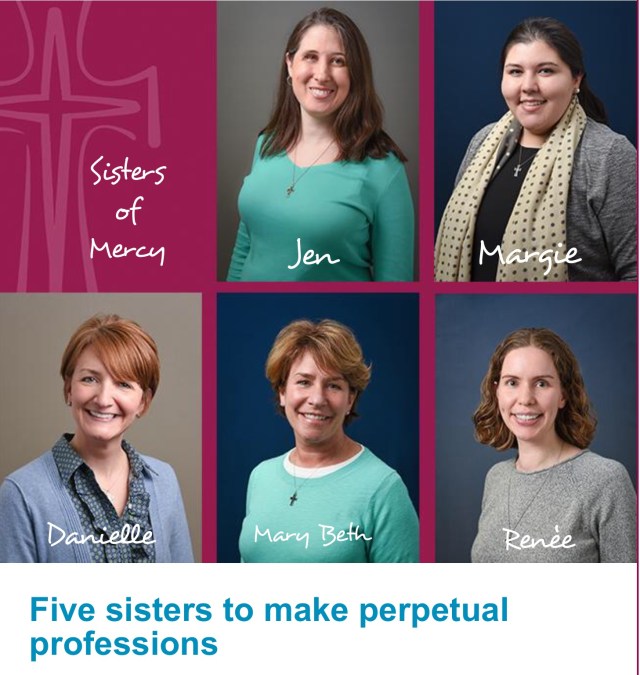
This Saturday, in our Merion chapel, four young women make their perpetual profession of vows as Sisters of Mercy. On July 13th, a fifth woman will make her final profession in the Mid-West Community.
We rejoice that these women have chosen to find their “more” as Sisters of Mercy. Will you join us in prayers of thanksgiving and benediction for them as they take this sacred step?
Let us too have the courage, as we pray today, to listen to Jesus ask us about our love. Let us answer sincerely, and ask for all we need to give the “more” in whatever way God asks of us.
Music: Love Like Jesus – Pawn Shop Kings (This one will wake you up!😀)
Today in Mercy, we experience both Paul and Jesus praying for their followers. They each use similar words.
Paul: And now I commend you to God and to that gracious word of his that can build you up and give you the inheritance among all who are consecrated.
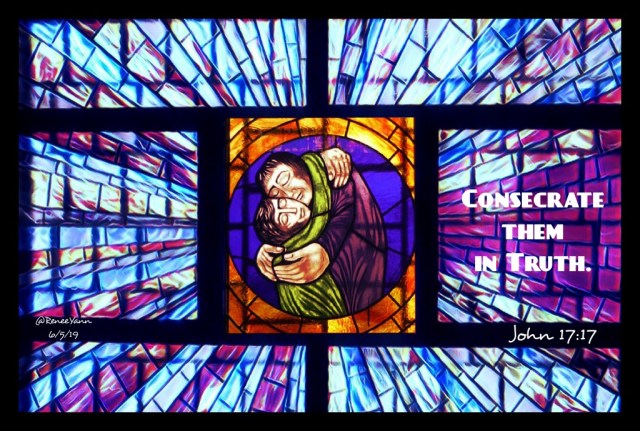
Jesus: Consecrate them in the truth. Your word is truth. As you sent me into the world, so I sent them into the world. And I consecrate myself for them, so that they also may be consecrated in truth.
Do you pray for others? To protect those you love? To change those who are bound in Spirit? To alleviate those who suffer? To awaken those that are caught in the vortex of selfishness or self-destruction? To increase the blessings of the generous?
Perhaps the greatest prayer we can offer for another is one like that of Paul and Jesus – a plea for the other to stand Blessed in the Truth of who they are in God — CONSECRATED by their Creaturehood, their Baptism, their faith, and their infinite power for Life in the Holy Spirit.
Today, we might pray like this for our Beloveds, and for those we might like to love better; for those who are unloved, and those unaware of how much they are loved.





 Lavish Mercy