… the children, for God’s sake

Friday, December 28, 2018

Feast of the Holy Innocents
Click here for readings

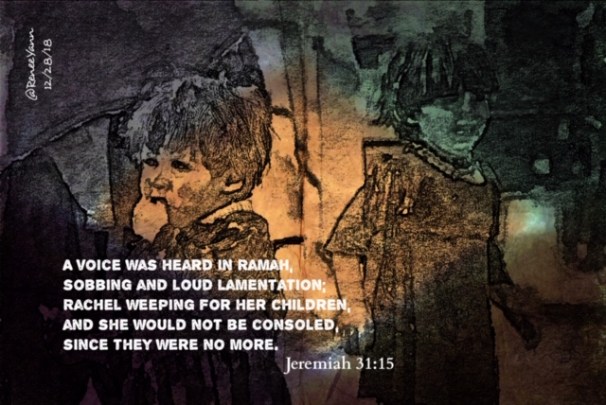
Jer 31_15 Ramah

Today, in Mercy, we are lifted to Light by John’s sacred words in our first reading:

Beloved:
This is the message that we have heard from Jesus Christ
and proclaim to you:
God is light, and in him there is no darkness at all.

Simply hearing it, we long to abide in that whole and healing Light.

But then we read our Gospel, among the saddest accounts in all of Scripture – the slaughter of the Holy Innocents. Their needless deaths come at the hands of a power-crazed and fearful man.  So hungry for his own aggrandizement, he tries to assure it by killing a generation of children.

It sounds impossible, doesn’t it, that anyone could be so hardened by evil? It sounds impossible that good people would execute this order of a mad man! It sounds impossible that human beings could be so blind to the sanctity of another’s life!

Dear friends, we must confront our own blindness. We must look into the eyes of our 21st century children – the border children, the children of Yemen, Syria, … the children of war, violence, drugs and poverty.

We must hear the cry of God, their Mother, and choose legislators and leaders who will honor life; who will shape global policies and relationships recognizing the common life we share in God – who will make true pro-life choices regarding gun control, arms sales, and an economy of endless war.

Our attitudes, our advocacy and our votes will either condemn or exonerate us when that Great Light ultimately reveals our hearts. When a society’s children become the victims of its indefensible corruption, we must say “Enough!”

Music: The Mediaeval Baebes – Coventry Carol

The “Coventry Carol” is an English Christmas Carol dating from the 16th century. The carol was traditionally performed in Coventry, England as part of a mystery play called “The Pageant of the Shearmen and Tailors”. The play depicts the Christmas story from chapter two in the Matthew’s Gospel. The carol itself refers to the massacre of the Holy Innocents in which Herod ordered all male infants under the age of two in Bethlehem to be killed, and takes the form of a lullaby sung by mothers of the doomed children.(Information from Wikipedia)

Seek Ye Comfort

Tuesday,  December 11, 2018

Click here for readings

Is 40_1 comfort ye

Today, in Mercy, we once again hear that powerful passage from Isaiah, “Comfort Ye, My People”.

Our Gospel gives us the gentle parable of the Good Shepherd who finds and comforts  his lost sheep.

As we listen to today’s tender music, let us slowly name in our prayer those who most need God’s comfort.

We may pray for ourselves, for someone we love, for those we know by name, or for those dear to God though nameless to us – all who suffer throughout the world.

Music: Comfort My People -Created by: Michelle Sherliza, OP; Music by: Monica Brown

No More War

Friday, December 7, 2018

Click here for readings

Dec 7 _2

Today, in Mercy, we pray for the gift of hope for ourselves, and for all who desperately need it today. Hope is the steely confidence that no matter how dire our condition, God abides with us and is lifting us toward Light. Hoping, unlike wishing, changes us not our circumstances. That is its magic, its power and its mystery.

Some will remember December 7, 1941. Some will still feel its imprint on their families although they were born years later.

No doubt, every American adult will have some sense of the enormity of war, whether it be WWII, Vietnam, Iraq, Afghanistan or all the other endless operations of war.

Let us pray together today for an end to war, and to all the immoral pursuits that lead to it. Even though it is difficult, let us hope and believe that humankind,  through the grace of God, is capable of more.

Music:  Where Have All the Flowers Gone – by the great Pete Seeger, prolific folk song writer and political activist.  On this recording, Pete is an old man singing with his grandson.

Prince of Peace

Tuesday, December 4, 2018

Readings: Click here for readings

Today, in Mercy,  majestic Isaiah bursts out, full-throated, in proclamation! 

Is 11_not by appear copy

Messianic Psalm 72 picks up his jubilant strain.

Justice shall flourish in his time,
and fullness of peace for ever.

And in our Gospel, Jesus affirms that the childlike will share the jubilation.

What a joy to hear these hope-filled readings once again!

We look forward with avid anticipation to  the redemption of all Creation in Christ.  We long for the One born in the Spirit of the Lord who will lead us with wisdom and understanding.

As Handel intones in today’s musical selection, “The government shall be upon his shoulders …” – that realm of peace, love, mutual respect and appreciation that will allow even the rival animals to lie down beside one another in security.

Today, let us pray with Jesus as he speaks with his Father in our Gospel: “I give you praise, Father, Lord of heaven and earth…” 

… and I ask you to bless our world with a foretaste of the peace you have promised. Let us see one another as sister and brother, not as enemy, foreigner, or rival. Let us put away the words of alienation, stereotyping and hatred. Let us all become your children once again.

Music:  For Unto Us A Child Is Word – Handel’s Messiah

Stand Up

Thursday, November 29, 2018

Click here for readings

human circle

Today in Mercy, our readings from Revelation and Luke are truly terrible, in the full meaning of that word: extremely distressing, causing terror.  They’re intended to be.

They describe and warn against times of destruction. Revelation describes the fall of Babylon. The Gospel relates the destruction of Jerusalem.

But neither reading is history. They are not offered so that we get the facts, the way a newspaper or encyclopedia reports a story.

These readings are given to us, and to the audiences they were originally written for, so that we might understand clearly this important reality: we live in two worlds, the material and the spiritual.

These worlds are intended by God to be united in one Creation, joined at the wedding feast of the Lamb. But we humans fail. We exalt and distort the power of the material world to the destruction of the spiritual. We split what God intended to be whole.

In other words, we build both global and personal kingdoms and governments that have no heart, have no soul.

If you think these readings describe only past civilizations, then look to the Mexican-US border. Look at the starving people of Yemen. Look at the devastation of the rainforest. Look at our drug-infested, gun-enthralled culture.

Jesus knew that his followers would battle these forces forever. He tells us that, in the midst of these destructive signs, we should

“ … stand erect and raise your heads
because your redemption is at hand.”

Jesus’s followers must stand as a sign of another way. We must raise our heads to say “No” to the heartless moral choices of our time. We cannot allow ourselves to be swept up in a culture of lies, political expediency, material greed, and dehumanization of whole peoples. We must break through the cabled propaganda we are fed to find God’s Word to us.

Our readings today ask us to take a good look at ourselves. How complicit are we in our own destruction by our failure to choose, speak, and act for Gospel justice in our world?

Music: No Outsiders – Rend Collective

Bread and Roses

Saturday, November 17, 2018

Readings: Click here for readings

Eliz_bread

Today, in Mercy, we celebrate the Memorial of St. Elizabeth of Hungary.  Elizabeth, a princess in Hungary, was married at the age of fourteen to Louis IV of Thuringia, a German state. Both rulers were kind and saintly. 

Elizabeth used her considerable royal resources to help the poor and hungry. She met them outside the walls of the palace, even building a small hospital there to care for the sick among them. 

But there was some controversy within the castle, questioning her charity as a depletion of the governmental treasures. 

Eliz windowJPG

Once, on a charitable journey, Elizabeth met her husband traveling with a band of such questioners. She carried baskets of bread to the poor, covered with her traveling cloaks. They demanded she reveal her cargo at which the bread is said to have been miraculously transformed into roses.

(St Elizabeth of Hungary with her crown and apron full of flowers. Blois château, France. One of a series of female saints in the Oratory (once the queen’s private chapel). Designed by Michel Dumas in 1858, the windows were painted by Claude Lavergne in 1859.)

As indicated by Pope Benedict XVI, Elizabeth is part of that long line of holy ones, whose relationship with Jesus moved them to justice and mercy for all people.

Praying with Elizabeth today, asking for insight on how to be loving and charitable in today’s world, one might consider this:

  • What would it be like to greet our border refugees with baskets of bread rather than barbed wire?
  • What would it be like if we built rose hedges rather than walls?

The caravan of refugees seeking asylum at our border mirrors many similar marchers throughout history, searching for a measure of equality and a livable life.

The music for today, aptly titled “Bread and Roses”, originated in the early 1900s, as women marched for improved working conditions and the right to vote.

Music: Bread and Roses

Lady

Friday, November 16, 2018

Readings: http://www.usccb.org/bible/readings/111618.cfm

Today, in Mercy, our first reading is from John’s very brief second epistle.

This is a fascinating passage. It is addressed to “Kyria”, Greek for “Lady”. The contents encourage this revered lady to keep herself and her household true to Christ.

Reading the passage, one wonders who “Kyria” is. At least three theories exist among scholars:

  • an actual religious leader 
  • a metaphor for the Church 
  • Mary, Mother of Jesus

The letter is beautifully personal in tone, so I like to think that Kyria was, indeed, an influential church leader and John’s beloved friend. So often, the names of early Christian women leaders are lost to history. Whether they were omitted in the original texts, or erased by subsequent misogynistic translators, we can only surmise. But the absence has served to support the misperception that women are of lesser consequence in the Church.

As we read 2 John, we can be aware of the major themes he entrusted to dear “Kyria”, whoever she might have been, to be transmitted to her household:

  • Truth is expressed through love, modeled to us in Jesus.
  • Obedience to God is expressed through service in His name.
  • Guard against any who distract you from these teachings.

Music: Kyria (Lady) is the feminine form of Kyrie , as in “Kyrie eleison” (Lord, have mercy).

So the music I thought of for today is the magnificent Kyrie Eleison from Charles Gounod’s Mass for St. Cecilia.

Peel the Onion

Thursday, November 15, 2018

 Click here for readings

Today, in Mercy, Jesus tells us a secret:

“The coming of the Kingdom of God cannot be observed,
and no one will announce, ‘Look, here it is,’ or, ‘There it is.’
For behold, the Kingdom of God is among you.”

And it remains a bit of a secret, even after He tells it, because it is often very hard to discern the “Kingdom among us”. There is nothing more invisible than something hiding in plain sight.

Lk17_21JPG

Through prayer, we discover that it is about our eyes – not visibility. It is about the power of grace within us to see beyond appearances. We need a soul that can “peel the onion” of experience to find the face of God resident within all things.

  • With that kind of eyes, you don’t just have a business meeting today.
    You have an opportunity to build God’s Kingdom through respect, encouragement and mutuality.
  • You don’t just pass a person begging on the corner.
    You walk near Christ himself accompanying a broken spirit.
  • You don’t just encounter the hurts and challenges of your life.
    You are invited by God into a living faith that finds his will in all things.
  • You don’t live in the world with just other creatures.
    You meet and honor the Divine Presence in every living thing.

Indeed, the Kingdom of God is right here among us.

May we see it!
May we treasure it!
May we reveal it!

Music:  Let Your Kingdom Come – Tommy Walker


Increase Our Faith

Monday, November 12, 2019

Click here for Readings

Lk17_5

Today, in Mercy,  we commemorate the Feast of St. Josaphat, not one of your common household saints. I actually never heard the name used, except for the expression “Jumpin’ Josaphat” (commonly invoked by Robin in the Batman series, in case you require documentation. 😀)

But Josaphat was quite a Saint. A deeply devout and holy monk, he lived in 16th century Lithuania, then part of the Polish Kingdom. At that time, the political variabilities of Europe were firmly intertwined with the bureaucracy of the Church, both Roman and Orthodox. This led to civic power struggles masquerading as religious conflicts.

Through the Union of Brest, the bishops who lived within the Polish-Lithuanian Commonwealth voted to unite with Rome. Many people were not happy with this decision – to the point of riots and mob violence. Josaphat worked tirelessly to realize this union and ultimately paid with his life at the hands of such a mob.

Even today we find, within the Church, divisions driven by politics and power clashes. Often expressed as the desire for ritual purity and historical rectitude, they cloak the fear and inability to grow in grace and mutuality.

We see these kinds of struggles in the factions trying to undermine Pope Francis. We can recognize them by their criticism without charity, their pronouncements without dialogue, and their own controlling hierarchies.

In our first reading, Paul writes to Titus who shepherds the nascent Church in Crete. Paul instructs him on the best ways to build a worshipping community without these infighting flaws.

In our Gospel, Jesus instructs the disciples on sin, repentance and forgiveness — all of which we encounter within the struggling community of faith. Hearing him, the  disciples immediately realize what it is they most need to engage the challenges before them:

Lord, increase our faith!

Let us join their prayer today for unity and love in the Christian Churches.

Music:  Increase Our Faith – David Haas

But God Does Notice

Sunday, November 11, 2018

 Click here for readings.

Today, in Mercy, we learn lessons from widows – those whose place in biblical times was uncertain and frightening. Without a husband, a woman experienced diminished standing in the legal, financial and political life of the community. 

Mk12_44 miteJPG

She was often dependent on charity, and was deemed fortunate to capture a bit of good will from those in better circumstances. 

There are several examples of widows being blessed by miracles, because they were among those most in need of them.

In today’s first reading and in the Gospel, we meet two widows displaying amazing charity and character strength.  The widow of Zarephath steadfastly prepares for death because she has nothing left to live on. When Elijah asks to share in her last few cornmeal cakes, she does not hesitate to feed him.

In our Gospel, it is significant that, just across the road from the well-stocked treasury, a nearly penniless widow gives her last coins to the poor.

In Elijah’s account, we learn the outcome of the widow’s generosity.  She reaps an abundant reward in perpetual flour and oil to sustain her.

We never learn what happens to Jesus’s widow. We are left to imagine that, in some way, her selflessness is rewarded.

It is so hard to give it all to God, especially if we feel we have little left for ourselves.  It is hard to give our love when we feel empty-hearted.  It is hard to give care when we feel unappreciated.  It is hard to assist others when we ourselves are exhausted. It is hard to do good if no one, not even God, seems to notice.

But God does notice.  Like Jesus on that long-ago afternoon, God is watching as we empty our coffers in service and care for the poor, sick, troubled and lost.

What we have to give may be small — a single corn cake or two little coins. It is the act of giving it that is large — and will make our hearts large by the choice.

One this date in 1841, Catherine McAuley, the first Sister of Mercy, died. She had given everything she had — a fortune actually.. and a life — for God’s poor and needy.  Let’s call on her to inspire us to greater charity and mercy. God knows we need to do something for this aching world!

Music:: Matthew West – Do Something