But WHY, for God’s Sake?

Tuesday, June 19, 2018

Readings: http://www.usccb.org/bible/readings/061918.cfm

Today, in Mercy, Jesus continues to instruct  us in the way of Christian perfection. As we look back over history, and contemplate the present, we realize that these are instructions many Christians have chosen to ignore.

Love your enemies.
Do good to those who hate you.

But WHY, for God’s sake??? Why should we love our ENEMIES???

And that’s exactly the answer: for God’s sake.

Jesus tells us that this is the way God loves, and that if we want to be like God, we must love that way too.

sun on good

God lets his rain – his grace – pour out to everyone. God does not withhold the hope for good from any creature. It doesn’t mean that God, or we, don’t recognize evil and sin in another. It means that we love despite it.

We may have a few people in our hearts whom we consider so evil or mean-hearted (people who hurt us or the world so egregiously) that we have withdrawn our respect and love from them.

These are the very people Jesus tells us to pray for today. May they be opened to God’s grace. May they be healed by Love. And may we.

Music: Tender Hearted~ by Jeanne Cotter


Peaceful Defiance

Monday, June 18, 2018

Readings: http://www.usccb.org/bible/readings/061818.cfm

Today, in Mercy, we encounter one of the most difficult passages of the Gospel – the admonitions to turn the other cheek, and go the extra mile. 

Wow, these go against every natural instinct (at least mine! 👿) If someone slaps me, I’m slapping back! If someone grabs my goods, forces my labor, or has the guts to borrow my necessities, I’m gonna’ resist! What about you? Even the Book of Exodus supports “an eye for an eye” kind of justice, right? Well, Jesus says, “No, not right!”. 

In this passage, Jesus shatters our natural inclinations for retribution, retaliation and even self-preservation. 

He says that when we are struck or insulted, we should not respond in kind. Rather we should continue to stand our ground without being diverted into the violence of the attacker.  

He says that when laws are used unjustly against us, we should not respond in kind. Rather, we should stand our ground and expose the unjust law by our willingness to engage it in the public forum.

He says that when unrecompensateded work is demanded of us, we should give it and more, thus doubly exposing the demander’s offense.

He says that to turn our back on a borrower, no matter how inopportune, is a form of violence against the borrower.

What Jesus is asking of us is a non-violent response to the insults and outrages thrown at us. But He is not asking us to be victims or doormats. Each of the admonitions instructs us not to ignore evil, but to respond to it with positive, peaceful strength.

defiant

Jesus himself is the quintessential example of this prophetic, non-violent lifestyle. He condemned evil for what it was, but he did not adopt its methods to do so.

Eileen Campbell

Sister of Mercy Eileen Campbell, arrested at the White House
for peaceful protest of inhumane immigration policies.

Recent history offers us stellar examples of individuals who have understood and practiced this Gospel passage: Mahatma Gandhi, Martin Luther King, Dorothy Day, Oscar Romero, Berta Cáceres, and other modern peace activists – ordinary Christians like you and me.

They have heard and responded to today’s Gospel. Can we?

On This Father’s Day

Sunday, June 17, 2018

Readings: http://www.usccb.org/bible/readings/061718.cfm

2 Cor 5_7 faith

Today, in Mercy, our Sunday readings are filled with the hope of new life, spoken out of the abyss of suffering.

Both Ezekiel’s and Paul’s communities were suffering under exile or persecution. In both cases, a powerful state has dehumanized and enslaved them – rendering them as “other”, unworthy of fraternal compassion.

These suffering communities hunger for the encouragement of their prophets, Ezekiel and Paul.

They long for Ezekiel’s majestic cedar, born from a single, hopeful branch – a life-giving tree where all can dwell in fullness and joy. It is a precursor of heaven, where they will be free and restored to honor.

They draw hope from Paul’s example of courage, believing with him that there is a new day coming where they will be known as precious and worthy in God’s sight.

What might these readings suggest to us, as we celebrate Father’s Day today?

As we contemplate the gift of fatherhood from the perspective of our own experience, let us be mindful of fathers and families experiencing exile and persecution similar to Ezekiel’s and Paul’s communities.

migrant fathers

The Bible tells us stories of our ancestors in faith, but it is also a living Word – speaking to our current experiences. Just this week, we have heard some in power positions use the Bible to justify the infliction of pain and hardship on other human beings. God must weep at such sinful arrogance!

Let us, instead, be inspired by these Scriptures to open our hearts in mercy. Let us pray for suffering migrant communities throughout the world, forced from their homes by war, crime, and greed. Let us pray for children torn from their families by blind, inhumane policies. 

Today, let us pray especially for these refugee fathers as their hopes are crushed and their families broken. And, where we can, let us do more than pray. Let us act for justice and mercy. Let us, at the very least, not rally behind a power that subverts the preciousness of human life and family.

Music: One Day When We All Get To Heaven written by Eliza Hewitt (1851-1920).

Fired by Love

Wednesday, June 13, 2018

Readings: http://www.usccb.org/bible/readings/061318.cfm

Ps 25 6_13_18

Today, in Mercy, when reading the passage about Elijah and the prophets of Baal, I was reminded of the Irving Berlin song, “Anything You Can Do, I Can Do Better”. In the reading, Elijah tests and even taunts Baal’s 450 prophets in a contest to prove whose God is true. Of course, Elijah wins in a stunning blast of fire. It is a religious exercise of “eradicate and supplant”.

The Gospel reading carries a similar theme.  Jesus’ followers seem to conclude that, because he is teaching something new, he is nullifying the customary Hebrew teachings. But Jesus says that, to the contrary, He is here to fulfill the Law, not to abolish it.

Religion, like any entrenched practice, tends over time to suffer the ill effects of institutionalization. Our rituals and devotions may become lifeless; our scriptures become rote. The power of our sacraments may be carelessly invoked and distractedly attended. A chasm grows between what we profess and what we live. We may become frozen. Sometimes, it might seem best to set the whole thing aflame and start all over again, like Elijah.

But Jesus challenges to us to go deeper than “practice”. Mere practice can easily become empty. Jesus shows us in his life what a fulfilled faith looks like. It is a faith expressed in service, sacrifice and inclusive mercy. It is a faith that, when brought to the pulpit and altar, carries the lives of those we love and serve. It is a faith, like the Psalmist’s, that listens for God’s direction deep in the experiences of life. It is a faith, not in contradiction to Law, but beyond it. It is a faith fired – transformed – by Love.

Music: Living Spirit, Holy Fire ~ David Haas

Prayer for Our Beloveds

Wednesday, June 6, 2018

Readings: http://www.usccb.org/bible/readings/060618.cfm

Today, in Mercy, we have the first of a few readings from Timothy, Paul’s beloved protégé in the faith.  Timothy had the blessing of not only Paul’s mentorship, but also of his own mother and grandmother who were devout Christian converts.

Lois and Timothy

Rembrandt’s Timothy and Lois

Today, we might give thanks for all those who have nurtured us in faith and love. We might also consider those who depend on us for the example and encouragement which leads them closer to God and to their best selves.

We might also pray for those desperate families and children seeking refuge at the US border. They also belong to us in Christ. May our prayer and advocacy help them to avoid harm.

It is our duty, in gratitude and mercy, to keep all these beloveds in our constant prayer, as Paul did Timothy in today’s tender reading.

Music: The Prayer

I pray you’ll be our eyes
And watch us where we go
And help us to be wise
In times when we don’t know

Let this be our prayer
When we lose our way
Lead us to a place
Guide us with your grace
To a place where we’ll be safe.

I pray we’ll find your light
And hold it in our hearts
When stars go out each night
Remind us where you are.

Let this be our prayer
When shadows fill our day
Lead us to a place
Guide us with your grace
To a place where we’ll be safe.

A world where pain and
sorrow will be ended
And every heart that’s
broken will be mended
And we’ll remember we
are all God’s children
Reaching out to touch you
Reaching to the sky.

We ask that life be kind
And watch us from above
We hope each soul will find
Another soul to love.

Let this be our prayer
Just like every child.
Needs to find a place
Guide us with your grace.
Give us faith so we’ll be safe

Corpus Christi

Sunday, June 3, 2018 ~ Corpus Christi

Readings:  http://www.usccb.org/bible/readings/060318.cfm

Pange 6_3_18


Today, in Mercy, we celebrate the Solemnity of the Most Holy Body and Blood of Christ. We just called it “Corpus Christi” when we were young. And I still do. Many of us, of a “certain age”, will remember the extravagant processions through our childhood neighborhoods, the garmented priest carrying the monstrance. Little children and adults accompanied the journeying Christ who blessed our neighbors, families, businesses and playgrounds.

Certainly, our neighborhoods today could use such a blessing. But the practice has become outdated in most parishes. Instead, it is we – the People of God and living Body of Christ – who must carry Christ’s Presence to our neighborhoods, workplaces, schools and commonplaces. How will you be Corpus Christi for the world today?

Music: Pange Lingua written by St. Thomas Aquinas

Let Your “Yes” Be “Yes!”

Friday, May 25, 2018

Readings: http://www.usccb.org/bible/readings/052518.cfm

Today, in Mercy, we once again are faced with “tough talk” readings. James is simply that kind of preacher. And, in the Gospel, Jesus takes on the gnarly topic of adultery. So it’s not going to be sweet inspiration today!

What both readings have in common is the quintessential call to integrity at the core of committed Christian life. Our word, given in compassion and mercy, should be our bond. Our loving care for ourselves and all Creation should be trustworthy and persevering. For a person of faith, “fake news” and “alternative facts” are simply code for the deceitful avoidance of our duty to love one another.

We should not allow deceit, indifference, pretense or abuse to ever adulterate our efforts to love. Respect for ourselves and for other human beings requires that we say “Yes” and “No” honestly. Our reverence for God demands that we offer the same loving veracity to God.

The covenant of marriage, or of religious profession, places this obligation in a particularly bright light. When we give ourselves in commitment to another, and receive their commitment in return, we imitate the Blessed Trinity who exist in the unity of selfless, creative love. This “Yes”or “I do” is tied to our very identity as a person capable of living in the mutuality of love as God does.

James and Jesus tell us today to take every care to treasure and protect such precious commitments by the deep integrity of our hearts.

Holy Trinity Icon by Andrej Rublëv, an Eastern Orthodox monk, considered to be one of the greatest medieval Russian painters of Orthodox icons and frescos.

Music: Russian Orthodox Chant ~ Srtensky Monastery Choir

https://m.youtube.com/watch?v=VyREJRz8wNI

Second String

Monday, May 14, 2018

Readings: http://www.usccb.org/bible/readings/051418.cfm

Today, in Mercy, on this feast of St. Matthias, we read about his election into the company of the Apostles.  Matthias was a bench player, a second stringer.   He had been with the disciples from the very beginning.  But, it was Judas Iscariot who was originally chosen for the A-team! Ultimately, through his faithful and enduring commitment, Matthias emerged as the one to take up the slack when Judas failed so miserably. His humble fidelity was recognized.

If we have ever felt like a second string, we can find consolation in Matthias.  And we might consider how important a second string is in music. Not only can the phrase indicate a back-up string should one break, it also is the name for the D string on musical instruments. Imagine how the great music of the world would be changed if second strings did not exist!

Act 1_26 Matthias

Music: Mstislav Rostropovich playing Cello Adagio in D minor by Alessandro Marcello

A Thimbleful of Metaphors

Saturday, May 12, 2018

Readings: http://www.usccb.org/bible/readings/051218.cfm

Today, in Mercy, our readings offer us two thoughts about communication. In the passage from Acts, Paul’s senior disciples Priscilla and Aquila need to work with a new young preacher Apollos to make sure he communicates the Word perfectly.

In the Gospel, John indicates that he has been communicating by metaphor, but that the post-Resurrection experience of the Holy Spirit will be clearer than metaphors.

Indeed, John’s writing is full of metaphor to the point that it can seem overwhelming – trying to press an infinite message into the thimble of our human minds. We need to read his Gospel not as we would read a newspaper, but as we would read a poem. This will open our minds to the suggested layers of meaning too big for human words. For example, Jesus was not really a shepherd. But the metaphor of “Good Shepherd” allows us to experience, in just two words, all Christ’s tender and protective love for His followers.

When reading John’s Gospel, it is good to savor it in thimblefuls, like a rich dessert.  Let its metaphorical sweetness sink in.

John16_25

Song: Word of God Speak – Mercy Me

Can Suffering and Sacrifice Lead to Glory?

Friday, May 11, 2018

Readings: http://www.usccb.org/bible/readings/051118.cfm

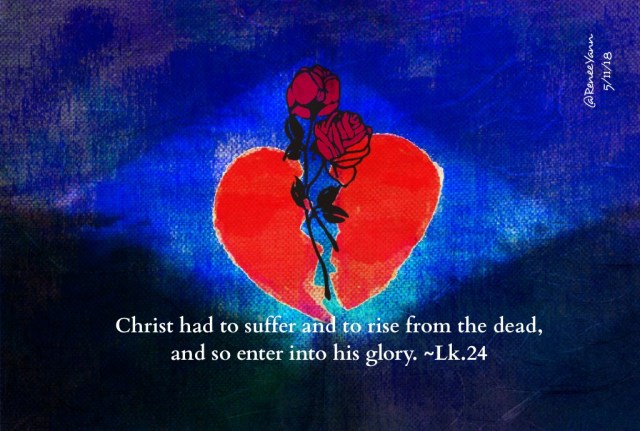
Today, in Mercy, Acts continues to describe the development of the early Church. Paul spends 18 months in Corinth, working with the new Christians through the many twists of a growing community. Luke’s Gospel reminds us of a key teaching for this, and our, community: If we really live like Christ, we will suffer, and die to ourselves before any hope of glory.

A true Christian life is not without sacrifice (which comes by choice) nor suffering (which comes by imposition). 

We sacrifice because we love. Consider all that parents sacrifice for their children’s sake.

When we suffer, we must also love, but add the hope for healing in ourselves and in anyone who causes our suffering.

This is to live like Christ.

Luke 24