Easter Tuesday: Yet We Believe

April 19, 2022

Today, in God’s Lavish Mercy, our readings present us with a picture of the nascent Church as it works toward understanding itself in the physical absence of Jesus.

Throughout the Gospels, we see a Christian community forming around a Leader they can see, hear and touch. Acts reveals how that community awakens to itself when Jesus is no longer materially present.

Acts shows us a Church like us. We have never seen Christ, nor heard him, nor touched him. And yet we believe, or want to believe.


In our reading today, Peter preaches with brutal honesty:

Let the whole house of Israel know for certain
that God has made him both Lord and Christ,
this Jesus whom you crucified.

Acts 2:26
acts2_38_heartstruck

Peter’s message gets through to the assembly, to the point that, when they hear it, they are “cut to the heart”. This phrase indicates a profound conversion in the way they believed. Peter tells them that their faith, like Jesus’ life, must now become a sign of contradiction to a “corrupt generation “.


What might this powerful passage say to us?

For one thing, the reading calls us to be honest about the sincerity of our faith.

  • Is it the core of our lives?
  • Or is it, at best, a Sunday hobby?
  • Does it pervade our relationships and choices, giving witness to Christ’s commission to love?
  • Or is it a tool to judge and vilify those who differ from us?

The reading doesn’t demand that we “preach our faith out loud”. It calls us to a much deeper and more courageous witness:

  • to be Truth in a world of lies
  • to be Peace in violence
  • to be Justice in the face of abuse and domination
  • to be Servant rather than be served
  • to be Love for those deemed unlovable
  • in other words, to be like Jesus

And to do it all because we have been “cut to the heart” by the witness of the Cross and Resurrection.


Poetry: attributed to St. Teresa of Ávila

Christ has no body but yours,
No hands, no feet on earth but yours,
Yours are the eyes with which He looks
Compassion on this world,
Yours are the feet with which He walks to do good,
Yours are the hands, with which He blesses all the world.
Yours are the hands, yours are the feet,
Yours are the eyes, you are His body.
Christ has no body now but yours,
No hands, no feet on earth but yours,
Yours are the eyes with which he looks
compassion on this world.
Christ has no body now on earth but yours.


Music: By Faith-Keith & Kristyn Getty

Easter Monday: Waking Ourselves to Resurrection

April 18, 2022

Mt28_8 fear_joy

Today, in God’s Lavish Mercy,  we enter the Easter Season which will last until June 4th. The next day we will celebrate Pentecost.

Throughout these several weeks, we will have a thorough reading of the Acts of the Apostles. 

Theologian Walter Brueggemann says this about Acts:

In the Book of Acts the church is
a restless, transformative agent
at work for emancipation

and well-being in the world.


As Easter People, transformed by the Resurrection of Jesus, that’s what we’re all called to be:

transformative agents
at work for emancipation

and well-being in the world.


Our models and inspiration will be found in these early women and men we read about over the next few weeks. This was a community fully committed and learning to be disciples. This was a community that acted – within a culture of death – for an alternative, life-giving world.

“The whole book of Acts is about power from God that the world cannot shut down. In scene after scene, there is a hard meeting between the church and worldly authorities, because worldly authorities are regularly baffled by this new power and resentful of it.”
At one point, in chapter 17, the followers of Jesus are accused of “turning the world upside down.
” (Brueggemann)


Our world sorely needs such an active Church, speaking clearly to the issues that threaten and limit human life and wholeness in God. It’s not easy to be that witness, but it is critical. Our Gospel suggests the difficulty, but also defines the motivation:

Mary Magdalene and the other Mary
went away quickly from the tomb,

fearful yet overjoyed,
and ran to announce the good news …


May we, though sometimes fearful, choose to be agents of the joyful Good News for our times. By our choices, attitudes and actions, may we be brave in witnessing Christ, even in trying circumstances!


Prose: from Deitrich Bonhoeffer

Discipleship never consists
in this or that specific action:
it is always a decision
either for or against
Jesus Christ.


Music: Mozart’s Exsultate Jubilate – sung by Regula Mühlemann

Be sure to wait after the applause for the Alleluia segment.

Exsultate, jubilate,
o vos animae beatae!
Dulcia cantica canendo,
cantui vestro respondendo,
psallant aethera cum me.

Fulget amica dies,
iam fugere et nubila et procellae;
exortus est justis inexspectata quies.
Undique obscura regnabat nox;
surgite tandem laeti,
qui timuistis adhuc,
et iucundi aurorae fortunatae
frondes dextera plena et lilia date.

Tu, virginum corona,
tu nobis pacem dona.
Tu consolare affectus,
unde suspirat cor. Alleluia.

Exult, rejoice,
o blessed souls!
Singing sweet songs,
singing your song,
the heavens sing praise with me.

A friendly day shines forth,
clouds and thunderstorms recede;
unforeseen peace has come to the righteous.
Darkness was all over the world;
arise joyfully at last
you, who were hitherto in fear,
and, leaning to the blissful morning light
lavishly present wreaths of leaves and lilies.

You, the Virgin’s garland ,
grant us peace.
Dull the grief,
which makes our heart sigh. Halleluja.

Lent: Trust the Light

April 4, 2022
Monday of the Fifth Week of Lent

Today, in God’s Lavish Mercy, our first reading offers us one of the most captivating, and perhaps infuriating, stories of the Bible – the story of Susanna. This is a tale that can offer us many points of reflection. Rather than offer you my own, I would like to refer you to this excellent article by Dr. Malka Zeiger Simkovich is a the Crown-Ryan Chair of Jewish Studies at Catholic Theological Union in Chicago, and the director of their Catholic-Jewish Studies program.


Our Gospel for today picks of the themes of knowledge, truth and judgement we have found in Daniel.

Jesus in facing mounting harassment and criticism from those threatened by his message. In today’s passage, a group of Pharisees engages in a verbal duel with Jesus:

The Pharisees said to him,
“You testify on your own behalf,
so your testimony cannot be verified.”
Jesus answered and said to them,
“Even if I do testify on my own behalf, my testimony can be verified,
because I know where I came from and where I am going.
But you do not know where I come from or where I am going.
You judge by appearances, but I do not judge anyone.

Jesus makes it clear that such mental gymnastics, devoid of heart and spirit, are nothing but a journey in darkness:

Jesus spoke to them again, saying,
“I am the light of the world.
Whoever follows me will not walk in darkness,
but will have the light of life.”


We’ve all met people who want to make faith into a mental Rubik’s cube. But deep faith will never fit into blocks and clever twists. Deep faith releases us from the need to have everything fit – from the futile imagination that we are in control of anything but our power to love.

As we pray with the little pieces of Susanna, Pharisees, and wicked elders we might discover in our own lives, let’s ask for the courage and grace to relax into the Light that Jesus offers us today.


Poetry: Peter Quince at the Clavier – Wallace Stevens

  I 

Just as my fingers on these keys 

Make music, so the selfsame sounds 

On my spirit make a music, too. 

Music is feeling, then, not sound; 

And thus it is that what I feel, 

Here in this room, desiring you, 

Thinking of your blue-shadowed silk, 

Is music. It is like the strain 

Waked in the elders by Susanna: 

Of a green evening, clear and warm, 

She bathed in her still garden, while 

The red-eyed elders, watching, felt 

The basses of their beings throb 

In witching chords, and their thin blood 

Pulse pizzicati of Hosanna. 

                                              II 

In the green water, clear and warm, 

Susanna lay. 

She searched 

The touch of springs, 

And found 

Concealed imaginings. 

She sighed, 

For so much melody. 

Upon the bank, she stood 

In the cool 

Of spent emotions. 

She felt, among the leaves, 

The dew 

Of old devotions. 

She walked upon the grass, 

Still quavering. 

The winds were like her maids, 

On timid feet, 

Fetching her woven scarves, 

Yet wavering. 

A breath upon her hand 

Muted the night. 

She turned— 

A cymbal crashed, 

And roaring horns. 

                                           III 

Soon, with a noise like tambourines, 

Came her attendant Byzantines. 

They wondered why Susanna cried 

Against the elders by her side; 

And as they whispered, the refrain 

Was like a willow swept by rain. 

Anon, their lamps’ uplifted flame 

Revealed Susanna and her shame. 

And then, the simpering Byzantines 

Fled, with a noise like tambourines. 

                                             IV 

Beauty is momentary in the mind— 

The fitful tracing of a portal; 

But in the flesh it is immortal. 

The body dies; the body’s beauty lives. 

So evenings die, in their green going, 

A wave, interminably flowing. 

So gardens die, their meek breath scenting 

The cowl of winter, done repenting. 

So maidens die, to the auroral 

Celebration of a maiden’s choral. 

Susanna’s music touched the bawdy strings 

Of those white elders; but, escaping, 

Left only Death’s ironic scraping. 

Now, in its immortality, it plays 

On the clear viol of her memory, 

And makes a constant sacrament of praise.


Music: Bach: Prelude in C Major, BWV 846, The Well-Tempered Clavier

Lent: Stop Pretending

April 2, 2022
Saturday of the Fourth Week of Lent

Today, in God’s Lavish Mercy, danger continues to escalate for Jesus.

Our first reading from Jeremiah foreshadows Jesus’s situation. Some powerful people didn’t want to hear what Jeremiah preached. And we can understand why: Jeremiah prophesied the destruction of Jerusalem because of Israel’s unfaithfulness. It’s a message that was hard to swallow.

jeremiah

The core of Jeremiah’s teaching was this:
You people have to change. This is not the way God created the world to be.

But the people couldn’t listen. They had let the skewed reality of their lives become normal and needed. They couldn’t accept the world of mutual love and justice that God imagined for them.


Jesus meets the same kind of stonewalling.

In today’s passage, the hard-hearted rationalize their resistance:

“The Christ will not come from Galilee, will he?
Does not Scripture say that the Christ will be of David’s family
and come from Bethlehem, the village where David lived?”

But their antagonism isn’t really about geography and lineage. It’s about blind comfort in a world balanced toward their advantage. It’s about the fear of grace-inspired change.

Lk8_generous heart


Isn’t it the truth that we’ll use almost any argument to resist what demands our conversion? I understand why these guys “each went to his own house”, as the Gospel says in closing. They took refuge from grace in the little roofed pretense of their own control.

They didn’t have the courage to open their hearts to Jesus. Do we?


Poetry: LOVE IS THE MASTER – RUMI

Love is the One who masters all things;
I am mastered totally by Love.
By my passion of love for Love
I have ground sweet as sugar.
O furious Wind, I am only a straw before you;
How could I know where I will be blown next?
Whoever claims to have made a pact with Destiny
Reveals himself a liar and a fool;
What is any of us but a straw in a storm?
How could anyone make a pact with a hurricane?
God is working everywhere his massive Resurrection;
How can we pretend to act on our own?
In the hand of Love I am like a cat in a sack;
Sometimes Love hoists me into the air,
Sometimes Love flings me into the air,
Love swings me round and round His head;
I have no peace, in this world or any other.
The lovers of God have fallen in a furious river;
They have surrendered themselves to Love’s commands.
Like mill wheels they turn, day and night, day and night,
Constantly turning and turning, and crying out.

Music:  Spirit, Open My Heart –  Alfred V. Fedak

Lent: The Deep Dive

March 29, 2022
Tuesday of the Fourth Week of Lent

Today, in God’s Mercy, our readings describe a deep and hidden stream revealed by God –

first to Ezechiel …

Raffael-vision-ezechiel
The Vision of Ezechiel by Rafael

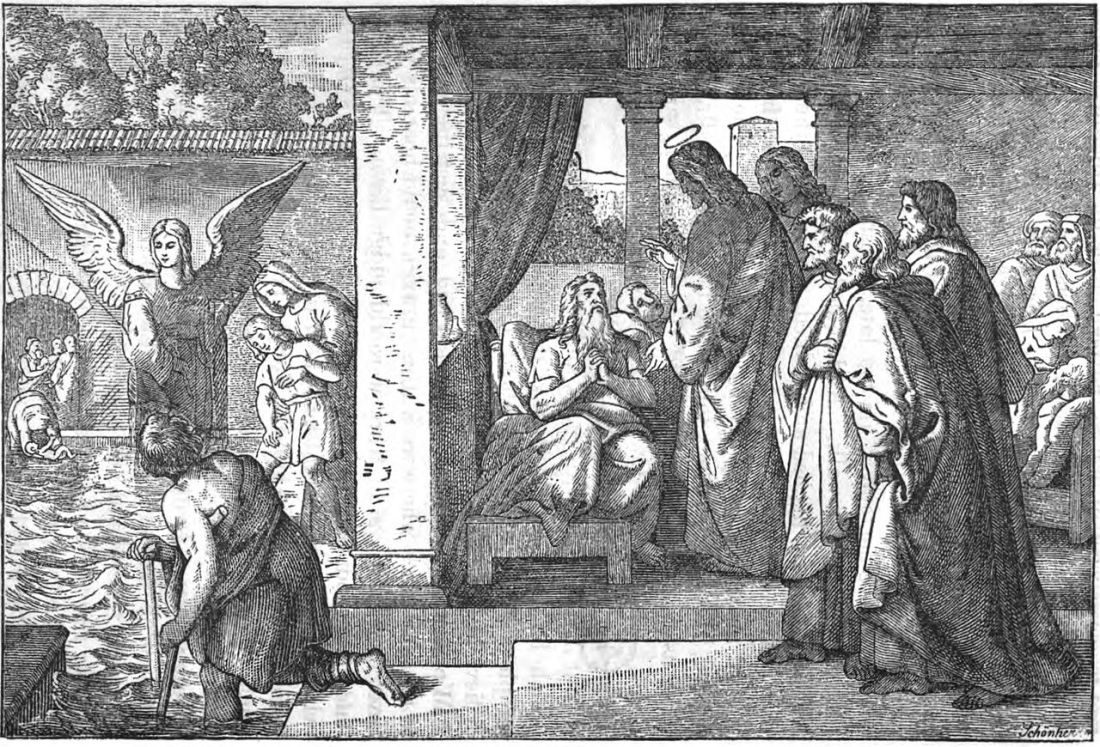
then to a long-paralyzed man …

Schönherr_The_pool_of_Bethesda
The pool of Bethesda, by Schönherr.

So many stories in Scripture are laced with the same theme: there is a infinite mystery hidden under the surface of life:

  • Keep searching. Keep searching. 
  • The precious pearl that awaits discovery. 
  • The lost coin that must be found. 
  • The mustard seed buried in circumstance. 
  • The stream running deep under appearances.

We might be tempted to dismiss our first reading from Ezechiel as over-described allegory. But its rendition of the slow, steady deepening, through which God leads the prophet, offers us an apt image to reflect on our own graced journey. 

Ez47_9 stream

Hasn’t God led us gently to the faith we have today? Like young children learning to ride the ocean breakers, we have been taught by a patient God Who returns in every tide to take us deeper into our next capacity for grace.


For thirty-eight years, the man in today’s Gospel has been paralyzed by the water’s edge. Maybe we know how he feels.

duck

He believes that his life is beyond transformation. He cannot dive under the surface of his circumstances to find the quickening waters.


Jesus gives him the key to unlock his paralysis. In a short phrase, Jesus offers the man a multilayered question:

  • What do you really want in your deepest heart?
  • When you find the answer, break through all that has kept you from that deepest desire. 
  • Step with Me through the next wave, and the next until, finally, we swim together in the great ocean of covenanted trust.

As our Responsorial Psalm-poem promises:

God is our refuge and our strength,
an ever-present help in distress.
Therefore we fear not, though the earth be shaken
and mountains plunge into the depths of the sea.

There is a stream whose runlets gladden the city of God,
the holy dwelling of the Most High.
God is in its midst; it shall not be disturbed;
God will help it at the break of dawn.

Music: I Am – Marty Goetz (Lyrics below)

Come, behold the works of the Lord
How He has wrought the desolation
How He has brought His early help
The Lord of Hosts is with us
The God of Jacob is our refuge
When the nations rage and all the kingdoms fall
He says I Am, I Am, I Am all

And there’s a river whose streams make glad the city of God
They flow to His Holy habitation
They flow to the home of the Most High
The Lord of Hosts is with us
The God of Jacob is our refuge
He breaks the bow, he shatters the spear
And says I Am, I Am, I Am here!

So we will not fear
Though the worlds should change
Though the waters roar
Though the mountains shake and tremble
For He’s a present help in trouble, in trouble

Be still and know that I am God
I Am exalted in the nations
I Am exalted in the earth
The Lord of Hosts is with us
The God of Jacob is our refuge
To the ends of the earth He causes wars to cease and says
I Am, I Am, I Am peace
He says I Am, I Am, I Am peace

Lent: Pray for the Enemy

March 24, 2022
Thursday of the Third Week of Lent

Today in God’s Lavish Mercy, Jeremiah begins our readings by describing the evil heart:

… they obeyed not, nor did they pay heed.
They walked in the hardness of their evil hearts
and turned their backs, not their faces, to Me.

Jeremiah :24

It is a terrible thing to encounter a truly evil-hearted person – someone who exudes a twisted energy which is the polar opposite of God’s Love.

I believe we are seeing such a individual now in the person of Vladimir Putin. His actions leave us astounded at their arrogance and cruelty. How can such a person face himself, and certainly, how can he face God?


But our Psalm and Gospel Verse, lead me to ask myself the question:

What if we prayed FOR Vladimir Putin?

Come, let us bow down in worship;
let us kneel before the LORD who made us.
For he is our God,
and we are the people he shepherds, the flock he guides.
R. If today you hear his voice, harden not your hearts.

What if we took pity on the wretched soul he has become and asked God to heal his mind and give him a new heart? He has become sick with evil, and that is a tragic thing to see in a leader responsible for millions of lives!


All of us feel tremendous sorrow and compassion toward the Ukrainian people. But in the end, no matter what, they will triumph through their sincerity, courage and faithfulness.

Putin, on the other hand, is otherwise lost for all eternity.


Will you consider praying today for Putin and those who share his evil culpabilities that they may yet hear the voice of goodness, justice, peace, and reverence for human life?

As we witness the power of God revealed in our Gospel story, let us ask that the evil of war be driven out of the hearts of all those responsible for the outrageous suffering and inhumanity being perpetrated again the people of Ukraine and in all war-infested parts of our world.


Music: Shchedryk by Mykola Leontovich

One of the world’s most famous Christmas songs – The Carol of the Bells – was based on the Ukrainian song Shchedryk, written in 1916 by composer Mykola Leontovich, which was in turn based on the melody and lyrics of a pre-Christian folk song.

This is Gimnazija Kranj Symphony Orchestra and Choir’s dedication to brave Ukrainian people who suffer under the brutal Russian invasion. Our musicians performed this beautiful love song a couple of years ago. Tine Bec did an amazing arrangement. It was composed by Mykola Leontovych: Shchedryk (Carol the Bells) with a splendid arrangement, made by composer Slovenian Tine Bec.

This arrangement is magical. It starts like deep sad mourning and continues to strengthen, unitarian voice, which is stronger than any steel, any armoury and any Russian bullet, rocket or trank grande. Music is a winner. It gives hope, unites us in a way, that no aggression will ever win.

Arrangement: Tine Bec
Piano: Monika Podlogar; Cello: Katarina Minatti

Lent: Forgive As Forgiven

March 22, 2022
Tuesday of the Third Week of Lent

Today, in God’s Lavish Mercy, we meet Azariah of Fiery Furnace – a great champion of faith ready to bolster ours in our own uncertain times.

In our reading from the Book of Daniel, Azariah (later Abednego) prays a moving prayer of urgency, repentance, supplication, and trust:

And now we follow you with our whole heart,
we hold you in awe and we pray to you.
Do not let us be put to shame,
but deal with us in your kindness and great mercy.
Deliver us by your wonders,
and bring glory to your name, O Lord.

This prayer rang very true for me today, as I prayed for God’s mercy and miracles all over our suffering earth, especially in Ukraine.


And then we move to our Gospel, which brings before us the always thorny issue of forgiveness. Forgiveness is easy when it is something we seek for ourselves. Yes, we may have done something wrong. But we see the issue from inside our own heart. We know we didn’t mean it, made a mistake, or didn’t fully understand the harm we caused. We know we deserve forgiveness.

But what about the other guys — the ones who hurt us or someone we love? They meant it, didn’t they!!!! Their treachery was no mistake. They understood all along the harm they would cause! How could we ever forgive them?

Isn’t that the way the tapes sometimes run in our heads when we are hurt by another, or when we witness such hurt?

In our Gospel, Jesus offers us the character of the forgiving master who represents our Creator. The parable teaches that God accepts and heals our weakness – God forgives. But once forgiven, we are called to be like God – forgiving others and desiring their healing.

Does this mean we ignore or forget the pain forced on others or ourselves? I don’t think so. It means that we use it as a catalyst to remember how in need of grace we and all our sisters and brothers are as we learn to live in love.


Poetry: As we pray with such awareness, how appropriate today’s psalm-poem is:

Your ways, O LORD, make known to me;
            teach me your paths,
Guide me in your truth and teach me,
            for you are God my savior.
Remember that your compassion, O LORD,
            and your kindness are from of old.
In your kindness remember me,
            because of your goodness, O LORD.
Good and upright is the LORD;
            thus showing sinners the way.
God guides the humble to justice,
            and teaches the humble God’s way.

Psalm 25:4-9

Music: Forgiveness – Matthew West

Lent: The Miracle of Transformation

March 21, 2022
Monday of the Third Week of Lent

Today, in God’s Lavish Mercy, our readings are about prophets and miracles, brought to us by Elisha and Jesus.

The core of the readings is this: some of us want the prophets’ miracles, but we don’t want their challenge to live in God’s freedom. We want their cures, only to return to lifestyles that make us spiritually sick or imprisoned.

Wanting to write about these themes, I decided to check with my favorite Old Testament scholar, Walter Brueggemann to see if he had any wisdom on the story of Naaman.

Naaman
Naaman brings his retinue and gifts… from The Pictorial History of Palestine and the Holy Land (1844) by John Kitto

Well, Walter certainly did…. something so good and wise that I won’t water it down with my own words. The link is below. It’s a little long, but so worth your reading and meditation. I hope you’ll take the time.

Click here for Walter Brueggemann’s article


Music: some instrumental music to listen to while you’re reading

Lent: To Drink from the Cup

March 16, 2022
Wednesday of the Second Week of Lent

Today, in God’s Lavish Mercy, we learn a lesson in humble leadership, thanks once again to “Mrs. Zebedee”.

Mk 10_38 cup

Our Gospel recounts the story of the mother of James and John interceding for her sons with Jesus. Like many overprotective mothers, she intervenes even into their adult lives. She wants to make sure they get the best deal for their investment with Jesus.


Listen, I understand and love her! I would be the same way with my kids if I had any. I often say it’s best I had none because “Overprotective Me” would have had to shadow them to school, dances, playgrounds etc. until they were about 35 years old!

But the point of this Gospel story isn’t Mrs. Zebedee’s overprotectiveness.  It has little to do with Mrs. Zebedee at all.


The point is that “Mrs. Zebedee” (like many of us) has missed the whole POINT. The Gospel story is about US and the integrity of our choice to live a life in the pattern of Jesus.

Christ’s disciples have decided to follow a man who says things like this:

  • The last shall be first and the first, last.
  • Unless you lay down your life, you cannot follow me.
  • Whoever takes the lowly position of a child is the greatest in the Kingdom of Heaven.

The seats at Christ’s right and left, which Mrs. Zebedee requests for her sons, will bring them rewards only through humility and sacrificial service.


Here’s the way a 14th century artist imagined the Zebedee family. (Dad looks happy!)

sons of zebedee
Mary Salome and Zebedee with their Sons James the Greater and John the Evangelist
(c.1511) by Hans von Kulmbach, Saint Louis Art Museum

Jesus is gentle with “Mrs. Zebedee”. He understands how hard it is for any of us to comprehend the hidden glory of a deeply Christian life. We are surrounded by a world that screams the opposite to us:

  • Me first!
  • Stand your ground!
  • Good guys finish last!

So Jesus turns to James and John (and to us). One can imagine the bemused look on Christ’s face. He knows the hearts of his disciples. He knows they have already given themselves to him. So he asks them for a confession of faith, “Can you drink the cup that I will drink?”

veronese-le-christ-rencontrant-la-femme-et-les-fils-de-zebedee_-_grenoble
The meeting of Christ with Zebedee’s wife and sons by Paolo Veronese

Their humble, faith-filled answer no doubt stuns their mother. She is left in wonder at the holy men her sons have become. Perhaps it is the beginning of her own deep conversion to Christ.

As we pray with this passage,
where do we find ourselves in this scene?
How immediate, sincere, and complete
is our response to Jesus’ question:
“Can you drink the cup….?”

Prose: by Henri J.M. Nouwen, Can You Drink the Cup?

Drinking the cup that Jesus drank
is living a life in and with the spirit of Jesus,
which is the spirit of unconditional love.
The intimacy between Jesus and Abba, his Father,
is an intimacy of complete trust,
in which there are no power games,
no mutually agreed upon promises,
no advance guarantees.
It is only love
—pure, unrestrained, and unlimited love.
Completely open, completely free.
That intimacy gave Jesus the strength to drink his cup.
That same intimacy Jesus wants to give us
so that we can drink ours.


Music: The More I Seek You – Kari Jobe

Lent: Untie the Knots

March 15, 2022
Tuesday of the Second week of Lent

Today, in God’s Lavish Mercy, in Isaiah’s prophecy, God addresses some of the most famous sinners in the Bible — the residents of Sodom and Gomorrah. And the Divine manner of that address is both gentle and direct…

Come now … let us set things right!

Come now, let us set things right,
says the LORD:
Though your sins be like scarlet,
they may become white as snow;
Though they be crimson red,
they may become white as wool.
If you are willing, and obey,
you shall eat the good things of the land;
But if you refuse and resist,
the sword shall consume you:
for the mouth of the LORD has spoken!

Isaiah 1:18-20

Setting things right! Aren’t there times in our lives when we long for that? Not in the sense of vengeance or some vigilante justice, but rather in the sense of balance, equity, peace, and understanding in our lives.


Some things go wrong in our lives – that’s just the way it is. And sometimes we struggle endlessly and futilely to realign them.

Even in the most tranquil and “together” lives, there are places of irresolution – little knots in our life story of “why” and “why not”; of “if” and “if only”.

These may be places where we can’t really “forget” and so have not really forgiven. They may be nagging questions left unanswered because we hadn’t the courage to ask. They may be reasons we wanted to explain but no one wanted to listen. They may be excuses or pretenses we have made for so long that we have begun to believe them ourselves.

In almost all such instances, a scarlet concupiscence is at the root of our suffering or pain – sin, not only in the other, but in ourselves that longs to be made white as snow.


In many such cases, the time passes when we might reach out to the other for mutual healing. Death, distance, stubborn resistance and other walls may block us from worldly reconciliation.

But in God’s realm, healing is still possible, as is the power of our desire for the other to be healed with us.

in Isaiah’s beautiful passage, God invites us to full and eternal wholeness. That wholeness is achieved through our willingness to be open before God and to practice obedient listening in our prayer.

If you are willing, and obey,
you shall eat the good things of the land.

Isaiah 1:19

Let’s listen to and trust the awesome invitation in Isaiah:
“Come now, let us set things right”
… come to Me where I will allow you to forgive yourself as I forgive you.
Let us begin to untie any grace-resistant knot in your heart.
Untied, it also frees the other to seek their own healing.


Poetry: Forgiveness – George MacDonald

God gives his child upon his slate a sum –
To find eternity in hours and years;
With both sides covered, back the child doth come,
His dim eyes swollen with shed and unshed tears;
God smiles, wipes clean the upper side and nether,
And says, ‘Now, dear, we’ll do the sum together!’

Music: White As Snow – Maranatha Singers