Dare to Follow the Way

Memorial of Saint Thérèse of the Child Jesus, Virgin and Doctor of the Church

Tuesday, October 1, 2019

Click here for readings

Today, in Mercy, we celebrate St. Thérèse, popularly venerated as The Little Flower. She propagated a spirituality that has become known as “The Little Way”. 


Rev. John F. Russell, O.Carm. describes the Little Way like this:
The Little Way is an image that tries to capture St. Thérèse’s understanding of being a disciple of Jesus Christ, of seeking holiness of life in the ordinary and the everyday.
Saint Therese based her “little way” on two fundamental convictions: 

  • God shows love by mercy and forgiveness
  • She could not be perfect in following the Lord. 

Both our readings today also talk about a “way”.
Zechariah has a vision of all nations following the way to a New Jerusalem. 

Thus says the LORD of hosts:
In those days ten men of every nationality,
speaking different tongues, shall take hold,

yes, take hold of every Jew by the edge of his garment and say,
“Let us go with you, for we have heard that God is with you.”
Dare

In our Gospel, Jesus begins his way on his final journey. He knows now that the way will be through suffering and death yet, He dared…

When the days for Jesus to be taken up were fulfilled,
he resolutely set his face toward Jerusalem…

Grace makes a way in our lives too. As with Thérèse, the ancient Jews, and Jesus, our particular way will unfold before us through prayer and a listening heart. It is the way of love that leads away from selfishness to God and God-in-Others.

Rumi’s poem captures it:

The way of love is not
a subtle argument. 

The door there
is devastation. 

Birds make great sky-circles
of their freedom.
How do they learn it?

They fall, and falling,
they’re given wings.

(In a later post today, I will share a poem by Amy Lowell which I feel could describe “the journey “ — Christ’s, mine, yours… and perhaps offer further food for prayer.)

Today, we pray for the courage and freedom to follow the Way, the Truth, and the Life.

Music: from the musical Godspell – By My Side

The song conveys the desire of Jesus’s disciples, all but Judas, to accompany him on his Way. They were not perfect – but they dared. As we consider our lives, have we dared? What “pebbles” have we willingly “put in our shoes” to follow Jesus?


Jealous for Me

Memorial of Saint Jerome, Priest and Doctor of the Church

Monday, September 30, 2019

Click here for readings

Today, in Mercy,  Zechariah channels God, with the most intense of human emotion.

The prophet wants Israel to have some understanding of God’s infinite love and hope for them, so he puts these words in God’s mouth:

I am intensely jealous for Zion,
stirred to jealous wrath for her.

Like a spouse longing for a lost beloved, God longs for the restoration of Israel to the Divine embrace.

Zech my people

Wherever our relationship with God is frayed or broken, God is jealous for us too. If we can turn our hearts in repentance, prayer, and hope, we too will hear God’s longing for us.


In our Gospel, Jesus tries to refocus his disciples on that loving call. In a classic example of missing the obvious, they are distracted over who is the most important. Here is the Lord of all sitting beside them, and they are arguing about their personal status!

By pointing to a child in their midst, Jesus reminds his followers of the innocence and transparency we need in order to open ourselves to God.

Let’s pray for that openness today so that we can hear and rejoice in a promise such as Israel heard through Zechariah:

You shall be my people, and I will be your God,
with faithfulness and justice.

Music: How He Loves Us – David Crowder Band

Haggai Impeaches Israel

Thursday of the Twenty-fifth Week in Ordinary Time

September 26, 2010

Click here for readings

Today, in Mercy – and tomorrow – we will hear from Haggai, one of the twelve minor prophets of the Hebrew Scriptures. These dozen writers are referred to as “minor” because of the length of their writings, not their value.

So Haggai, even though many of us have never heard of him, has something important to say for Judeo-Christian tradition and for each of us who read him. Let’s see what that might be.

Hag1_9JPG

Haggai is prophesying during the Persian period of Jewish history, around the middle of the 6th century, BC. The Jewish people had been back home from the Babylonian captivity for almost 20 years. When they first returned they were passionate about rebuilding the Temple. But as the decades passed, and opposition from their non-Jewish neighbors increased, their commitment waned.

The building of worship places has always been an activity with fans on both sides of the aisle. Some argue that God needs a spot where the Divine Presence can be recognized and revered. Others believe that the effort and resources expended in such building could better be used in human services for God’s poor and needy people. Haggai’s community had people in both camps. (Sound familiar?)

Haggai offers a turning point for their arguments. He tells the people they are a mess. The absence of a central symbol for their faith has weakened and scattered them to their own selfish pursuits. He tells them to look at themselves:

Consider your ways!
You have sown much, but have brought in little;
you have eaten, but have not been satisfied;
You have drunk, but have not been exhilarated;
have clothed yourselves, but not been warmed;
And whoever earned wages
earned them for a bag with holes in it.

The Temple, while it is important, isn’t the most important part of Haggai’s prophecy. He tells the people they have lost their souls. The lack of a central, shared faith has caused them to forget who they are. They will remember only when they remember God’s centrality in their lives.

Haggai appeals to the people to restore a public life which gives honor to God. For their time and circumstance, such a return is symbolized by the rebuilding of the Temple which had been destroyed at the time of their enslavement by Babylon.

We humans often forget what’s important. We chip away at, and ultimately destroy, what makes us who we are by little acts of faithlessness, deceit, covetousness and envy. These small treacheries grow into big ones redeemable only by an impeachment of the soul and the renewal of a common moral purpose.

If the message strikes you as extremely germane to current day realities, I’m glad.

Music: Come Back to Me – by Gregory Norbet, sung by John Michael Talbot

God’s Immutable Mercy

Wednesday of the Twenty-fifth Week in Ordinary Time

September 25, 2019

Click here for readings

Today, in Mercy, Ezra carries on his shoulders the whole repentant nation of Israel. He is bent in “shame and humiliation” for them as he begins his prayer for God’s mercy.

It is a highly dramatic prayer, ripping out from Ezra’s soul. He not only wants to get God’s attention. Ezra wants to make an indelible impression on the community he prays for.

Picture the scene as you wish. What comes to my imagination, (although somewhat sacrilegious)  is something like a James Brown brand of intensity:

for your reference: James Brown performs “Please Please Please” (Wait for the cape at 60 secs!)


God doesn’t shout back an answer to Ezra’s expressive prayer. Instead, we get the sense of God’s still, eternal Presence waiting for Israel’s eyes to clear in recognition, like finally seeing the mountain peak through the mist:

Ez9_8mercy rock

And now, but a short time ago,
mercy came to us from the LORD, our God,

who left us a remnant
and gave us a stake in his holy place;

thus our God has brightened our eyes
and given us relief in our servitude.


“ …God has given us a stake in his holy place”….
That place is ever-present,
ever-available Mercy
– always awaiting us
if we can clear our hearts to see it.

Once we do see the faithfulness of God, we are ready to chance the journey Jesus invites us to in today’s Gospel:

Take nothing for the journey ….
set out and go from village to village

proclaiming the good news
and restoring wholeness everywhere.

Music: Great Is Thy Faithfulness – written by Thomas O. Chisholm.
Sung here by AustinStoneWorship – Jaleesa McCreary (Note the sweet smile on her beautiful face just before she begins to sing. Grace!)

Radicals for God

Memorial of Saint Pius of Pietrelcina, Priest

September 23, 2019

Click here for readings

Luke8_17 hiddenJPG

Today, in Mercy,  we’re dealing with a few names we might not be familiar with.

Pius of Pietrelcina whose Feast we celebrate. Ever heard of him?

Oh, wait a minute, maybe you have. This holy man is more popularly known as “Padre Pio”. Still no clue? How about this?

Padre Pio was a Capuchin Franciscan friar who has become one of the most popular saints in the Church. While it was his receiving of the stigmata that distinguished him for many, his real saintliness lay in his love for sinners and his work for their redemption.

Pope Paul VI said this shortly after Padre Pio’s death: “Look what fame he had, what a worldwide following gathered around him! But why? Because he was a philosopher? Because he was wise? Because he had resources at his disposal? No – because he said Mass humbly, heard confessions from dawn to dusk and was–it is not easy to say it–one who bore the wounds of our Lord. He was a man of prayer and suffering.”

Ezra is our other maybe unfamiliar character. His book in the Old Testament doesn’t get a lot of play. It’s only ten chapters and lacks the exultant poetry of an Isaiah or a Jeremiah.

But Ezra’s, and his buddy Nehemiah’s, contribution to Judeo-Christian spirituality are critically important. These two Hebrew leaders accompanied the People back to their Promised Land after the Babylonian Captivity. But more than that, they fostered and admonished the People to return to their original relationship with God – a relationship rooted in the Promise given to Abraham.

Luke, who gives us today’s Gospel, we know well. Even today’s passage, we might know by heart. Let your lamp shine.  Let your life be truth. Do we live that message?

All the individuals mentioned in today’s celebrations and readings were radicals. The Word and Promise of God were everything to them. Through all the challenges of their lives, they kept coming back to their immutable relationship with the God of Love and Fidelity. They kept inviting others into the circle of that faith.

Praying with them today, may we have the same strong and resolute hearts.

Music: Hymn of Promise – Hope Publishing 

You May Not Want to Hear This…

Twenty-fifth Sunday in Ordinary Time

September 22, 2019

Click here for readings

Today, in Mercy, our readings make one thing very clear: we cannot serve both God and “mammon”.

The problem is that we have a hard time figuring out what mammon is. Experience tells us that it’s a lot more than just money, because there are people with money who do a good job serving God.

It seems to me that “mammon” is more the illusion that we are only our money … our possessions, and that we – or anybody else- is nothing without them. 

This misperception is so fundamental to our inability to live the Gospel that it cripples our souls. The love of “mammon” becomes an overwhelming, incurable addiction that feeds on the well-being of our neighbor.

As our first reading tells us, living by this addiction invokes God’s eternal anger:

The LORD has sworn by the pride of Jacob:
Never will I forget a thing they have done!

Our Gospel tells us that we can’t have it both ways. We either live within the generosity and inclusivity of God, or we’re outside it:

No servant can serve two masters.
He will either hate one and love the other,

or be devoted to one and despise the other.

This is a challenging but fundamental teaching of the Gospel. It is essential that we consider how we live it.

Walter Bruggemann, in his book Money and Possessions says this:

Jesus said it … succinctly. You cannot serve God and mammon. You cannot serve God and do what you please with your money or your sex or your land. And then he says, “Don’t be anxious, because everything you need will be given to you.” But you must decide. Christians have a long history of trying to squeeze Jesus out of public life and reduce him to a private little Savior. But to do this is to ignore what the Bible really says. Jesus talks a great deal about the kingdom of God—and what he means by that is a public life reorganized toward neighborliness. . . .

Let’s have the courage to pray with that thought today.

Music: a simple mantra, but powerful if we can live it: Love God, Love Neighbor by Dale Sechrest

At the Table of Mercy

Feast of Saint Matthew, Apostle and evangelist

September 21, 2019

Click here for readings

Today, in Mercy, we celebrate the feast of St. Matthew. The Gospel chosen for the day is Matthew’s own account of his call and the subsequent event lodged in his memory – the first meal he shared with Jesus.

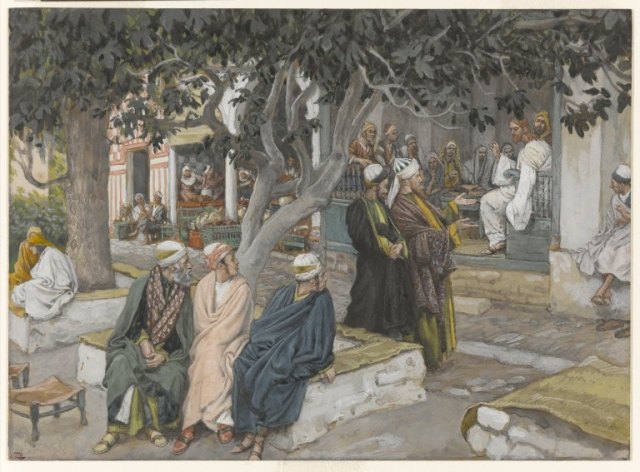
tissot
The Meal in the House of Matthew by James Tissot from the Brooklyn Museum

Apparently Matthew’s house was a do-drop-in kind of house. Matthew’s friends easily gathered at the meal. Even the Pharisees got a view of his table. 

I doubt that Matthew did the cooking. Perhaps his wife or mother, though never mentioned, were the true authors of his hospitality. She may have been that type of cook who lifts the sweet and savory scent of spices into the air, capturing in their welcome all who pass by.

Mt9_10 table

Jesus settles in to that welcome as do his table companions – disciples, tax collectors and sinners. They seem comfortable in their shared humanity. But today, with Jesus, they are invited to the perfection of that humanity in his abundant grace. They too receive a call this day.

We know only how some of these guests responded to this amazing invitation in their lives.

  • Matthew became an apostle and a saint.
  • The Pharisees retreated to their self-protective criticisms and condemnations.

How the others embraced or rejected this graceful moment is left unspoken.

With every Eucharistic moment of our lives, Jesus invites us to humanity’s table – a table transformed by his becoming one of us. His presence changes us all from sinners, tax collectors, or however else we are categorized. With Jesus, we are simply God’s children, fed and replenished by mercy, changed by a sacred invitation.

May we be aware of our “eucharists ” today, every encounter with another human being. The table may or may not be visible in the everyday circumstances around which we gather. Jesus will not be visible either – unless we have the eyes to see him in ourselves and those with whom we share life.

Music:  Come to the Table – Sidewalk Prophets

Lay Hold of Eternal Life

Memorial of Saints Andrew Kim Tae-gŏn, Priest, and Paul Chŏng Ha-sang, and Companions, Martyrs

Friday, September 20, 2019

Click here for readings

Today, in Mercy, we celebrate the feast of the Korean Martyrs. Their astounding faith stood against excruciating suffering but did not waver.

Korean_martyrs
Vatican [GFDL (http://www.gnu.org/copyleft/fdl.html)
A brief, inspiring story of the Korean Church is available here.


Today’s readings carry a common theme of resources, both material and spiritual, and how we use them.

Paul tells Timothy:

we brought nothing into the world,
just as we shall not be able to take anything out of it.

Still…

the love of money is the root of all evils,
and some people in their desire for it
have strayed from the faith

and have pierced themselves with many pains.

Our Psalm tells us that those who are poor in spirit realize that they possess nothing, that all they have is a gift from God. This realization is the source of their blessing.

Luke’s Gospel lists several women who supported Jesus’s ministry out of their resources. They, and no doubt the men depending them, had been touched and changed by Jesus.

1 Tim6_12 call

Each of our readings reminds us that deepened relationship with God releases in us those God given gifts of our Creation – the gifts of which Paul reminds Timothy:

But you, beloved of God,
… pursue righteousness, devotion,

faith, love, patience, and gentleness.
Compete well for the faith.
Lay hold of eternal life,
to which you were called
when you made the noble profession of faith

in the presence of many witnesses.

By the inspiration of the Korean Martyrs, may we hear and respond.

Music: a real foot tapper today – Hear the Call of the Kingdom – Kristyn Getty

Anoint Your Life

Thursday of the Twenty-fourth Week in Ordinary Time

September 19, 2019

Click here for readings

Today, in Mercy, I would like to share a piece from a book I am (slowly….) writing:

Lk7_17 jar

The scene is heavy with color, sounds, scents and movement.  The summer sun has begun its long descent through the western sky, filling the garden with orange light and umber shadows. Simon and his household make final preparations for the arrival of Jesus. The dining area is meticulously set in the arbored courtyard, the klinai or dining couches angled so that Simon may have the full consideration of Jesus once the supper begins. The scent of roasting lamb drifts from a nearby spit, incensing the entire space with heightened appetite. Slowly, the scene fills with the ancient Gospel characters, each carrying his or her own hungers to the table.

What is it that Simon the Pharisee most craves from this momentous opportunity to capture Jesus’ attention? He is a man of intellect who rationalizes that Jesus should respond in a certain way to the approaches of a sinful woman. Would his hunger have been satisfied had Jesus met this prediction? Or was a deeper hunger challenged when Jesus defied Simon’s expectation, inviting him to a fresh relationship with his own heart?

1112px-Albrecht_Bouts-Jesus_chez_Simon_le_Pharisien_IMG_1407
By Aelbrecht Bouts – Own work, CC BY-SA 2.0 fr, https://commons.wikimedia.org/w/index.php?curid=4234098

What spectrum of hungers comes with the many guests at this dinner? Are the disciples longing for Jesus to successfully argue his theology with this prominent Pharisee?  Are the other guests hoping to have their allegiances – whatever they may be – proven by the evening’s conversation? And Jesus himself, what hunger does he carry to the diverse gathering of his Father’s children? What yet unmet hopes for his ministry might he long to feed on this special evening?

But there is one among the many whose hunger is obvious.  At first unnoticed by the party, she slips in through the open hedge, advancing toward Jesus with a natural grace even the greatest wealth cannot bestow.  Her lustrous hair falls freely down her long, slender back.  She is bejeweled and bangled with the ornaments of her trade. Her face, though beautiful, reflects the weight of her desperate loneliness and forced self-sufficiency.

She is a woman no longer with pretense. The entire town already has cast her in a mold she will never escape. She has come as she is to the feet of Jesus, presenting her unadorned hope in an alabaster jar.

As we begin our prayer today, what hungers do we take to the feet of Jesus? Let us lift the alabaster jar. Let us decant the ointment of our prayer.  Let us anoint our lives.

The Deeper Melody of Wisdom

Wednesday of the Twenty-fourth Week in Ordinary Time

September 18, 2019

Click here for readings

Today, in Mercy, Jesus speaks to us like a frustrated parent.

All of us have seen fussy children, needing a nap, twisting around noisily from toy to toy, satisfied only to swipe the toy another child is playing with.

Jesus compares his resistant listeners to such children. They were not convinced by the austere preaching of John the Baptist. They are not moved by the loving freedom of Christ’s message. They find in both teachings only theories to toy with and toss aside. Because their hearts are hardened by distraction, they cannot find the heart in the truth offered to them.

Oh my goodness! Are we not living in the midst of such hardening distractions? So much in our culture invites us to “play” rather than to relate with our environment, with our lives. Advertising tempts us to get as much as possible out of everything, but to give nothing back. Media thrives by convincing us that we are the center of the universe.

We make a lot of noise when we feel threatened by the quiet truth of our common creaturehood and its inherent demand that we live in reverence for one another and for the God who created us.

John preached a message of repentance from such sinful self-absorption. He lost his head over it. Jesus preached the Word of transcendent love and mutual service. He was crucified for it. Each was seen as a threat to the manipulated Law that had become the refuge of their hardened listeners.

We see the pattern repeated down the long corridors of history, filling its passage with martyrs. We see it in our own day wherever someone tells the truth about the demands of the Gospel.

In our own Church, we see Pope Francis persecuted – even by some of his own bishops – for his call for compassion, mercy, and reverence for every person, for all Creation.

Indeed, we still live in the frenzied marketplace where 

“We played the flute for you, but you did not dance.
  We sang a dirge, but you did not weep.”

Ps107_wisdom well

Luke’s final cryptic verse may suggest our deliverance from such frenzy:

“But wisdom is vindicated by all her children.”

Our hearts recognize the Wisdom figures in our world. They have heard the true melody of God in their lives. By steady reflection and good works, they have gone beyond the din of a sinfully distracting culture. The result is inner peace, joy, and salvation, like that of John and Jesus —- and Pope Francis.

May we have the courage to go deep into Christ’s Word to embrace this Truth.

Music: Perfect Wisdom of Our God – Keith and Kristyn Getty