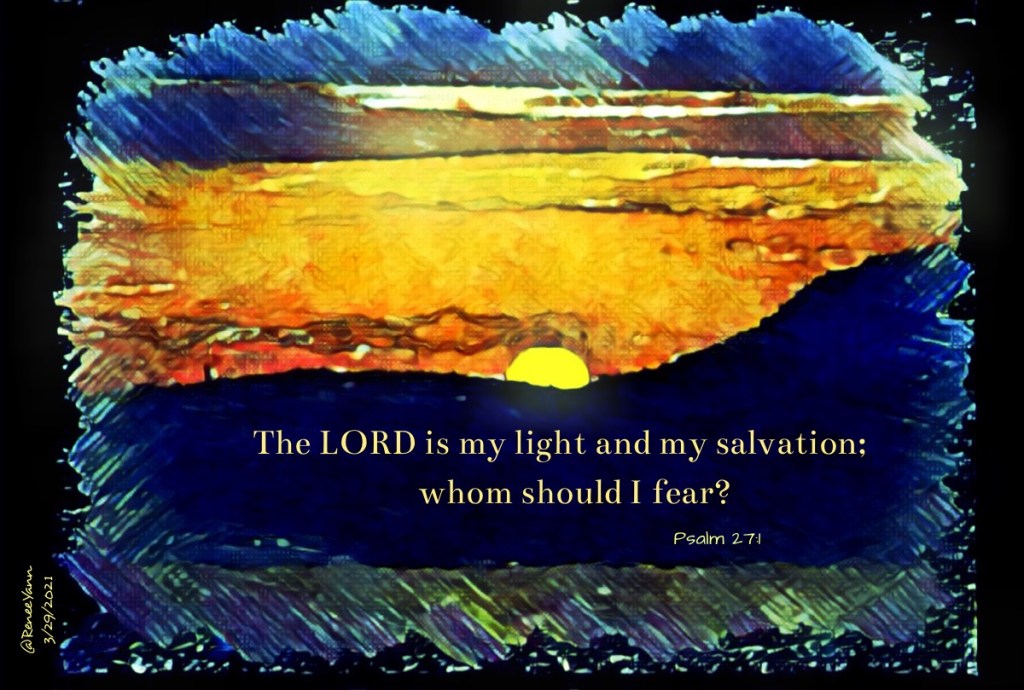
Monday of Holy Week

Monday of Holy Week


March 29, 2021

Today, in God’s Lavish Mercy, we pray with Psalm 27 which is a cry for help from one who is confident of God’s care.

The LORD is my light and my salvation;
    whom should I fear?
The LORD is my life’s refuge;
    of whom should I be afraid?

Psalm 27:1

Despite these verses, the psalmist obviously is afraid, otherwise why pray? As we begin Holy Week, we might imagine Jesus voicing such a prayer. Confident of the Father’s participation in his life, Jesus nevertheless must face daunting realities with courage – but not without fear.

We can learn so much from Jesus in this.

It is a very unusual, and perhaps non-existent, person who has no fears. We all fear something… maybe many things. It is human to fear that which we cannot see, control, or withstand. Even the one touting his great fearlessness is likely afraid of being seen as weak.

What Jesus teaches us is not to let our faith, love and hope be dominated by fear; rather, to engage our lives courageously with these three virtues despite our normal human fears. In so doing, we become the person God hopes for us to be, just as Jesus did.


Who would I be,
and what power would be expressed in my life,
if I were not dominated by fear?

Paula D’Arcy

The triumph is in resisting that domination, not in being fearless. Nelson Mandela has written, “I learned that courage was not the absence of fear, but the triumph over it. The brave man is not he who does not feel afraid, but he who conquers that fear.


I think Jesus was afraid during these final days of his life, but he pushed through to the truth of God’s Will for his life. We can ask Jesus to help us in our fears by praying as he might have with Psalm 27:

You are my light and my salvation
   Whom then shall I fear?

You are the strength of my life
  of what shall I be afraid?

Trials, enemies, changes, difficulties—
  they rise up and they resolve

Therefore–
   I will trust you
   I will wait for you
   I will seek you.

transliteration of Psalm 27 by Christine Robinson

Poetry: from T.S. Eliot, Four Quartet, East Coker

I said to my soul, be still, and let the dark come upon you
Which shall be the darkness of God. As, in a theatre,
The lights are extinguished, for the scene to be changed
With a hollow rumble of wings, with a movement of darkness on darkness,
And we know that the hills and the trees, the distant panorama
And the bold imposing facade are all being rolled away--
Or as, when an underground train, in the tube, stops too long between stations
And the conversation rises and slowly fades into silence
And you see behind every face the mental emptiness deepen
Leaving only the growing terror of nothing to think about;
Or when, under ether, the mind is conscious but conscious of nothing--
I said to my soul, be still, and wait without hope
For hope would be hope for the wrong thing; wait without love,
For love would be love of the wrong thing; there is yet faith
But the faith and the love and the hope are all in the waiting.
Wait without thought, for you are not ready for thought:
So the darkness shall be the light, and the stillness the dancing.

Music: Be Still My Soul – Katharina Amalia Dorothea von Schlegel, born 1697

A Psalm from Jeremiah

Saturday of the Fifth Week of Lent

March 27, 2021


Today, in God’s Lavish Mercy, we pray a responsorial from the Book of Jeremiah:

The Lord will guard us, as a shepherd guards the flock.

The psalm today, with the first reading, brings assurance that God remains with us through suffering and will heal and make us whole again.

That reassurance is needed as we hear the Gospel’s tone darken. After the raising of Lazarus, the whole nation waits to see what will happen to Jesus as Passover nears.


I think, in some ways, impending doom is almost worse than doom itself. Picture the part in a movie where the attacker waits in the dark while the victim tiptoes into lurking danger.

That frightening music they always play! Sometimes the tension heightens to the point that I have to hit the mute or close my eyes!


Entry of Christ into Jerusalem, a 1617 oil painting by Flemish Baroque painter Anthony van Dyck

This is what all surrounding Jerusalem felt like in today’s Gospel. The dark edge of evil hangs in inevitable threat.

But for Jesus, who walked in the hidden light of the Father, the moment brought more than threatening shadows. It was time to fulfill an ancient promise. It was time to offer the greatest act of Love.

Hear the word of the LORD, O nations,
    proclaim it on distant isles, and say:
He who scattered Israel, now gathers them together,
    he guards them as a shepherd his flock.
The LORD shall ransom Jacob,
    he shall redeem him from the hand of his conqueror.

Jeremiah 31: 10-12

As Jesus went off alone to Ephraim to prepare his heart and soul for this ultimate fulfillment, perhaps a prayer from Jeremiah strengthened him, a remembered promise from Ezekiel focused him.

Let us pray with Jesus today as he asks the Father to “shepherd” him. With Jesus, may we find our own strengths and understandings in these ancient prophets.


Poetry: Redemption by George Herbert (1593-1633)who was a Welsh-born poet, orator, and priest of the Church of England. His poetry is associated with the writings of the metaphysical poets, and he is recognised as “one of the foremost British devotional lyricists.”

Having been tenant long to a rich lord, 
    Not thriving, I resolvèd to be bold, 
    And make a suit unto him, to afford 
A new small-rented lease, and cancel th’ old. 

In heaven at his manor I him sought; 
    They told me there that he was lately gone 
    About some land, which he had dearly bought 
Long since on earth, to take possessiòn. 

I straight returned, and knowing his great birth, 
    Sought him accordingly in great resorts; 
    In cities, theaters, gardens, parks, and courts; 

At length I heard a ragged noise and mirth 
    Of thieves and murderers; there I him espied, 
    Who straight, Your suit is granted, said, and died.

Music: Like a Shepherd – St. Louis Jesuits

Psalm 23: Darkness to Light

Monday of the Fifth Week of Lent

Monday, March 22, 2021

Today, in God’s Lavish Mercy, we pray with our revered Psalm 23. This powerful prayer of confidence and hope fits well with today’s readings.

In the passage from Daniel, the innocent Susanna never wavers in her trust:

O eternal God, you know what is hidden
and are aware of all things before they come to be:
you know that they have testified falsely against me. 
Here I am about to die,
though I have done none of the things
with which these wicked men have charged me.”
The Lord heard her prayer.

Daniel 13: 42-44

In our Gospel, the woman – though not innocent – stills finds refuge in Jesus’s mercy.

So he was left alone with the woman before him.
Then Jesus straightened up and said to her,
“Woman, where are they?
Has no one condemned you?”
She replied, “No one, sir.”
Then Jesus said, “Neither do I condemn you.
Go, and from now on do not sin any more.”

John 8: 9-11

Like these two women, we may find ourselves in a dark valley at times. Whether we are innocent or guilty in arriving there, God abides with us in mercy. 

The key is to acknowledge our situation and to reach out to that Mercy. In that way, even though we encounter difficulty, as said in Psalm 23, we live in Light and not in shadow:

Only goodness and kindness follow me
all the days of my life;
And I shall dwell in the house of the LORD
for years to come.

Psalm 23: 5-6

Poetry: Light by Rabindranath Tagore

Light, my light, the world-filling light, 
the eye-kissing light, heart-sweetening light!

Ah, the light dances, my darling, at the center of my life; 
the light strikes, my darling, the chords of my love; 
the sky opens, the wind runs wild, laughter passes over the earth.

The butterflies spread their sails on the sea of light. 
Lilies and jasmines surge up on the crest of the waves of light.

The light is shattered into gold on every cloud, my darling, 
and it scatters gems in profusion.

Mirth spreads from leaf to leaf, my darling, 
and gladness without measure.
 The heaven’s river has drowned its banks 
and the flood of joy is abroad.


Laetare Sunday — Remember Joy!


In preparing for today’s reflection, I decided to look back a year ago to Laetare Sunday 2020. We were just beginning a very troubling and painful journey. We had no idea the depths to which it would take us. I hadn’t even learned to call our enemy “Covid”, as you will see. 

Yet as I read the past reflection in the light of where we are today, I was filled with awe, gratitude, sadness and remembrance.

I thought it might be good to offer the selection as a re-read for today as we stand on the brink of hope, Daylight Savings Time and a Spring that, for twelve terrible months, we couldn’t count on seeing.

As we begin to help one another heal, hope, and fully live again, let’s continue to pray for another. Thank you all for being part of the Lavish Mercy community whose prayer helped carry us all through these times.

May God bless you all  — and good health, good heart, good Spirit to every one of you.


Laetare! Rejoice! Lent has run half its distance to Easter.

I know it may be a bit difficult to rejoice in this Corona time, but think of this:
Spring has stepped over the horizon!  The long winter watch is over. But before we shake off its black velvet wraps for good, it might be well to think about what winter has taught us. It may strengthen us for this unusually challenging spring!

The stretch of time between November and April is all about waiting. Bulbs wait under the frozen earth.  Bears hibernate in the cold mountains.  Birds migrate, their old nests empty until the spring. All creation seems to enter a time of patience and unrealized expectation.  But it is not a time of desolation.  It is a time of hope for things yet unseen. Perhaps we can make our Corona time that kind of hopeful time.

We human beings also experience “winter” – not simply the seasonal one – but “winters of the spirit”.  We all go through times when our nests have been emptied; times when all the beautiful flowering aspects of our lives seem dormant; times when our vigor and strength seem to hide in the cave of depression or sadness.  These “winters” take many forms.  We may find ourselves sick of a job we had always loved. We may find a long, committed relationship wavering.  We may find the burdens of age or economics overwhelming us.  We may be the unwilling bearers of responsibilities we had not bargained for.

But if we listen, under the deep silence of waning winter, the wind rustles.  It carries the hint of a new season.  It carries the hope of the renewing cycle of our lives.  In that silence, we may be able to hear our own heartbeat more clearly.  We may come to a clearer understanding of what is most important in our lives.  In the stillness, we may be forced to know and understand ourselves in a deeper way.

In this time of global angst and uncertainty, I think of a powerful image from the works of St. Teresa of Avila.  St. Teresa imagines God as a warm healer leaning over our frozen world, setting free the beauty of our spirits. This is what she says:

And God is always there, if you feel wounded.
He kneels over this earth like a divine medic,
and His love thaws the holy in us.

Teresa of Avila

Every time you touch another person’s life,  — in these times, from at least six feet away — you have the chance to change winter into spring.  You have a chance to be like God.

Call someone who may feel very alone.  Be “Laetare” for them! Pray for someone suffering illness or loss. Send healing hopes to those you may not even know in distant places of our shared earth. Light, Easter rising and renewed life will come. Let us trust God and hold one another up as we wait.


Music: Laetare Jerusalem – Discantus

Laetáre Jerúsalem:
et convéntum fácite
ómnes qui dilígitis éam:
gaudéte cum laetítia,
qui in tristítia fuístis:
ut exsultétis, et satiémini
abubéribus consolatiónis véstrae.

Ps.: Laetátus sum in his quae dícta sunt míhi:
in dómum Dómini íbimus. 

Glória Pátri, et Fílio,
et Spirítui Sáncto.
Sicut erat in princípio,
et nunc, et semper,
et in saécula saeculórum. Amen. 

Laetáre Jerúsalem:
et convéntum fácite
ómnes qui dilígitis éam:
gaudéte cum laetítia,
qui in tristítia fuístis:
ut exsultétis, et satiémini
abubéribus consolatiónis véstrae.

Rejoice, O Jerusalem: 
and come together all you that love her: 
rejoice with joy you that have been in sorrow: 
that you may exult, 
and be filled from the breasts of your consolation

Ps.: I rejoiced at the things that were said to me: 
we shall go into the house of the Lord. 

Glory be to the Father, 
and to the Son, and to the Holy Spirit;
as it was in the beginning, 
is now, and ever shall be, world without end. Amen.

Psalm 81: Through the Storm

Friday of the Third Week of Lent

March 12, 2021


Today, in God’s Lavish Mercy, we pray with Psalm 81, another call to listen to God’s Word in order to find the fullness of life:

If only my people would hear me,
    and Israel walk in my ways,
I would feed them with the best of wheat,
    and with honey from the rock I would fill them.


But honestly, isn’t it hard to listen sometimes. Even the psalm suggests that there are such loud, distracting events in our lives that we sometimes can’t hear that Word:

In distress you called, and I rescued you.
 Unseen, I answered you in thunder;
    I tested you at the waters of Meribah.
Hear, my people, and I will admonish you;
    O Israel, will you not hear me?


The psalm shows us that God’s deepest Word
comes to us in thunder, in storm.
It is a truth Jesus embraced on Calvary.
It is a truth our lives will sometimes require of us.


This morning my prayer is filled with thoughts of my friend whose young daughter died last week. When even I, who never met Emily, can feel the overwhelming sadness of her untimely death, what unbearable storm must surround her parents! How can they hear the word of faith in the tumult?


Many years ago, I attended an evening event on the other side of my state. During the ceremony, a tornado touched down very nearby. After several frightening hours, I was able to travel back to my hotel, about five miles away.

But the roads were blocked with debris. The streets lights and signs had been blown down. And I was completely unfamiliar with the vicinity. I did eventually make it “home” to the hotel, but it wasn’t the same as I had left it. Part of the roof lay across the street. The window in my room had been fractured and boarded up.

For me, the memory is a parable about suffering. When the storm comes, we may pass through it, but we are not unchanged. Our world is not unchanged.

Jesus was not unchanged by Good Friday and Easter Sunday. By hearing God’s Word in the storm, Jesus was transformed. This is the legacy of faith Christ has given us in the Paschal Mystery. May it strengthen, heal, and transform us this Lent. May it comfort all those who so dearly love Emily.


Poetry: The Man Watching  by Rainer Maria Rilke, Translated by Robert Bly

I can tell by the way the trees beat, after
so many dull days, on my worried windowpanes
that a storm is coming,
and I hear the far-off fields say things
I can’t bear without a friend,
I can’t love without a sister.

The storm, the shifter of shapes, drives on 
across the woods and across time,
and the world looks as if it had no age:
the landscape, like a line in the psalm book, 
is seriousness and weight and eternity.

What we choose to fight is so tiny! 
What fights with us is so great. 
If only we would let ourselves be dominated
as things do by some immense storm, 
we would become strong too, and not need names.

When we win it’s with small things, 
and the triumph itself makes us small. 
What is extraordinary and eternal
does not want to be bent by us. 
I mean the Angel who appeared
to the wrestlers of the Old Testament:
when the wrestlers’ sinews 
grew long like metal strings, 
he felt them under his fingers 
like chords of deep music.

Whoever was beaten by this Angel 
(who often simply declined the fight) 
went away proud and strengthened
and great from that harsh hand, 
that kneaded him as if to change his shape. 
Winning does not tempt that man. 
This is how he grows: by being defeated, decisively, 
by constantly greater beings.


Music: Moonlight Sonata in a Thunderstorm 

Psalm 31: The Plot

Wednesday of the Second Week of Lent

March 3, 2021

Today, in God’s Lavish Mercy, we pray with Psalm 31 which expresses a pleading reflective of our first powerful reading from Jeremiah.

Come, let us contrive a plot against Jeremiah.
… let us destroy him by his own tongue;
let us carefully note his every word.

Jeremiah 18:18

This verse (18:18) is the pivotal turning point where everything goes south for Jeremiah. The Israelite power structure really didn’t want to hear what Jeremiah was telling them. He pins their troubles – the destruction the Temple and Babylonian Captivity – on one thing: their faithlessness to the Covenant with Yahweh.


Jeremiah is an archetype of the condemned prophet whom we meet in Jesus. Today’s Gospel reveals the same pivotal turning point for Jesus:

We are going up to Jerusalem,
and the Son of Man will be handed over to the chief priests
and the scribes,
and they will condemn him to death,
and hand him over to the Gentiles
to be mocked and scourged and crucified,
and he will be raised on the third day.

Matthew 20:18-19

They told the Truth – that we must continually discern God’s Word for our lives, always seeking love, mercy and justice. Few had the courage to listen. Most chose sinful resistance.

The suffering prophet has only one recourse when “hearing the whispers of the crowd, that frighten me from every side, as they consult together against me, plotting to take my life.” Psalm 31:14

That recourse is complete and trusting surrender to God. Psalm 31 reveals this surrender in a verse Jesus ultimately prays from the Cross:

Into your hands I commend my spirit;
    you will redeem me, O LORD, O faithful God.

Psalm 31:6

Lent calls us to the message of Jeremiah and Jesus – to examine our lives in light of love, mercy and justice. Let us pray in the spirit of Jesus today to be open to Truth in our own lives and to build Truth in our communities.


Poetry: The Paradox by Paul Laurence Dunbar
The poem carries a tone similar to sorrowful Jeremiah’s poetry.

I am the mother of sorrows,
I am the ender of grief;
I am the bud and the blossom,
I am the late-falling leaf.

I am thy priest and thy poet,
I am thy serf and thy king;
I cure the tears of the heartsick,
When I come near they shall sing.

White are my hands as the snowdrop;
Swart are my fingers as clay;
Dark is my frown as the midnight,
Fair is my brow as the day.

Battle and war are my minions,
Doing my will as divine;
I am the calmer of passions,
Peace is a nursling of mine.

Speak to me gently or curse me,
Seek me or fly from my sight;
I am thy fool in the morning,
Thou art my slave in the night.

Down to the grave will I take thee,
Out from the noise of the strife;
Then shalt thou see me and know me–
Death, then, no longer, but life.

Then shalt thou sing at my coming.
Kiss me with passionate breath,
Clasp me and smile to have thought me
Aught save the foeman of Death.

Come to me, brother, when weary,
Come when thy lonely heart swells;
I ‘ll guide thy footsteps and lead thee
Down where the Dream Woman dwells.

Music: Symphony No.1 – Jeremiah by Leonard Bernstein 

Summary: an excellent introduction to this symphony

Entire Symphony:

Psalm 79: Prisoners

Monday of the Second Week in Lent

March 1, 2021


Today, in God’s Lavish Mercy, we pray with Psalm 79, marked in some translations as “A Prayer for Jerusalem”. The psalm is also considered one of the “Sad Songs of Zion” which lament the destruction of the Temple and the ensuing Babylonian Captivity.

We might compare the context for Psalm 79 to what Americans felt on 9/11 or Pearl Harbor. All serenity, confidence, and trust were shattered. The world was broken and we didn’t know if it could be mended.


Praying Psalm 79, I think of the experience of prisoners – prisoners of all kinds. I think of those whose bodies are in jail, and of those whose minds, hearts and souls are similarly confined. Their worlds have been broken, as has their victim’s, even if the victim was themselves.

Let the prisoners’ sighing come before you;
    with your great power free those doomed to death.

Psalm 79:11

I think how our crimes, or addictions, or hateful prejudices – or whatever shape our sinfulness takes – eventually incarcerate us.

And I think of James.


I remember being presented with the “opportunity”. I was about 12 years old and I hero-worshipped my 7th grade teacher, Sister Helen Carmel, SSJ. But I wasn’t so sure about what she was inviting us to do.

Sister had a list of prisoners in Eastern State Penitentiary. She painted a picture of them as lonely and often abandoned people who needed prayers and kindness. She wondered if some of us might like to take a prisoner as a pen pal.

Now, I’ll be honest, the last thing I wanted was a prisoner pen pal! I was becoming a teenager! I wanted new ice skates, an A on my math test, and Jimmy Danvers to hold my hand and treat me to pizza some Friday night.

But because I loved Sister Helen Carmel like a second mother, I got a pen pal. And, maybe because she loved me like a daughter, she gave me a doozie: James, who was on death row.

James and I corresponded occasionally for about three years until he wrote to say there would be no more letters. He didn’t say why, but I knew his time had come either for release or execution. I never learned which. I didn’t want to.


Around the time that James and I corresponded, a teenage girl was brutally raped and murdered, her ravaged body left in the mud of Fairmount Park. 

She went to Catholic high school like I did! She was a teenager like I was! She liked movies and friends and Friday nights like I did! I realized that what had happened to her could have happened to me! Her name, Mary Anne, was perpetually sealed in my mind. When her killer was apprehended and eventually sentenced to death, I was glad. 

But because of James, my gladness was conflicted. These two men have fought a tug of war in my soul ever since. 

Does a human being ever really forfeit the right to life because of their heinous actions? Does society ever have the right to take a life in retribution for crime? I still struggle with the feelings these questions generate. I have spent decades trying to learn how to change my heart from a retributive to a restorative model of justice.

It doesn’t just happen. It takes prayer, education, and right choices. It has taken me the help of more enlightened spirits like St. Joseph Sister Helen Prejean  and Mercy Sister Mary Healy.


Today we state clearly that ‘the death penalty is inadmissible’ and the Church is firmly committed
to calling for its abolition worldwide.

Pope Francis

The Pope has revised the Catechism
of the Roman Catholic Church to state that, 
“The death penalty is an attack
on the inviolability and dignity of the person
that is inadmissible in all cases.”

As we pray with Psalm 79 today, may we have the charity and courage to pray for condemned prisoners, their victim’s beloveds, and for a society that can create effective reform to heal the root causes of major crime.

Help us, O God our savior,
    because of the glory of your name;
Deliver us and pardon our sins
  for your name’s sake.

Psalm 79:9

No poem today. Some music though: The Prisoners’ Chorus from Beethoven’s opera “Fidelio”

Psalm 31: An Inextinguishable Light

Monday of the Fourth Week in Ordinary Time

February 1, 2021


Today, in God’s Lavish Mercy, we pray with Psalm 31 which assures us that we can rest in God’s love if we will just hope.

Let your hearts take comfort,
all who hope in the Lord.

Psalm 31: 25

Hope can be a complex virtue to understand.
The Catholic Catechism describes Hope in this way:
Hope is the theological virtue
by which we desire the kingdom of heaven
and eternal life as our happiness,
placing our trust in Christ’s promises
and relying not on our own strength,
but on the help of the grace of the Holy Spirit.
(CCC 1817)


This definition offers an important key. The kind of hope we are praying about in our psalm is a “virtue”, not a feeling. And in particular, hope is one of the three theological virtues which, according to the brilliant Thomas Aquinas means this:

… these virtues are called theological virtues
“because they have God for their object,
both in so far as by them we are properly directed to Him,
and because they are infused into our souls by God alone,
as also, finally, because we come to know of them
only by Divine revelation in the Sacred Scriptures”.


Now, you know, Thomas wasn’t probably that fun to talk with, given all that theological Latin. But, wow, he nailed this one.

What I think he meant, in other words, is that we are not talking about the feeling of hope, as when we put a soufflé in the oven and hope it doesn’t collapse. Or when we study like crazy and hope the right questions are on the exam. Or even when, more importantly, we make a life choice like marriage or religious life and hope it will bring us a fulfilling, lasting joy.

These kinds of “hopes” might be better defined as optimistic expectations. If they fail to be fulfilled, we might give up on them, perhaps even stop trying to achieve the kind of joy they promised. (That’s a whole other reflection! 🙂 )

Instead, the Hope we are praying about today is not a feeling. It is a gift, given by God and nurtured by our faithful practice of scriptural prayer.

Just like “Life” which is breathed into us by God without any cooperation of our own, the virtue of Hope – along with Faith and Love – is infused into our souls in God’s loving act of creation.

And just like the principle of life,
Faith, Hope, and Love
reside in us forever.


These theological realities can be hard to grasp. To make it easier, I turn them into images for my prayer. I picture Faith, Hope and Love as three small but inextinguishable candle flames deep in my spirit. God is the One who fires their light and warmth.

The circumstances of my life, chosen or imposed, can affect my ability to see and feel the power of these gifts. But circumstances cannot extinguish them because they belong to God not to me.

Once I said in my anguish,
    “I am cut off from your sight”;
Yet you heard the sound of my pleading
    when I cried out to you.

Psalm 31: 23

By prayer, and the faithful effort to be open to God’s Presence in my life, these virtues deepen in me. I can rest assured in their divine constancy. Their power and energy fuel my life both in the favorable and unfavorable “winds” of my circumstances.

Love the LORD, all you his faithful ones!
    The LORD keeps those who are constant,
    but more than requites those who act proudly.

Psalm 31: 24

I found this tender transliteration of Psalm 31 by Christine Robison helpful for my prayer:

I have come to you, O God, please, take me in.
Hear my prayers, be my rock, my stronghold, my castle.
Help me untangle myself from the web of confusions 
and self-deceptions that I’m stuck in.

I put my trust in you—I give you my life.
I have turned
from the temptation to trust the ten thousand things.
I have turned
from the temptation to despair of your love and help.

I have learned
to see you in my sorrows and afflictions
A lot of my life went by before I managed this,
which makes me sad.

Now, I practice trust and open-hearted acceptance
of my life as it is.
Now I practice trust and open-hearted acceptance
of You as You are.

Poetry: Hope – Lisel Mueller

It hovers in dark corners
before the lights are turned on,
it shakes sleep from its eyes
and drops from mushroom gills,
it explodes in the starry heads
of dandelions turned sages,
it sticks to the wings of green angels
that sail from the tops of maples.

It sprouts in each occluded eye
of the many-eyed potato,
it lives in each earthworm segment
surviving cruelty,
it is the motion that runs
from the eyes to the tail of a dog,
it is the mouth that inflates the lungs
of the child that has just been born.

It is the singular gift
we cannot destroy in ourselves,
the argument that refutes death,
the genius that invents the future,
all we know of God.
It is the serum which makes us swear
not to betray one another;
it is in this poem, trying to speak.

Music: Lavender Shadows – Michael Hoppé

Psalm 37: The Problem of Evil

Friday of the Third Week in Ordinary Time

January 29, 2021


from today’s first reading

Today, in God’s Lavish Mercy, we pray with Psalm 37 which some interpret as a response to the problem of evil. The Hebrew scriptures often express this problem as a question: why do the wicked prosper and the good suffer? 

The valiant one whose steps are guided by the LORD,
who will delight in his way,
May stumble, but he will never fall,
for the LORD holds his hand.

Psalm 37: 23-24

I think many of us see the evil in the world and are saddened, stunned, and confused by it. We share the disillusionment posed in Rabbi Harold Kushner’s classic book, “When Bad Things Happen to Good People”.

I don’t know about you, but I even have gotten angry with God over the question. When I ministered as hospice chaplain, there were many nights I spent in tearful, protesting astonishment at God’s so-called “Will”.

I have a dear and abundantly faithful friend who swears she will tell God off when she gets to heaven. Ever been like her?😉

Over the years I’ve come to understand that, well actually, we just don’t understand. I have also come to trust that God mysteriously abides with us in our suffering, drawing us ever deeper into that ineffable mystery.

Psalm 37 encourages that trust, and its ensuant behavior, within our own lives:

Trust in the LORD and do good,
    that you may dwell in the land and be fed in security.
Take delight in the LORD,
    and he will grant you your heart’s requests.
Commit to the LORD your way;
    trust in him, and he will act.
He will make justice dawn for you like the light;
    bright as the noonday shall be your vindication. 

Psalm 37: 3-6

Psalm 37 acknowledges that, though we trust, our trust is often tested by what we see in the world.

The salvation of the just is from the LORD;
    who is their refuge in time of distress.
And the LORD helps them and delivers them;
    the Lord delivers them from the wicked and saves them,
    because they take refuge in God.

Psalm 37: 39-40

Perhaps for our prayer today, we would like to test our hearts against this trust, given the circumstances and awarenesses of our own lives. Where is it that we “take refuge” when “bad things happen”?


Poetry: “Talking to Grief” by Denise Levertov

Ah, grief, I should not treat you
like a homeless dog
who comes to the back door
for a crust, for a meatless bone.
I should trust you.

I should coax you
into the house and give you
your own corner,
a worn mat to lie on,
your own water dish.

You think I don’t know you’ve been living
under my porch.
You long for your real place to be readied
before winter comes. You need
your name,
your collar and tag. You need
the right to warn off intruders,
to consider my house your own
and me your person
and yourself
my own dog.

Music: You Want It Darker – by Leonard Cohen who was a Canadian singer-songwriter, poet, and novelist. His work explored religion, politics, isolation, depression, sexuality, loss, death and romantic relationships. Many will be familiar with his highly popularized and beautifully haunting song


Cohen invokes in the song what seem to be phrases from the story of the “binding of Isaac” in Genesis 22, when God commanded Abraham to slaughter his beloved son, Isaac. The Hebrew word Hineni, which means “Here I am,” is repeated thrice in the “You Want It Darker” song and in Genesis 22 (vs. 1, 7, 11). …

“Hineni” resonates with obedient readiness. It is what a faithful Jew says to God when summoned and called, even in the face of the “valley of the shadow of death.” But Cohen is not so willing to embrace this word in the face of such deep darkness. Indeed, he “wants out” if thus is how the Dealer deals. He will not simply submit without protest against death, without shouting out from within the dark mystery that enfolds humanity.

Dr. Tom Neal – Academic Dean and Professor of Spiritual Theology, Notre Dame Seminary, New Orleans, LA

Psalm 110: A Chasuble of Justice

Monday of the Second Week in Ordinary Time

January 18, 2021


Today, in God’s Lavish Mercy, we pray with Psalm 110 where we are re-introduced to Melchizedek, the first priest mentioned in Genesis 14.


Yours is princely power in the day of your birth, in holy splendor;
    before the daystar, like the dew, I have begotten you.”
The LORD has sworn, and will not repent:
    “You are a priest forever, according to the order of Melchizedek.”

Psalm 110: 3-4

And our two readings today show us Jesus, the one High Priest, through whom we are fully redeemed.

In the days when he was in the Flesh,
Jesus offered prayers and supplications with loud cries and tears
to the one who was able to save him from death,
and he was heard because of his reverence.
Son though he was, he learned obedience from what he suffered;
and when he was made perfect,
he became the source of eternal salvation for all who obey him.

Hebrews 5: 7-9

It is so appropriate to consider the meaning of priesthood as we commemorate the life of Rev. Dr. Martin Luther King. In the image of Christ, Dr. King wore a chasuble of justice for our time.

A priest is one :

  • who is set apart
  • who mediates the Divine
  • who bears witness
  • who ministers
  • who offers sacrifice
  • who transforms through prophetic hope

As a Catholic priest vests with the chasuble for Mass, this prayer is said:

Domine, qui dixisti:
Jugum meum suave est et onus meum leve:
fac, ut istud portare sic valeam,
quod consequar tuam gratiam.

Lord, you have said:
My yoke is sweet and my burden is light.
Grant that I may carry your yoke well
so as to obtain your grace.

Indeed, Martin Luther King “carried the yoke well”
to obtain the grace of justice for all of us.


Poetry: two poems in which the poet, Margaret Walker, uses the persona of Amos the Prophet to describe Martin Luther King. One poem is written before, and one after, Dr. King’s assassination.

Amos, 1963 – Margaret Walker – 1914-1997

Amos is a Shepherd of suffering sheep;
A pastor preaching in the depths of Alabama
Preaching social justice to the Southland
Preaching to the poor a new gospel of love
With the words of a god and the dreams of a man
Amos is our loving Shepherd of the sheep
Crying out to the stricken land
“You have sold the righteous for silver
And the poor for a pair of shoes.
My God is a mighty avenger
And He shall come with His rod in His hand.”
Preaching to the persecuted and the disinherited millions
Preaching love and justice to the solid southern land
Amos is a Prophet with a vision of brotherly love
With a vision and a dream of the red hills of Georgia
“When Justice shall roll down like water
And righteousness like a mighty stream.”
Amos is our Shepherd standing in the Shadow of our God
Tending his flocks all over the hills of Albany
And the seething streets of Selma and of bitter Birmingham.

Amos (Postscript, 1968)

From Montgomery to Memphis he marches
He stands on the threshold of tomorrow
He breaks the bars of iron and they remove the signs
He opens the gates of our prisons.
He speaks to the captive hearts of America
He bares raw their conscience
He is a man of peace for the people
Amos is a Prophet of the Lord
Amos speaks through Eternity
The glorious Word of the Lord!

Music: American Dream – Bobby Womack