Psalm 33: God’s Peace

Friday of the Twenty-eighth Week in Ordinary Time

October 16, 2020


Today, in God’s Lavish Mercy, we pray with Psalm 33 which has been described as “a song of praise” and a call to worship. But as I pray with it this morning, I think of the psalm as much more. Within it is a profound call to social justice grounded in faith.

Maybe my attitude is the result of a commercial I keep thinking about. You may have seen it – the one for an organization called Wounded Warriors. Every time I see it, my soul splits. There is deep compassion, admiration and respect for the veterans depicted. But there is also the raging question “WHY!”.

How can we still allow, tout, and support the systemic atrocity of war in any form? How can we see these young men and women, bodies maimed and lives fractured, and not be outraged that war even exists!


I think that, thousands of years ago, the writer of Psalm 33 may have entertained similar questions. The psalmist realizes that it is not by the superiority of the nation state that a people gains righteousness and mercy.

The LORD foils the plan of nations,
frustrates the designs of peoples.
But the plan of the LORD stands forever,
the designs of his heart through all generations.
Blessed is the nation whose God is the LORD,
the people chosen as his inheritance.

Psalm 33:10-12

It is instead by acknowledging God’s care for all peoples that a nation achieves the humility, understanding, and courage to help build universal peace.

From heaven the LORD looks down
and observes all the children of Adam,
From his dwelling place he surveys
all who dwell on earth.
The One who fashioned together their hearts
is the One who knows all their works.

Psalm 33:13-15

The challenge of global peace-making is daunting. We “children of Adam” have permitted ourselves to not only normalize, but to exalt war. Reversing the systems that depend on and lead to war will be a long, complex, and arduous pursuit.

But for God’s sake, and our own, we must do it!
Our soul waits for the LORD,
he is our help and shield.
For in him our hearts rejoice;
in his holy name we trust.
May your mercy, LORD, be upon us;
as we put our hope in you.

Psalm 33: 20-21

Reading: from
In Truth, Peace
MESSAGE OF HIS HOLINESS POPE BENEDICT XVI
FOR THE CELEBRATION OF THE WORLD DAY OF PEACE
1 JANUARY 2006

The theme chosen for this year’s reflection—In truth, peace — expresses the conviction that wherever and whenever men and women are enlightened by the splendour of truth, they naturally set out on the path of peace. The Pastoral Constitution Gaudium et Spes, promulgated forty years ago at the conclusion of the Second Vatican Council, stated that humankind will not succeed in ”building a truly more human world for everyone, everywhere on earth, unless all people are renewed in spirit and converted to the truth of peace”. 

But what do those words, ”the truth of peace”, really mean? To respond adequately to this question, we must realize that peace cannot be reduced to the simple absence of armed conflict, but needs to be understood as ”the fruit of an order which has been planted in human society by its divine Founder”, an order ”which must be brought about by humanity in its thirst for ever more perfect justice”. As the result of an order planned and willed by the love of God, peace has an intrinsic and invincible truth of its own, and corresponds ”to an irrepressible yearning and hope dwelling within us”.


Music: Let There Be Peace on Earth sung by the magnificent Wintley Phipps

Psalm 98: The Lord Remembers

Memorial of Saint Teresa of Jesus, Virgin and Doctor of the Church

October 15, 2020

Today, in God’s Lavish Mercy, on this feast of the great St. Teresa of Avila, we pray with Psalm 98.

Our psalm is the exultant song of a joyful and triumphant people – a people grateful and blessed by the Lord’s Presence among them.

Sing to the LORD a new song,
Who has done wondrous deeds;
Whose right hand has won for us
the victory of peace.

Psalm 98:1-2

We have all experienced these types of moments when we feel “delivered”.

  • We might have been praying for someone’s health, or our own.
  • We might have been caught in a difficult decision.
  • We might have been waiting for an acceptance letter or call.
  • We might have been hoping our apology would be accepted, or that one would be given.
  • We might have been aching for an inspiration, a thread of hope, or a new understanding.

And then —- Light!

We know what it feels like when the Light comes. But often, it is not the light we had expected. True “deliverance” comes not from shedding a worrisome circumstance. Instead, it comes from being incorporated into an unshakable faith and trust, as St. Teresa of Ávila describes it:

May today there be peace within. 
May you trust God that you are exactly where you are meant to be. 
May you not forget the infinite possibilities that are born of faith. 
May you use those gifts that you have received, and pass on the love that has been given to you. 
May you be content knowing you are a child of God. 
Let this presence settle into your bones, and allow your soul the freedom to sing, dance, praise and love. 
It is there for each and every one of us.


Poem: Nada Te Turbe – Teresa of Ávila

Let nothing disturb you,
Let nothing frighten you,
All things are passing:
God alone is changeless.
Patience
obtains all things.
Whoever has God
lacks nothing;
God alone suffices.

Nada te turbe,
Nada te espante.
Todo se pasa.
Dios no se muda.
La paciencia 
Todo lo alcanza.
Quien a Dios tiene,
Nada le falta.
Solo Dios basta.


Music: Voice in My Heart – Iris Koh


A beautiful reflection in Spanish from the Discalced Carmelite Sisters

Psalm 139: Life Knitter

Tuesday of the Twenty-seventh Week in Ordinary Time

October 6, 2020


Today, in God’s Lavish Mercy, we pray with Psalm 139 with its powerful image of God, the Life Knitter.

This psalm is hauntingly beautiful as it carries us in prayer to the moment of our own incarnation. We are awed by the thought of God touching us into life deep in the darkness of our mother’s womb.


Paul, in our first reading, says that even from that first moment, he was “set apart and called through grace.”

Every one of us receives the same divine mark as Paul. Every one of our lives is known full well in God’s love:

My soul also you knew full well;
nor was my frame unknown to you
When I was made in secret,
when I was fashioned in the depths of the earth.


Praying with this psalm, I am profoundly aware of the “life issues” at the root of U.S. culture and politics which face us in this election. I place myself before my Creator as I grapple with my abhorrence of abortion and my deep commitment to a “whole life” morality.

The document I share below has guided me as I try to faithfully discern the best moral choice in voting. As the document points out, “Faith does not fit into political parties neatly”. Indeed there is currently no party platform that fully and perfectly responds to the moral demands of our faith. Yet that faith requires that we participate in the political process of moving toward such a response.

Faithful voters are presented with a dilemma in the fullest sense of that word, that is, ” a circumstance in which a choice must be made between two or more alternatives that seem equally undesirable.”

Still, it is not enough to abandon our discernment to a single-issue mentality.

Besides considering the whole range of life and justice concerns, we must calculate the moral character of those we choose to govern and set national policy:

  • their honesty, compassion, decency, respect, toward all people; 
  • their capacity for mutuality, dialogue, and peace-building; 
  • their “economics morality”, (i.e. who shares in the basic rights necessary for a decent life)
  • their vision of democracy, human rights, and international power
  • their compatibility with the total legacy of Catholic social teaching

As we pray with Psalm 139 today, let us bring our concerns and hopes to God and ask for inspiration and courage.

Click below for the voting discernment document Equally Sacred Priorities


Poem: Invocation by Everett Hoagland

(Originality from Philadelphia, PA, Hoagland was Poet Laureate of New Bedford, MA 1994-1998. He is Professor Emeritus at UMass Dartmouth.)

Architect of icebergs, snowflakes,
crystals, rainbows, sand grains, dust motes, atoms.

Mason whose tools are glaciers, rain, rivers, ocean.

Chemist who made blood
of seawater, bone of minerals in stone, milk

of love. Whatever

You are, I know this,
Spinner, You are everywhere, in All The Ever-
Changing Above, whirling around us.

Yes, in the loose strands,
in the rough weave of the common

cloth threaded with our DNA on hubbed, spoked
Spinning Wheel that is this world, solar system, galaxy,

universe.

Help us to see ourselves in all creation,
and all creation in ourselves, ourselves in one another.

Remind those of us who like connections
made with similes, metaphors, symbols
all of us are, everything is
already connected.

Remind us as oceans go, so go we. As the air goes, so go we.
As other life forms on Earth go, so go we.

As our planet goes, so go we. Great Poet,
who inspired In The Beginning was The Word . . . ,

edit our thought so our ethics are our politics,
and our actions the afterlives of our words.”

Music: I Cannot Hide from You

Psalm 27: Seek God’s Face

Memorial of Saint Thérèse of the Child Jesus, Virgin and Doctor of the Church

October 1, 2020

Today, in God’s Lavish Mercy, we pray with Psalm 27 – and gosh, did I need it!

I believe that I shall see the bounty of the LORD
in the land of the living.
Wait for the LORD with courage;
be stouthearted, and wait for the LORD.

I woke up this morning still half sick from watching last night’s “debate”. I fully agree with this estimation from Jon Meacham:


“No hyperbole: The incumbent’s behavior this evening
is the lowest moment in the history of the presidency
since Andrew Johnson’s racist state papers.”


(Jon Meacham, the 2009 Pulitzer Prize for Biography for American Lion: Andrew Jackson in the White House. Meacham holds the Carolyn T. and Robert M. Rogers Endowed Chair in American Presidency at Vanderbilt University)


I care about how my country’s leadership has degenerated. I care about how that collapse affects all of our lives especially poor, sick, and marginalized persons. It is painful to witness a situation where leadership suffers from an egregious forfeiture of responsibility and care for anything but its own self-interests.

It’s very hard to find prayer’s central clarity
when a dysfunctional world spins around us.
I asked myself today,:
“Can Psalm 27 help me?
Can the Little Flower shed some light for me?”.


Psalm 27 is a prayer that moves from relentless hope to deeply rooted faith. It is a remedy I crave.

Hear my voice, LORD, when I call;
have mercy on me and answer me.
“Come,” says my heart, “seek God’s face”;
your face, LORD, do I seek!


Walter Brueggemann places great emphasis on verse 27:3 and the particular word “though”….

Though an army encamp against me,
my heart does not fear;
Though war be waged against me,
even then do I trust.

Bruggemann says this:

I suggest that the psalm pivots in verse 3 on the word “though,” which is an act of defiance. It is a bold and brave “nevertheless, notwithstanding”…
… This “though” is a well-grounded, adamant refusal to participate in the anxiety that is all around.


St. Thérèse of Lisieux wasn’t into “politics” as we commonly define the term. But her life in the abbey presented a good deal of human “politics” which challenged her spiritual growth. Here are a few quotes that I plan to pray with today to invite their blessings on my own anxieties, and to listen for where they might call me to hope, trust and faith, as well as productive, not fretful, action. You might like to do the same.

My whole strength lies in prayer and sacrifice, these are my invincible arms; they can move hearts far better than words, I know it by experience. 
― The Little Way for Everyone Day: Thoughts from Thérèse of Lisieux

Joy is not found in the things which surround us, but lives only in the soul. 
― The Story of a Soul: The Autobiography of St. Thérèse of Lisieux

It is wrong to pass one’s time in fretting, instead of sleeping on the Heart of Jesus. 
― ibid.


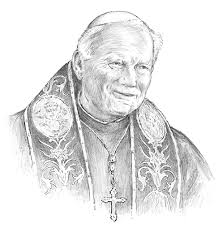
In place of a poem today, this tidbit about Psalm 27 from Pope John Paul II:

The faithful know that being consistent creates ostracism and even provokes 
contempt and hostility in a society that often chooses to live under the banner 
of personal prestige, ostentatious success, wealth, unbridled enjoyment. 
They are not alone, however, and preserve a surprising interior peace in their hearts because, as the marvellous “antiphon” that opens the Psalm says, 
“the Lord is light and salvation… the stronghold of life” (cf. Ps 27: 1) of the just. 
He continuously repeats: “Whom shall I fear?”, “Of whom shall I be afraid?”, 
“My heart shall not fear”, “Yet I will trust” (cf. vv. 1, 3).
JOHN PAUL II- GENERAL AUDIENCE
Wednesday, 21 April 2004

Music: The Lord is My Light and My Salvation – Haas and Haugen 

Refrain: The Lord is my light and my salvation, of whom shall I be afraid?

The Lord is my light and my help; whom should I fear?The Lord is the stronghold of my life; before whom should I shrink?

There is one thing I ask of the Lord; for this I long;
to live in the house of the Lord all the days of my life.

I believe I shall see the goodness of the Lord, in the land of the living;
hope in him and take heart, hope in the Lord!

Psalm 88: Outlook Gloomy

Memorial of Saint Jerome, Priest and Doctor of the Church

September 30, 2020

Today, in God’s Lavish Mercy, we pray with Psalm 88. It’s supposed to be a gloomy, rainy day around here where I live, and Psalm 88 isn’t going to help! It is the desperate prayer of one who hears no answer from God:

But I, O LORD, cry out to you;
with my morning prayer I wait upon you.
Why, O LORD, do you reject me;
why hide from me your face?


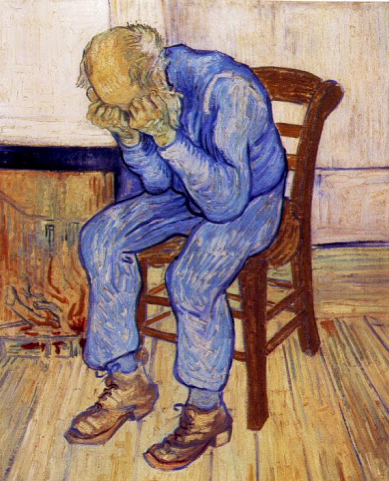
Sorrowful Man – Vincent Van Gogh

According to Martin Marty, a professor of church history at the University of Chicago,
Psalm 88 is “a wintry landscape of unrelieved bleakness.”
Psalm 88 ends by saying:
You have taken my companions and loved ones from me; 
the darkness is my closest friend.
Indeed, in Hebrew the last word of the psalm is “darkness”.
~ from Wikipedia


Also from Wikipedia:

J.M.Neale and R.F. Littledale, writing in the 19th century, find that Psalm 88 “stands alone in all the Psalter for the unrelieved gloom, the hopeless sorrow of its tone. Even the very saddest of the others, and the Lamentations themselves, admit some variations of key, some strains of hopefulness; here only all is darkness to the close.”


Gratefully, I have seldom been in the place of this psalm … but that doesn’t mean never. Many of you, I imagine, could say the same.

So what do we do when life, by our choices or despite them, finds us irrevocably caught in spiritual darkness? What happens to us when we think God isn’t listening to our prayer, or maybe that there was never any God in the first place?

St. John of the Cross says this:

Live in faith and hope,
though it be in darkness,
for in this darkness God protects the soul.
Cast your care upon God
for you are His and He will not forget you.
Do not think that He is leaving you alone,
for that would be to wrong Him.

John’s further writings show us that this darkness, rather than alienate John from God, was the source of unparalleled union with God.

May we be blessed in the same way.🙏


One dark night, 
Kindled in love with yearnings—oh, happy chance!— 
I went forth without being observed, 
My house being now at rest.
In darkness and secure, 
By the secret ladder, disguised—oh, happy chance!—
In darkness and in concealment, 
My house being now at rest.
In the happy night, 
In secret, when none saw me,
Nor I beheld aught, 
Without light or guide, save that which burned in my heart.
This light guided me 
More surely than the light of noonday
To the place where he (well I knew who!) was awaiting me— 
A place where none appeared.
Oh, night that guided me, 
Oh, night more lovely than the dawn,
Oh, night that joined Beloved with lover, 
Lover transformed in the Beloved!
~ John of the Cross

Poetry: Sorrow – Renee Yann, RSM

You must be alone
    with sorrow
    before you can leave it,
    or it will crush you
    like a dark, heavy rock.

    You must drive into
    the hollow of its face,
    under the ledges
    it projects against you.
    Feel its cold granite
    pressed to your grain.

    In time,
    it will allow your turning
    to rest your back
    within its curve.

    Only then,
    you will be free to leave it,
    walking lightly once again
    on yielding earth.

    When you return, it will be freely,
    on a pilgrimage,
    to touch the name you carved once
    in your heart’s anguish.

Music: Holy Darkness – John Michael Talbot

Psalm 25: God’s Will?

Twenty-sixth Sunday in Ordinary Time

September 27, 2020


Today, in God’s Lavish Mercy, we pray with Psalm 25, set perfectly in the midst of a few readings that speak to us about, among other things , “the Father’s Will”.

I think there is no greater spiritual mystery than the meaning of  “God’s Will”, (and not wanting to show up Thomas Aquinas, I’ll resist explaining it here. 😂🧐)

But we’ve all heard attempts at explaining it, haven’t we, especially as it relates to suffering— as in:

  • everything that happens is God’s Will, so we must accept it
  • God wills our suffering to test us
  • if God wills that we suffer, He will give us the strength to endure it

I just don’t think so … not the God I love and Who loves me.

But these attempts to explain suffering are understandable because we want to rationalize the things we fear. Most of us, I think, struggle with the problem of evil and suffering in the world. We want to know what to do when, as Rabbi Kushner wrote, “… Bad Things Happen to Good People”.


Our first reading from Ezekiel shows us that even the ancient peoples met this struggle. The prophet seems to suggest that if you’re bad, you’ll suffer. If you repent, you won’t. Well, we all know that’s not quite the reality! But nice try, Ezekiel.

Our psalm gently leads to another way of facing suffering as the psalmist prays for wisdom, compassion and divine guidance. In the Garden of Gethsemane, Jesus himself prayed like this as he confronted his impending suffering.


In our second reading, Paul places before us the example of Jesus who, in the face of suffering, was transformed by love:

Praying with these readings, each one of us must come to our own peace with the mystery of suffering. What we can be sure of is this: God’s Will is always for our wholeness and joy as so simply taught to us when we were little children:

God made me to know, love, and serve God, 
and to be happy with God in this world and forever.

Our Gospel tells us that such happiness comes through faith and loving service, through responding to “the Father’s Will”.  May we have the insight, the love and the courage!


Poetry: Of Being by Denise Levertov 

I know this happiness
is provisional:

       the looming presences—
       great suffering, great fear—

       withdraw only
       into peripheral vision:

but ineluctable this shimmering
of wind in the blue leaves:

this flood of stillness
widening the lake of sky:

this need to dance,
this need to kneel:

       this mystery:

Music: To You, O Lord (Psalm 25) Graham Kendrick

Psalm 56: Light from Dark

Saturday of the Twenty-fourth Week in Ordinary Time

Saturday, September 19, 2020


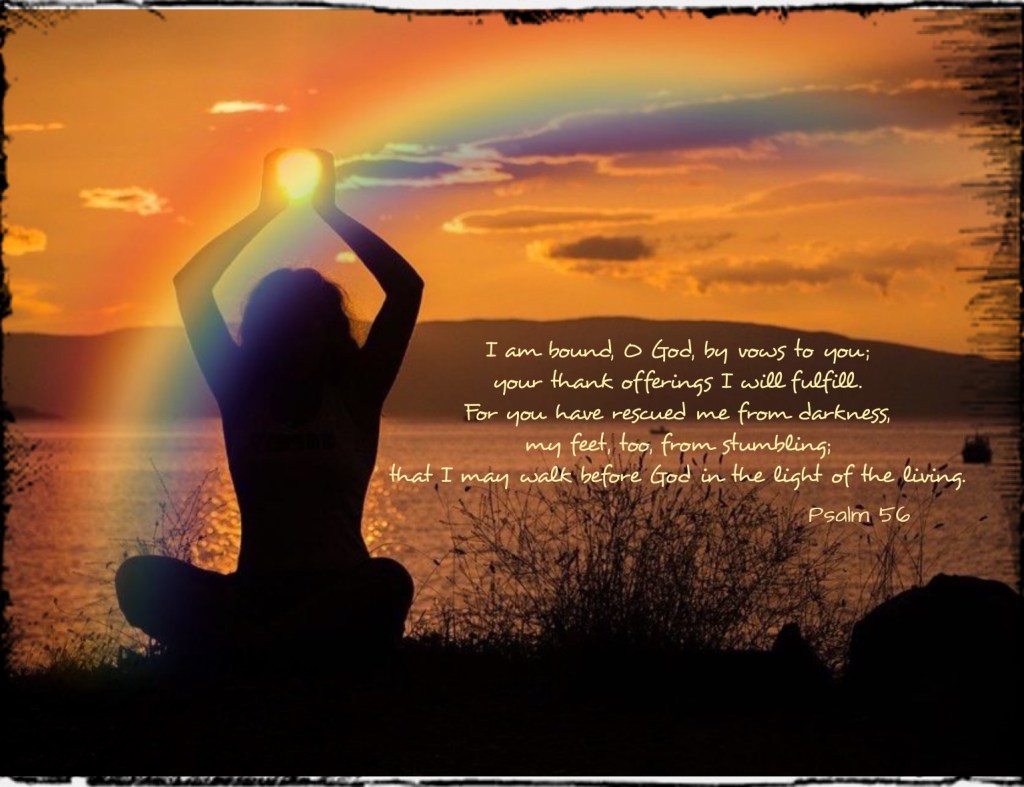
Today, in God’s Lavish Mercy, we pray with Psalm 56, an unusual mix of lamentation and praise, of light and dark emotions. Many consider the psalm to be a prayer of David in the midst of his problems with Solomon.

Our prayer can be this kind of mix at times. We might feel stressed by the exigencies of life, calling on God to ease our angst and protect us. At the same time, we have a underlying confidence that God is with us, even in difficulty. Such a prayer is not unlike the one Jesus prayed in Gethsemane.


I cherish a verse from Psalm 56 not included in today’s reading. In beautiful simile, the line captures suffering still imbued with trust. I especially like the old translation from the King James Version:

Today’s verses reflect the confidence born of such honest and steadfast prayer. There comes a surety in God’s abiding, a shift from self-centered fear, a welling up of praise for the One who saves us, not only from our troubles, but from our anxious selves.

Now I know that God is with me.
In God, in whose promise I glory,
in God I trust without fear;
what can flesh do against me?


Poetry: Mount of Olives by Irene Zimmerman, OSF

He falls, crying,
“Help me, Father.”
Though his acquiescence rings
true as a well-tuned violin, the searing bow brings
tears of blood
as it plays across the taut strings
of his human dread of dying.

Music: Psalm 56 – by Share Faith

Psalm 17: Apple of God’s Eye

Friday of the Twenty-fourth Week in Ordinary Time

Friday, September 18, 2020


Today, in God’s Lavish Mercy, we pray with Psalm 17, a confident prayer calling on God’s intervention.

The psalmist tenders a plea:

Hear, O LORD, a just suit;
attend to my outcry;
hearken to my prayer
from lips without deceit.

Psalm 17:1

But before reiterating that plea, the pray-er convinces God that she is worthy of an answer:

You have tested my heart,
searched it in the night.
You have tried me by fire,
but find no malice in me.
My mouth has not transgressed
as others often do.
As your lips have instructed me,
I have kept from the way of the lawless.

Psalm 17: 3-4

It sounds a little boastful but it really isn’t. The one who prays this psalm is very familiar with God and God with her. There are no secrets between them. She knows that she is infinitely loved and protected, not despite her vulnerability but because of it. 

The psalmist, from long experience, is confident asking for help, as we would be asking a friend to turn and listen to us:

I call upon you; answer me, O God.
Turn your ear to me; hear my speech.

Psalm 17: 7

Have you ever been asked for prayers because you are “a good prayer”?
It happens to nuns all the time.

But no prayer is more powerful than another. We say “Of course” to such requests because it is our intention to join our prayer with that of the requester.

Show your wonderful mercy,
you who deliver with your right arm
those who seek refuge from their foes.
Keep me as the apple of your eye;
hide me in the shadow of your wings

Psalm 17: 8-9

Each of us is God’s “eye-apple”. Each of us, when we give ourselves to a long familiarity with God, will be wrapped in the confidence of one who is always answered.

( In a second posting, I’ll be sending on an extra meditation on The Eye of God by Macrina Wiederkehr – beautifully profound.)


Poetry: As Kingfishers Catch Fire – Gerard Manley Hopkins

by Alcedo Atthis

As kingfishers catch fire, dragonflies draw flame; 
As tumbled over rim in roundy wells 
Stones ring; like each tucked string tells, each hung bell’s 
Bow swung finds tongue to fling out broad its name; 
Each mortal thing does one thing and the same: 
Deals out that being indoors each one dwells; 
Selves — goes itself; myself it speaks and spells, 
Crying Whát I dó is me: for that I came. 

I say móre: the just man justices; 
Keeps grace: thát keeps all his goings graces; 
Acts in God’s eye what in God’s eye he is — 
Chríst — for Christ plays in ten thousand places, 
Lovely in limbs, and lovely in eyes not his 
To the Father through the features of men’s faces. 


Music:   The Apple of My Eye by Umb-5 and Sam Carter

Sometimes a non-spiritual song captures a spiritual meaning in a beautiful way. Let God sing to you with this lovely song.

Psalm 100: Joy Hides in Sorrow

Memorial of Our Lady of Sorrows

Tuesday, September 15, 2020


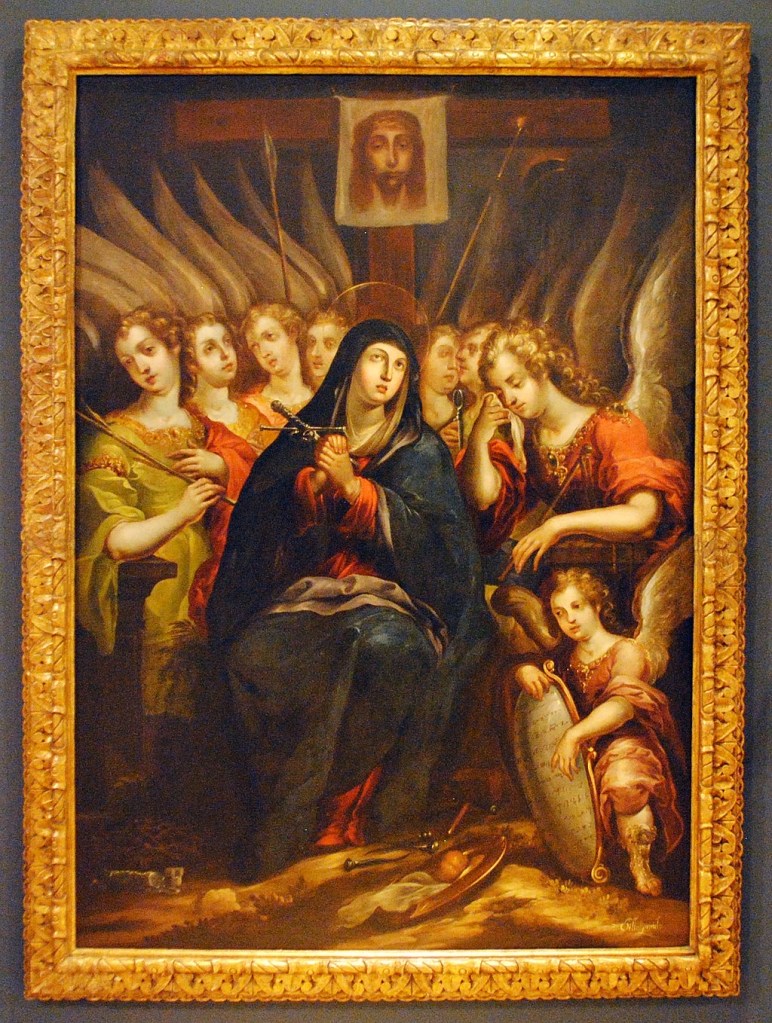
Today, in God’s Lavish Mercy, we pray with Psalm 100, the “Jubilate Deo” – “Rejoice in the Lord”. These verses, on the feast of our Sorrowful Mother, might seem a bit contradictory:

Sing joyfully to the LORD, all you lands;
serve the LORD with gladness;
come before him with joyful song.

But I think the seeming contradiction reveals a deep truth.

For those who live in God,
no sorrow can eradicate their resolute joy.


La Dolorosa (Lady of Sorrows or Mater Dolorosa) is a work by Cristóbal de Villalpando at the Musep Soumaya in Mexico City.

Certainly, like Mary, the faithful heart feels sorrow for both personal pain and the pain of all Creation. But the pain and sorrow is not the end of their feeling. There is a joyful hope because God abides with us in any suffering, promising that no evil can defeat the one who believes.

Mary believed that with all her heart and lived it. She invites us to the same courageous faith. As Psalm 100 assures us:

Know that the LORD is God;
Who made us, whose we are;
God’s people, the flock God tends.

For the Lord is good, 
whose kindness endures forever,
and whose faithfulness is to all generations.


Poem: Today’s poetic passage is from one of the great classics of Christian literature, A Woman Wrapped in Silence by Father John W. Lynch.

The book is a masterpiece best appreciated in reflective contemplation. I have chosen a sliver of its beauty today, one of many that captures Mary’s joy born of faith-filled suffering. This selection imagines what it was like when Mary remained in the Upper Room as the others, not knowing what to expect, went to the tomb early on Easter morning. The Resurrected Jesus comes to Mary first, before any other appearance.


Or is 
it true or thought of her she found no need
To search? And better said that she had known
Within, they’d not discover him again
Among the dead? That he would not be there
Entombed, and she had known, and only watched
Them now as they were whispering of him,

And let them go, and listened afterward
To footsteps that were fading in the dark.

To wait him here. Alone. Alone. A woman
Lonely in the silence and the trust
Of silence in her heart that did not seek,
Or cry, or search, but only waited him.

We have no word of this sweet certainty
That hides in her. There is not granted line
Writ meager in the scripture that will tell
By even some poor, unavailing tag
Of language what she keeps within the silence.
This is hers. We are not told of this,
This quaking instant, this return, this Light
Beyond the tryst of dawn when she first lifted
Up her eyes, and quiet, unamazed,
Saw He was near.

Music: Jubilate Deo – Mozart

Psalm 45: God Longs for Us

Wednesday, September 9, 2020

Today, in God’s Lavish Mercy, we pray with Psalm 45 which scripture scholars interpret as a Davidic wedding song. Many believe it refers to the marriage of a king to the daughter of a royal foreign house.

The psalm is set today between two powerful readings. 

In our first reading, Paul gives an extended opinion piece on celibacy and marriage, a reading which has spawned countless academic interpretations. Our Gospel, pivotal to our understanding of holiness, also has generated abundant scholarly commentary.

We may finish today’s readings wondering who must I be to become the person God wants me to be? Celibate? Poor? Hungry? Sorrowful? Persecuted?  Like Francis Thompson in his famous poem, The Hound of Heaven, we may feel pursued by a God we might rather ignore!

For, though I knew His love Who followèd, 
        Yet was I sore adread 
Lest, having Him, I must have naught beside

Indeed, the answer is not simple. Each person’s path to God’s heart is different. The readings don’t give us a foolproof map. Instead, they give us prompts about where we might go off the path.

In other words, the readings spread the stars across our heavens. But we must find our own bearings in life to allow us to continually deepen our relationship with God. If our current circumstances and choices prevent that in any way, we must reorient ourselves.


For me the lesson is this. God desires our complete love and worship. God wants to be the center of our lives. That’s why we exist. All the rest is incidental.

Our psalm captures it in this way:

Hear, my child, and see; turn your ear,
forget those things to which you are accustomed.
So shall the Lord desire your full commitment;
the Lord Whom you must worship with your life.


Our Gospel is uncompromising in its warning that obsession with material goods, personal comfort, and selfish success blocks our awareness of how distant we can grow from God:

But woe to you who are rich,
for you have received your consolation.
But woe to you who are filled now,
for you will be hungry.
Woe to you who laugh now,
for you will grieve and weep.
Woe to you when all speak well of you,
for their ancestors treated the false 
prophets in this way.


We are blessed if we are free of these woes, but it is hard in a culture spiritually crippled by these obsessions.

Psalm 45 calls us to “bend our ear” toward God’s invitation. By sincere prayer and loving vigilance, we can hear the Divine whisper within our circumstances, leading us to fullness of life with God. We will recognize it by this: it always calls us to justice, mercy, and charity.

You love justice and hate wrongdoing;
therefore God, your God, has anointed you
with the oil of gladness above your peers.


Poetry: Excerpt from The Hound of Heaven by Francis Thompson

( It’s a little “frilly” with early 20th century Romanticism, but – oh my! – some of its lines get burned into the memory!)

I fled Him, down the nights and down the days; 
I fled Him, down the arches of the years; 
I fled Him, down the labyrinthine ways 
Of my own mind; and in the mist of tears 
I hid from Him, and under running laughter. 
Up vistaed hopes I sped; 
And shot, precipitated, 
Adown Titanic glooms of chasmèd fears, 
From those strong Feet that followed, followed after. 
But with unhurrying chase, 
And unperturbèd pace, 
Deliberate speed, majestic instancy, 
They beat—and a Voice beat 
More instant than the Feet— 
‘All things betray thee, who betrayest Me.’ 

Music: I Long for You – Ro Atilano