Psalm 13: Mary’s Trust

Feast of the Nativity of the Blessed Virgin Mary

Tuesday, September 8, 2020

Today, in God’s Lavish Mercy, on our Blessed Mother’s birthday, we pray with the beautiful final verses of Psalm 13.
These verses embody an immense shift in form from the psalm’s early lines. Early on, the psalmist cries out four times, “How long, O Lord?”.

How long: 

  • Will you forget me?
  • Will you hide your face from me?
  • Must I carry sorrow in my soul?
  • Will my enemy triumph over me?

Referring to these early verses reminds us that Mary’s life was full of sorrow as well as joy. On a feast like today, we think of Mary in her heavenly glory. But in her lifetime, Mary suffered many sorrows. She was an unwed mother, a refugee, and a widow. She was the mother of an executed “criminal” and a leader of his persecuted band.

The Julian of Norwich, “Her Showing of Love”

What was it that allowed Mary to transcend sorrow and claim joy? Our psalm verses today help us to understand. They show the psalmist turning to heartfelt prayer., trusting God’s abiding protection.

Look upon me, answer me, LORD, my God!
Give light to my eyes lest I sleep in death,
Lest my enemy say, “I have prevailed,”
lest my foes rejoice at my downfall.


That deep trust ultimately yields not only peace,
but joy.
Mary, singer of the Magnificat,
is the quintessence of that holy joy.


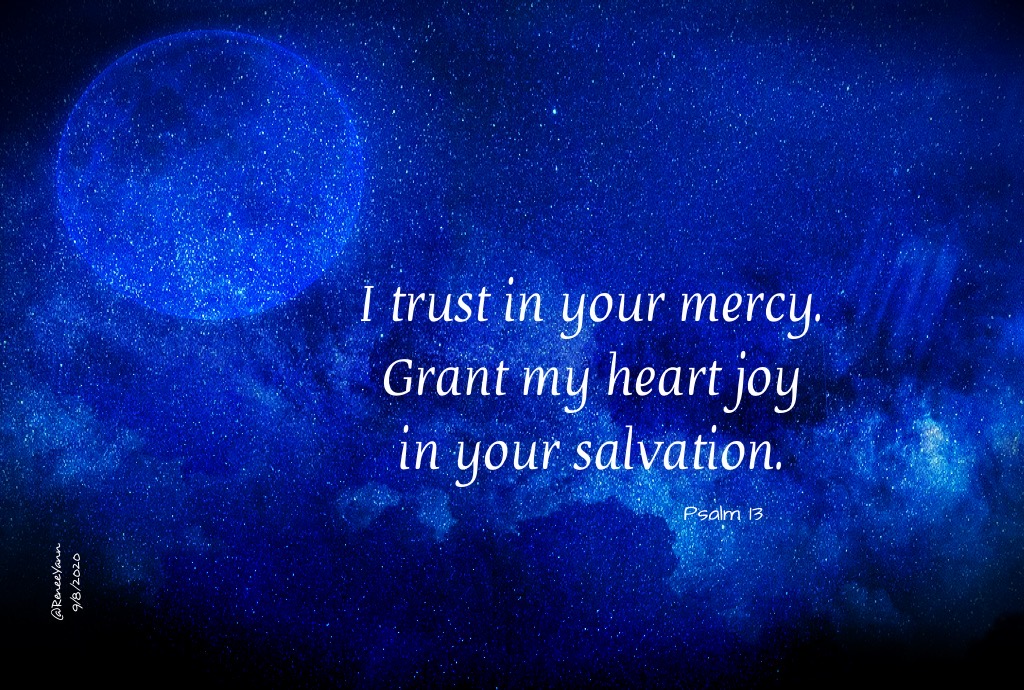
But I trust in your mercy.
Grant my heart joy in your salvation,
I will sing to the LORD,
Who has dealt bountifully with me!

Today, in our prayer, we ask Mary to love and guide us through the challenges of our lives.


Poetry: Three Days – Madeleine L’Engle

Friday:
When you agree to be the mother of God
you make no conditions, no stipulations.
You flinch before neither cruel thorn nor rod.
You accept the tears; you endure the tribulations.
But, my God, I didn't know it would be like this.
I didn't ask for a child so different from others.
I wanted only the ordinary bliss,
to be the most mundane of mothers.

Saturday:
When I first saw the mystery of the Word
made flesh I never thought that in his side
I'd see the callous wound of Roman sword
piercing my heart on the hill where he died.
How can the Word be silenced? Where has it gone?
Where are the angel voices that sang at his birth?
My frail heart falters. I need the light of the Son.
What is this darkness over the face of the earth?
Sunday:
Dear God, He has come, the Word has come again.
There is no terror left in silence, in clouds, in gloom.
He has conquered the hate; he has overcome the pain.
Where, days ago, was death lies only an empty tomb.
The secret should have come to me with his birth,
when glory shone through darkness, peace through strife.
For every birth follows a kind of death, and only after pain comes life.

Music: Magnificat – Daughters of Mary

(To see Latin and English verses, click the little arrowhead just below the picture on the right.)
Psalm 95:Hear the Voice

Twenty-third Sunday in Ordinary Time

Sunday, September 6, 2020

Today, in God’s Lavish Mercy, we pray with Psalm 95, a favorite of liturgists, and one we have met several times before. What different light might it offer us today as we pray?

The psalm today serves as a bridge between powerful readings about neighborly love and fraternal correction. These readings tell us to listen for God’s heartbeat in our world and to enter its rhythm. 

They also tell us to love our neighbor enough that, if she or he is out of synch with God’s rhythm, we help align them by our counsel and example.

Have you ever tried to do that? It’s really tough!


First of all, we have to be so vigilant about the purity of our own intentions. We can’t instruct our friends in righteousness out of our own confusion. So often, our desire for others to “improve” grows out of our opinionated self-interest. You might remember what Jesus said about extracting the plank from our own eye before removing the splinter from our neighbor’s!


Next we really have to love our sister or brother and sincerely want their good. We have to forgive them any hurt they have caused us. We have to be bigger than most of us, speaking for myself, are inclined to be.

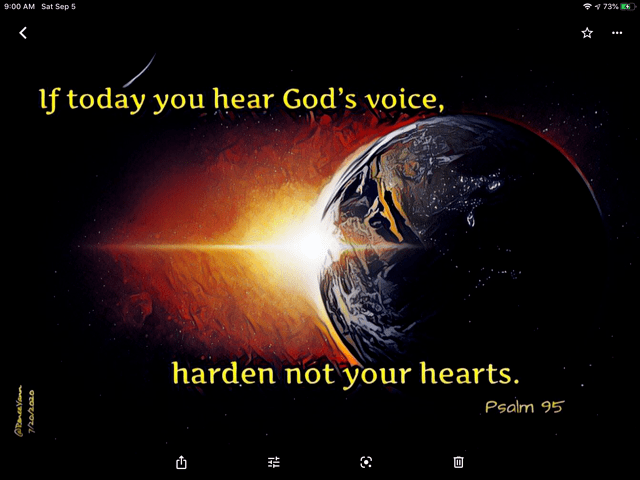
As the psalm tells us, we can’t have hard hearts. As we approach our sister or brother, our hearts must be softened by listening, patience, understanding, humility and hope. We have to be sure the “voice” we’re sharing comes from God not self.

Harden not your hearts as at Meribah,
as in the day of Massah in the desert,
Where your fathers tempted me;
they tested me though they had seen my works.

And the flip of all this, of course, is that when we are the one out of rhythm, we receive loving correction in the same spirit of openness.

Lots of Grace is needed on both sides of this dance! May we learn and receive it!


Poetry: The Gift by Li-Young Lee

To pull the metal splinter from my palm
my father recited a story in a low voice.
I watched his lovely face and not the blade.
Before the story ended, he’d removed
the iron sliver I thought I’d die from.

I can’t remember the tale,
but hear his voice still, a well
of dark water, a prayer.
And I recall his hands,
two measures of tenderness
he laid against my face,
the flames of discipline
he raised above my head.

Had you entered that afternoon
you would have thought you saw a man
planting something in a boy’s palm,
a silver tear, a tiny flame.
Had you followed that boy
you would have arrived here,
where I bend over my wife’s right hand.

Look how I shave her thumbnail down
so carefully she feels no pain.
Watch as I lift the splinter out.
I was seven when my father
took my hand like this,
and I did not hold that shard
between my fingers and think,
Metal that will bury me,
christen it Little Assassin,
Ore Going Deep for My Heart.
And I did not lift up my wound and cry,
Death visited here!
I did what a child does
when he’s given something to keep.
I kissed my father.

Music: Let Me Hear Your Voice – Francesca LaRose

Psalm 145: Mercy Makes Us Sing

Tuesday of the Twenty-second Week in Ordinary Time

September 1, 2020

2018 reflection on Corinthians 

Today, in God’s Lavish Mercy, we pray with Psalm 145, a consoling hymn of confidence in God’s Mercy.

And, my dears, all I really want to say to you is, “September 1st! God bless us! We have made it this far in these times (as one gifted friend calls them, “these quantum weird times”.)

And, certainly, we pray in profound companionship with all those who suffer because of this pandemic. But at the same time we are so grateful for all who have, so far, been delivered from its grasp!

So hooray for us, and hooray for God! Let’s pick up our hope, energy and faith by drinking in the beauty of Psalm 145. Together, in faith, we CAN make it to a vaccine time- a time to forget,  AND to remember all that might transform and bless us from these days…

… because God is MERCY,
and there is some gift for all of us
even in shadow

The LORD is gracious and merciful,
slow to anger and of great kindness.
The LORD is good to all
and compassionate toward all his works.


Jesus meets the demon in today’s Gospel, a demon who is no match for Uncreated Grace. By the power of our Baptism, let us draw that Grace into our spirits, into our world today as we pray. 

And let us be at once both astonished and confident in the power of God’s Word to heal even the immense darkness of our world.

Jesus went down to Capernaum, a town of Galilee.
He taught them on the sabbath,
and they were astonished at his teaching
because he spoke with authority.


Poetry: The Fountain – Denise Levertov

Don’t say, don’t say there is no water
to solace the dryness at our hearts.
I have seen

the fountain springing out of the rock wall
and you drinking there. And I too
before your eyes

found footholds and climbed
to drink the cool water.

The woman of that place, shading her eyes,
frowned as she watched—but not because
she grudged the water,

only because she was waiting
to see we drank our fill and were
refreshed.

Don’t say, don’t say there is no water.
That fountain is there among its scalloped
green and gray stones,

it is still there and always there
with its quiet song and strange power
to spring in us,
up and out through the rock.

A Second Poem for the month’s beginning: September by Deborah Landau
Some of us might also find ourselves somewhere  in this wistful poem. I just like it. Thought some of you might too. 🤗

Dazzling emptiness of the black green end of summer no one
running in the yard pulse pulse the absence.

Leave them not to the empty yards.

They resembled a family. Long quiet hours. Sometimes
one was angry sometimes someone called her "wife"
someone's hair receding.

An uptick in the hormone canopy embodied a restlessness
and oh what to do with it.

(How she arrived in a hush in a looking away and not looking.)
It had been some time since richness intangible
and then they made a whole coat of it.

Meanwhile August moved toward its impervious finale.

A mood by the river. Gone. One lucid rush carrying them along.

Borderless and open the days go on—

Music: I Will Praise Your Name – Marty Hagen and David Haas

Antiphon: | will praise your name, my King and my God.
1. I will give you glory, my God and King, and I will bless your name forever.
Every day I will bless and praise your name forever.
2. The Lord is full of grace and mercy. He is kind and slow to anger.
He is good in all His works and full of compassion.
3. Let all your works give you thanks, O Lord, and let all the faithful bless you.
Let them speak of your might, O Lord, the glory of your kingdom.
4. The Lord is faithful in all His words, and always near. His name is holy.He lifts up all those who fall. He raises up the lowly.

Psalm 63: The Longing

Twenty-second Sunday in Ordinary Time

August 30, 2020

Today, in God’s Lavish Mercy, we pray with the magnificent Psalm 63 which captures the soul’s deep longing for God.

It is a longing that, once released in the heart, must be satisfied.


In our first reading, Jeremiah experiences it akin to an addiction, the power of it consuming his life:

I say to myself, I will not mention him,
I will speak in his name no more.
But then it becomes like fire burning in my heart,
imprisoned in my bones;
I grow weary holding it in, I cannot endure it.

Jeremiah 20:9

Paul, in his letter to the Romans, says not to resist the longing, but to let ourselves be consumed by it like a sacrificial offering:

I urge you, brothers and sisters, by the mercies of God,
to offer your bodies as a living sacrifice,
holy and pleasing to God, your spiritual worship. 

Romans 12:1

Jesus, in our Gospel, is the One who surrenders himself fully to that holy longing. He calls us to imitate him:

For whoever wishes to save his life will lose it,
but whoever loses his life for my sake will find it.


These are profound readings calling us a place that words cannot describe, a place where the Cross intersects with the truth of our lives. May we have the grace to hear and believe.


Poetry: The Longing – Rumi

There is a candle in your heart,
ready to be kindled.
There is a void in your soul,
ready to be filled.

You feel it, don't you?
You feel the separation
from the Beloved.

Invite Love to quench you,
embrace the fire.

Remind those who tell you otherwise that 
Love
comes to you of its own accord, 
and the longing for it cannot be learned in any school.

Music: The Prayer – Montserrat Cabalé

Psalm 33: Unfailing Trust

Memorial of the Passion of Saint John the Baptist

August 29, 2020

Today, in God’s Lavish Mercy, we pray again with Psalm 33. Today’s verses console us with the reminder that God is watching over us, as individuals and as communities.

Blessed the nation whose God is the LORD,
the people chosen for God’s own inheritance.
From heaven the LORD looks down;
seeing all humanity.

You know, sometimes I wonder! How can God see some of the things going on in the world and not intervene? How can God let innocence suffer? The psalm seems to promise that intervention, but does it really?

But see, the eyes of the LORD are upon those who fear God,
upon those who hope for God’s kindness,
To deliver them from death
and preserve them in spite of famine.

That last line is the zinger. It doesn’t say there will be no famine. It simply says that the God-fearing will be preserved despite the famine.


Hasn’t your life taught you that? We’ve all been through lots of things that we asked God to take away – pain, sadness, fear, loss. Probably most, if not all, of those burdens remained with us until we worked through them. 

By faith and God’s Grace, we came through the other side stronger, deeper, more faithful. If we can trust God, “wait on the Lord”, the way comes to us – a way that leads us more deeply into God’s freedom and joy.

Our soul waits for the LORD,
who is our help and our shield,
For in God our hearts rejoice;
in God’s holy name we trust.

Let’s pray for that kind of faith and trust for ourselves and for our beloveds. Let’s pray for the courage to learn it by unfailing prayer and practice.


Poetry: In Memoriam A. H. H. OBIIT MDCCCXXXIII: 54
by Alfred Lord Tennyson

Oh, yet we trust that somehow good 
         Will be the final end of ill, 
         To pangs of nature, sins of will, 
Defects of doubt, and taints of blood; 

That nothing walks with aimless feet; 
         That not one life shall be destroy'd, 
         Or cast as rubbish to the void, 
When God hath made the pile complete; 

That not a worm is cloven in vain; 
         That not a moth with vain desire 
         Is shrivell'd in a fruitless fire, 
Or but subserves another's gain. 

Behold, we know not anything; 
         I can but trust that good shall fall 
         At last—far off—at last, to all, 
And every winter change to spring. 

So runs my dream: but what am I? 
         An infant crying in the night: 
         An infant crying for the light: 
And with no language but a cry. 

Music: The Passion of John – Johann Sebastian Bach

This piece is not about John the Baptist. It is an excerpt from two hour meditation of the Passion narrative in John the Evangelist’s Gospel.

However, this beautiful excerpt fits so well with today’s reflection.

Psalm 33:Love’s Design

Memorial of Saint Augustine, Bishop and Doctor of the Church

August 28, 2020


Today, in God’s Lavish Mercy, we pray with Psalm 33, a song of praise calling the people to rejoice in God’s justice and kindness.

In its attitude of trust and freedom, the Psalm might remind us of Robert Browning’s verse:

God’s in his heaven. All’s right with the world.

But neither in the psalmist’s time, nor in Browning’s, was everything really “all right” with the world. Things are never really “all right” with the world. There is always war, crime, hunger, disease, natural disasters, and a slew of other troubles brewing somewhere.

So how can the psalmist or any other preacher invite us to trust, believe, and rejoice like this?

Exult, you just, in the LORD;
praise from the upright is fitting.
Give thanks to the LORD on the harp;
with the ten-stringed lyre chant his praises.


Keywords in this verse give us a clue: those who are just and upright will see the pattern of God’s mercy which lies deeper than the troubles of this world. They will trust and be comforted by God’s transcendent faithfulness to us in all things. Their faith and joy in the face of suffering will confound the faithless.


Calling us to the full meaning of Christ’s sacrificial love, Paul reiterates this mysteriously contradictory truth in our first reading :

For the foolishness of God is wiser than human wisdom,
and the weakness of God is stronger than human strength.

For Christians, the Cross is the ultimate symbol of this profound wisdom and strength. It is a mystery too deep for our understanding, but by faith we may slowly become immersed in its Truth.


The message of the cross is foolishness to those who are perishing, 
but to us who are being saved it is the power of God.

1 Corinthians 18

As we pray with Psalm 33 today, let us be aware of the cause of our joy – a holy joy deeply rooted in God, trusting God’s Will for our salvation in the pattern of Jesus Christ.


For upright is the word of the LORD,
and all God’s works are trustworthy.
The LORD loves justice and right;
of the kindness of the Lord the earth is full.


Poetry: Primary Wonder – Denise Levertov

Days pass when I forget the mystery.
Problems insoluble and problems offering
their own ignored solutions
jostle for my attention, they crowd its antechamber
along with a host of diversions, my courtiers, wearing
their colored clothes; cap and bells.
                                                        And then
once more the quiet mystery
is present to me, the throng’s clamor
recedes: the mystery
that there is anything, anything at all,
let alone cosmos, joy, memory, everything,
rather than void: and that, O Lord,
Creator, Hallowed One, You still,
hour by hour sustain it.

Music: Your Cross Changes Everything – Matt Redman

Psalm 96: Singing in the Rain

 Tuesday of the Twenty-first Week in Ordinary Time

August 25, 2020

Today, in God’s Lavish Mercy, we pray with Psalm 96 which calls the people to praise God in music and dance because they have been chosen and confirmed as God’s People. 

The psalm may have been composed by David to mark the return of the Ark of the Covenant to Jerusalem. At that time, Israel had a sense of great victory, restoration, and security as David assumed kingship at God’s command.

But today’s particular verses have an eschatological tone. They turn the attention of the praise singer to the overarching fact that God is infinitely larger than any present small victory. They imply that the only true victory and restoration are found in complete abandonment to God’s power in our lives no matter our situation.

Say among the nations: The Lord is king.
God has made the world firm, not to be moved;
God governs the peoples with equity.


That Divine Power is easy enough to sing about when things go well for us, as they were for Israel at that time. But can we still praise God’s dominion and power when things seem bleak, when we don’t feel in control of our reality?

Psalm 96 invites us to that deep abandonment of self into God’s unfailing Mercy, no matter our life’s weather.

Declare among the nations: The LORD is king.
The world will surely stand fast, never to be shaken.
God rules the peoples with fairness.

When we struggle to find that kind of holy equanimity, Psalm 96 suggests we look to nature, and to its persistent return to Divine Balance, even after upheaval. So too will any unbalance in us be restored within the infinite arc of God’s abiding love. And that is the real reason to always sing God’s praise!

Let the heavens be glad and the earth rejoice;
let the sea and what fills it resound;
let the plains be joyful and all that is in them!
Then shall all the trees of the forest exult.

Before the Lord Who comes;
Who comes to rule the earth.
God shall rule the world with justice
and the peoples with constancy.

Poetry: To Him Who Is Feared by Eleazar Ben Kalir
Translated by Lady Katie Magnus
from the Liturgy for Rosh Hashana

To Him who is feared a Crown will I bring.
Thrice Holy each day acclaim Him my King;
At altars, ye mighty, proclaim loud His praise,
And multitudes too may whisper His lays.
Ye angels, ye men, whose good deeds He records—
Sing, He is One, His is good, our yoke is the Lord’s!
Praise Him trembling to-day, His mercy is wide—
Ye who fear for His wrath—it doth not abide!
Ye seraphim, high above storm clouds may sing;
Men and angels make music, th’ All-seeing is king. 
As ye open your lips, at His Name they shall cease—
Transgression and sin—in their place shall be peace;
And thrice shall the Shophar re-echo your song
On mountain and altar to whom both belong. 

Music: O Sing Unto the Lord – Handel

Psalm 107: Lost Then Found

Memorial of Saint Pius X, Pope

August 21, 2020

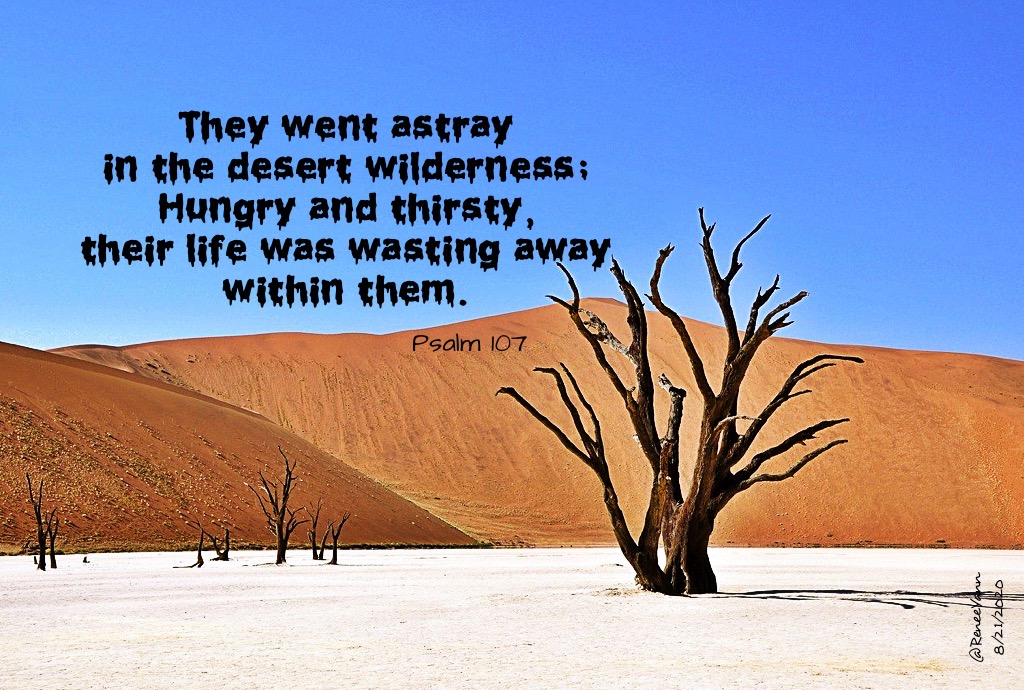
Today, in God’s Lavish Mercy, we pray with Psalm 107, a chant of gratitude to God’s Mercy from the lost who have been found.

There are all kinds of “lost”. 

There are small “losts” like when I misinterpret my GPS and keep hearing “Recalculating route…”. 

Then there are huge “losts” like when a beloved dies and our life’s anchor breaks.

This morning’s psalm and reading are speaking of a particular kind of “lost”, one that comes from wandering away from Love, for whatever reason that happens to us.


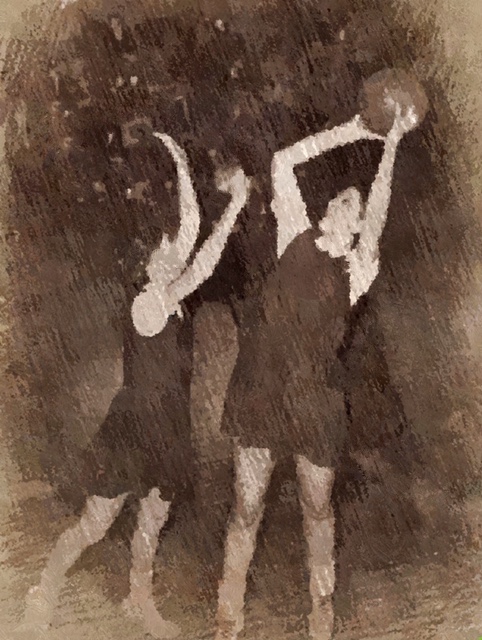
As I pray these readings, the face of a good high school friend comes to mind. Judy was a super basketball player. Everything about her was vigor, coordination, and that all-American beauty that needed no makeup to impress anybody.

After graduation, I went into the silence of the pre-Vatican II convent and Judy disappeared into her future. When our five-year reunion rolled around, I looked forward to reconnecting with her.

When I saw her, my heart broke. She was a shadow of herself, emaciated, listless, and lightless. She silently shouted a refrain like today’s verse from Ezekiel:

Our bones are dried up,
our hope is lost, and we are cut off.

We were both twenty-three years old. I was just beginning to grow into my hopes. Judy was already divorced, alone, and the mother of a father-starved child.

That kind of “lost” feels almost irredeemable. 


But Psalm 107 assures us that, in faith, no loss, no alienation is irredeemable.

They cried to the LORD in their distress;
from their straits God rescued them.
And led them by a direct way
to the healing of community.


Judy and I stayed in touch for a few years. Despite her troubles, she kept faith. That was the key.

She did the hard work to find herself again with the help of family, friends, counselors, and a supportive faith community. Eventually, she remarried and was happy the last time I saw her before she moved to the west coast.


This morning, I see such apparent parallels between Israel’s and Judy’s story. That helps me look back over my own life for the same, perhaps not so dramatic, parallels and to be grateful for the many times God found me.

Let them give thanks for God’s Mercy
and wondrous deeds to us,
Because God has satisfied the longing soul
and filled the hungry heart with good things.


Photo by Markus Spiske on Pexels.com

Poetry: Lost – Carl Sandburg

Desolate and lone 
All night long on the lake 
Where fog trails and mist creeps, 
The whistle of a boat 
Calls and cries unendingly, 
Like some lost child 
In tears and trouble 
Hunting the harbor’s breast 
And the harbor’s eyes. 


Music: Amazing Grace – Sean Clive

Psalm 67: Bless Us All!

Twentieth Sunday in Ordinary Time
August 16, 2020

Today, in Mercy, we read the story of the Canaanite woman whom Jesus first meets with a sarcastic banter. The banter however serves to expose some of the alienating prejudices of Jesus’s time which he then dissolves in a sweeping act of mercy and inclusion. His actions signify a new culture of divine justice offered to all people. The reading challenges us to confront our own prejudices and any limitations we place on who belongs to the Kingdom of God.

from this Sunday’s Reflection – 2017

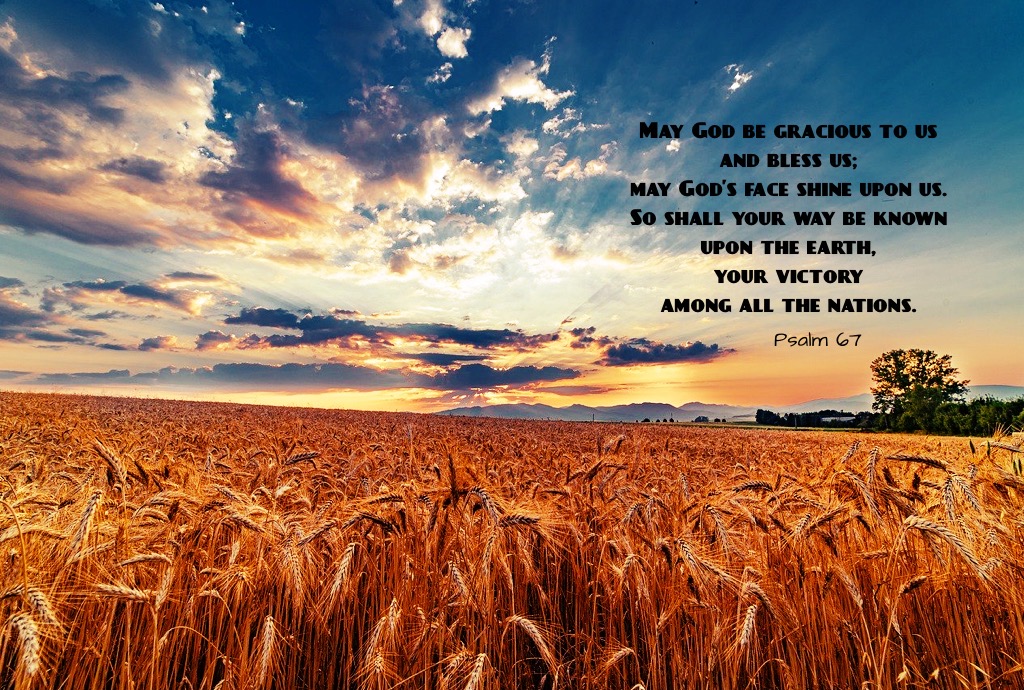
Today, in God’s Lavish Mercy, we pray with Psalm 67, a call to God for universal blessing on all Creation. Written to invoke a benediction on the land’s harvest, the Psalm blossoms into a generous prayer for the whole world to bask in God’s abundance.

May the nations be glad and rejoice;
for you judge the peoples with fairness,
you guide the nations upon the earth.

What if we prayed like that for all our brothers and sisters worldwide! What if we acted toward them with a justice that would make their abundance possible as well as our own! This is the Gospel mandate Jesus entrusted to us.

Psalm 67 shows the maturing of a nation from its own legitimate self-interests into its responsibility within all Creation.


In the USA, as our pre-election political awareness heightens, let’s learn from Psalm 67. Let’s broadly educate ourselves to the fundamental moral issues underlying various partisan platforms. 

For a religious person, voting is hard. There are profound moral issues on all sides of the question. A single issue approach does not work. An adamant stance on a single issue is the easy but inadequate approach. 


Even Jesus, in today’s Gospel, can be moved to a new way of thinking. The outcast Canaanite woman prevails on Jesus to broaden his kingdom. He opens his heart to another way of bringing mercy to all those longing for it.


Voting is a moral act. How we choose demonstrates the God we believe in.


May the peoples praise you, God;
may ALL the peoples praise you!


Poetry: Selah by Honoreé Fannane Jeffers

“The past few weeks were very hopeful for me, as an African-American. I saw images of young Black people out in the streets protesting, to make this country a better place. As an older person who stayed inside while these young folks put their bodies on the line, I wanted to celebrate them. I wrote this poem as a spiritual exaltation of Black faith, that our hoped-for change for our country is coming.”

Honoreé Fanonne Jeffers

Selah
after Margaret Walker’s “For My People”


The Lord clings to my hands
             after a night of shouting. 
                           The Lord stands on my roof 
             & sleeps in my bed. 
Sings the darkened, Egun tunnel— 
             cooks my food in abundance, 
                           though I was once foolish 
             & wished for an emptied stomach. 
The Lord drapes me with rolls of fat 
             & plaits my hair with sanity. 
                           Gives me air, 
             music from unremembered fever. 
This air
                            oh that i may give air to my people 
                            oh interruption of murder 
                                         the welcome Selah
The Lord is a green, Tubman escape. 
             A street buzzing with concern, 
                           minds discarding answers. 
             Black feet on a centuries-long journey.
The Lord is the dead one scratching my face, 
             pinching me in dreams. 
                           The screaming of the little girl that I was, 
             the rocking of the little girl that I was— 
the sweet hush of her healing. 
             Her syllables 
                           skipping on homesick pink. 
             I pray to my God of confused love, 
a toe touching blood 
             & swimming through Moses-water. 
                           A cloth & wise rocking. 
             An eventual Passover, 
outlined skeletons will sing 
             this day of air 
                           for my people—
                                         oh the roar of God 
                                         oh our prophesied walking

Music: Charles Ives – Psalm 67

Isaiah Sings!

Memorial of Saint Maximilian Kolbe, Priest and Martyr

August 14, 2020


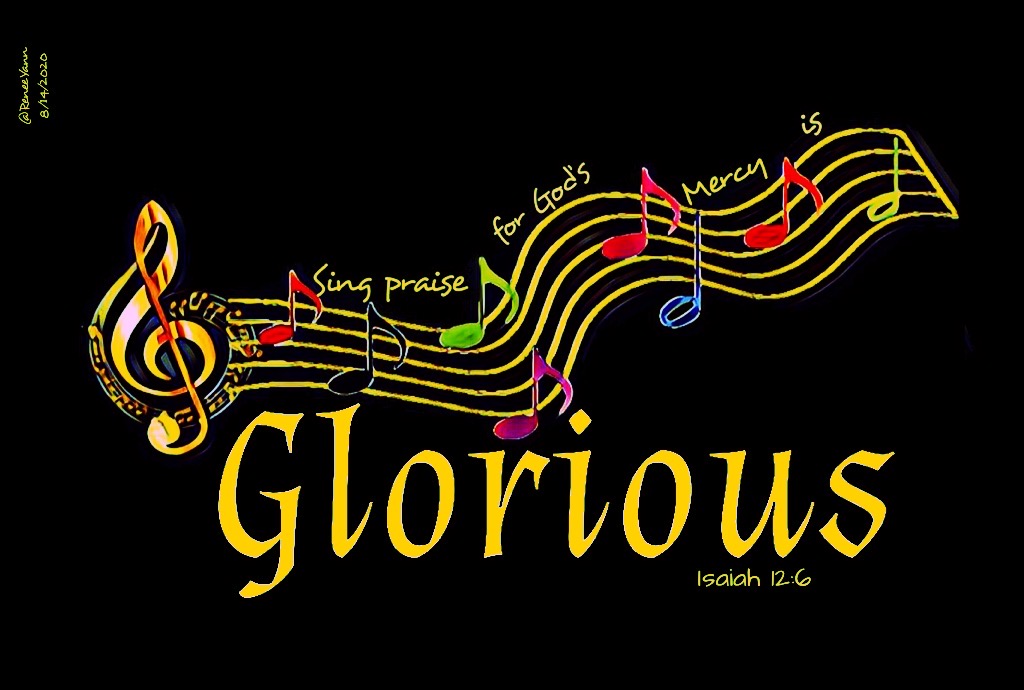
Today, in God’s Lavish Mercy, we pray with a passage from the poet-prophet Isaiah in which he calls the people to rejoice at their deliverance.

Sing praise to the LORD for his glorious achievement;
let this be known throughout all the earth.
Shout with exultation, O city of Zion,
for great in your midst
is the Holy One of Israel!


Isaiah 12 is one of a number of hymns found outside the Book of Psalms in the Old Testament. Other examples are Exodus 15:1-18, 21 and Amos 4:13; 5:8-9; 9:5-6 (Craddock, Hayes, Holliday, Tucker: Preaching through the Christian Year)

For an excellent graphic overview of these “songs”, click here. I enjoyed studying this chart.


Isaiah’s first eleven chapters center on God’s judgement for Israel’s infidelity. But Isaiah is never without hope. Chapter 12 is a joyful and grateful hymn celebrating that hope.

Isaiah’s hymn hit the right chord for me today. I think hope is a little hard to come by in these pandemic days, don’t you? 

Besides Covid, there are quite a few others “stabs” out there as we try to float the hope’s balloon – unemployment, business uncertainty, climate concerns, natural disasters, political irresponsibility, leadership failures just to reference a few. For some, these issues are so oppressive that they, “feel like it’s the end of the world”.


Isaiah is the guy when we feel even a little bit like this. Isaiah was profoundly convinced that God is with us in all our experiences and will ultimately resolve them for our good.

God indeed is my savior;
I am confident and unafraid.
My strength and my courage is the LORD,
and he has been my savior.
With joy you will draw water
at the fountain of salvation.


Poetry: To Go into the Dark by Wendell Berry

To go into the dark with a light
is to know the light.
To know the dark, go dark,
go without sight.
And find
that the dark too
blooms and sings
and is traveled by dark feet and dark wings.

Music:  Winter Cold Night – John Foley, SJ

Yes, this is a Christmas song, but I think it carries the perfect feeling for today’s reflection. Indeed, Jesus Christ is our Hope. May his Light be born in us daily.

Dark, dark, the winter cold night. Lu-lee-lay.
Hope is hard to come by. Lu-lee-lay.
Hard, hard, the journey tonight. Lu—lee-lay.
Star, guide, hope, hide our poor, winter cold night.
And on earth, peace, good will among men.
Lean, lean, the livin' tonight. Lu-lee-lay.
Star seems darker sometimes. Lu-lee-lay.
Unto you is born this day a Savior.
Pain, yes, in the bornin' tonight. Lu lee—lay.
Star, guide, hope, hide our poor, winter cold night.