Moses’s Psalm: Dark to Light

Friday of the Eighteenth Week in Ordinary Time

August 7, 2020

Today, in God’s Lavish Mercy, we pray once again with Deuteronomy 32, often referred to as the Psalm of Moses. And once again, our psalm links the heavy messages of our two main readings.

In our first reading from Nahum, the prophet describes Israel’s future restoration after the bloody destruction of Nineveh, chief city of the Assyrian conquerors.

In our Gospel, Jesus foretells his own Passion and Death, and the necessity that his disciples carry their own crosses.

The tenor of both readings is soberly captured in our psalm:

Learn then that I, I alone, am God,
and there is no god besides me.
It is I who bring both death and life,
I who inflict wounds and heal them.

Given the heavy, stormy morning here where I live, these readings are hitting me like a wet blanket! It’s hard to find the link to Light within them, but I believe there always is one – and I’ll suggest one subsequently. But first this.

Often in life, too, it’s hard to find the link to light. Harsh and insufferable realities can stubbornly darken our horizons.

Just this morning, I read about a podcast in which Michelle Obama had revealed a struggle with depression:

“These are not, they are not fulfilling times, spiritually,” Mrs Obama said. “I know that I am dealing with some form of low-grade depression. Not just because of the quarantine, but because of the racial strife, and just seeing this administration, watching the hypocrisy of it, day in and day out, is dispiriting.”


Mrs. Obama is describing her “Nineveh”.  Mine is pretty similar. What’s yours?
And how do we hold faith, even in the middle of “Nineveh”?

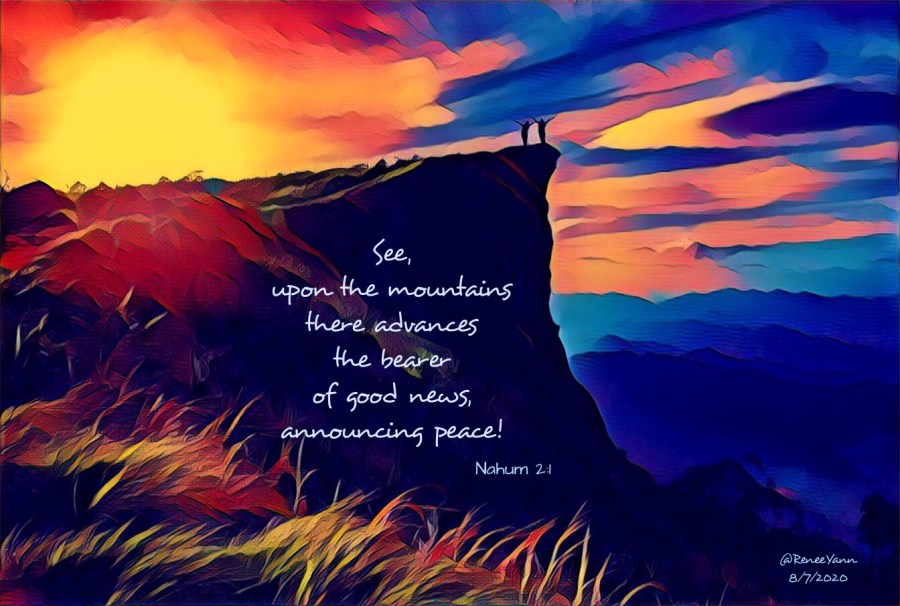
These assuring verses from Nahum offer the flicker of Light and the promise of Salvation. They encourage us to stay strong, remain faithful. We must keep lifting our eyes to the future that God dreams for all people, discerning its rising like the sun in a morning mist.

See, upon the mountains there advances
the bearer of good news, 
announcing peace!
Celebrate your feasts, O My people,
fulfill your vows!
…. The LORD will restore the beloved vine,
its hope, courage and strength …


Poetry: The Good God and the Evil God – Kahlil Gibran

The Good God and the Evil God 
met on the mountain top.
The Good God said, 
“Good day to you, brother.”
The Evil God did not answer.

And the Good God said, 
“You are in a bad humour today.”
“Yes,” said the Evil God, 
“for of late I have been often mistaken for you, 
called by your name, and treated 
as if I were you, and it ill-pleases me.”
And the Good God said, 
“But I too have been mistaken for you 
and called by your name.”

The Evil God walked away 
cursing the stupidity of humankind.

Music: How Beautiful – Joe Wise

Psalm 97: Majesty

Feast of the Transfiguration of the Lord

August 6, 2020

Today, in God’s Lavish Mercy, on this glorious Feast of the Transfiguration, we pray with Psalm 97 which prophesies the messianic era when God will reign supreme over the earth. Its verses announce God’s sovereignty, establishment of justice, and universal joy.

Transfiguration by Giovanni Bellini

Our Gospel describes the moment when Jesus gave his three disciples a glimpse of that future glory in order to sustain them through the sufferings to come.


As we pray Psalm 97 today, we might think of our experiences of God’s beauty, tenderness, and joy. Remembering and storing these small, accumulated revelations helps us to hold faith in times of darkness or trouble.

In Martin Luther King’s final speech the night before he was assassinated, he spoke of his own such transfiguring moments and the courageous faith they inspired in him:

Well, I don’t know what will happen now. We’ve got some difficult days ahead. But it doesn’t matter with me now. Because I’ve been to the mountaintop. And I don’t mind. Like anybody, I would like to live a long life. Longevity has its place. But I’m not concerned about that now. I just want to do God’s will. And He’s allowed me to go up to the mountain. And I’ve looked over. And I’ve seen the promised land. I may not get there with you. But I want you to know tonight, that we, as a people, will get to the promised land. And I’m happy, tonight. I’m not worried about anything. I’m not fearing any man. Mine eyes have seen the glory of the coming of the Lord.


Also in our prayer today, we are mindful of the 75th anniversary of the atomic bombings of Hiroshima and Nagasaki, an event which represents the complete inversion of God’s will for the Peaceful Kingdom. 

Majesty, turned inside out by our sin, becomes terror.

Robert Oppenheimer, one of the designers of the atomic bomb, reflecting on the bomb’s first test, said that as he watched the huge blast wave ripple out over the New Mexico desert, a line from the Hindu scripture Bhagavad Gita came to mind: “Now I am become Death the Destroyer of Worlds.


Psalm 97 reminds us that all Creation belongs to God:

The LORD is king; let the earth rejoice;
let the many islands be glad.
Clouds and darkness are round about him,
justice and judgment are the foundation of his throne.

If, by faith, we learn to see and reverence God’s glory in all things, we can be delivered from the terrors of war, racism, and every other deathly weapon which threatens us. As Psalm 97 so encouragingly closes:

You who love the LORD, hate evil,
God protects the souls of the faithful,
rescues them from the hand of the wicked.
Light dawns for the just,
and gladness for the honest of heart.
Rejoice in the LORD, you just,
and give thanks at the remembrance of his holiness.


Poetry: Origami by Joyce Sutphen 

In Hiroshima’s Peace Park there is a statue of Sadako Sasaki lifting a crane in her arms. Sadako was two years old when the atomic bomb was dropped; she was diagnosed with leukemia ten years later. The Japanese believe that folding a thousand origami cranes brings good fortune. Sadako spent the last months of her young life folding hundreds of paper cranes. She folded 644 before she died.


Origami

It starts
with a blank sheet,
an undanced floor,
air where no sound
erases the silence.

As soon as
you play the first note,
write down a word,
step onto the empty stage,
you've moved closer
to the creature inside.

Remember—
a square
can end up as frog, cardinal,
mantis, or fish.
You can make
what you want,
do what you wish.

Music: Our God Reigns – James Kilbane

How lovely on the mountains

Are the feet of him

Who brings good news,good news

Announcing peace, proclaiming

News of happiness.

Our God reigns; our God reigns!

Chorus:

Our God reigns!

Our God reigns!

Our God reigns!

Our God reigns!

He had no stately form;

He had no majesty,

That we should be

drawn to Him.

He was despised,

and we took no account of Him,

Yet now He reigns

With the Most High.

Out of the tomb He came

With grace and majesty;

He is alive, He is alive.

God loves us so see here His hands,

His feet, His side.

Yes, we know

He is alive.

Psalm 119: The Truth

Monday of the Eighteenth Week in Ordinary Time

August 3, 2020


Today, in Mercy, we pray for a persevering faith. Sometimes, it is very late into our prayer that the unexpected answer comes to us. May we recognize it and welcome it out of the darkness. We pray especially for those who have endured long years of prayerful waiting: for those with chronic illnesses, for the elderly, for widows and widowers, for those who want to believe but can’t.

from 2016

Today, in God’s Lavish Mercy, we pray with a return to Psalm 119. Set today between fascinating passages from both Jeremiah and Matthew, our psalm presents us with a particularly strong challenge:

Let my heart be perfect in your statutes,
that I be not put to shame.

In our first reading, the false prophet Hananiah tries to put Jeremiah to shame by preaching a rosy prophecy in contradiction to Jeremiah’s difficult but truthful “fire and brimstone” warnings. Hananiah eventually gets caught in his own lies.

In Matthew’s Gospel, Peter discovers another dimension of truth – that without faith, he cannot endure the storm


Psalm 119’s verses are a prayer to stay true to the Law, the Word, even in difficulty and storm. 

The psalmist recognizes our human propensity sometimes to create the world we want rather than face the one we have. We do it by lying to ourselves and others until, eventually, our alternative universe falls apart – just like Hananiah’s.

Because, like Peter, we focus on ourselves and our fears, we miss Jesus’s invitation to walk in faith over our life’s rough waters.


Our psalm today voices our prayer not to get twisted on life’s road, to have the courage to embrace the truth of ourselves, our environment, and our world. That truth is revealed when we love and live God’s Law by our justice and mercy toward all Creation.

From your ordinances I turn not away,
for you have instructed me.


Poetry: from Robert Frost

Two roads diverged in a yellow wood,
And sorry I could not travel both
And be one traveler, long I stood
And looked down one as far as I could
To where it bent in the undergrowth;

Then took the other, as just as fair,
And having perhaps the better claim,
Because it was grassy and wanted wear;
Though as for that the passing there
Had worn them really about the same,

And both that morning equally lay
In leaves no step had trodden black.
Oh, I kept the first for another day!
Yet knowing how way leads on to way,
I doubted if I should ever come back.

I shall be telling this with a sigh
Somewhere ages and ages hence:
Two roads diverged in a wood, and I—
I took the one less traveled by,a
And that has made all the difference.

Music: Long and Winding Road – Beatles song sung by David Archuleta

Psalm 69: Stuck!

Memorial of Saint Alphonsus Liguori, Bishop and Doctor of the Church

August 1, 2020

Today, in Mercy, we pray for the light of God’s Word in our hearts. God speaks to us in all things. Sometimes, all we need to do is ask God, “What are You saying to me in this circumstance?” Then listen for Love. The answer is always wrapped in Love – and Love is not always easy.

Thought from 2016, Friday of the 17th Week

Today, in God’s Lavish Mercy, we pray again with Psalm 69.  In today’s accompanying readings, Jeremiah and John the Baptist are living out the meaning.of the psalm.

Each of these great prophets has been ensnared by the civic evil of their times, personified in Old Testament princes and New Testament Herod and Herodias. The power structure surrounding each prophet stood in direct contradiction to their witness to God’s Word. Those structures, when confronted with a sacred truth, tried to overwhelm the messenger, like quicksand swallows an innocent traveler.

Rescue me out of the mire; may I not sink!
may I be rescued from my foes,
and from the watery depths.
Let not the flood-waters overwhelm me,
nor the abyss swallow me up,
nor the pit close its mouth over me.


The psalm raises to our prayer the reality that such struggles continue in our time. We live in a wonderful but still sinful world where every person decides, everyday, where he or she will stand in the contest between good and evil.

The decision is sometimes very clear. At other times, the waters are so muddied with lies, propaganda, greed, fear, bias. and unexamined privilege that we feel mired in confusion or resistance.

But I am afflicted and in pain;
let your saving help, O God, protect me.
I will praise the name of God in song,
and I will glorify him with thanksgiving.

Psalm 69 throws us a rescue line in today’s final verse:

See, you lowly ones, and be glad;
you who seek God, may your hearts revive!
For the LORD hears the poor,
and his own who are in bonds God spurns not.

The steady path to truth lies with those who seek God among the humble and poor. The humble are the ones through whom the Lord speaks. They are God’s own. Jeremiah and the Baptist understood this truth and preached it by their lives.

We might examine our lives today in the light of their witness and the message of this challenging psalm.


Poetry:  Beginners – Denise Levertov


‘From too much love of living,
Hope and desire set free,
Even the weariest river
Winds somewhere to the sea—‘


But we have only begun
to love the earth.
We have only begun
to imagine the fullness of life.
How could we tire of hope?
—so much is in bud.
How can desire fail?
—we have only begun
to imagine justice and mercy,
only begun to envision
how it might be
to live as siblings with beast and flower,
not as oppressors.
Surely our river
cannot already be hastening
into the sea of nonbeing?
Surely it cannot
drag, in the silt,
all that is innocent?
Not yet, not yet—
there is too much broken
that must be mended,
too much hurt we have done to each other
that cannot yet be forgiven.
We have only begun to know
the power that is in us if we would join
our solitudes in the communion of struggle.
So much is unfolding that must
complete its gesture,
so much is in bud.

Music:  The Cry of the Poor – John Foley, SJ

Psalm 69: Answer Me, O Lord

Memorial of Saint Ignatius of Loyola, Priest

July 31, 2020


Today, in God’s Lavish Mercy, we pray with Psalm 69, a heart-felt lament whose verses are often paralleled with the sufferings of Jesus.

I have become an outcast to my brothers,
a stranger to my mother’s sons,
Because zeal for your house consumes me,
and the insults of those who blaspheme you fall upon me.

Psalm 69: 9

Christ did not please Himself; but as it is written,
“The reproaches of those who reproached You fell on Me”.

Roman 15: 3

Praying with Psalm 69 this morning, and in the light of both our first reading and Gospel, I am aware of how God’s prophets suffer to proclaim mercy, justice, and truth.

Jeremiah suffered in the hope and conviction that God imagined a future of justice for all God’s people. He stood in the midst of the Temple worshippers and condemned their pretense of righteousness.

Jesus stood at the center of his hometown synagogue to proclaim that the long hoped-for redemption had come. But like Jeremiah’s listeners, Jesus’s neighbors also turned on him.

In our own lifetimes, we see the persecution and hatred which is leveled at modern prophets who call the world to justice and mercy. Even within our own Church, we see how Pope Francis is vilified by those whose privileged excesses are threatened by his charity.


As I write this reflection, our country celebrates the life of one of its noblest prophets, the sainted John Lewis. In the image of all the great Justice Witnesses, John endured incredible suffering for the sake of people’s dignity and freedom. He was able to do so because, like Jeremiah and Jesus, he didn’t look inward at his wounds. He looked outward for the redemption of others … the prize of justice:

Never give up, never give in, never give out. 
Keep the faith, and keep your eyes on the prize. 
Together, we can redeem the soul of America.

John Lewis

Let us pray today that the voices of true prophets may be heard and heeded. In this age when technology and social media can quickly disseminate vitriol, hatred, and conspiracy, let us pray for discerning hearts and courageous wills.

But I pray to you, O LORD,
for the time of your favor, O God!
In your great kindness answer me
with your constant help.

Psalm 69; 14

Poetry: Prophet by Carl Dennis

Prophet
You'll never be much of a prophet if, when the call comes
To preach to Nineveh, you flee on the ship for Tarshish
That Jonah fled on, afraid like him of the people's outrage
Were they to hear the edict that in thirty days
Their city in all its glory will be overthrown.

The sea storm that harried Jonah won't harry you.
No big fish will be waiting to swallow you whole
And keep you down in the dark till your mood
Shifts from fear to thankfulness and you want to serve.
No. You'll land safe at Tarshish and learn the language
And get a job in a countinghouse by the harbor
And marry and raise a family you can be proud of
In a neighborhood not too rowdy for comfort.

If you're going to be a prophet, you must listen the first time.
Setting off at sunrise, you can't be disheartened
If you arrive at Nineveh long past midnight,
On foot, your donkey having run off with your baggage.
You'll have to settle for a room in the cheapest hotel
And toss all night on the lice-ridden mattress
That Jonah is spared. In the space of three sentences
He jumps from his donkey, speaks out, and is heeded, while you,

Preaching next day in the rain on a noisy corner,
Are likely to be ignored, outshouted by old-clothes dealers
And fishwives, mocked by schoolboys for your accent.
And then it's a week in jail for disturbing the peace.
There you'll have time, as you sit in a dungeon
Darker than a whale's belly, to ask if the trip
Is a big mistake, the heavenly voice mere mood,

The mission a fancy. Jonah's biggest complaint
Is that God, when the people repent and ask forgiveness,
Is glad to forgive them and cancels the doomsday
Specified in the prophecy, leaving his prophet
To look like a fool. So God takes time to explain
How it's wrong to want a city like this one to burn,
How a prophet's supposed to redeem the future,
Not predict it. But you'll be left with the question
Why your city's been spared when nobody's different,

Nobody in the soup kitchen you open,
Though one or two of the hungriest
May be grateful enough for the soup to listen
When you talk about turning their lives around.
It will be hard to believe these are the saving remnant
Kin to the ten just men that would have sufficed
To save Gomorrah if Abraham could have found them.

You'll have to tell them frankly you can't explain
Why Nineveh is still standing though you hope to learn
At the feet of a prophet who for all you know
May be turning his donkey toward Nineveh even now.
[from Practical Gods (2001)

Music: Lord, in Your Great Love – Orchard Enterprises

Psalm 59: Did Martha Pray It?

Memorial of Saint Martha

July 29, 2020


Today, in God’s Lavish Mercy, on this feast of St. Martha, we pray with Psalm 59.

The psalm is introduced with an interesting phrase: a miktam of David, when Saul sent people to watch his house and kill him. 

The meaning of the word mitkam is unclear, but the meaning of the rest of the phrase is abundantly evident. David felt threatened by the forces of King Saul who surrounded his house day and night awaiting an opportunity to attack him.

The psalm bemoans that situation. In two complementary stanzas, the psalmist asks God for victory and deliverance. Each ends with a refrain of praise and gratitude.


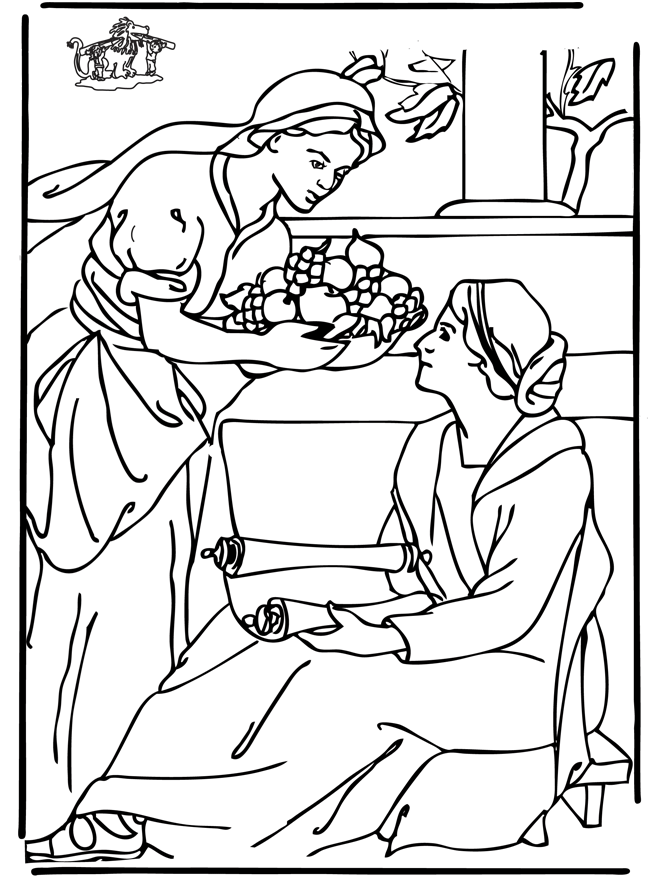
As I pray this psalm today, my mind goes to a house in Bethany. Three siblings live there who are friends of Jesus. Each loves Jesus in her or his own way, according to their personalities. 

The Gospels give us a vivid perception of Mary’s love. We can easily imagine the immensely grateful love of resurrected Lazarus. 

Then there is Martha of whom we know so little. A woman who found comfort in creating a hospitable home. A woman who commanded a well-functioning kitchen. A woman who, silent except for her famous sisterly complaint, let her works speak her love.

As their friendship with Jesus grew, and as Jesus became more notorious to the Jewish leaders, their little house no doubt became the object of inimical fascination.

Jesus’s enemies watched him, but that also watched his friends, frightening many away from Jesus’s side.

As this reality intensified, perhaps phrases of Psalm 59 rose in Martha’s heart as she prayed:

Rescue me from my enemies, O my God;
from my adversaries defend me….
… For behold, they lie in wait for my life;
mighty men come together against me,
Not for any offense or sin of mine, O LORD.

We can only guess what this little family suffered in order to be Jesus’s friends, both during his lifetime and by their witness in the subsequent early Christian Church. But by faith, we can be certain they rejoiced in the Divine Gift these sufferings brought them.

But I will sing of your strength
and revel at dawn in your mercy;
You have been my stronghold,
my refuge in the day of distress.
O my strength! your praise will I sing;
for you, O God, are my stronghold,
my merciful God!

Let us pray today to be, like Martha of Bethany, devoted friends of God.

Poetry:  You, neighbor God – Rainer Maria Rilke

You, neighbor god, if sometimes in the night
I rouse you with loud knocking, I do so
only because I seldom hear you breathe
and know: you are alone.
And should you need a drink, no one is there
to reach it to you, groping in the dark.
Always I hearken. Give but a small sign.
I am quite near.
Between us there is but a narrow wall,
and by sheer chance; for it would take
merely a call from your lips or from mine
to break it down,
and that without a sound.
The wall is builded of your images.
They stand before you hiding you like names.
And when the light within me blazes high
that in my inmost soul I know you by,
the radiance is squandered on their frames.
And then my senses, which too soon grow lame,
exiled from you, must go their homeless ways.

Music: Psalm 59 – Esther Mui

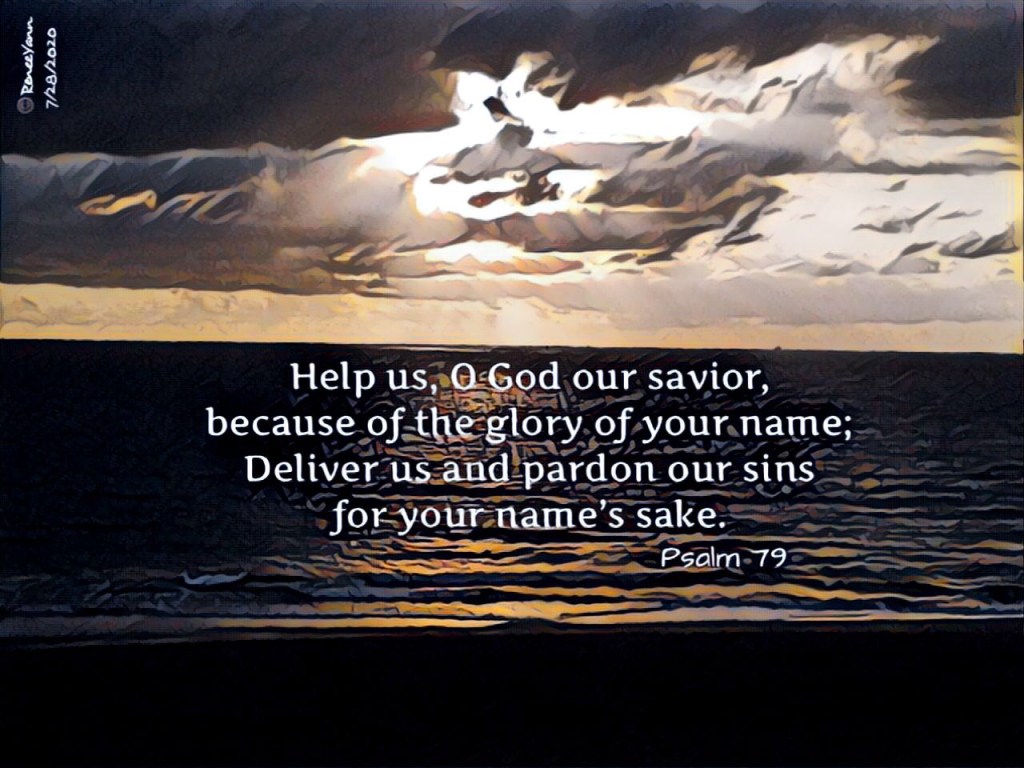
Psalm 79: Brought Low, O Lord!

Tuesday of the Seventeenth Week in Ordinary Time

July 28, 2020


Today, in God’s Lavish Mercy, we pray with Psalm 79, which is identified as “a psalm of Asaph”. The Psalms of Asaph are the twelve psalms numbered as 50 and 73–83 and either transcribed by Asaph or sung by the Asaphic choir. So Asaph is a bit like the Andrew Lloyd Weber of the Psalms, absorbing David’s prayers and rendering them in song.

One of the most important aspects of the Psalms is the deep honesty of their prayer. Those praying do not pretend to be anything but what they are: frightened, bereft, angry, delighted, grateful beyond words – whatever the situation of their lives.

Psalm 79 is a particularly moving hymn of communal lament. The psalmist prays for all the People with a nearly startling honesty:

Remember not against us the iniquities of the past;
may your compassion quickly come to us,
for we are brought very low.

Each evening, in this pandemic time, I find myself saying a very similar prayer.

Dear God, please be merciful to all our world.
We are in terrible trouble.

Help us to hold on and lead us out of darkness.


Psalm 79 compares the troubles to being imprisoned… trapped, no escape. Certainly, that is the feeling for many of us during these days when “we are brought very low” by a global disease and a dysfunctional political culture.

Let the prisoners’ sighing come before you;
with your great power free those doomed to death.


Ah, there is the hinge for our faith to hold on to … God’s great Power in all things. That merciful Power is at work despite appearances. God is able and will bring Light out of darkness, Life out of destruction.

One day – perhaps not now – but one day, we will recognize that Power. The waiting is called Faith.

Then we, your people and the sheep of your pasture,
will give thanks to you forever;
through all generations we will declare your praise.


Poetry: Prayer by John Frederick Nims


Music: Psalm 79 by Psalms Reborn

Psalm 36: Whew!

Thursday of the Sixteenth Week in Ordinary Time

July 23, 2020

From 2016:
Today, in Mercy, we pray to be childlike. As life seasons us, it also sometimes hardens us with an impermeability that prevents continued spiritual growth. We pray for the gifts of trust, hope and faith to return our hearts to the openness of a child that we may respond joyfully to the Holy Spirit.


Today, in God’s Lavish Mercy, we pray with Psalm 36, a praise hymn of David after a frightening encounter with an enemy.

I could have used this psalm last week. Someone immensely dear to me was hospitalized with suspicion of Covid 19. The fear, for him and for all who love him, was pretty overwhelming.

I did manage a prayer of abandonment before the negative diagnosis was returned about 36 hours later. But I’m rather sure that, like most of my attempts at abandonment, it was somewhat half-hearted. I really wanted my own will and hoped God’s Will was in alignment. Blessedly, it was.

But I would like to deepen in true trust and abandonment to God’s care for me and for all of us.


Psalm 36 gives us a chance to examine David’s prayer of abandonment, which drawing on a long history of God’s wisdom and favor, deeply trusts himself to God.

In our prayer today, we might recall God’s faithful care throughout our lives and release into God’s hands any worries we carry. Let us simply receive that infinite, refreshing fountain of grace pouring over all Creation.

Fountain of Life stained glass window at the Church of St. Maria del Mar in Barcelona,  copyright José Luíz Bernardes Ribeiro, https://creativecommons.org/licenses/by-sa/3.0/

Poetry:  Fountains in the sea by Marin Sorescu, translated by Seamus Heaney

Sorescu was a Romanian poet and playwright and one of the most popular figures to emerge from Romanian literary culture since the 1960s. He died in 1996, the year he was nominated for the Nobel Prize in Literature

Seamus Heaney, who died in 2013, was an Irish poet, playwright and translator. He received the 1995 Nobel Prize in Literature.

Fountains in the sea

Water: no matter how much, there is still not enough.
Cunning life keeps asking for more and then a drop more.
Our ankles are weighted with lead, we delve under the wave.
We bend to our spades, we survive the force of the gusher.

Our bodies fountain with sweat in the deeps of the sea,
Our forehead aches and holds like a sunken prow.
We are out of breath, divining the heart of the geyser,
Constellations are bobbing like corks above on the swell.

Earth is a waterwheel, the buckets go up and go down,
But to keep the whole aqueous architecture standing its ground
We must make a ring with our bodies and dance out a round
On the dreamt eye of water, the dreamt eye of water, the dreamt eye of water.

Water: no matter how much, there is still not enough.
Come rain, come thunder, come deluged dams washed away,
Our thirst is unquenchable. A cloud in the water’s a siren.
We become two shades, deliquescent, drowning in song.

My love, under the tall sky of hope
Our love and our love alone
Keeps dowsing for water.
Sinking the well of each other, digging together.
Each one the other’s phantom limb in the sea.

Music: Your Love, Oh Lord – Third Day

Psalm 85: Believe a New World into Being

Tuesday of the Sixteenth Week in Ordinary Time

July 21, 2020


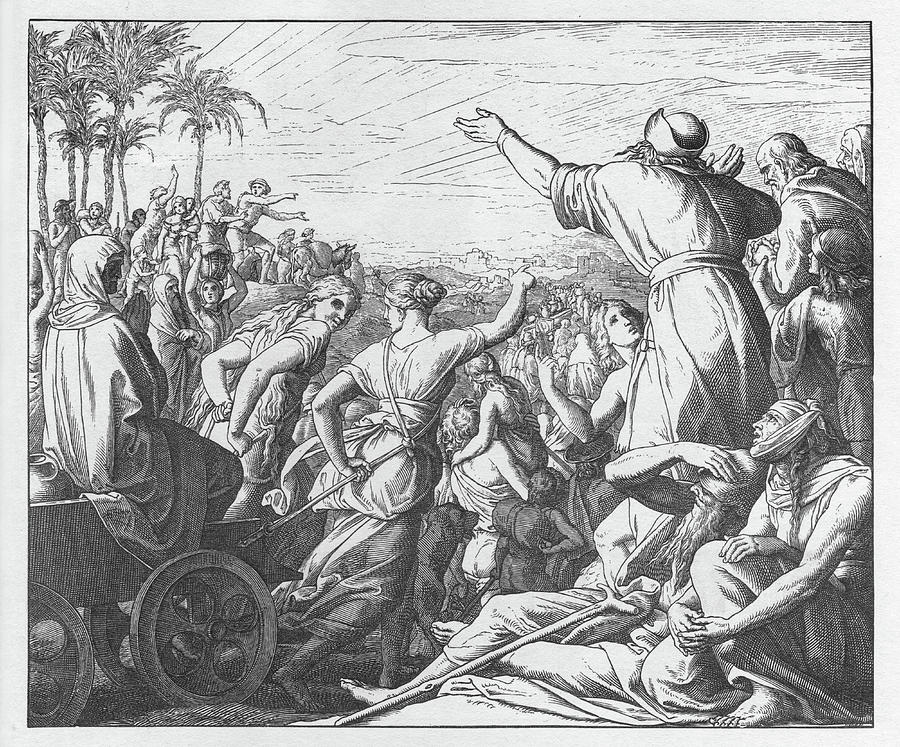
Return from Babylon by Julius Schnoor von Carolsfeld

Today, in God’s Lavish Mercy, we pray with Psalm 85. In Judaism, it is called “a psalm of returned exiles” as it reflects the experience of the Jews returning to their ravished land after the Babylonian exile. Things are a mess, and they have to start all over again to rebuild their Abrahamic nation. 

But they pray as if it is already accomplished.

Despite their suffering and captivity, the people have not lost hope in the promise of Yahweh. They expect its fulfillment and call on God to make it happen.

You have favored, O LORD, your land;
you have brought back the captives of Jacob.
You have forgiven the guilt of your people;
you have covered all their sins.
You have withdrawn all your wrath;
you have revoked your burning anger.


This is the power and beauty of a pure and faithful heart. It is free to “believe” God into action. We find this prayerful power expressed over and over in the Psalms. It is answered by God’s almighty and active desire for our good.


The Psalms mediate to us the great promise keeper whose resolve guarantees that the world is not a closed system. Creation, instead, is a world very much in process, sure to come to full shalom. Despair is the fate of a world “without god,” where there are no new gifts to be given. The Psalms refuse that world, knowing that God is not yet finished. Consequently, the Psalms can gather all the great words of the covenant and apply them to the future …

Walter Bruggemann

During these pandemic times, don’t prayer and promises like these speak to our hearts?

I find myself wondering what the world will be like when we finally “return” – come out of our “Covid exile” – what it will be like to see and hug the family, friends and community we love and miss right now, or to fully mourn those we have lost – what it will be like to resume our soul’s unworried dance with Creation and Time.


As we imagine that world, how might we hope for it to be more reflective of God’s dream for us than the world we closed down last March, than the “Babylon” we are experiencing? How will our prayers and actions for merciful justice “believe” God’s promises into reality for all God’s People?

Will you not instead give us life;
and shall not your people rejoice in you?
Show us, O LORD, your kindness,
and grant us your salvation.

I picture some ancient Jewish woman or man standing amidst the rubble of the ruined Temple. How deep did that person have to reach to find the faith and hope to move God?

I picture us standing in a very sick and dysfunctional world. Can we reach that deep ourselves by praying in the childlike, confident spirit of the Psalms:

Lord, show us your mercy and love.


Poetry: Antidotes to Fear of Death – by Rebecca Elson, a gifted Canadian–American astronomer and writer. Elson was diagnosed with non-Hodgkin’s lymphoma at the age of 29. With treatment, it went into remission, and in 1996 she married the Italian artist Angelo di Cintio. However, the cancer returned soon afterwards. Elson died of the disease in Cambridge in May 1999, at the age of 39.

A volume of wide-ranging poetry and essays she wrote from her teens until shortly before her death was published posthumously as A Responsibility to Awe in 2001 in the United Kingdom, and in 2002 in the United States. 

Antidotes to the Fear of Death

Sometimes as an antidote
To fear of death,
I eat the stars.

Those nights, lying on my back,
I suck them from the quenching dark
Til they are all, all inside me,
Pepper hot and sharp.

Sometimes, instead, I stir myself
Into a universe still young,
Still warm as blood:

No outer space, just space,
The light of all the not yet stars
Drifting like a bright mist,
And all of us, and everything
Already there
But unconstrained by form.

And sometime it’s enough
To lie down here on earth
Beside our long ancestral bones:

To walk across the cobble fields
Of our discarded skulls,
Each like a treasure, like a chrysalis,
Thinking: whatever left these husks
Flew off on bright wings.

Music: Going Home– based on Antonin Dvořák’s Largo from New World Symphony, lyrics by William Arms Fisher, sung here by Alex Boyé with the Mormon Tabernacle Choir

Psalm 102: God’s Time

Thursday of the Fifteenth Week in Ordinary Time

July 16, 2020

From 2018: Feast of Our Lady of Mount Carmel

Today, in God’s Lavish Mercy, we pray with Psalm 102, one of the seven penitential psalms. It is introduced as “the prayer of the afflicted”.

Yet, I find our verses today full of hope. They look with confidence to a better future.

You, O LORD, abide forever,
and your name through all generations.
You will arise and have mercy on Zion,
for it is time to pity her.

That last line, “for it is time to pity her”, is particularly touching as the psalmist nudges God to move forward with healing. Don’t we  pray like that sometimes?

  • Dear God, I’ve had all I can take! Please fix this — now!
  • Lord, I’ve learned my lesson. Please relent and rescue me.
  • Jesus, please let this trial be over and let us survive.
  • Lord, it is time for this to be over!

The bedrock of this prayer is the psalmist’s deep trust that God will act as God has promised:

The nations shall revere your name, O LORD,
and all the kings of the earth your glory,
When the LORD has rebuilt Zion
and appeared in his glory;
When he has regarded the prayer of the destitute,
and not despised their prayer.


You may find your heart filled with a prayer like this today. Surely, our whole human community voices a longing for the pandemic sufferings to be over. Or there may be other afflictions you carry that are testing the limits of your endurance.

Psalm 94 holds out encouragement and hope. Reach for it and let it strengthen you.

But you are forever the same, Lord, 
without beginning or end, 
infinite in your compassion, 
fathomless in your love. 
You rebuild the desolate city; 
you bring the exiles back home. 
You grant the poor your abundance; 
you guide the nations toward peace.
You hear the cry of the destitute 
and the sobbing of the oppressed. 
You soothe the pain of the captive; 
you set the prisoner free. 
Come to me too in your mercy 
and set my soul at peace.
from A Book of Psalms by Stephen Mitchell

Poetry: from Burnt Norton – T.S. Eliot

Time present and time past
Are both perhaps present in time future, 
And time future contained in time past.
If all time is eternally present
All time is unredeemable.
What might have been is an abstraction 
Remaining a perpetual possibility
Only in a world of speculation.
What might have been and what has been 
Point to one end, which is always present. 
Footfalls echo in the memory
Down the passage which we did not take 
Towards the door we never opened
Into the rose-garden. 
My words echo 
Thus, in your mind.

Music: On Time God – Deborah Kline Iantorno