A Passion Like Christ’s

Memorial of the Passion of Saint John the Baptist

Thursday, August 29, 2019

Readings: http://www.usccb.org/bible/readings/082919.cfm

Today, in Mercy, we commemorate the Passion of John the Baptist who, besides Mary, was the greatest saint embracing both the Old and the New Testaments.

When I was young, the memorial was simply referred to as “The Beheading of John the Baptist”. The term “passion” captures its meaning so much more clearly:

  • it inclines us to realize the similarities between John’s passion and death and that of Jesus.
  • it shifts the power of the event to John, who chose his fate by the courage of his witness, rather than to see Herod, the “beheader”, as the agent of the story.

John’s whole prophetic life was part of his “passion”. It inevitably led him to this ultimate confrontation with evil.

Walter Bruggemann, in his transformational book “The Prophetic Imagination” writes about prophets. He indicates that prophets emerge in the context of “totalism” – those paralyzing systems which attempt to control and dominate all freedom and possibility.

Totalism kills ideas, hope, freedom, choice, self-determination, and creativity for the sake of controlling reality for its own advantage. Totalism is the ultimate “abusive relationship “.

Brueggemann defines the prophet as one engaged in these three tasks:

  • the prophet is clear on the force and illegitimacy of the totalism.
  • the prophet pronounces the truth about the force of the totalism that contradicts the purpose of God.
  • the prophet articulates the alternative world that God has promised, and that God is actually creating within the chaos around us.

Every age requires prophets because every age is infected with “Herods” trying to thwart God’s reign of love, mercy, truth, freedom, and joy. In our own time, the poison of totalism is quite evident in those systems fueled by racism, militarism, financial duplicity, desecration of the earth, and the sad array of other ideologies that cripple humanity.

Today, as we pray with this great saint, may we be inspired to respond to our own prophetic call – to be prophetic signs of love, mutual reverence, joy, Gospel justice,and lavish mercy for our world.

Music: I think of this song by Simon and Garfunkel as the modern day song of John the Baptist.

https://youtu.be/XgbBLKet14E

Faithful Monica

Memorial of Saint Monica

Tuesday, August 27, 2019

Click here for readings

Today, in Mercy, we celebrate St. Monica, mother of St. Augustine of Hippo.

Monica
Santa Monica e Sant’Agostino by Giuseppe Riva (This work is in the public domain n its country of origin and other countries and areas where the copyright is the author’s life plus 100 years or less.)

Monica had a difficult life, burdened by an autocratic pagan husband. She was forbidden to have her children baptized. Augustine worried her deeply because he developed into a wayward and lazy young man. Eventually he was wooed by the Manichaean heresy which denied Christ as God. This was too much for Monica. She asked him to leave her house.

But Monica continued for seventeen years to pray for and encourage Augustine to return to a faithful, moral life. Finally through the influence of St. Ambrose, Augustine was converted.

How many mothers and fathers, friends and spouses have prayed like this for someone they love? How many of us have had a “lost sheep” right in the center of our family but beyond its touch?

Monica’s great love and faithful devotion to her son are reminiscent of Paul’s love for his Thessalonian flock:

… we were gentle among you,
as a nursing mother cares for her children.
With such affection for you, we were determined to share with you
not only the Gospel of God, but our very selves as well,
so dearly beloved had you become to us.

This is the way God loves us and draws us to himself. It is the way that we, who carry God’s love in the world, must be with one another.

Our Gospel gives us another example of how disgusted Jesus is with those who pretend the “exteriors” of faith but on the inside are “blind hypocrites… full of plunder and self-indulgence”.

Instead, we need a faith like Monica’s, humble and generous but at the same time tenacious and persevering in seeking good.

Music: Give Me the Faith Which Can Remove – written by Charles Wesley, younger brother of John Wesley, founder of Methodism

Wherever … with Love

Friday of the Twentieth Week in Ordinary Time

August 23, 2019

Click here for readings

Today, in Mercy, I thank God that we have gotten to the Book of Ruth. The wars and subterfuges of the Judges we’re sorely testing me!😂 But the beautiful story of Ruth and Naomi, familiar and beloved, offers us a more spontaneous inspiration for prayer.

Naomi’s husband and only two sons have died. Her only remaining family are her two daughters-in-law, Ruth and Orpha. Naomi, resigning herself to a lonely death, urges these two young women to return to their kinsmen and begin new lives. Orpha acquiesces. 

Naomi RuthJPG
Ruth Swearing Allegiance to Naomi by Jans Victor (1619-1676)

But Ruth abides. Together, she and her mother-in-law return to Bethlehem, Naomi’s homeland. There, by her humble and steadfast work to support Naomi, Ruth attracts the love and admiration of Boaz, whom she eventually marries.

On the surface, and appropriately, we may read the story to be about Naomi and Ruth, their response to devastating bereavement, and their ultimate, fruitful devotion to each other.

However, on a deeper level, we may see Naomi as a symbol of suffering and need, and Ruth as an icon of God. In that manner of reading:

  • God suffers our diminishments with us
  • God refuses to abandon us 
  • God accompanies us to a new understanding of ourselves
  • God works to feed our poverty of mind, heart and spirit
  • God brings our brokenness to wholeness by loving fidelity to us

What a different kind of message from Judges the Book of Ruth brings us – a tender and merciful God more like the God of the Gospel. Although the author of the Book of Ruth is unknown, some think – because of the tone and characters – that it was written by a woman. I like that thought.

May our prayer today take us to the place where God abides with us in any suffering or spiritual longing we hold. May God’s faithful companionship heal and transform us. May God’s song of fidelity thrill, delight and sustain us. May we return it with generosity and joy.

Music: Covenant Song – Rory Cooney and Gary Daigle (Lyrics below)

Wherever you go, I will follow, Wherever you live is my home.
Though days be of blessing or sorrow, though house be of canvas or stone,
Though Eden be lost to the past, though mountains before us be vast,
Wherever you go, I am with you. I never will leave you alone.

Whatever you dream, I am with you, when stars call your name in the night
Though shadows and mist cloud the future,
together we bear there a light.
Like Abram and Sarah we stand, with only a promise in hand.
But lead where you dream: I will follow. To dream with you is my delight.

And though you should fall, you will find me, when no other friend can you claim,
when foes beat you down or betray you, and others desert you in shame.
When home and dreams aren’t enough, and you run away from my love,
I’ll raise you from where you have fallen. Faithful to you is my name.

Wherever you die, I will be there to sing you to sleep with a psalm,
to soothe you with tales our journey, your fears and your doubts I will calm.
We’ll live when journeys are done forever in mem’ry as one.
And we will be buried together, and awaken to greet a new dawn.

Wherever you go, I will follow. Behold! The horizon shines clear.
The possible gleams like a city: together we’ve nothing to fear.
So speak with words bold and true the message my heart speaks to you.
You won’t be alone, I have promised. Wherever you go, I am here.

On That Day & This One

Many things live, not just the plants, animals and humans that grace our world.  Memories and promises live.  Vows live. So do grudges and prejudices. Unlike our physical life, these less tangible realities become stronger with time.  Tales of valor and achievement live, often becoming epic with the passing of the years.

Simple kindness lives too, blessing not only the current receiver, but the unseen generations to whom it is passed. Every morning, old fears and new hopes wake up within us all.  They vie with each other to become the engines of our lives.  The happy ones among us have learned to let hope win.

mother Patricia with flower
Mother Patricia near her death in 1915

On this date in 1861, a small group of just such happy, hopeful people came to Philadelphia. On that hot August afternoon, the first Philadelphia Sisters of Mercy, led by 26-year old Patricia Waldron, arrived at Broad Street Station in North Philadelphia. They carried no worldly possessions. They came with only a dream for Mercy.  It was a dream so alive in them that it still inspires us today, over 150 years later.


Can’t you see them standing on the busy platform, the hissing steam trains encircling them in mist?  They must have felt “be-misted” themselves, these mostly Irish country girls engulfed in a big city.

Union troops heading south crowded the platform.  Busy Broad Street crackled with news of the burgeoning national strife.  Lincoln himself would visit the city in the coming weeks.

And hidden within the seams of this bustling city’s garment lay the poor – the ones for whom they had come.  How to reach them?  How to help them change their lives?

Ranging from sixteen to twenty-seven years old, these brave young women had been charged with establishing a kind of “new nation” themselves – not of politics, but of mercy.  I am sure they, like the young stout-hearted soldiers surrounding them, were also a little weak-kneed. They too had their battles to face. They too would see starvation, illness, attack and death – but they would endure for the sake of the Mercy dream, God’s dream for the poor.

cemetery
Today we honor our beloved foremothers who led the way in faith and commitment.

Enduring dreams begin with small first steps.  So, hailing a horse-drawn carriage, Mother Patricia Waldron led her young band to their new lives.  Thus she began the grace-filled saga many of us know so well and of which we are a part today.  Their dream lives in us who love Mercy:

  • in our continued effort to find those who are poor and sick in a world that ignores them
  • in our choice to be compassionate in a world that often chooses violence
  • in our commitment to care in a world of treacherous indifference

On that sultry August day 1861,  and on this one 2019, people have choices to make.  They have vows to keep. Some choices live forever.  In the name of Mercy, what will you choose today?

Vow

Memorial of the Queenship of the Blessed Virgin Mary

August 22, 2019

Click here for readings

Today, in Mercy, the Book of Judges offers us the story of Jephthat and his daughter – and it is a doozy!

885
The Daughter of Jephthat – Edgar Degas

Again, in a nutshell, Jephthat is recruited to lead an army against the Ammonites. He makes an obviously unconsidered vow that, if he is victorious, he will make a burnt offering to God of “whatever comes first out of his door” upon his return. Unfortunately, the first thing out his door is his only daughter. After giving his daughter the time she requests to “mourn her virginity”, Jephthat fulfills his vow.

Treatises have been written about how to interpret this troublesome passage – from St. John Chrysostom, to St. Ambrose, to modern Biblical scholars. No clear, single answer emerges. And for the purpose of prayer, it needn’t.

One thing the passage does make clear is that vows are critically important and have consequences.

Danielle-signing-vows
Sisters of Mercy – Perpetual Profession of Vows

We make all kinds of “vows” in our lives. Some are foolish ones, like Jephthat’s, where we promise God something simply to get our way. We glorify such promises by calling them vows. They are really one-sided bargains we make to fuel our self-interested goals.

A true vow is the tying of our heart and soul to a Love, Truth, and Hope beyond ourselves.  It is the binding of our life and future to a power we will understand only with the long fidelity of time and shared experience. It is a giving that, even if rescinded, still will change our character forever. It is a giving that, if sustained, will transform us into the very Love, Truth, and Hope which first embraced us.

Our Gospel makes clear that God takes our vows seriously.  They are our invitations to the banquet, whether they come in the form of Baptismal vows, marriage vows, religious vows, or others forms of commitment to love and service.  Once we have engaged these vows, we need to respond and to enflesh the Spirit of God within them. If we don’t, if we ignore the holy invitation within our life circumstances, we will end up in a “darkness” outside of God’s hope for us.

But if, as God hopes, we fully embrace the spirit and depth of God’s invitation, we become whole in God, “the chosen”, the beloved.


I have always loved this poem by Alice Meynell, “ The Neophyte”. It fills me with a holy awe and exuberant joy at the mysterious power of being in love with God

The Neophyte – Alice Meynell

Who knows what days I answer for to-day?
   Giving the bud I give the flower. I bow
   This yet unfaded and a faded brow;
Bending these knees and feeble knees, I pray.

 Thoughts yet unripe in me I bend one way,
   Give one repose to pain I know not now,
   One check to joy that comes, I guess not how.
I dedicate my fields when Spring is grey.

 O rash! (I smile) to pledge my hidden wheat.
   I fold to-day at altars far apart
Hands trembling with what toils? In their retreat
   I seal my love to-be, my folded art.
I light the tapers at my head and feet,
   And lay the crucifix on this silent heart.


(Appropriately, as we talk about faithfulness to vows, this date marks the anniversary of the arrival of the Sisters of Mercy in Philadelphia in 1861 – our Philadelphia Foundation Day. In a later post today, I will share a brief reflection of thanksgiving and challenge for this anniversary.)

Music: Center of My Life – Paul Inwood

Better Look Under Your Terebinth!

Memorial of Saint Bernard, Abbot and Doctor of the Church

Tuesday, August 20, 2019

Click here for readings

Today in Mercy, on this feast of St. Bernard, the liturgy offers us a little bit more of the Books of Judges. The reading for today is about Gideon, warrior judge, who delivered the Israelites from the oppression of the Midianites.

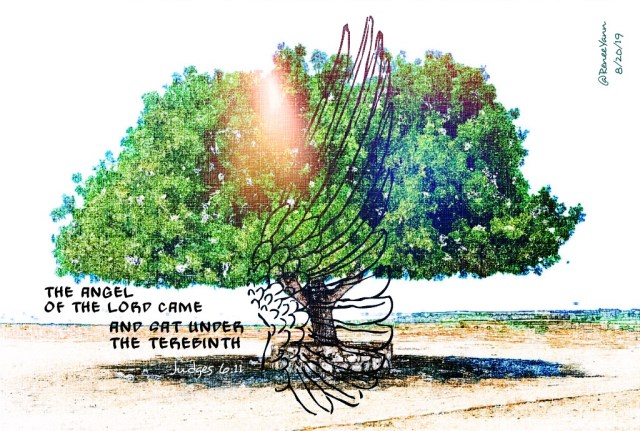
Judges6_11 terebinth
What the heck is a “terebinth” anyway? – a small southern European tree of the cashew family that was formerly a source of turpentine.

For me, these passages about wars and deliverers create conflict. Believing in Christ’s message of peace and mutual love, we have a spiritual abhorrence for war and a resistance to taking sides in confusing civil conflicts.

covers

But as our wonderful retreat guide last week (Clare D’Auria, OSF) told us, with the Scriptures, as with writings from cultures not our own, we have to “get under the language” to find the deeper spiritual meanings.


Here’s what I find “under the language” of Gideon’s story.

  • A person unafraid of transparency with God:

The angel of the LORD came and sat under the terebinth.
Gideon said to the Lord, “My Lord, if the LORD is with us,
why has all this happened to us?

  • A person open to God’s Presence in his ordinary daily circumstances:

The angel of the LORD came and sat under the terebinth
… where Gideon was beating out wheat
 

  • A person who is unaware of God’s astounding power within him:

The LORD turned to him and said, “Go with the strength you have
and save Israel from the power of Midian.
It is I who send you.”
But Gideon answered him, “Please, my lord, how can I save Israel?

  • A person whose faith continued to be shaky even in the presence of God:

Gideon answered the Lord, “If I find favor with you,
give me a sign that you are speaking with me.

  • A person awestruck by God’s willingness to be personally present to him:

“Alas, Lord GOD,
that I have seen the angel of the LORD face to face!”

  • A person who responds to God in loving worship and visible witness:

The LORD answered him,
“Be calm, do not fear. You shall not die.”
So Gideon built there an altar to the LORD
and called it Yahweh-shalom.

God visits each one of us in our daily experiences. We want to be transparent with God in both our joys and sorrows, our needs and our abundance. We want to give over to God our hesitancies and fears as we respond wholeheartedly to God’s invitation to grace. By the witness of our faith and good works, we want to give God praise for being in our lives – under our terebinth.

Under the language, I found a lot of Gideon in myself. You?

Music: In honor of the great St. Bernard of Clairvaux, please enjoy this beautiful him attributed to him – Jesu, Dulcis Memoria (translation below)

The sweet memory of Jesus
Giving true joy to the heart:
But more than honey and all things
His sweet presence.

Nothing more delightful is sung,
Nothing more pleasing heard,
Nothing sweeter thought,
Than Jesus, the Son of God.

O Jesus, hope of the penitent,
How gracious you are to those who ask
How good to those who seek you;
But what [are you] to those who find?

No tongue may tell,
No letter express;
He who has experience of it can believe
What it is to love Jesus.

O Jesus, may you be our joy,
You who are our future reward.
May our glory be in you
Throughout all eternity.
Amen


Do or Do Not

Monday of the Twentieth Week in Ordinary Time

August 19, 2019

Click here for readings

Today, in Mercy, our readings are about possessions – in every sense of that word.

In today’s reading from Judges, the first of a few this week, we see Israel in the years between entering the Promised Land to the rise of Saul as king. During these four hundred years, a series of judges tries to keep Israel on track with God. It is a frustrating assignment!

As today’s passage describes, the Israelites get caught in an endlessly repeating cycle:

  • worship false gods
  • get zapped by true God
  • feel really bad, say sorry
  • be forgiven
  • repeat cycle

Hmm! I’ve seen this pattern somewhere before. Oh, yeah! It’s just like the one describing all my good intentions that never quite materialized!

do or do not

Many of us can identify with the rich young man in the Gospel. We want to take our relationship with God up a notch. We would like to be better, holier people. But we may also, like the young man, like the ancient Israelites, be caught in a cycle of behaviors and choices which inhibit us.

Mt19_22many possessions

Jesus tells this young man to get rid of his possessions, freeing him to really follow Jesus.

What possesses us, holding us back from that radical following? 

It is not always material goods. They are easy to identify and dispatch. It is our tightly held and hidden illusions, resentments, prejudices, assumptions, entitlements, fears, jealousies, disappointments, angers. These are the heavy chains that cling to us as we try to move deeper into God.

May we be inspired by Matthew’s young man to recognize and break through the cycles that bind us by hearing God’s invitation to wholeness – an invitation always deep within our life circumstances.

Music: Out of the Deep – Julie Bernstein

Bearer of Hope

Nineteenth Sunday in Ordinary Time

August 11, 2019

Click here for readings

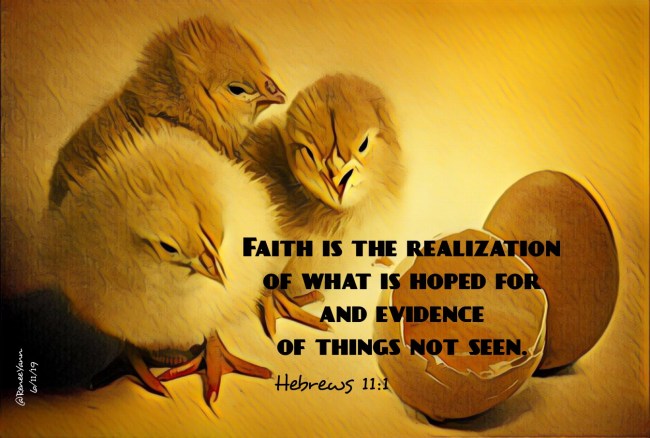
Hebrews11_1 Fith_hope

Today, in Mercy, we have a few slightly complex readings. But, as with all Sunday lectionary choices, they are strung together by a single theme. 

Upon first reading, we might think that theme is FAITH since the word is mentioned at least eight times. And, indeed, “faith” is the foundation of these readings – the faith of Abraham, Isaac, Jacob, the Desert Jews, the disciples, and the new Christian community. 

It is the testimony of this ancient and enduring faith that encourages us to be ready, as Jesus says in today’s Gospel:

Do not be afraid any longer, little flock,
for your Father is pleased to give you the kingdom.

This phrase of Jesus reveals another, deeper, theme: courageous hope.

How awesome that God, in covenant with God’s People, could keep alive – for 400 years- the hope of salvation! How miraculous that these ordinary farmers, milkmaids, herdsman, and shepherds could sustain their hope through numerous generations!

Today’s readings are sending us this message:


Be courageous!
You are the Bearer of Hope
to this generation!


It may seem in our world, and in our individual lives, that God tarries beyond tolerance in answering our hope – for peace, civility, equality, security, goodness.  But we must remember that with God there is no time. God is already responding within the long fidelity of our hope. (Our clocks and Apple watches just are obscuring our view. 😉)

That faithful hope creates the space for charity. And charity is the human face of Divine Love already Abiding.

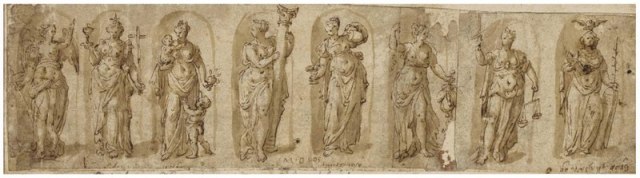
Faith, Hope, and Charity – the theological virtues (Remember that from your Baltimore Catechism?). 

Virtues
The Theological and Cardinal Virtues with Wisdom: Hope, Faith, Charity, Fortitude, Temperance, Liberality, Justice and Sapientia by Maarten de Vos (1532-1603)

These virtues are the foundation of the spiritual life. Contemporary theology ties these irrevocably to the virtue of justice – the seeking of right relationship in all Creation.

Anselm Min, Professor of Religion at Claremont Graduate University, has edited a powerful book on this subject. (Unfortunately, now out print and thus hugely expensive). One reviewer of the book, Lameck Banda, Professor at Justo Mwale University in Lusaka, Zambia, offers this insight into Min’s collection:

“The running thread throughout this book is that, whichever way the contemporary culture may seek to view and treat faith, hope, and love, the ultimate goal of these virtues is to radically and comprehensively address issues which tend to undermine the agenda of justice.”

That summary in itself gave me a lot to think and pray about. I hope it inspires you as well. God bless your Sunday!

Rohr

Music: Hymn of Hope from The Secret Garden by Rolf Lovland

Unless…

Feast of Saint Lawrence, Deacon and Martyr

August 10, 2019

Click here for readings

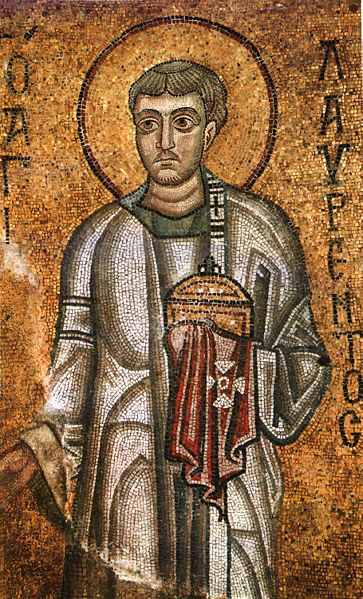
St. Lawrence
Saint Lawrence. Mosaic from the Saint Sophia Cathedral in Kiev.

Today, in Mercy, we celebrate the feast of St. Lawrence who is noted for his love for those who were poor. Legend has it that Lawrence was demanded, before his martyrdom, to turn over the Church’s riches to the emperor Valerian. Instead, he distributed all the resources among the poor. Lawrence then gathered all these people, presenting them before Valerian with these words:

Behold in these poor persons
the treasures which I promised to show you –
these are the true treasures of the Church.

Lawrence was likely inspired by readings like today’s. In Corinthians, Paul encourages us to be cheerful givers. He says this delights God, the Giver of Divine Abundance, whom we are imitating.

John12_24 grain wheat

In our reading from John, Jesus says that only in dying to ourselves do we live – the ultimate generosity. He says that only by doing this can we truly follow him.

While these readings are clear and simple, they are so profound that we can hardly take in their message. What they ask of us is daunting! The encouragement Jesus gives us to respond to his challenge is this:

The Father will honor whoever serves me.

St. Lawrence believed and lived this promise. What about us?

Music: Before the Bread – Elizabeth Alexander

We all want our lives to be full and complete – to be “bread”. But there are many steps before the grain of wheat becomes bread, as captured in this elegant acapella canon.

Failure Is An Option!

Memorial of Saint Dominic, Priest

August 8, 2019

Click here for readings

Today, in Mercy, on this Memorial of St. Domenic, our first reading gives us a lesson in failure. It is a situation we all face in life. If you haven’t, then you aren’t trying hard enough.

Numbers20_13_Failure

In our reading today, even the great Moses fails. But, you might ask, hasn’t he failed a number of times already? The smashed commandments, the golden calf, the complaints about manna? These were all human frustrations and inadequacies Moses would not have chosen.

Today’s failure is different. It is a failure in leadership. Any leadership role we hold, we hold in the name of God. We are parents, employers, teachers, pastors, religious leaders, supervisors, captains, managers…and so on. The cloak of responsibility covers each one of us at various times in our lives. Wearing it, we put on God’s trust in us to honor Him and those he has given us.

Dore_Rock
Moses Striking the Rock in Horeb, engraving by Gustave Doré from “La Sainte Bible”

When Moses and Aaron asked God to give the people water, God said, 

Take your staff and assemble the community,
you and your brother Aaron,
and in their presence order the rock to yield its waters.
From the rock you shall bring forth water for the congregation
and their livestock to drink.

Moses, caught in his own frustrations, did as God said but not before castigating the community and striking the rock twice.

So what?, you might say. 

Here’s the “What”. These acts betray Moses’ failure to trust God and to give God honor before the community. Perhaps unwittingly, Moses made it look like he was the one who summoned the water.

This reading calls us to always give God the glory. We are never really in charge of anything. We just do our best to make a path for life, goodness, love and wholeness.

If, through a leadership role, we are called to assist God in re-creating the world, let us do it with exquisite humility, trust, reverence, intentionality and praise.

Music: Humble – Audrey Assad