Today, in God’s Lavish Mercy, we pray with Psalm 87 which is both a celebration of and a longing for God’s Presence as symbolized for the psalmist in Jerusalem, Zion, the Temple.
His foundation upon the holy mountains the LORD loves: The gates of Zion, more than any dwelling of Jacob. Glorious things are said of you, O city of God!
Psalm 87: 1-3
For the psalmist, who is in exile, Zion was the visible expression of God’s exclusive relationship with Israel – the longed-for Kingdom.
In our reading from Acts, the concept of God’s Kingdom takes a larger shape. Jewish Christians, scattered in persecution, began to share the Good News with Gentiles. Barnabas blesses this sharing. He and Paul spend a year in Antioch teaching these new Christians who will not have the same devotion to “Zion”.
So where is “the Kingdom” now?
Our Gospel shows us Jesus, walking in the Temple portico one winter morning. He stands amidst the very symbols extolled in Psalm 87. He points his listeners, who are still resistant, toward the only true “kingdom”, one he has described before:
Now when He was asked by the Pharisees when the kingdom of God would come, He answered them and said, “The kingdom of God does not come with observation; nor will they say, ‘See here!’ or ‘See there!’ For indeed, the kingdom of God is within you.”
Luke 17: 20-21
We know from the Beatitudes that the “kingdom of God” belongs to the poor and the persecuted:
Blessed are the poor in spirit, for theirs is the Kingdom of Heaven….. ……Blessed are those who are persecuted because of righteousness, for theirs is the Kingdom of Heaven.
Perhaps there is a touch of biblical irony in the fact that our poor and persecuted psalmist, exiled from beautiful Zion, already possessed the “kingdom” within! But, without the benefit of Jesus’s teaching, it seems he didn’t realize it.
Do we realize it?
Prose: from Hans Küng
(For my spiritual reading recently , I returned to an old favorite Hans Küng, a revered Catholic priest and Vatican II theologian who died earlier this month. Word of his death took me back to my 1960s heady theology days.🙏😇)
Here are two relevant quotes to our thoughts on “the Kingdom” today:
The meaning of the church does not reside in what it is but in what it is moving towards. It is the reign of God which the church hopes for, bears witness to and proclaims.
Hans Küng: The Church
The kingdom of God is creation healed.
Hans Küng: On Being a Christian
Music: The Holy City, Jerusalem sung by Jessye Norman
Today, in God’s Lavish Mercy, we pray with Psalm 66, the exuberant prayer of those who recognize the beauty of God in their lives. They can see Love’s sacred thread, even when it is woven in subtle tones through the fabric of their lives.
I want to be one of those people, don’t you?
But sometimes, life might not look so beautiful. Surely it didn’t for some of the persecuted Christians in today’s first reading. And yet they remained faithful and found joy.
Now those who had been scattered went about preaching the word. … Thus Philip went down to the city of Samaria and proclaimed the Christ to them. With one accord, the crowds paid attention to what was said by Philip when they heard it and saw the signs he was doing… There was great joy in that city.
Acts 8:4-8
Joy is not dependent on circumstances. It is a foundational disposition of those convinced of God’s loving and faithful presence in our lives and in all Creation. It is a gift that accompanies faith, nurtures hope, and impels charity.
It is what our soul looks like when it shouts “Wow!” to God.
Say to God: “How awesome your deeds! Before your great strength all contradiction cringes. All the earth falls in worship before you; they sing of you, sing of your name!”
Psalm 66: 3-4
We can’t just WILL ourselves into this kind of joy. But we can ask for it, pray for it, plead for it. Such a prayer will turn and open our hearts toward our generous God Who longs to bless us with joy.
Poetry: Joy and Woe – William Blake
Joy and woe are woven fine,
A clothing for the soul divine,
Under every grief and pine,
Runs a joy with silken twine.
It is right it should be so,
We were made for joy and woe,
And when this we rightly know,
Through the world we safely go.
Today, in God’s Lavish Mercy, we pray with Psalm 119, the prayer of one who delights in and lives by the Law.
Yes, your decrees are my delight; they are my counselors. I declared my ways, and you answered me; teach me your statutes. Make me understand the way of your precepts, and I will meditate on your wondrous deeds.
Psalm 119: 24-27
“Law”, as it is used in this psalm, speaks of that perfect Divine Order which creates and holds all things in Love. Praying this psalm, we ask to become ever more aligned to that Love.
Remove from me all guile, and favor me with your law. The way of truth I have chosen; I have set your ordinances before me.
Psalm 119: 29-30
Such might have been the prayer of Stephen, as we read of his angelic face in Acts today. Such might have been the desire of those who followed Jesus across the sea in today’s Gospel asking, “What can we do to accomplish the works of God?”.
And it could be our prayer too.
Poetry: God Wishes Me a Happy Birthday
As I pray Psalm 119 today on my birthday, I hear God responding once again in a poem I wrote a few years ago. Perhaps you would like to keep it for your own birthday, dear friends.
On the day I made you,
I made thousands of other creatures.
Human beings,
each reflecting some facet of my infinite image.
Beautiful birds, riotous monkeys, infinitesimal ants.
My lava broke through earth's crusts to form new islands.
I folded hidden mountains into yet undiscovered gorges,
bent rivers into surprise journeys,
washed entire beaches onto new shores.
I was busy the day I made you.
War raged and I welcomed its many victims into heaven.
More creatures died on your birthday than were born.
More came home to me than went out to begin their journey.
But you were one who went out.
When I opened my hand and breathed your journey into you,
I smiled.
I saw the wonders that could bless the world because of you.
I saw a rainbow of love, generosity, mutuality,
happiness, encouragement, and faith
gathered like an unhatched egg in your heart.
I saw the storms and winds
that would release that prism in your soul.
I saw it spread across a wide sky
because of all the years
and experiences that I would give you.
I saw the hint of sunrise in you.
Its name was mercy.
It was a gift fired by the energy of My own heart.
I looked beyond you to the cold and shadowed world
that you could comfort with its light and warmth.
I was happy on the day I made you.
I was filled with hope for the blessing you would be.
I am still filled with joy, hope and love for you
on this your long-after birthday.
You have tried to live my sacred dream for you.
As the sun rises glorious in the eastern sky,
I promise you a future full of love.
Notice that the western sky reflects the brilliance of the sunrise,
just as all the years now past assure you
of my presence at the core of your life.
You have been and are infinitely loved.
Become Love in return.
Your days are replete with mercy.
Become Mercy in return.
Today, in God’s Lavish Mercy, we pray with Psalm 93, a resounding song of praise to our majestic God.
As I read the whole psalm, which is brief, I find myself standing at the Atlantic’s edge with my mother. I was just old enough to appreciate the enormity of the ocean. I asked Mom what made the waves stop at our tiptoes. She told me that God held it in place like soup in a big bowl. I remember being glad that God was in charge because the waves seemed awesome to me.
A little personal distraction: My grand-nephews enjoying the ever-awesome ocean
Today’s psalmist seems to share some of these young feelings:
The flood has raised up, LORD; the flood has raised up its roar; the flood has raised its pounding waves.
More powerful than the roar of many waters, more powerful than the breakers of the sea, powerful in the heavens is the LORD.
Psalm 93:4-5
Set between today’s two readings, our psalm invites us to entrust ourselves completely to this all-powerful God whose merciful rule goes infinitely beyond earth’s seas.
Jesus said to Nicodemus: “‘You must be born from above.’ The wind blows where it wills, and you can hear the sound it makes, but you do not know where it comes from or where it goes; so it is with everyone who is born of the Spirit.”
Dear, questioning Nicodemus struggled a bit to open his heart in complete faith. But he stayed with the struggle until the power of the Resurrection transformed him.
As we pray Psalm 93, we might stand with the psalmist or with Nicodemus at the edge of any ocean which challenges, mystifies, delights or frightens us. May we grow in confidence, as they did, that our eternal, omnipotent God ever reigns with merciful love – over the vastness of Creation and the small intimate waves of our lives.
Your decrees are firmly established; holiness befits your house, LORD, for all the length of days.
Psalm 93:5
Poetry: A Hymn – Ann Brontë
Eternal power of earth and air,
Unseen, yet seen in all around,
Remote, but dwelling everywhere,
Though silent, heard in every sound.
If e'er thine ear in mercy bent
When wretched mortals cried to thee,
And if indeed thy Son was sent
To save lost sinners such as me.
Then hear me now, while kneeling here;
I lift to thee my heart and eye
And all my soul ascends in prayer;
O give me - give me Faith I cry.
Without some glimmering in my heart,
I could not raise this fervent prayer;
But O a stronger light impart,
And in thy mercy fix it there!
While Faith is with me I am blest;
It turns my darkest night to day;
But while I clasp it to my breast
I often feel it slide away.
Then cold and dark my spirit sinks,
To see my light of life depart,
And every fiend of Hell methinks
Enjoys the anguish of my heart.
What shall I do if all my love,
My hopes, my toil, are cast away,
And if there be no God above
To hear and bless me when I pray?
If this be vain delusion all,
If death be an eternal sleep,
And none can hear my secret call,
Or see the silent tears I weep.
O help me God! for thou alone
Canst my distracted soul relieve;
Forsake it not -- it is thine own,
Though weak yet longing to believe.
O drive these cruel doubts away
And make me know that thou art God;
A Faith that shines by night and day
Will lighten every earthly load.
If I believe that Jesus died
And waking rose to reign above,
Then surely Sorrow, Sin and Pride
Must yield to peace and hope and love.
And all the blessed words he said
Will strength and holy joy impart,
A shield of safety o'er my head,
A spring of comfort in my heart.
Music: Here Is Love, Vast as an Ocean, beautifully sung by Huw Priday, first in Welsh then in English.
The text of this hymn was originally in Welsh, “Dyma gariad fel y moroedd,” written by William Rees (1802–1883, also known as Gwilym Hiraethog). By one account, Rees was “one of the most versatile and gifted Welshmen of the nineteenth century and exercised a powerful influence on politics, religion, poetry, and literature in Wales.”
Rees’ text played a prominent role in the Welsh revival of 1904–1905, led by evangelist Evan Roberts (1878–1951) of Glamorganshire. As with any great evangelistic movement, its success was closely associated with music and musicians.
VERSE 1
Here is love vast as the ocean,
Loving-kindness as the flood,
When the Prince of Life, our ransom,
Shed for us His precious blood.
Who His love will not remember?
Who can cease to sing His praise?
He can never be forgotten
Throughout heav’n’s eternal days.
VERSE 2
On the Mount of Crucifixion,
Fountains opened deep and wide;
Through the flood-gates of God’s mercy
Flowed a vast and gracious tide.
Grace and love like mighty rivers
Poured incessant from above;
Heaven’s peace and perfect justice
Kissed a guilty world in love.
VERSE 3
Here is love that conquered evil:
Christ, the firstborn from the grave;
Death has failed to be found equal
To the life of Him Who saves.
In the valley of our darkness
Dawned His everlasting light;
Perfect love in glorious radiance
Has repelled death’s hellish night.
VERSE 4
That same love beyond all measure,
Mocked and slain by hateful men,
Lives and reigns in resurrection
And can never die again.
Here is love for all the ages,
Radiant Sun of Heav’n He stands,
Calling home His Father’s children,
Holding forth His wounded hands.
VERSE 5
Here is love, vast as the heavens;
Countless as the stars above
Are the souls that He has ransomed,
Precious daughters, treasured sons.
We are called to feast forever on a love beyond our time;
Today, in God’s Lavish Mercy, we pray again with Psalm 118, today’s verses a song of utter confidence in, and thanks for, God’s faithfulness.
Give thanks to the LORD who is is good, whose mercy endures forever. My strength and my courage is the LORD, who has been my savior. The joyful shout of victory in the tents of the just.
Psalm 118: 1, 14-15
That profound trust and gratitude are captured in the enduring word:
“Forever” is a word we tend to toss about carelessly, as in:
It took my pizza forever to get here!
I promise I’ll love you forever.
Really? Could “forever” possibly apply in both these cases????
I think, in fact, we cannot begin to conceptualize “forever”, just as we cannot possibly conceptualize God.
What we can do is
to pick up the fabric of our life as it flows through time,
to place it with trust in God’s enduring love,
to slowly, continually become knit into God’s faithfulness,
to finally become still as, in each moment, that Love carries us to “forever”.
Poetry: two selections today
Forever – is composed of Nows by Emily Dickinson
Forever – is composed of Nows –
‘Tis not a different time –
Except for Infiniteness –
And Latitude of Home –
From this – experienced Here –
Remove the Dates – to These –
Let Months dissolve in further Months –
And Years – exhale in Years –
Without Debate – or Pause –
Or Celebrated Days –
No different Our Years would be
From Anno Dominies
From Miracles by C.S. Lewis

It is probable that Nature is not really in Time
and almost certain that God is not.
Time is probably (like perspective) the mode of our perception.
There is therefore in reality no question of God's
at one point in time (the moment of creation)
adapting the material history of this universe
in advance to free acts
which you or I are to perform
at a later point in Time.

To God
all the physical events and all the human acts
are present in an eternal Now.
The liberation of finite wills
and the creation of the whole material history of the universe
(related to the acts of those wills in all the necessary complexity)
is to God a single operation.
In this sense God did not create the universe long ago
but creates it at this minute—at every minute.
Today, in God’s Lavish Mercy, we pray with Psalm 8 – “a unique hymn of praise of God as Creator”, according to scripture scholar Roland Murphy, O.Carm.
Murphy goes on to explain:
Normally a hymn calls upon people to praise God, but not here. A communal refrain forms an inclusio (vv.2,10) for an individual hymn of admiration (vv.3-9)
(“Inclusio” is biblical theology jargon. It means a literary device based on a concentric principle, also known as bracketing or an envelope structure, which consists of creating a frame by placing similar material at the beginning and end of a section)
We might like to use the idea of an “inclusio” in our own prayer –
just taking that one phrase from the psalm which strikes our heart
beginning our prayer time with its rhythm
repeating it gently and continuously
letting it speak to us without further words
letting its images blossom in our prayer
letting it take us deeper into God’s heartbeat
closing our prayer time and entering our day with its cadence informing our spirit.
Prose: from William Butler Yeats
The purpose of rhythm … is to prolong the moment of contemplation – the moment when we are both asleep and awake, which is the one moment of creation — by hushing us with an alluring monotony, while it holds us waking by variety…
Today, in God’s Lavish Mercy, we pray with Psalm 147, a poem filled with reasons to love and praise God. Today’s selected verses mention just a few of those reasons.
The blessings of security and family:
Worship the Lord, O Jerusalem; praise your God, O Zion, who has strengthened the bars of your gates, who has blessed your children within you.
Psalm 147: 12-13
The blessings of diverse Creation:
The Lord sends out a command to the earth, and this word runs very swiftly. The Lord gives snow like wool and scatters hoarfrost like ashes
Psalm 147: 15-16
The blessings of faith and religious heritage:
The Lord declares the word to Jacob, statutes and judgements to Israel. The Lord has not done so to any other nation; to them these judgements have not been revealed.
Psalm 147: 19-20
Sometimes we spend a lot of energy praying over the things we think we need rather than recognizing all that we have.
This morning as I prayed, a personal thanksgiving psalm unfolded in my heart:
Hundreds of snow geese followed their yearly flight path right over my home, honking a symphony of hope.
The sun rose warm, tugging a clear promise of spring up over the horizon.
The Psalms lay open in my lap, a rich gift of the ages to my sometimes thin prayer.
My beloved communities slowly awakened and blossomed around me – my Mercy sisters, the toddlers in the daycare below me, the daily hum of the Motherhouse across the path outside my window, the buses carrying children to our Mercy schools
My family texting from their faraway homes.
I imagined myself as a small part of the magnificent communities described by beloved Pope Francis in Laudato Sí and Fratelli Tutti.
I felt those communities slowly beginning to recover from this past year’s devastation.
I prayed my sense of blessing into those still so deeply broken by global suffering, begging for their healing.
Gratitude for my blessings overwhelmed me, as it did our psalmist in #147:
Hallelujah! How good to sing praise to our God; how pleasant to give fitting praise.
Psalm 147:1
Poem: God Moves in a Mysterious Way – William Cowper
God moves in a mysterious way,
    His wonders to perform;
He plants his footsteps in the sea,
    And rides upon the storm.

Deep in unfathomable mines
    Of never failing skill;
He treasures up his bright designs,
    And works His sovereign will.

Ye fearful saints fresh courage take,
    The clouds ye so much dread
Are big with mercy, and shall break
    In blessings on your head.

Judge not the Lord by feeble sense,
    But trust him for his grace;
Behind a frowning providence,
    He hides a smiling face.

His purposes will ripen fast,
    Unfolding ev'ry hour;
The bud may have a bitter taste,
    But sweet will be the flow'r.

Blind unbelief is sure to err,
    And scan his work in vain;
God is his own interpreter,
    And he will make it plain.
Music: The Snow Goose – John Ritchie
Speaking of geese this morning, one of my all time favorite stories is “The Snow Goose” by Paul Gallico. I hope many of you have read it. It’s beautiful. I found a website that talks all about it, even with a Richard Harris movie included! For those who might be interested in a literary excursion 😀:
Today, in God’s Lavish Mercy, we pray with Psalm 25, a prayer full of humility, thanksgiving, and hope.
Your ways, O LORD, make known to me; teach me your paths, Guide me in your truth and teach me, for you are God my savior.
Psalm 25: 4-5
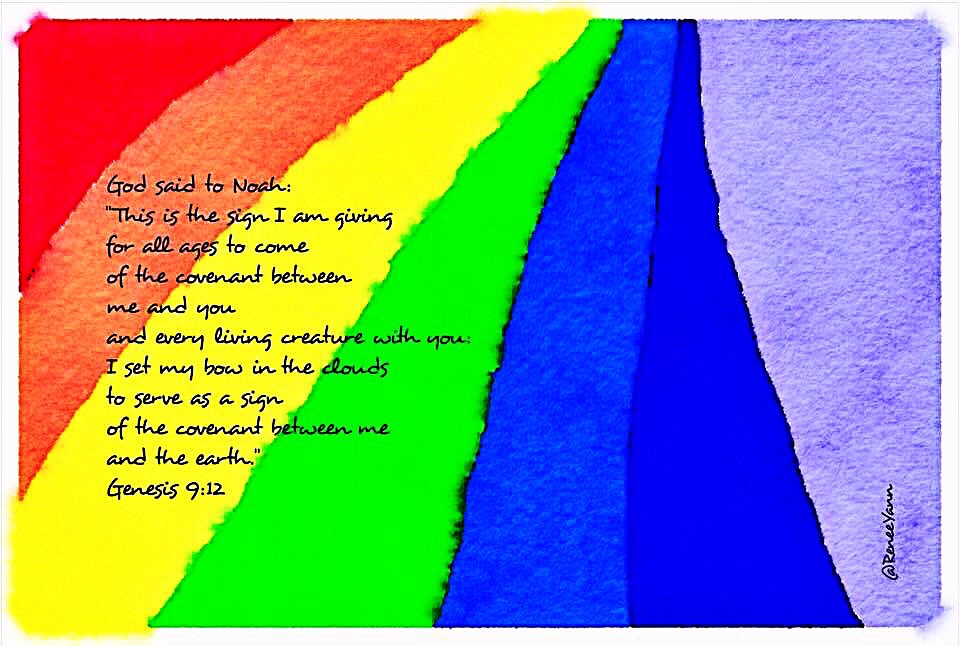
Genesis 9:12
On this First Sunday of Lent, the psalm is set between the wonderful Noah story, its interpretation by Peter, and the proclamation of Christ’s redemptive mission.
Like Noah, humankind has come through the storm of an ages-long messianic longing. Jesus is the Rainbow rising out of that darkness. His Light passes into us through the prismed waters of our Baptism. Indeed, as our Psalm declares:
Good and upright is the LORD, showing sinners the way. God guides the humble to justice, and teaches the humble the godly way.
Psalm 25: 8-9
When our psalmist first begins to pray, the light within seems shadowed and the vibrancy of his soul perhaps fractured. At times, we have felt the same way.
But the psalmist’s sincere and humble prayer catches God’s Light, allowing the passage from shadows to to the full rainbow of Mercy. May it be so for all of us as well as we journey with Jesus through Lent.
Poetry: on a separate post today due to its length — but so worth the time to read and savor.
Music: Rainbow by Robert Plant – Let God sing this song to you, perhaps the way God sang in Noah’s heart when he was delivered from the flood.
I found a lucky charm
I dressed it up with love
I crossed the Seven Seas to you
Will it be enough?

And I will be a rainbow
Oh, now your storm is gone
And I will bring the song for you
And I will carry on
Ooh Ooh Ooh
Ooh Ooh Ooh

I'm reachin' for the stars
In the sky above
Oh, I will bring their beauty home
The colors of my love

And I will be a rainbow
Now your storm is gone
And I will bring my song to you
And I will carry on
(Hummed interlude)

Love is enough
Though the world be a wind
And the woods have no voice but the voice of complaining

My hands shall not tremble, my feet shall not falter
The voyage shall not weary, the fish shall not alter
Hmm, It's rainbow, oh it's rainbow
Oh, can't you see the eyes are the eyes of a lover

Pocket full of hearts
A world that's filled with love
A love that carries all before
The passion and the flood

I lie beneath the rainbow
Now your tears have gone
And I will sing my song for you
And I will carry on
(Repeated interlude)
Today, in God’s Lavish Mercy, we pray with Psalm 1, a familiar reminder of what a working relationship with God looks like:
Blessed the one who follows not the counsel of the wicked Nor walks in the way of sinners, nor sits in the company of the insolent, But delights in the law of the LORD and meditates on God’s law day and night.
Psalm 1:1-2
The phrases in that little verse are so powerful!
We have seen all too clearly what happens when people “follow the counsel of the wicked”. We know how easily we can be infected by the negativity of “the insolent”. There is a spiritual distemper in us when these fractious humors fill the atmosphere.
Instead, we seek the peace and delight of being right with God. We embrace God’s law as a support and inspiration to guide us.
When we think of God’s Law, we might rightly think of the Commandments, the Beatitudes, the Torah, the Gospel – those places where we find the Law codified in words.
But we might also think of God’s Law as that silent omnipotent force that lifts the sun from darkness and sets it down again, that holds the seas in their global bowl, that lights the night with fiery stars.
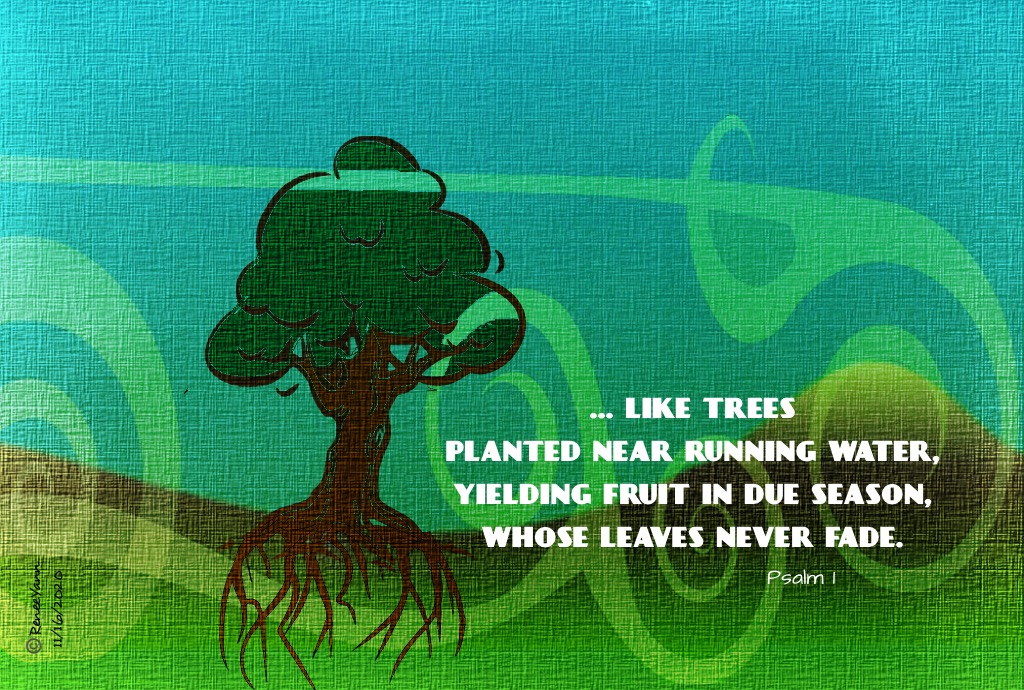
Affinity with God’s Law is that loving practice which, by intrinsic prayer and reflection, gives over every moment of our lives to God’s order. That alignment, rooting us in God’s “due season”, allows goodness to blossom in us like a fruitful tree – an unfading, abundant harvest …
Like a tree planted near running water, That yields its fruit in due season, and whose leaves never fade, ever prospering.
Psalm 1:3
Poetry: Onto a Vast Plain – Rainer Maria Rilke
Listen.
You are not surprised at the force of the storm—
you have seen it growing.
The trees flee. Their flight
sets the boulevards streaming. And you know:
he whom they flee is the one
you move toward. All your senses
sing him, as you stand at the window.

The weeks stood still in summer.
The trees’ blood rose. Now you feel
it wants to sink back
into the source of everything. You thought
you could trust that power
when you plucked the fruit:
now it becomes a riddle again
and you again a stranger.

Summer was like your house: you know
where each thing stood.
Now you must go out into your heart
as onto a vast plain. Now
the immense loneliness begins.

The days go numb, the wind
sucks the world from your senses like withered leaves.

Through the empty branches the sky remains.
It is what you have.
Be earth now, and evensong.
Be the ground lying under that sky.
Be modest now, like a thing
ripened until it is real,
so that he who began it all
can feel you when he reaches for you.


















 Lavish Mercy